


 SHARE:
- American Nations: A History of the Eleven Rival Regional Cultures of North America
- Viking (2011)
When Prime Minister Stephen Harper declared Quebec a nation back in 2006, he was right -- but he didn't go far enough.
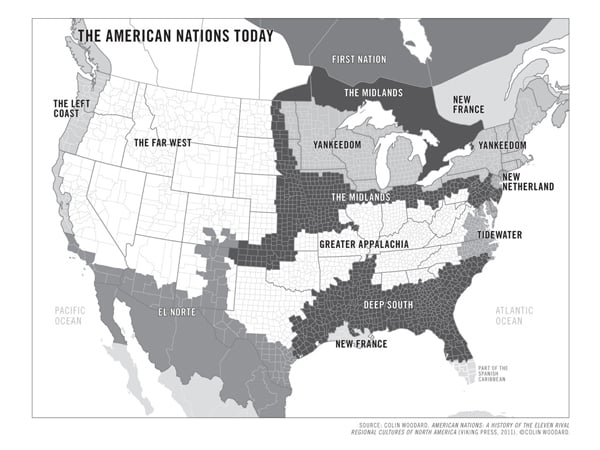
According to U.S. historian Colin Woodard, Canada is actually six nations, with only two entirely within our borders. Quebec is New France, which has an outlying province in Louisiana. The Maritimes are the northeast extension of Yankeedom, which stretches around the south of the Great Lakes to include Wisconsin, Minnesota, and the eastern edge of the Dakotas.
The Midlands extend west from southern New Jersey all the way to the Great Plains, then north around Yankeedom into Manitoba and eastward again to include most of Ontario.
The rest of the Prairies and most of B.C. are The Far West.
The Left Coast, a Chile-like nation, runs north from Monterey, California through western B.C. and on to Alaska.
The only all-Canadian nations, Woodard argues, are Newfoundland and Labrador and First Nation, which extends over most of the country north of New France, The Midlands, and The Far West.
Meanwhile, the U.S. also includes the nations of New Netherland (Greater New York and northern New Jersey); Tidewater, including eastern Virginia, eastern North Carolina, Washington D.C., and the states around Chesapeake Bay; Greater Appalachia, stretching to eastern New Mexico; Deep South (South Carolina to east Texas); and El Norte, which includes Mexico's northern tier of states as well as the southern regions of California, Arizona, New Mexico, and Texas.
This is the entertaining premise of a very different history of North America: whatever the states, provinces and federations may be, Woodard argues that the real struggles have been between nations based on ethnicity, culture, religion, and politics. No nation is strong enough to dominate. It must form alliances with other nations to gain control of its federal government.
No melting pot
Far from being a melting pot, North America's nations still show the accidents of early settlement and policy. New France, for example, began as an alliance of equals between the natives and a handful of French settlers. Britain imposed ethnic cleansing on the Acadians, who transplanted their nation to Louisiana. But Quebec itself had too many people to deport. So New France's national culture survived British conquest, American invasion, and endless cultural pressure from both the U.S. and anglophone Canada.
Similarly, says Woodard, the Dutch colony of New Netherland was a multicultural trading hub, wedged between the conformist, communitarian Puritans of Yankeedom and the aristocratic planters of Tidewater. It remains a nation of its own, tolerant of diversity and dedicated to making as much money as humanly possible.
Furthermore, most of these nations expanded west to pursue their own needs, not those of the United States. Once they established their own colonies in the west, like-minded people tended to settle there, strengthening the national culture.
The Midlands, for example, started with William Penn's Utopian Quaker colony of Pennsylvania, which offered religious tolerance to all. It attracted middle-class farmers (including sects like the Amish), who then moved due west through northern Ohio, Indiana and Illinois before spreading out into the Great Plains and then north into Ontario and Manitoba. Midlanders tend to be multicultural, middle class, and politically moderate.
The Deep South, Woodard tells us, was actually a colony of the the Caribbean sugar island of Barbados. It was the richest, most horrible English-speaking culture in history, built not only on slavery but on deliberately working slaves to death. The Barbadians expanded north, founded Charleston, South Carolina, and pushed west wherever slave labour could enrich them. By the 1850s, the Deep South was seriously thinking about a "Golden Circle" -- a slave empire that would include all of Mexico, Cuba, and the Caribbean.
The warrior nation of Greater Appalachia
In this the Deep South's ally was Greater Appalachia. In the early 18th century, the British Isles' "borderlands" -- Ulster, northern England and lowland Scotland -- were economic disaster zones. With an individualist culture cherishing personal honour and violence in its defence, the "Borderlanders" migrated to the colonies and headed west to get away from law and order.
Once in the Appalachians, these Scots-Irish provoked wars with the natives and with the established authorities alike. Their violence shocked the Quakers of Philadelphia, not to mention the Cherokee -- who were deported to Oklahoma on the Trail of Tears by Andrew Jackson, the first Appalachian president. Appalachians, Woodard says, have supported (and fought in) most American wars.
Two new nations emerged in the second half of the 19th century. The Left Coast was founded by New England merchants and missionaries plus Appalachian miners and farmers. It now extends through B.C. to Alaska, a nation blending "New England intellectualism" plus the Appalachian "culture of individual fulfilment."
The Far West, with little rainfall, didn't appeal to farmers. Instead, it fell under the control of railroads, mining companies, and other resource-extraction cartels. Far Westerners' only use for government was to provide subsidies for resource extraction and ranching. Alberta's oil patch descends directly from the Nevada silver companies and Montana's copper barons.
Woodard's insight shows American (and Canadian) history as the struggle of these nations to control their federal governments. Since the U.S. Civil War, he argues, Americans have been part of either the "Dixie bloc" or the "Northern Coalition." Each gains power in Congress and the White House by winning the support of "swing nations" like The Midlands. For the last 30 or 40 years, the Dixie bloc has usually been in control, cutting taxes and launching wars.
Rule by the Far West (and the burbs)
In Canada, Midlands Ontario and New France ruled until recently, when the Far West won enough Midlands voters in the Ontario suburbs to gain power. Like the Deep South-Appalachian Dixie bloc, this new coalition glorifies the military while despising education and dissent.
It's both helpful and discouraging to look at Canada as contending nations, not just regions. Our disputes are not mere local squabbles. Nations are not open to calm, reasoned argument against their national interests; they yield only to force or to cost-effective bargains.
So after a century and a half of successful resource exploitation, The Far West has no reason to give a damn about The Left Coast's worries about pipelines and supertankers. Nor does the Left Coast care much for The Far West's corporate values. (But bear in mind that interior B.C. is solidly Far West.)
This contending-nations perspective implies no resolution to the Northern Gateway dispute (and many others) except by force or bribery. Given Woodard's thesis, the only solution for us Left Coasters is a new alliance of Canadian nations that could overcome the present coalition of the Prairies and the Ontario suburbs.
New France, in Woodard's view, is by far the most liberal nation on the continent, "the most postmodern nation in North America." He cites studies showing it to be "the region of North America with the highest degree of enlightened individualism and the least respect for traditional forms of authority. (British Columbia and New England were its closest rivals in this regard, Dixie states its polar opposite.)"
Woodard also notes the rise of a nation both new and old: First Nation, spanning the northern third of the country but with a population of only 300,000.
A new vision of ourselves
Perhaps our Left Coast politicians should begin to explore the possibility of closer ties with New France and First Nation, as well as Newfoundland and Labrador and the Maritime extension of Yankeedom. Such a coast-to-coast-to-coast alliance would offer a real challenge to the present coalition.
But Woodard also observes that the American and Canadian nations are increasingly polarized as like-minded migrants settle with their own kind. He sees the possibility of a political crisis that could lead to the breakup of the United States and Mexico, with consequences for the nations of Canada as well.
"If this extreme scenario were to come to pass," he writes, "North America would likely be a far more dangerous, volatile, and unstable place, inviting meddling from imperial powers overseas. If this scenario of crisis and breakup seems far-fetched, consider the fact that, 40 years ago, the leaders of the Soviet Union would have thought the same thing about their continent-spanning federation."
Whatever the plausibility of that analogy, Colin Woodard has given us a new vision of ourselves and our politics -- one that frees us to see our history, our present and our future in a very different light. ![[Tyee]](/design-article.thetyee.ca/ui/img/yellowblob.png)
Read more: Politics












Tyee Commenting Guidelines
Comments that violate guidelines risk being deleted, and violations may result in a temporary or permanent user ban. Maintain the spirit of good conversation to stay in the discussion.
*Please note The Tyee is not a forum for spreading misinformation about COVID-19, denying its existence or minimizing its risk to public health.
Do:
Do not: