There's no easy path to reinvent global economy, but Mike Lewis's new book offers some 'trailblazers' marks.'
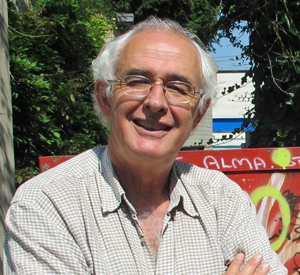
Author Mike Lewis's personal motto: 'Make hope more concrete and despair less convincing.' Photo: Adam Pez.

-
Two books with same title by Heinberg and Rubin raise a daunting political question.
-
That's the message of Vancouver's Degrowth advocates, who scoff at city hall's 'greenest city' pledge.
-
Two experts lecturing in Vancouver warn resource-rich nations aren't immune.
- The Resilience Imperative
- Michael Lewis and Pat Conaty
- New Society Publishers (2012)
With his smudged glasses, bald pate fringed with tousled white hair, and deep well of enthusiasm, 60-year-old Mike Lewis vaguely resembles "Doc" Brown, the energetic Back to the Future scientist played by Christopher Lloyd.
But unlike the strange bursts of panic that characterize Doc's personality, Lewis is calm and reflective. He's the current executive director of the Canadian Centre for Community Renewal in Vancouver, and he's well-known for his research studying the links between charities, cooperatives and non-profit groups, and the economy. His work has been cited widely in B.C. and across the world.
Recently, he's turned to addressing the formidable challenge of reinventing our globalized economy from the ground up. That work has now culminated in the book The Resilience Imperative, released in print this week.
The book takes an optimistic view of what is likely a huge and complex challenge ahead.
Climate change, fossil-fuel dependence "and globalization as we know it" make current economies "very vulnerable to unraveling," Lewis said. "We're [soon] going to be in a situation where we have to figure out our basic needs on a more local and regional basis."
According to Lewis, there's definitely no clear path to that end.
"Anybody that is asking you for road maps, well, forget it! You gotta build the road as you travel it. That's the reality," he said. "My personal motto is 'make hope more concrete and despair less convincing.'"
Lewis concedes he's often mistaken for an academic, but his expertise in economic resiliency wasn't distilled in an ivory tower or a lab. Rather, it developed over four decades of work in the "trenches" of community work. He got his first taste of organizing at 17, when he was hired by the United Church at $100 a month to work in Alert, B.C. The small island community, way up Vancouver Island's inner coast, is "half white and half Indian," he said. "That was sort of my opening."
He later got an undergraduate degree at the University of Calgary in social work and went on to found what would become Canadian Centre for Community Renewal at age 25. Since then his work has expanded to include 1,000 different programs which focus on helping communities take more control of their own economy and social services, he said.
In the late 1990s, Lewis made a name for himself analyzing what resources remained in B.C. communities devastated by the collapse of the forestry industry. But the true nature of what he saw happening didn't come into focus until 2003, he said. That year he took his three grandkids to see a salmon run at Stamp Falls, near Port Alberni.
"We were watching these salmon rise up, and you just think: that child's grandchild may never, ever experience this."
That experience became the emotional inspiration for The Resilience Imperative. For the book, Lewis partnered with American co-author Pat Conaty, a fellow at the United Kingdom's New Economic Foundation. The two blended their lifetime of experiences examining local economies, and brought together a patchwork quilt of local innovations -- from fossil-fuel free Kristianstad, Sweden, to local food movements in Latin America -- to highlight plausible ways to make our society more sustainable.
While on a very human level, writing the book was an experience to be "cherished," piecing together so many topics wasn't easy, he said.
"It's one thing to talk about it, but how and where's the experience and instructions to actually start to connect between food, energy conservation, renewable energy, finance, land reform, democratizing of the economy -- how do you put those pieces together and understand it so it doesn't just become a big morass of murky shit?" he said.
In The Resilience Imperative's introduction, Lewis writes that he can't offer "panaceas" to global problems, but he hopes the book at least provides a few "trailblazers' marks" for where to start.
During our interview, here's what else Lewis had to say...
On why local innovations are important:
"If you think of any of the examples in our book, if you think of Seikatsu cooperative in Japan... they were concerned about farmers not being able to make a living. They were middle-class Japanese women and they wanted to have safe food that was ecologically grown.
"They created the first what they called teikei, which means 'partnership.' The colloquial meaning is 'food with the farmers face on it.'
"The food part of their system today turns over $1 billion. And they've taken the ecological and social and economic values at the heart of their beginnings and worked it all the way through the supply chain.
"Now that's been a 40-year transition. We need to figure out how to scale that up much faster; that's part of our challenge.
"I think all of these things I'm describing [in the book] have the potential for becoming the seed-bed in a community for scaling up innovation."
On where BC is doing it right:
"There's already tons happening in terms of trying to build the pieces of a more local and regional food system that used to exist [in B.C.], but that was hollowed out by globalization over the last 50 to 60 years.
"When you look at the entire food system... all the way through, it's oriented much more to an export-oriented agricultural framework, and that's what provincial policy and federal policy have been supporting for some time.
"All of the new growth has been [with] local farmers who have been building the new food system for some time, so there's all kind of gaps, right, and people are working at it. In Vancouver, you've got the Food Hub project.
"People are trying to cobble it together, and it's been making real progress, but it's been slow."
On the premier's reality 'parody':
"First I should start by saying at least we have a carbon tax; that's a positive, but the fact that it's been capped at $30 [a tonne] -- $30 is not enough, according to a lot of people, if you really want to take into account the costs of carbon.
"We have to radically expand our investment in renewable energy. We've begun to change behaviours to some extent, around driving and transportation and some of the fossil fuel, by virtue of the carbon tax. We need to extend the carbon tax to the fossil-fuel industry.
"The premier's declaration that natural gas is no longer considered a fossil fuel -- essentially we're going full bore. 'Let's go for it, this is incredibly important to the B.C. economy, jobs, wealth generator;' -- she's saying this is a contribution to reducing carbon globally. This is the line. Which is an absolute parody on reality."
Why pipeline criticism needs tweaking:
"I don't agree with the number of people who argue [against] the Enbridge pipeline based on localized environmental... issues. There's all the localized environmental risks, but it's part of a bigger picture.
"I think partly the building of a coalition around these issues has really got to have carbon as a major feature to it, along with the environmental [risks] and the lack economic benefits associated with it in British Columbia.
"There's a model that locks us into continuing emissions that is akin to putting our foot on the accelerator while you're heading towards the precipice. The reality is that if we get locked into spending more and more energy to get less and less out of the fossil fuel reserves we have, which are getting harder and harder to get and more expensive to mine and process, there's no future for the planet or for people on that path."
On ending despair, and books:
"I sat in the alley across here quite a lot last year trying to meet a Sept. 30 deadline; and... at the end of that day putting the finishing touches on chapter 12, I started crying. It was partly exhaustion; it was also partly just this tension that I've had for some time -- and I still have it -- which is we know that by virtue of the kind of innovations that we describe in this book that [change] is possible, but that does not necessarily mean it's probable.
"We need to see the world differently. If we don't develop peripheral vision we're not going to come up with solutions to our problems, and that's part of the problem with Canadian policy at the moment. We're still seeing the world in growth terms. We're still seeing fossil-fuels as our way to become an energy superpower, and we're seeing our development path as being linked to taking tar sands, putting it across in Enbridge and shipping the bitumen over and across to China."
And a final call to the resilient:
"We're not uni-dimensional people; I don't just sit here and write books. We can be actors in more than one spot. But we need to build our movements together in ways that they are federated to bring the pieces people are concentrating on together.
"The only way that I know of getting change: you have to act consistently over time in an organized way with focused intention on the opposition side and the proposition side. Resist and build, resist and build -- that's kind of the rhythm that I feel will characterize a lot of different people across every part of the political spectrum who care about the planet and who care about their children and who care about the future." ![[Tyee]](http://thetyee.cachefly.net/ui/img/ico_fishie.png)
Adam Pez is completing a practicum at The Tyee.
19
Login or register to post comments
Fiat lux
44 weeks ago
The local and global
The local and global economies don't have to be reinvented, as they have been invented millions of years ago by the Laws of Thermodynamics we all learn in highschools, then spend years in universities and a lifetime, using idiotic theories to try to ignore them.
As we can not create or destroy anything , only convert resources into other forms and ultimately into pollution, the whole system can be defined in one sentence:
"Wealth can not be created, only taken from others, the environment and future generations"
Enough to make any good faithful scream with horror, but unbreakable by anybody and any means. If we could create wealth, which means energy and resource control, we wouldn't have crime, wars, colonization, suicide bombers, and the Fraser Institute to enslave people's minds.
Once humanity comes to grips with the obvious, staring them in the faces, the whole economic system can be rebuilt for the betterment of everybody and sustainability.
But to do this we'll need a monetary system that can not be used to distort realities under the control of self appointed rulers,
to change the physical dimensions of trade goods.
As an artist, I can say that I'm creating works of art, but from the physical/economic point of realities, I only use and convert resources into other forms. As does the whole economic system, defined in textbooks as :"The science for the management and distribution of scarce resources"
Not "wealth creation" or similar crap.
Ed Deak.
pwlg
44 weeks ago
well written and well said
seth
44 weeks ago
Wrong ed
With an infinite supply of dirt cheap energy and the infinite resources of the solar system already here or in our reach, there is no industrial or engineering limit to wealth creation at zero environmental cost.
The problem is however as you point out is a corrupt and inefficient political, economic and monetary structure incapable of meeting our needs.
The change may come from some of our more benign billionaires like Elon Musk or Paul Allen gifting mankind, with the needed technology.
Fiat lux
44 weeks ago
All actions cause equal
All actions cause equal reactions...
This is not my invention, but a long standing physical rule. The reactions may be immediate, or occur in the most unexpected ways and places.
Of course, now the usual reply from the faithful is "Do you want us to go back to the caves and stone axes ?"
I have the most modern equipment and tools I can afford, but the question is how they are going be used and for what purpose?
A lot of damage and energy use could be cut back by local production systems making long lasting products, instead of the short lifespan , wasteful garbage now filling our stores and dumps.
I've spent a lifetime in manufacturing and know what and how can be done to save resources and energy.
By the way, there are now serious questions about the health effects of wind farms.
Fiat lux
44 weeks ago
By the way.....If there would
By the way.....If there would ever be infinite amounts of dirt cheap energy, it will be controlled by the usual special interest classes and used to enslave, exploit and colonize.
Endless examples in history, as we can see it even now in our present times.
Ed Deak.
seth
44 weeks ago
Evil
Is it necessary that all the monied class be evil Ed? Is it not possible that at least some may get their jolly's by helping mankind?
Sometimes it only takes one man at the right time and place and the world changes forever.
The infinite supply of energy Ed is nuclear, either Gen IV machines like the DMSR or GE Prism or nuke Fusion. There are a few small startups in the fields with billionaire funding and of course China/India who seem more immune to Big Oil influence peddling. It only takes one.
Wind/solar are dangerous distractions in the struggle.
hg
44 weeks ago
Energy
All the energy consumed by manifested life forms on earth comes from the sun. It does not matter, what kind of energy we use, it is finite. The only answer is renewable resources and sustainable lifestyles.
andsbc
44 weeks ago
Seth
Appreciate your positivity, but you watch too many movies.
I agree that it's counterproductive to demonize the wealthy. But there is no forthcoming technological "answer", no billionaire philanthropic savior waiting in the wings.
Humanity has been living beyond its means and needs to change. Change takes thought and effort and it is difficult. It takes all of us.
Hakuin
44 weeks ago
perhaps an apocalypse will save humanity
We can't seem to get it together to get our seed off this rock before another rock comes along and smacks it, at least not the way we are going.
So, perhaps trashing our biome to the almost-point-of-extinction and precipitating a great crash and winnowing (or harrowing)will save us in the end. If only a few scraps of humanity are left to eke out a living on this self-imposed crab-bucket maybe we will get luckier second time around. Perhaps the psychopaths won't get the upper hand next time and we'll build a rational society. If we stay lucky on asteroid roulette for a few more millennia we might just get off this planet after all.
Fiat lux
44 weeks ago
Power corrupts, ultimate
Power corrupts, ultimate power corrupts ultimately.
I have circulated among the high and mighty in Vancouver, from 1957 to 79, in their homes, offices , boardrooms and that was one of the reasons I missed out of a fortune by refusing to paint their portraits. I worked for and with them, but never glorified them .
If Seth's dream of unlimited nuke power would become a reality, sooner of later it would be used for criminal purposes, especially the main danger would be in the hands of religious fanatics.
They can blow up a few "infidel" with their suicide bombings today, but with radio active materials in their hands could poison large areas and kill endless numbers, on their way to the 7th level of heaven and into the arms of 52 virgins, promised by their priests.
Dreams and theories are very nice, but sometimes we should remain hard nosed realists. The use of DU ammo in Bosnia and Iraq will kill people for hundreds or thousands of years, denied by the USA, but the real stuff from nuke power stations could kill millions.
Ed Deak.
seth
44 weeks ago
Just the facts.
"..All the energy consumed by manifested life forms on earth comes from the sun.."
Nope there is an infinite supply of energy in uranium and thorium deposits burned in Gen IV reactors, like Indian's new 500 Mw unit in service this year. Just the current supply of nuke waste is sufficient to power the world for a thousand years.
"no billionaire philanthropic savior waiting in the wings"
Nope see India above.
"but with radio active materials in their hands could poison large areas "
Nope wouldn't work - too impractical. Much simpler to use bio or chemical weapons.
"The use of DU ammo in Bosnia and Iraq will kill people for hundreds or thousands of years"
Du is not dangerous unless you ingest. You can even buy it on Ebay. Very valuable fuel for nukes though.
,".. but the real stuff from nuke power stations could kill millions."
Simply not possible and incredibly impractical. Much easier much more spectacular terrist targets like nuke bomb sized LNG tankers are readily available.
judycross
44 weeks ago
Really, if he wants to reform the global economy
why not try throwing out the Banksters before fiddling with energy sources?
Canada would be pretty resilliant if we used our own resources instead of exporting them.
Bitumen could flow east and be refined here to replace the 50% of our supply which is inported. Import replacement is a fundamental plank in self sufficiency, no?
Instead of either of the obvious steps above, this genius wants to fiddle with something innocuous based on a fiction concocted out of fiddled data used to construct cockamamie climate models which were used to scare the public into believing the impossible.
"Global Warming Science Facts: More Proof That CO2 Emissions Do Not Cause Accelerated Warming
James Hansen and NASA predicted that 'business-as-usual' CO2 emissions growth would cause significant and accelerating warming - the latest empirical evidence confirms that their climate models were wildly wrong"
http://www.c3headlines.com/2012/07/global-warming-science-proof-co2-emissions-dont-cause-warming-climate-models.html
BTW, Seth, DU is "blowing in the wind" and breathing it isn't so good either.
“Map of regions within a 1000 mile radius of Baghdad and Afghanistan which have been contaminated with depleted uranium since 1991. Depleted uranium dust will be repeatedly recycled throughout this dry region, and also carried around the world. More than ten times the amount of radiation, released during atmospheric testing, has been released from depleted uranium weaponry since 1991. In 2002 the US government admitted that every person living in the US between 1957 and 1963 was internally contaminated with radiation.” (Leuren Moret)
What the US and its allies have done is set western India on to certain annihilation. Dr. Keith Baverstock, a WHO radiation expert, co-authored a report in November 2001, warning that the long-term health effects of DU would endanger Iraq’s civilian population, and that the dry climate would increase exposure from the tiny particles blowing around and be inhaled for years to come. WHO refused to publish the study, bowing to pressure from the IAEA. Dr. Baverstock released the damning report to the media in February 2004."
http://www.globalresearch.ca/index.php?context=va&aid=2057
Fiat lux
44 weeks ago
Seth....There's no such thing
Seth....There's no such thing as "not practical" for people who intend to commit suicide while killing the infidel, to get to the 7th level of heaven as "defenders of the faith".
The same applies to Rapturists........
There are all kinds of badly deformed and totally braindead children and animals are being born in DU infected areas. This is a well proven fact, not a theory.
I've spent 14 months in a post war German military hospital with the mangled bodies of the victims of the insanity of war , then 2 more years in Austria, starving, running around in rags, but I've never heard anybody saying a bad word against Hitler. He was a "great guy with the best of intentions".
The same goes for all faith filled fanatics, regardless whether they push ideologies, religions or any other "beliefs", including the oil, or nuke based economies.
The point is that we don't need either and all actions cause equal reactions we don't need.
Not that I'd have worry at my age, but would hope that our descendants won't have to suffer the agonies of faith based theories, we had to.
Ed Deak.
lynn
44 weeks ago
Enjoyed reading this article
"Anybody that is asking you for road maps, well, forget it! You gotta build the road as you travel it. That's the reality," he said. "My personal motto is 'make hope more concrete and despair less convincing."
A very good strategy - I like the measure of practicality and the intentional momentum of 'resist and build' that Lewis subscribes to.
Even when hope seems unrealistic, I don't how we can proceed without it.
RickW
44 weeks ago
Ed (and seth)
Ed is right. The only way to thwart this desire to control is for each citizen to have personalized power at her/his disposal which doesn't need a grid that can be controlled/destroyed by others.
It's not much different than building a castle at a stategic point in a river to demand "user fees" from the passing traffic -quite common a few hundred years ago, even though the river itself was free for everyone's use.
Geoff Dean
44 weeks ago
too late for sustainability; aim for resilience?
Dennis Meadows, one of the authors of 1972's Limits to Growth, used the same word this year at the Smithsonian Institution's celebration of the 40th anniversary of LtG's publication. (Check out his speech - the 5th video - at http://si.edu/consortia/limitstogrowth2012; Lester Brown's there too, along with some other very interesting speakers.) We've had 40 years to try to turn towards sustainability; it may be too late; we'll have to learn to be resilient to climate change, energy shortages, etc. And we still need to move away from fossil fuels, regardless.
Hakuin
44 weeks ago
Seth:
http://www.businessinsider.com/a-stunning-36-percent-of-fukushima-children-have-abnormal-growths-from-radiation-exposure-2012-7
Hakuin
44 weeks ago
and further:
http://japandailypress.com/small-japanese-village-becomes-first-to-go-100-solar-power-176744
kitapbigi
14 weeks ago
can't say I am surprised. If
can't say I am surprised. If it is so utterly impossible to arrest, try and convict politicians for grossly violating the public trust with secret sweetheart deals made before they were kicked out, can we at least hang some forest company executives? Torture them first of course, that's legal now.
kredi hesaplama-evim şahane-evim şahane-evim şahane-evim şahane-mobilya modelleri-evim şahane