

 SHARE:
- The Totem Pole: An Intercultural History
- Douglas and McIntyre (2010)
People are often astounded to find out that totem poles were only found on a narrow strip of the west coast and only a handful of coastal First Nations carved them prior to the 20th century, says Aaron Glass, co-author of a new book about the iconic Northwest coast art form.
"When I met people on airplanes and told them I was working on this book, they were always really surprised by that. They just thought that Indians carved totem poles."
Totem poles, he says, have been added to the stereotype of the North American Indian, along with the teepee, the tomahawk and the feathered headdress. The monumental carvings can be found in front of small trading posts across the continent, as "must haves" in the halls of prestigious museums around the world and as municipal landmarks in cities with no historic connection to them.
"Wherever you go, it sometimes seems, you are likely to encounter a totem pole..." So begins the prologue to The Totem Pole: An Intercultural History, Aldona Jonaitis and Aaron Glass's book about the intertwined native and non-native understanding of the totem pole.
Jonaitis, concerned that many tourists didn't understand what they were seeing in places like Ketichikan's Totem Bight, wanted to reveal how the enduring art form has been repackaged and repurposed since pre-contact days. People want to recognize the figures, picking out a raven, a bear or a killer whale, but then they walk away with the impression that they understand the meaning of the pole. She believes they are still missing an important part of the story.
"[People] assume this is an ancient form of aboriginal art and that where you see these poles in Alaska, for example, there were always poles at that site in Alaska. The point is that neither of these things are true," she says.
The practice of carving poles is relatively new, says Jonaitis, an art historian, director emerita of the University of Alaska's Museum of the North and professor at the University of Alaska Fairbanks, who set out to write a cultural biography of the totem pole. Because of her full-time work duties, she hired a young anthropology student, Aaron Glass, to do research for her. He began sending her not only incredibly researched data, but in her words, "these smart ideas about this or that facet of totem poles." Rather than referencing his ideas, she asked if he would like to co-author the book.
More than a decade later Jonaitis's young student is an assistant professor of anthropology at Bard Graduate Centre in New York City and their book has been published in Canada by Douglas and McIntyre and in the United States by the University of Washington Press. The Totem Pole: An Intercultural History has recently been named finalist for the Roderick Haig-Brown Regional Prize, a BC Book Prize.
The Tyee spoke by telephone with the authors in Glass's New York office to find out why the totem pole has held such a grasp on the popular imagination. Here is what they had to say...
On common misperceptions about poles:
Aaron Glass: Probably the most significant stereotype is that they were worshipped or were objects of spiritual attention. That they were protective of the village. While totem poles certainly expressed aspects of First Nation spirituality, especially their relationships with their ancestors, they are not religious icons.
Part of the byproduct of totem poles becoming so iconic, is they've become very widespread. All over North America you can see totem poles of various shapes and sizes at trading posts, on other native reserves and in every little tourist town.
That people don't know where totem poles come from is probably more true in the United States than in Canada. But you go to the Canadian Museum of Civilization and the Great Hall is filled with totem poles. Totem poles are used by Canada's national history museum to represent the country of Canada. It's part of a long process of using these objects to represent much broader areas. I'm not sure that every visitor to the museum gets it. Especially when they can drive across Canada and buy totem poles on Mikmaq, Cree and Ojibway reserves.
On why they chose to look at poles through an intercultural history lens:
Aaron Glass: As a contemporary cultural icon, the totem pole is the result of over two centuries of cultural contact, exchange and colonialism. It is really a story about a long complicated process of settlement, native responses to settlement, changing policies, practices of representation and artists responding to these changing historical circumstances. And so rather than drawing on the idea of a cross-cultural comparison, we wanted to show that these are integrated histories. The term intercultural spoke to us of this deeply intertwined history. It's been intercultural since the day that people arrived on the shores of Alaska and coastal B.C.
Aldona Jonaitis: If you learn about the intercultural dimension of poles and start seeing them in that way then you are going to get a much richer story about what the pole is about and maybe dispel some of the stereotypes about Indians that most people still have.
Aaron Glass: Also, the vast majority of books about totem poles are guidebooks -- where to find them and how to read them. The better of those books are the result of consultation with indigenous people. Ideally the families who own poles or who originally owned the rights to images on poles. One could conceivably do a very sensitive and accurate book on those meanings and stories. But that's not the book we chose to write.
On surprises that came out of the research:
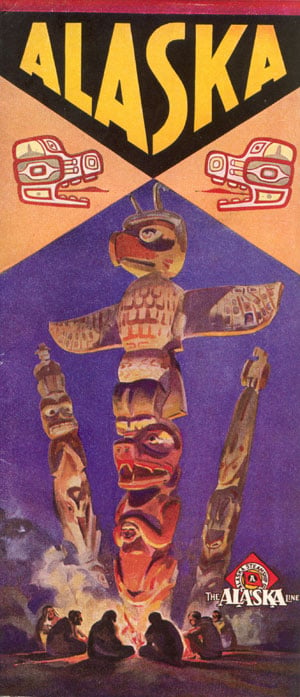
Aaron Glass: The most iconic totem pole, the classic pole that we think of today, the most reproduced variation is a relatively short pole with a Thunderbird or Eagle displaying outstretched wings on top of a Bear holding a person. This type of pole was statistically incredibly rare on the coast.
In fact, it seems that all of these images [they have a photo essay in the book] were derived from two sets of Kwakwaka'wakw house posts. A set that stood in Alert Bay and a set that stood in Stanley Park in Vancouver (replicas are still there). These poles show up over and over again. Sometimes exactly as they appear in life, sometimes with slight variations.
The disconnect between what we think of as the iconic totem pole and what the vast majority of totem poles on the coast actually look like, really stood out for me. Ironically, today, you see this image mostly on souvenirs of Alaska.
On the tourism draw:
Aldona Jonaitis: What I found most surprising is how totem poles were such a major draw for tourism at the turn of the century. Steamships began coming up the coast in the 1880s and we got a lot of information from travel brochures. At the time, totem poles were the reason to travel to Alaska. Yes, you'll see glaciers, but you'll see totem poles. Mountains and totem poles; wildlife and totem poles. That is not the case anymore. Totem poles are still an important part of Alaska's draw but by no means as popular as before.
Aaron Glass: A parallel came later in the 20th century as part of the 1958 Centennial when the B.C. Government decided to create the "Route of the Totems" by putting poles at all of the border crossings and major transit routes from the Washington/B.C. border to the B.C./Alaska border. It was originally called the "Route of the Haidas." But only when participating native artists and scholars complained saying there were several different First Nations along the route, did they change it.
On why they're called totem poles:
Aaron Glass: At the turn of the 19th century there was a lot of interest in totemism. Freud wrote a book on this, along with famous sociologists like Emile Durkheim. Totemism was thought to be the primordial religion. I think, in a way, the misnomer of calling them totem poles contributed to their appeal. It gave them an aura of exoticism. You can imagine if they were called heraldic poles or crest poles. Totem pole implies all sorts of things about them that is inaccurate, but is certainly appealing.
People have folded totem poles into their experience of other monumental art forms. Like Tiki poles from the South Pacific. Egyptian monoliths. Mesoamerican stela. Any tall cylindrical column with stacked figures on it tends to get included in peoples' minds. I think the sense that you can read poles as if they were hieroglyphics or pictograms comes from people's experience with other kinds of art forms. They resonate with other objects of civilizations.
Also keep in mind that a century ago, people didn't think of indigenous North Americans as having civilizations like the Aztec or the Egyptians. We've always been told they were nomadic hunter-gatherers, living in small egalitarian bands -- the settler idea of who inhabited North America. And then they found these monumental art forms attached to permanent houses and villages. There was a disconnect in people's minds between what they thought Native Americans were culturally, and these monumental artworks.
On the role of anthropologists in the intercultural story of totem poles:
Aldona Jonaitis: Anthropologists have had such a major role in the history of totem poles. They collected them, they wrote about them and then there was someone like Franz Boas, a person who reified the poles as an important item of First Nations art and culture.
But my favourite anthropologist is Wilson Duff. He's known for "rescuing poles" by salvaging them -- many from Haida Gwaii. In addition, he contributed to the notion that there was a classic style of Northwest coast art and a classic totem pole.
Aaron Glass: The reason we devoted a whole chapter to him is his career is a real pivot point in the history of the totem pole and in the history of scholarly intervention in poles.
The earliest anthropologists like Boas collected poles under the assumption that the culture was vanishing and wanted to save them before they disappeared. Then totem poles were used to create theories of social evolution; they signified stages in the longer evolutionary story about cultural development. And then you have anthropologists involved in these larger preservation and restoration projects. Marius Barbeau, Wilson Duff and others in the United States. They moved poles around, usually from indigenous communities to urban centres and museums, with the goal of making them more accessible. Often, especially when Wilson Duff was working, extensive dialogue happened with chiefs and owners of poles, which helped distinguish him from earlier anthropologists.
Then you get anthropologists and other scholars involved in promoting, exhibiting and valuing totem poles as art. Most recently, scholars are doing detailed historical studies, attributing 19th century poles to individual carvers as well as working with First Nations to facilitate repatriation claims.
Duff is really a pivot point in this story, because he starts off with the salvage project, raised totem poles into the realm of high art and changed his own mind in the process (later he regretted "salvaging the poles"). So he allows us to tell a lot of different stories.
Aldona Jonaitis: The thing about Duff is he did not acknowledge the enduring nature of the pole. He lamented how the poles no longer looked right, how the artists lost the ability to make them. Even though poles were being made at the time that Duff wrote, those were not the right poles. So that's why I said he contributed to the creation of a canon. These are good poles; these are not good poles. And he did not acknowledge the value of the continuing nature of pole production in the 20th century.
On whether totem poles ever almost died out:
Aaron Glass: Did they almost die out? It depends what you consider a totem pole. And it depends which First Nations groups you're talking about and it depends on who is answering the question. What criteria are people using to evaluate what's a real totem pole and what is not?
Among some Haida groups, they stopped making full-sized poles in the late 1880s right when they ramped up the production of miniature poles. And so the miniaturization kept the totem pole form alive among those Haida groups. At exactly the same time in the 1880s the Kwakwaka'wakw groups started making full-size poles with multi-figures. The ones we consider iconic today. And they never really stopped. Then other groups like the Coast Salish who had ancestor figures and other kinds of sculptural traditions started carving poles in the early 20th century partially to keep up with expectations about what Northwest coast people do.
What we argue in the book is that the totem pole has been a constantly evolving form, so there was never a moment when "it" almost died. It kept changing, migrating, transforming. This is not a story of death and rebirth it is a story of continual transformation.
On the continual transformation of totem poles:
Aldona Jonaitis: There are so many new contexts for poles. They are now commissioned by individuals and corporations. They are raised in communities as family memorials, they identify native space, i.e. in front of a native school or a cultural centre. They are still important draws for tourism and they are government diplomatic gifts. What I think is really interesting is the notion of poles as part of the healing process. Two are mentioned in the book: a pole in Alaska for a young man who died of a drug overdose. And in Vancouver there is a pole memorializing a young man killed in racial violence. This person was not even native, but the pole is a memento of that tragic event.
Aaron Glass: Then there is the ever-expanding role of totem pole kitsch. The pole has moved into every possible realm of souvenir marketing (puzzles, Frisbees, magnets and models, and don't forget haute couture as in a 1991 Isaac Mishrahi dress). In the digital realm, on Facebook's most popular game application, Farmville, you can now decorate your farms with different totem poles, including the iconic pole from Alert Bay.
There is no limit to the ways poles insinuate themselves in this contemporary world. And what is most interesting is that in many places on the coast indigenous people are reclaiming the totem pole to serve the function it was meant to serve, as markers of family ancestry and claims to the land. All these other forms are circulating globally and in cyberspace, but totem poles are thriving on the coast to do the work of advertising native claims. In a way that sort of counters the spread of these vapid and de-cultured poles in other contexts. ![[Tyee]](/design-article.thetyee.ca/ui/img/yellowblob.png)
Read more: Indigenous


Tyee Commenting Guidelines
Comments that violate guidelines risk being deleted, and violations may result in a temporary or permanent user ban. Maintain the spirit of good conversation to stay in the discussion.
*Please note The Tyee is not a forum for spreading misinformation about COVID-19, denying its existence or minimizing its risk to public health.
Do:
Do not: