

Nagata: The Roots of 'Fox News North'
Beware the agendas of media barons. Sun News Network's vitriol feeds a wider erosion of our public conversation. Last in a series.



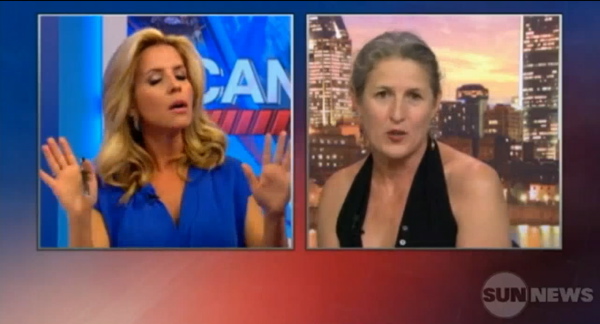
Sun TV anchor Krista Erickson berating contemporary dancer Margie Gillis for making art that is publicly funded.
Sun TV anchor Krista Erickson berating contemporary dancer Margie Gillis for making art that is publicly funded.
In the second part of this essay, yesterday, I wrote about the brief and unfortunate romance between the Parti Québecois and Quebecor. When the party leader ordered the caucus to support the media company's arena project, five MNAs bolted and the party plunged into a tailspin. Speaking to Jean-Martin Aussant, one of the newly independent lawmakers, he told me he believes Quebecor has found a far more natural dance partner: a former PQ cabinet minister now launching a new right-wing, nationalist party.
Public opinion
The special law protecting the arena deal was supposed to pass unanimously in the spring. It didn't, principally thanks to -- not the PQ implosion -- but the heroics of two independent MNAs from opposite ends of the political spectrum. Éric Caire is a fiscal conservative from the Québec City region, originally elected under the right-wing ADQ banner. Amir Khadir is the leader of Québec Solidaire, a quasi-Marxist alliance of Montréal-based social justice activists. (Interim NDP leader Nycole Turmel was, until recently, a member.)
When Quebecor's CEO Pierre Karl Péladeau came to the National Assembly to testify before a parliamentary committee on the arena law, we were treated to the heartwarming sight of two elected officials actually doing their job. That is, they asked PKP (on his own live television channel) exactly how the deal benefited anyone aside from Quebecor.
Éric Caire was the star of the committee hearings. Limited by his independent status to very little speaking time, he adopted a rapid-fire, courtroom style of interrogation. In under two minutes, he forced Péladeau to expose his central bluff: the idea that if the bill didn't pass immediately, the arena itself would be scrapped.
Caire, no doubt besieged by furious, hockey loving constituents, stepped back and let Khadir take the lead on part two: a dramatic vow to filibuster the bill itself until the clock ran down. Using the filibuster as an excuse, Premier Jean Charest announced the debate would resume after summer holidays and washed his hands of the matter.
For his pains, Khadir has been summarily tarred and feathered by -- who else? Quebecor's editorial hit squad, backed up, it would seem, by the population at large. This impression of a massive emotional wave is achieved through the use of independent public opinion polling, a very powerful tool indeed. Politicians dismiss polls when asked about them publicly, but they are secretly obsessed. It was poll data that convinced Pauline Marois that the arena was the shortcut to a PQ sweep of the ridings around Quebec City. And it is poll data that Quebecor has begun using as a blunt instrument to bludgeon unyielding obstacles, in this case opponents to the company's arena plans.
That week a black rectangle appeared instead of the front page of the Journal de Québec. The entire front of the newspaper was printed flat black, with huge white letters spelling out in French: "ANGER RUMBLING IN Quebec City". The sub-headline read: "Exclusive Poll".
Inside, the numbers told the tale. Are you in favour of the arena project? A whopping 83 per cent replied yes. Are you satisfied with the government's handling of the special law? Fifty-nine per cent replied no. Do you believe pushing back the vote on the special law could delay construction of the new arena? Sixty-four per cent replied yes. That question stood out, because of what the premier had said all along: his government had already earmarked the money and construction would go ahead as planned -- hockey team or no hockey team. Péladeau merely suggested the opposite, and the mob, as it were, ruled.
Even more disingenuous was a poll question premised directly on this fiction: "Who, according to you, is primarily responsible for delaying construction on the arena?" Thirty-four per cent replied Amir Khadir. The second-place villain, at 27 per cent, was Denis de Belleval -- the man challenging the deal in court, and another favourite target of the Quebecor columnists.
The firm commissioned for this exclusive poll, and many others across Quebecor's media properties, was Montréal-based Léger Marketing. Here I must tread carefully. Léger is highly regarded within the sector of market research. Using a diverse array of proprietary polling methods, it regularly produces accurate snapshots of voting intentions and public opinion on key political issues. Independence is what gives such a firm its credibility. But Léger's relationship with Quebecor raises legitimate questions about that independence.
And the winner is…
Close to Christmas last year, the media company commissioned a poll on the "2010 business personality of the year". The winner was Pierre Karl Péladeau. An executive from Léger Marketing appeared on Quebecor's 24-hour news channel to explain why. First of all, Péladeau had launched his new 3G wireless network amid much (Quebecor-generated) fanfare. There was also the lockout at his newspaper, the Journal de Montréal. And of course he was omnipresent in coverage of the Nordiques saga, as a prospective team owner.
All reasonable points, made at a slow time of year for news. But the poll still raised eyebrows. After all, the CEO of Léger marketing, Jean-Marc Léger, is on the board of directors at Quebecor's television network. He also writes opinion pieces for the Quebecor papers. In fact, he's one of the columnists called out by The Gazette's Don Macpherson as a xenophobe.
Léger isn't just publicly critical of ethnic groups who demand accommodation while "holding contempt for our French language and culture." He's critical of "aboriginals living on government subsidies while disrespecting the laws of the land." In fact, in one column alone, written in June, he took shots at Canadian passports, the governor and lieutenants-general, the provincial Liberals, anglos, and "street bums".
I'm glad Jean-Marc Léger has opinions. I have some too. One of my opinions is that polling firms should maintain a nominal level of independence from their clients. If a media company intends to publish poll data as "news" to advance its own business interests, my opinion is that a polling company interested in maintaining its own credibility should refuse the contract.
Simplest of all, I believe that public opinion polls should be premised on reality, and the questions should not be written based on the client's existing editorial. I have no evidence of any such complicity between Léger and Quebecor. But I do have questions. How does the market research CEO ensure his political opinions are restricted to his newspaper columns? What is the process when his company receives a contract offer? How much back and forth is there over the wording and order of the questions? Basically, what mechanisms are in place to ensure independence from big clients like Quebecor?
I called Léger Marketing and put some of these general questions to the research director. He told me my questions would be best handled by the CEO himself. After several requests, I have yet to hear back from Jean-Marc Léger. Quebecor also declined comment. The impression I'm left with is that public opinion is being wielded to advance private interests, via a cowed political class. On that front, I'd love it if my mind could be set at ease.
État de situation
Nothing I'm saying here is particularly novel. I have no hot scoops, only publicly available information. But I feel compelled to write about Quebecor for two reasons.
The first is that, for such an influential cultural institution, the company isn't held up to much public scrutiny. The locked-out writers, now gone from the Journal de Montréal, provide some notable exceptions. Media blogger Steve Faguy is another. His Gazette colleague Don Macpherson sometimes sticks his head above the parapet. There are private radio jocks who ridicule Quebecor, and academics, like Marc-François Bernier, who warn of the power of its media convergence model.
But most people shrug and keep their mouths shut: politicians, because they have too much to lose, and journalists, because they're either paid by Quebecor or a competitor, which blunts their criticism. (Or because they're aware of Quebecor's penchant for costly lawsuits.) When I worked for CTV, a subsidiary of Bell Media, I had orders to avoid discussing the budding telecom war between Quebecor and Bell. I can't produce email evidence, because [email protected] no longer exists. At the time, the directive made sense to me, because I knew I couldn't possibly be objective. Still, I felt a strange sensation covering the political wrangling over the Quebecor arena, knowing I was working for Péladeau's main rival. (The Canadiens, the Nordiques' old rival, now play in the Bell Centre in Montréal. Bell was apparently the other secret bidder on the Québec City arena contract, but was rejected in favour of Quebecor.)
I'm partly writing about this stuff because it feels good to finally be allowed to. But the real reason for this piece is because I see what's happening in Québec as a blueprint for the rest of the country.
I mentioned the company's 37 daily papers. Since buying Osprey and Sun Media, Quebecor has become the largest newspaper chain in Canada. If you read the Kingston Whig Standard, the North Bay Nugget, the London Free Press, or Fort McMurray Today, you're reading a Quebecor paper. Same goes for the Ottawa, Toronto, Winnipeg, Edmonton, or Calgary Sun. Those free "24 Hours" commuter tabloids are Quebecor content too.
Here comes the Sun Network
You've probably heard of the Sun News Network, even if you don't watch it. They're "Canada's home for hard news and straight talk," or unofficially, "Fox News North." It's a comparison the network encourages, as the whole point is to openly promote a right-wing agenda. In that vein, the Sun chain has taken to calling the CBC "the State Broadcaster", and much effort is spent filing access-to-info requests demanding how much the taxpayer spends on CEO Hubert Lacroix's morning yogurt, etcetera.
If you haven't seen Sun anchor Krista Erickson shout down contemporary dancer Margie Gillis over arts grants, the "interview" effectively encapsulates what Quebecor's English-language network is all about. (The hypocrisy becomes clear when you realize that Quebecor took home $3.7 million last year in federal publication grants. And that's peanuts, next to the cost of a taxpayer-funded hockey arena.)
Or consider correspondent Brian Lilley's "commie hunt" within the Ottawa press gallery. Or host Ezra Levant's passionate defence of the tar sands. Through a strange alliance with Alberta conservatives, Quebecor is working to expand beyond its home province, and continue its project on a national scale.
In 1997, a frustrated ex-Reform Party MP named Stephen Harper co-wrote the following: "a strategic alliance of Québec nationalists with conservatives outside Québec might become possible, and it might be enough to sustain a government." At the time, he was chafing under what he called the "benign dictatorship" of Liberal government. But his fascination with Québec nationalism was not just a passing flirtation. The philosophical overlap remains, and it leads to some strange echoes.
During his majority-winning campaign, Harper robotically repeated the same metaphor: "A sea of troubles is lapping at our shores. Under our leadership, this country, Canada, is the closest thing the world has to an island of stability and security." This notion of a beleaguered island should be immediately familiar from sovereignist discourse. In Harper's hands, it's a self-fulfilling prophecy.
Nagata: The Roots of 'Fox News North': Page 1 of 2
What have we missed? What do you think? We want to know. Comment below. Keep in mind:
Do:
Do not: