Opinion

Why Flaherty Loves His $50 Billion Deficit

After creating it with tax cuts, he has an excuse to slash government.

By Murray Dobbin, 1 Jun 2009, TheTyee.ca

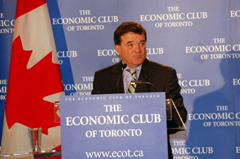
Jim Flaherty

Finance Minister Jim Flaherty reassures his base: Economic Club of Toronto.

It is astonishing given all the commentary and news stories about the "sudden" $50 billion federal deficit there has not been a single story in the mainstream media that focuses on the principal explanation: the huge tax cuts made by the Liberals and Conservatives since 1995.

First it was former finance minister Paul Martin with his $100 billion income tax cut over five years starting in 2000. Then it was Jim Flaherty in 2007 with $60 billion over five years. Add to that the $12 billion lost each year by lowering the GST from seven per cent to five per cent and the $50 billion is no mystery. It was an inevitability whenever the next recession hit.

But what to make of the sudden embrace of deficits by those who built their political careers on fiscal conservatism? There is no mystery here, either. Neo-cons like Jim Flaherty don't really care about deficits per se -- their ultimate goal is downsizing the social and redistributive role of government. From that perspective, the $50 billion shortfall is a godsend: a useful crisis that will provide the rationale for huge spending cuts.

Without all those tax cuts, it is arguable that there would be no deficit at all. Not only that, of course, we could have been spending that money on the collective needs of Canadians -- municipal infrastructure, national child care, pharmacare, lowered tuition fees, money for greening the economy, targeted industrial development.

Giving away the store

Between 1984 and 2006, the federal government voluntarily gave up more than $250 billion in revenue through tax cuts, which went disproportionately to the wealthy and large corporations. But just looking at the tax cuts implemented by the current minister since that time reveals that half the projected deficit was caused by Jim Flaherty himself.

According to a January 2008 study by Marc Lee, a senior economist with the Canadian Centre for Policy Alternatives (CCPA), Flaherty's 2006 and 2007 tax cuts (scheduled to be phased in over five years) would result in a loss of revenue for 2008-09 of $28.2 billion: $5.9 billion in corporate taxes, $10.3 billion in personal income taxes and $12 billion in GST revenue. The corporate tax cuts skyrocket to $14.8 billion in 2012-13, according to Lee, as the corporate income tax rate falls to 15 per cent, the lowest of the G7 and one of the lowest in the OECD.

Given the severe recession, these numbers would be somewhat lower but it does not alter the fact that the cuts were ill-advised and never accomplished their stated goals. The ideology held that these cuts would lead to economic growth and massive new corporate investment. All that was needed for endless growth into the future was for government to "get out of the way."

The corporate tax cuts produced just what one would expect -- a huge increase in pre- and after tax profits through 2007 but without any comparable increase in new productive investment or productivity. Canada has been cutting corporate taxes for 10 years to levels now well below those of our main "competitor" -- the US (where the rate has remained steady through the decade) -- and yet our international competitiveness has declined. While the statutory corporate tax rate was being reduced by 11 percentage points since 1999, the Word Economic Forum reports that our competitiveness declined from fifth place in 1999 to tenth in 2008-09.

Indeed, corporate tax rates seem to have little to do with competitiveness. Six of the top ten countries are Northern European nations with some of the highest corporate tax rates in the world.

Tax cuts and spending cuts are key elements of the Washington Consensus -- the ideology that has driven the global economy since the 1980s. This failed ideology was all about reducing the percentage of the economy devoted to public spending. This was revealed in dramatic fashion by Paul Martin in his 1995 speech on his budget, famous for cutting federal social spending by 40 per cent. Martin boasted, oddly enough, not about slaying the deficit but about reducing the role of government: "Relative to the size of our economy, program spending will be lower in 1996–97 than at any time since 1951." To maintain that lofty accomplishment, Martin rid the country of huge budget surpluses in the late 1990s with his $100 billion tax cut.

The price of a civilized society

"Taxes," said American jurist Oliver Wendell Holmes, "are the price we pay for a civilized society." Ultimately, when citizens decide questions about taxes, they are choosing between public goods and private goods. Presumably, the overall goal is one of happiness and if that is the case, a recent study suggests that so-called "tax relief" (taxes framed as an affliction) is over-rated. The Organization for Economic Cooperation and Development survey showed people in Denmark, Finland and the Netherlands ranked first, second and third, respectively, in the OECD's rankings of "life satisfaction." They are amongst the highest taxed countries in the world. Canada was eighth -- but one of only five countries to have registered a decline between 2000 and 2006.

Another study, by economist Hugh MacKenzie of the CCPA, shows that Canadians get a great deal for the taxes they pay. Every Canadian gets an average of $17,000 worth of benefits from their tax-funded public services, which translates to about $41,000 for a middle-income family -- or 63 per cent of its yearly income. Says MacKenzie: "Tax cuts don't give you money for free. They introduce a trade off between a private benefit in the form of lower taxes and a reduced public benefit."

There are only two ways to deal with the extraordinary deficits the country is facing: cuts to social spending or a return to a tax system that pays for the things we want.

Jim Flaherty can hardly wait to use the $50 billion "crisis" to start cutting.

Will Canadians stop him?

Related Tyee stories:

 [Tyee]

33  Comments:

  • Camero409

    01-06-2009

    Make It Fail!

    That's what the conservatives and the so called liberals in BC are all about. If you underfund, don't streamline, don't increase efficiency then it fails. Let the ultra right wing Frase Institute and Canadian Federation of Independent Businesses make the commentary of how badly it's failing, then you can make changes.

    The Governments make the bullets and let their unofficial spoksmen, the Fraser Institue and Canadian Federation of Independent Businesses fire them.

    What is happening here is our conversion to the american way of doing things. It's obvious that the conservatives are funded by major corporations. Most major corporations are american. Major corporations answer to their shareholders (many of whom are memebers of the above mentioned institutions). What is it that they want? PROFITS!

    How do they increase profits? Reduce taxes and labour costs. How do you do that? Infulence the government in power. How do you do that? Pay them off with election funding, jobs after their political careers, etc.

    What O'Flarity and other conservative finance ministers are doing is exactly what the major corporations want. Make it fail so government can justify selling it off (Atomic Energy of Canada) to the private sector and allowing the private sector to run it. In some instances let the private sector run it and fund it with public funds (hospital cleaning staff for example).

    We are being taken over by major corporations through osmosis. It's privatization of our government right before our eyes and we can't see it or we're too paralized to do anything about it.

    Make it Fail then Privatize it!

  • RickW

    01-06-2009

    The speed with which the Cons......

    .....embraced deficit spending, after swearing that it would never happen, is truly dizzying!

    I wonder if they are targeting the EI surplus..........?

  • realisticman

    01-06-2009

    Feeling Bloated

    Another question we need to ask is, 'can we afford the bloated government bureaucracy'. The federal bureaucracy has ballooned.

    Another study a few years ago showed that not only are there more public servants than there were since the end of the downsizing in 1997-98, but they earn higher salaries, take more vacation, book off sick more frequently, suffer from rising rates of depression and anxiety, take more parental leave and face bigger health and dental bills.

    This gigantic horde is costing us money and they are not even healthy or happy.

    Time for a new study of bureaucracy in Canada, especially considering the overlap that occurs because we have the federal as well as the provincial workers and now we are going into deficit spending we cannot afford it all.

    Health care and education should not have to suffer because government has become too large.

  • jimorsheryl

    01-06-2009

    What makes you think......

    The government would have been in any better shape if they hadn't reduced taxes?

    Are you naive enough to think governments don't simply spend ALL the money they can, and then some?

  • Van Isle

    01-06-2009

    How come hardly anyone

    How come hardly anyone mentions that Flaherty was with the Mike Harris government in Ontario and we all know what screw-ups they were. The man is getting a free ride. And yes I think that a reccession?depression is exactly what these guys want; so they can sell-off the farm. That goes for Campbell too.

  • G West

    01-06-2009

    R/Man

    What study?

    What data?

    Please.

    Van Isle, you're dead on - there is a study of what happened in Ontario under Harris/Flaherty...And it ain't pretty.

    Jim or Sheryl - Yes on the first point; No on the second.

    There are civilized countries with rational systems - Canada under the neo con liberals and conservatives isn't one of them.

    NDP governments run smaller deficits and less often then either of your friends.

  • Skywalker

    01-06-2009

    Those who forget history...

    Realisticman just proved everything Dobbin stated in the article above. It is an old game where you never consider the real causes, never reverse an earlier decision just keep looking for a scapegoat. Blame the civil service and cut their ranks then when you can't deliver the service any longer, privatize.

    I am not surprised that Realisticman walked right into the conservative myth without ever giving it a thought..

  • Cynic

    01-06-2009

    Another excellent piece of

    Another excellent piece of gatekeeping by Mr. Dobbin. Superficial at best, typical to the point of boredom. Look at this entirely erroneous statement:

    "There are only two ways to deal with the extraordinary deficits the country is facing: cuts to social spending or a return to a tax system that pays for the things we want."

    Bullshit, and Dobbin knows it. The democratic solution is dead simple: have the Bank of Canada pick up the federal government's bonds. Then restrict the private banks from printing money by reinstating the statutory reserves that were phased out from 1991 to 1993. THIS is the solution, and it's nothing new, the feds have done this many times before, using the Bank of Canada to help fund the war effort and the post-war boom. There is simply no good reason for the government to shop its bonds to the capital markets where private banks can merely print money out of thin air to buy those bonds and thereby put us further into debt slavery.

    Instead, Mr. Dobbin perpetuates the same old tired paradigm, flailing away at the branches, wasting his high dudgeon on the periphery. Go ahead, Murray, play with the numbers all you like. Money reform is the only answer and until we get it, the numbers will never work.

  • moodyguy

    01-06-2009

    Obvious

    Thank you Murray for pointing out the obvious. Unfortunately, the failed ideology still has many adherents and has been so strong for so long that many members of the population believe that it is true. Look at competitive economies around the world and you will see a strong mixed market base with heavy government involvement. This is true fore Finland (extremely competitive), Norway which if compared to Alberta as an oil producer puts Alberta to shame in terms of fiscal prudence (which is drastically different from tax slashing giveaways), the Asian tigers when they were growing, the Celtic tiger etc. If you look at countries that actually engaged in massive privatization and government slashing, you come up with a list of impoverished "developing" (most are sliding backwards)countries which experience endemic corruption. Hopefully, these conservative fools in Ottawa do not do too much irreparable damage before they are replaced.

  • realisticman

    01-06-2009

    Another Study

    http://www.tbs-sct.gc.ca/media/nr-cp/2005/1031-eng.asp

    800 pages but worth the read, ha!

    The study also confirms that workers in lower-end jobs make considerably more than similar workers in the private sector, especially clerical employees who won a historic $3.4-billion pay equity settlement.

    GWest, "NDP governments run smaller deficits...". When they used to have the rare brief chance.

    I guess you read Chantal today, "More than ever, though, the continued relevance of the federal NDP lies almost exclusively with the relative success of the other parties, rather than with anything its leader says or does." Take that Jack!

  • seth

    01-06-2009

    The Wrecking Crew

    A book by Thomas Franks shows how the Neocon's wreck government programs deliberately when they get in power. They can then say - look, see what we are saying, the government can't do anything right.

    The convention centre fiasco was a case in point. The BC voter bought it.

  • jwstewart

    01-06-2009

    Possibly partially correct

    Dobbin states a $28.2 billion loss of revenue from tax cuts in 08-09.

    To me this accounts for slightly more than half of the projected deficit. The rest would have had to come from somewhere else.

    Actually what I suspect is that since UI is funded from general revenues, all those newly unemployed are causing the govt to incur much higher UI payments than any previous government anticipated.

    A fully funded UI system would isolate the government from deficits in a economic downturn.

  • realisticman

    01-06-2009

    Here to stay

    We just went through a provincial election and the both parties were almost tripping over themselves to get to the mike with promises of tax cuts!

  • Rod Smelser

    01-06-2009

    "realistic"man: Thanks for the link!

    realisticman
    http://www.tbs-sct.gc.ca/media/nr-cp/2005/1031-eng.asp

    800 pages but worth the read, ha!

    The study also confirms that workers in lower-end jobs make considerably more than similar workers in the private sector, especially clerical employees who won a historic $3.4-billion pay equity settlement.

    Thanks for this link, "realistic"man, it's a bit surprising given your world-view that you would offer up a federal government document in support of your position. I haven't had time to read the first 8 pages, let alone all 800 (BTW, how many have you read, "realistic"?).

    But this thought did occur to me. This paper is the work of the Treasury Board. In terms of federal government labour relations, the Treasury Board is the government's employer. I wonder if it might not be in the Treasury Board's interest, as the employer, to put forward material which states that the workers they employ are highly paid, that in other words, no further upward adjustments are necessary.

  • realisticman

    01-06-2009

    Rod

    As a federal employee perhaps you can tell us if it would be possible for the top leadership at Treasury Board to slant and create false statements within an 800 page study that their own department was producing.

  • sdgreen

    01-06-2009

    Nonsense from Dobbin

    The logic of the left to leave the population living like drones through extreme taxation is beyond comprehension.

    The Dobbin Factor is predicated on massive government control of everything, repression of innovation, freedoms, competition, plus total isolationism.

    Dobbin's idol, right now is that of Hugo Chevaz whose country has adopted radical socialism and is now teetering on financial ruin.

    Just look at Britain whose leftist Labour Party has basically destroyed that great nation. Look at France where socialist policies and the Unions have created the absolute right to entitlement, notwithstanding the ability to pay.

    The policies of collectivisim simply do not work well; Russian learned that the hard way. Even China has abandoned the very principal. North Korea is another example of a failed Marxist/Socialist methology of governance.

    Nay, high taxation does not solve anything other than to stifle the advance of humanity. Competition, freedoms, small government, is the only way to go.

  • SharingIsGood

    01-06-2009

    Adjunct to the insightful M.D.

    The New York Times just published a piece that, like Murray Dobbin, dumps another spadeful of dirt into the Reaganomics grave.

    http://www.nytimes.com/2009/06/01/opinion/01krugman.html?em

    Years before the current world economic collapse, there were several (often ballyhooed) Tyee "lefties" asserting that economic collapse under current neoliberal monetary control was enevitible. Taking from the working and the middle classes to give to the wealthy was the recipe for the disasters that regularly assaulted free-market capitalism through it's infancy into the 1930s.
    http://history1800s.about.com/od/thegildedage/a/financialpanics.htm

    Had not a gruelling decade of economic downturn(the 30's) preceded Europe's WW-II, I assert that Europe's WW-II likely would not have happened the way it did. The hopelessness brought on by the Great Depression added to the economic reparations laid upon Germany for WW-I (punishments that would have taken 3 Germans generations to repay) gave fascism extra traction in Germany. The economic hard times that are now upon us can likewise provide leverage for the fascist manipulations at play in BC under the guise of BC Liberal party neo-liberal economic policies.

    The forces of Globalization do not have the best interest of the average Canadian at heart. In fact, its proponents have no interest in people at all; the corporate leaders of this ideology are interested in amassing capital and power for themselves through manipulating world labour, commodity and consumer markets. Globalization is the ultimate goal of neoliberal capitalism turned loose upon the world. Corporate fascism is the ultimate form of unregulated neoliberal capitalism. We see corporate fascism in BC through the give-away of our public assets to large corporate entities while, as consumers, we find ourselves facing more and more consumer products being shipped from afar. Depressions enable corporations to ask that we continually work longer and harder for less. Globalization is the "race to the bottom". It is a method for speeding up and increasing the consumption of the world's dwindling resources. It is a method for allowing already powerful corporations to exact ever-increasing percentages of capital from the labour/production/consumption equation while paying continually lower taxes.

    Television has become a huge part of the manipulation. Popular shows like "What not to Wear, Extreme Make-Over, Extreme Make-Over Home Edition, and Flip this House" have become the ultimate vehicles for transporting neoliberal messages for the masses. They continually teach people to be dissatisfied with ordinary. They market wasteful and destructive practices that lead consumers away from getting by with what they have, saving and conserving. Everyone must have new hardwood floors, stainless steel appliances, and granite counter tops. All must maximize their mortgages. Invasive breast implants are investments in oneself!

  • Frank

    01-06-2009

    Conservative mangement of the economy

    Cut corporate taxes, go into deficit, blame a mythical bloated public service.

    Perhaps the COns will save money by slashing the jobs of the people who do the environmental reviews before projects can happen. I'm sure business will welcome the resulting delays for the good of the economy.

  • realisticman

    01-06-2009

    Frank

    I guess you have been celebrating the nationalization of General Motors and the $1.4 million for each union job that your government just announced that you will be paying. More deficits there. Cuts will have to come eventually.

    The Russkies must be laughing, eh?

  • Frank

    01-06-2009

    realisticman

    I voted against this government and their constant handouts to their corporate friends.

    You on the other hand voted for them and their corporate tax cuts and handouts.

    I believe what you like most is the fact that the Cons can hand money over to their corporate friends, receive donations and political support in return, see unionized workers on the dole and get to blame it all on social programs?

  • realisticman

    01-06-2009

    Corporate Friends?

    The Conservatives in there now have never been supported by Bay Street. It's the Liberals that were. The Conservative's support is at the grass roots level.

    Blame.
    Too bad you see it that way but the fact is that the whole economy is in a tough way and one can be sure that everyone is prepared to give something up to make it all work again. That will include government employees as well as those on the receiving end of public largess. It builds character and strengthens a people when they join in unison to overcome difficulties. Think of Russia under siege, or England under bombardment, or France under occupation, or Cuba under embargo.

  • Frank

    01-06-2009

    realisticman

    Iggy and Harper are both supported by Bay Street.

    "and one can be sure that everyone is prepared to give something up to make it all work again."

    Two things, first, many people don't have to give up anything, in fact, for many its a gain as their taxes have been cut. It'll be people on the bottom, as always, that suffer for the Conservative largess for their corporate friends.

    "Think of Russia under siege, or England under bombardment, or France under occupation, or Cuba under embargo."

    Actually a better comparison would be to Vichy France. Harper equals Petain or Quisling?

    After all, the people responsible for kicking low income Canadians are other Canadians who would rather the poor pay the piper and not themselves.

  • used to live in...

    01-06-2009

    Gasoline on the fire

    Mr. Dobbin, your commentary is right on the money. Might I suggest that when this federal government reduced corporate and dividend taxes and lowered the GST from 7% to 6 and then 5, the cumulative affect is a fanning of the already over-heated economy. With near record employment levels, near record low interest rates and sky-high commdoity prices the last thing Canada needed was tax cuts. This was like putting gasoline on the fire.

  • The discussion for this story is closed. No more comments can be added.