Inside the WTO's Collapsed Deal
World's poor dodged disastrous policies when world trade talks failed.
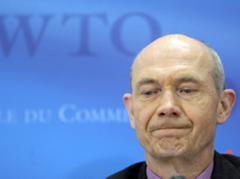
World Trade Organization Director General Pascal Lamy.
On July 21, the World Trade Organization held yet another meeting billed as a "do or die" effort to pull off a new global trade deal. Since the Doha round of talks were launched in Qatar seven years ago, trade ministers have met five times to work on an agreement. The ministerial meeting held last summer was charged with a sense of urgency, with warnings that this might be the last chance to hammer out a deal. So the hype about how this summer's meeting represented a "moment of truth" for the negotiations seemed like an overused ploy to get negotiators to resolve their differences.
Lucky Break for Harper
Basically sidelined from the negotiations along with the majority of WTO members, the Canadian government did not have to show its cards as the trade talks crumbled. If the negotiations had not foundered on the issue of how to safeguard farmers from surges in agricultural imports, Canada's delegation could have been caught in a politically dicey position over agricultural marketing boards.
The Wheat Board is one of the last obstacles to total dominance of world grain markets by agribusiness and was targeted by the U.S. and the E.U. for elimination in the Doha round. Saskatchewan's agriculture minister undermined Canada's negotiating position by stating publicly in Geneva while the talks were going on that Canada might have to make concessions in this area. But while the Harper government has demonstrated its hostility to the Canadian Wheat Board, it would probably be loathe to go into an election this fall having just traded away the dairy and poultry marketing boards supported by farmers in Quebec and Ontario.
Trade Minister Michael Fortier asserted at the negotiations that "our position on supply management will not change," but this assertion did not have to be tested since the key players walked away from the table.
-- Ellen Gould
This time, though, negotiators' inability to reach a deal seems more serious, with key figures appearing genuinely deflated at the outcome. WTO Director General Pascal Lamy said that "there is no escaping the fact that this meeting has failed," and that the multilateral trading system came out of it "dented."
Negotiators behaving badly
The recriminations over who was to blame for the failure were so venomous that they may poison the atmosphere for a resumption of multilateral talks for some time to come. The American negotiator claimed negotiators had actually reached an agreement but that two of the seven members of the core negotiating group -- a clear reference to India and China -- had scuttled it by rejecting a compromise reached on a key provision.
The provision in question dealt with how to protect farmers from a surge in agricultural imports. The Indian negotiator retorted that a strong safeguard against such surges was essential to the livelihoods of the world's poorest farmers and "could not be traded off against the commercial interests of the developed countries."
The E.U.'s trade chief, Peter Mandelson, slammed the conduct of the U.S. negotiators and hinted that rather than working for success, the U.S. was actually preparing for the failure of the talks.
The U.S. delegation shot back that "the E.U.'s anger is misdirected, misguided and being misused," accusing Mandelson of trying to divert attention from the fact that the European position on agriculture was under attack by some of its own member states.
Farmers in the balance
What are the consequences of this year's ministerial collapse? If the only news you got about the latest WTO failure came from the business press, you would think that it was a major blow to the poor. An editorial in the Wall Street Journal entitled "The End of Free Trade?" said the meeting had historic significance because "for the first time since the multilateral trading rounds began after World War II, a trade expansion effort has ended in failure." The Journal said the Indian trade minister was the "main villain" and he bore responsibility for blocking progress for impoverished people in his country.
But generally organizations around the world that work on behalf of the disadvantaged have been celebrating the collapse of the so-called Doha Development Round. In exchange for largely illusory cuts to developed country farm-subsidies, developing countries were being asked to open their markets even further to the manufactured goods and services of developed countries. Basically, they were expected to permanently block their own path to development by eliminating the capacity to protect infant industries with tariffs, the path that the U.S. and Europe had followed to industrialize their own economies.
The U.S. was claiming it was willing to make big reductions to its agricultural subsidies, but the recent passage of a $300 billion farm bill by the U.S. Congress make it unlikely that the U.S. is serious about real reductions. Such farm subsidies put developing-country farmers at a huge competitive disadvantage. In addition, a number of studies have showed that even if developed countries did actually cut their agricultural subsidies, it would make little difference to world poverty. A report from the United Nations Conference on Trade and Development concluded that a Doha agreement could cost developing countries huge losses in tariff revenue, four times as much as any benefits they might gain.
Ramping up a global banking disaster?
Not even registering on the radar of the mainstream media were the consequences of a WTO package deal that would have included liberalization of services. It is remarkable that in the midst of a major financial crisis, with shockwaves continuing to be felt from the U.S. subprime mortgage disaster, journalists did not cover the financial services aspects of the WTO negotiations.
In what Director General Pascal Lamy reported as a bright spot in the talks, countries met on July 26 to signal the major concessions they were prepared to make on services. Apparently oblivious to the shaky state of international banks, some countries proposed that they would eliminate deposit requirements for foreign bank branches. They said they would open up to increased trade in financial derivatives, even though these products are a prime source of financial instability. The trade ministers' cheery attitude towards further financial liberalization begs the question of how bad the financial crisis would have to get before they thought twice about permanently deregulating the sector through trade commitments.
Under the WTO services agreement, if countries commit to the complete opening of a sector, they have to allow unlimited foreign ownership in that sector. Some of the trade ministers at the services meeting announced their countries were willing to allow total foreign control of key areas like banking, telecommunications, health and postal services. While Lamy's report of the services meeting names Canada as one of the 27 countries represented, he does not identify who made which offer to liberalize. So Lamy's report does not tell us what new offers Canada may have made.
David Robinson, in his capacity as trade and education consultant for Education International, a global union federation claiming to represent 30 million teachers and other education workers, met with WTO negotiators during the ministerial to discuss potential impacts on public education. Robinson told The Tyee his organization's principle concern is that "commitments taken could lead to locking in the forces of privatization." Commitments to allow the establishment of foreign for-profit institutions, for example, could undermine domestic efforts to build a strong public education system.
Education International also objects to the development of new WTO "disciplines" restricting how services are regulated, particularly in relation to requirements for education qualifications. Robinson said if governments tried to strengthen education qualifications for teachers, the proposed WTO restrictions on regulation could mean these governments would be challenged for creating a restriction on trade in education services. These WTO restrictions on the right to regulate still may be imposed, despite the collapse of the Doha round.
Cherry-picking the results
Although the ministerial meeting just ended in failure last week, it is already clear how different delegations are manoeuvring for advantage in the post-Doha era. Brazil, which jumped ship in Geneva on the developing-country coalition opposing deep cuts to industrial tariffs, has contacted President Bush directly to signal Brazil is still willing to negotiate.
The U.S. is questioning the fundamental premise of a comprehensive trade package, one that covers agriculture, market access for industrial goods, and services. The U.S. trade negotiator said at her last news conference: "Why should it have to come together at exactly the same time? We need to reflect on how we move forward, but there are ways of moving forward certainly with pieces of this, both near term and longer term." The U.S. would probably like to harvest the services and industrial commitments that were made without having to give anything in the area of agriculture.
But the Indian trade minister has already rejected this option, saying that the WTO is not a buffet where countries can just take what they want without making concessions. And while Pascal Lamy is claiming the WTO could proceed in all the areas where there was agreement, this view is categorically rejected by countries like Argentina that were excluded from the inner circle of seven countries that did most of the negotiating.
The Bolivian way
In their debriefing on a services meeting held as part of the ministerial, WTO staff described it as "dreadful." At this meeting, Bolivia, Venezuela, Cuba and Nicaragua blasted the chair of the services negotiations for the text of a report he had drafted on how the negotiations would proceed.
Among other things, this report would have had governments commit to locking in existing liberalization so that they would not be able to undo privatization and deregulation without risking a WTO challenge. Surprisingly, the group of countries that had previously given their okay to this language -- a group that included Canada, the U.S. and the E.U. -- mostly sat on their hands at the meeting and did not come to the chair's defence.
While Bolivia is marginalized by the powers that be at the WTO, its views probably are more mainstream than those of most trade negotiators. It is Bolivia's position that services like health, education and water should be excluded from commercial trade negotiations because they are basic human rights. Local food production should be given priority over imports because the environmental costs of transporting foreign food have to be taken into account. The patenting of all life forms should be prohibited.
These positions were sent in a letter from Bolivian president Evo Morales to Pascal Lamy. They provide a glimpse of what a real "development" round of negotiations might look like.
Related Tyee stories:
- Food Fight: Canada vs. Europe We're forcing GMOs on people who fear them.
- Cultural Diversity: Canada's UN Victory A protection the US fought. But will it work?
- Time to Tame Corporate Power Global CEOs are unclear on the concept of government. They think it's their support staff.


30
Login or register to post comments
Jeffrey J.
3 years ago
Corporate Press Silence
Thank you once again Tyee and Ms. Gould for writing about a critical issue that no-one in the mainstream press (i.e. business press) is allowed to cover. This is why independent news organizations like the Tyee (and others) are crucial for democracy. The corporate elites have a myopic view of success, and failure, which is invariably the exact opposite of its actual meaning. Glad to hear poor nations dodged the bullet!
Van Isle
3 years ago
Read the other day where the
Read the other day where the Norwegian Foreign Minister commented that the breakdown in these talks has seen the end where the west dictates trade deals and that the "New World Order" is shifting. I wouldn't count on it yet; somehow they'll come back to the table and our Governments will make concessions (in other words, screw the citizens of their own countries) to please their masters. I wonder if any of our political and busines elite ever thought that they could be bordering on (economic) treason?
Fiat lux
3 years ago
So called "free trade" has
So called "free trade" has very little to do with genuine trade. It was planned and is being executed as a vehicle for world colonization by a few mega corporations with the perceived power of imaginary capital.
Let's hear some arguments in favour of foreign banks coming into Canada, or any other country, and be able to to "create" local, domestic currencies, so that the multinational carbetbagger, corporate mafia can move in and buy up all infrastructure and service providers, colonizing and enslaving countries.
Where the "poor" farmers are concerned, the master plan is to push them off their lands, into city slums, so that the agribiz corporate mafia can move in and take over their lands. It would never be the farmers who'd benefit, but the same corporations trading with themselves at both ends, as it is already happening under the NAFTA racket.
The world's food supply is already controlled by the conspiracy 2-3mega corporations, who are controlling the prices paid to farmers and to "consumers", raking in incredible profits .
This is why an obedient and brainwashed Harper wants to kill off the Canadian supply management systems, so they can come in and take over completely, destroying even what is left of independent , family farming.
What our ranchers will get for their calves this Fall, will again be 50 -60% of what they were getting 10 years ago and the prices have been long decided in corporate offices, while calling it "free market" and "free enterprise', stealing everybody blind.
The world has always been ruled by crooks and nuts, but never to the degree as now, pointed out in this article in good detail.
China now has some $3. trillion of worthless US dollar reserves. Watch them coming in and buying up Canada and all other resource based economies under WTO rules.
Ed Deak.
avandoc
3 years ago
Want to learn more?
If you want to understand how one multinational corporation positions itself to become nt in agriculture, go see "The World According to Monsanto" at Vancity Theatre. Trade agreements are just one part of the equation. The ruthless tactics such corporations use destroy lives everywhere. The PR firms they hire put forward an image of "corporate responsibility" at the same time that they use cloak-and-dagger techniques to discredit critics.
The Latin American countries, some more (Bolivia) and some less (Brazil) than others, are breaking away from multinational corporate tion. The US is so preoccupied with the middle east that this trend has taken it almost by surprise. Its clumsy attempt to start a war between Colombia and Venezuela failed, but it remains to be seen how far Latin countries can go before provoking a concerted response. Canadians should be vigilant that the US doesn't try to draw us into counterrevolutionary activities, but Canadian mining companies are unhappy with Ecuador and are surely letting Harper and Emerson know.
Michael
3 years ago
Failure of WTO talks will be a disaster for the poor
In the last 20 years more people have been lifted out of poverty, largely the result of trade liberalization, than anytime in human history. Yet writers like Ellen Gould continue to look right past this progress and beat the drum about tariffs and regulation. Going down this road is a mistake. The failure of Doha will be a disaster for the poor.
alive
3 years ago
time's are a changing
How is that saying: "He who has the gold, calls the tune"?
Only news is that the USA no longer is the one with the gold (power), and it has not quite realized its waning position.
This is the time for developing countries to stand up for their rights, because the domino's are about to tumble!
Van Isle
3 years ago
Comment on Michael's
Comment on Michael's statement about how better off people are with liberal trade. Horseshit, just another myth that is created by the elite's professional liars, oops, spin doctor, oops, public relations people. How come the Mexicians are some much worse off since NAFTA? Michael, you've been listening to Brian Mulroney too much
Cynic
3 years ago
Michael, it looks like the
Michael, it looks like the corporate media have a lock on your intellect. Snap out of it.
I suspect the "collapse" of this round of negotiations is just another little stumbling block for the World Totalitarian Offensive. The pursuit of their agenda is always characterised by relentlessness and incremental success. Fearmongering and warmongering works wonders for them. At least there are sings of hope in Latin America.
There. I made a comment and feel much better now.
pender paul
3 years ago
a synonym for stealing
"...package deal that would have included liberalization of services..." The WTO, the World Bank and various free trade agreements have never been about making life better for working class folks--it has always been about transferring the wealth of a nation from its citizens to the hands of the capitalists. "Liberalization" is just a fancy way of saying "stealing". The WTO had its origins in the GATT in the late 40s when the corporate elite from all sides who made buckets of money as a result of the 2nd big dust-up regrouped and made plans for even more profits. Maybe the WTO will go the way of the dodo--one can only hope.
Michael
3 years ago
To Cynic
Actually, the UN has a lock on my mind, that is where the poverty stats are from. While were at it Cynic, riddle me this. Name me a developing country that has maintained high tariffs and regulation, all in the name of protecting its domestic market, that has resulted in better living standards for its citizens.
Michael
3 years ago
To Van Isle
"The overall benefits of NAFTA have been quantified by several economists . . . They assess that NAFTA has been positive for Mexico whose poverty rates have fallen, and real income salaries have risen even after accounting for the 1994–1995 Economic Crisis."[url=http://en.wikipedia.org/wiki/Economy_of_Mexico#NAFTA]
Sectors of the economy that have done poorly are state owned, such as their oil sector. There you see declining production and fewer and fewer jobs due to lack of investment.
Cynic
3 years ago
"Name me a developing
"Name me a developing country that has maintained high tariffs and regulation, all in the name of protecting its domestic market, that has resulted in better living standards for its citizens."
How about the USA? All developed countries were once developing and they did their developing behind "protectionist" trade barriers. That's why they're called protectionist.
Statistics can lie, Michael. Instead, try opening your eyes and look around. Today's world is not an accident and there is no shortage of anything. There is however a fascist elite that is conning a gullible populace toward some evil end. Researching and understanding the banking system is the most revealing.
G West
3 years ago
"FREE" Trade comes at a high cost
It is indeed a ‘fact’ that many economists have predicted “developing” countries with great numbers of unskilled workers would benefit from globalization through increased demand for their unskilled-intensive goods.
However, the conclusion that the last 20 years of “globalized” trade has helped the poor is simplistic and inconsistent with the facts. Such statements as the one Michael has made above here totally ignores a whole range of studies that document the unarguable conclusion that globalization has been accompanied a rise in inequality within developing countries; this kind of offset – especially in countries like India and China and particularly in their rural areas as well as in jurisdictions like Mexico make the promise of reduced poverty a hollow one.
The study of globalization and poverty has a number of implications. First, resistance, whether by tariffs or non-tariff means, to exports from developing countries will tend to worsen poverty in those countries. Second, there has been almost no concern with targeting the needs of the poor in countries likely to be hurt by globalization. This fact is reflected in the anomalous and essentially evil result that India is now producing more billionaires that anywhere else in the world at the same time that, among the poorest 75% of the population in rural areas, starvation, suicide and desperation are becoming endemic. Third, the evidence suggests that relying on trade or foreign investment does not alleviate poverty. The poor need education, improved infrastructure, access to credit, health care, decent housing, clean water and an opportunity to find ways to support themselves in occupations THEY choose.
Globalization has done nothing whatever to address the fundamental problems of the poor. Whatever gains have been made in the past two decades in terms of increasing food productivity will be lost within the next dozen years as increasing costs for transportation and fuel, combined with agricultural failures and increasing population (not to mention over-consumption in the West) and the effects of global warming and climate change.
All the foregoing, added to the effects of currency crises and inflation, combined with the knowledge that global food production has not met current needs during, I believe, seven out of the last ten years, bodes ill for the poor. Not only in the developing world either.
Fiat lux
3 years ago
There are all kinds of stats
There are all kinds of stats and figures showing that NAFTA has ruined the Mexican middle class merchants, farmers, etc, forcing millions off the land and into city slums.
Some Mexican economists, not on the payroll of the corporate mafia, claim that 70% of Mexicans are now below poverty levels and 50 million live on less than $3/day.
And it is coming here with the foodbank lines and homelessness growing every day.
If you haven't seen and experienced Canadian, and also American, living standards in the 50s and 60s, you haven't seen anything. We now have over 1000% inflation of costs and wages hardly doubled, or even went down.
I was apprenticing at .75 cents and hour, my wife was making about the same in various jobs in the mid 50s and we lived comfortably, rented 2 rooms at $35/mo. drove a car at .20 odd cents/gal. and our grocery bill was in the 10s per wk.
NAFTA is not free trade, but free exploitation in the name of "competiveness".
Ed Deak.
ME2
3 years ago
WTO's Friedmanomics
If someone who was making $200 a day last year is now making $220, and someone else who was making $50 a day is now making $55, both have enjoyed a 10% pay raise.
Tell that to a neocon economist, and he / she'll point out to you that that means the average person got a pay raise of $12.50, and aren't we so generous to poor people, eh?
Throw into that same mix a bunch of even better paid high-end people and now the extra to the low paid worker will automatically cause the economist to suggest the low-end worker is obviously paid far too much, and a paycut is in order.
Van Isle
3 years ago
Michael, there is one
Michael, there is one country that comes to mind that doesn't have any afillations whats so ever is Norway. Why, heavens to Betsy, it's also a social democracy, and, to boot, it has no national debt. It is part of the Nordic Council which is some sort of loosy-goosy arrangement with the other nordic countries, but has turned down joining the EU twice, even at the stronge urgings of it's politians. Ooops, forgot about Switzerland too; same deal, the only thing that they have joined is the United Nations and that has only been in the last 10 years, and only have observer status.
Skywalker
3 years ago
Poetic Justice.
It is interesting that the very principle that marks the globalization effort will be the undoing of the U.S. economy. China will become the economic powerhouse over the U.S. simply because the greed that demands cheaper labour to maximize profit will make China stronger. These people that view democracy only in terms of the unfettered right to do business will eventually reap their reward. Poetic Justice! Way to go WalMart.
Fiat lux
3 years ago
Let us remember that the
Let us remember that the Swiss government and some major unions, are drooling to join the EU, but, unlike here in Canada, and in many other countries, where the governments are permitted to sell everything off, they can't do it without public approval and they won't get it, because people won't vote for it.
The EU is nothing but a corporate racket to take over and colonize Eastern Europe, where now people are pushed off their lands by the millions and can no longer afford to buy houses, or businesses, in their own lands, everything being taken over by the carpetbagger mafia. As in Mexico.
Yet, their governments are still pushing that fraud, as they do here the NAFTA, SPP and NAU.
Will people ever wake up and smell the rot of corruption, being sold off by their own politicians for a few directorship ?
Canada is the richest country on Earth and could become self sufficient, healthy and well off, but we're being stolen blind by
the screwballers of the WTO, the carpetbaggers and the Reform Party now governing from coast to coast under various aliases, as here in BC.
Ed Deak.
nca
3 years ago
WTO
Thanks to Ellen and the Tyee for the update on something that affects us all, whether we`re paying attention or not. Where else but the Tyee can we find what we need to know?
In a future article, I`d like to hear more on Brasil, and why it jumped ship.
Michael
3 years ago
To G West
"However, the conclusion that the last 20 years of “globalized” trade has helped the poor is simplistic and inconsistent with the facts."
As long as you overlook South Korea, China, Malaysia, Vietnam, India, Brazil, Peru, Chile and few other dozen countries.
"Such statements as the one Michael has made above here totally ignores a whole range of studies that document the unarguable conclusion that globalization has been accompanied a rise in inequality within developing countries;"
And since globalization creates inequality, we should stop it. Even though trade has resulted in lifting the economic lifeboats of millions, we should just stop it.
"There has been almost no concern with targeting the needs of the poor in countries likely to be hurt by globalization. This fact is reflected in the anomalous and essentially evil result that India is now producing more billionaires that anywhere else in the world at the same time that, among the poorest 75% of the population in rural areas, starvation, suicide and desperation are becoming endemic."
Despite the fact that social spending in India has doubled in the last five years, laregly due to an increased tax base due to globalization. (Reasons given for failure of these social programs is poor planning, lack of communication and corruption. No mention of globalization.) [http://www.hindustantimes.com/storypage/storypage.aspx?sectionName=&id=83158038-51b9-4c0d-aaab-84359c21d863&&Headline=Social+sector+spending&strParent=strParentID]
G West
3 years ago
Well Michael
Perhaps you'd care to spend some time with this:
http://yaleglobal.yale.edu/display.article?id=9084
G West
3 years ago
Or this
http://www.mstbrazil.org/?q=kenfieldonethanolquestion2007
ME2
3 years ago
GWest
I dunno, Garth, them sites sure looks pretty commonisty to me - well, slippery slopery anyway.
RickW
3 years ago
Simple fact is, wealth is gravitating to the top 5%
So, with 19 people making $1, and one person making $150, Friedmanomics would dictate that the average wage is $8.50. The trouble is, those 19 people are still only making a dollar, even though the cost of living ratchets up in response to the $8.50 figure.
ME2 expressed it best:
Michael:
Did the UN figures factor out the top 5% of any given population?
Fiat lux
3 years ago
I was on a World Bank
I was on a World Bank debating list a few years ago, involving some 6-7,000 economists and interested parties, from all parts of the world.
I'll never forget what the ambassador of one of the impoverished African countries to Taiwan wrote: "We were always poor, but at least we always had something, but now we have nothing. No food, no education...."
At another time the foreign minister of another African country was asked whether it bothered him that United Fruit was taking out .94 cents of every dollar produced in his country. He replied :"I'm not interested in what they're taking out, only what they leave behind".
Thanks to the fraud of globalization, which should really be called "colonization with the perceived power of imaginary capital created from the air by some bank" .
Here we're watching a long line of ore trucks taking BC's capital out of the country. Yes, the employees are well paid, but treated like dirt and the province does get some royalties, but those are chickenfeed against what is taken out in the name of "wealth creating foreign investment", a racket, if there ever was one: Foreign investors bring nothing to a country. Especially a rich country like Canada.
The sale of capital is not GDP, or income, yet our pimp governments and economists are boasting that we have a "booming economy" by selling the future of our children.
How about the tens of thousands of Indian and other farmers who committed suicide when they've lost their lands to the corporate mafia? How about the millions of jobs lost in North America alone? There was an Indian mogul on TV some years ago, boasting that they'll take 50 million jobs from Europe and North America. How many times do we dial a 1-800 number and have somebody in India answer? How about the spam calls?
Costs can not be cut, only transferred on other sectors, the environment and the future.
The purpose of globalization is to separate the producers from the users and steal both sides blind. The biggest fraud in human history.
Ed Deak.
Fiat lux
3 years ago
Interesting facts about
Interesting facts about NAFTA
http://www.guardian.co.uk/commentisfree/2008/jul/29/wto.usforeignpolicy
canuck
3 years ago
I remember buying the lot
I remember buying the lot for our first house and what it cost to build it. Lot in an upscale subdivision in the urban city of London, Ontario was $1600...house completed by a general contractor $12,800 CMHC mortgage payments--PIT at 6 1/4% amortized over 25 years, just over $110/month which we tortured ourselves wondering however we would make them. We managed to make them with one person working. I stayed home and looked after our child.
Fast forward 47 years for our retirement home in a rural community that we completely built ourselves at the ages of 60 and 65, from being a hole in the ground to the finished house. Lot $16,900--finished house with no subtrades, $90,000.
What possibility do young couples have of one of the partners staying home, raising and family, and having a home of their own with the possibility of their teens getting a higher education or becoming a well-paid tradesperson?
What accounts for such a large increase? Globalization of materials and greed! The world has not become a better place despite all these so-called beneficial trade agreements!
RickW
3 years ago
Ed
Obama has stated he will make the US energy-INdependant if he is elected prez. I wonder if that means casting out the tar sands........
Fiat lux
3 years ago
The tar sands, or rather
The tar sands, or rather their control and ownership, is part of the US "energy independence" plans, under the SPP and NAU.
Wealth can not be created, only taken.
How many more centuries does the stupid human race have to go through, unless the whole caboodle blows up from "wealth creating" schemes, before this simple physical law, we all learn in highschools all over the world, will sink in ??????
We can't "create" anything, only take resources and convert them into other forms and ultimately into garbage and pollution.
The more the present day "wealth creation", the more the damage, garbage and pollution until everybody chokes.
Including the blundering idiots who promote this crime wave.
Ed Deak.
canuck
3 years ago
Most grandparents did work hard
but were able to afford homes of their own with grandma not being among the workers.
The world needs to return to being a saner place where homes are affordable, work is restricted to a single earner of not more than 10 hours a day, enough food to put on the table and with the expectation that families would be able to somehow afford higher education for their teens either in the form of a degree or a well-paid trade.
Stop globalization and make this a better world but not for multinationals--instead for the popoulations that live in their countries.