- Ms Kaye is a Tyee Builder. You can be, too.
- Mary Carlisle is a Tyee Builder. You can be, too.
- Prem Gill is a Tyee Builder. You can be, too.
- Nancy Flight is a Tyee Builder. You can be, too.
- Justin Everett is a Tyee Builder. You can be, too.
- John Westover is a Tyee Builder. You can be, too.
- Nora Etches is a Tyee Builder. You can be, too.
- Edward Henderson is a Tyee Builder. You can be, too.
- Bharadwaj Chandramouli is a Tyee Builder. You can be, too.
- Dean Chatterson is a Tyee Builder. You can be, too.
- Marius Scurtescu is a Tyee Builder. You can be, too.
- Robert Parkes is a Tyee Builder. You can be, too.
- James Murton is a Tyee Builder. You can be, too.
- Susan Doyle is a Tyee Builder. You can be, too.
- Vincent Strgar is a Tyee Builder. You can be, too.
- Helen Spiegelman is a Tyee Builder. You can be, too.
- Subir Guin is a Tyee Builder. You can be, too.
- Kimball Finigan is a Tyee Builder. You can be, too.
- Joanne Manley is a Tyee Builder. You can be, too.
- David Leach is a Tyee Builder. You can be, too.
Dirty Politics Fuel 'Salmon Wars'
Fishermen 'scapegoated' says former BC fisheries advisor Dennis Brown.
The defiance and suspicion thrown at the DFO by fishermen after the announced closure of the Fraser River sockeye fishery is just more proof that salmon are highly political animals in this corner of the country.
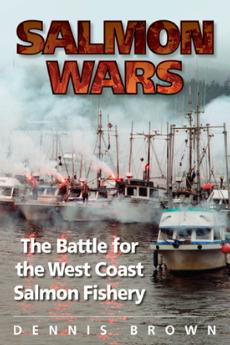
Dennis Brown knows first hand just how cut throat those politics can get. The author of a new book, Salmon Wars: The Battle for the West Coast Salmon Fishery, Brown worked during the 1980s as a Fraser Valley organizer with the United Fishermen and Allied Workers' Union, and rose to secretary-treasurer for the union.
Over time Brown became deeply, though not bitterly, cynical. Politics do roil fiercely throughout the industry, whether it be dealings with federal and provincial or state governments in Canada or the United States, or the power exerted by a tiny circle of large corporations who dominate the business. And a big step on Brown's journey towards cynicism was his decision to leave his top union job to become fisheries advisor to BC Premier Glen Clark.
At the time, Brown hoped to further his work to better the fishery as a culture and cherished way of life, which he had enjoyed. Though a strong and long-time NDP supporter, he admits he was horrified by what he witnessed as a visitor to the inner corridors of politics.
Throwing fishermen off EI
For example, even as cutbacks to the fleet were being proposed under the Mifflin Report of 1996, the federal government claimed it couldn't afford special fishermen's assistance programs from Human Resources Development Canada. This despite a "whopping $12 billion surplus in the EI fund at the time", Brown writes.
He notes that as the Ottawa-driven cutbacks began to bite into the fleet, the government handed huge grants totalling scores of millions of dollars directly to close to half Canada's 100 largest banks and other corporations, right out of those same HRDC coffers. Some of that, says Brown, went into the big cannery and fisheries companies, while fishermen were left to starve and EI for fishermen in winter became a thing of the past because fishermen didn't work long enough to qualify.
Fish as weapons
In an interview with The Tyee, Brown reinforced that fish have all too often by used simply as a weapon in the continuing, no-holds-barred, multi-scene political war which has plagued and ultimately wrecked the salmon fisheries on Canada's West Coast.
"On the East Coast, at least their politicians are accountable to the fisheries because if they don't, they don't get the votes from the electorate. Out here the votes aren't here for the government, so people like (former fisheries minister) Anderson are more interested in catering to the recreational fishermen than in looking after the commercial fishery.
"There are not the votes here and my impression is that the politicians feel they will gain more favour with the electorate if they work in with the environmentalists and make scapegoats out of the fishermen and go along with the big corporations (including the forest companies)."
Corporate giants
Brown said that, while he is no social engineer, he fears the salmon fishing and farming industries are well on the way to being just cash cows for large corporations and their urban-dwelling masters and investors, rather than a means of spreading wealth along the BC coast.
The industry, he said, is being put into the hands of so few companies and corporations that he fears the day may come in the not-too-distant future that some foreign power or international corporate giant from overseas might come along and buy up the entire fishery.
Brown said steps continue to be taken to stifle dissent and protests from within the fleet and increase and perpetuate the control of the industry into the hands of an ever-tightening group of larger and larger corporations.
That leaves the front-line personnel and unions as well as the governments with fewer and few companies to deal with and in increasingly powerful positions of influence over communities' and the province's economy, able to do pretty much what they want within regulation from more and more depleted enforcement agencies.
Exciting read
Because Salmon Wars is so well-crafted, it is an intensely fascinating and even exciting read which does not require the reader to arrive with much knowledge about BC's salmon fisheries or even the way they have evolved over the past three or four decades. Big names abound, including magnate Jim Pattison, former Premier Glen Clark, Federal Fisheries Minister David Anderson, and the issues were huge, spreading across the Canada-U.S. border and reaching the top-most level of government and bureaucracies.
The main delight of this quickly acclaimed book, which shot straight into the best-seller lists, is in the peek it gives behind the curtain of many highly-public events and governmental decisions.
It is only a peek. Brown admitted to The Tyee after the book's launch that he doesn't tell all. He says he was in fact quite sparing in his treatment of the premier for whom he worked. Although he says Clark is still not happy with the handling he received, Brown says he could have included other material which would have left the one-time leader of the party Brown still loves even unhappier.
He also notes wryly that Clark, who once wanted to wrest jurisdiction for BC's marine fisheries away from Ottawa and particularly then-federal fisheries minister David Anderson, now works for BC billionaire Jimmy Pattison, owner of Save-on-Foods, numerous car dealerships and a sizeable slice of the commercial fishing and processing pie.
Anderson 'arrogant'
Former federal fisheries minister David Anderson comes off no better in the book. Brown portrays Anderson as arrogant towards fishermen on the coast he continues to be elected to represent, and instrumental to the sell-out of the salmon fisheries to the United States, Alaska and the big cannery companies.
The truth of the matter, Brown told The Tyee, is that when he moved over from union and fisheries sector politics and entered the murky world of federal-provincial-international politics, what he began to see and experience first-hand so shocked and disgusted him that it left him totally devastated for a full year after he lost his advisory job with the government, when the NDP were routed in 2001.
Brown said he needed to write the book not so much as an expose of politics and politicians, but as a therapy for his bruised and damaged soul. What started out as a year-long project to get it out of his blood became a four-year authorship program.
Caught in a net
Brown notes that the vast majority of fishermen who go out to harvest BC's salmon in sometimes difficult conditions really aren't all that interested in politics. They love the independence and freedom of the lifestyle. They truly honour and revere the fish they depend on. They just want to be left alone to get on with their lives, paid a reasonable price and given enough of the icon fish they harvest to make a decent living.
But that's not the way things have turned out. Brown illustrates how fishermen have been not just targeted but also caught in the middle and used time and time again in the multi-realm, interlocking battle for power over fish. So commercial fishermen have been forced over the years to become increasingly aware just how central to their very existence politics are.
But who could blame anyone for not wanting to sail into such polluted political waters? Talk about skulduggery, deception, spin-doctoring, egotism, vindictiveness and malice. It's all there in Salmon Wars. Fish don't vote, so they just don't count. And there aren't many fishermen left to vote any more, so their voice doesn't count for much any more either.
Campbell River journalist Quentin Dodd is a regular contributor to The Tyee. ![]()


56
Login or register to post comments
asher
6 years ago
Comments on "Dirty Politics Fuel 'Salmon Wars'"
I hope there is something in this book about the anti-Indian movement against the aboriginal fishery. Conservative MP John Cummins, the Reform Party, BC FIRE and the BC Fisheries Survival Coalitions all used to rely heavily upon BC Reports to spew hatred against aboriginal rights. Thankfully BC Reports is out of business but Global TV is still out there telling a simple story that the injuns are to blame for decreasing fish stocks.
Grumpy
6 years ago
The illegal fishing for commercial (oops - food fishery) by local first nations bands is one of the prime reasons for this disasterous affair.
John Cummins is a hero for defying the government and DFO. One tires of the poor indian rhetoric, so well played by the illegal native fisherman, they are making a fortune selling illegal salmon and the Federal Liberals do nothing about it.
Even the native fishermen past Hope are getting fed up with the illegal fishing in the liwer Fraser.
I think everyone should fish in a massive protest and see what happens. But no, we are too weak kneed for revolution!
KWD
6 years ago
Infighting among stakeholders (all British Columbians) is the easiest way to take the heat off those doing the damage. Fish and forests be damned. Heaven forbid that the shareholders in BC’s fisheries, forestry or Pattison Empires should suffer economic loss.
That non-natives continue to fault and blame natives for all that is wrong within the Eurocentric Ministries of Fisheries and Forestry Resource Rape and Pillage is a testament to the power and mindset of media conglomerates, industry and government, and their willingness to contain and manipulate public opinion.
freebear
6 years ago
I do not think native people are making millions selling food fish.
Food fish is a right, commercial fishing is a priveledge.
I suppose Mr. Cummins thinks that he has the right to commercially fish the last salmon.
We all can not be fisherman, unless we all fish from skiffs! A livlihood is not a right.
ursus
6 years ago
ok grumpy, what about the deforestation, pollution have you counted how many pulp mills and sawmills and other heavy industries have storm drains running into the Rivers of B.C., I can remember what it used to be like when the salmon were running. The whole dam country stunk and this was more then five hundred miles from the Ocean.
What about all the big fish charter operations, offshore fisheries, alaskan fishermen intercepting the salmon on their way in, the reason I heard for the ferry being surrounded in Rupert, (was working there shortly after).
The u.s. coast guard escorted the american fisherman down below the a line to fish our salmon and when the Canadian Fisherman showed up the coast guard started taking dry runs at them, this because a washington state fish company made a deal to intercept the u.s. run off Russia selling the salmon into the asian market!
Btw the americans pretty much own our fishing industry now, most of the processing is going to their plants in washington state, how smart is that, like letting them control our oil and gas, stupid is as stupid does, good for the cyman accounts tho eh!
Might point grumpy is that there are many contributing factors to the decline in our salmon, not the least of which is political and government stupidity if not corruption. Dfo has in my opinion sold the fisherman out, hell we even had a dfo parasite working for the fish farmers lobby group while tax payers paid his wage, they should have given the fisherman a lobbiest at the same time!!!
It is easy to blame one individual group though isn't it, instead of looking at the over all picture and thinking that maybe we had a part in this too, all of us consumers! Looking the other way while corporations are raping the province for quick profits polluting the hell out of it, lining a few politicians and beaurocrats pockets in the process!
ursus
6 years ago
I suspect your mister cummings is grandstanding, looking for the anti native vote, picking a nice easy target for his rhetoric, placing blame on people with out the resources to fight back.
A group that has been historicaly easy to sh!t on. Guess he got your vote though eh.
clubofrome
6 years ago
Hmm, this all sounds familiar..... I wonder if there has ever been another crisis with fish in this country? I just can't put my finger on it. Was it Cod? Yes I think it was, on the east coast. Yes I remember now, there used to be this big east coast fishery based in the Maritimes and New England. Grand Banks or something? They must have fished that resource for hundreds of years until they finally found the seals responsible for that collapse. Perhaps if we do a little more investigation we'll see that some of these eastern seals have snuck across the country and have invaded our salmon fishery. Or perhaps the natives are at fault here. We may even be able to trace this back to one extremely over zealous fish catcher! The natives have been fishing here for hundreds, perhaps thousands of years and have obviously mismanaged this resource. Then we and the DFO step in to try and fix things the blame is turned on us. Whitey and the corporation, just trying to make a buck. .....Oh my God!!! This just in: Ocean temperatures rising average 2 degress!!! Forget that other stuff, here is the smoking gun that points to way the salmon have disappeared. What? The toxic accumulation in the fish is having an effect on breeding? Forget the warming thing, we've found the real smoking gun!!!
The smoking gun: Over fishing. When you catch more than the species can recover. See: Cod
Add on top of the raping of this resource, pollution, fish farms and habit loss. Even grade two students understand this. What the fuc* is wrong with you people?
jackrusell
6 years ago
Having worked on a Troller in the early 90's I have seen first hand the role DFO plays in this and I have to agree that the science is not as exact as they claim. The decline in stocks may have been created by all the pollution fish farms and habitat loss. Over fishing? Maybe if you consider that a Siener can wipe out 10,000 fish in one pull of the net in a very short time that could be possible. But the wealth could be spread if we allowed the not so efficient methods of fishing such as Trolling and Gil nets to work the runs. It would be easier to keep the count. I didn't know of too many trollers pulling in more than 1000 sockeye in a day, a very good day. I also remember getting $2.75 per pound for these fish when we sold them and saw them in the grocery stores for the same price for 100 grams.I lost track of where I was going with this...
ursus
6 years ago
kinda like the long liners on the east coast had they been the only ones fishing the industry would be alive and well today, good points, a dragger for instance may have to catch four hundred tons of fish to keep two hundred, they have to throw the species over board that they are not licensed for like salmon, they can't even keep them for personal consumption.
I seriously doubt thaey can control what is and isn't caught in their nets eh. More stupidity, I have been told that the DFO has more econmist working for them then fish cops, beginning to wonder.
allan
6 years ago
ursus, I just did the west coast trail for the too manyth time and was shocked at the massive seagull populations since my last trip three years ago.
All the bigger rivers (thus campsites), are inundated with seagulls, tens of thousands of the white feathered friends.
No, the rivers are not known as great food caches and hikers certainly don't encourage too many, so I do suspect those draggers you refer to above may be their meal ticket.
Any fishing machine that jettisons 50 percent of its catch back into the sea is a guaranteed meal for a gull and thousands of its relatives.
Why are those clearcutters allowed to operate in Canadian waters?
KWD
6 years ago
Allan, I doubt that the increase you notice is due to draggers, although it would be nice to find some excuse to stop their marine sterilization program.
If the gulls are actually on the increase it is probably due to a combination of other factors like a lack of serious predation, an ever-increasing supply of food (garbage) provided by the100 hikers per day allowed on the trail and a greater abundance of natural food in the marine environment due to warmer ocean temperatures (climate change).
Or, perhaps they migrated from Victoria and they’re just waiting for the legislature to reconvene so they can resume their normal diet of BS.
darcy.mcgee
6 years ago
c'mon. tell me what Rafe thinks.
The only person who's opinion matters about salmon is Rafe. Everbody knows that.
kurt
6 years ago
Kudos to the DFO for finally putting some enforcement teeth into the Sto:lo for their sinful sockeye rape at Chilliwack. Also plaudits for the Tsawassen and other bands at the mouth of the Fraser for generally adhering to the rules which are in place.
With modern technology (set nets across the river stretching to the bottom) it only takes a handful of bad apples to wipe out the Fraser sockeye run. Are the natives to blame? Not really - the Sto:lo couldn't possibly eat all the millions of sockeye even if they shared them with every native sister and brother in the province. Which they don't. But if you are among the whiteys who buy poached salmon from the natives you are the problem.
ursus
6 years ago
hey kurt do you really think the natives are taking millions of salmon, if they were dfo would be all over them and would have years ago to protect not the salmon fisherman but the sports fishing industry.
Do you have proof to back this up? Maybe if we hadn't destroyed so much habitat polluted and screwed up the Salmon fishery in general thanks dfo that there would be enough Salmon to go around for everyone!
Like I said in an earlier post a dragger take as much as 400 tons of fish to keep 200, they throw the species like Salmon and Halibut over board the fish are dead if they can't keep the dead fish and sell them or feed the poor, shut the draggers down, send them back to the East Coast where most of them came from.
scylla
6 years ago
Ursus, as you know, the Fraser sockeye is only an occasional sportsfish. As you also know, because of the high public profile of the aboriginal "food" fisheries, DFO prosecutes violations only when they get grossly out of hand and the press gets wind of it.
I make no case for the dragger's near-criminal despoilations, but I would point out in support of Jackrussel that perhaps the largest single group of seiners - the primary reason for the extinction of hundeds of small salmon stocks - left are aboriginal (many of them millionaires) and that native fishers have in the past participated just as greedily in various violations such as creek robbing, etc as their non-native counterparts.
I write that only to point out that it's long past time aboriginals took possession of and recognised their own historical part in bringing the fisheries to where they are today.
None of the above is meant to excuse DFO's long-standing use of pseudoscience in justifying the resource rape which has typified its management of our fisheries.
ursus
6 years ago
Scyllia I thought the 7 dayers around Hardy have that monoply tied up. Doesn't jimmy own a pile of Seiners? Have heard that the dfo has moved openings to accomodate the adventist who do not fish on Sunday, any truth to that rumour?
jackrusell
6 years ago
I think yo are correct ursus I have also heard that jimmy and his bc packers have a near monopoly on the siene fleet.
freebear
6 years ago
Scylla:
Please distinguish between Aboriginal fishers for food and aboriginal commercial fisherman.
The two are not the same!
Irregardless, too few fish and too many fishers! (not counting environmental changes, degradation and so on).
I would wager that MP Cummins would argue that he has the right (sorry sanctioned priveledge) to catch the last salmon!
ursus
6 years ago
think he owns canfisco too. When he says jump I suspect dfo says not why but how high!
asher
6 years ago
Scylla wirtes...
"I write that only to point out that it's long past time aboriginals took possession of and recognised their own historical part in bringing the fisheries to where they are today."
When I went to school and university in BC I was not taught that native people were not allowed to vote until 1959, that their fishing weirs were declared illegal and were not even allowed to use outboard motors on their fishing boats.
Why don't you mention that the history of fishing in BC has been based on criminalizing aboriginal fishing methods in order to rob and disempower First Nations of their primary financial base?
I think you mean to say that it is long past time that NON-ABORIGINALS took possession of and recognised their own historical part in bringing the fisheries to where they are today.
I was glad to see in the BC section of the Globe and Mail today that Ernie Crey of the Sto:lo Nation pointed out the racist double standard that the DFO is practicing: While they fine and even jail illegal aboriginal fishers of the aboriginal fishery on the Fraser, illegal commercial fishers are not even fined.
scylla
6 years ago
I've heard many stories about the weirs up and down the Coast, the remnants of some which are still visible today. The most reasonable argument for their banning being that many were left still fishing after their owners were done with them, the result of the breakdown of traditions following the massive populatiun declines.
On the other hand, I was also told that after that, the Americans moved in and built their own weirs to catch the Fraser runs going by the Delta.
The big problem I see with this issue, as with so many others like it, is that today's Historical Revisionists (excused by Deconstructionist theory) are busy rewriting history from a blatatantly pro-aboriginal perspective (a la David Suzuki), merely recreating the same type of one-sided mythologies they accuse our historians of writing.
Thus, it's near impossible to find the "other side" of these issues written from a modern perspective. This is obious when trying to find anything unbiased from the desks of academics in UBC or U Vic, they're so embroiled in the "Indian Industry".
Sorry, this is a poor response, I admit. Perhaps another thread will provide an opportunity for wider discussion.
asher
6 years ago
You are saying that the most reasonable argument for banning fishing weirs was that after the injuns had died there was no one to use them? That seems rather unreasonable. And why were outboard motors and other traditional fishing methods banned as well?
The aim of the changes in the Indian Act regarding fishing was to decrease the economic power of First Nations by criminalizing their fishing methods. The Nations of BC and their fish resources were like the sheiks of Saudi Arabia and their oil resources. Them having a substantial economic base was a threat since they would be economically independent from the government. But the whole idea of the Indian Act is to make Indians "wards of the state" - financially dependent. The more one becomes indentured to another the easier it is to manipulate that person or people.
Around the same time as these revisions to the Indian Act were being made, the same British colonial system of control of the natives created similar restrictive laws in India where only state controled outfits were allowed to produce salt. We know how those laws were changed: A bunch of Indians and Gandhi (maybe he was from Alberta too) went to the sea and made their own salt.
But I guess there is some reasonable argument why salt production was state controlled. It could not have been to keep the injuns down.
Now, we don't have British colonists in power of the fisheries, but instead we have corporations which pull the strings. The Rockefeller oil corporations such as Imperial Oil and Texaco have exploited aboriginal people all around the world for over a hundred years. They have offered a model on how to steal natural resources from aboriginal people. And corporations from other industries have just copied what the oil companies have done.
scylla
6 years ago
Well, Asher, forget about the offer of further dialogue, since you seem unwilling to understand plain English.
anarcho
6 years ago
When in doubt blame the Native People. Racism comes to the rescue. The fish problem just couldn't have anything to do with draggers and big greedy corporations, could it?
asher
6 years ago
Just admitted you got licked?
netscaper2
6 years ago
Whats the big deal....screw the white fisher men I say. Every year, right on schedule, my native buddy takes some time out from his terribly busy work day to do some fishing on the Fraser. Then he delivers to me a dozen or so fresh salmon, just out of the net, cleaned and ready to cut and wrap. Right to my door. How good is that. I used to waste my money on fishing gear and a "licence". Who needs that when I can just wait and have that tedious stuff done for me. After all, it's food fisheries isn't it. What a great system we have, don't you agree ???
scylla
6 years ago
According to asher and anarcho you're a racist for telling it like it is. Shame on you.
And no, asher, just that there is no coping with your rhetoric stream. If I debunk one statement, you've got a thousand more. And not one will ever be resolved, since you don't have to. Laying on the guilt trip works 100% for most of us whiteys.
asher
6 years ago
Scylla, there is little chance of reasonable dialogue with you if you write this kind of junk... "perhaps the largest single group of seiners - the primary reason for the extinction of hundeds of small salmon stocks - left are aboriginal (many of them millionaires)"
First, if you are going to single out a racial group and criticize them, you better be certain of what you are writing. Saying "perhaps" aboriginals are "primarily" responsible is just malicious, weasel word junk verging on a complaint to the Human Rights Committee. If there were as many aboriginal millionaires out there as you would have us believe, then they'd be suing people like you for comments like that. Look at what CIBC Jeff Rubin said about Muslims for which he was taken to task for instantly.
Second, it is not just the number of seiners that matters; it is the catch efficiency of each individually. Then you equivocate between aboriginal fishers and the aboriginal fishery as freebear pointed out. More junk from you.
Finally, you seemingly warn readers that "many of them [are] millionaires." So what if they are? How ofetn are we told that white commercial fishers are millionaires? I guess we should be alarmed because this was the great fear of early colonists: First Nations were earning money through the fisheries so as to be on par with non-aboriginals, be able to organize politically and fight for their rights. This very fear of rich and empowered First Nations motivated the criminalization of traditional fishing technologies and the outlawing of the use of engine-powered boats for aboriginal fishers.
Too bad you cannot write English, Scylla. How does a weir go about fishing anyhow? Does it pick itself up and throw itself about? Read your confused sentence again. The weir is fishing the fish. Again, this is equivocation since usually people fish, but you equate weirs with people. Maybe injuns are just objects to you just like a column of stats on hockey scores.
You did not attempt to answer why engine-powered boats were outlawed for aboriginal fishers. I guess you have no stats or stories for an attempt at some equivocal garbage.
All in all, Scylla's comments here just reminds me of old racist junk from BC Reports. Now, they have gone out of circulation, BC FIRE is no more, and the BC Liberals have abandonned that KKK-inspired, one-law-for-all, blame-the-Indian rhetoric.
It has been hobbled, but we still got the corporate fed anti-Indian network of the media (e.g., Global TV), politicians (e.g., John Cummins) and associations (e.g., BC Fisheries Survival Coalition) distracting a lot of people from the real problem, the Jimmy Pattison group and other corporations.
asher
6 years ago
Again, you refuse to answer why engine-powered boats were outlawed. You call a comment rhetoric when it contains a simple question that you cannot answer with your garbage. Pathos.
rkewen
6 years ago
I think the real reasons for the decline in fish stocks are obscured by this silly war of words trying to blame it on the white guys or the indians or even ultimately the DFO. I think that issues such as:
-industial pollution (pulp mills, mines, smelters etc.)
-dammed and diverted watersheds that flood or lower water levels at critical times or block access to spawning grounds
-fish farming Atlantic Salmon on the coast of the Pacific and the associated problems such as sea lice (also they are fed ground up wild fish)
-global warming which affect both ocean temperatures and currents and precipitation levels that affect both water levels and temperatures in spawning streams
Add to all the above the wasteful fish factory fishing methods that a previous poster characterized as clear-cutting the ocean leading to the waste of half or more of the catch because they aren't the right species and soon there won't be many salmon left for white or native fisherpeople.
But it is in the interests of the Corporate elite who run Ottawa, Victoria and Washington D.C. to have cowboys and indians blaming each other instead of the real culprits.
truthseeker
6 years ago
I'm not going to comment on the above, but to add additional information. Years ago, when I moved to Chilliwack, I was shocked at the amount of salmon for sale by aboriginal people. Salmon were being sold by aboriginal people literally by the potatoe sack full. It soon became obvious to me that everyone knew that this was illegal activity, because some buyers would refuse to buy salmon except through third parties. Presumably, these third parties would take the blame if the sale was detected. There was even a booming business in the sale of smokers. Some people even advertised discretely that they would smoke your (illegal) salmon for you. How can anyone with even a speck of honesty pretend that the aboriginal people have not been and are currently not abusing their aboriginal fishing "rights"? Perhaps the answer is for the commercial fishermen ( white and aboriginal)to do all the fishing and then to provide each aboriginal family with the free fish that they need for food. After all, the aboriginals claim that they need to fish to feed their families. Such an approach would ensure that the commercial fishermen get to fish and that the aboriginal people get all the fish to eat that they can eat.
rkewen
6 years ago
I'm not going to deny what truthseeker says he witnessed with his own eyes along the Lower Fraser River. However, I would like everyone to compare the condition of the fish stocks and the overall evironment of the New World after thousands of years of management by natives to its condition today after the materialistic greed worshipping white immigrants took over the stewardship (in just a few hundred years)! I know the population was a lot smaller, but so was the attitude towards the land and water to which we all owe our existence no matter how developed we become.
lynn
6 years ago
While there is no doubt the wild fishery has been mis-managed by DFO, rkewen's point about the devastating effects of the corporate elite's assault on our natural environment is very well taken. The balance of nature has been terribly tampered with in the name of greed.
But to be honest, and less politically correct than some, I live on the coast and I, too, have been approached to buy salmon from the back of a pick-up truck spilling over with hundreds of wild salmon ready to be scooped into garbage bags for anyone with the dollars to buy them.
It is disturbing to see in its excess and obviously more than just fish for food.
Still, I think the list of reasons stated by rkewen above more accurately reflect the real contributing factors to the overwhelming decline in fish stocks.
But you still have to ask why is the food fishery being abused?
It stems from a fear, I think, on the part of aboriginal people that the fish will not be here for long ...and the recognition that they have little control in changing that in a elitist-dominated power structure. And there is a certain degree of take as you have learned others have greedily taken from you... and betray the rules a little for your own benefit as others have betrayed them against you in the same way. History certainly reveals they are justified in that mistrust. Which explains I think somewhat how a food fishery has become infused with a desperation to grab what you can while it is still here.
It doesn't make it right but it makes it understandable.
And of course, the aboriginal people are quite justified in their fear that the wild salmon will not be here for too much longer. It is sure looking that way of late.
So before nature has no defenders and stands no chance at all against being ransacked in every direction, it is time the power structure was shared by all, not just a privileged few.
In the interests of all, not just a privileged few.
And that trust is restored through a genuine committment by all to returning the balance to our natural environment and to the wild fishery that was once such an important and sacred aspect of aboriginal life.
KWD
6 years ago
Pollution, dams, fish farms, global warming, clearcuts, urban sprawl and techno-fixes ad nauseam, are products with a distinctly European label. They are post-contact “problems†brought by the colonizers. This is not to say that, given enough time, indigenous populations wouldn’t have ‘evolved’ similar destructive behaviours without European help.
However, short of some natural geographical barrier limiting contact with the “New Worldâ€, socio-econo-political change was and is inevitable and irresistible. Coastal aboriginal communities were only too willing and eager to change their traditional trading behaviours and engage in similar activities with Europeans.
The belief that First Nations had some unique insight into resource management is largely myth. The abundance of fish and forests, at contact, likely had more to do with the lack of technological development (capable of the large-scale destruction revered by industrialized societies), the indigenous social structure (community-comes-first vs individual-comes-first mindset, brought by the colonizers) and superstition than it did with some mythical ‘balance-in-nature’ management skill or foresight.
lynn
6 years ago
But I think that's the point, there was no compartmentalized management skills needed because they lived their lives through their social structure rather than through systems that demand managing. Their lives and their culture interwoven and integrated.
Isn't that what insight is?
Now our systems live our lives.
anarcho
6 years ago
"This is not to say that, given enough time, indigenous populations wouldn’t have ‘evolved’ similar destructive behaviours without European help."
Hmm - They were here for at least 10,000 years without developing these destructive behavior. Capitalists of European origin managed to kill off the fish (and trees) in a mere 100 years. The problem isn't Indians or Europeans, it is the state/capitalist system. Small independent fishers of what ever race could have maintained a sustainable fishery. It was the introduction of capitalist fisheries (and other forms of capitalist induced destruction such as clear cut logging) that is responsible. To try to rectify things we ought to consider: 1. community ownership of salmon streams thereby eliminating the problem of stream destruction by logging companies. 2. Outlawing draggers and seiners - small boats only - gill netters and trollers 3. Canneries and packers only allowed if owned as a coop by the fishers themselves. 4. get tough with foreign poachers - enforce the 200 mile limit - shoot em out of the water if need be.
truthseeker
6 years ago
Thank you KWD for your comments of five hours ago! I believe that you have presented information which cuts through what so often is really just propoganda about what has happened in the past. I wonder,though,what is the point in discussing what used to be?
The problem we have with diminishing fish stocks exists here and now and has to be solved here and now.
Yes, lynn ,our systems tend to live our lives. Now, what can be done here and now to make sure that one of our systems - DFO - does it's job and does it with courage and fairness for all?
I suggested one idea: have commercial fishermen (white and aboriginal) do all the fishing and and have those fishermen provide aboriginal people with all the free fish they need. That way, the commercial fishermen (white and aboriginal) get to fish and the aboriginal people get all the fish they need to eat. Of course, such a fishery would have to be overseen by a DFO or other agency run with courage and a determination to be fair to all and to preserve our fisheries.
KWD
6 years ago
“They were here for at least 10,000 years without developing these destructive behavior.†So what is it you are saying: Without contact they wouldn’t change? They are immune to change?
Given what we know of human history, not changing seems an unlikely outcome. Whether it would have taken another 10,000 years or 200, is irrelevant. Given the rate of global encroachment, the odds of any society remaining socially, economically and/or politically isolated are low to non-existent.
And yes, I agree, a return to community rather than the individualistic goals glamorized by the capitalist mindset is appealing but the capitalist system will have to collapse under its own weight first. Those that have enjoyed affluence will not willingly settle for living with less nor will they tolerate those that suggest changing their lifestyle. Who will be the first to sacrifice pleasure for pain?
And, truthseeker, sorry about dwelling on the past I guess the point in raising the past is that it's simply a part of this discussion I find interesting.
The "problem" of diminishing fish stocks (or any resource for that matter) needs to be dealt with now, but to deal with those problems effectively requires a far greater change in the human psyche than would result from simply revisiting destructive technogies.
scylla
6 years ago
Those who prefer to think "greed" and destruction of the environment is an European, Capitalist invention, should read A Short History of Progress by Ronald Wright (April '05).
anarcho
6 years ago
"Those who prefer to think "greed" and destruction of the environment is an European, Capitalist invention, should read A Short History of Progress by Ronald Wright (April '05)."
I have read it and it's mostly rubbish, not taking into account recent findings.
Furthermore, no one has ever said that environmental destruction could be reduced just to capitalism or Europeans. The Romans in the first instance and the Mongols in the second... Capitalism simply heightened the destruction. The real root of the problem is the existance of the state and class division, both of which transcend nationality and the modern economy.
KWD
6 years ago
“Furthermore, no one has ever said that environmental destruction could be reduced just to capitalism or Europeans.†Bang on anarcho. North America could just as easily have been ‘colonized’ by Fascists or Communists of Asian origin. And, I agree, to believe Capitalism has a monopoly on environmental destruction is simply naïve.
However, if we want to look at the “real root of the problemâ€, we must go deeper than “the existence of state and class divisionâ€. State and class division are constructs and as a result are products of the way we are trained to think … we aren’t born with an understanding of those labels.
That there is a reluctance to recognize that fact is not surprising. Life is less painful if we can avoid looking at ourselves. And it is my guess that there is a segment of society (religious, political and economic power brokers) that would prefer we not look too closely at exposing judgments and labels.
clubofrome
6 years ago
I don't think you need to go any deeper than what you said earlier. Community comes first vs individual come first. Nice observation.
anarcho
6 years ago
KWD wrote: "However, if we want to look at the “real root of the problemâ€, we must go deeper than “the existence of state and class divisionâ€. State and class division are constructs and as a result are products of the way we are trained to think … we aren’t born with an understanding of those labels.
That there is a reluctance to recognize that fact is not surprising. Life is less painful if we can avoid looking at ourselves. And it is my guess that there is a segment of society (religious, political and economic power brokers) that would prefer we not look too closely at exposing judgments and labels."
I am not sure what you mean by this. Class and state are not just labels or constructs. They are situations imposed upon populations with force and violence and maintained by force and violence. I would add that the origins of this imposition appears to be environmental, rooted in the climate changes begininning about 6000 years ago...
KWD
6 years ago
“I don't think you need to go any deeper…†clubofrome, I would like to I think you are right, and perhaps I should take your advice, but unless there is an awareness of and examination of the existence of the illusions that we accept as society – class, state or religion – we’ll never get off our ‘left’ or ‘right’ political, economic or religious merry go rounds and conflicts that seem to be so diversionary and so destructive.
Anarcho, class and state are illusions (abstractions). They are purely subjective and exist only because we have created them. You cannot see a class or a state, but you can see the members that comprise those ideological entities. You can examine the thinking of those members, and question how they come to associate themselves with any particular ideology (illusion). And hopefully, in the process, arrive at ways of reducing conflict and destruction by identifying the distortional value judgments associated with the labels by pointing out how individuals have come to rely on labels believing the labels to be reality.
clubofrome
6 years ago
I just think the complexities have grown exponentially, population + religion + economics + politics + loss of species/diversity = extinction for humans. It's fascinating the way it is all unravelling, no one really knows when or where, so many variables. So simplicity, for me = clarity. To look at the big picture is staggering.
KWD
6 years ago
Precisely! Individual + distortional thinking = conflict. How much simpler can it be?
anarcho
6 years ago
"Anarcho, class and state are illusions (abstractions). They are purely subjective and exist only because we have created them. You cannot see a class or a state, but you can see the members that comprise those ideological entities. You can examine the thinking of those members, and question how they come to associate themselves with any particular ideology (illusion). And hopefully, in the process, arrive at ways of reducing conflict and destruction by identifying the distortional value judgments associated with the labels by pointing out how individuals have come to rely on labels believing the labels to be reality."
True to a limited and very abstract sense. But don't tell that to someone being tortured or gunned down in the street. All words and concepts are abstractions. There is really no such thing as trees for example, since all trees are individual and unique. But we still cut down these abstractions for lumber. If you don't like the term class, well how about saying "a small minority that uses force to exploit others?"
scylla
6 years ago
Says Anarcho
"I have read it and it's mostly rubbish, not taking into account recent findings".....And...."Class and state are not just labels or constructs. They are situations imposed upon populations with force and violence and maintained by force and violence. I would add that the origins of this imposition appears to be environmental, rooted in the climate changes begininning about 6000 years ago..."
Oh? How recent? The book was published last April. How is it rubbish? Clearly you haven't read the book.
Maybe you should also read The Fallacy of Wildlife Conservation and learn about Wise Use. If you're going to pretend knowledge about human use of the environment you'd better do some reading.
truthseeker
6 years ago
No wonder we can't solve the problem of what to do about our falling fish stocks and how to harvest them: we can't even stay on the topic. Having said that, however, I have found the comments of KWH, scylla, and anarco quite interesting even though (in my opinion) mostly off-topic. How about a new topic called something like: Canada's Real Politics?
Also, I'll definately look for "The Fallacy of Wildlife Conservation" and "A Short History of Progress" and check them out.
anarcho
6 years ago
"Oh? How recent? The book was published last April. How is it rubbish? Clearly you haven't read the book.
Maybe you should also read The Fallacy of Wildlife Conservation and learn about Wise Use. If you're going to pretend knowledge about human use of the environment you'd better do some reading."
I read about a third of the book then put it down as a waste of time. He does not include the latest information on the development of agriculture and class society. It doesn't matter that the book was written in April. His information is at least 20 years out of date in these matters. No, I haven't read "The Fallacy..." When I find it I will. But one book is not the last word on a subject. I have read scores of books and articles on the matter at hand, and actually have a degree in social science (Sociology and Anthropology) SFU 1970.) Not that the latter should mean much, as credentials don't impressd me, but I have been studying and writing ever since I graduated. Generally it is not good to act in such an arrogant manner with people you disagree with, as you just have with me - unless they are total idiots like RE - since they actually might know a thing or two...
asher
6 years ago
The following quotation on Wise Use is from http://www.sourcewatch.org/index.php?title=Wise_Use_Movement
WISE USE's SHARE BC used the same kind of "grass roots" lies about its membership as BC FIRE did. They were just organizations concocted by Reform Party and far right political organizers to manipulate community voices to speak for corporate interests.
It inspired a number of spin-off groups, including the "Share" groups in the Canadian province of British Columbia (B.C.), which give the appearance of being grass-roots community organizations, but are in fact organized and funded by major corporations. (For example, the "B.C. Forest Alliance" was chaired for its initial period by an executive of Burson-Marsteller.) This type of "fake grass-roots" group led to their description of the advocacy as being an astroturf campaign.
scylla
6 years ago
Well, Anarcho, educationally, you've got my HS beat flat down, and likely have read much mure than myself.
But my info re Wrights conclusions is different than yours. But I can sympathise with you if you're a bit offput by his extrapolations re prehistorical people, such as the Neanderthals, though I'm not aware of how he's misinterpreted or falsified events concerning our earliest recorded civilisations and tribal groupings.
Your effort to place the entire blame for environmental and societal ills upon hierarchies is just belabouring the obvious, while ignoring the much deeper roots of the problem, which begin with our inability to cope with the Wise Use argument, a point which Asher also chose to conveniently ignore.
We're groping our way towards a conciliation with Deep Ecology, a concept which humankind has often given lip service to, but has never developed sufficient philosophical, political and scientific understand to embrace.
Until we do, we will continue to blame other people, other races, other systems, and other nationalities for our environmental and social problems which derive from our own inability to control self-interest.
My posting re the Aboriginal inability to take ownership of their own failings rather than this continuous blaming everything on Whitey evoked the standard response, so I withdrew until your posting which I interpreted, perhaps falsely, as supporting theirs.
If you''re looking for something which is truly unsettling re our cultural shibboleths, try Deep Ecology - its time is approaching fast.
But only if I was wrong re your intent will I apologise for my remarks re your posting.
asher
6 years ago
Most recently Scylla has recommended that we embrace the ecofascism of Deep Ecology.
Let us look at this Dirty Politics Fuel 'Salmon Wars' comments section of The Tyee to see what Scylla has written and stood for:
1. anti-Indian racism
Scylla writes:
2. the corporate environmental movement Wise Use (aka SHARE BC)
Scylla writes:
3. environmental fascism
Scylla writes:
I would request that The Tyee readers and contributors speak out in this comments section and other forums against what Scylla stands for. Is a left-wing publication to be a home for the spreading of ideologies of hate?
The following quote on Deep Ecology as ecofascism is from...
http://www.risingtide.nl/greenpepper/envracism/ecofacism.html
netscaper2
6 years ago
Hey asher...I'm with you buddy. I gave up sport fushing some time ago cause of the hassle of buying a licence and standing in a filthy river with a very expensive rod and reel
trying to get dinner. Now I just wait for my indian buddy to come knockin' on my door with a dozen or so Coho, cleaned and ready to cut and wrap....How easy is that. I even asked him if he wanted a beer as it was very warm. He declined as he had several more deliveries to make to his valued white customers.....You see, I'm doing my part in conserving the salmon by not fishing, and the natives ? Geeez, it's just food fishery, isn't it ?
scylla
6 years ago
From Ashers risingtide site:
I've never read such a clumsily contrived pile of BS in my life.
Run - don't walk- back to the funny-farm, Asher.
asher
6 years ago
The guide for the anti-Indian movement in Canada was Mel Smith's Our Home or Native Land in which Rafe Mair wrote the Foreword.
Smith had been hired onto the Reform Party political strategy team in the 1990s. The arguments in his book were little more than Reform-party positions dressed up as legal scholarship. It was denounced as racist from the sart, but the repetition of anti-Indian rhetoric spread quickly in printed form via BC Reports and the verbal form via Rafe Mair.
One of the strategies of the anti-Indian movement was to stir up fear about land claims. They tried to scare people into thinking that if injuns got a land settlement, peace would collapse and lawless would rule. They wanted people to think that injuns would probably start shootin' up the place and we would be living in Injun run apartheid. Skeena MP Mike Scott of the Reform Party even said there would be "social unrest like never seen before....We are so close to violence in rural BC that it's not funny."
These kinds of statements were part of the scare campaign. Rafe also engaged in this tactic in the Foreword:
Some of the shibboleths for this movement are: "equal rights for everyone" and "one law for all" and all the combinations you can make of these two phrases. Many racist networks in North America have been using these catch-phrases since the rise of David Duke from the KKK to a seat in the Louisiana Legislature in the 1980s. "One law for all" is actually a very old legal term from the days of ancient Rome used to rule over its minorities. It is a rather meaningless phrase which can be interpretted anyway one likes, but it has become a slogan for racist rhetoric these days.
I don't know what the shibboleths are for Deep Ecology. It would not be surpsising if Scylla, who propagates anti-Indian rhetoric, would also propagate eco-fascist junk.
There is probably room for ecofascism in the green left. One example would be the fisheries. It would be very easy to divide lefties between those who would fight for the aboriginal right to fish versus those lefties who have been scared into thinking the aboriginals are mismanaging their fishery and are responsible for their impending collapse. The corporate interests of Global TV News, Vancouver Sun and Rafe push this one. Having a camera crew race out on a boat to confront an injun illegally catching fish is much more dramatic than a story on band council accounting.
Rafe and his cohorts were unable to scare people into derailing treaty negotiations. The Nisga'a treaty is now law after almost 100 years of negotiations. Corporate interests were able to get a referendum on the Nisga'a treaty though, but it was ignored in the end. 12,000 people spoiled their ballots; many calling it racist and divisive.
However, Rafe is still a voice for a gang who is still trying to scare people into rejecting the aboriginal fishery; all the while, trying to divide the left at the same time. He still works for his corporate masters after all. A leopard doesn't change its spots.