Opinion

Paul Martin's Stunted Imagination

One year on, do we have a prime minister yet?

By Murray Dobbin, 21 Dec 2004, TheTyee.ca

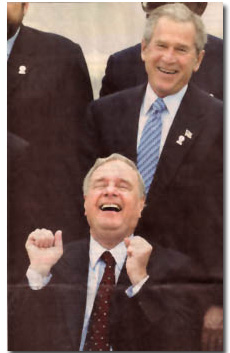
bushmartinsm

TheTyee.ca


When I decided to write a book on Paul Martin I wasn't aiming at a biography -- just a political profile so that Canadians would know something about their apparent next prime minister. But I guess I expected that along the way I would discover what made him tick. Collecting all the stuff of his careers -- quotes, decisions, opinions of others, the people he chose to associate with -- and then work backwards to discover his essence: that which drove him to relentlessly pursue Canada's top job.


But I never found it.


I concluded that it wasn't there to find and instead tried to find out why. The answer began simply enough. Paul Martin was a corporate CEO for many years before he ever got involved in politics and thus entered politics with no operational set of values other than expediency. He was the quintessential CEO whose actions were dictated by the single minded pursuit of the bottom line.


That's common to all CEOs -- as CEOs. But other corporate figures have entered politics and demonstrated some core essence. Even Brian Mulroney, who loved to please the powerful, was genuinely moved by the plight of Africa. But nothing seems to actually move Paul Martin. It's as if that part of our prime minister just never developed, like a limb that atrophied.


Hollow drifter


When he made political speeches, of course, it sounded like he had a vision, especially during the Liberal leadership campaign: "This leadership race is about the future and the changes we need to make as a country. It is about embracing new ideas and charting a new course. I want to lead a new government with a renewed sense of purpose...."


But these, it turns out, were the words of Hollowman. There was no substance. Now there is just drift in the direction that is easiest, unfettered by principle, affected only by the hard political facts on the ground, a minority government. This is true even in the area where Martin did hint at substance: creating a bold new role for Canada "in the world."


In Iraq, Martin had the opportunity to build on what Canadians have become increasingly proud of: the fact that we did not join this criminal bloodletting. But did Martin state that he was with the people of Canada? No. When asked by CNN if Canada would consider sending troops to Iraq, Martin said we didn't have enough. Pressed on whether he would not or could not send troops, Martin repeated his answer, implying that he would send them if we had them.


In Haiti, Martin shamed Canada by joining a US-led coup against the elected government of Jean Bertrand Aristide, a kind of Iraq-lite that he obviously hopes will not be noticed by Canadians. Martin recently hosted a conference of some 400 of Haiti's diaspora élite living in Canada, aiming to legitimize puppet Haitian Prime Minister Gerard Latortue. No principle discernable here, just the worst kind of real politic in the interests of "investors."


Dancing on heads of missiles


On missile defence again the prime minister could have stood on principle and with the majority of Canadians who know this scheme won't work, is irrelevant to Canada's security needs, threatens to start a new arms race, is designed even in its rudimentary stage as a potential offensive weapon against foreign satellites, and is based on the absurd premise that a country would willingly commit mass suicide by attacking the U.S. Paul Martin has not yet joined the coalition of the idiots. But his constant dancing around the issue is so embarrassing that even if he does eventually stay out, he will get no credit for it, because it will not be a principled decision.


As if to underline just how close Canada is getting to George Bush's disastrous policy in the Middle East, Martin has indicated that Canada will now move closer to Israel in the struggle that is pivotal to peace in the region, and key to convincing Muslims world-wide that the West is not at war with Islam. This move is unforgivable opportunism especially at a time when Palestinians are looking for reassurance from the West that choosing a moderate for their new President might actually lead to peace.


Paul Martin and his group of hard ball, loyal advisors spent so long achieving power that they lost their capacity to imagine how to use it; that is, how to govern a nation. Ironically, it is the minority situation that has led to Paul Martin's only public policy successes: medicare and child care. Ironic, because these initiatives were taken not on principle but, again, in the interests of political power.


Is one year to soon to judge? Perhaps. But if Paul Martin ultimately fails to make a significant mark as a Canadian prime minister it will be due to his failure of imagination. A man with no essence is obliged to look to others for substance. Usually, that is a recipe for mediocrity.


Murray Dobbin's 'State of the Nation' column appears twice monthly on The Tyee. He is author of Paul Martin: CEO for Canada?
 [Tyee]

26  Comments:

Login or register to post comments

  • ronaldo (not verified)

    7 years ago

    It was embarrassing to here Gadhafi, say of Paul Martin, "We will always be friends". Just because other leaders are meeting with him does not mean Paul Martin has to. The fact that meeting Gadhafi was less controversial than meeting with the Dalai Lama, says alot about him. Mr. Martin attempted to link increasing "trade" with Libya to some sort of improvement in human rights in Libya. I have studied economics and at no time have I ever heard this link between, "free markets and free people", apparently it is simply a meaningless cliche. What was more telling was the statement by several business leaders that they "did not want to talk about human rights". This is economics, having nothing to do with the environment, biology, human rights, science etc...apparently in a world of its own very much like Harry Potter.

  • Jim (not verified)

    7 years ago

    Even though the phrase "free markets and free people" may not be laid out in a text book you cannot deny the relationship between the two. In most cases people who live in free market economies enjoy greater personal freedoms. Countries that have closed markets/economies, extreme socialism, communism or any dictatorship, have very restricted personal freedoms. China is a current example of how a move towards economic freedom and growth can lead to revolutionary changes in personal freedoms. You need to start somewhere.

  • Norman Spector (not verified)

    7 years ago

    Canadians don't seem to be bothered too much by any of this, any more than they were in June. Martin is still by far their choice as best qualified to lead the country.

  • lynn (not verified)

    7 years ago

    Martin has never had any sizzle, certainly not any fired by imagination. I never understood why he was being thrust forward to center stage by those who were in such a hurry to do so. He seems fidgety, uncomfortable in his own skin, like a too loose swimsuit on a crowded beach.

    I don't think you can reproduce the "essence" Dobbin refers to, there is no redeeming Martin, short of a miracle. Essence has to do with the human spirit and is hard-earned by the courage of one's choices. Far too many of the so-called leaders of the world today have no real vision or imagination, just an eye for business and a belief in power and the bottom line. There are a lot of these men in grey pinstripes, the walking dead, calling the shots these days; some of them even democratically voted for. The scary part is they have nothing to lose.

  • ronaldo (not verified)

    7 years ago

    I don't know why Canadians are not troubled by any of Martin's actions. Maybe people work too hard at their jobs for too little pay, and consequently have too little energy to devote to getting informed about world affairs. Is it possible that Canadians, who voted liberal, are wrong? Is it possible that some people don't make informed voting decisions, and vote against their own best interest? Is it possible that all the people in Alberta, who voted for Ralph Klein, are wrong and global warming is really happening? We have greater personal freedom because it is directly provided, since we have democratic elections. It is not appropriate to lump multiple unrelated concepts into one, like "free-market" and "free-people" without clear evidence. Opening up a country for multi-national corporations to exploit, as opposed to being exploited by domestic companies is very similar. Some workers in China are not provided wages, only food and shelter, definition of slavery(The Economist Feb. 2004), upper-class Chinese people have a relatively low life-span of 58 years, China has a relatively high suicide rate, China tried to cover-up the SARS virus, Beijing is turning into a desert and they have to spray paint the grass green.... China does not have a free-press, so many Chinese people may be unaware of these things unlike the outside world. Establishing an independant public broadcaster like CBC in Canada, BBC in U.K are good first steps. Interestingly these 2 capture many journalism awards because they are motivated by quality, not advertising dollars.

  • deeby (not verified)

    7 years ago

    I think the average centre-occupying Canadian is willing to forgive Paul Martin anything, all for his amazing, simultaneous feat of not being Stephen Harper OR Jean Cretien ;-)

  • marcia stobbart (not verified)

    7 years ago

    Re Paul Martin. What was there to figure out with respect to this person? He's a tycoon driven individual that obviously never took honours history nor economics. He's an excellent "Southern'style politician - his style is - whatever it takes to win and he took the liberal leadership and won in 2004. Does he really have a tough inner core as did Chretein? The answer to that is obvious. As a token to please George Bush sending a dozen Canadian to monitor Iraq's free election is like signing a death warrant, is it not?

  • shirin (not verified)

    7 years ago

    deeby - actually, I like Martin because he is not harper but dislike him for not being chretien. That little guy from Shawinigan grew on me the more he aggravated the bush administration. At least Dobbin wouldn't have to have worked so hard in building up a "character with a tale to tell" with the small-town guy - whether you love him or hate him. - I feel I owe him for keeping our hands clean of more unjust bloodshed. Canadians chose Martin simply out of fear - he couldn't rock the boat if he tried - but he better not sign us up to be the human shield for enemies of the States - which is everyone else on the planet currently - with the exception of Israel of course.

  • Earnest Canuck (not verified)

    7 years ago

    I dunno; Martin may have some surprises for us yet. When you take off Dobbin's ideological specs and look at what PM PM's actually been up to since the election, he seems a pretty steady-as-it-goes, not-entirely-disastrous, typical Liberal functionary. But how much of his seeming passivity is due to the unique political moment, with a minority government, Quebec separatism quiescent, and the economy doing tolerably well? I'd be keeping my head down, too. (Let me apologize to fellow l-t Tyeenas for my wrongheaded prediction that the pizza Parliament would lead to immediate fireworks and excitement on the federal front. I was wrong. A political junkie can hope, can't he?)// But political trouble can never be deferred too long, and we should soon get a better measure of the man and his government. I will predict (cos I never learn) that the missile defence controversy will soon sputter out and that our Middle East policy will remain mildly pro-Israel. I think by the end of '05 we're going to see new problems on the unity file (Quebec nationalism goes in cycles, see) and on drug legalization (the marijuana-decrim bill can't be watered down any further; it will pass; and this will infuriate all the right people). And of course we may expect the unexpected. So this most curious and contingent Prime Minister may suddenly display a spine, or have what spine he has yanked out of him in the flux of events; we will have to see. I do think you're rushing to judgment a bit here, Mr Dobbin.

  • notacolony.ca (not verified)

    7 years ago

    All Paul Martin has to do is say no to missile defense and he'll win a majority next election. He'll recover lost ground in Quebec and elsewhere. He'll also innoculate himself from criticism over "deeper integration" with the USA, which will continue under the radar with reckless abandon. If Jack Layton would assume a keener willingness to fight against assimilation, be more critical of NAFTA and how it has left us with diminished wiggle-room , especially since 911, the NDP could gain significantly in the event of another minority government, a likely result should Martin capitulate on BMD, the likely scenario.

  • Al Lehmann (not verified)

    7 years ago

    What is it with all these fake names? It always struck me that if you have something to say you should not be ashamed to be the person saying it. "notacolony": Come on! And "Norman Spector"! Who can believe it?! :)

  • Jay Currie (not verified)

    7 years ago

    The wonderful thing about Paul Martin is that he is Kleenex. He flies in the wind, can be horked on at will and still is convinced he is soft and pillowy for the Canadian people.

    Try, if you will, to remember a position Paul has stood for...there, you see, nothing of any subtance.

    Without the lamers in the CPC and the NDP Martin would be done. Sadly, they are all too concerned with exotic dancers and SSM.

  • allan (not verified)

    7 years ago

    Jim, could you please define "free market" for some of us rubes in here. Is that when you can buy drugs on the corner, a little self protection (rocket launchers) from that guy in the bar and start up a food bank without government intervention?

  • Norman Spector (not verified)

    7 years ago

    Jay re without the lamers, etc.: If my grandmother had wheels, she'd be a bus.

  • BC Mary (not verified)

    7 years ago

    Will I live long enough to hear a serious enquiry into exactly what Paul Martin's supporters did (while reorganizing our electoral system) which got so many of them investigated, arrested and/or charged?? It's feared that organized crime may have slithered throughout B.C. and right up into the P.M.O. That's a loss of sovereignty ... a huge issue, which puts the nation at risk. How is it that we hear more about Bertuzzi than Martin?

  • KF (not verified)

    7 years ago

    Newsflash: Martin has no vision or ideas... tell us something we didnt know! A more interesting question is who in Ottawa is stepping forward to fill the power vacuum and influence the public agenda in the absence of political leadership. Who among the lobbyists, special interest groups, bureaucrats, media, etc. is taking advantage of the current situation while the nation is distracted by stories about strippers and sleaze.

  • RickW (not verified)

    7 years ago

    "Norman Spector, 12/21/2004 3:12:13 PM, writes: Canadians don't seem to be bothered too much by any of this, any more than they were in June. Martin is still by far their choice as best qualified to lead the country." Choice by default perhaps, but certainly no choice by accomplishment. And it goes far towards explaining the low voter turnout......

  • RickW (not verified)

    7 years ago

    PS. I am convinced that Paul Martin's agenda is proceeding as planned, namely a virtual amalgamation with the USA. His function right now is simply to not make waves..........

  • Sal (not verified)

    7 years ago

    Paul Martin is as phony as a $3.00 bill. And that is why I can't stand him. He has absolutely no spine. People like that will not change at his age, unless, maybe (very maybe) he has a traumatic/revelatory experience in his life. Part of the problem with attracting quality candidates into leadership roles today in canada has to do with the monopolization of the nation's news agenda by right wing owners of our mass media, like Izzy Asper. Smash the media monopoly, report on was is authentic and strengthens our collective ethical values, and higher quality leaders will come forth in this country, I believe. If not, we are heading down the path of right-wing extremism, like the U.S. of Eh.

  • RickW (not verified)

    7 years ago

    Good Lord, Man (or woman)! Wash out yer mouth fer sayin' such things! You want to spoil the whole notion of "free" enterprise, or what??????

  • wellherewegoagain (not verified)

    7 years ago

    Can anyone explain this to me? Is this what we expect from sold out Paul Martin and CIA? http://www.sfu.ca/casr/ft-lagasse1.htm http://www.sfu.ca/casr/ index.htm - Canadian American Strategy Review Canada-US Relations - Defence Partnership – July 2003 NORAD, NorthCom, and the Binational Planning Group: The Evolution of Canada–US Defence Relations – Part 1 Philippe Lagassé holds a Master's degree from the War Studies Program at the Royal Military College, Kingston Continental Defence in the Wake of 11 September: A New Urgency In the aftermath of the 11 September 2001 attacks, defence of the North American continent returned to the forefront of American national security policy. The Bush Administration quickly formed a civilian-led, cabinet-level Department of Homeland Security. On the military side, on 17 April 2002, Secretary of Defense Donald Rumsfeld announced that the American Unified Command Plan (UCP) was being updated to include a new regional command – Northern Command (NorthCom). The new command was given responsibility for the continental United States, Canada, Mexico, portions of the Caribbean and the contiguous waters in the Atlantic and Pacific oceans up to 500 miles off the North American coastline. NorthCom's mandate is to "provide a necessary focus for [continental] aerospace, land and sea defenses, and critical support for [the] nation’s civil authorities in times of national need." Rumsfeld boasted that the introduction of NorthCom – with all of North America as its geographic command – "is part of the greatest transformation of the Unified Command Plan since its inception in 1947." NorthCom is a wholly American command. Inescapably, however, its presence will profoundly influence those other states included within its geographic area of responsibility. Canadian military and political leaders, mindful of historic and continuing military ties to the United States, have engaged in an increasing number of debates regarding the significance of this singular UCP revision. The formation of NorthCom has revived familiar disputes regarding the need to cooperate with the US in continental defence, weighed against the likely impact of such cooperation on our nation's sovereignty. Implications for Canadian Defence Policy What impact will the formation of NorthCom have on Canadian national security policy? To address this question, we need to review the history of the Canada–US continental defence relationship, paying special attention to Canadian concerns regarding sovereignty. Such a review will highlight lasting trends in the North American continental defence relationship. To grasp the increasing priority given to continental defence within the United States military and political leadership since 11 September 2001, we need to examine the details of NorthCom’s structure and function. With this back- ground information in hand, we can evaluate NorthCom's likely influence on Canadian foreign and defence policy. It is predicted that, 'after NorthCom', the evolution of Canada's relationship with the US, and any future Canadian contributions to continental defence, will follow closely the pattern of historical experience. Sovereignty and Ambiguity How has Canada approached cooperative continental defence with the United States in the past? Despite concerns about its sovereignty, Canada has tended to embrace joint continental defence efforts with the United States. At the forefront of these efforts is the Canadian military, which has been remarkably successful in convincing their political masters of the necessity of binational cooperation in the defence of North America. In 1982, reflecting on the importance assigned to the North American Aerospace Defence Command (NORAD), renowned Canadian diplomat John W. Holmes noted: "NORAD, which seems a step in the continentalization of North American defence, can be regarded from another angle as a means of preserving a Canadian role and an appropriate degree of sovereignty in a situation in which, if there were no rules, the Americans would simply take over the defence of the continent." Defence Against Help Typically characterized as a "defence against help" strategy, the reality described by Holmes characterizes the Canadian approach to continental defence for the better part of the 20th century. To be precise, since before the Second World War, Canada has continually chosen to forego a pure, but vulnerable, sovereignty. Instead, Canada has opted for a somewhat truncated, but better secured, sovereignty by cooperating in the defence of the continent with the United States. In truth, of all the trends in the Canada–US defence relationship, this sovereignty/security trade-off has been an ever-present, acceptable accommodation. Speaking at Queen's University in August 1938, American President Franklin Roosevelt pledged that "the people of the United States will not stand by if domination of Canada is threatened by any other Empire." Replying within the week, Canadian Prime Minister Mackenzie King declared that "enemy forces should not be able to pursue their way either by land, sea or air to the United States across Canada." This 'Kingston Dispensation', as named by Michel Fortmann and David Haglund, reveals an early manifestation of Canada's sovereignty dilemma. Faced with an implicit suggestion that America would be willing to protect the continent alone if necessary, King realized that Canada had to bolster its own defences to alleviate its neighbour's concerns. While Canada and the United States did not establish any joint continental defence measures at this time, Canadian defence policy has nonetheless been influenced by American interests ever since. In fact, it was in Canada's interests to take account of America's sense of vulnerability. Canada-US Permanent Joint Board on Defence The Permanent Joint Board on Defence (PJBD) – formed in 1940 – continues to be the highest bilateral defence forum between Canada and the United States, providing both governments with senior military and diplomatic contact. Despite the success of the PJBD, however, the Second World War also alerted Canadian decision-makers to the need to be cautious in dealing with the United States. Early in the war, in an effort to build the Alaskan Highway, and man the Northeast Staging Route to Europe, the United States stationed a formidable number of its forces on Canadian soil. Unsurprisingly, Canadian officials regarded this American presence with alarm. For instance, the Canadian High Commissioner in London, Vincent Massey, was unapologetic in his sentiment that "Canada has been too preoccupied with her own war effort to cope with the Americans who unfortunately, under the cover of the needs of war, are acting in the Northwest as if they owned the country." Luckily, before the war's end, Ottawa obtained guarantees of an American withdrawal. While Canadian officials did not question that these deployments had been made in good faith, the ease with which they had occurred signalled that concrete steps were needed to prevent a similar strain on Canadian sovereignty. xxxxxxxxxxxxxxxxxxxxxxxxxxxxxxxxxxxxxxxxxxxxxxxxx NORAD, NorthCom, and the Binational Planning Group: The Evolution of Canada–US Defence Relations — Part 6 Reactions from the Canadian Public Canadian reactions to this renewed interest in continental defence have been divided. On the one hand, Senator Colin Kenny, Chairman of the Standing Senate Committee on National Security and Defence, has been a leading voice in Parliament supporting greater Canada–US continental defence collaboration. Conversely, the likelihood of increased cooperation between Canadian and American forces has also invoked critical responses. When DND provided the press with details about the Binational Planning Group and its mandate, Canada's two national newspapers focused their attention on the possibility of American soldiers operating on Canadian soil. In The Globe and Mail, for instance, a headline read: "Deal would let U.S. troops operate in Canada." For its part, the National Post proclaimed: "Terror fight may bring U.S. troops here." Canadian Armed Forces under US Command Foremost among the academic detractors of further continental defence collaboration is Michael Byers of Duke University. In his May 2002 report, Canadian armed forces under U.S. command, Byers provides several cautionary warnings about Canadian involvement in an expanded joint continental defence with the United States. Most prominent among his warnings are the degradation of Canadian sovereignty and undue American influence in the foreign and defence policies of Canada. For Byers, the notion of American operational control of Canadian forces – foreseen by the Binational Planning Group in the event of a cross-border aid to the civil power mission – is problematic. To be precise, Byers believes that the line between operational control and national command is too easily blurred. In fact, in his estimation, the distinction between operational control and command is merely an exercise in semantics. With respect to the conduct of Canadian foreign policy, Byers contends that the United States might also use the force requirements of continental defence to prevent Canada from engaging in unilateral endeavours which go against American policy aspirations, such as an airlift to Cuba. In opposing greater Canada–US defence cooperation, therefore, Byers and the Canadian press are revisiting sovereignty apprehensions that have plagued Canadian participation in continental defence since World War II. Defence Against Help Ultimately, in light of Canada's traditional response to continental defence, the arguments of Byers and other fervent Canadian nationalists will be acknowledged, but will go unheeded. Concerns about Canadian sovereignty and independence have always given ground (to some degree) to geographic, political, and military imperatives – a contiguous land mass, the long-standing Canada–US defence relationship, the "defence against help" argument, and the presence of a common threat to our western heritage. In fact, Canada and the United States have cooperated in defending the continent since the Basic Security Plan of 1946. Through the years, it has been repeatedly demonstrated that the threats to Canadian sovereignty resulting from military cooperation with the United States have been exaggerated. In addition, as with any long-term agreement between two nations, the compromise of sovereignty goes both ways. (Canadian soldiers could just as easily find themselves on American soil.) The US and Canadian Navies have been allowed to operate in each other's waters and to share data since the fifties. Successive Canadian governments have been keenly aware that, if they do not participate in the defence of North America, they run the risk of having the United States shoulder the burden alone. Thus Canada would surrender the final claim that any nation can make for its own sovereignty: self-defence. Arguably, then, the true menace to Canadian sovereignty is not collaboration with the United States in defence of the continent, but rather, the turning away from such collaboration. The threat posed by terrorists and criminal organizations is perceived, both by DND and the Royal Canadian Mounted Police, as being as much a Canadian concern as an American one. The present Canadian [Chrétien] government has chosen to participate in the "War on Terrorism". The future prime minister [Paul Martin] is likely to reach a similar conclusion. If these non-state enemies are worth pursuing across the globe, surely they merit the effort required to defend against them at home. Conclusion There can be no doubt that NorthCom and the increased American interest in continental defence have had, and will have, a noticeable impact on Canadian national security policy. In many ways, the current Binational Planning Group represents an evolution of the principles of the Basic Security Plan (BSP) of 1946. Both came about due to the emergence of a common threat and the recognition – on the part of both Canada and the United States – that North America cannot be effectively defended by either nation alone. Both agreements recognized the need to cooperate on land, and at sea. Not unexpectedly, both initiatives also raised concerns about Canadian sovereignty. For its part, the BSP survived the scrutiny of guarded sovereignists. Thus far, the Binational Planning Group appears to have done the same, though it is subject to review after its initial two-year mandate by both the Minister of National Defence and the Minister of Foreign Affairs. A final point of consideration relates to the possible expansion or enlargement of the Binational Planning Group. It is noteworthy to recall that the 1953 Military Study Group (MSG), a planning group similar to the current one, evolved into the creation of NORAD. This evolution from an ad hoc planning group to a formal, long-standing defence agreement between the two countries occurred in spite of early misgivings by the St. Laurent government. At present, senior military officials in the United States are already suggesting the formation of a "naval NORAD." Since the Binational Planning Group is examining enhanced maritime and coastal defence cooperation, it is possible that a joint maritime command could emerge to fulfill this task. NorthCom's close relations with the Binational Planning Group could lead to a North American version of NATO's Allied Command Europe (ACE). Its mission would be to conduct binational land, sea, and air defence, as well as provide aid to the civil power operations on the continent. As long as the United States is committed to defending the North American continent, Canada will be compelled to work with its neighbour – or face exclusion from those key decisions related to its own territorial defence. NorthCom is an exclusively American command, but it will likely have a far-reaching impact, embracing the entire continent. Philippe Lagassé holds a Master's degree from the War Studies Program at the Royal Military College, Kingston. In Fall 2003, he will become a PhD student in Political Science at Carleton University, Ottawa. A full, unedited version of this paper was originally published (with footnotes) by the Canadian Military Journal (CMJ) in their Spring 2003 edition. < Part 1 – Canada-US Relations – Continental Defence after september 11." I have a question to all of you: Did anyone see this situation discussed in public? Were we asked if we wanted to be part of any american strategic disaster? Paul Martin and his CEO's friends are salivating with the money their business and business associates are going to making with a joined security perimeter. Just like the steel companies providing steel for the american army. How sweet!!! Paul Martin and his cohorts are as crook as they come. Norman Spector should know. He worked for crook drunkard Mulroney...(in a alcohol re-hab while OKA went up in flames.... I remember....

  • RickW (not verified)

    7 years ago

    "Paul Martin and his CEO's friends are salivating with the money their business and business associates are going to making with a joined security perimeter. Just like the steel companies providing steel for the american army. How sweet!!!" And that just about sums up in it's entirety, the raison d'etre for Canadian politics.......

  • Tom (not verified)

    7 years ago

    In the past the Liberals have always bean known for buying votes by making promises and creating social programs (ie. medicare) so what the liberals are doing now is natural for them. And considering our media tends to lean to the left, it is no wander that we keep rewarding them with majorities.

  • BC Mary (not verified)

    7 years ago

    Had to larf, yesterday, when India jerked Paul Martin's chain by admonishing him for his stance on ... what was it? ... doesn't really matter, does it ... something about holy matrimony, civil rights, and the rule of law. Something he'd promised Canadians he'd do, to create fairness amongst his citizens.

    But Mr Martin is our Prime Minister partly because Liberal campaign workers like Basi & Virk rounded up many East Indian votes. Now these voters may feel obliged to obey India's call to reject Mr Martin's next parliamentary move.

    So will our Prime Minister try to please Canada? or India? He apparently can't do both. Looks like he is well and truly trying to ride two horses, each going in a different direction ... yee haaaa!!

  • Dave A. (not verified)

    7 years ago

    I've just fired off an e-mail to the appropiate ministers in the federal government, expressing my outrage at the the remarks by Frank McKenna, the Martin-appointed ambassador to the U.S.A, stating that "Canada is on board with the U.S. on missile defence". I hope others will feel so inclined to do so. I also hope the storm over same-sex marriage and the Gomery inquiry revelations, etc., does not detract from our (Canadian) rejection of this proposal. I would hope that the peace forces in this country will mobile sooner than the projected Mar.19/05 nation-wide demonstrations against this abomination. Let's let Mr. Dithers know how we really feel about this and turn up the heat on him.

  • twee (not verified)

    7 years ago

    I have to write an essay for school.
    the choice of subject include: A public figure that has had a negative impact.
    i think i've found my subject.

    • No best comments selected by an editor for this story yet. To see all comments, click the All Comments tab, above.
    • The discussion for this story is closed. No more comments can be added.