Don't Forget the Country

Michael Kluckner wants us to honour rural heritage buildings as well as urban ones.

By Charles Campbell, 8 Dec 2006, TheTyee.ca

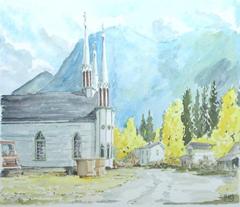
Holy Cross Catholic Church

Skookumchuk Village's Holy Cross Catholic Church.

Michael Kluckner has left the buildings. It seems inconceivable that someone whose life is so bound up in recording and protecting the history of B.C. should leave this place. But in late November, as the snow fell, he moved with his Australian wife Christine Allen to the place of her birth.

It's entirely possible that he'll come back for more than a visit. He'll be missed if he grows old in some 19th century town at the foot of the Blue Mountains near Sydney. At least he's left us a few books -- and three decades of persistent advocacy that have helped prop heritage preservation up on some wobbly feet. Things are hardly perfect. In rural parts of the province, we're losing historic legacies at a troubling rate. But we're better off than we once were, and much credit accrues to Kluckner, the 55-year-old heritage advocate, painter and (until recently) Langley farmer.

When we met at the Wicked Café at Seventh and Hemlock, a few days before his departure, he was without regret. "Every time I've gone to Australia, dating back to the 1980s, I've seen something differently than I did before. I've been able to get away from my predictable response to my hometown," Kluckner said. "We were finding Vancouver is wonderful in all of its newness and change, but still we felt that we'd been here for too long."

Perhaps it's not so surprising that Kluckner should leave, given the peculiarities of his outlook on heritage. He's not a fetishist, obsessed with this building or that style. And he's not a museologist of the kind that will dress up an old house with a spinning wheel to make it more "authentic." What interests him most are the neighbourhoods in the midst of change, the tapestry of buildings, and what the interactions tell us about ourselves.

He first brought his passions -- watercolours, old buildings and the people who live our history -- together in 1984, in Vancouver: The Way It Was. Now he's put 14 books behind him. The latest is Vancouver Remembered (Whitecap) -- a collection of photos, paintings of old houses, watercolour maps that arose from dreams of flying, and anecdotes that traces the evolution of our city. Of course, as Kluckner acknowledges in the book, the city's history has been fairly well canvassed. As such, Vancouver Remembered is at its best when it goes -- as it often does -- to the least obvious places.

There are far more unexplored corners in Kluckner's other recent book, 2005's Vanishing British Columbia (UBC Press). It surveys the province's threatened heritage, which is disappearing at an alarming rate. Blame political will, our cultural blind spots and the lack of capacity in many rural areas. Kluckner notes that when former Canadian Heritage minister Sheila Copps initiated the federal government's Historic Places Initiative, she figured the country had lost 20 per cent of its historic buildings in 30 years. In the West's rural areas, Kluckner writes, that proportion is much higher.

Often the buildings disappear with barely a whimper. In 1987, Kluckner notes in Vanishing British Columbia, Salt Spring's 1865 Travellers' Rest -- the oldest building in the Gulf Islands and one of the oldest in the province -- was deemed by the Gulf Islands' heritage inventory to be structurally sound with good potential for restoration. In 2003 it was demolished.

Kluckner believes Canadians' self-image is part of the problem when it comes to protecting such history. "In spite of all the changes [in Australia], the sunburnt homestead with a few gum trees still seems to tug at their national heartstrings," he writes in Vanishing British Columbia. "In Canada, most popular images are pure landscape containing no evidence of people at all."

While he was working on the B.C. project, he posted his watercolours on the Internet, which resulted in considerable feedback from people who ended up on his website while searching for local or family history. Their stories -- which are also disappearing from our collective memory -- help make Vanishing British Columbia a gorgeous and fascinating book.

Herewith, a few more observations from Michael Kluckner on what we've saved, what we've lost, and what he's leaving behind.

On Vancouver's big lie:

"I always felt that the worst canard that has ever been foisted on Vancouver is that it will always be Vancouver because it has the beautiful mountains and the view and the harbour.

"In the 1980s and 1990s, the city -- particularly the residential parts of the city -- didn't have an understanding of the values that made the place so interesting to live in. And it was the evolved neighbourhoods, the change in the layers of the landscape. I began to paint these things, focusing on things that were completely emotional as opposed to architectural. Dappled sunlight on the side of a building at a particular time of year, the way that the colours were. This is something that I would go back to every year to look at.

"As you clear-cut these neighbourhoods -- this analogy of clear-cutting came up because it was so much a part of the environmental movement -- it seemed to me that we were in the city at that time, and to a certain degree now in the multi-family [parts of the] city, we were living in something that was as visually interesting as a plantation forest.

"I tried [as a heritage advocate] to make the connections between the broader issue of sustainability and the environmental movement and heritage preservation, which is about reuse, and about controlling the rate of change, and about having layers in the landscape. The media in general and the broader environmental movement is obsessed with seals and bears and so on, and can't seem to make the connection between the way people live and the values they have about human-made objects and the richness of the city.

"Would you go to Singapore, which is all of one layer? Or would you go to Paris, which is layers on the landscape? Singapore 35 years ago had all those layers. Now it doesn't. To me the richness of city life is a combination of a 2000 building and a 1980s building and a 1912 building. It's the combination of textures and colours that obsesses me about heritage. I'm very little concerned about the minutiae of architectural styles, or great architects. For me it's all about how it works as a tapestry on the landscape, how people come and go, how people [including one at this particular moment in the Wicked Café] leave doors open in the middle of winter because this is Vancouver..."

On density as an excuse for redevelopment:

"If the current [Vancouver] council collectively had a brain, they would realize that eco-density is an area like South Granville. These walk-up apartments -- that to me is eco-density. There are 10 suites on a 66-foot lot. They're affordable suites. If you tore that place down, and replaced it with a building that was in theory more environmentally friendly, it would take you about 40 years to pay back the energy that you used in building the new place. Plus you would lose affordability, which is another aspect of what I think of as eco-density. These are the people that walk, that tend to use transit, that are supporting the local businesses.

"We may come back in five years and find that the neighbourhood has changed because the buildings have been torn down and replaced by wildly ostentatious crap that people are building -- the 'limited collection of fine residences' -- and I think you'll find that the net density will not really have gone up and affordability will be out the window. The place will work in a less environmentally friendly way, and you'll lose heritage."

On the value of the edge, and the demise of a modest apartment that housed Café Zizanie, at Seventh and Fir:

"Apparently it was city land. With the demise of my beloved little old store at Seventh and Fir, there's this little chunk that's gone. To me it was this accidental place that you'd come upon. I'd look at it in different light at different times of year; when the trees that were too big for the lot would change colour, it was an evolving piece of art as far as I was concerned. I must have painted it five or six times before it was demolished. When that type of thing disappears, the edge conditions disappear.

"Vancouver in the 1950s, '60s and '70s was all about edge conditions. It was all about this pending sense of change. It was something I tried to capture in the watercolours. There was always this sense of something waiting or hanging or about to become something different, and we didn't know what it was.

"The genius of Kitsilano in the 1960s and the Drive and Grandview in the 1980s was the juxtaposition of change. You'd see it reflected in the differences between houses and gardens, the places that were getting better and the places that were getting worse, different cultures rubbing together. That was really stimulating to me. Many neighbourhoods in Vancouver are coming to a point at which change is stopping, because the places are all finished and they're all tidy. Kitsilano to me has become a really dull place, because all the change has stopped."

On clear-cutting postwar bungalows:

"These returned veterans' bungalows -- with the low-hip roofs and the beer-bottle stucco above the foundation line, and the horizontal board siding below was always painted a kind of lurid turquoise, and they had one hydrangea in the front yard -- people want to double floor space. I love those places, but they were so under built on the lot. The reason that the Edwardian stuff has proved to be reusable is that they tend to be maxed out on the lots. Those classic Craftsman houses, on Stephens and McDonald, they're overbuilt."

On what Vancouver's doing right:

"In Vancouver, what we the activists wanted in the 1980s was a managed process that would retain buildings within development change. We got that. Vancouver's policy works really well. It's kind of a bloodless thing. It doesn't tend to engage people in an emotional dialogue about values in the city. But it works. Generally, you can still see the layers in most of downtown. If Vancouver had a really strong economy in the 1970s, a lot of that would have disappeared because we didn't have the sophistication in the public policies.

"The Stanley Theatre is a good example. The idea of transferring density off of that -- I think it went onto the Wall Centre -- that's a really sophisticated mechanism. Victoria has coped really well, but it hasn't had the pressure to change."

On British Columbia's two solitudes:

"But then you get out into the countryside, and you've got the two solitudes, the urban and the rural. In the city, most of the change is due to development. The city's rich, and it can make choices, and most of the time they are pretty good choices. But out in the countryside, change is due to abandonment, and there's no money. And so that layer of human settlement is just disappearing off the landscape, and I think the province is impoverished due to the loss of that layer.

"In terms of heritage planning and inventories, the province has actually been quite proactive at finding money. And now the energy's going into the so-called keynote buildings, because of the development of the national register of historic places. Planning to a certain degree works in communities that are organized. You see it in Kamloops and Kelowna to a certain extent, in terms of retaining these layers.

"But then there's these almost folkloric places. For example, Doukhobor community villages in the Kootenays. There are just a handful now instead of a hundred. This is the evidence of the largest communal living experiment ever in Canada, and fascinating from that point of view. You then get The Land Conservancy [of B.C.] coming in and helping to buy one of the key places. The land conservancies are one of the most positive of the initiatives that have come along, and they've come along privately. The TLC is just a remarkable organization. The Nature Conservancy of Canada is very good too. And they've gotten into cultural sites, as has the land conservancy."

On the virtue of taking individual heritage preservation initiatives out of government hands:

"One of the things I can take some credit for being involved in at the very beginning and suggesting it is the privatizing of the B.C. Heritage Trust and the creation of the Heritage Legacy Fund of B.C., which was given $5 million in seed money right in the darkest days of the Liberal government. I was the treasurer, until a few weeks ago.

"The Land Conservancy is one of the partners in the heritage legacy fund, and they're going out and doing things like this marvellous high-wire act with the Kogawa house [where Obasan author Joy Kogawa lived before the Second World War internment of Japanese-Canadians]. In a sense, they are showing how some public money, put into an endowment administered by a private foundation, with private fundraising, can really make a difference. You think of how significant the Kogawa house is as a site on the cultural map of Canada. They're able to save this in the hottest real estate market that Vancouver's ever seen.

"Politicians come and go, and they're focused on their term of office. Stewardship is a longer-term commitment. The National Trusts in Britain and Australia have never been governmental organizations. There are governmental organizations in England that perform really good roles, but I think the evidence is that governments, whether they are left or right, can't be counted on to have consistent policies that allow for stewardship.

"The grassroots desire to save the Kogawa house -- this is not something that was seen by the Liberal or Conservative governments federally as being important. But there were obviously people all over the country who said 'This is important.' The people are ahead of the government on that. A mechanism that allows this to happen is often much more flexible. The reality is that in Australia, England, Scotland, you get people's interests reflected through an organization more than you get people's values reflected through a government. Governments have other fish to fry.

"The city is somehow way more accessible to people. What's missing is the idea of heritage that is more holistic. Going back to the walk-up apartments on South Granville -- somehow these buildings have to be recognized holistically as being part of the city's future as much as they are a part of the past."

On why the NDP ignored heritage preservation:

"It was the Bill Bennett government that created the B.C. Heritage Trust. Those were the golden days, the late '70s going through the mid '80s, for the Heritage Trust. The Bill Vander Zalm government began to take it apart, but during the NDP years of 1991 to 2001, funding for the B.C. Heritage Trust was cut by about 85 percent.

"They couldn't make the connection between preservation of these sites and broader social, cultural and environmental issues. They were more interested in funding straight-out cultural stuff."

What the provincial government can do, and how the Liberals created a crisis for Barkerville:

"The province, in a systematic way, has to add to the endowment of the heritage legacy fund. The more consistent funding in the long term, the more capacity will develop all over the province, of people saying 'We can get some money to help with this project, because there are people over here who believe in this stuff long term.' They have to give consistent long-term funding to the heritage branch. The historic sites that were part of the B.C. government, the Barkervilles, they're in crisis. The big ones are really in crisis, because of underfunding before the Liberals came in and then the Liberals suddenly saying we have to devolve these things."

On the one thing he'd wind back the clock to save:

"In terms of more recent issues, in the main I've enjoyed the evolution of Vancouver. If you could somehow go back to 1949, though, and the demolition of the [original] Hotel Vancouver [where the Toronto Dominion tower and Sears are today]. That started the process of redevelopment around Granville and Georgia, and the eventual attempt to fix up Granville Street as a mall. I can say without any doubt that Granville was a hell of a lot better as a street in the 1960s. Granville was really exciting. Chinatown too. Chinatown will probably come back. But they can't undo the Pacific Centre. They can't undo the Vancouver Centre."

On the one attitude he would change:

"I think what annoys me most is the number of people I know who have driven every back road in Tuscany but have never been to Ashcroft. I think that annoys me more than any individual loss. Well-off, well-educated people with strong Canadian values have just completely ignored what is in their backyard. These places represent broad themes in our culture, whether it's the Travellers' Rest on Salt Spring, or some First Nations church on a little reserve up in the Interior."

Related links and Tyee stories:

 [Tyee]

70  Comments:

Login or register to post comments

  • fish

    5 years ago

    Comments on "Don't Forget the Country"

    Oh, sorry to see this wonderful advocate leave our province, our country. What a gift to Australia. And he's right about places like Ashcroft with their layers of history right in front of us. The opera house is a gem (on the inside. And hopefully the visionary who is currently undertaking its restoration will find the money to restore the exterior as well.). The building that houses the museum in Ashcroft is beautiful. And there are a few of the colonial bungalows there and a few painted ladies (houses, that is) as well. So many of our small towns have these integral cores that coax and lure the intrepid traveller in to experience some rich experience of our past.

  • Grumpy

    5 years ago

    We don't give a damn about heritage in this province, as the Premier cares more about Hawaii, than BC.

    Wonder why the tourists are staying away? BC has become a meca for the rich and wannabe rich, to flash themselves at grossly overpriced venues, for the rest, BC is bloddy boring - a no fun province!

  • kjc

    5 years ago

    The real name of "Skookumchuck Village" is Skatin.

  • kjc

    5 years ago

    Skookumchuk refers to the speed of the river (Chinook strong + water) as it passes through Skatin. A lot of people think that the name refers to the hotspring nearby but its real name is St. Agnes Well after one of James Douglas's daughters as the original name for Harrison Hotsprings is St. Alice Well, named for another daughter.

    The native name for the hotspring is T'sik.

    The road into through its campground is a cut off section of the original Douglas Trail, the first road ever built into the interior of BC. One traveller's diary of the time noted that he had the first bath since leaving San Francisco four months earlier at St. Agnes Well. It is a genuine goldrush era campground, built through the centuries by the people who have come to use the springs,

    It is an important historical site that should be preserved as it is and despite the fact that it is privately owned by the Tretheway family, who provide its facilities, it is genuinely deserving of protection.

  • village

    5 years ago

    He visited the region I live in and was a genuine advocate for the preservation of some great buildings which can be found and too often lost[/I .., in the hustle and bustle of the lower mainland .. to unplanned development that do not factor in sufficiently enough the HUMAN SETTLEMENT objectives..
    of quality community living itself*..

    PEOPLE after all, as the very building block of society , of neighbourhoods..of cities ( villages ) and whatever other settlements one can imagine .

    Of trees, of Arboretum value and of very historical buildings which give a visitor a powerful sense of an era.. circa early 1900's when they were constructed...

    Magnificent architecture , along with what could become lands that will be perhaps be challenged by First Nations , having had some presence in that land along the river... thousands of years ago...

    ( THIS REMAINS TO BE SEEN.., BUT WITH THE PROVINCIAL GOVERNMENT alleged OWNERSHIP OF THESE LANDS.., there could become a fascinating debate and perhaps legal challenge of the designs that the GOVERNMENT MIGHT HAVE , or the future uses they might plan for these lands..)

    The interesting point is that Michael lent support to the preservation of the buildings themselves..and this was greatly appreciated in this region *..

    thanks .. Michael.., you will be missed..,for you genuinely walked the talk..* , as they say.

    Of course I speak of the COQUITLAM RIVER .., and '' kwekwetlum ''.., language nomenclature roots..., in the land of the .. mountain ranges and abundant salmon..*.. ONCE UPON A TIME *.

    There is yearly an event that people out here often refer to as TREEFEST *.. AND I WOULD PERSONALLY ENCOURAGE ANY LOWER MAINLAND RESIDENT TO ATTEND THESE..

    for if ever there was an experience to be had.. in the lower mainland .. as to depicting the early 1900's.. it would be when this particular land was appropriated to construct .. what was called , in those days , THE HOSPITAL OF THE MIND..

    in the early days..
    appropriately named.., when one thinks of our desperate need in these accelerated lives of ours.. to find an OASIS ..., that would indeed.., give us a refuge from our [I]incessant accelerated notions of ..., advancing our lifestyles , growing our wealth.., without ever asking ourselves a more fundamental question ... , : like...

    Are we really further ahead .., with experiences , such as HAPPINESS., LOVE.. CONTENTMENT and improved conditions that would help the .....

    ''IMAGE NATIONS ''... that we've invented for our well being..?[B][I],

    in other word NEIGHBOURHOODS.. , are they really a place now for social interaction , for getting to know one's neighbours.., are they really - or rather - should they not become , ONCE AGAIN , the building blocks of VILLAGE and CITIES [B]especially , and can we not find our way out of the ''REGIONAL FORESTS' ' thinking paradigm that influence , our behaviours in these neighbourhoods ..., ( which are now built with a fast buck in mind , and are more and more disconnected to the very FABRIC OF THE COMMUNITY they are built in..*

    We can no longer see the forest for the trees .. ( think buildings , houses , developments and what have you ).. nor can we see the trees for the forest being ever so abundant..
    * think houses , trees , townhouses.. condominiums.., towers.., building after building.. ).. and then ask yourself the question of ...

    WHAT IS IT WE CANNOT EVER SEE.. SINCE IT IS HIDDEN .. OUT OF SIGHT AND OUT OF VIEW.. and that is the very roots.. beneath the earth.. , without which .. neither forest nor trees..... ( or for that matter houses.. ) .. could exist.. ,

    Having the wood industry in mind as I think about these things..

    village

    [I]Just a thought I wanted to share .. , thanks for the GREAT ARTICLE.. and especially , thanks for the links provided.., giving great sources to further one's research and what have you ...

  • coldmoon

    5 years ago

    "It's entirely possible that he'll come back for more than a visit. He'll be missed if he grows old in some 19th century town at the foot of the Blue Mountains near Sidney."

    I think it's spelled "Sydney." Sidney is the spelling of the town on Vancouver Island.

  • village

    5 years ago

    To Kjc.. :

    Fascinating bit of history you bring to that particular part of this province..

    I visited Fort Vancouver over a period of years and came away fascinated with certain great historical documentation they have..., on DOUGLAS and HIS DAUGHTER ... . ( I would encourage you to look into this source of historical data )..*

    THE EARLIER NOMENCLATURE YOU BRING TO THE SURFACE IS ALSO REALLY APPRECIATED .. FOR THEY PROVIDE THE CLUES TO THE EARLIEST OF THE SETTLEMENTS AND SETTLERS.. and will also provide many important indicators of the very land we so appreciate and uncaringly exploit at times *...

    Do you have more information on Douglas and his times in the province .. once he journeyed north .. with the HUDSON BAY COMPANY itself.., and can you confirm your knowledge of this individual.., as i hear claims that he came for the CARIBBEAN'S.. .. are you researched on these subject matters ?

    If not , thanks for adding to the understanding of that particular region of B.C. ..

    village

  • village

    5 years ago

    that should read .. '' from the CARIBBEAN'S ..''

    and while I'm at it.., Kjc., WHICH tribes were in existence .. in that part of our province.., when the FUR TRADERS arrived.., at their earliest point of arrival.., ? ( do you have any oral interpretations of the .... beginning period.., of CONTACT.., be it from the OCEANS .. or the rivers..

    '' from Canada by land '' , if you get the drift of my question.

    AS TO THE GREAT SAILING SHIPS THEMSELVES ALSO.. WHO PLIED THE WORLD OCEANS .. seeking fortunes and opportunity.., ( are there any hints of stories that could describe the arrival of these .. ''outsiders '', as I am convinced they were perceived by those that had settled.. thousands of years earlier.., )

    any suggestion or links or for that matter and more importantly , any thoughts you might have on any of the above query .

    thanks in advance..
    take care..
    village..

  • kjc

    5 years ago

    Thanks also for you comments Village. The hotspring at Skookumchuk is a sacred place that is very near and dear to my heart. I even managed its campground for a summer (and what a great one it was!)

    Although little has changed in the campground, the springs themselves have come a long way from the humble place I remember from the 80s and the Trethewey (prev misspelling) family deserve great credit for their caretaking of this very special and historic place. Politically, however, it is a very complicated situation.

    My knowledge of the springs and the daughter(s?) of James Douglas stems from knowledge of the area that I have accumulated through the years sharing the tubs and fireside chats with other locals and members of the Trethewey family.

  • village

    5 years ago

    hanks Kjc ,

    You obviously must be aware of the ARTICLES written in the VANCOUVER SUN papers of late.. , ( have you any comments on these stories ? ) .. which I appreciated , by the way.. for I felt that BC in general .. through it's communications apparatus .., is reaching a point of a genuine search of not only IDENTITY itself.. but one that will eventually find it's roots in the NATIVE LAND.. and the over the mountain CANADA expeditions that have eventually left it's mark and signature.., as did
    the '' from Canada by Land '' etchings of so many years ago..

    The other thought that comes to me.., and I will have to check for your response later in the day -(contractual obligations and all.. )- you know ,
    dealing with our respective day to day lives.., of keeping our head above the CHAOS of THE HUMMING OF INDUSTRY.. and at the same time trying to ensure that one is still , not only above water , so to speak.. but able to continue , not only the journey of life itself.. ,but the journey of exploration and discovery .. of the marvels of NATURE.., ( and I remind anyone reading this .. that our HUMAN NATURE is factored in.. loud and clear)..into this observation..

    So .., I , personally would love to hear some of the stories , Kjc , that you would have heard .., around these SACRED PLACES.., , or hints thereof of some of the wisdom that would be conveyed by these tales.., any chance of getting to read these on this post?

    I'll check in later.., and thanks for the exploration and discovery itself.. of another fellow settler .. in the LAND .. of.. a future in the making *..

    village

  • biscotti

    5 years ago

    Quote:
    On why the NDP ignored heritage preservation:

    I remember NDP Minister Bill Barlee wouldn't even support the George Ryga Centre in Summerland. Fortunately, the feisty George Ryga Society has maintained this important site and resource on its own.

    For those unfamiliar with George Ryga and his writing, see http://www.abcbookworld.com/?state=view_author&author_id=1321

  • grub

    5 years ago

    Quote:
    "I think what annoys me most is the number of people I know who have driven every back road in Tuscany but have never been to Ashcroft. I think that annoys me more than any individual loss. Well-off, well-educated people with strong Canadian values have just completely ignored what is in their backyard. These places represent broad themes in our culture....

    My sentiments exactly!

  • BC Mary

    5 years ago

    Hullo ... it's Hudson's Bay Company when you mean the Company of Gentlemen Trading Out of ... well, yeah ... Hudson Bay. Our little secret, eh?

    I kinda remember those NDP days ... when every time that government tried to set aside Agricultural Land Act holdings or a new Provincial Park the old Socred/Reform/CCRAP/Alliance/eventuallyBCLiberals would set up such a howl ... so it probably became second nature for them to duck whenever a historic site was proposed. Just guessing, of course.

  • Fiat lux

    5 years ago

    About 20 years ago, I was lucky to have been able to photograph and later draw and paint a number of pictures of the historical gold mining town of Quesnel Forks, which has no completely crumbled to dust. I intend to do more.

    All my drawings and paintings of QF have been donated to the Williams Lake Museum and can be seen there. What I still have at home, hanging in our house, and what I shall do in te future will also be donated to the Museum.

    I also took a number of photos of another historic building, the Big Lake Ranch roadhouse, before it was torn down by the owners, who couldn't afford to rebuild it. I haven't been able to do any artwork on this yet.

    Of course, there's no money for heritage, because our wealth creating foreign investor, multinational mafia demands more and more taxcuts, to take out of the country, supported by our governments and their brainded economists.

    Vancouver was a delightful place to live in , in the '50s and '60s, but started becoming a dump by the '70s and now it is.

    On the other hand, with the planned depopulation of the countryside, people have to move somewhere to survive.

    But then this is neoclassical market capitalism, so who are we to complain?

    If anybody's interested in my QF pictures, drop me a line at

    and I'll send scans of a few. No, I ain't no amateur, but and old pro with over 60 years of art experience, especially with graphite pencil.

    Ed Deak.

  • BC Mary

    5 years ago

    Charles Campbell: a nice story, many thanks.

    Just wondering about this comment:

    Quote:
    In 1987, Kluckner notes in Vanishing British Columbia, Salt Spring's 1865 Travellers' Rest -- the oldest building in the Gulf Islands and one of the oldest in the province -- was deemed by the Gulf Islands' heritage to be structurally sound with good potential for restoration. In 2003 it was demolished.

    I know Salt Spring Island well and can't remember a place of this name or the demolition. Minutes ago, I asked a longtime SSI resident and she can't remember such a place. Could this have been on another gulf island?

  • village

    5 years ago

    Once upon a time , I was handed a fascinating document that recounted not only the voyage of some CANADA dignitary to the West Coast.. , but the document had very powerful etchings or perhaps better described as ink drawings..

    THEY WERE VERY INFORMATIVE .. especially so, as I still have one of these sketches .., that I use , from time to time to remind people.. of what the landscape could have been.., for indeed, this particular .., individual had this ability and the good intention to preserve what he was experiencing as they..., travelled to the distance lands..., within the CANADA ..territory*

    These and many more surely can be found in the heartland.., for this is where the journey began.., for that phase of our development *..

    MAPS , and so much more is available..of The Fur Trade era.., and of course.., LE CANADIEN*.., played a prominent role , along with the First Nations.., and especially the offspring of these two cultures.., who produced the children of LES CANADIENS*.. ( Métis ).. by any other name.. who travelled to the far reaches of NORTH AMERICA itself.. serving the MASTERS OF THE DAY.., as per THE FUR TRADING COMPANIES .., on both sides of the 49th parallel.. AND more.., as they subsequently settled the regions of their liking..*..

    A powerful reminder , ( their spirit ) still present in this year ..of 2006.

    village *.. ( thousand year old cultures gradually clashed.. as they attempted to fully grasp the others intentions and eventual actions ).

    but certain meetings of the mind and bodies produced a certain PEOPLE who clearly saw the advantage to get along and find a way to an alliance of sort .. and create famillies that would eventually not only go through the clashes and the inevitable wars.., but also found an identity* ..

    Of course none of the larger Empires had any use for these PEOPLE's and simply wrote them out of the HISTORY,
    *

    The NARRATIVE of CANADA , can never be complete without a full understanding of the role they played in planting the seeds of a GREATER CANADA.. then any one could have ever imagined..,

  • village

    5 years ago

    To Biscotti ,

    That play , and in my case , the LP
    ( long play ) record that had the music was a revelation for me .. of GEORGE RYGA'S TALENT ..

    Did he write the Music ? and if not , who did ?

    I still can hear the power of the ...
    ascent of that dragon fly ..*..

    Thanks for the link .. re: the backgrounder on this wonderful creative individual.

    You mention one other group , is there a link for this group also.. ?

    THANKS ,once again

    Village,

  • village

    5 years ago

    from a previous post.. it should read

    ''WITHIN A CANADA IMAGINED TERRITORY*'' and FUTURE HOMELAND under CONSTRUCTION...''

  • village

    5 years ago

    from the ground up!

  • Fiat lux

    5 years ago

    Remember that the main purpose of globalization is the destruction of "identity", because it may lead to "democracy", criminal economic systems can not afford to exist.

    Ed Deak.

  • Fiat lux

    5 years ago

    ....should read "can not permit to exist"

    Ed ............

  • biscotti

    5 years ago

    hi village:
    I believe the music for Rita Joe was written by Ann Mortifee, who played the singer in the original cast.

    It's worth reading the last, posthumous anthology of George's writing, Summerland, published by Talonbooks.

    The George Ryga Centre Society puts on concerts, makes an annual award for political writing, and hosts an annual songwriting workshop with Roy Forbes and Bill Henderson. Bill's association goes back to being part of Chilliwack/The Collectors, with whom George collaborated to produce Grass and Wild Strawberries.

    There's also an Annual Acoustic Guitar Workshop - Slide and Fingerstyle Techniques - this February with Ken Hamm.

    I don't think they have a website, but you can contact the centre via Ken Smedley and ask to be put on their mailing list:
    Box 323
    Amstrong, BC
    V0E1B0
    Ph: 250-546-9886

  • village

    5 years ago

    Thanks Biscotti , VERY HELPFUL.

    Anne Mortifee was also recently , (perhaps mid year) involved with some theatrical musical presentation , AS I CALL IT .., didn't get to attend , and I regret it ! Anybody see it ? , what was your impression ?

    The backgrounder you provided Biscotti , encourages me to contact the mailing address , and perhaps , even phoning Ken Smedley..

    I have fond memories of a group of who played some fascinating music .. and they came from one of the ISLANDS.. between THE TWO VANCOUVER's .. , he , yes , Dan Rubin , if my memory serves me well.. played a powerful and haunting violin.. , and his group., the name of which I cannot recall for the moment.., were exceptional, and travelled across British Columbia..,

    When I think of the two VANCOUVER'S ..
    ( Island and city thereof..,) ,

    Making realise , one more time.. that FORT VANCOUVER down in the state of Washington needs to be factored into the equation , if we are ever , to fully understand how we've come to be named BRITISH COLUMBIA..*..

    Thanks once again , Biscotti ..*

  • village

    5 years ago

    To Fiat Lux ..,

    IDENTITY .. yes that word and all of it's power and meaning somehow lost in the equation .

    The discussions following the article written for the Tyee , on November 28,2006 took on that subject matter and I came away from the experience with a new found admiration for those that inhabit the land we call CANADA...

    ( intelligence in the land.., was indeed available and I recommend each and every reader on this post to have a look on that particular forum that flowed from the article..).. entitled.:

    ''QUEBEC A NATION ? we asked an expert ''

    You could have and perhaps still provide input in that particular forum .

    I think all you need to do is enter the title in the search engine of the TYEE and it will offer you many links.. but the one you want is the one that carries the date .. NOVEMBER 28, 2006 for reference..

    take care..

    I'm looking forward to your observations .

    Village ,

  • Charles Campbell

    5 years ago

    BC Mary,
    No mistake on where the Travellers' Rest is. I guess you'll have to buy the book for all the details. Your question points up a central issue, though. How could we not be aware of this? It's a a problem.
    Charles

  • jimmy_laroux

    5 years ago

    I'd recommend Paving Paradise by Mr. Kluckner. 15 years old, but as relevant now as ever (maybe more so).

  • BC Mary

    5 years ago

    Charles, I don't recall asking for "all the details" ... and it's ungracious of you to suggest that.

    Nor can I see how it would be cutting into book sales if someone said "Oh sure, that's the old Rita's Inn" ... or "Joe Blow's house used to be Travellers' Rest." Or something.

    Actually, I think I'd be more interested in Michael Kluckner's book if I believed there had actually been such a place somewhere on Salt Spring Island. Can't quite believe that the proud SSIslanders wouldn't have known and raised hell about it.

  • Charles Campbell

    5 years ago

    BC Mary, I sometimes forget that my tongue is not always seen to be in my cheek. Sorry if you took offence; none was intended. I'd say I took none at your suggestion that I may have made a mistake, but perhaps my flippancy was a response to that. I'm sure Michael will take none at the suggestion that he might have done the same. Vanishing British Columbia notes that the Travellers' Rest was in the Burgoyne Valley near Fulford Harbour. It was originally the home of market gardener and innkeeper Joseph Akerman Sr., and served as a store and the first inn on Salt Spring. Salt Spring architect and resident Jonathan Yardley told Kluckner in 2004 that there was no significant official interest at all to protect the building. Best, Charles

  • Skookum1

    5 years ago

    Quote:
    The real name of "Skookumchuck Village" is Skatin.

    In St'at'imcets, it certainly is, BUT NOT IN ENGLISH. And actually "Skookumchuck Village" isn't right either; it's Skookumchuck Hot Springs. I'm getting tired of the insistence that Chinook or English names for places are "wrong" and a sort of reverse linguistic colonialization takes place where English is supposed to adopt the often unpronounceable (in English) names from aboriginal languages. A good example is the conceit that "Squamish Nation" is "a bastardized colonial name" as someone on Wikipedia said when justifying renaming that article to "Sḵwxwú7mesh-ulh Uxwumixw", as if that were an English name, or that anyone would know what the hell the Uxwumixw part meant ("nation", sort of).

    Skatin schamtin. Even the Port Douglas Band call themselves the Douglas Band in English and don't insist on the indigenous Xa'xtsa, and the Lillooet Band only occasionally insist that their village/band be called T'it'kt (or Tl'itl'kt, which is closer) in English, at least in spoken English.

    Also, more pointedly, the village at Skookumchuck Hot Springs (aka St. Agnes' Well) was founded as an Oblate mission, and the Oblates proselytized in Chinook. The location was already known as "the Falls of the Lillooet" and no doubt local natives used Skatin for the location (a "Falls" in frontier English could simply mean a rapid, which also was termed a skookumchuck); but there was no village there to be named until the Oblates built their church and accompanying European-sylte housing. So what's the "right" name? Depends on whose heritage, and whose politics, you're buying into.

  • kjc

    5 years ago

    I repeat, the name of the village at Skookumchuk is Skatin (pronounced Ssh-k-ah-teen) and that is IN ENGLISH as St'at'imcets has only recently become a written language.

    Skatin is 3 kms from the springs which are officially named St. Agnes Well. "Skookumchuk" is moreorless a nickname for the whole area although locals do ususally called the hotspings Skookumchuk or even Skookie.

    Judging from the presence of numerous eastkan pits that dot the riverbank, both the springs and the village site were in use long before the Oblates showed up. The church is no longer in use as such. Somehow the pervert priests managed to put most of them off of Catholicism. As for the springs, the hot mud that the springs produced as they bubbled up through the ground was used by the locals for purification and healing. The hot tubs come 100% from the white man.

    The Tretheweys bought the springs and the surrounding area over forty years ago when Alan Trethewey landed the contract to build the hydro line that cuts through there. Quite some time ago, he promised that he would sell the springs back to Skatin but it is a sale that is yet to be completed.

    Although it is true that T'it'ket is rarely used in Lillooet, mostly it is referred to as T-Bird (short for Thunderbird) by the locals.

    I buy into everyone's heritage which is to say that I don't believe that white women from Ontario should be entitled to rights and priveleges that people who were born and raised in the area do not enjoy just because they married an Indian.

    Village - I believe that we are going the wrong way in this province and that "native rights" are being used to privatize the lands of resources of BC into the hands of corporations and their new native "partners" who need to be warned that, given as how it is the same gang who privatized the vast assets of the Russian people into the hands of the "Oligarchs," that there is no intention that these assets will remain in the hands of the Indian people of this province.

    Once they are off the tax payer teat to which they have become so accustomed, the Indian "nations" will go bankrupt and the banks will take them to the cleaners.

    Although I just got censored off of a Council of Canadians chat list for saying as much.

    Killing the messanger.

  • Skookum1

    5 years ago

    Oh, I know how to pronounce Skatin and unless you're St'at'imc I probably pronounce it better than you do (I'm from Shalalth, as it is in English, or Ts'alalh as it is in p.c.-orthography St'at'imcets). And IN ENGLISH the name of the place has always been Skookumchuck, or Skookumchuck Hot Springs. If I met someone from there in Mt. Currie or Pemberton THAT's where they'd tell me where they were from; if I asked which First Nation they belonged to they might say the Skatin First Nation, or more likely (now) In-SHUCK-ch. There are those who insist on using Skatin when speaking of the place now but that's p.c.-revisionism; the assumption that Skookumchuck (w/wo "Hot Springs") isn't a valid name except for the area is hogwash historically. Skatin now, sure, is the rancherie, such as it is; but the village (the Catholic village, not the ancient one) was always called Skookumchuck by its priests, its chiefs and by visitors. Skatin was unheard of in English until VERY recent times. It is now the name of the First Nation, but that's not the same thing as being the name of the town (likeiwse the N'quatqua First Nation and D'Arcy, or the Seton Lake First Nation and the six or seven villages through Seton Portage and Shalalth which have various names); Skatin is not the name that's always been used for the Catholic village-parish since it was created; Skookumchuck is. It's a p.c. conceit to suggest that Skookumchuck - a word from the language spoken in the hybrid/polyglot culture of the frontier, and which is native in origin ("skookum" from old Chinookan, "chuck" from Nootka) - is not an authentic word, implicitly that it's wrong because it's not in the local indigenous languages. But history has more layer than just one language, and in this case there's an on-the-ground reality that for all of its existence the village surrounding The Church of the Holy Redeemer has been called Skookumchuck, and/or Skookumchuck Hot Springs. Yes, "Skookumchuck" can refer to the locality just as "Pemberton" can refer to the whole Pemberton valley, but this is not its definition or a complete description of its usage.

    Yeah, and in local English in Lillooet the main rancherie IS called "the T-Bird". And why? Because T'it'kt (Tl'itl'kt) is danged near unpronounceable even for most St'at'imc. And the insistent use of a St'at'imcets orthographic system makes the p.c. spellings (as opposed to the older ones, e.g. St'at'imc vs. Stl'atl'imx) even less a part of English than they were in the first place, i.e. in this case because of the use of /T'/, which is the 'tl' sound, as it is usually transcribed in nearly every other First Nations latinized spelling system. But as with the subscript q's and superscript w's in the "real" version of the name of the Squamish Nation, these letters don't exist in English NOR SHOULD THEY HAVE TO.

    It happens, for example, that "Skatin" is in the p.c. spelling system because, as you point out, that initial /S/ is pronounced as a "sh", and that /a/ happens to be a schwa ("uh"), and the /i/ in -in is like -een, which is how by the way it would normally be written in un-p.c.ified English renderings of native names (another example Camchin - Kumsheen, meaning Lytton and actually meaning more or less the same thing as Kamloops - t'kumlups or thereabouts in "proper" Secwepemc).

    My point is that you can't induct a name from another language into English without some sense of its pronounciation rules. Moskva is not the English name for Moscow, nor do we usually say Roma or Athina when we mean Rome and Athens; we may say Beijing now rather than Peking but we still don't get the tones right, so it's just as incorrect as mispronouncing Skatin with a sibilant as opposed to fricative-aspirant /s/ or whatever "sh" is in linguistic terms; same with the "long" /i/ in the second syllable.

  • Skookum1

    5 years ago

    I'm being picky because p.c.language types are picky. And they pick and choose, too, IMO, as far as what logicalities they apply; Skatin is not an acceptable anglicization of the St'at'imcets-orthograpy "Skatin"; it should be more something like Shkateen (something like which which shows up in frontier-era documents here and there, maybe in Teit also). If the name has to exist in English, English-speakers shouldn't have to learn St'at'imcets orthographic/pronunication rules to use it properly; otherwise they'd say, looking at it without hearing it first, SCAT-uhn.

    The bigger joke is that 40 years ago most St'a'timc/Lil'wat/In-SHUCK-ch elders (as likewise throughout BC) spoke more Chinook than St'at'imcets (or in the rest of BC the various other traditional languages); there's been a deliberate effort in linguistics to suppress Chinook studies as being detrimental to the survival of the ancient languages; condemning a Chinook Jargon-language name for not being authentic is, to me, all part of the propaganda built into p.c. linguistic politics.

    "Skookumchuck", not name also appears on the Declaration of the Lillooet Tribe (1911). Here are the list of signees:
    JAMES NRAITESKEL, Chief Lillooet Band
    JAMES STAGER, Chief Pemberton Band
    PETER CHALAL, Chief Mission Band
    JAMES JAMES, Chief Seaton Lake Band
    JOHN KOIUSTGHEN, Chief Pasulko Band
    DAVID EKSIEPALUS, Chief No 2 Lillooet Band
    CHARLES NEKAULA, Chief Nkempts Band
    JAMES SMITH, Chief Tenas Lake Band
    HARRY NKASUSA, Chief Samakwa Band
    PAUL KOITELAMUGH, Chief Skookum Chuck Band
    AUGUST AKSTONKAIL, Chief Port Douglas Band
    JEAN BABTISTE, Chief No 1 Cayuse Creek Band
    DAVID SKWINSTWAUGH, Chief Bridge River Band
    HOMAS BULL, Chief Slahoos Band
    THOMAS JACK, Chief Anderson Lake Band
    CHIEF FRANSOIS THOMAS ADOLPH, for La Fountain Indians

    If it was good enough for Paul Koitelmaugh and his colleagues, who are you to say different?

    Samakwa in the list above is today's Semahquam (pronounced Shuh-mah-kwum, although you wouldn't know it by that spellling, would you?). The Tenas Lake Band (Little Lillooet Lake) in the same area doesn't exist anymore. Slahoos is the Seton shore of the Portage (which would here seem to include the Nkait or Necait community on the Anderson shore as it's not listed; Seaton Lake here would be the Shalalth band). The Nkempts Band is now absorbed into the Cayuse Band (who have recently p.c.ified that Chinook/anglo word into Kiy-oose, even though it's ultimately of Spanish origin...)

  • Skookum1

    5 years ago

    I was wrong about Shalalth<->Seaton Lake Band, as there's
    PETER CHALAL, Chief Mission Band
    JAMES JAMES, Chief Seaton Lake Band
    and Mission would definitely be Shalalth; there must have been more than one village on Seton Lake in those days (other than Slahoos/Slaus at the Portage), or the Seaton Lake Band is a combination of the others; all these together with Anderson Lake (now N'Quatqua) were before the Indian Act grouped as the Lakes Lillooet; the declaration came a few years after their long-time leader Chief Hunter Jack was murdered on Seton Lake. Thomas Jack, listed as chief of the Anderson Lake Band, was his son and successor, but did not retain his father's role over the other bands of the Lakes people. The Nkempts Band may have been a branch of them - Nkempts or Nkoomptch is the big gorge and creek connecting Seton Lake to the Fraser, and the foot of Seton Lake had been Lakes Lillooet for a very long time; Indian Reserve allocations and Indian Act management revisions have sinced placed it with the Lillooet Band.

    Who, as I am told re an interesting aside, were informed by the white contractors building houses for the band's chief back in the '70s or so, that skeletons had been found in the foundation excavations. The chief snapped "they're not my ancestors" and ordered the construction to proceed without archaeological investigation or proper removal and reburial/reconsecration of the remains. Very pointedly, they would have been those of the Seton Lake people, probably in fact of the Oleman family whose fishing camp had been there "since time immemorial".

    And just try to get the Thompsons and Shuswaps to talk about their extermination of the Stuwix (Nicola Athapaskans). What I'm getting at is that it's not only modern culture that's good at systematically destroying "heritage"......

  • Skookum1

    5 years ago

    The Stuwix, by the way, were done away with so completely that not even their own name for themselves survives. Although their Thompson-speaking didn't participate in the raids which slowly and ultimately wiped them out, the name Stuwix is from the language of the people (the Thompsons) who wiped them out, and means "strangers". According to Teit, even St'at'imc was a term used by other peoples to refer to them (as "Stlatlemuk", people of stlatl according to St'at'imc tradition, with St'at' being the site of the original village where Lillooet's current Main Street/downtown) Teit says they had different names among themselves; so even it's not a "correct" name, when you dig into the history...it's "correct" now only because the bands have decided it is, with the Lil'wat-origin name Lillooet now applied to the Fraser area bands, and the Fraser-area-origin name St'at'imc applied to the Lower Lillooet, or at least to Mt. Currie/Lil'wat (the In-SHUCK-ch take part in the St'a'timcets language authority, though, I think).

  • Fiat lux

    5 years ago

    This may be a silly question, off the subject, but does anyoone of you know what the word "Itcha" means?

    We inherited a very dear, beautiful cat with this name and have been trying to find out what it means, for 6 years ?

    Ed Deak.

  • Skookum1

    5 years ago

    I first heard it as part of an article by, I think, Paul St. Pierre, in reference to the Chilcotin version of Kickapoo Joy Juice - "Itcha Mountain Fog", a particularly bootleg "cocktail" served at the Anahim Lake or Alexis Creek Rodeo(s). The Itcha Mountains are part of the Itcha-Ilgachuz volcanoes in that area, which include Tsisiutl in the Rainbow Rang as well as Itcha, Downtown and some other volcanic peaks; "Itcha" is also the name of a particular group of local natives, although I'm not sure if they're Chilcotin or Carrier; Carrier I think.

  • Fiat lux

    5 years ago

    Many thanks..... I've asked some native people, went on the Net and into some band offices in Williams Lake, but yours is about the best explanation I've received. I have seen the name on the maps, but never could figure what it means.

    If it is a band in this area, certainly nobody seems to have heard of it.

    We got the cat from the SPCA and didn't want to change her name.

    We're in an alleged "taboo" area here, on account of some sea battle between 2 tribes on Quesnel Lake, hundreds of years ago, when a storm wiped out both sides and the area was deserted with some ancient lodge remains on Cariboo Island.

    Ed Deak. Big Lake.

  • Skookum1

    5 years ago

    The article that mentioned the Itcha Mountain Fog also made reference to a group called "the Itchas"; this may not be a band name but a vernacular usage (like saying "Setons" or "Nicolas" when the Tshalalh'mc or Scw'exmx are meant). According to bivouac.com Itcha Mountain is the namesake of the range, but it doesn't say what Itcha means or if it's the name of the mountain, i.e. why it's the name of the mountain. Itcha-Ilgachuz Provincial Park or protected area of whatever it is includes Itcha Mountain, of course.

  • Skookum1

    5 years ago

    Quote:
    We're in an alleged "taboo" area here, on account of some sea battle between 2 tribes on Quesnel Lake, hundreds of years ago, when a storm wiped out both sides and the area was deserted with some ancient lodge remains on Cariboo Island.

    Sounds like the war between the Sekani and the Shuswap; it was the grandfather of Chief Nicola (Xwistestmexteqen, to be "correct") who drove the Sekani out of the North Thompson and/or the Cariboo Plateau; the battle on Quesnel Lake may have had to do with that; or, for that matter, might have to do with internecine war within the Shuswap (Bonapartes and Adams Lake Shuswap still don't get along well, as I recall...).

    Although seems to have changed, apparently Marble Canyon between Pavilion and Hat Creek is/was also taboo, also because of a battle. Doesn't seem to affect tribal travel/affinities these days, but it might be the reason Blin-Wright's wagon road went over Pavilion Mountain instead of via the logical route via Hat Creek. His native and Chinese labourers didn't want to build through taboo ground...another reason for the taboo there is the giant memorial to Coyote's, er, masculine appendage, and also the presence of a lot of petroglyphic/pictographic remains, suggestive of a mystic/ritual space as well. But the story I heard had to do with a massacre.....

    The aforementioned Stuwix apparently used to live in the central Fraser - from Big Bar up through Gang Ranch - but were driven out by "bad neighbours" (either the Shuswap or Chilcotin, apparently); although another version says/claims they were Chinookan and came up from the Lower Columbia; they may have been a combination of two exiled peoples.

    Whatever. They were driven from the Fraser and granted refuge by Nicola's great-grandfather in the upper Nicola, and ultimately wiped out by the Canyon Thompsons and the plateau Shuswap (though partly by assimilation with neighbouring Nicola Thompson-Okanagan families, who also included some Shuswap family lines including Nicola's own).

    They may have lived in the Cariboo Plateua, which is why the long ramble re the battle on Quesnel Lake. They were not, as far as I can tell, "canoe people", however, unlike the Shuswap and Sekani.

  • Fiat lux

    5 years ago

    Most interesting and thanks. The lodges on Cariboo Island were apparent winter quarters, with the big holes still in the ground, with the hole for the winter food supply far away.

    It is difficult to imagine how they must have dug those holes without iron tools.

    They must have had canoes, or some way to get to the island. In any case, Quesnel Lake is a very large body of water with a complicated shape and tribes must have been using it for travel and fishing.

    Ed Deak.

  • village

    5 years ago

    I encourage everyone to contact Ed Deak and take him up on his offer : '' to have 5 etchings / painting sent to you..

    They are magnificent and create in the viewer the timelessness of HISTORY ITSELF.*

    Thanks once again, I Can't wait to see the other masterful works you've produced Mr. Deak.. (* you absolutely correct when you state : ''No, I ain't no amateur, but and old pro with over 60 years of art experience, especially with graphite pencil.'' .

    Very beautiful, hauntingly so , and yet reminiscent of the signature of HUMAN SETTLEMENTS and how peoples lived .

    Village ,

  • village

    5 years ago

    I've been away and having returned from my voyages ( contractual obligations and all ) I was fascinated by the posts that accumulated on this subject matter of .. DON'T FORGET THE COUNTRY ..

    Thinking now of the powerfull '' language canvas '' that flowed from the Post Kjc made , I come away realising that the complexity of communications and the territorial imperatives that flowed from these various '' secret codes '' , which tribes of all kinds devised .., were the lynchpin of and guarantors of IDENTITY..*..

    and territory .., for how could you hold on to large domains , without a means to communicate and extend your presence.

    Be they the high priest of other civilisations .. or for that matter shaman like chiefs , here in the territory now called CANADA.. ( from sea to sea to sea..)..who via thousands of years of inherited cultures and ways of survival along with an INTELLIGENCE OF THE LAND.. A knowledge that created a people .. FIRST NATIONS.. all.. though having in each of their '' territory '' a settlement strategy and a chance at immortality..., ( so to speak ,as the children of the children of the children..perpetuated the dreams and visions of the elders ).. I was struck by the clear seperation that the ROCKY MOUNTAINS created .. no wonder BRITISH COLUMBIA NEVER SPEAK OF SEPERATING.. IT IS BY NATURE AND LAND A SEPERATION *.. and with such a unique and diverse set of conditions , the FIRST NATIONS themselves offer up a glimpse of that difference.. and there is a beautifull saying in the CANADIEN language.. that says..

    VIVE LA DIFFÉRENCE ! ...,

    Being from the East Coast of Canada originally and listening with great interest to RADIO- CANADA these days , specifically to a program Serge Bouchard ( a Radio Animator ) created and hosts .. called LES REMARQUABLES OUBLIÉS *.. A resurgence of the MEMORY I speak of from times to times.., bodes well for the future of CANADA.. , for once we get the fullness of our NARRATIVE.., we will be able to face , not only past and present with confidence but with inner strenght , we will be able to tackle the FUTURE ..*

    ( continued )

  • village

    5 years ago

    A PROGRAM , as I was saying having certain ressemblance to what was done by Stephen Humes for the Vancouver Sun.., except for the fact that it was RADIO.., and had many story telling attributes that makes the listener return week after week to hear of the legends , of the PEOPLES .., who were larger then life itself.., and yet had become lost in the COLLECTIVE MEMORY*..

    Great warriors such as PONTIAC.. and others such as MADAME MONTOUR .., who was from the mixture of ALGONQUINS and the original French Settlers.., to then transfer to the IROQUOIS .. in playing a role of translator and ambassodor.. of sorts.., at the earliest of the European presence .. in North America..

    ( what is fascinating about her life and the role she played.., in the CANADA of OLD.. and the subsequent transformations of the ENGLISH SETTLERS of NEW ENGLAND.. , ( taking into consideration the AMERICAN REVOLUTION itself.., and the role she played during these times.., ) being part of the negotiating of treaties .. and on and on *.. ( she speaking English and French and the languages of the tribes that she'd lived with )..,seeing herself as a '' GO BETWEEN '' .. she rose to prominence in the United States of America.. and her offsprings /descendents continued the tradition .. as interpretators between the First Nations tribes and the Americans.., living to a ripe old age.. and having been .. a legend in her times.*..

    But one example of the depth and the scope of what that program covers..,
    it's unfortunately only available in French .. , BUT FOR THOSE WHO CAN .. UNDERSTAND THAT LANGUAGE .. they have a web site and the ARCHIVES are readily available .., they can be listened to and they offer a glimpse .., of that part of CANADA that eventually made it's way to the PACIFIC NORTH WEST ...

    I realise after reading skookum 1 paint a very complex language environment and I come away thinking that beyond the ROCKIES themselves.. ( on each side of that great divide ).. there is much to be learned to be researched ... as to how HUMAN SETTLEMENTS themselves evolved .., in this land we now call
    CANADA *..

    To Jck ; I'm still interested in hearing what you've experienced and heard , that may explain away , the oral history ( transmitted memory )of many tribes . There is much to be gained by speaking of our own experience and contributing to the larger understanding of why ... , interpretations and even translations and MEANINGS themselves .., are forever the point of contention..

    ( depending from what optics one chooses to describe and study.. LANGUAGES themselves.. )

    Your thoughts also on the OLIGARCHY and how , in Russia , much as happened in most recent times merits closer scrutiny ..

    When you say that AND I quote : ''

    Village - I believe that we are going the wrong way in this province and that "native rights" are being used to privatize the lands of resources of BC into the hands of corporations and their new native "partners" who need to be warned that, given as how it is the same gang who privatized the vast assets of the Russian people into the hands of the "Oligarchs," that there is no intention that these assets will remain in the hands of the Indian people of this province.

    Once they are off the tax payer teat to which they have become so accustomed, the Indian "nations" will go bankrupt and the banks will take them to the cleaners.

    Although I just got censored off of a Council of Canadians chat list for saying as much.

    Killing the messanger.

    Please expand on these comments you've made .

    Village ,

  • maestro

    5 years ago

    To: MICHAEL KLUCKNER

    Many Thanks for all your excellent works...one of the best local heritage sources we have...Hopefully only on a short sabbatical " Down Under ".

    Hey VILLAGE , nice to see you again....enjoy reading your comments and the inherent style you use.

    Hey SKOOKUM 1....keep up the submissions of the BC History lessons, awesome work !!!

  • BC Mary

    5 years ago

    Many thanks to Skookum 1. Would sure like to hear your reaction to that big celebration yesterday which they call a land claims settlement. A treaty with the First Nations Tsawwassen Band.

    I think that no, it's not. It's a continuation of the BCRail deal.

    It's a critical, cruel, cynical step in the sale of BCRail. And it was celebrated so as to look like a Treaty settlement. Like hell it is.

    The Campbell government has given 207 hectares of prime Delta farmland, situated right up against the Roberts Bank port. They've transferred it to the Tsawwassen First Nation, who have agreed to give up their Reserve status and to begin paying property taxes.

    How are they going to do that? Easy. Tthe Campbell government has removed this land from the Agricultural Land Reserve making it OK to pave the richest, blackest soil in B.C. (Only 4% of BC land is arable.)

    And for what? So that the Tsawwassens will be forced to make deals with industrial developers, even selling the land to industry if they so decide.

    And for what? So that the industrial developers (who probably would like to buy Deltaport and Roberts Bank someday) can build warehouses for the shipping containers arriving and departing via the adjoining port facilities.

    In other words: the farmlands will become a functioning part of the BCRail port facility ... making it all the more pricey (in cash terms) when a future government again puts Roberts Bank up for sale.

    So what seemed like a long-awaited treaty settlement is really just another part of Gordon Campbell's real estate plan to sell off BCRail and everything connected to it. Why else are there 185 spin doctors in the Ministry of Finance? (See Order in Council #656 dated 12 Sept. '06) Why else?

    And isn't an attack upon B.C.'s First Nations anywhere, and on B.C.'s Agricultural Land Reserve everywhere, really an attack upon us all?

  • maestro

    5 years ago

    BC Mary:

    Put your good logic perhaps into more of a 180 degree mode...

    Substitute "X" for "Y" and " Y" for "X".

    I will make a prediction here...on the TYEE ....and all the indications are are that ANOTHER major announcement will be made VERY soon...involving a similar situation not far away from Tsawassen ...given this last announcement.

    The silence is currently deafening, thus something MAJOR soon.

    The floodgates are about to open...and BIG time.

  • michaelk

    5 years ago

    The narrative about Skookumchuck/Skatin, including links to the group who are restoring the church, is on my site at http://www.michaelkluckner.com/bciw6skookumchuck.html

    And re: Saltspring. Go to http://www.michaelkluckner.com/bciw7saltspring.html

    In fact, the whole book is on my website, along with a myriad of other comments and things that couldn't be jammed between the covers.

  • Skookum1

    5 years ago

    Re the Delta/Tsawwassen treaty: I don't have much knowledge of the Tsawwassens per se, and Delta to me has always been something of a foreign country (being flat and all). But it does strike me that $150 million doesn't seem like much given the scale of government revenues that have been earned and/or spent in their traditional territory (BC Ferries, the Roberts Bank Superport, Hwy 99, various industries, tax revenue from Ladner and Tsawwassen etc.).

    It's a buy-off and I think you're right here, as we can also expect to see with the Maa-nulth agreement, that the settlement goes nowhere near far enough; both will be rejected by other bands/nations because of the government's achievement of "certainty", which means absolution of native title (I haven't read the agreements but I'd venture the government did not sign to share sovereignty...). And that $150 million is paid out over 30 years, a mere 5 million a year. Thing is when that runs out, or when other money is borrowed against it (!) it's going to get ruined simply by attrition and inflation, not to mention endemic graft and nepotism on both sides (not pointing the finger at band governments here, just reminding that both sides are just as bad with this, though the natives do tend to get exposed more than stuff like, oh, the Ledge raids...).

    And yeah, it's too close to the CN/BCR deal and also to the private management issues around BC Ferries and terminal expansion to not have something to do with them, ultimately - if only politically/strategically. Why the Tsawwassens have agreed to cut this particular deal remains to be seen, I'd wager. Because like the native corporations that were established in Alaska, material settlements vanish in fairly quick order when big business and the banks are in on the action. I'll also bet we see some native P3s emerge in the wake of this....

  • Fiat lux

    5 years ago

    The problem is that the whole world has been doped with the deadly drug of the neoclassical market economy theory and by the time the world wakes up, it will be too late. The chains will be locked tight.

    The plans of the North Van bands to plaster Lions Gate with huge billboards is a good example.

    There was a woman chief of the Tsawassen on TV, when the treaty was signed, declaring that part of their plan for the land includes "market" solutions. Meanwhile the banks are planning to create the capital to take over the whole shebang.

    The plans for world control have been going on for over 40 years, that I know of, so they can wait for the consummation a little longer.

    Ed Deak.

  • Skookum1

    5 years ago

    Quote:
    There was a woman chief of the Tsawassen on TV, when the treaty was signed, declaring that part of their plan for the land includes "market" solutions.

    When I was in Lillooet last September for a short visit, the local paper had an article or two on the purchase of lands in the Municipality by the Lillooet Tribal Council, or maybe one of its sub-bands (Cayuse Creek or Lillooet); the land by the bridge on either side. Various locals had something to say about it; part of the implication is to buy out the white man, and also to control key strategic points (the LTC's bands already having demonstrated control over a few, such as the rail line and Hwy 99). But implicitly it seems to try and make the nation/band a moving force in the local economy so it gets to call the shots; and if there's a big cash-in on property when urban expansion inevitably draws Lillooet into the speculative property markets, they'll have property they can make boodle on like everyone else. Symbolically, the lands purchased including buildings that are various former government offices.

  • BC Mary

    5 years ago

    michaelk: thank you for the link which allows anyone to see Travellers' Rest as it was, on Salt Spring Island.

    You certainly have a genius for expressing sunlight. I will enjoy re-visiting these scenes often.

    Best wishes from one whose best beloved home was on some south-facing, sunny waterfront on Pender Island.

  • michaelk

    5 years ago

    To: BCMary

    Thanks for the comment about sunlight -- the play of light across these old places can be magical.

    To: everyone and further to the South Granville neighbourhood, where we lived for 3 months before coming to Australia. I'm sure when we return to Vancouver that area will be populated by older, richer, more car-using people, and the change will have taken place entirely consistently with city policies, even though they are branded as eco-density or eco-friendly. The problem: nobody is factoring in the energy value of those existing 60 year old apartment buildings, and their usefulness to the growing city (and the usefulness of similar areas elsewhere). Call them heritage, call them affordable housing, call them whatever you want, but the decision-makers need to make sure they're kept and continue in use. This is as much a part of our environmentally sustainable future as local food or climate change or any of the other big issues.

  • G West

    5 years ago

    michaelk
    Sounds like Australia hasn't quite captured your heart yet Michael. You'll be needed when you come back.

    Thanks.

  • pure

    5 years ago

    Australia is a great place. Enjoy Michael.

  • Skookum1

    5 years ago

    Just curious since you're here, MK - did you ever paint the old Ruskin store or its counterparts in Iron Mountain, Stave Gardens, Silverdale, maybe the old Brown Bear Inn in Steelhead? Ruskin Hall? We lived by the dam, in the company-built '20s-vintage bungalows; figure you must have sketched something around there.

    Your picture of the Pavilion store-chimney is always haunting for me; I knew the people who lived there in the late '70s/early 80s, and of course know its historical significance. Not the first frontier-era building in that area to perish in fire, though...(12 Mile House recently went, in fact).

  • Skookum1

    5 years ago

    Somewhere above I said Holy Redeemer when I meant Holy Cross; Holy Redeemer was the church on the old Lillooet Rancherie, the T-Bird, before it was wiped out with the rest of the old rancherie in the big fire of the early '70s ('74?). It was also very elaborate, like the contemporary St Mary the Virgin (Anglican; also destroyed by fire). The church at Nkiat, on the Anderson shore of Seton Portage, is also fairly elaborate and in search of funding; though its counterpart on the Seton Lake shore of the Portage, St. Christopher's at Slosh, is in pretty poor shape, like the Cayoosh Creek Church by Hwy 99 (now missing its steeple); the old Mission church at Shalalth is long-gone, D'Arcy/N'quat'qua also is in bad shape; seems to me both Pavilion and Fountain have been restored, or are well-cared for. What about the Leon Creek church in your paintings - is it well-maintained.

    That there's never been a compendium of such churches, in photobook or guidebook form, strikes me as odd as they're easily among the most picturesque and distinct elements of our rural countryside and our history; or "their" history anyway....

    It's an odd thing in Seton; many elders are still devout Catholics, younger First Nations people are pretty hostile to the church as an institution depite their elders' devotion. So the pouring of money into the Nkiat church was a bit controversial and tainted with the forbidden tease of being a tourist draw; but not a draw for parishioners any longer; it's been a very long time since there was a resident priest at the Portage or Shalalth, though....

  • fish

    5 years ago

    "That there's never been a compendium of such churches, in photobook or guidebook form, strikes me as odd as they're easily among the most picturesque and distinct elements of our rural countryside and our history; or "their" history anyway...."

    Sounds like a terrific book, Skookum, and I'd say you're the guy to write it! Photographs would be great. And if MK's book has an urgent message beyond the obvious one -- to pay attention to our own local culture, our own history -- it's that these buildings can disappear before our very eyes. I'm thinking of the Pavilion store, the Princeton Hotel, etc.

  • Skookum1

    5 years ago

    Quote:
    And if MK's book has an urgent message beyond the obvious one -- to pay attention to our own local culture, our own history -- it's that these buildings can disappear before our very eyes. I'm thinking of the Pavilion store, the Princeton Hotel, etc.

    So much already has it's hard to know where to begin; the Pavilion store and Princeton Hotel are relatively recent losses....it's too depressing and lengthy a list to even begin, in fact...

  • kjc

    5 years ago

    Skookum1 - Although you are obviously very knowlegable about the early history of BC and have posted a good deal of fascinating information on this subject, in calling Skatin, Skatin I am not being pc. In fact on the issue of 'native rights' lately, I have become very un-pc. The people who live there call the village Skatin and refer to themselves as the Skatin Nation which is a bit of stretch as far as I am concerned but that is good enough for me. When I lived three kms from it a few years back, I never heard anyone call it anything different.

    The sign at the entrance of the hot springs lists three names with St. Agnes Well, its official name and how it appears on MoF maps of the area. Skookumchuk Hotsprings and T'sik are listed, but in much smaller print.

    Californians know how to pronounce San Joaquin and Mission Viejo, to give just two examples of place names that predate the current lingua franca. Skookumchuk, as you point out, is a Chinook word compounded from two different coastal native tongue and not from the local dialect. But really I could care less. Call it whatever you want to.

    Village - It's all "market solutions", "hard economic choices" and "accessing better funding models" now and the main culprit involved are Goldman Sachs and the rest of the Rothschilds banking fronts who funded the "Oligarchs" (Jewish to the point that there was a TV series about them on Israeli TV) in their takeover of the vast assets that were created by the Russian people through years of brutal hardship and Communist enslavement.

    At the time of the outbreatk of WW1, the Russian Empire had the fastest growing economy in the world and were world leaders in art, music, philosophy, literature, dance and just about any other cultural activity you could name. Alexander I freed the serfs (who belonged to the propery and could not be bought and sold) several years befoe the slaves were freed in America and the condition of the working class in Russia was no different than anywhere else in the industrialized world. In fact, Engels book of the same name was written about the conditions of the working class in England and Germany, not Russia. The Romanovs were by far the richest family in the world and heirs to the crown of Russia and eleven other crowns to boot. They had extensive investments all over the world including outright ownership of one-third of Manhatten Island, the silver mines in Colorado and a controlling interest in the US railroad system.

    Ah . . . railroads. Goldman Sachs are on the board of directors of CN Rail, they recommended the sale of Whistler Blackcomb to Fortress Investments (who recently also just acquired RailAmerica) which is made of principals of Goldman Sachs and one other Rothschilds bank fronts (I can't remember the name just now and surprise - Fortress' BoD list has been removed from their website) and, oh yes, they just bought Kinder Morgan (former BC Gas) outright.

    I mean, just because the Protocols read like a blueprint of the history of the past 100 years, doesn't make them real now does it? Why not just smear the Tsar?

    Ed Deak - It has been going on for a lot longer than 40 years.

  • Fiat lux

    5 years ago

    APOLOGIES....I'm having problems with my mailbox. Just phoned my server, who told me that there are 161 messages waiting, but I can't get them.

    So, if anybody wrote asking for my Quesnel Forks drawings and paintings, I only received 2 requests when the subject came up, which I replied, and nothing since. I'll be happy to send them out when I can get my mail.

    I switched servers to a wireless high speed system a couple of weeks ago, and my machine is still acting up.

    Ed Deak, Big Lake.

  • village

    5 years ago

    I feel for you Fiat Lux, happened to me before and felt overwhelmed when trying to get through the backlog..

    Maestro ,nice meeting up with you again.. , and wouldn't you say that this subject matter.. of ''DON'T FORGET THE COUNTRY '' speaks volumes to one previous post ... as we tried to get to the roots of the question... of .., that article written by Rafe .. who sprung a topic matter that elicited great observations from all fronts..

    As a matter of fact I look fondly at that article as my entry into these kinds of discussions , these kinds of FORUMS *.. which indeed point to the kind of 21st Century ... ( Guttenberg like ) responses to the ''disconnect'' that we ,, the peoples of CANADA .. , or others I'm sure in all kinds of GOVERNANCE MODELS they've inherited.., are clearly aware of.. .,

    The disconnect .. gradually being bridged by people's such as yourself who aren't afraid to engage into IDEAS.. and IMAGINATIVE LEAPS to eventually innovate .. to search out and seek..
    not only answers but questions also ..
    guaranteeing a vibrant ''intelligence in the land''..*..as I call it .

    Now , when we hear skookum 1's fascinating backgrounder to the language history .. of the First Nations in this Province.. and put that side by side with Kjc's initial contribution .. to then - when I factor in very fascinating comments you were making in the .. NOW QUEBEC IS A NATION ? article written by Rafe Mair and subsequently hugely commented on and discussed in the FORUM that flowed from his article written in the TYEE... , ( making me realise , once again the beauty of this type of journalism.. )..or PEOPLE'S COMMUNICATION, for lack of a better description.. to what is really a revolution as powerful as the printing press..

    THUS ..,this is right down your alley.. Maestro.. ( and mine ) , MINDS INDEED FROM EVERY CORNER OF THIS PROVINCE THAT FINDS IT'S WAY INTO THESE FORUMS..,

    Creating the ''intelligence in the land '' awakening that is so vital , so critical for our survival as a NATION*
    * (Canada ) CANADA'S .. in more ways then one..,

    We live in the ''land of the many Canada's ..'' , within our territorially communications imperatives LIMITS.., which dictate our understanding , our innerstanding also and inevitable ability to OUTERSTAND our very imaginative leap .. for IDENTITY*... ( for a Future in the making .., as the works in progress that we are.. ).. CANADA , within and without .., which will it be.. ladies and gentleman.? Do we have what it takes to find an accommodation for all of our very diverse and creative points of views..*? ME THINKS YES.. AND THAT WE NEED TO ENGAGE MORE IN THE PROCESS ITSELF.. OF THE IMAGE NATION .., called CANADA.. *

    ( continued )

  • village

    5 years ago

    So the FIRST NATIONS struggle to recollect the residual memories of their respective existences as unique and distinct tribes... , is a picture driven home to me.. very clearly.. when one takes into consideration SKOOKUM 1,s
    encyclopaedic knowledge of these types of HUMAN SETTLEMENTS.. and the history that could explain away their existence or disappearance..and the evidence that remains to explain away how they may have evolved in this territory , we now call BRITISH COLUMBIA..

    there is in my mind.. Kjc's first post, also , on the language interpretation of a local settlement and SACRED SITE...as he remembers it .. that speaks to the ORAL HISTORY.. of the ELDERS and how was transmitted for millennia before the written word.. , the very codes and DNA's of IDENTITY.. that clearly provided the signature for each of these unique tribes FIRST NATIONS all.., now found and at times lost in the LAND OF THE MANY CANADA's.. which also..

    as with these governances models that have evolved.. such as Provinces .. within a FEDERAL system.. , , provide for another look at how cultures.. how communities , nations and what have you.., how groups within groups retain a link and a connection with their essence and yes ROOTS.., bringing up the discussions we had on previous posts.. , Maestro.

    I would like to see your sharp mind attempt observations on issues that arises as we hear SKOOKUM 1, contribution as to ''a sense of place'' , ''sense of belonging '' and
    ''sense of identity '' itself.. , ..

    all the while factoring Jkc's clear contribution as He/She ? gives his/her rendition of MEMORY and .. '' sense of place '', '' sense of belonging'' and ''sense of Identity''.........

    We are all observers and participants at the same time.. on a stage.. , that asks of each and everyone of us.. as MICHAEL k. above does, in asking us to take into consideration the memories of the country , and it is through the well written article by.. the author above thanks to the TYEE's ingenuous FORUM FORMAT .. .. asks of us not to forget.. to in effect learn from the past..and from the MEMORIES that have an eerie way to remind us that everything is ...passing .. even the very memories themselves..* ..ECHOES OF JANE JACOBS .. cautionary wisdom...

    Bringing us to the greater leap of the imagination itself.. as to getting a glimpse at the future.. ( the greatest of the unknowns that we , as homo sapiens , have ever had to face up to.. )..

    Take Care.. , ( nice meeting up with you , once again .. )

    Village ,

  • Fiat lux

    5 years ago

    Managed to get the mailbox open, but may have lost a pile of mail in the process.

    If anybody wrote to me, please send it again.

    Thanks, Ed Deak.

  • village

    5 years ago

    To Maestro.. THE KIND OF THINKING I WAS REFERRING TO.. WENT LIKE THIS.. as to a post you provided ... in the discussions that flowed from:.. NOW QUEBEC IS A NATION ? .. article written by Rafe Mair..

    YOUR POST AT ONE MOMENT IN THE DISCUSSIONS WENT LIKE THIS..

    '' They say many basic laws of nature can be applied to humans and human interactions...

    The physics , the uncertainty principle , the quantum physics/quantum politics, Inequilibrium....

    ..and your friends comment We Are so UNCONNECTED. This reminds me of a thermodynamic law...where ultimately everything ends up in maximum disorder, (though life itself is in sheer conflict to this, at least in a PHYSICAL sense.)

    Maybe things always come full circle. The journey starts with a genesis..an origin,,a homeland/motherland. The variables change and then the great dispersion..people see no attachment to the old land..the equilibrium shift encourages the risk and defines the risk as beneficial and less costly to seek a new land or surroundings.

    It may have been on the same continent. However, after the early pioneers discovered the New World..was it not like Garden of Eden II? A fresh start was possible, and all the hope it gave, to try again and do it right a second time ie...learn from history?

    Eden II ..what happened ? From voyageurs and pioneers who blazed trails, to the need to form a "civilized society"....again....the fort..the village..the cities...the provinces the united provinces = Canada.

    Would the epitome be a plateau yet a positive one? a stable and secure society.

    Unfortunately we forgot about the snakes in Eden....

    and as I was re-reading that thought .. it came to me that ..perhaps the FIRST NATIONS surely would have recognised the '' snake '' arriving , perhaps .. not right away.. but with what now has been documented.. of the BIOLOGICAL warfare approach taken.. who knows.. ?

    Anyway , this is why I wanted you to turn your mind on the issues that arise... from SNOOKUM 1's observations and Kjc's .. ..

    ( PROVIDING TO ALL OF US.. MUCH FOOD FOR THOUGHT *.. ) as they did.. I would have thought your input would bring other dimentions and issues on the table , so to speak..

    it seemed to go down the very road of definition of '' nationhood '' and the very roots of language and identity itself... as were the discussions surrounding the article .. written by Rafe at the time..

    For any reader who does not know the article and FORUM that I'm speaking of..I would recommend a visit to the TYEE and give it a read..: entitled .. NOW QUEBEC IS A NATION?.. written I believe around september of this year.. 25th of September or thereabout..

    especially relevant .. as I see Rafe is at it again.. in his most recent one entitled.. : WITH GRITS , CANADA SPLITS?

    stay tune..., the more things change , the more they stay the same..,.. in certain people's ways of thinking that is ..

    Take Care ,
    Village,

  • RickW

    5 years ago

    http://www.cbc.ca/canada/british-columbia/story/2006/12/13/bc-logs.html?ref=rss
    Rich Coleman, when asked by a caller on CBC Radio's Almanac if the communities where raw logs were cut for export, were going to get some of the increased revenues froom the taxes, said no, that Victoria gets it all.

    Another nail in the coffin of the hinterland.

    May as well collect what art and memories of rural BC that you can, 'cause "they" are trying their damndest to make it history.

  • village

    5 years ago

    An important observation you make RickW.

    Taking in the political dimension and the decisions that are made in and of themselves.. brings to the Population at large a clear picture of '' WHETHER OR NOT THE ELECTED CHOSEN are indeed IN TUNE WITH THEIR ELECTORATE .''

    I came upon a concept years ago that made me realise how POLITICAL PARTIES might well eventually evolve and emerge once again as relevant '' means to an end'' kind of role that they were meant to play.

    By way of reflection let us look at the example that follows : In a DEMOCRATICALLY inspired method of Governance that has shown itself to be flexible and at times even handed in it's attempt at the impossible*.. : ie.. delivering a level playing field.. , for one and for all..
    in an equal seeming and fair formula *..
    ( all impossible really , [U]yet needing to be felt to be.., as close as possible to being the hoped for EQUALITY we all so ,in utopian fashion..
    wish for )..

    Let's think about this for a minute *..
    We , who ELECT.., seeking a fair distribution of our resources , of our bounty and overall wealth.. ( be it generated through our human efforts..or simply available within the '' TERRITORY'' that we've been so fortunate to claim as our very own..)

    .often by the luck of the draw.. for who individualy can truthfully say that they've had anything to do with how , when , where and with who.. we eventually find ourselves with .., on questions of the original place of birth itself...* bring up the question and relevance of the ... eventual .. I THINK , THEREFORE I AM.., powerfull self realisation ..

    continued ...

  • village

    5 years ago

    A self realisation , as I was saying..

    ''that indeed the MIND PLAYS A VERY IMPORTANT ROLE..IN OUR '' THINKING ANIMAL'' EXISTENCE.., '' and we urgently need to acknowledge that mind frontier .. as one of the most complex - at least as complex in it's construct as the UNIVERSE itself.. that we so often want to get a handle on*

    TO EACH HIS OWN.. AND TO EACH HIS ZONE.. as the saying goes..,

    Forever developing within the deepest part of our HOMO SAPIENS psyche..., a territorially driven imperative.., , built in for survival.., : to survive , then grow.., as per our abilities to IMAGINE that SCENARIO*...

    I suppose what I'm attempting to describe.., is our evolutionary climb as the '' thinking animal '' that we've become.., imagining for millions and millions of years..., our very existence .., imagining .. as to remembering our lessons learned in the past.., and imagining our immediate moments and surroundings..,as per the secrets we've been able to decode.., from NATURE herself..

    (* whenever we've had the collective wisdom to listen with INTELLIGENCE to the language that NATURE has developed .., for herself )..

    Take how wilderness and it's inhabitants have for millenniums learned to heed the signs.. and yes the language of NATURE !

    We , of the Homo Sapiens., are now , for the most part , collectively speaking , disconnected.., from what was for millennia.., our source of intelligence.., as we learned so much from NATURE herself.., to have us in the future fully returning one day .. to her language.., to her millions of years of ENGINEERING.. having as she has done..,
    ( NATURE ).., evolved..

    continued ...

  • village

    5 years ago

    Evolved indeed.. , and with her , our thinking animal attributes .. thrived..,

    Solutions to every complex problems and yes, more solutions.., creating along the way.., KNOWLEDGE.. AND YES
    INTELLIGENCE.. that our forefathers (and foremothers ) have learned to delve into .., to fathom to the furthest reaches of the UNIVERSE also.., as we attempt our very own..

    HEAVEN..., indeed, as we , within our CREATED LANGUAGES and IMAGINATIONS ..
    developed an imaginary HEAVEN.. itself.,

    Religions have for over generations and cultures provided for the kind of search .. ( tools really ) in our feeble attempts at divining the unknowns of the UNIVERSE itself..

    UNKNOWN TO US.. AS A SPECIES.. BUT NOT AN UNKNOWN TO THE UNIVERSE ITSELF.., for it can be said that any ordered entity has intelligence at it's roots.. and me thinks this is how RELIGIONS all over the world gained a foothold.. )in various ''dominions'' or TERRITORIES.., wherever '' tribes '' eventually resulted... ( accounting for a fascinating array of beliefs.. as to the origin of life.. and all of the mysteries that come with THINKING .. in and of itself.. )

    ( and I suppose the very idea of GOD comes from that sense of the UNI- verse*)..

    think about this.. word , ''UNI. '' and ''VERSE ''.. does it not sound like the opening line..of one of the most successfully deployed imaginary feat of this planet.. ( at least until you fully realise that other books.. such as the KORAN.. or for that matter.. the various '' SACRED '' books that can be explored.., in INDIA or even further as to each continent of this planet..,
    in CHINA.,, ect..) all attempts at ', mapping the great mysteries and unknowns of the world's that each respective group found themselves in..
    ( or lost themselves in.., depending on the conditions and the individual works in progress that was being attempted by these eventual SETTLERS all.., in the context of HUMAN HABITAT seeking wanderers.. )

    NOW AS TO OUR BEING AWARE OF FIRST NATIONS BELIEFS IN THIS '' NEW WORLD'' THERE CAN BE SAID THAT WE HAVE MUCH TO LEARN.., FOR IT IS WITH NATURE HERSELF THAT MOST OF THESE PEOPLE'S OF ''TURTLE ISLAND'' AS SOME OF THEM REFER TO.., AS PART OF THE CONTINENTS AND PLANET* ITSELF..? ( people that have looked into this closer ..or better yet have the experience or the transmitted knowledge of these languages.., ) could clearly provide additional comments to this feeble observation ..

    We of course are mainly cognisant of the BIBLE..( for the most part ), which coming from the EUROPE of old..and with our earlier pioneers, having managed to transplant itself in NORTH AMERICA.. to indeed be imbedded very deeply within the collective ''TRIBES '' of the host FIRST NATIONS who received the arrival of these strangers from strange lands , far far from their lands..,,, not all tribes and not all belief s , but it has been well documented that the ceremonial attributes of a certain religion ( catholic ) , resonated well with many tribes who saw in these iconic dimentions .., parallel worlds they could not only associate with but create for themselves *..

    continued....

  • village

    5 years ago

    indeed.. these arriving '' tribes'' bent on finding new fertile lands .. for not only their survival.. of body..but also seeking .., soils that will encourage .., growth.., of their imaginations ,, HENCE minds..., BEING THE MOST IMPORTANT COMPONENT OF THAT JOURNEY to the new world.., , it is my contention.. minds that would not only impact on other minds.. but minds that would go , or attempt to go..to infinity itself.., ( of thought , of thinking..).. and so was born a revolution of another dimention...
    * not only to reach for the stars themselves.., but to explore and discover NATURE'S power and her secrets.. and eventual eternal quest *
    for life *

    As these distant explorers and discovers..,* from a unique Europe centric perspective.., having chanced upon ..., new worlds.., and new lands.., came to experience.., mind revolutionary ideas.., *( they were all far from the governance structures that had followed them for the greatest part of their lives.., and now were in front of a much larger governance.., of NATURE herself.., ( PROVIDING AS SHE DID .. , IMMENSE POTENTIAL AND POSSIBILITIES.. AND MORE IMPORTANT PROVIDING SUSTENANCE AND A PLACE FOR
    THINKING.. REFLECTING.
    .

    ( WHO HASN'T BENEFITED FROM THAT WALK IN THE FOREST? )

    continued.....

  • village

    5 years ago

    As I continue this '' walk in the forest'' , I ask myself often.., now many of us really have kept in CONTACT*.

    a memory of that first contact for one and the continuing struggle for imagining that first meeting of different peoples and cultures..

    indeed, the First Nations.., with what has been their ability to not only and survive but also to .. thrive.. ONCE UPON A TIME.., and now .. as we ask the questions such as ... RickW asks..

    of our politicians and what , if any lessons can be learned from the MEMORIES.. and knowledge learned..:

    indeed.., as PEOPLE'S .., one and all who have taken up the challenges of growing and learning.., there is the question of our needing to demystify what government and politics is all about..,

    and when we fully realise that it's about a way of thinking , it's really about collective minds.., ALL OF OUR MINDS coming to a consensus of action of acceptance of guidance and rules we create for our betterment..

    RULES OF THE ROADS OF LIFE ITSELF..,
    ( and all we need is to make sure that we fully understand that we are the 'DRIVERS '' of that political environment and institution ..

    and as we fully educate our fellow citizens ( and ourselves ) to that reality.., that there are '' rules of the road'' and they've evolved due to the tried and true.., trial and error approach to survival of life itself..*)...

    And So.., let's fully understand ,(innerstand) and ( outerstand ) the very meaning of being engaged as a citizen*..

    IT REALLY ISN'T THEM AND US...RATHER WE ARE THEM AND THEY ARE US... an integral and a continuum of thought processes ..arriving at a moment of acceptance and decision*..

    Simply look in the mirror and realise that ''they'' completely and faithfully reflect our ... collective ways of thinking..,

    »( for if it was otherwise.., would we not be able to do something about it ?)..

    MIND OF BRITISH COLUMBIA.. MIND OF CANADA... these are the obvious new
    frontiers to EXPLORE and DISCOVER..

    ourselves.., really * this is why the disconnect as a reality today.. needs to be bridged, needs to be reconnected*

    Take Care..,
    Village,

    and DON'T FORGET THE COUNTRY ( indeed )
    in more ways then one .

    • No best comments selected by an editor for this story yet. To see all comments, click the All Comments tab, above.
    • The discussion for this story is closed. No more comments can be added.