Opinion

Transit Geeks Rejoice!

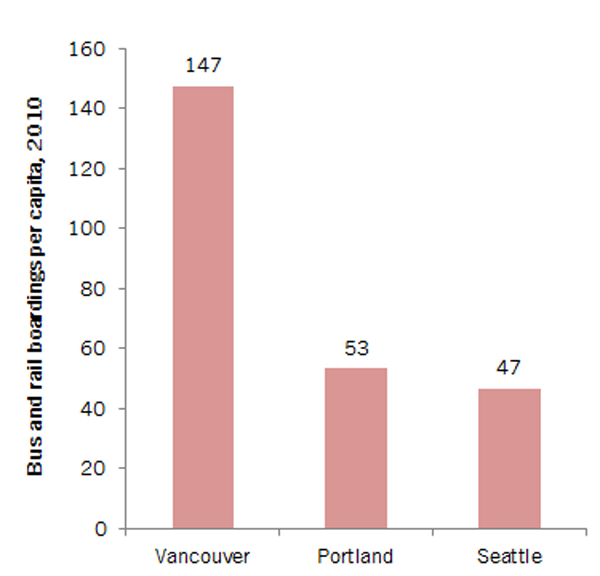
Not only does Vancouver crush Portland and Seattle, but proving it involves nifty analysis and charts.

By Clark Williams-Derry, 19 Jul 2012, Sightline.org

Transit ridership graph

Chart courtesy of Sightline Institute.

Related

When it comes to commuting by transit in the larger cities on North America's northwest coast, neither Portland nor Seattle can hold a candle to greater Vancouver.

The simplest comparison among the three cities looks at the average number of bus and rail transit boardings per person, per year, in the entire metro area. And on that measure, Vancouver vastly outstrips its two southern neighbors (see chart at top of story).


Unfortunately, the story is somewhat more complicated than this chart suggests. Vancouver's transit system encourages transfers -- and since there's a single, unified transit agency for metro Vancouver, there's good data on how many riders actually transfer in the course of a single trip. Seattle, in contrast, has so many overlapping transit systems that it's very difficult to assess how many transfers there really are.

Still, even if you assume that each transit boarding in Portland and Seattle represents a single trip, but use Vancouver's data on "trips" rather than "vehicle boardings," Metro Vancouver still beats the two U.S cities handily:

Using the same "trip" definitions in the chart above, a mode-by-mode breakdown shows that Portland has far more rail riders than Seattle, while greater Seattle edges out greater Portland in bus ridership. But Vancouver still comes out on top in both categories.

Trips per capita, 2010*

By Bus: Vancouver 56, Portland 32, Seattle 43
By Light Rail: Vancouver 33, Portland 21, Seattle 3
By Commuter Rail: Vancouver 1, Portland 0, Seattle 1

Bus and rail trip graph

*Note: Vancouver data represent transit "trips," while data for both Portland and Seattle represent transit "boardings."

Of course, there's still more to the story. These charts exclude a number of transit modes, including dial-a-ride transit (which is typically door-to-door service offered to those who are physically unable to use standard transit service), as well as vanpools and ferries. I've decided to keep those out of the analysis for now, but I'll note that after including ferry trips in the total trip count count, Seattle's per capita transit ridership ties Portland's; and when you add in vanpools as well as ferries, Seattle narrowly edges Portland.

So perhaps Portland and Seattle are about tied... but tied in a race to see who comes in a distant second to Vancouver.

Notes and Caveats:

For this analysis, we considered all of the transit agencies in the greater Portland and Seattle metropolitan areas, as listed in the National Transit Database. For Seattle, those agencies included King County Metro, Sound Transit, Community Transit (in Snohomish County), Everett Transit, the City of Seattle, and a handful of ferry providers -- but not Kitsap Transit. For Portland, it included Trimet, C-Tran in Clark County, the South Metro Area Regional Transit agency in Wilsonville, and the Metro vanpool program.

All data for Metro Vancouver comes from Translink. In Seattle, Light Rail includes the monorail and South Lake Union Trolley. Population for the Seattle metro area includes the full population of King, Snohomish, and Pierce counties. Greater Portland's population includes Clark County, Washington, and Clackamas, Multnomah, and Washington counties in Oregon. Population for greater Vancouver includes all of Metro Vancouver. Note that Seattle and Portland population totals, as described above, may differ from the populations of the service areas as defined in the National Transit Database.  [Tyee]

29  Comments:

Login or register to post comments

  • snert

    43 weeks ago

    Hmmm?

    Long on hype, short on apples. It might be nice to see the respective population densities and surface areas include in the article. Also the total length or each type transit system.

    The article should have been written so that the disclaimer, "*Note: Vancouver data represent transit "trips," while data for both Portland and Seattle represent transit "boardings."" was never used.

  • Grumpy

    43 weeks ago

    Beware of TransLink and its questionable statistics.

    Really, this nothing more than TransLink speak; a self congratulatory bit of nonsense.

    Comparing Vancouver with Portland and Seattle is more than "apples and oranges", it is like comparing fruit with vegetables.

    The study also forgets to mention that now over 100,000 - $1.00 a day U-Pass, which gives pass holders unlimited travel on Vancouver's transit system. This means U-Pass holders are skewing ridership figures with multiple trips and multiple trips means the U-Pass holder is being counted multiple times. This is called "recycling".

    Also, TransLink forces bus riders onto SkyTrain and has admitted that over 80% of SkyTrain's ridership first takes a bus and again are recounted and is another example of "recycling".

    Not mentioned is that both Portland and Seattle are less dense than Vancouver and have established major highways through the city, unlike Vancouver, which means it is easier to get around by car.

    The other big difference is that both Seattle's and Portland's public transit agencies are audited regularly by Federal agencies, while in Vancouver, TransLink and BC Transit (and their statistics) are never seriously audited by provincial and federal agencies and their statistical analysis is questionable.

    Despite well over $8 billion dollars has been spent on two SkyTrain mini-metros and the Canada Line hybrid metro, Vancouver is still rated as having the worst congestion in Canada and second only to LA in Canada and the USA combined and is the real reason for this little bit of propaganda.

    http://www.railforthevalley.com/latest-news/zweisystem/letters-to-the-editor/

  • Rico

    43 weeks ago

    Poor Grumpy

    Ah Grumpy it must be horrible being Grumpy all the time. Especially sad if you are always hating the city you live in (or near at least).

    It is worth noting the article actually went easy on Seattle and Portland. Vancouver looks even better if you compare transit mode share (I know a lot of this is because of density and a lack of Freeway infrastructure in Vancouver but still). You should note that even in your everything is a Translink conspiracy mind that mode share data is collected by Statistics Canada (or the Census bureau in the States)....Oh no even Stats Can is in on it....

    In addition you should note Vancouver got a significant increase in transit mode share for its 6 billion dollar investment while Portland's transit mode share stayed the same after its 4 billion dollar investment.
    How do you measure transit success? If it is change in mode share or numbers of new riders or cost per rider or cost per new rider Vancouver's investment is paying much better returns than Portlands (I have not seen the numbers for Seattle for all of those measures but I would assume Vancouvers system beats them as well).

    As for congestion I read the study, it raises some interesting observations but has some flaws as well. The SouthofFraser blog did a good 'critique' of the congestion study. http://www.southfraser.net/

  • dwlonline

    43 weeks ago

    Data for 2010

    Though this is good news for Metro Vancouver, it would be nice to see data from a different year for me to find this conclusive.

    In February 2010, thanks to the Olympics, we had more transit users than normal in our city. During the games, everyone was using transit to get around. Like it or not, that spike in ridership creates an unfair advantage for us over the other two cities as far as a comparison of "regular transit use" is concerned.

  • Grumpy

    43 weeks ago

    Oh yes Rico transit is such a success, that...........

    ...........nobody buys with SkyTrain; no one copies Vancouver's transit planning; and Vancouver has the worst congestion in Canada and only second to Los Angles.

    The taxpayer has spent almost $9 billion on a dated light-metro system that has done little to attract people to the transit system and is noted in giving bus customers an inconvenient transfer from bus to SkyTrain.

    Dated, expensive, and inefficient best sums up TransLink and again why this 'puff' piece has been written.

    If the public really knew the real story about transit and TransLink, there would be hell to pay!

  • Rico

    43 weeks ago

    dwlonline and grumpy

    dwlonline, good catch I missed that the base year was 2010 but the APTA numbers for 2011 showed Vancouver had more boardings in 2011 than 2010 so it should not be a problem.

    Grumpy, Grumpy, Grumpy....Forgot to mention both Seattle and Portland Universities have a U-Pass (doesn't it suck when it turns out everybody likes and uses something you rail about? Pretty sure most cities/universities have some version of the Upass).

    'The taxpayer has spent almost $9 billion on a dated light-metro system that has done little to attract people to the transit system' apart from the mysterious figure of 9 billion (pretty sure to date in current dollar values the Skytrain/Canada line expenditures are 6 billion including trains, not sure if it includes interest charges but I am sure there has not been 3 billion in interest). According to Stats Canada (going from memory but I could look it up if you insist) in 1989 transit mode share in Metro Vancouver was about 8.5% in 2008 (pre Canada Line) transit mode share for Metro Vancouver was 16.5% (numbers would be higher for the City of Vancouver). That would qualify as 'attracting people to transit,' I figure....especially since in the past you have praised Portlands system as attracting people to transit and its transit mode share has remainded static and its ridership/boardings have risen less quickly than Vancouvers. Why the hate on for Vancouver transit? Did someone at Translink kick you off a bus once?

  • Macb423

    43 weeks ago

    "Not mentioned is that both

    "Not mentioned is that both Portland and Seattle are less dense than Vancouver and have established major highways through the city, unlike Vancouver, which means it is easier to get around by car."

    And Grumpy thinks this is a BAD thing for Vancouver?? Thank God for those protesters in the 70s who stopped highways going through our downtown.

    I've lived in Seattle. I-5, I-90 and 520 are ugly gashes that ruined Seattle's Chinatown and wrecked any sense neighborhood in downtown. I much prefer getting around in Vancouver to Seattle. I don't have to own a car here. It was inconceivable not to own a car in Seattle, even though I lived in a very central neighborhood.

  • Hakuin

    43 weeks ago

  • Michael Kidder

    43 weeks ago

    Macb423

    You're Welcome

  • snert

    43 weeks ago

    Michael Kidder

    I think you might want to try living up the valley for a few years before you start crowing too loudly.

    Congestion equals pollution no matter which way you cut it. Public transit will not alleviate that.

    I think we should all start to work on getting the Greater Surrey Regional District up and running, let Vancouver wallow in it's own effluent.

    Far too much attention is being paid to this prima donna of 'world class' cities. Grumpy is right but for the wrong reasons.

  • rac

    43 weeks ago

    Marketing Move

    Grumpy, are you really that naive? The congestion "study" that you mention was obviously just a brilliant marketing move by the GPS company. Obviously it worked.

    If you look objectively, LRT in North America has not been that successful outside of Calgary. In Calgary, its success is mainly due to high downtown parking prices.

  • Grumpy

    43 weeks ago

    er rac..............

    ...........neither than SkyTrain old chum, just one demonstration line in Detroit and a glorified and heavily subsidized airport people mover in New York.

    So lets see only two SkyTrains built in the USA since 1980 versus 25 or so new light rail lines.

    So if we look at SkyTrain objectively, it has been a complete marketing failure!

    If we had invested the same amount of money into light rail instead of SkyTrain the present "rail" network would have been at least three times a large or even larger, carry double todays present ridership.

    Vancouver's dismal congestion ranking (plus the massive gateway highway and bridge project) has shown that SkyTrain has been a failure. SkyTrain does carry a lot of people, but they are recycled from the bus system by forced transfers - now that's clever marketing.

  • Michael Kidder

    43 weeks ago

    Snert

    I agree that, ultimately, it would be nice if every polluter everywhere got to ‘wallow in its own effluent’; if effluent could only be trained to stay nicely where it was created.

    But our geography dictates that every car that reaches downtown equals even more crap blowing up the valley. So for those doomed to driving downtown because of shortsighted transit planning; it is partly your own shit you smell, not just the elitist Vancouverites.

    The lack of freeways through Vancouver is not the issue in the valley. And while congestion does indeed equal pollution, there simply isn’t enough surface area in our shared valley to give everyone their own thru-lane into town. All those pesky rivers and peninsulas preclude paving our way to freedom. A more realistic solution needs to be presented.

    Over the past forty years an entire network of light-rail could have been built, at a fraction of the cost of those pretty photo-op sky trains, if only someone had listened and planned ahead. But no, at all levels of government, strip mall mentality has permeated; local counsels beholding to developers, provincial governments beholding to anyone who will give their parties money, and federal governments who just don’t seem to get it.

    None of this is a strictly Fraser Valley problem of course. Cities everywhere are facing the same issues. What to do with all the damn people and the feces they create?

  • Michael Kidder

    43 weeks ago

    BTW

    Ex resident of Surrey and White Rock

    Current resident of Richmond

    About to be a resident of Ladner

  • Rico

    43 weeks ago

    Can Grumpy learn?

    Actually I think it is a valid question, Grumpy can have some good points (of course they are always the same ones) but he does not seem to acknowledge any points that differ from his very narrow view (at least on transit). However I do need to agree with him on one point, discounting LRT in North America because only Calgary is successful is unfair. Especially since the same could be said about Vancouver (I am not aware of any other 'mini' metro systems in North America I would call successful).

    EDITED FOR PERSONAL INSULTS -- MODERATOR

    Grumpy when you say,'If we had invested the same amount of money into light rail instead of SkyTrain the present "rail" network would have been at least three times a large or even larger, carry double todays present ridership.' You are full of it. If you look at the results from Calgary maybe you could draw that conclusion, if you look at the results from any other North American city you would see that we have done better on ridership/mode share per dollar here in Vancouver. In the end it comes down to a lot of small details. I think it is safe to say that any reasonably well designed 'mini' metro will far exceed the ridership on any but the most rare LRT lines....unless they are constructed just like a 'mini' metro (ie Ottawa at a price similar or higher than the Canada Line). That said not everyplace justifies a metro and some places have naturally existing right of ways that connect destinations that would be perfect LRT routes....only be careful....a lot of the reason the Canada Line is so successful is the fact that it goes to a lot of destinations on a direct route between destinations. A LRT on the Arbutus corridor (that you advocated for) would have been much cheaper to build but would have added distance while missing most of the major destinations between Vancouver and Richmond and that (rather than LRT vs metro) is why it would have had much less ridership that the Canada Line. I would be willing to bet that on a cost per new rider basis the Canada Line would have beat the Arbutus corridor, just like on a cost per new rider basis the Vancouver skytrain system probably beats almost every North American LRT system except Calgary (certainly it beats the Portland and Seattle systems). I know you hate Vancouver but the numbers are pretty clear whether you like it or not. Transit in Vancouver is highly successful (based on ridership or transit mode share or even if you base it on the cost/new rider on Skytrain). Stop bashing Vancouver and help make constructive suggestions to make it better (I know you don't do constructive...but try..).

  • Dan the socialist

    43 weeks ago

    Transit in Vancouver is

    Transit in Vancouver is highly successful
    ==

    I will comment on that later once I stop laughing so hard..lol

  • Rico

    43 weeks ago

    Dan the socialist

    I meant to say in a North American context transit in Vancouver is very successful. Clearly we are not in the same league as Europe or Asia.

    Feel free to point out a North American city that performs better with Transit than Vancouver, I can only think of a few, New York, Toronto, Montreal and Ottawa. Others maybe Calgary, Boston San Fransisco and Chicago (depending on what metrics you use and personal preferances) considering Vancouvers size I would say that is pretty good (I probably left out one or two but the general point stands). Also note most of the cities I listed are much older/bigger with more pre-automobile development than Vancouver.

  • snert

    43 weeks ago

    Michael Kidder

    Vancouver is the Toronto of BC. It thinks it is the centre of the universe. Maybe it's time to start working on those areas that surround Vancouver and get them organized with better transit options. Oh, wait we're doing that already. Just forget about the city. We've wasted enough money on their screwed up planning.

  • Michael Kidder

    43 weeks ago

    Why the ‘us versus them’

    Why the ‘us versus them’ bullshit. We share a finite valley on a finite planet. My odious discharges are in your soup; and yours in mine. It is a small world after all.

    There is a difference between proposing solutions and pointing fingers.

  • Grumpy

    43 weeks ago

    The Canada Line successful...................

    .......oh please don't insult me any more.

    The Canada line is a truncated metro that can attribute its ridership with the mass force feeding of Richmond and South Delta/Surrey buses and the proliferate use of the U-Pass. Oh yes and let us not forget the YVR workers who use the Canada line for free on Sea Island!

    The Canada line as built has less capacity than a modern streetcar or light rail line.

    The Canada Line is too expensive to extend into Richmond and is useless for inter Richmond travel.

    The Canada line was supposed to take 200,000 car journeys off the road but highway use has increased.

    Transit users in South Delta want their direct to Vancouver bus service back as the forced transfer is troublesome and most now drive to Vancouver instead of taking the bus.

    The Canada Line is an over built metro, built to appease the Liberal anti-LRT crowd along the Arbutus Corridor, the P-3 Lobby lead by the then Premier's brother, and the Liberal friendly YVR who wanted a metro for international status. In the real world, subways are never built unless ridership exceeds 15,000 pphpd or more, yet the Canada Lines maximum capacity is 15,000 pphpd.

    Yeah a real-class success.

  • Rico

    43 weeks ago

    Canada line

    Where to begin. ...so many flaws in your post.
    To start with any change in service means some people will get better service and hopefully only a few will get worse service. The fact that ridership in South Delta and on the feeder buses from Surrey have dramatically increased since the Canada line was built says that more people now have better service than those who have poorer service. Since YVR spent a wack of cash I certainly have no problem with letting its employees use the line free on Sea Island. They still pay if they leave Sea Island.

    You are actually sort of correct about capacity, but only sort of. You could have a higher capacity LRT line but without expensive grade seperation it would be very slow on Cambie because you could not have full signal priority at high frequencies(not to mention car turns onto cross streets).That being said it will be a while before we reach 15,000pphpd and so travel time is more important as long as the system has enough capacity...and it does.

    Care to post a link for highway use increasing? Pricetags actually posted something showing that traffic through the Deas tunnel have decreased by a very small amount over the last few years, throw in population growth and that is impressive.

    Now for your famous in the real world subways are never built unless they have at least 15,000pphpd. What a crock. There are so many subways with less than 15,000pphpd it would probably take a full post to list them all. Obvously the real world is bit different than you think it is.

  • tofumagoo

    43 weeks ago

    Multiple transit options

    One shouldn't look at any single mode of transportation in isolation from others. For example, I suspect that there are more bicycle commuters in Portland than in Vancouver, if only because of the support the city provides for cyclists. For example, see http://www.portlandoregon.gov/transportation/39402 .
    A better comparison could be made by looking at the percentage of trips made using the different modes (car, public transit, bicycle, walking, other) along with the length (distance and time) of the trip. And of course, you could always survey a population on how satisfied they are with their transportation options. No transportation mode is complaint free.

  • mjscox

    43 weeks ago

    U-pass user

    Just to be clear: I have had the use of the monthly U-pass while a graduate student, and I don't see how I could be counted at all, considering that (a) I've never had a fare check at the Canada Line or Skytrain and (b) I show my U-Pass card to the bus drivers, but I never actually pass it through the ticket machine because it takes way too long to do that and neither the driver nor all the passengers standing in line behind me, or those on the bus, appreciate the delays caused by the slow technology of the ticket dispensing/franking machines. So you tell me how Translink or anyone actually counts pass holders, other than by sales of the passes and some fancy math around your "average" user's transit habits.

  • Rico

    43 weeks ago

    tofumagoo

    I agree entirely in reality it is not the number of transit trips we want to maximize but the number of car trips we want to minimize. I can't remember where I saw it but I did see something (perhaps from the Siteline institute as well) comparing the different modes between Vancouver Seattle and Portland. Pretty sure Portland led with biking over Vancouver but not by much. Vancouver had way more walking than Portland. Seattle had low biking but good walking numbers.

  • snert

    43 weeks ago

    Rico

    Quote:
    Pricetags actually posted something showing that traffic through the Deas tunnel have decreased by a very small amount over the last few years, throw in population growth and that is impressive.

    It's only impressive if you know the rest of the transportation stats for the other transportation options serving the same areas. Further it may only be a symptom of the congestion that plagues the route and have no other relevance.

  • Fii

    43 weeks ago

    It's probably just a lot more

    It's probably just a lot more expensive to own a car here and has little to do with the people being more envirnomentally friendly. I was told at an Enterprise car rental that in BC we pay the hightest insurance rates in North America. Gas is more expensive here; Portland would definitely get more sun so perhaps more people ride bikes than take transit.

    Anyway, the whole idea of it being a "race" was typical "We're the best, pat ourselves on the back" bs and the whole article made me roll my eyes once again at the smug attitude of people in this city.

  • Rico

    43 weeks ago

    Snert and Fii

    Snert, you are correct but the only other transportation option I can think of between South Delta/Richmond/Vancouver would be transit....and that has increased significantly....And yes it could be a symptom of the congestion (or not since buses would also be caught in the jam).

    Fii,
    I actually think the reverse is the problem that annoys me. Clearly we are not the best in many areas, but Vancouver is a pretty good place. What Vancouver has a lot of is people who trash it well beyond what is warrented. Grumpy is a case in point, Vancouver certainly does not have the best transit in the world, but it has some of the better transit in North America (I know a low bar) and most of the cities with better transit in North America are much larger/older with established systems. If you listen to Grumpy we have the worst transit in the world....which we clearly don't. In the end people like me end up sounding like cheerleaders because all we have time to do is stand up to the bashers....also note the author of the article is from Seattle (not Vancouver) so you should only be rolling your eyes at my 'cheerleading' in the comments not at the city in general.

  • Rico

    43 weeks ago

    Snert

    To the best of my knowledge the only viable transportation options for South Delta/Richmond/Vancouver would be by car or transit on the Deas tunnel. Transit use from South Delta to Richmond has significantly increased with the Canada Line. And yes it could be because of congestion, especially from Oak street onwards because the Canada Line avoids the congestion. Buses would also get caught in the congestion at the tunnel (although there are bus lanes part way).

  • Rico

    43 weeks ago

    Snert

    To the best of my knowledge the only viable transportation options for South Delta/Richmond/Vancouver would be by car or transit on the Deas tunnel. Transit use from South Delta to Richmond has significantly increased with the Canada Line. And yes it could be because of congestion, especially from Oak street onwards because the Canada Line avoids the congestion. Buses would also get caught in the congestion at the tunnel (although there are bus lanes part way).

    • The discussion for this story is closed. No more comments can be added.