

Opinion

The Rise of 'New English'

A new grammar order is dawning. Plus 10 ways to tell if you speak the language.

By Crawford Kilian, 16 Feb 2012, TheTyee.ca

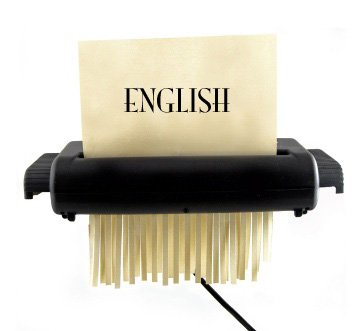
Old English through the shredder

Goodbye, English language of yore.

Related

Linguists estimate that about 2,500 of the world's 6,000 languages are "endangered." One of them is mine: 20th century North American Standard English.

An endangered language is one whose speakers' children are unlikely to be using it 100 years from now. North American Standard is already vanishing before our eyes (and ears).

I have an understandable reason to regret its passing: I taught it from 1967 to 2010. Long before I left the classroom, though, I knew I was whipped. Better said, Standard was whipped -- by more politically powerful dialects.

A dialect is a version of a language that's more or less understandable to speakers of other dialects. If a dialect's speakers wield political and economic power, they establish the de facto standard for the whole language. So when my beloved Standard is no longer the standard, I know power has moved away from me and mine. Those who speak and write New English are in the saddle.

The Standard I learned in the 1940s and 50s was a hand-me-down from the English of the 19th-century British and North American upper middle classes. (Aristocrats spoke and wrote as they pleased, and damn your bloody eyes if you didn't approve, you contemptible little clerk.)

Those middle classes, relentlessly rising, tended to ape the manners of their betters -- not because they admired aristocratic behaviour, but because that was where the money, power and prestige were.

The English of power

Chaucer, I taught my students, wrote and spoke in the dialect of 14th-century London. Lots of poets were active then, but their works were doomed by their rural dialects. London English was the English of power, and you learned it if you sought to rise with the rest of the middle class.

But even London English was subject to linguistic drift. Constant immigration brought new words, unusual grammar, and odd accents. Imperial expansion accelerated the process even as it planted colonies in North America, Australia and South Africa -- where London and rural English dialects evolved away from their roots.

The power elites' dialects in those colonies rapidly evolved into local Standards, but none survived intact for more than a generation or two. Speakers of other dialects were always migrating into the country, or rising from the lower classes, to create new standards.

Worst of all, kids of all classes ignored their parents' dialect and invented their own. The Norman masters of medieval England must have been furious when they had to hire French tutors for their own children, who'd been hanging out in the barnyard with the Saxon peasants' kids, learning rude words until they were now speaking like peasants themselves.

If you like old American films, you hear a lot of the now-dead dialect called Mid-Atlantic. You can hear it also on CBC Radio programs like Rewind. I certainly heard it in the radio and movies of the 1940s, but by 1960 my generation had framed its own Standard.

And now... the test!

That Standard is now on its way out, along with its speakers. New English -- yet another mutant -- is reframing my dialect as Old English. New and Old dialects still overlap, but you might as well know which one you're speaking. So here are 10 ways to tell if you speak the New English of youth or the Old English of age. If these sentences sound OK to you, you're New English; if they don't, good luck finding a nursing home where they'll understand you.

1. "Thank you very much." "No problem." In Old English, the answer would be: "You're welcome."

2. "Me and him went to the Canucks game." In Old English, "me" and "him" are in the objective case, not the subjective; in New English, "I" and "me" and "he" and "him" are interchangeable: "Dad gave he and I tickets to the Canucks game."

3. "Snow and sleet is falling on the Coquihalla." Old English treats a compound subject as plural. New English doesn't know what a compound subject is.

4. "The Sedins played great in the third period." In Old English, verbs take adverbs, not adjectives: "The Sedins played brilliantly in the third period."

5. "You did real good in your presentation, you're sure to make the sale." In Old English, you do real good when you donate to the Red Cross, and you do really well when your presentation impresses your audience. Also, in Old English, you put a period or semicolon between one independent clause and another if you don't want to use a conjunction like "so."

6. "We've done alright since we moved to Calgary." In Old English, "alright" is alwrong. We say "all right."

7. "The company has less full-time employees, but the amount of part-timers has grown." In Old English, "less" and "amount" apply only to non-count nouns like "flour" and "wealth." It says "fewer employees" and "number of part-timers."

8. "The committee made a fulsome study of the problem." In Old English, "fulsome" means insincerely flattering. In New English, it somehow means "full."

9. "She's an alumni of Simon Fraser." In Old English (and Old Latin), "alumni" is the male plural of "alumnus," and she must be an alumna of SFU.

10. "So I'm like, ‘What's your problem?'" In Old English, "I'm like" is pronounced "I said."

New English isn't "wrong." It's just the latest mutation of an endlessly evolving language. And language usage helps to define who's in and who's out. Speak the language like a native, and the natives accept you. Speak it with an accent, or ungrammatically, and the natives will know you're not one of them. (My Fair Lady is the classic dramatization of language as class weapon.)

So my generation of Old English speakers will always be at a distance from New English speakers. They understand us (mostly). We understand them (mostly). But we recognize that our dialects reflect bodies of experience forever closed to one another.

New English will of course age. By mid-century, it may have evolved into a "Mid-Pacific" dialect, as rich in Chinese and Japanese terms as Chaucer's was rich in French. Or Spanish may move in and make itself at home.

Whatever, as New English speakers would say. Each new dialect will reflect shifts in power as each generation rises. And aging New English speakers will no doubt be scandalized when they say "Thank you," and young louts will say "Huh?" instead of a polite "No problem."  [Tyee]

51  Comments:

Login or register to post comments

  • Mal Content

    1 year ago

    The rise of the new English

    Very well done. I taught the old English from 1970 to 2010 and can relate to all that you have said. I was once reprimanded by a school superintendent for responding to a student's correct answer with "okay" rather than "that's right".
    I also remember Prof. Archie Baker at SFU lecturing on the futility of rules of grammar saying, " A mistake every one makes is not a mistake."
    From the back of the theatre came, "55 million Germans can't be wrong!"
    Please keep up the good writing.

  • Mal Content

    1 year ago

    Correction

    Of course, it was Prof. Ron Baker, not to be confused with Prof. Archie Mc Pherson of the geography dept. Both of whom were great educators.

  • Don_EC

    1 year ago

    Disappearance of "Take"

    The 11th item I would add to your list is the rapid disappearance of the word "take" from our discourse in the past decade.

    It has been almost universally replaced by "bring", regardless of the proximity of the speaker to the final destination of the object in question.

  • snert

    1 year ago

    The problem is simple

    People are no longer required to put their thoughts in measured form. Most communication now is impulsive and nobody really cares how grammatically correct it is as long as the message is understood.

    Then, of course, there is legalese which has to be so correct that it might as well be a foreign language.

  • Birch

    1 year ago

    Truly a Pleasant Piece

    Thank you for another amusing look at linguistic drift in contemporary culture. I find my students somewhat incredulous to find that, yes, people really spoke that way in Shakespeare's day.

    It would truly be futile to fight linguistic change. On the other hand, it is counterproductive not to struggle against muddying of meaning. We may all think we know what we mean when we exchange the warm fuzzies of banal cliches, but Orwell's cautionary criticisms in POLITICS AND THE ENGLISH LANGUAGE and other works should not be ignored. And of course, how does it go?
    "I know you believe you understand what you think I said, but I am not sure you realize that what you heard is not what I meant."

    Keep writing these illuminating pieces. Best of luck.

  • Kreditanstalt

    1 year ago

    Into that dark night...

    The dumbing of...Canada?

    I've also noticed the lamentable trend toward video and audio, in place of actual READING, online...

  • Sam Gunsch

    1 year ago

    Hansard records spread of "New English"

    "The committee made a fulsome study of the problem."

    Alberta's Hansard now documents your observation re the "New English" version of "fulsome".

    Just a couple days ago, in our legislature, our new premier, Alberta's Alison Redford, said 'fulsome' with great emphasis on the "New English" meaning, several times in an almost identical sentence structure to describe and defend the work of committee that reviewed proposed mega-powerlines.

    For anyone familiar with the powerlines political history, Redford's usage contrasted with Standard English meaning is thus quite unintentionally ironic.

  • wiley

    1 year ago

    yo

    dude? come on dude, git wit the program dude. kay?

  • Rian Harrison

    1 year ago

    New English

    Spenser wrote no English, but elisions are no problem.

  • Rian Harrison

    1 year ago

    New English

    And unless you own a salmon stream or barrels of scotch, "you're welcome" is simply an inaccuracy hardened into a cliche.

  • anarcho

    1 year ago

    Seems like nothing but bad

    Seems like nothing but bad grammar to me - the spread of illiteracy. Some how I don't see grammar teachers and editors putting up with it

  • DroneLove

    1 year ago

    Big miss: Nouns as verbs

    Good article, but you left out one of the most important recently developments... the widespread rise of nouns as verbs.

    "Just google it"
    "I'll friend you"
    etc...

  • dannyyam

    1 year ago

    An entertaining read.

    I find myself frequently using both styles myself. The only bit I found myself puzzling over was fulsome. I am aware of the usual definition of the word as above, but I had no idea that it now implied somehow "full".

    While I routinely lament the loss of spelling and grammar (even in published works and news), I had a good teacher who understood that a language is ALIVE and changes as the populace that uses it changes. Anyone who questions this should review the "spurious words" section of the Oxford English Dictionary.

  • snert

    1 year ago

    I love this one

    "9. "She's an alumni of Simon Fraser." In Old English (and Old Latin), "alumni" is the male plural of "alumnus," and she must be an alumna of SFU."

    We're speaking English here not Latin so I think it's about time alumni became gender neutral. Nothing like trying to justify the use of stuffy olde dead languages.

  • videopro

    1 year ago

    Use's of the apostrophe

    Thank you, Crawford, for bringing up this topic. Considering your background in the classroom, I admire your tolerance of those who are now truly butchering the English language. I would, however, respectfully suggest that there are several different levels of butchering occurring here.

    I would suggest "Thank you / No problem" and "I'm like, 'whatever'" are examples of what you call New English - mindless phraseology but without obvious grammatical and other errors.

    "The data is clear", "the media's killing us" and "I memorized the names of several Attorney Generals" are mildly unaware but certainly not majorly ignorant (just checking to see if you are paying attention - haha).

    But "Me and him were learned animal husbandry out of Wichita" is another story entirely in the apparent evolution of the English language; God help us.

    My personal favourite in the demise of proper written English is the recent onslaught of the apostrophe. As Dave Barry explains in his role as "Mr. Language Person", the apostrophe is used to alert the reader that an "s" is coming up at the end of the word, as in ... "not responsible for any item's". Extra points when the apostrophe is use in verb's, and I swear I am seeing this every day on the internet: "she walk's her dog every morning". Pretty pathetic.

  • avandoc

    1 year ago

    And just a few more

    "I'm good " seems to mean "no thank you," not "I'm well behaved." People are disappearing and are being replaced by folks. And folks add "stuff" as a suffix to any word to avoid saying something more precise or concise.

  • Langley

    1 year ago

    Bothersome

    I'm becoming used to people speaking in 'whatever' English. It doesn't bother me none.

    This really bother's me. My cat's are also bothered. Apostrophe's on plural's. Absolutely disgusting.

    Any businesses that have made this mistake on their advertising get an instant permanent boycott from me. A man's gotta have a code.

  • ratemmer

    1 year ago

    You guys will love this

    Our friends at The Oatmeal have created some hillariously excellent grammar cartoons to help bridge the divide between those who grew up on books and the proper use of semi-colons... and those who grew up on the Internet

    http://theoatmeal.com/tag/grammar

    (I would also add to your list my very favourite sin... the superfluous use of parentheses)

  • Bailey

    1 year ago

    Sufficiency of scale

    These are created dialects, as opposed to more organically evolved regionalisms or accents.

    They are created usually to delineate class distinctions that become important for political reasons. The expressions "I'm like" and "me, I'm all about" derive from subcultural aspirations of southern California high school kids, and these have been culturally transplanted in bulk by television, very much like the Transatlantic was transmitted by radio in the 30s 40s and 50s.

    The last organically evolved English dialect I know of was the inner city black variation that arose after the hippy moment that had been increasingly inhabiting subcultural neighborhoods there evacuated, distressed by large fires and concentrated police and political actions. They moved outward to the countryside and the remaining subclasses there felt the need for a clear cultural identity.

    Most of the nonstandard English I hear now is just a bit precious. It seems to be self-consciously created to prove to the young that they are not yet old, or to some group that they are not some other group.

    I doubt it will last, but it does stand a good chance of becoming evolutionary, and resulting in a new organic format down the road, two or three versions down the road, unless the current downturn in television consumption continues and removes the vector and bulk transmission mechanism.

    I sort of alternate between two theories, depending on my day. One that it's an intentional vagueification meant to prevent analytical thought among the masses, like Orwell described as 'Newspeak' in "1984", and one that it's nothing more than poor teaching in an insecure jobmarket.

  • Granville

    1 year ago

    The linguistic dichotomy isn't really an issue...

    as long as both people are speaking the same version of English.

    If two young people are having sex, they are likely to speak the "New English" as they do.

    When two older folks are having sex they will speak "Old English".

    That is why it is unwise for a 60 year-old man to have sex with an 18 year-old girl. It isn't the age difference that is the problem, but the linguistic difference.

    It is just plain distracting to hear her say "Oooh, like, please do me again" as she blows bubblegum and listens to her iPod music.

    At least, that is what they say.

  • Rian Harrison

    1 year ago

    New English

    The avoidance of errors is nothing to brag about.

  • saeros

    1 year ago

    Interesting article. Just a few points...

    If you could speak to someone from 10th century England, they would likely say the same things about how you speak English as you do about how people speak it now; except you wouldn't understand them, and vice versa. Things change.

    I just have a few comments about some of the things you wrote, most interesting of which is number 8. Each number in my response corresponds to the number in your test:

    1. Strictly speaking, they wouldn't have said "you're welcome" in Old English. They would have said something to the effect of 'Georne!' (YOR-neh). In any case. I still hear most people say "you're welcome".

    2. The cases have been disappearing from english for a long time; it's not a phenomenon of 'new english'. Pronouns are the final line of defense against the tidal wave of simplification. I believe it was the effect of Norman French beginning in 1066 that led us down this path.

    6. 'Alright' was first attested in 1893. That isn't particularly 'new'.

    7. Incidentally, 'less' originated in Old English as læs (adv.), or læssa (adj.), meaning something like 'smaller'. It also meant 'younger' at one point. Things change.

    8. Now here's the really interesting one. The word fulsome originated in the 13th century with the meaning of 'full' or 'abundant'. Only in the 17th century did it come to mean 'insincerely flattering'. The new usage in fact follows the original usage. It's funny how things play out over time.

    9. When words are borrowed into a language, they are often modified, as they should be, to match the the morphology of the new language. In latin 'alumni' might be the masculine plural form, and 'alumnae' the femnine plural, but that distinction is null, and dead in modern english. It's the same with what you refer to as 'old english', too.

    10. The usage of like in that way ("going, like, really fast") originated in the 1950's. I believe it's called a discourse particle.

  • Moonbug

    1 year ago

    one small quibble

    In Old English, "less" and "amount" apply only to non-count nouns like "flour" and "wealth." It says "fewer employees" and "number of part-timers."

    *

    Except the "rule" is not that simple:

    "Thus the first “exception” to the “rules”: Use “less” when the context refers to a quantity, rather than individual things, even if there are a number of things. Thus, “he earns less than a thousand dollars a week,” but “he earns five hundred fewer dollars than his wife.” "

    "Other “exceptions” include distances (“less” than ten miles away), percentages and fractions (“less” than two-thirds of the voters), time (“less” than sixty seconds), measurement (“less” than thirty square yards), etc., etc., etc. (And, by the way, you shouldn’t use “fewer number,” as in “a fewer number of people.” When you say “fewer,” you’re already signaling that you’re talking numbers.)"

    "Merriam Webster’s Dictionary of English Usage points out that the “rule” actually started out as a “guideline,” where common sense, ear and elegance trump “right” and “wrong.”"

    http://www.cjr.org/language_corner/less_is_fewer.php

    This article is nice in that it doesn't try to mark one language "right" and the other "wrong" - but the reason many of these usages are falling out of style is that they are nonsensical. To the average person, "less" and "fewer" mean exactly the same thing.

    Yet then you have some people on their crusade to feel special and "right" - campaigning (wrongly I might add) to take the word "less" off grocery express lanes:

    http://www.telegraph.co.uk/news/uknews/2659948/Tesco-to-ditch-ten-items-or-less-sign-after-good-grammar-campaign.html

    Its just such a colossal waste of energy to try to fight the tide of linguistic change - and it is also quite an elitist undertaking.

  • VivianLea Doubt

    1 year ago

    pathetic...

    '..."she walk's her dog every morning". Pretty pathetic.' Why is it pathetic that she walks her dog? No problem, hey, I just wanted to point out that you weren't very clear there...

    Language is our attempt (mind, attempt is used purposefully) to communicate meaning to each other, and the way I see it anything that enriches that is marvelous. I have no difficuly understanding "no problem" said with a smile from someone I've thanked: the antithesis is the sour citizen who replies "you're welcome" with no hint of friendliness in the perfectly correct fashion. I'll try not to belabour the point, although I'm tempted...because honestly, WTF does 'style' have over 'substance'?

    Sigh. I suppose we'll have to ask our premier. Saeros (capitalized because used at the beginning of a sentence, but OMG, I don't know which is correct - to be polite and use the name as written, or...) anyway, saeros, please come here more often.

    Smilies :)

  • mr_fletch

    1 year ago

    A non-English angle

    Being a native Swedish speaker, it might interest you that the exact same debate is going on regarding changes in the Swedish language.

    On one hand, die hard grammar fiends are lamenting the deterioration of the great Swedish language of yorn. But languages everywhere evolve.

    We don't speak Shakespeare's (yes! I got the apostrophe right!) English or Gustav Wasa's Swedish.

    The main things to distinguish between are misspellings, misuse of words, apostrophes etc and - language evolution.

    "She walk's her dog" is of course just plain wrong, while "I'm like 'whatever'" is (in my mind) language evolution and therefore by definition is not wrong by everyone's standards.

    Believing that there is a 'right' way to speak and write a language means that you are bound for a life on the side lines, bitterly commenting on the sad state of things, instead of enjoying the fact that languages are dynamic and not set in stone centuries ago.

    On a side note, it is relatively easy to read and understand mr Shakespeare's texts in the 21st century, while reading a 16th century Swedish document is very hard (for a Swedish speaker). Probably goes to show that a small language like Swedish undergoes way faster changes than e.g. English.

    Second side note: Don't bash me to hard on my English since it is my second language ;-)

  • snert

    1 year ago

    saeros

    Quote:
    I believe it's called a discourse particle.

    The grammar police must be demented library gnomes who compulsively pigeon-hole everything.

  • Granville

    1 year ago

    This is a lot like a discussion I heard last week on

    Robert's Rules.

    Like, who gives a s**t, then, like?

  • jimmmmy

    1 year ago

    you get paid for this

    your article is tremendously inane. talk about mailing it in

  • Bailey

    1 year ago

    The thought police vs. the grammar police

    Grammar is the structure of language. Language is the structure of meaning. Meaning is the structure of culture. Culture of life.

    I would you like to hear you last three discourse on the nature of your need to criticize other people's interests, or to assign levels of importance to things you don't understand well enough to value.

    Or, as Robert might rule: your remarks are quite out of order.

  • zalm

    1 year ago

    Sometimes

    I swear, and speak in New English, perhaps on the tool line at work. I also occasionally eat fast food when I feel like being a pig. I have been known to drink beer in some of the worst dives in Vancouver, have laid my head in one or two hovels that bedbugs would have been too proud to share with me, read Chris Hitchins, and have regretted a one-night stand that offered little opportunity to me to demonstrate anything other than a little-used talent for being a rutting pig solely concerned with my own selfishness.

    But I don't do those things very often.

    I prefer to live my life drinking a better wine that matches the nourishing meal of fresh ingredients that leaves me with vigour instead of a thick head. The softness of the pillows at the B&Bs I stay at is matched only by the comfort of my own bed. I'm more edified and touched burying my head in Tennyson or Atwood, and I certainly enjoy much more an erotic session of lovemaking marked more by a sharing than a grasping.

    And I generally speak "Old English" because and it represents my thoughts better, with wit and humour, and it can be done completely without pain. The people I speak to in this manner find me engaging and offer their own stories in return, in whatever language they can muster, and we both gain.

    I'm not sure why we want to draw such lines around our common speech. Our lives can only be the less for it, and besides, all young people eventually grow up.

  • snert

    1 year ago

    Bailey

    Quote:
    Grammar is the structure of language. Language is the structure of meaning. Meaning is the structure of culture. Culture of life.

    You are absolutely correct but as often happens in life there is more than one shape to that structure and it can be equally as correct.

  • snert

    1 year ago

    OOPS

    "there is more than one shape to that structure and it can be equally as correct."

    should read - there are more shapes to those structures and they can be equally correct.

    We do need comment editing capabilities.

  • Bailey

    1 year ago

    Thank you, snert

    Once again, as I've noticed before, you rise to meet the discussion. I appreciate that very much.

    And, to return your compliment sincerely, you are also absolutely correct There are a great many interlocking structures which make up every aspect of reality, and certainly that's got to be true of something as complex as life. We discuss them all if we get the chance.

    This article was just quite limited, compared to all of everything, though, even compared to our own individual lives, and the living of them.

    We were just noticing how language is changing around here, and talking about that. It does involve tiny details, but there's nothing blameworthy there. Ten thousand pigeonholes, assigned to ten thousand pigeons, but I really have nothing against pigeons. They're quite interesting and pretty. Worthy of notice and discussion.

    I don't think you can legitimately criticize people for talking about them, any more than you could criticize stamp collectors or tea aficionados or bloggers. We all explore the available complexities of life one way or another.

  • gaulois

    1 year ago

    Dumming down of languages

    Perhaps not isolated to English. And could English in fact not be a form of French dumb down? ;-)

  • Bailey

    1 year ago

    Now that's interesting

    One could make a good case for that.

    In 1066 the Normans invaded the Saxon held Anglish isles and started to define the language in classes. Norman terms for ordinary things were defined as refined and proper, while Saxon words for the same things were redefined as rude.

    Manure is a Norman derivation while shit is the Saxon term for the exact same material. I leave it to you to decide which is still, one thousand years later, considered uncouth and which is acceptable.

  • VivianLea Doubt

    1 year ago

    manure vs shit

    Hmmm. I mean clearly there is a place for both, wouldn't you say? I do try to use the anglo-saxon words sparingly, but to my mind 'shit' is one of those words that just cannot be replaced in certain contexts.

    I can happily accept that I am uncouth, but I think it's more nuanced than that - I like to use words precisely, choosing exactly the right one. Zalm brings up a nice metaphor: I have been a wine lover (and oenophile is not correct here) for many years, as well as a chef, and choose my food and drink most carefully. But when eating Thai red curry, or Schezuan, there is nothing better than an ice-cold beer to accompany the meal...few wines could carry those intense spices.

    I suppose what I am thinking most about in light of this discussion is how politics might be transformed if there was more plain-speaking (we have enough of the uncouth there, thank you) - more texture, maybe. Ah well, I can't resist, maybe just less shit.

  • lynn

    1 year ago

    Great discussion.

    Language. Of gold. Of wood. Useful vessels all the same.

    "Of myn estaat I nyl nat make no boost.
    For wel ye knowe, a lord in his houshold,
    He nath nat every vessel al of gold;
    Somme been of tree, and doon hir lord servyse. ":

    "Purity in body and heart
    May please some--as for me, I make no boast.
    For, as you know, no master of a household
    Has all of his utensils made of gold;
    Some are wood, and yet they are of use."

    - The Wife of Bath's Prologue

  • Bailey

    1 year ago

    Pretty shitty

    Let's see, how many irreplacable places are there for that word anyway.

    Holy shit; that's some good shit you got there: shit yeah!
    shit happens; go shit in your hat; Are you shitting me? She was fit to shit a brick.

    Anybody else got any?

  • siamdave

    1 year ago

    You want to hear mangled

    You want to hear mangled English you ought to try teaching in Thailand for awhile - that is REALLY depressing.
    More serious - in Canada, and other 'native-speaking' English countries, the mangling is, when you think about it, not so much a sign of simply natural growth and change, but a sign that people are being dumbed down. One thing I have learned from teaching in Thailand, which has a quite simple language compared to English, is that English is a very clear and precise language (for most things - exceptions certainly) - and that clarity and precision is very much tied in with grammar. When those who control our society encourage young people to regress their understanding of grammar and vocabulary (the building blocks of any language), it's not some benign change - it is very much with the understanding that people who think in simplistic terms are very much easier to control.

  • Bailey

    1 year ago

    In other words...

    Bullshit baffles brains.

    Sorry, I couldn't resist. This is actually quite fun.

    I hadn't realized how very many English expressions that word dominates. But I'll let it go now, if nobody wants to play.

    It's not like I give a shit.

  • snert

    1 year ago

  • VivianLea Doubt

    1 year ago

    alright...

    Well, I don't tend to use shit in any of the aforementioned ways. But let us take the sentence "He shit himself." One could phrase that in a number of ways:
    "He soiled himself."
    "He lost control of his bowels."
    Or perhaps, even:
    "He crapped himself."
    Although I do not think one would say: "He manured himself."

    I simply want to make the argument that, in certain circumstances and contexts "He shit himself" might be the most precise, graphic, and direct way of conveying the idea.Funny, but I find "he crapped himself" the most offensive, which no doubt reflects my intense dislike of mealy-mouthed, meaningless phrases.

  • Bailey

    1 year ago

    Actually...

    That expression means "He was very frightened"

    I know I said I would stop.

  • la.nitpickette

    1 year ago

    re: Big miss: Nouns as verbs

    In English, new lexemes (words) can be generated through numerous mechanisms. One example is "derivation": switching a word from one lexical category to another by attaching an affix to it. For example, adding the suffix "-ed" to the noun "blog" creates the verb "blogged". 

    Changing a non-verb into a verb in this fashion is sometimes referred to as "verbalization". (Nominalization (non-noun into noun) & adjectivation (non-adjective into adjective) are similar processes). When the movement is from noun to verb, as in the example above ("blogged"), the result is called a "denominalized verb".

    Derivation can also occur *without* affixation or any other change in the form of a lexeme; this is known as "conversion" or "zero derivation".

    Zero derivation is neither unusual nor novel; in fact, many of our most common words were created via this mechanism. Examples can be found on virtually every page of the English dictionary. Shakespeare — who invented over 1700 of our common words through conversion & related processes — seems to have been particularly fond of creating verbs from nouns.

    Here are some examples of common English words created through zero derivation (with the earliest attested use of the converted form) :

    - verbs from nouns or adjectives : 
    gossip (1611), torture (1594), launder (1609), track (1565), hint (ca.1648), wanton* (1582), pair (1578), chair (i.e., 'chair a meeting'; 1921), access (i.e., 'access files or information', 'open access'; 1953)

    - nouns from verbs or adjectives : 
    invite (1659), laugh (1592), scratch (1580s), wanton* (ca.1520), reach (ca.1520), flirt (i.e., one who flirts; 1747), rant (1654)

    [* A note for clarity: "wanton" appears in both lists because "wanton" (noun) & "wanton" (verb) are both conversions from the earlier "wanton" (adjective)].

    Admittedly, newly converted words can seem very strange or even 'wrong'. As Calvin (of "Calvin & Hobbes") has observed, "verbing weirds language" . Yet the widespread use of nouns as verbs is not evidence of encroaching linguistic/grammatical incompetence. Rather, anglophones (like speakers of many other languages) are generating new verbal forms in accordance with established mechanisms of lexical production.

    That is to type, 'verbing' nouns is one of the primary ways in which English makes words.

    I say, "Hurrah, English!" for being so productive & inventive.

  • dorothy

    1 year ago

    That's the way of it...

    "could English in fact not be a form of French dumb down? ;-)"

    Nope. English is a Danish dialect.

  • Gizmotech

    1 year ago

    Not all of this is a problem

    1. "Thank you very much." "No problem."
    But we have responded with more than just You're welcome for a long time. Answers may include: Enjoy, no worries, etc... among a variety of non-verbal responses.

    2. "Me and him went to the Canucks game."
    The need for a distinction in objective vs subjective case in English is unimportant to the understanding of the language. This is, as you pointed out, evolutionary.

    3. "Snow and sleet is falling on the Coquihalla." This is likely due to the fact that the items, though compounded, are not separate from their category of weather. Plural is still used in "Cats and Dogs are..."

    4. "The Sedins played great in the third period." In Old English, verbs take adverbs, not adjectives.

    But the fine line between adjectives and adverbs can be traced to "ly", otherwise they both qualify their target.

    5. "You did real good in your presentation, you're sure to make the sale."
    Amazing how "a real good job" can be compressed down to "real good". I wonder if we've ever reduced anything else... Ohh I can't argue with the punctuation; just terrible.

    6. "We've done alright since we moved to Calgary." alright does not mean the same thing as to do all right anymore. It has evolved into coexistence with "well".

    7. "The company has less full-time employees, but the amount of part-timers has grown."
    Another reply brilliantly summed this up.

    8. "The committee made a fulsome study of the problem." This must be rather unique to a particular area as this is the first time I've heard mention of this.

    9. "She's an alumni of Simon Fraser."
    Are you going to insist that we borrow in all 5 declencions and corresponding genders? We have a hard enough time teaching basic use of Their/There/They're these days.

    10. "So I'm like, ‘What's your problem?'" This to me is a rather intuitive evolution. It encompasses more than just to say, as tone and physical expression can also be conveyed by expressing "like" in the person to person discourse.

    English is evolving, but not all of the complaints listed are evolutions.

    To the person who complained about zero derivation of nouns into verbs I strongly suggest you take a good long look at English. It's been doing this for a very LONG time.

  • Gizmotech

    1 year ago

    Not all of this is a problem

    1. "Thank you very much." "No problem."
    But we have responded with more than just You're welcome for a long time. Answers may include: Enjoy, no worries, etc... among a variety of non-verbal responses.

    2. "Me and him went to the Canucks game."
    The need for a distinction in objective vs subjective case in English is unimportant to the understanding of the language. This is, as you pointed out, evolutionary.

    3. "Snow and sleet is falling on the Coquihalla." This is likely due to the fact that the items, though compounded, are not separate from their category of weather. Plural is still used in "Cats and Dogs are..."

    4. "The Sedins played great in the third period." In Old English, verbs take adverbs, not adjectives.

    But the fine line between adjectives and adverbs can be traced to "ly", otherwise they both qualify their target.

    5. "You did real good in your presentation, you're sure to make the sale."
    Amazing how "a real good job" can be compressed down to "real good". I wonder if we've ever reduced anything else... Ohh I can't argue with the punctuation; just terrible.

    6. "We've done alright since we moved to Calgary." alright does not mean the same thing as to do all right anymore. It has evolved into coexistence with "well".

    7. "The company has less full-time employees, but the amount of part-timers has grown."
    Another reply brilliantly summed this up.

    8. "The committee made a fulsome study of the problem." This must be rather unique to a particular area as this is the first time I've heard mention of this.

    9. "She's an alumni of Simon Fraser."
    Are you going to insist that we borrow in all 5 declencions and corresponding genders? We have a hard enough time teaching basic use of Their/There/They're these days.

    10. "So I'm like, ‘What's your problem?'" This to me is a rather intuitive evolution. It encompasses more than just to say, as tone and physical expression can also be conveyed by expressing "like" in the person to person discourse.

    English is evolving, but not all of the complaints listed are evolutions.

    To the person who complained about zero derivation of nouns into verbs I strongly suggest you take a good long look at English. It's been doing this for a very LONG time.

  • soozchef

    1 year ago

    Couple and Try

    Interesting that some of the 'experts' posting comments make errors in their comments, as in "A couple days ago..." What happened to "a couple OF days ago.."?
    And another common one, "to try and do something", when it should be "to try TO do something".

  • martensg

    1 year ago

    Verbs as Nouns

    Why are people alarmed by nouns employed as verbs? Perhaps because the example is often "Google," which irritates people for other reasons.

    Shakespeare often made nouns into verbs. There is long precedence for this. What's the problem?

    I hope English never becomes too stiff at the back it can't learn a new dance turn.

    Much love to you all!

  • martensg

    1 year ago

    Nouns as Verbs

    Why are people alarmed by nouns employed as verbs? The example is often "Google," which irritates people for other reasons.

    Shakespeare often made nouns into verbs. There is long precedence for this. What's the problem?

    I hope English never becomes too stiff at the back it can't learn a new dance turn.

    Much love to you all!

  • gvidotto

    1 year ago

    English

    Loved your article. Well read and thought out. I'm a Grammar Geek, and am married to the "Old English." I wonder what people will be speaking a hundred years from now?

    Giovanni
    www.findingklowna.com