

 SHARE:
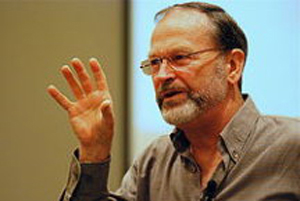
Last December, after more than 40 years teaching at the School of Community and Regional Planning (SCARP) at the University of British Columbia, Bill Rees gave his last lecture as a full-time professor.
As one of his last students, I found his class captivating, and in following up with many of his former students, realized they felt the same way. His career defined the modern science of sustainability, and touched the lives of many, inspiring individuals to devote their lives towards adapting our species to live responsibly on this planet.
"I can't imagine a better job," said Rees. "I get up in the morning and it's wide open. I can't imagine that people pay me to be a teacher at a university, to work with brilliant young minds, and have enjoyed every minute of it.”"
Rees' reputation as an academic maverick began in the 1970s, when he was appointed to a committee to set up what became the Westwater Resource Institute. Because the team of academics on the committee didn't know each other, they decided to hold a series of short talks describing the work they were doing.
"I had been at UBC a couple of years then, and... I was trying to figure out how ecology could fit into planning, which was very much oriented towards social sciences at the time. I delivered a talk on a few topics I thought were important, including human carrying capacity [and] a quick and dirty estimate of how many people the resources of the Lower Mainland could support. My number was roughly 50,000," he said.
Canadian resource economist Peter Pearse approached Rees after his talk and invited him to lunch. Rees was excited to think he had influenced an established, well-known economist, but Rees recalls Pearse telling him, "You're obviously not a stupid person, but if you continue to pursue this line of research, your career at UBC will be nasty, brutish and short."
Pearse explained that the idea of carrying capacity for humans had long been made irrelevant by modern economics, which understood that human technological innovation and trade would be able to overcome any resource restraints. It was a friendly wake-up call for Rees.
"I'm critical of my students who come into planning school without an understanding of science, yet I had no understanding of economics. I left that meeting with my tail between my legs and it took me a few years to recover. Yet, something was working away in the back of my mind."
One night, Rees woke up and everything clicked.
"It was like there was a lightbulb over my head. I realized that even if a human population was trading, the concept of carrying capacity asks how many people a particular habitat can support, and I flipped the ratio over. I started asking how much area is needed to support a certain number of people, [and] that area could be anywhere on the planet."
The concept of the ecological footprint was born, allowing Rees to challenge the traditional economic notions of trade and technology.
Bill and the 'Bryan Adams Phenomenon'
Rees joined SCARP in 1969. His four-decade career at UBC has been marked by a prolific output of writings, a resume of over 80 pages and the development of the ecological footprint concept, while helping to found numerous organizations such as the David Suzuki Foundation, the Canadian Society for Ecological Economics and the International Society for Ecological Economics.
Rees said he's always been motivated to help others understand his love of the planet's evolutionary processes. "I have always found ecology stunning and fascinating. How organisms adapt and change in their environments... it exceeds the best science fiction in terms of its sheer wonder," he says.
As the current director of SCARP, Penny Gurstein reviews the student evaluations of Rees' courses at the end of each term. "I saw written comments where people said things like, 'This course changed my life.'"
Thomas Bevan from Kitchener, Ontario started at SCARP last year and took his first class with Rees in early 2011, following up with a second course as soon as he could.
"Bill was amazing," Bevan said. "He made a convincing argument for why humans must collectively change the paradigm that informs our policy on economic growth. But most of all he was fun, and made the classroom a fun and exciting atmosphere, where it was safe to ask the silliest questions." Bevan was so touched by Rees, he wrote a poem about his experience in the class. (See sidebar.)
Motivating individual students to work towards a sustainable society, Rees helped quietly shape Vancouver. Mark Holland's career was defined by his time in Rees' classes, leading him to become one of Vancouver's first professional sustainability consultants. "I was able to start my practice because of Bill's approach, which wasn't environmentalism. It was simple, pragmatic, factual and comprehensive, not a political ideology."
Holland was first inspired by Rees during his undergrad in Landscape Architecture in the early 1990s. "I heard about Bill all the time in my classes and received permission to take his graduate level courses. This set the trajectory for the next 15 years of my life."
After 10 years of pursuing many different university degrees, Holland said, "Bill is the most compelling professor I've ever sat under. His ability to weave things from apparently unrelated disciplines together was unparalleled and phenomenal. He brought a completely different perspective on governance and public policy, and his background in ecology anchored him in looking at how the human species could manage itself on this planet."
Jennie Moore will finish her PhD with Rees in the next few months. She credits her first experiences sitting in Rees' lectures as where she developed her "internal compass."
"I've seen him raise a room of 500 people to their feet where they are wiping tears from their eyes," she said. "When he speaks from the heart, he can connect deeply with other people."
As with many students who took Rees' classes at SCARP, both Moore and Holland weren't aware of his legacy before the class. For many years, Rees' impact on the science of sustainability went mostly unacknowledged, they said.
"Bill suffers from the Bryan Adams Phenomenon," said Moore. "He's so much larger internationally than what his impact locally has been. While SCARP and Vancouver will always be the place where the ecological footprint was invented, I haven't seen the local government adopt the footprint to the extent that I have in other places around the world.
"With the Greenest City Action Plan, it is the first time a city locally has acknowledged and worked with the ecological footprint, and Metro Vancouver will be referring to it in a new strategy. It is starting to take hold, but it has taken a long time."
Party at the end of the world
Rees was reluctant to have a retirement party that recognized his work. "Bill is the kind of guy that is really uncomfortable with any acknowledgements about himself, and he really just wants to sit in his office and work," said SCARP's Gurstein.
On Nov. 19, colleagues and friends like David Suzuki gathered to deliver a tribute to Rees at a banquet organized by SCARP and The One Earth Initiative, a non-profit organization Rees helped found, and where he'll be spending some of his time now that he's a professor emeritus at SCARP. Former students flew in from Winnipeg and even Halifax for the event.
"In the end, I was very touched, very moved and enjoyed myself immensely," Rees said.
Letters from friends that couldn't attend were read aloud, and Rees was presented with gifts, like a survival backpack to help him navigate the coming collapse he frequently talks about.
"A lot of people talk about Bill's gloom and doom scenarios, even though he's just describing trends due to our biology to consume as much as possible," Emmanuel Prinet of One Earth explained.
Suzuki and his wife, Tara Cullis, gave Rees a wind-up flashlight. Other gifts from friends included bird-watching binoculars and an emergency bottle of wine. Because peak oil would slow down Rees travel schedule, Prinet contributed several books to the backpack, one of them titled The Best Places to Kiss in the Northwest.
The evening closed with a hand-drawn stop animation video put together by One Earth, telling the story of how Rees was inspired to link human carrying capacity to the word "footprint" when a colleague remarked that his newer laptop had a much smaller footprint on his desk than his older, bulkier model. The animation shows how Rees was influenced growing up on a farm in Ontario, the place where he first realized that humanity wasn't separate from nature -- and where he lost a toe, literally giving him a smaller footprint.
Planning for the future
As UBC moves towards building an international reputation in sustainability, it will have to do so without the man that Holland credits for establishing it. "I think a very significant amount of UBC's position on the global stage and reputation for sustainability is because of the almost-psychosocial impact that Bill has on people."
While SCARP is a school in transition, the profession of planning is facing an equally dramatic shift. "When I came to the school in the early 1970s," said Rees, "planning in the public domain was much more appreciated.
"Over 40 years, we've had a substantial change in public attitude. We've gotten into a market mentality. We've ceded our ability to control our destiny to the values of the marketplace."
The world is facing several crises simultaneously, he points out, "and if we're going to pull this off as a species, we're going to have to use planning in a way we've never had a precedent for."
Planning today must regain "a high understanding of the fundamental hard science associated with global change and the economic ramifications of that. There is a huge social justice issue, and it's entirely conceivable that over the next few decades we'll see potentially hundreds of millions of refugees fleeing rising oceans and drying lands," Rees said.
"All of these strategies of land use planning and water planning are going to come to the forefront in ways we could never conceive."
Now that he's leaving the planning school, Rees will be focusing more of his energy on the One Earth Initiative.
"Just prior to the World Urban Forum, Bill made a presentation at an event at UBC," One Earth co-founder Dagmar Timmer said. "Bill's very first slide was a picture of a smog-covered sunrise in Suzhou, China, and he asked, 'What is Canada's contribution to eco-degradation in China?' That slide in itself was such a strong motivator for us to work together to address these long range impacts of our actions."*
One Earth's first big project was a side event at the 2006 United Nations World Urban Forum, focusing on policies for creating regenerative urban footprints. Rees was the keynote. He's still influencing policy, giving a speech at the UN last month. After Rees spoke, one the delegates raised his placard and said to Rees, "I don't understand why I'm not getting this level of detail in my briefings. Why aren't my briefings telling me the scope of the challenge so we can get serious about it?"
Getting serious, while still creating a positive vision for living sustainably, is One Earth's goal. Rees joins the rest of the One Earth team in calling for the creation of compelling, attractive visions of sustainable futures, though he may have a reputation as Dr. Doom.*
"Bill always says to us that we need to think at least 10 years ahead," says Prinet. "He's trying to not just think about today, but also imagine what's happening later and integrating that in his thinking about policy ideas."
Rees' next footprints
No longer teaching full time at SCARP, Rees is moving on to what's next. He's already been invited to teach short term courses at a few universities. For the first stop of his world tour, he'll be at Newcastle University for most of March.
In December, as Rees' his last course at SCARP wound down, he reminded his students to use science to focus on long-term consequences. By understanding the issues of ecological degradation and sustainability covered during the semester, each and every student was now tasked with building a new cultural narrative that shifts our species from competitive individualism, greed and narrow self-interest toward community cooperation and collective interest.
Though tinged with hope, his message rides on tremendous consequences from inaction. Rees quoted from the 2007 Swedish Tällberg Forum which stated, "Do we know what we need to do? Probably yes. Will we do it? Probably not."
Rees laid out it down. "Failure to assert collective reason over instinct will lead to civil strife, resource wars and ecological destruction. That's the summary of the entire course."
Understanding the immensity of the burden he'd just given to the few dozen students in the room, he lightened the mood by joking, "Your job is to go forth into the world and change everything, so that I may enjoy a fruitful retirement."
You can find Rees on Twitter @ecofootnotes and on his new blog.
Story updated Feb. 3 at 6:45 p.m. ![[Tyee]](/design-article.thetyee.ca/ui/img/yellowblob.png)
Read more: Education, Environment

Tyee Commenting Guidelines
Comments that violate guidelines risk being deleted, and violations may result in a temporary or permanent user ban. Maintain the spirit of good conversation to stay in the discussion.
*Please note The Tyee is not a forum for spreading misinformation about COVID-19, denying its existence or minimizing its risk to public health.
Do:
Do not: