- Ms Kaye is a Tyee Builder. You can be, too.
- Mary Carlisle is a Tyee Builder. You can be, too.
- Prem Gill is a Tyee Builder. You can be, too.
- Nancy Flight is a Tyee Builder. You can be, too.
- Justin Everett is a Tyee Builder. You can be, too.
- John Westover is a Tyee Builder. You can be, too.
- Nora Etches is a Tyee Builder. You can be, too.
- Edward Henderson is a Tyee Builder. You can be, too.
- Bharadwaj Chandramouli is a Tyee Builder. You can be, too.
- Dean Chatterson is a Tyee Builder. You can be, too.
- Marius Scurtescu is a Tyee Builder. You can be, too.
- Robert Parkes is a Tyee Builder. You can be, too.
- James Murton is a Tyee Builder. You can be, too.
- Susan Doyle is a Tyee Builder. You can be, too.
- Vincent Strgar is a Tyee Builder. You can be, too.
- Helen Spiegelman is a Tyee Builder. You can be, too.
- Subir Guin is a Tyee Builder. You can be, too.
- Kimball Finigan is a Tyee Builder. You can be, too.
- Joanne Manley is a Tyee Builder. You can be, too.
- David Leach is a Tyee Builder. You can be, too.
It's the Economy, Dippers
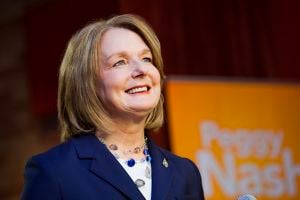
In NDP leadership debate, Peggy Nash stakes out territory party needs to conquer.
Well-versed: Nash was NDP's finance critic before running for leader.
The NDP leadership race suddenly seems like a very long, drawn-out affair. Initially, there was much outrage, especially from Thomas Mulcair, at the suggestion that the party go along with what Jack Layton seemed to want: an earlier leadership convention in January. But now many in the party, lead by Winnipeg MP Pat Martin, worry that the party's performance in the Commons is suffering because many of its strongest MPs are out of their critic roles and pre-occupied with the race.
A couple of polls suggest the NDP is slipping and the Liberals are gaining at their expense, with the pollsters musing about the impact of the race as well. One poll in particular should cause the party concern as it hints at a more serious cause for declining support: Canadians' increasing worry about the economy.
In a Nanos poll of a week ago "jobs and the economy" (at 29.3 per cent) pushed the traditional leading issue, health care, well down into second place (22.8 per cent). And that concern for the economy was up three per cent in a single month. It should be noted that health care almost never falls from first place -- just once in my memory when it fell just behind the environment for a brief period.
While the poll did not probe the reason for the upsurge in Liberal support (tied with the NDP at around 27 per cent while the Conservatives dipped under 36 per cent) it seems reasonable to conclude that if people are concerned about the economy they go to the parties that have traditionally garnered more trust on the issue: the Liberals and Conservatives.
The economy will likely continue to be the number one issue for a majority of Canadians for some time to come. More people are more indebted than ever before, hundreds of thousands have mortgages in danger of default with a two or three point increase in interest rates, wage increases continue to lag behind inflation, unemployment and underemployment are still high, and the crisis in Europe and the weak U.S. economy represent a major threat to the Canadian economy. And now more and more analysts are suggesting China is headed for slower growth -- which means lower demand for Canadian resources. This has not escaped the notice of Canada's largest corporations, either. They are sitting on some $450 billion of cash that they show no sign of investing.
Layton's breakthrough
The NDP has always been skittish about the economy as an issue. After all, it competes politically in a capitalist world and the conventional wisdom is that the capitalist parties have the edge on how to manage the economy. But by avoiding talking about it (like they did for most of the 1988 free trade election) the party continually reinforced the notion that it can't be trusted on the issue.
The party always counted on its traditional issues to carry the day -- Medicare, social programs, the environment, and education -- policies that required robust, activist government. So long as government seemed able to provide for those things, the NDP held its own. But during times that either the Liberals or the Conservatives played the deficit hysteria card, they faltered, as they did in the 1990s when Paul Martin successfully cut 40 per cent off federal social spending on the heels of a four-year fear campaign about the debt.
In the last election the party ran on Jack Layton and broke through the wall of mistrust of government than characterizes the Canadian electorate. And in Quebec, he benefitted from that province's long history of supporting a strong social role for the state. But Jack is gone, mistrust is back, and people are looking for reassurances that someone knows how to guide the economy.
There is no better time for the NDP to avoid its coy relationship with economic policy. The Occupy phenomenon highlighted the growing inequality that liberating the market has produced; the Harper government's policies have been a complete failure (except briefly with a stimulus package forced on it by the opposition); the Liberal Party, despite the recent bump in the polls may well be terminal (see Peter C. Newman's new book pronouncing it effectively dead).
Sunday's leadership debate demonstrated that the party is finally getting it: it actually focused on the economy. But only two of the leading candidates -- Peggy Nash and Paul Dewar -- had released anything like economic policy statements before the debate. It would have been a lot more meaningful if the other candidates (Nikki Ashton also released an economic statement earlier) had their economic policies in place.
It should not come as a surprise that Nash, finance critic until she announced her campaign, is leading in this policy contest. She has focused attention on reversing the decade-long trend of exporting raw resources and returning to a value-added economy; fairer taxes; requiring companies to make binding commitments on jobs and development (that would violate NAFTA, but perhaps we should); massively increase public investment in the face of the private sector's refusal to do so; strengthen income security programs that were decimated under the Liberals; and integrate and enhance social programs with a view to boosting jobs and productivity. She also calls for formal co-operation between government, business, labour and universities to guide a return to a comprehensive industrial policy -- pointing to Finland, Korea, Brazil, and Germany's successful approaches.
One debate won't do it
Paul Dewar's plan -- "Creating Good Jobs and Training for the Jobs of Tomorrow" -- is thin and conventional by comparison. Calling for "support for small and medium-sized businesses" is meaningless rhetoric. "Reinvigorated national training programs. . . " doesn't mean much either if the private sector isn't investing. He does call for a permanent infrastructure program and promotion of value added industries but so far with little detail. He promises to go after tax havens but says nothing about fair tax reform. In the debate he had no answers to Brian Topp's question about where he would get the revenue for his program promises.
There is a long way to go for the NDP to establish itself as a serious contender for the 'good economic manager' title. One debate won't do it. But if the other candidates take up the gauntlet thrown down by Nash, it could go a long way to breaking the 40-year taboo. The final outcome for an NDP economic policy needs to include, in addition to Nash’s points, a commitment to strengthen the domestic economy by ending the 25-year suppression of wages, a clear and detailed tax reform policy (Brian Topp's strength at the moment) to increase government revenues; vigorous enforcement of labour standards to protect workers from ruthless employers; a national energy policy that places limits on tar sands expansion and puts current oil industry subsidies to work rapidly developing alternative energy sources, and lastly an acknowledgement that unfettered consumerism is an unsustainable economic policy. That means a shift away from private goods to public goods. Economic policy is seen as dull stuff, but there is no reason it can't be visionary. ![]()


22
Login or register to post comments
igbymac
24 weeks ago
Until one of the political dough-heads
...can link together our illegal war policy and capitalist economics with its human and environmental victims, domestically and globally, we are left with rhetoric and stupidity 'leading' the way.
'It's the economy' is so Bill (I didn't inhale or have sexual relations with that woman) Clinton. It's time government served the people, not the economy. Too bad the obvious is so tough to see. Huxley nailed it when he said, and I paraphrase the thought, we would willingly surrender our thinking only to enslave ourselves in the process.
hollinm
24 weeks ago
NDP Debate
When I see a comprehensive economic policy by one of these candidates with numbers attached,indepently verified to show the impact on Canadians then I will know whether the NDP really understands the economy or is simply a wolf in sheeps' clothing offering a chicken in every pot.
doggone
24 weeks ago
"Someday, Lady,...."
I have been hoping for some viable option in voting choice for yo these many and lackluster as they have been lately I still vote for the NDP.
Maybe this Lady has some "BackBone".
It's time!
ron wilton
24 weeks ago
hockey sticks
When you can't go to Canadian Tire and buy your kid a hockey stick that was made in Canada, but only ones made in China line the walls, then it it is time to take back our jobs, our economy, our identity, our self worth and the respect of the next generation.
We can mill our logs into lumber here.
We can refine our crude oil here'
We can make our clothes here.
We can grow our food here.
We can build our planes, trains, ships and automobiles here.
We can bloody well make 'our' hockey sticks here.
It's our game, let 'us' play it.
Ed Seedhouse
24 weeks ago
I am waiting for some
I am waiting for some candidate to finally say out loud what has been obvious for four years, namely that conventional economics has failed and that the "neoliberal" economic model of macroeconomics is simply wrong, disastrously wrong.
Some evidence that one or more of them has read and understood Steve Keene (http://www.debtdeflation.com/blogs/) or Bill Mitchell (http://bilbo.economicoutlook.net/blog/) would be a good start.
These are not socialists, they are capitalists who understand and explain how money and the economy actually works, as opposed to the mainstream fallacies. I am a long time party member who is not a socialist and I know of hardly any members who are.
If the NDP gains power
Ed Seedhouse
24 weeks ago
If the NDP gains power and
If the NDP gains power and simply follows the current dominate macroeconomic theory it will fail just as badly as the Liberals did and the Conservatives are in the process of doing.
I remain hopeful, but I am waiting for one of these folks to lead by pointing out the disastrous failure of neoliberal economics and monetarism, and point to a credible alternative.
The economic "credibility" of the Liberals and Conservatives is actually their greatest weakness, a balloon ready to be popped by the needle of reason, if anyone has the leadership qualities to do that.
Cynic
24 weeks ago
Visionary economic policy:
Visionary economic policy: the finance minister stands up in the House and announces that henceforth all Canadian government bonds will be purchased by the Bank of Canada and will no longer be shopped out to the international capital markets. Anything less will be more of the same, piling debt upon debt.
Economic policy can only be visionary if it recognises that the private banks are printing over 95% of our money supply and supplying it only as debt; and that they supply principal only but demand principal plus interest in repayment, thereby making total debt impossible to pay off and thus entrenching the 1% in their positions of power.
realisticman
24 weeks ago
Brazil?
"She (Peggy Nash) also calls for formal co-operation between government, business, labour and universities to guide a return to a comprehensive industrial policy -- pointing to Finland, Korea, Brazil, and Germany's successful approaches."
OECD Report today, reported on The Hook:
"At 50 to 1, Brazil's income gap remains much higher than in many other countries, "
At around 10:1 Canada makes Brazil look feudal.
alda
24 weeks ago
In order to avoid a
In order to avoid a conversation about raising taxes that will potentially terrify middle-class Canadians, some consistent public-friendly PR language needs to be used by everyone on the hustings.
The phrase needs to clearly imply that the raising of (certain) taxes is fair and just for everyone. "Tax reform" isn't bad, but it's bland and open to interpretation. Someone needs to come up with something clever that suggests a FAIR-PIE, equitable tax reform that shifts the burden away from the middle & lower classes. (Perhaps using the image of a pie-chart to show the stats, or something.)
I hope the party hires some clever PR types who can come up with 3-4 strong phrases on the big issues. Such phrases should be repeated ad nauseum for voters during the run-up to the next elections. KISS.
janetvickers
24 weeks ago
Leadership
towards a sustainable future requires us to be strategic idiots. Doing the right thing is improbable and self-anihilating in the current social climate that places the economy as number one where most folks get their information from corporate propaganda.
So leadership must come from the masses, and the masses must be re-educated if we are to survive.
This is dismissed as idealism but unless we can work together on the future, we shall soon become extinct on this planet.
pwlg
24 weeks ago
NDP and economics
Thanks Murray for making this the challenge for the NDP in gaining federal governing status in Canada.
I am grateful to Ed Seedhouse for providing the links above. I found a direct link to Steve Keen's interview on BBC's HardTalk November 2011 which I suggest readers view.
http://www.youtube.com/watch?v=rGkmgnprrIU
Artemesia
24 weeks ago
I would like to recommend Cynic's comment as best
Unfortunately, there is no way to do it.
Cynic's comment brings up what is really the most basic point. The power to issue the money supply should be returned to government and taken back from private banks.
The system Canada used between 1935-1975 must be reinstated.
Call for Renaisssance of the Bank of Canada
http://comer.org/projects/index.htm
pwlg
24 weeks ago
re-educate
Another video of Steve Keen on Debunking Economics worth watching:
http://www.youtube.com/watch?v=qG3CU1st_l8&feature=results_main&playnext=1&list=PL8FAFB0CF1D76E77B
marcerickson
24 weeks ago
NAFTA should go
I've seen enough to realize that NAFTA should go - it's a corporate benefit plane and doesn't do much for the people.
igbymac
24 weeks ago
Dr Keen
...debunks neoclassical economics, with which I agree.
But likewise, thinking economics (his or some other rendition) is going to solve our human woes is one assumption that needs to be removed from his own thinking as well.
He suggests, as has occurred in different nations historically, writing off all debt since our economic crisis is one of debt. Of course the utilitarian view is this is best for society on the whole despite punishing those without debt -- those who have lived within their means or 'stolen' enough wealth along the way.
So then what? What about a redistribution of wealth afterwards? What economic pseudo-capitalist model does he want to put in its place?
The problem I foresee is a return to the same misplaced thinking, where human self-realization is the supreme principle of ethics despite us living collectively and being reliant upon one another, socially, to survive.
We have real human problems, not simply ones explained on the balance by mathematically formulated models or theories.
RickOshea
24 weeks ago
I TOLD You So...
The ND party should have had a huge 'I told you so' moment when the financial crash of 2007 took place... but they failed miserably to take advantage of those events.
Now, it's the OWS movement, not the socialists that are taking the fore to point out the abject failure of neo-liberal economics.
Moving to the right like the Liberal party did would be a huge strategic blunder - abandoning their superior political economic model - a regulated, mixed (private/public) economy and a progressive tax system at the exact moment its merits become incontrovertible.
siamdave
24 weeks ago
very disappointing -
- that the NDP, or Murray, do not seem to be getting any brighter about the root of the problems here - who controls 'our' money. If you don't tackle this, anything else is just, as the saying goes, dicking around with the deck chairs. If they (NWO, new feudalists, call em what you will) control the money, they control everything else. Even a kid knows that. If anyone from any wouldbe NDP leader is reading this, get educated here - What Happened http://www.rudemacedon.ca/what-happened.html . Your economic promises are completely pointless if you don't understand the money situation first. As more people are starting to understand.
OwlRol
24 weeks ago
NDP, if elected, will move slowly
The frustration of commenters here is obvious and, in many cases, on target. Some solutions presented are better than others.
Cynic makes a great point about economic policy, Ed S. is correct about neo liberal economics, Ron W. about value added products and outsourcing, and more from others.
But it took well over 30 years of neo-liberal policy and propaganda to get us to where we are now.
Unless we can accept some type of revolution, something I don't think most Canadians would go for, the process of reverting to a different, but more equitable, just and sustainable system will take many years, if at all, given the opposition.
janetvickers is lucid on this point, to follow the correct course immediately at this time would be political suicide. It will take years to get us where we want to go, step by incremental step.
Lula's success in Brazil has taken a long time and is by no means complete, but consider where their dictatorial government was in the 1980s and 90s. By comparison, Hugo Chavez has had limited success and has drawn considerable ire in Venezuela.
The NDP, even if they don't want to shift to the middle, must draw in centrist voters to have any hope of forming government, or that far right cabal, masking themselves as centre right, will continue to rule.
If the NDP can show themselves as a capable and compassionate government, only then will they be able to introduce progressive bills into law, and that, with great difficulty, given the right blind side mainstream media and trans national influences, including NAFTA and such trade agreements.
To expect any government to make large rapid changes in its first mandate is surely naive, better then that unlikely rebellion.
But an electoral voting change may be a good start.
igbymac
24 weeks ago
Keep polishing that turd, OwlRol
Surely by now you can grasp that the needed reform is NOT coming through through the ballot box. Your thinking is ultimately stone-walled with self-censorship, so you remain faithful to the idea that changing the crew has hope.
This might have been the reasonable approach 25-odd years ago, particularly when there was no BigOil campaign to capture the minds of the public and pit them against scientific consensus; or before the fall of the Soviet Union opened the gates to American Imperial ambition on an epic scale.
In short it is our politics that need addressing, not the politicians. We are governed, whether you want to accept this fact or not, by a corporatocracy owned by the elite plutocrats. It is riddled with so much conflict of interest (GE as mainstream propagandist and war profiteer, but one example), we are only flooded with stories bettering its bottom line. And these stories are not in the interests of the people because the media is no longer a watchdog. Those days are long gone. This is now a world lead by the Military-Industrial-Media complex.
The very fact that you can see that the political route 'will take many years', and will likely be an unsuccessful one 'given the opposition' because the necessary and proper conduct is 'political suicide', surely it tells you the dilemma we find ourselves in is beyond the political machinations of our times.
And despite all this, you turn away from taking the next logical step and, instead, you continue to support the corruption of state through the voting process. Talk about dissonance.
Forget the politics. Forget voting. It's like kicking the car tires hoping it'll get the vehicle fired up. Not only won't it start the car but, even if it did, the car is a write-off and up-side down in the ditch.
The 'let's vote' suggestion is exactly the type of contrived thinking the establishment is relying upon. Like the watch-dog media, today's democratic vote for substantive change is no more. We change our thinking or we die, suffering gravely on the way out.
Either folks understand the issues you pointed out (as you clearly do), and then follow them to their obvious conclusion (which you clearly do not), or they remain intellectually captured by the imperialism of their cultural traditions and continue marching to their own demise.
I just wonder why you are so afraid to take the next step and call for revolution?
Granville
24 weeks ago
My vote goes to the guy with the turban
Sorry; I don't know his name, but he sounded like a determined leader. Like Jack himself in fact. The NDP needs a no-nonsense bulldog to bite through the Harper bullsh*t and take a bite out of his arse. No philosophers need apply.
By the way, where is Michael Ignatieff now, and who cares?
hg
24 weeks ago
Economy
The cruel hard truth is, that what is good for the economy is not necessarily good for the people. The economy has been booming, while the standard of living has been steadily eroded, starting with the onset of trickle down economics.
Peggy Nash has her facts straight. She is my choice for leader of the NDP, smart, financial experience, parliamentary experience, rooted in social justice.
realisticman
24 weeks ago
Chop, chop!
"She (Nash) also calls for formal co-operation between government, business, labour and universities to guide a return to a comprehensive industrial policy -- pointing to Finland, Korea, Brazil, ..."
The Brazilian Senate has approved controversial legislation that reforms rules on the amount of land farmers must preserve as forest.
Dec.7.2011 BBC
"This is the first time we're ending the monopoly, that we're ending the environmental dictatorship where half a dozen [non-governmental organisations] controlled the environment ministry," said Sen Katia Abreu, president of Brazil's National Agriculture and Livestock Association (CNA).
Greenpeace Amazon spokesman Marcio Astrini told the Associated Press news agency that the new code would reduce the area required for conservation, so allowing new deforestation. "
That's what they call, "a comprehensive industrial policy".