Opinion

Our Most Loved Resource? Water

British Columbians are keen to protect rivers, lakes, streams, and wetlands, a new poll finds.

By Linda Nowlan, 22 Nov 2010, TheTyee.ca

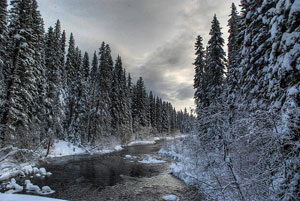
River in winter

McLeod River, B.C. Photo courtesy of Tad McIlwraith from Your BC: The Tyee's Photo Pool.

Related

We love our water, so much that we want new rules to protect the elixir of life. Water is the most highly valued natural resource we have, according to a new poll from the McAllister polling group done for WWF Canada and the Vancouver Foundation, released today.

While it may be predictable that 98 per cent of British Columbians feel fresh water is crucial to the prosperity and quality of life in B.C., it's less obvious that 72 per cent say nature should be the priority for managing water use during times of water scarcity -- even if it slows economic growth. And 62 per cent of those polled said that current rules governing water use in B.C. were not strict enough to ensure the future sustainability of B.C.'s fresh water resources.

The citizens of the province are giving a strong go-ahead signal to the government to do what it takes to protect and conserve our rivers, lakes, streams, and wetlands.

So take note, beleaguered politicians from all parties: this is a good news story. Bold reforms to safeguard water laws are likely to attract public support. Just as the carbon tax turned out to be a popular move by the Liberals (and opposition to the tax was a disaster for the NDP), ensuring nature's needs for water are met promises to be popular.

Time to make four changes to Water Act

How strong are the province's current water law proposals? The fine details have not yet been released, but all indications are that we're on the right track. The government's pledges to 'modernize' the Water Act are well underway.

Four key changes are needed, and the government is poised to act on them all.

Put stream health first. The first promise is that water law will prioritize stream health and new legislation will protect environmental flows. This is an answer to the question: How much water does a river need?

Though we humans think we have first dibs on clean water, it's really the aquatic ecosystem itself with all the services that nature provides to us -- ecosystem services -- that should get top priority. The government has assured us that by 2012, all water managers will know what a healthy stream is, and fish will finally have rights to water.

Secondly, change the rules around water governance. Governance is a popular term in policy wonk circles these days. Basically, it refers to who gets to make the decisions, and how they decide. B.C. now has a patchwork of rules in place for different areas. The public wants a greater say. We all have a role to play in sustainable water use: consumers who shower, wash cars and water lawns; power generators who use water to generate lower carbon forms of energy; farmers who irrigate food crops; oil and gas companies who use great quantities in production; and many others.

Then we have water allocation, the tricky question of who gets what. Rules designed to promote settlement in B.C. back in the early 1900s when the law was first passed, that gave priority to whichever farmer, rancher or miner was first to put a pipe in a creek, are sorely outdated. These 'first in time, first in right' rules would seem ridiculous if applied in any other context. If you moved into a new neighbourhood, would you expect to get less water than your neighbour who moved in last week? Exactly.

Modernizing allocation rules will involve balancing key interests. But as the poll demonstrated, and as water scientists agree, nature's needs for water should come first. A whopping 94 per cent of those polled favour ensuring that the protection of nature, wildlife and species like salmon get top priority for water.

Next up is groundwater. B.C. has the dubious distinction of being almost alone in the developed world in not requiring groundwater users to obtain some form of license before they drill a well. (There are some exceptions for massive new wells.) And this omission is not because we have unlimited groundwater supplies at our beck and call. Just ask residents of the Okanagan, the Gulf Islands, or the Nicola Valley. They'll tell you they need groundwater controls to protect drinking water, and to ensure there's enough for cattle, migrating salmon, and peach orchards. After all, every source of water is connected in the hydrological cycle. Kudos to the government for confirming that it will finally remedy this glaring defect in B.C. water law.

We are fortunate in B.C. to have an abundance of free-flowing wild rivers, as well as multi-use rivers at the base of our economy and society. We love our water, and we welcome the law reforms needed to keep it healthy. Let's hope the current political upheaval doesn't derail the scheduled reforms.  [Tyee]

21  Comments:

Login or register to post comments

  • Okanagan Orchardist

    1 year ago

    I can't believe my eyes....

    "Kudos to the government for confirming that it will finally remedy this glaring defect in B.C. water law."
    Linda Nolan, puleese! And you are an environmental lawyer?? You have obviously been sitting in your office on the 10th floor somewhere west of Granville St. writing books on water resources without ever having travelled anywhere in BC and looked at what is actually happening there.
    What a bunch of drivel!!

  • Ricky

    1 year ago

    Great!

    It's good to see we're making such progress, Linda!

    Whoops, what was that? Another clean power call? Oh no biggie, as long as we're on the right track, what's a few more dammed streams (Whoops, I meant "weired") in the big scheme of things? I'm sure once we've determined how much water those streams really need, those wonderful independent power companies will go ahead and take those down those little hydro projects found to be diverting too much water, with nary a trace left behind, and no cost to British Columbians. Heck, it might even create a few jobs!

  • jacksonupnorth

    1 year ago

    Start by getting rid of the Environmental Assessment Office

    British Columbians are going to have to get serious about water protection because the current government will sell it out to the first buyer. Many people are not aware the Ministry of Environment has a policy called 1:1 (one for one) whereby a company can pay a certain amount of money to destroy wetland with the money supposedly to repair wetlands elsewhere. The fact that the BC EAO has never turned down an application speaks volumes. They approved the destruction of Fish Lake in the cariboo. They were on their way to approving a toxic waste landfill in the watershed of Swan Lake Provincial Park near Dawson Creek. Despite the fact that a previous landslide was found on the steep hillside where the dump was to go they still have only "suspended" the process to allow the proponent to have new studies done.

  • Yeoman

    1 year ago

    There is great support for

    There is great support for stream protection until it personally affects someone. Just try getting ignorant home-owners to stop mowing right to the streambank!

  • KWD

    1 year ago

    elevating the dialogue

    For a taste of what some NGOs are doing to to bring water (ab)use issues to the attention of our politicians, and the public, visit http://www.watershed-watch.org/

    Although salmon survival is their prime concern, they consider all aspects of hydrological cycles, including ground water issues.

  • Talon

    1 year ago

    environment vs profit

    Whatever one's political bent might be, there is one underlying fact that supercedes all else. All Else! The environment is our mother and clean water and clean air are gifts from our mother. We should respect that before all other decisions are made. Hold the people responsible who are not being responsible for the collective welfare of the planet and its inhabitants. Greed is a nasty addiction. Talon

  • Dukeboy

    1 year ago

    Water

    Linda, haven't you heard yet about Harper gutting the 130 year old Navigable Waters Protection Act in his 2009 omnibus budget bill? Haven't you heard about Harper allowing the destruction of 16 lakes across Canaad with mine owners dumping their toxic wastes in them? Haven't you heard that Harper destroyed the NWPA so Campbell and his buddies along with foreign multinational corporations could dam every stream, creek and river capable of floating a canoe which the 130 year old NWPA was based on?

  • Dukeboy

    1 year ago

    Council of C anadians

    Maybe Linda could access the Council of Canadians website or the other websites that are trying to save Canada's water supply from the multinationals and see what is happening in this world she is writing about? Maybe she could comment on CETA (Canada Europe Trade Agreementy) that threatens to give OUR
    water to European multinationals so they can sell it back to us!

  • snert

    1 year ago

    Absolutely nothing wrong

    with putting water to to work for us in whatever task we wish. It's what happens to it after we are finished with using it where the problem lies. That's the area where we need to clean up our act not just saying no to everything.

    Placing drinking water intakes down stream from sewage outlets would certainly provide some incentive to clean things up.

  • jnewcomb

    1 year ago

    EDITED -- MODERATOR

    EDITED FOR UNFOUNDED ACCUSATION. -- TYEE MODERATOR Actually, most valuable resource is probably air, but not included? Unfortunately, asking respondents who are sitting watching their tvs in Vancouver suburbs about how fresh water plays a role in their consumer lives would get answers that those activists don't want to hear - they just want to bash the agricultural and industrial users of water in BC.

    People in BC need to know how much water it takes to get them their food and their lifestyle. Every pound of beef, every orange and banana, and every bit of their cars has taken an immense amount of either farm water or industry water to get it to them. So any policy that seeks to provide additional habitat protections must be balanced against providing those goods. Hopefully, with more information, respondents can make better choices - but misleading polls don't help.

  • greengreen

    1 year ago

    the important questions....

    Is there anything "in the works" to prevent water from becoming a commodity for corporations?
    Is there anything "in the works" to put a halt to the privatization of water?
    Is there anything "in the works" to ensure that water is considered a public resource to be managed for the public good-the good of all, not just the elite?

  • Peter Dimitrov

    1 year ago

    Seriously Left Water Governance: Part One

    I sugest that a seriously left Water Governance Act for British Columbia might incorporate some or all of the following ideas, such as:

    1.Entrenching the water law concept of public trust doctrine in regards to the use, allocation and management of all water resources in British Columbia.

    This concept will obligate the Government to make water use decisions in the best public interest as distinguished from private interest and it should make it easer for the public to get legal standing in the courts to advance legal arguments pertaining to water and water law related issues.

    2. Entrenching the idea that the use of water for development of hydroelectricity that will be linked to a high voltage transmission line, or for the export of water beyond provincial boundaries by a privately owned, or a publicly listed stock-exchange corporation is not a benefical use of water and is thereby not allowed.

    This concept will disallow the allocation of water licenses for hydroelectric generation to private or publicly traded corporations that seek to link to a high voltage transmission line and thereby sell power, or that seek bulk export of water beyond the provincial boundary.

    3. Repealing the "first in time, first in right" doctrine of water allocation, and replacing it with a water license allocation system that establish priorities for water use according to such public interest priorities, in a descending order, with the most important user allocation being residential use, wildlife, fish and park use, agricultural use, recreation use, commercial and industrial use, provincial trans-basin boundary use, inter-provincial trans-basin boundary use, or some reasonable revision and facsimile thereof;

    4. Designating the boundaries of Watershed Management Regions for all watersheds in British Columbia;

    5. Establishing decentralized regional Watershed Management Councils for all British Columbia Watershed boundary areas, especially on a priority basis where industrial or hydroelectric development exists, or where a water license for power generation, or a license for coal bed methane exploration, or mining project, has been applied for, or is in the process of being approved;

    6. Establishing that the majority of members to each Watershed Management Council will consist of Canadian citizens resident within, and directly elected from the Watershed Management region where they permanently reside, with a minority of members to be appointed by the Government of British Columbia and that First Nations have a signifcant seat at each of those Councils.

  • Peter Dimitrov

    1 year ago

    Seriously Left Water Governance: Part Two

    7. Establishing the terms of office and duties for each elected citizen-member of the aforementioned Watershed Management Councils.

    8. Establishing conflict of interest and disclosure requirements for all citizens seeking to be elected to a Watershed Management Council.

    9. Establish a "future employment and contract" prohibition of "x" years thereby preventing formerly elected members of a Watershed Management Council from being employed or contracted by a commercial or industrial water user or association of such users.

    10. Defining the meaning of the term 'lobbyist" and to require that all lobbyists enter their names and other particulars with a local Watershed Management Council Lobbyist Registry before being permitted to lobby a local Watershed Management Council member or members. Defining regulations pertaining to the ethical conduct of lobbyists.

    11. Entrenching the legal principle of "harmonization" thereby requiring that each Watershed Management Council abide by province wide harmonized standards including but not limited to such binding laws as: that public ownership of public B.C. water shall not be transferred to private ownership; that allocations for use to water shall no longer be according to the current rule of "first in time, first in right" but according to a new province wide scheme of allocation as previously described in paragraph 3 herein; that leases or licenses for water use be for a fixed term no longer then 'x" years, renewable upon application and upon specified conditions; that revenues from water rentals be distributed according to an equitable formula between the Province and each Watershed Management Council; that water rentals from the use of water for hydroelectric power generation be established by reference to the market price of that power; that the beneficial use of water will be defined as "x,y,z"; that Province wide drinking water quality standards apply within all regions; that source protection and water conservation plans be developed by local Watershed Management Councils that 'meet or exceed' province wide standards; that local Watershed Management Councils establish a licensing requirement for groundwater extraction that is beyond a provincially defined threshhold; that there be a protocol to amend the Water Act and the fiscal sharing of water rents that abides by principles of administrative and constitutional law but which gives regional Watershed Managment Councils a weighted voting priority; and other innovative ideas as may be presented to the Citizens Commission on Water Governance.

  • Peter Dimitrov

    1 year ago

    Seriously Left Water Governance: Part Three

    12. That parallel with the aforementioned principle of harmonization, the principle of subsidiarity be included within a new Water Governance Act, thereby giving final decision making authority to local Watershed Management Councils to devise by regulations the process whereby Watershed Management Plans shall be established, updated and approved by the electorate in each Watershed Management Region, in consultation with existing water license holders, existing and potential user/stakeholder communities existing within each Watershed Management region.

    Furthermore that local Watershed Management Councils be legally empowered to develop source protection and water conservation plans that 'meet or exceed' province wide standards, and furthermore, that they establish a licensing requirement for groundwater extraction that exceed a provincially defined threshhold. [Note: source protection plans were recommeded by the Walkerton Inquiry to protected drinking water quality. They are also useful to protect groundwater degradation from such activities as agribusiness and coal-bed methane extraction, and likewise groundwater dependent ecosystems, parks, ecological reserves. ]

    13. That local Watershed Management Councils be empowered to devise regulations specifying reserve-rights to the use of water for the purposes of fish protection, recreation use, wildlife use, parks and ecological reserves, heritage use, First Nations use, environmental flows, groundwater dependent ecosystems, and any other benefical use of water.

    14. Establishing that intellectual property rights to commercially sensitive water related information and/or services remain confidential and under public ownership,care and control;

    15. That citizens and all water users, including riparian landowners have a right to judicially appeal any decision of a Watershed Management Council to a Provincal Watershed Management Appeals Board, equally composed of Provincial appointees and representatives from an association of BC Watershed Management Councils. The decision from such Appeal Board will be final.

  • ragingran

    1 year ago

    WAM SHAM

    As many comments here suggest, WAM is a SHAM! It is a thinly veiled attempt to commodify our water so sale to the highest bidder can proceed.

    Unremarked by the press is the fact that the entire Water Stewardship Branch of the Ministry of Environment has been transferred to the new Monster Ministry of Natural Resource Operations (NRO). You know, that "one-stop shop" for private investors. This includes administrative jurisdiction over the Water Act and the Water Protection Act.

    Never mind that the new Minister of the Environment, Murray Coell, told the Vancouver Sun on Oct 26 "the most important issue in his new portfolio will be the modernization of the Water Act." The Water Act is no longer in his portfolio! (See Appendix B of the Oct 25 Order in Council #652 where the Water Act is listed under the portfolio of NRO).

    As to protecting streams, forget it. The government has no data, few hydrometric stations and no scientists to establish meaningful minimum stream flows. It will all be done with computer modeling. "Garbage in garbage out" computer modeling.

    And I can guarantee you that NO water source protection from any resource extraction or related activities (road building, site clearing, electrical grids, pipelines, tailing ponds, etc) will exist under the new NRO jurisdiction.

    Domestic water license holders will see their legal rights extinguished as domestic use will become "permitted" use.

    The agriculture industry will lose any FITFIR (first in time, first in right) protection and you can watch food security efforts go down the drain as water markets are established.

    Citizens will pay more for water and what they save in usage this way will be autioned off to private investors.

    Shame on you, Linda! for repeating this party-line propaganda about WAM and ignoring the true effects on the citizens of BC.

  • Goodcupotea

    1 year ago

    Thank Maude Barlow

    We can thank Maude Barlow and the Council of Canadians for awareness on the water issue years and years ago.

  • Noggy

    1 year ago

    Would someone tell the truth, please!

    This article is nauseating, far from the truth, it's all shiny and glossy like those fancy home magazines full of advertising.

  • Intention Pure

    1 year ago

    Research and critical thinking:

    This article displays no critical thinking, with little to no basic research done (let alone thorough and independent research) into what is one of the most current critical issues to Canadians: the commodification of water. Public trust doctrine regarding water as a commons was not even mentioned. The true story is HUGE, with a great many twists and turns, books written on the subject, and people turning up dead regarding it. http://www.waterwarcrimes.com/newest-developments-blog---breaking-news---follow-ongoing-developments-here.html

    http://www.waterwarcrimes.com/the-good-guys---who-we-are---how-you-can-contact-us---how-you-can-support-our-fight-for-justice-and-why-we-are-telling-this-story.html

  • lynn

    1 year ago

    Great comments.

    Yes, enough of the glossed over stuff - where's the true grit?

    Too much of the sugary kool-aid.

    Too little of the real water story.

  • RickW

    1 year ago

    And Who Has The Priority?

    http://www.walrusmagazine.com/articles/2010.10-environment-the-last-great-water-fight/
    Excerpt:
    About 800 kilometres away, the W. A. C. Bennett Dam stands astride the headwaters of the Peace. Each spring, British Columbia’s Crown-owned electric utility collects snowmelt and rainwater from the northern Rocky Mountains behind the dam, forming one of the world’s largest man-made lakes. Come the early evenings and colder nights of autumn, when British Columbians demand more power to light and heat their homes, the company opens its gates to drive ten giant turbines, releasing a surge of water downstream. For the wildlife of the Peace-Athabasca Delta, the flood arrives at the worst possible time.
    “The whole Slave rises six, seven feet, backs up in all these little creeks,” explained Thacker, who until recently ran traplines once the tugboat season ended. “The beaver have settled in for the winter, building their houses and putting in their feed. They aren’t expecting it, so they drown. In the spring, I go up a little creek by my cabin, probably four, five big [beaver] lodges there, they’re all dead, a lot of dead beaver floating around. And moose, too, all over, drowned.”

    Will something like this be taken into account?

    Snert says we can do anything we like with the water, and it all depends on what we do with it afterwards. What would you propose here, snert?

  • aorangi

    1 year ago

    water

    Kissinger was here in the late 70's and said "If Canada won't supply the US with water when we ask, we'll come and get it". Be afraid.

    The Fed has the last word on water. Harper has abandoned the International Joint Commission (Boundary Waters Treaty) which has served Canada well for 109 years. Why? Because the US is running dry with all those cities in the desert, groundwater polluted,city supplies polluted, the growing of export rice in Texas, etc etc. Maybe he wants the US to drain further supplies from the Great Lakes which the Army Corps of Engineers is polluting wholesale as we speak, and as likely he wants the money from bulk water sales over which the Fed has the power to allot; Not the provinces.

    Awareness of all this is growing and we must thank our native people for their environmental actions to help preserve clean water albeit, and to our shame, they don't have it for themselves.

    • The discussion for this story is closed. No more comments can be added.