Opinion

Smaller Families, Later: What It Means for BC

For first time since 1930, women over 40 more likely to give birth than teens.

By Clark Williams-Derry, 16 Aug 2010, Sightline.org

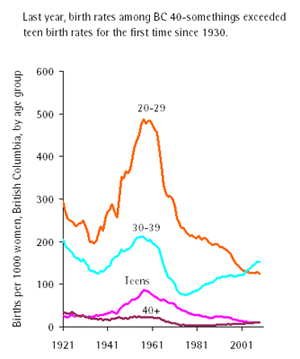
Graph of BC fertility by age

Chart: Sightline Institute.

Related

Here's a bit of interesting child-bearing news: last year, and for the first time since 1930, 40-somethings in British Columbia were more likely to give birth than were teens.

The chart above is drawn largely from data provided by the B.C. provincial statistics agency (see here for data since 1987).  And if you look closely at the lower right, you'll see that the pink line (teen birth rates) has fallen in recent years, even as the maroon line (birth rates among 40-somethings) has inched up. In 2009, the two lines crossed, as birth rates for 40-somethings crept ahead of births among B.C. teens.

But that's a relatively small part of the province's overall fertility picture. Looking at bigger and longer-term trends, two points leap out. 

Changing housing market

First and foremost, the baby boom -- the era that defined "normal" for many of today's political, economic, and cultural leaders -- was truly an anomalous period in history. Birth rates simply sky-rocketed in the middle of the last century, and then fell just as fast as they rose. Because of that fall, particularly among the under-30 set, a lot of hidden cultural assumptions about what's "normal" just aren't as relevant as they used to be. 

Some demographers now argue, for example, that the demand for detached single-family housing -- the housing model that dominated the baby boom -- has more or less peaked, as baby-boomers are starting to sell their suburban homes and as people spend more of their lives with no kids in the home.

I'm sure that if you're a home builder, that's tough news to hear.

See you later, kids

Second, you can see that B.C. women are clearly choosing smaller families later in life. As of 2009, the total fertility rate" in the province stood at 1.5 lifetime births per woman. That's actually a bit higher than it was in 2003, but historically it's near its all-time low. 

The fall in teen births, relative to 40-somethings, is part of this trend, but the bigger part is the fall in 20-something births, relative to births among 30-somethings. (The blue and orange lines in the chart above crossed back in 2003.) As career and educational opportunities have opened up for women, and as access to safe contraception has widened, women have chosen to delay childbearing and to have fewer kids. And both of those trends have worked to slow the pace of population growth.

A last point of note here: in both B.C. and the Northwest states in the U.S., teen births actually rose -- slightly but unmistakably -- between 2004 and 2007. But starting in 2008 the trends started moving down again. It's hard to peg the teen birth rates to any particular political trend, since the patterns were similar in both the U.S. Northwest and in British Columbia -- two areas that have very different political cultures. But regardless of the cause, it's good to see at least preliminary news that teen births are on the wane again.  [Tyee]

16  Comments:

Login or register to post comments

  • CanadianLatitude

    1 year ago

    People can not afford to

    People can not afford to settle down and have kids early, especially with high housing costs, maybe they have student loans and the high cost of living in general. That is why I am not surprised people are waiting to have kids.

    Pretty soon only the elite and rich will be able to afford children..

  • alive

    1 year ago

    me, me and me

    Perhaps this is the result of our ever increasing alienation from one another?
    People are becoming more self-reliant and have less trust or dependency on another human being.
    Eventually the biological clock forces the hand, so to speak.
    If this survey shows anything, it is that few people care to commit to anything that includes long term involvement.

  • Chris H

    1 year ago

    Morally superior to NOT have children?

    Look at this past Tyee article: http://thetyee.ca/Life/2009/08/05/ChildfreeChoice/

    People are championing a childfree lifestyle. Any reason to believe that will not have an effect on birth rates?

  • runner

    1 year ago

    statistics?

    "The chart above is drawn largely from data provided by the B.C. provincial statistics agency"

    ha ha - that's pretty funny to post this article right next to Rafe's anti-census rant :-)

    You would think that any government with control over immigration, child services, and health care would be interested to know that older women are having more children, or that the overall domestic birthrate per woman is dropping.

  • little-wren

    1 year ago

    baby time

    I am a grandmother & mother of four plus one adopted. The best time to have a baby is when your own mother is in her 30's or 40's. Waiting until you have collected scads of doo-dads & your mother is failing is...well...short-sighted.

    Single mothers with over-the-hill parents have a very rough time trying to drum up some support.

  • Jerry Munro

    1 year ago

    It's not all about mommy. Or daddy...

    "Here's a bit of interesting child-bearing news: last year, and for the first time since 1930, 40-somethings in British Columbia were more likely to give birth than were teens."

    Hmmm. And do we think this is a good thing?

    I don't. Watch those Downe Syndrome stats, along with foetus and other post birthing development issues.

    And as for being able to "afford" to have families at more appropriate "younger" ages, I don't recall it ever being "affordable" for most, certainly working class folks. We simply had them anyway... no birth control, and never regretted it. (By the time we were 26 and 27, the Mrs and I had four kids already.)

    There's something else at work here than "affordability" issues alone. I asked the Mrs what she thought it was, in part to see if her view was similar to mine, and she said immediately, "People have different expectations than they used to. They want more stuff. They want everything in place beforehand."

    Which I agree with, but... I think there is a tad more to it than that.

    Secondly, they can. That is, modern birth control technologies has made "delay" possible. And there is a point in the delay cycle where it stops being important I think, observing my own grand-daughters, until the alarm bells of the old biological clock start going off. Then it's panic stations time. When for many, they simply delayed too long... without artificial interventions anyway.

    But thirdly, the relationship between men and women at some very fundamental level, which I am not entirely certain of, has been changed too, making secure relationships that allow for family building more "iffy", as in difficult to create. (More observations of my daughters and grand-daughters.)

    And finally, who knows, there may even be other natural "forces" at work beneath the level of our consciousness, given large urban population densities etc, seeking to drive us in the direction of major population reductions. It is not unknown at least, elsewhere in nature, that population densities trigger changes in reproductivity behaviours.

    What afterall, would make us think that we might not have particular spatial requirements which current population densities might be violating the comfort, or reproductive cycle zone of. (I know it's one of the things that drive me out of The City, in search of a perceived "lebensraum".

    Though, if that is true, it isn't working equally as well in China or India, as two examples, for sure.

    Anyway, I find it to be a slightly disturbing, even "unnatural" phenomena, that women in their 40s might be producing more babies than at least used to be more typically younger, naturally fertile women-, who might actually be around to see their grandchildren. (Kid yourself not. Grannies and grandpas are important too.)

    It's not all about mommy. Or daddy.

  • Gary Lund

    1 year ago

    Demand falling for single family homes?

    Demand may eventually fall for detached housing, but in view of the price of houses in Vancouver, there's no waning of demand yet! Maybe if the prices drop by 60%, they'll be in line with affordability for the working class and middle class.

  • Jerry Munro

    1 year ago

    Ideology, consumerism and family planning...

    Though I think Mrs Coyote is actually "mainly" right. It was said, by Old Karl I believe (or at least he was one who said it as well) that the "ruling" or dominant ideology, or set of ideas of any age is the ideology of its ruling class. And there is no doubt that the ideology of capitalism's ruling class, in largest measure, is "the capitalist market", which is manifest as "consumerism", and "the pursuit of self-interest" as a dominant feature of social life. All of which at least "appears" to be at work here as a central element, effecting folks "family" plans. Very often until it is too late.

  • alive

    1 year ago

    the cost involved

    What It Means for BC?
    It means that birthing becomes a more complicated and expensive thing, particularly so if atificial insemenation is requested.
    Seems that couples postpone and then rely on society to help them achieve what they should have done decades ago.

    Yes, many things are possible, I am sure for instance,that I could pursue a university education now, after my retirement; but it is ego satisfaction and should not be sponsored by anyone.

  • sicntired

    1 year ago

    What it means for me in B.C.

    It means my daughter went from a health nut to a triple bypass and a stint in three years.The family plus the health thing and it's into rehab.I thought having children later in life made for better parents.Seems I should have thought back to my childhood.All the kids with older parents usually wound up with difficult lives watching their parents die very early.There are two babies out there who are wondering where mommy is,again.I guess that's how I raised her.Now we reap the whirlwind.

  • Rhea

    1 year ago

    here come the usual finger-wagging stereotypes....

    ...about the "selfish DINKS" or "self-centred people who put off kids to afford a big screen TV".

    "It's not all about mommy. Or daddy." This is crap, pardon my French.

    It's not about the parents unless it's about mommy and daddy being forced to choose between paying the rent or paying for childcare. Or the likelihood of daddy walking out and leaving mommy a single parent with no support, because the cuts to family maintenance enforcement have rendered it unenforceable. Or the higher chances of child abuse and neglect in a situation that's high stress, or where parents are either uneducated or literally feel like they have no options because this society treats like kids like some kind of consumer luxury good. Or if having kids means that you're going to be eating from the food bank while on maternity leave, because it pays a pathetic amount - less than 55% of what you earned at $10/hour. And remember, most people who qualify for parental leave pay have been paying into it - it's not a freebie. And good luck getting any kind of assistance if you have a kid with a disability. Not to mention the complete and total lack of affordable, reliable childcare in this city.

    A lot of people in the Lower Mainland delay childbearing or have fewer kids because they feel that they can't afford the NECESSITIES like food, rent and clothing on top of childcare on the average income in this city...at least not without a real financial struggle. Staying home isn't necessarily a choice when you barely qualify for maternity pay and quitting would cut the family income in half. Not exactly a recipe for family stability, which is the foundation for healthy kids. Move to the country, you say? Oh, really? And work where? If you're working retail or white collar or anything that's not government or tourism or resource based, that's pretty damned impossible. And what if it means leaving your family and/or support system here?

  • Rhea

    1 year ago

    ..continued

    If you had your kids 10, 15 or 20 years ago, the cost of living was less than half of what it is now, jobs were a lot more secure, housing was cheaper, the economy was in better shape, there was actually a forestry industry...it was literally a different world in BC. I know so many people with one or two kids who are making a family income of $60K and are struggling to survive. And that's not because of financial excesses, as so many older people seem to think...these are people who are frugal, pay their bills and taxes, and basically are totally screwed because they can't afford to live in the GVRD and can't find jobs or relocate to somewhere cheaper. It's really easy to say "well, people should have more kids, after all *I* had 4 kids early and WE were fine." Your situation is no longer the norm it used to be. Get educated.

    Yes, I'm sure there are people who choose to have few or no or later kids for what you might see as selfish reasons. Would it really be better for them to have kids when they aren't ready or don't want them? Really? I'd feel sorry for the kids. The people who want kids but are struggling to afford it are the ones who need help. Affordable child care would be a HUGE deal for most working parents. And a lot of people who work would love to stay home with the kids, but can't afford to. As in can't afford that food, shelter and clothing, not as in can't afford a vacation and a new car.

    rant over now.

  • Jerry Munro

    1 year ago

    Rave on...

    "It's not about the parents unless it's about mommy and daddy being forced to choose between paying the rent or paying for childcare. Or the likelihood of daddy walking out and leaving mommy a single parent with no support, because the cuts to family maintenance enforcement have rendered it unenforceable." Rhea.

    Sounds like you really want to talk to my Mrs. about poverty and such, about which we both know more than you seem to realize in your own self-righteousness. And I'm not defending poverty,or saying that life isn't difficult. It always has been for working class people... including through numerous economic depressions far worse than this, thus far.

    There is a problem out there, as therer always has been... only folks refuse to draw the proper conclusions. Stop crying in your beer, or your tea, and fight back. Kick ass.

    You don't have a problem dearie, that hasn't existed before. Contrary to what some folks seem to think today... that they have it worse.

    There is nothing, or at least very little, that is unique about today, that others have not lived, survived and fought through before. Stop whining and start fighting back.

  • Jerry Munro

    1 year ago

    Rhea and the way it is...

    Actually, I apologize a bit to you Rhea. Not that I think I am wrong, but you seem to have got my intent a bit screwed up.

    The central point I'm making is that there is more than "hard times" or even "poverty" involved here, in this entirely historically new phenomena of "older" women producing more babies than younger, "more naturally fertile" women. And the proof of that is, that most previous generations, except maybe "baby boomers", and them I'm not so sure about either, have had it actually worse in terms of standard of living and poverty issues than recent generations and even this one.(I and my Mrs predate the baby boom actually. We were the tail end of the Great Depression.) And yet, they and we produced more babies in our "best" physical years than currently, despite life being harder in material terms.

    And I am not advocating large families. There is no need for them anymore, I suspect. Though this country's population, without immigration, is actually in decline, whether it needs to be or not.

    Indeed, if poverty was the issue, large parts of the world from Bangladesh to India to China are serious anomalies then. In fact, poorer people actually produce more babies than in the "wealthier" countries of the West.

    So again, there is more than these issues involved in what is happening. And I suggest it has more to do, overall, with the more widespread acceptance, by men and women, of the capitalist marketplace "ideology/morality". Which is, in practise across society, everybody looking after #1, and the Devil take the hindmost; the hindmost being the working poor and underclass.

    People, men and women, are not having kids because they don't want to have them enough, they are an inconvenience to careers etc, and "stuff" and status is more important to them... until, that is, the panic of the biological clock strikes.

    Additionally, that is NOT to say that there are not a lot of folks still, like my wife and I were, having a goddamn hard time making ends meet and putting food on the table. Of course there are. We have always been a feature of capitalism, and even before it.

    But again, it has ever been thus for working class folks. At least those who are not making incomes that allow themselves to delude themselves into thinking that they are part of the Middle Class. Which is laughable. But then, their lives are changing now too, and drifting back to a more traditional, for capitalism, marginality.

    The times are deteriorating, but there is still a fair ways to go to get back to where it was before even piss poor welfare and socialized medical care, which still exists more than it did, I'll tell you. I remember.

    But like then, and the failure of folks in those times as much as now, society is still needing to be transformed into something qualitatively better than what it is for working folks. Something more broadly and inclusively working class friendly.

  • RickW

    1 year ago

    little-wren

    I agree with you completely and totally! Kids were meant to be raised in conjunction with the grandparents, so that Mom can get some work/education under her belt. But that would mean a cohesive family unit.

    I would recommend your comment for "Best Comment". But for some reason, the Tyee won't let me......

  • helen highwater

    1 year ago

    too many people anyway

    You'd think that women in their 40's would have figured out by then that there are already 7 billion human beings on this planet, and that they should not have children at all.

    • The discussion for this story is closed. No more comments can be added.