

 SHARE:
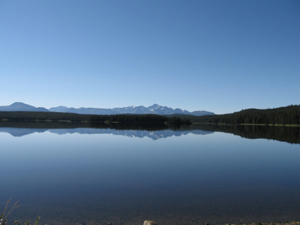
If you read the news last week thinking a trout-rich northern British Columbia lake was "saved" from being filled with toxic tailings from the proposed Prosperity mine, you would be wrong.
Despite a negative environmental assessment report, the federal government could still find the project "justifiable under the circumstances" and give the go-ahead if it decides that other factors outweigh the environmental costs -- for example, the economic benefits of killing Teztan Biny Lake, also known as Fish Lake.
Unfortunately, if the government relies on the numbers handed to it by the panel, the measure of economic benefits the government will be vastly overestimated. A strong independent case has been made that the mine will cost British Columbians more than it will benefit them -- but that analysis is not in front of federal decision makers.
A slew of adverse effects
The conclusion of last week's assessment report from the federal government's Prosperity review panel was that an array of significantly adverse effects would inevitably result if Taseko's copper-gold mining project in the Chilcotin area was to proceed. The panel concluded that the Taseko's mine would result in significant adverse effects to fish and fish habitat, navigation, current use of lands and resources for traditional purposes by Aboriginal communities, cultural heritage, and on certain Aboriginal title and rights in the area.
Unlike most federal assessment panels, which do not find significant adverse effects of proposed projects, this one found a slew of them.
Strangely, however, the panel didn't, or couldn't, actually recommend to the federal authorities that in the light of all these negative impacts the project ought not to be approved. Instead, the panel was directed to provide information to the ministers to help them decide whether or not the project could be justified, even if there were adverse effects.
One of the usual suspects in these matters of justifiability is, of course, the alleged substantial economic benefits of the proposed project. In this case, the numbers trotted out by Taseko are not inconsequential -- 375 direct jobs, an annual payroll of approximately $30 million, $200 million in annual expenditures in the provincial economy, some $30 million in government revenues, and an overall injection of $50 billion into the economy over 20 years. These are, unfortunately, the numbers the panel passed along to the ministers as reliable information on the economic benefits of the project the ministers could consider in their decision-making.
The difficulty with all this is that in terms of identifying the net economic benefits of the project, the numbers provided by the company are seriously misleading.
Relying on the company’s numbers
The panel had expert evidence before it that Taseko had substantially overestimated the economic benefits of its project and yet, in providing information to the ministers concerning justifiability, it did not pass on the only independent analysis available. This is bad news, because it is virtually certain that the ministers will examine the issue of economic benefits if they contemplate approving the project despite the serious environmental and cultural consequences identified by the panel.
Not incidentally, these are the same numbers with which Robin Jungers, then executive director of the BC Environmental Assessment Office, "justified" the project in his December 2009 recommendation to provincial ministers to approve the project, even though the loss of Fish Lake was determined to be a significant adverse environmental effect. B.C.'s review of the Prosperity mine was a sham in many ways, but this particular move by the executive director to rely on extraneous information from the company about the presumed economic benefits to justify approval to the provincial ministers was outright shameful. The economics of Prosperity were never independently examined by the B.C. review process, and the executive director had no business writing off the environmental impacts of Prosperity against presumed economic benefits.
The unreliability of Taseko's stated numbers came to light when independent expert evidence on the economics of the project was presented to the Prosperity panel.
Huge costs not taken into account
Marvin Shaffer, an SFU professor and prominent resource economist in B.C., examined the company's statements of net costs and benefits of the project, and concluded that the net costs would significantly exceed the estimated benefits.
For example, Shaffer noted in his technical submission that Taseko estimated it would be buying power at $37 per MWh, based on what it is currently paying for power at its operating Gibraltar mine near Williams Lake. However, the cost to BC Hydro of acquiring this power would be much higher. Shaffer used Hydro's 2006 call for energy, which averaged $88 per MWh, to conclude that Hydro would lose $50 on each incremental MWh, or approximately $35 million each year over the mine life. This cost would ultimately be borne by all the customers of Hydro.
Shaffer told the panel that the BC EAO's conclusion that "there is no expected cost to future generations except for the loss of Fish Lake and Little Fish lake” was factually incorrect. There would be a very large, on-going cost to present and future generations from this arrangement.
Shaffer also noted there would be some employment net benefits, but these would be limited by the fact that labour shortages are expected in the medium to long term, and the job opportunities generated by the project are not likely to employ persons who would otherwise be unemployed. Similarly, there are some government net benefits from mineral taxes and income taxes, but these are far less than the gross tax impacts presented by Taseko, and not at all certain.
Tax revenues overestimated
As for tax revenues to government, Shaffer questioned the company's estimate of $25 million per year, stating that the effective tax rate, taking into account financing and corporate tax strategies, would be less that $7.5 million. Further, there is no certainty such payments would be made, since it would depend upon the economic performance of the mine and the corporate strategies used to minimize payments.
Joan Kuyek, testifying for MiningWatch Canada corroborated Shaffer's point that actual taxes paid by the company could be significantly less than what Taseko was alleging. On its Gibraltar mine, according to Kuyek, Taseko paid mineral taxes of $606,000 on an operating profit of $28.1 million in 2008, and $981,000 on an operating profit of $48.3 million in 2009, the tax averaging some two per cent over these two years. As for income taxes, Taseko estimated its 2009 tax at statutory rates of $3.38 million, but paid only $669,000, slightly over one per cent of its operating profit.
In total, Shaffer concluded that the direct corporate income mineral and property taxes paid by the mine might yield up to $11 million per year, far less than the $35 million cost imposed on Hydro on each year. Shaffer also did some calculations for air contaminant and GHG emissions costs to B.C., showing that unless the mine pays carbon taxes or permit fees in amounts sufficient to offset these emissions, they could cost British Columbians some $2.6 million per year during construction and operation.
Other economic costs, unquantified but considered by Shaffer to be "strongly negative overall" include pressures on housing, services and infrastructure, impacts to traditional resources and cultural values of the affected Aboriginal communities.
Shaffer pointed out that decision-makers need to look at net economic benefits, and determine whether they would be of a magnitude that would offset the adverse effects. So, for example, potential estimates of employment induced by the project would need to consider the incremental employment or other benefits of those jobs relative to what those hired would otherwise be doing. Similarly with estimates of government revenue impacts -- these need to indicate the incremental revenues governments would receive and would need to net out the incremental expenditures government would incur.
British Columbians could lose big
Shaffer's overall conclusion is that contrary to Taseko's pronouncements that the project would generate billions of dollars of net benefits, the project would appear, based on available information, to generate significant net costs for British Columbians and Canadians as a whole. Not including the unquantified environmental, cultural and social costs, Shaffer concludes that the net costs of the project would average $20 million per year over the life of the mine. This number is based on Shaffer's use of the 2006 reference rate for power at $88 per MWh -- recent numbers in the media suggest electricity from Site C at $160 per MWh.
The picture from all this is that the net economic benefits of the proposed Prosperity mine will be substantially less than what the company tells us and may, in fact, be negative overall. So, if the federal cabinet is even thinking of justifying the project on economic grounds, it would be well served by careful scrutiny of the evidentiary record from the panel hearings, or else an independent critical assessment of the project economics by someone who knows what they're doing. ![[Tyee]](/design-article.thetyee.ca/ui/img/yellowblob.png)
Read more: Labour + Industry, Environment












Tyee Commenting Guidelines
Comments that violate guidelines risk being deleted, and violations may result in a temporary or permanent user ban. Maintain the spirit of good conversation to stay in the discussion.
*Please note The Tyee is not a forum for spreading misinformation about COVID-19, denying its existence or minimizing its risk to public health.
Do:
Do not: