
'Gassed' by oil sands operations, families say they've been forced to evacuate.
Residents near Baytex bitumen facility say they are being poisoned by off-gassing. Photo: Richard Labrecque.

-
Poisoned air. Sunken gunk. A clean-up nightmare. What we're learning from the oil sands 'DilBit' dump into the Kalamazoo River.
-
Diluted bitumen creates toxic cloud public would be forced to flee, as occurred in Kalamazoo.
-
What to call Alberta's reserves is raising a fuss, but for wrong reason, research indicates.
- Read more: Energy, Health, Labour + Industry,
Another Alberta pollution scandal has forced as many as six residents from their homes and poisoned scores of other citizens near the Peace River Oil Sands in the northwest corner of the province.
"It's a desperate situation," said Vivianne Laliberte who moved into her son's place last October after being repeatedly "gassed" from emissions from oil sands operations just 5 kilometres from her 85-year-old farm.
"There are a lot of sick people but they don't have the money to move," Laliberte told The Tyee. Her farm is located 48 kilometres south of Peace River.
Emissions from heavy oil extraction and storage facilities owned by Calgary-based Baytex Energy Corp., a heavy oil producer, forced her and her husband to abandon their property.
"But I don't blame the company," added Laliberte.
"I blame the ERCB (Alberta's energy regulator). They are not doing proper monitoring and are withholding data. They are responsible for this going on for years. They have lied to us more than the company. I don't know how they sleep at night."
Greg Melchin, a former Alberta Energy Minister and Tory politician, sits on the board of Baytex Energy.
Darin Barter, spokesman for the Energy Resources Conservation Board (ERBC), says the board "continues to take this matter seriously. We have worked directly and frequently with residents, industry and other government agencies on these concerns."
Barter adds that the ERCB has assigned an extra inspector to the region and that "the ERCB is currently examining our regulatory options that may assist in resolving this issue."
But residents, many of whom were recently profiled in a three-part CBC series, say the province has failed to regulate hydrocarbons being vented off of hundreds of bitumen storage tanks in the region.
No regulations
"There are no regulations on heated bitumen products. The carcinogens coming off those tanks are just crazy," says 50-year-old Carmen Langer, who worked in the industry for two decades.
His ranch, located 27 kilometres north of Peace River, is surrounded by hundreds of wells and hundreds of bitumen storage tanks.
"Three generations built this farm and now industry pollution is taking it away from us," says Langer, who recently sold his cattle. "We're done. I won't sell my home contaminated. We're not that kind of people."
Langer, who calls bureaucrats and politicians every day for action on bitumen vapour recovery, recently presented a $3.8-million bill to the province for land contamination and property devaluation.
"The government is mental not to deal with this situation," said Langer.
But Ian Johnson, an independent scientist with a PhD in chemistry who has advised citizens on the inadequacy of government air monitoring, does not think the government has any interest in regulating.
"Industry isn't contravening any regulations because there are none that I know of. It's a case of colossal mismanagement," explained Johnson.
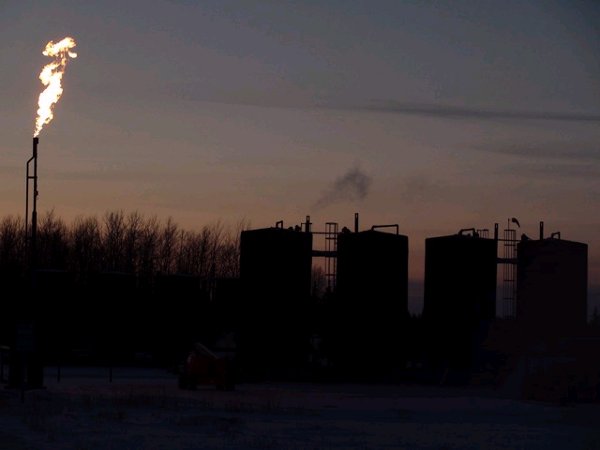
Flaring gas and bitumen storage tanks near home Labrecque family says it has been forced to leave. Photo: Daniel Labrecque.
A FAMILY'S BITUMEN HELL
The family of Alain Labrecque began its descent into bitumen hell in December 2010.
That's when Labrecque, a 36-year-old farmer and logger, began to experience debilitating headaches and periods of dizziness.
"I never had headaches in my life. I couldn't shake them off and then my eyes began to develop a twitch."
One day his wife, Karla, lost her balance and fell down the stairs. Their two preschool-age children would inexplicably fall off their chairs. "The kids were really clumsy."
Four months later the family's symptoms temporarily lifted and the air appeared to be cleaner. But then rank odours wafted across their property again and the headaches and dizzy spells returned.
At that point Labrecque confronted his neighbour, Calgary-based Baytex Energy, located just half a mile south of his farm.
The heavy oil company had been expanding its bitumen field and Labrecque now suspected his family's ill health was due to poisonous vapors from the company's 16 bitumen storage tanks.
"Sometimes the vapours smelled like bitumen and then like the pesticide Round-Up. Others smelt like burning tires," says Labrecque. "They were injecting chemicals and emulsifiers into the tanks because bitumen is so molasses-like."
But the company greeted the family's concerns with outright denial. "They said 'Prove it. It is not us.' They took the bully approach. They are so arrogant."
During the summer of 2011 one company official promised to fix the problem but the poisonous smells returned with a vengeance in the fall. "They didn't fix anything."
By November the fumes were so powerful that the family evacuated their farm and moved into a small rental property. Labreque tried to work on the farm part-time, but the volatile hydrocarbon emissions stuck to his clothes like glue and made the family sick when he came home at night.
A member of the Energy Resource Conservation Board (Alberta's lacklustre energy regulator) told Labrecque this week that low levels of hydrogen sulfide (H2S) had most likely poisoned the family but that the board had no rules for controlling low levels of H2S.
H2S or "dirty gas" is a cyanide-like poison that targets the brain and lungs. Studies have found low-level exposure can cause nausea, vomiting, vertigo and personality changes. Sour gas facilities, due to leaks and spills, have devalued rural property throughout Alberta.
Over the last 40 years dirty gas pollution has forced more than a hundred rural Albertans from their homes, killed more than 35 workers and asphyxiated thousands of cattle and horses.
The production of bitumen can produce as many as 1,400 known pollutants. Most are not monitored by industry or government. But sour gas has proven a major concern in oil sands operations north of Fort McMurray too. At three different industrial monitoring sites levels of hydrogen sulfide pollution have exceeded limits for one hour exposure more than 2,400 times over the last decade. The 24-hour standard has been exceeded more than 400 times.
This year Labrecque abandoned his three-generation family grain farm and moved his family to Smithers, B.C., to breathe clean air.
He says there is only one solution to ongoing bitumen pollution in Peace River.
"They should shut down the tanks and put in a closed-loop system so there are no emissions."
— Andrew Nikiforuk
Bitumen deposits around Peace River vary greatly in quality, sulfur content and thickness. Some deposits can be recovered with steam injection while others use a cold production method known as CHOPS. It pumps both bitumen and sand to the surface from 600-metre-deep deposits. The ultra-heavy oil is then stored in heated tanks (up to 120 degrees) where gases can build up. Once vented into the air these toxic fumes can travel for miles.
A 2003 Shell Bitumen Handbook notes that bitumen fumes from heated storage tanks can "result in the irritation to the eyes, nose and respiratory tract and headaches and nausea" and adds that exposure should be minimized. Moreover, emissions from storage tanks can contain polycyclic aromatic hydrocarbons (PAH) as well as hydrogen sulfide, a deadly neurotoxin even at small levels.
Pollutants also change with the quality of heated bitumen stored in the tanks. One Australian study found that measured off-gassing pollutants included PAH, benzene, toluene, ethyl benzene and xylene, chloromethane and acetone.
Her children 'were being poisoned'
Another family gassed by Baytex's operations recently set up their own website documenting their ordeal as environmental refugees in Canada's wealthiest province. (See sidebar)
"I have two young children who I initially thought were going through a clumsy stage related to either a growth spurt or simply due to their age but now I know that they were being poisoned," writes Karla Labrecque on her website.
"My three-year-old looked like he was a ghost most days while my two-year-old would repeatedly lose her balance while sitting and fall off furniture. Since making the difficult decision to leave our farm, both my children have made dramatic recoveries but I can't help but think about what long-term effects they may suffer."
Labrecque, who says she is not a tree hugger or environmentalist, is not lobbying to have Baytex Energy shut down.
"I just want to be able to safely return to my home. I simply ask Baytex Energy to clean up its act, keep their emissions contained in a closed system and to provide all of us with a community in which we can breathe freely."
Ever since tar sand operators increased the scale of their drilling and operations three years ago, residents have complained of a myriad of symptoms -- headaches, disorientation, blackouts leading to bad falls, night sweats, chronic nose and throat irritation, lung congestion, chronic coughing, reduced sense of smell, extreme fatigue and swollen lymph glands.
"We had none of these symptoms before the oil sands operations began in our area," says Laliberte. "Some symptoms clear up within hours of leaving the area, while others take a few days. Some, like our sense of smell, have not returned to normal."
In a 2012 letter to Alberta Premier Alison Redford, Vivanne and Marcel Laliberte wrote that:
"Every breath we take when at home is poisoning us. We believe that the air contaminants have been absorbed into the materials of our home and are retained there. We are in temporary accommodations in Peace River. Promises such as, 'We are working on it' or 'We are hoping for changes at some unspecified time in the future' don't pay our electricity, heating and telephone bills."
Added the letter:
"We are reading Barbara Coloroso's book, The Bully, the Bullied, and the Bystander. We are anxious to get to the part that explains how to get a bully to feel empathy. We are far more interested in building an empathic society, where the well-being of all is paramount, rather than one in which contemptuous bullies rule and the well-being of the shareholder reigns supreme."
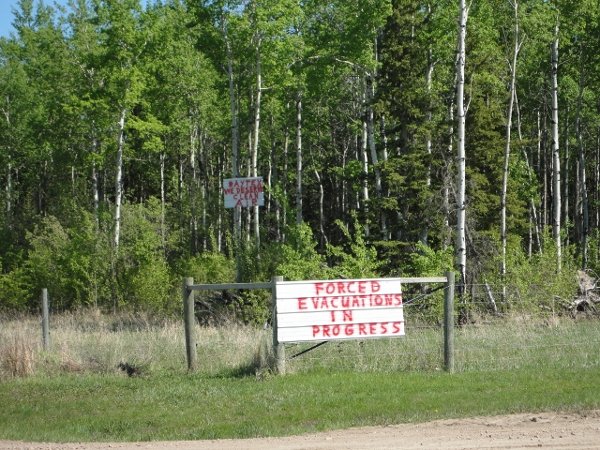
Residents near Baytex say pollution penetration makes their homes uninhabitable even if off-gassing stopped. Photo: Karla Labrecque.
Laliberte, who was born and raised in the region, said she has not received a reply from the premier who promoted Alberta's environmental track record in the United States last week.
'Get yourself out of the area'
Laliberte told The Tyee that rural residents who have sought medical help also had trouble finding physicians "who dared look into the matter, fearing repercussions. One person was told by a specialist, 'I can't do anything. Get yourself out of the area.' Another was told, 'I don't want to hear about it anymore. You need a lawyer, not a doctor.' This happened in three different centres in the province."
Johnson, who has criticized air monitoring in the region as fraudulent, has also called the ERCB's response to the pollution totally inadequate in letters to Environment Minister Diana McQueen.
After receiving a pollution complaint on Jan. 4 from rancher Carmen Langer (the rancher has since found dead deer in his yard after pollution events and has now sold all of his livestock), the board initiated its so-called "Peace River Cooperative Odor Complaint Protocol."
It consists of asking heavy oil producers in the region such as Shell, Penn West, Baytex and Murphy to dispatch "staff or agents to check its facilities and review activities from the previous 24 hours." In most cases, such ad-hoc investigations reveal "nothing identified."
In the region, Shell has remodified its storage tanks to capture their toxic emissions while other companies have not.
'Committed to producing oil safely': Baytex
According to the Peace River Record Gazette, the ERCB has responded to more than 600 complaints, 400 inspections and 1,300 investigations in the Three Creeks/Reno area over the last two years with little change in emissions reduction.
Yet the ERCB website makes no mention of these ongoing events and concerns. "We do not post personal information or details around landowner concerns or official complaints on our website for FOIP reasons," explained Barter in an email.
Baytex's website declares that the heavy oil producer believes "in keeping best practices and the needs of our neighbours and partners in mind when operating our business and when sharing a community space."
Andrea Beblow, spokesperson for Baytex Energy, said air quality near Baytex facilities meets Alberta regulations but that "we commissioned a comprehensive air quality study involving landowners, regulatory authorities and other stakeholders."
"Every employee at Baytex is committed to producing oil safely and in an environmentally benign manner," added Beblow in an email. ![[Tyee]](http://thetyee.cachefly.net/ui/img/ico_fishie.png)
Award-winning journalist Andrew Nikiforuk has been writing about the energy industry for two decades and is a contributing editor to The Tyee. Find his previous Tyee articles here.
40
Login or register to post comments
Fiat lux
12 weeks ago
Just wait when the cancer
Just wait when the cancer epidemics begin among the workers and in the neighbouring areas.
It swill be interesting to see what the excuses will be ?
Ed Deak.
Hakuin
12 weeks ago
More ammo
https://realitydrop.org/
Talon
12 weeks ago
Toxic Vapours
"But I don't blame the company," added Laliberte. This telling quote from the story says it all. The companies are not doing anything wrong, it is the government that is at fault. I think everyone in Alberta has been sniffing the vapours for far too long. The truth from BP in their 2013 Energy Report says that they are going to develop all the oil and tarsands they can get their hands on. They also say that if humans burn all that BP can produce the outlook for the future of humanity will be grim indeed. It is our choice says BP, they just produce the stuff, we are not forced to use it. Such hubris is challenging to say the least, but it is true - it is up to each one of us to make the decision. What have you done for your planet lately? Cheers.
gracie17
12 weeks ago
None of them blame the company
but they blame the government, which is pretty much the same entity. The regulators move from "governing" to overpaid company boards at will. A disturbing article on more than one level. It looks like Alberta has pretty much succeeded with their propaganda when the people most directly affected by the tar sands operations still seem to support them.
Hakuin
12 weeks ago
think Albertar will catch up to China?
http://www.huffingtonpost.com/2013/02/23/china-cancer-villages-pollution_n_2744879.html
rangerkim
12 weeks ago
off topic, but I gotta say ...
So this is the world we live in today. I heard on CBC radio this morning this most bizarre juxtaposition;
The lead was the $85 billion sequester which was touted as having a "profound and devastating effect" not only today and in the months to come but for years into the future.
The following story was the US State Dep't report which states that a 2700 km 36" pipeline that promotes the additional use of 1.1 million barrels per day (plus the additional 366,000 barrels per day to mine that bitumen; a 3:1 ratio, an EROI that tarsand producers can only dream about) has absolutely no effect one way or another.
What the hell is going on?!? Should I look around for Alice to take my complaint to the Queen of Hearts?
The sequester means a cut of 2%, big deal! More bitumen production and fossil fuel use is going to tip our only home into and unlivable place; that is indeed a big deal!
annie57
12 weeks ago
Alberta's Toxic Culture In Healthcare
"Laliberte told The Tyee that rural residents who have sought medical help also had trouble finding physicians 'who dared look into the matter, fearing repercussions. One person was told by a specialist, 'I can't do anything. Get yourself out of the area.' Another was told, 'I don't want to hear about it anymore. You need a lawyer, not a doctor.' This happened in three different centres in the province."
Is anyone surprised?
"Some doctors said they were threatened with losing their jobs or their hospital privileges, and had their mental competency questioned, simply for critiquing the system on behalf of their patients.
Others were labelled 'negative' or 'misinformed,' and told to stop speaking out of turn.
'A culture of fear, intimidation, apathy, elitism and manipulation exists and has existed for some time,' said one respondent. Another described the culture in Alberta healthcare as one of systemic harassment and intimidation, with a negative effect on patient safety.
'Even rumours of intimidation were enough to stop some doctors from advocating,' the report says.
... He also says Alberta has difficulty recruiting medical professionals because of the toxic culture in healthcare: 'Top doctors are staying away when they find out what happened to people like Dr. McNamee.'"
http://www.albertaviews.ab.ca/2012/11/01/doctor-intimidation/
Texwriter99
12 weeks ago
OILSANDS COMPLAINT
Let me separate fact from fiction here
Alberta has no tarsands. Tarsands is an old name that has been out of scientific use since 1951. Petrochemically, tar is man made and Alberta has oilsands. Bitumen is extracted from the quartz sand by a hot water process and bitumen is then converted to oil by extracting mainly coke and sulphur. What is left is synthetic crude oil.
Peace River heavy oil is not carcinogenic. But the complaints should have been answerted by your MLA and by ERCB and by AHS. No excuse there. 28,000 people work in heavy oil in the oilsands and are medically tested annually. There is no evidence of any permanent illness. But that does not mean there is no problem. I did talk to three Doctors in the region and all denied what is stated in the article. I am an Industrial Health specialist and suggest an official complaint must be made through your MLA. I dont doubt for a minute that you are getting sick over fumes. Asphalting new road makes people sick.
Your MLA is duty bound to take your complaint. Most doctors are not qualified to deal with industrial health problems as they cant determine the real cause.
This is specialist work with sensitive instruments like DRAEGERS and GAS DETECTORS used for natural gas etc.
Hakuin
12 weeks ago
TARsands
they are TARsands. Oilsands sounds nicer. We don't care about nice.
Hakuin
12 weeks ago
safe safe safe!!! ("safe")
https://www.scientificamerican.com/article.cfm?id=oil-sands-raise-levels-of-carcinogens-in-regional-waters
Fiat lux
12 weeks ago
Federal scientists have found
Federal scientists have found heavy poisons in lakes far from the tar sands. Claiming that no damage is done to humans is ridiculous, or paid off.
http://www.nytimes.com/2013/01/13/world/americas/oil-sand-industry-in-canada-tied-to-higher-carcinogen-level.html?_r=0
http://www.csmonitor.com/Environment/Energy-Voices/2013/0108/Canadian-oil-sands-pollute-nearby-lakes.-Report-is-blow-to-Keystone-pipeline
http://www.cbc.ca/news/canada/north/story/2010/09/16/edmonton-oilsands-deformed-fish.html
All kinds of scientific articles on the subject
Ed Deak.
annie57
12 weeks ago
Hide And Seek
Texwriter99,
"I did talk to three Doctors in the region and all denied what is stated in the article."
What exactly did they deny?
"Most doctors are not qualified to deal with industrial health problems as they cant determine the real cause."
Perhaps the industry and government could start handing over the information, such as data collected "with sensitive instruments like DRAEGERS and GAS DETECTORS used for natural gas etc." so our good doctors can do their jobs, "determine the real cause" and assist and inform our citizens.
"Canada’s doctors called Wednesday for a full diagnosis of the health and environmental effects of natural resource development — particularly in Alberta’s oilsands ... .
Delegates to the Canadian Medical Association’s annual general council meeting overwhelmingly endorsed a resolution asking for public and timely access to all government and industry data on the potential human health effects of 'natural resource extraction projects.'
... Alberta Medical Association president Dr. Linda Slocombe, another member of the province’s delegation to the CMA meeting, said the potential impact of asbestos mining, shale gas explorations and other projects must also be examined.
The doctors want to ensure appropriate monitoring of health hazards takes place, and 'that information is relayed to the health professionals, so we are able to help our patients', Slocombe said.”
http://www.ernstversusencana.ca/longer-article-doctors-demand-access-to-all-health-data-on-oilsands-and-other-natural-resource-extraction-projects-including-shale-gas
rangerkim
12 weeks ago
Hey Tex
EDITED FOR PERSONAL INSULT/UNVERFIED ACCUSATION ABOUT ANOTHER COMMENTER -- MODERATOR
Second, Ya don know whatcha talkin about.
Third, ... well I better not
annie57
12 weeks ago
There's No Place Like Home
"Langer, who calls bureaucrats and politicians every day for action on bitumen vapour recovery, recently presented a $3.8-million bill to the province for land contamination and property devaluation."
I expect we're going to see more property devaluation and people walking away from their homes as the resource extraction spreads across Canada.
"But that’s not the only challenge that the secrecy of the gas companies creates. Companies do not disclose where the wells themselves will be drilled. So an investor who buys a triplex in a town where drilling is expected to begin could end up with a well in their back yard—and that’s bad news for property values.
A Colorado study done in 2001 in La Plata County showed that properties with coal-bed methane gas wells were valued 22% less than similar properties without wells. More recently, says Chase, 'property values have plummeted 70% and some people have walked away from their homes.'
The reasons why property values fall so significantly are because of the negative impacts of fracking. The drilling can release toxic gases—including explosive methane—into the air, contaminate water sources and reduce the look of the property.
These side effects are triggering mortgage companies in the U.S. to take a second look at properties near or on wells. It’s becoming increasingly common for buyers to be denied mortgages for homes in areas where fracking is taking place. Insurance companies are also being cautious. Some are no longer insuring homes that have gas wells near by."
http://www.canadianrealestatemagazine.ca/component/k2/item/1381-fracking-buyer-beware
pwlg
12 weeks ago
In the Peace River country of BC residents suffer
VanCity Theatre is showing documentary film, "Trouble in the Peace", March 2nd, 3rd, and 6th.
http://www.viff.org/theatre/programs/pg2544-trouble-in-the-peace
"When livestock begin dying and people become mysteriously ill after gas leaks in Peace River Country in northwestern BC, a series of bombs are set off on the pipelines in reaction. "Trouble in the Peace" follows Karl Mattson, an enigmatic and reclusive cowboy, as he struggles to make sense of what’s happening to his town and the people in it. Feeling scared and alone, he embarks on a unique course of action in an attempt to save his family and unite the community."
pwlg
12 weeks ago
BAYTEX ENERGY
Once again we find the government employees pension fund, BC Investment Management Corporation, bcIMC, heavily invested in tar sands.
As of March 2012 bcIMC had more than $71 million invested in Baytex Energy.
When will workers wrestle back their pension funds from the destructive investments of bcIMC and have them invested in companies that don't put people, especially children, at risk?
Is this another example of Christy Clark's "Families First" initiatives?
pwlg
12 weeks ago
texwriter
Can you explain naturally forming tar pits, tar seeps?
Could you provide information that 28,000 workers who work in the tar sands are medically tested annually? For what?
The only test workers receive working in the tar sands are pee tests for drugs and alcohol.
In my more than 30 years working in pulp mills, refineries, mines and the tar sands I have never been required to have an annual medical check-up to determine impacts to my health and well-being.
I do know however that my fellow workers who have worked as long in these industries are increasingly getting cancer related diseases, debilitating respiratory illnesses and other fatal diseases.
As the heavy industry workforce ages so does the work related diseases and deaths at earlier ages. My monthly union magazine publishes several pages of members who have passed away from work related diseases.
pwlg
12 weeks ago
more bcIMC investments in Peace River tar sands
The article also lists Shell, Penn West and Murphy Oil participating in the tar sands rush in Peace River.
bcIMC has a total of almost 1/4 of a billion dollars ($247.3 million) invested in these 3 companies.
maryhebblewhite
11 weeks ago
Alberta 'tar' sands oil and US action on Keystone pipeline
My husband and I marched in the 2/27 Wash DC demonstration against the pipeline, stopping at the Whitehouse and the State Dept. Pres. Obama was in FL playing gold with Tiger Woods. It has been said that he also met with oil co representatives. As many of you know, our Dept of State has now issued findings that the pipeline does not add to the climate/greenhouse gas problem -- apparently because China will somehow burn the Alberta deposits anyway. There were 40 to 50,000 marchers in DC. Including a US basketball star, Rosario Dawson (African American actress of note), the Sen from Rhode Island, a Latina Congresswoman, Bill McKinnon the leader of 350.org (climate activist), Michael Brune Exec Dir of Sierra Club, and more. And First Nations leaders from BC, Alberta, and Oklahoma. There were people from BC, Montana, N. Dakota, Minnesota, Wisconsin, Michigan (the pipeline disaster into the Kalamzaoo R), Colorado (burning forests), New Mexico, Oklahoma, Louiisiana, Misssouri, Ohio, North Carolina, Florida, South GA, and the Atlanta area -- our area. White haired (us!) and the young, parents with children, college students, and thousands of homemade banners. The DC tv news hiad maybe 4 min per channel.None of the substantive speeches were covered. The Washington Post gaver it half page (good) withg good photos, bu9t no substantive quotes (eg., about climate science, or about jobs and productivity rising in many US states in wind and solar -- the industries' viability!). Very very little of this made the mainstream media elsewhere - I have been searching the coverage online. Papers tended to cover the arrests of leaders who handcuffed themselves to the White House fence several day8s before the actual demoinstration, but the sheer size of the march itself anid the substance of the speeches - not even mentioned - zip - in the Atlanta Journal, or so far as I can find, the NY Times. I'm still looking. It can be found on UTube and Moms' Clean Air Force.
This says what we're up against.
I fwd links sent me by a BC activist friend. I have joined several CA based activism networks. Please: You guys if you have not already, join 350.org (my activist friend has done so) , Moms Clean Air Force, Union of Concerned Scientists, Physicians for Social Responsibility, truthout.org, Sierra Club, Greenpeace, etc., climatejustice.org, climateprogress.org.
Sierra Club has a forceful current petition to Obama and Kerry, currently available.
Also, one can go to Whitehouse, find 'contact' and the means to email Obama.
The pro-pipeline advocates have outspent the anti pipeline advocates 35 to 1. It is not accidenital that the massive demonstration was so little covered.
If interested in more expose -- eg., the Koch Bros - see Greg Pallast's latest book which follows the money and the political influence.
Thanks for all you are doing...many thanks.
maryhebblewhite
11 weeks ago
Help America advocate w/Obama & Sec STate Kerry against Keystone
Almost 50,000 Americans led by 350.org's Bill McKibben and Sierra Club's Exec Michael Brune came from all over our country and also from your First Nations to Wash DC and marched against Keystonhe pipeline and the 'tar sands" in general, on a 2/17. This went significantly under reported by mainstream media....checked the Atlanta Journal (my hometown ppr) & NY Times, and still checking. There is mention of the arrests of McKibben, Brune and others a few days BEFORE the march, for cuffing themselves to the White House fence. But outside of DC I know of no coverage of the SIZE of the demonstration. And no coverage of the SUBSTANTIVE content of speeches by a dozen leaders of prominence (eg.,science, and facts on the increasing viability of solar and wind, health probs in Alberta, etc). A year ago, the first 350.org Keystone demo scored 12,000 protesters. And I think it cot more mainstream cover. Obama gave a good climate/.greenhouse gas statement in his State of the Union address but is not walking the walk. John Kerry's State Dept has issued a report concluding that the Keystone will not add to climiate change -- I guess because we assume that China will get the oil some other way. We're at the tipping point. But tipping doesn't just stop at a certain temp! We can still halt it, though Im noit optimistic, and is fallacious reasoning to say 'well it's tipping right now, nothing more we can do, might as well keep on with fossil fuel exploitation and not develop our wind and solar and mass rapid transit." The moiney spent pro-pipeline is 35 to 1 greater than that spent by advocates against it. I've joined several Canadian acrivism sites and signed petition and passed them on it fellow American activists. I get fwds from a BC activist friend. That's how I got this item. Please. Do the same. Go to truthout.org, climatejustice.org, 350.org, climateprogress.org, Greenpeace, Sierraclub.org, unionofconcerned scientists.org, physiciansforsocialrpssponsibility.org oceana, Care2 petitionsite, AAVAZ.org, and sign onto petitions to Obama and Secty of STate Kerry....Sierra Club has a strong one right now. THANK you, Canadians, for all you do.
rangerkim
11 weeks ago
Hey Tex, c'mon back
Mea Culpa. My bad
The Moderator reminded me of a very important point here; if one is passionate about the sanctity and preservation of our one and only environment in which we can thrive, and I am, then one needs all the support and cooperation possible. That includes support and cooperation from the very same people who are making a living destroying the environment by producing the hydrocarbons that we all use.
So Tex, chin up, I was wrong to malign you. We need and want you here reading these articles by Nikiforuk and participating in the conversation that follows. I will not take cheap shots at your character. I will, however continue to use the term 'tarsands' for 2 reasons: a)the phrase seems to be a hot button and however juvenile and unhelpful to the greater cause, I really do enjoy goading the other side, and b)the petrocorps and their paid shills, whomever they might be, chose 'oilsands' as a more benign, greener and friendlier term for what is essentially the permanent destruction of a significant portion of the Boreal ecosystem and I am not favourably disposed to allow anyone to paint such a wanton act with pretty words.
So, Tex, c'mon in, take a seat. Let's talk.
Steve Hetherington
11 weeks ago
Welcome aboard Mary
Good to have you here and sharing your insights.I think the long and short of it is the msm is in no way our friend and are only there to dumb us down---ok--we get it.What do we do?How do we inform Joe public?The crimes are so obvious to us who care enough to dig with eyes open but sadly it is not enough.As soon as a movement starts and appears to be on the verge of making a difference----the screen goes dark(idle no more)How do we eclipse msm.
I have nothing but respect for the wisdoms such as those from Fiat and the like who submit"without violence"---but how do we do it?How do we bring about change?Please don't say voting------not enough!-----Anyone?
Clocks tick'n away here folks.
Just look at what a travesty a hand full of folks have done to this province(country)
How,without some sort of civil disobedience(or violence) can we hope to correct it?
Hakuin
11 weeks ago
hmmm
how about "moral authority"?
Hakuin
11 weeks ago
(hey Ed!)
(present for ya:
http://www.rbcpa.com/Mungerspeech_june_95.pdf
Steve Hetherington
11 weeks ago
Hay Hak
What's your version of moral authority?
ShShSh--don't wake Luke.
Hakuin
11 weeks ago
Oh, something gandhian I suppose
We are in a position a lot like the occupied Tibetans. The thugs are watching, hoping for a chance to justify more oppression. One big advantage though, in our case we actually outnumber them. All we need is one incident, critically timed. A single pebble starts the landslide.
carfreecity
11 weeks ago
STOP
we have suffered decades from all this stupid oil/automobile business
i hung up the keys to the car a few years ago because i can't stand being gassed everyday and living with the NOISE, filth and Stress from all this overuse of these Weapons of Mass Destruction
the Tarsands are ore support for it.
G West
11 weeks ago
Tar Sands is the right word Texwriter99
Let me remind you what Orwell said about 'political' language, in which your suggestion about what one ought to call the TAR SANDS indulges.
"Political language...is designed to make lies sound truthful and murder respectable, and to give an appearance of solidity to pure wind."Politics and the English Language
Now I know you've introduced 'science' into this argument in an attempt to further confuse the issue. I am quite certain, had Orwell lived longer and continued to write, that he would also have penned an equally influential and scathing essay on the subject of obfuscatory scientific language.
Generally, it is a watchword for those seeking truth to be very careful when anyone suggests that the first thing we have to do is change the way we have traditionally referred to common objects and processes.
One other small but important point needs to be made about a comment from an anonymous source who makes a particularly broad statement such as the one you have made about the carcinogenic properties of a particular kind of hydrocarbon. Although you may be familiar with the National Toxicology Program and the CEBS database, I doubt that you are qualified to make the statement in your post.
Furthermore, you and any other readers who are sanguine about the health effects of various kinds of exposures to crude oil would do well to spend some time on the NTP data base, which can be accessed here:
http://www.niehs.nih.gov/research/resources/databases/cebs/index.cfm
A simple search, for those unfamiliar with the website, will produce dozens of pages of study data which will make your suggestion look rather ridiculous. Just type in the search term 'crude oil' in the upper right corner...
bhglennie
11 weeks ago
toxic cleanup ?
A year ago I saw an ad or program about a company that had developed technology to solidify the toxic goop wastes that takes weeks not years. The only problem they saw was for all companies to implement it so no one had an unfair cost of production advantage.
Since then, instead of imposing legislation to implement cleanup, the Harper Conservative government has relaxed even more environmental laws.
The companies in the 'sands' all say they would do something if everyone else does, SO WHY NOT PASS THE REGULATIONS- and take their license away if they don't do it !
the crucible
11 weeks ago
Bitumen - not oil or tar "sands"
If we are going to get into semantic arguments, the proper terminology is "bitumen sands", not oil or tar.
Colloquially, it was historically called "tar sands" up until about 20-30 years ago, when the oil industry started pushing the term "oil sands" as part of it's PR.
So "tar sands"and "oil sands" are both equally correct/incorrect in conversational usage. Any "corrections" should use the more accurate term "bitumen sands", especially if one is trying to introduce technical accuracy into the conversation.
Hakuin
11 weeks ago
since the tar sands development is driven by
greed and vanity rather than rational use of the resources available to our ephemeral species in our soap bubble biome it is inappropriate to introduce technical accuracy into the discourse. We who would preserve humanity must use every weapon including emotional in a war of survival against the terminally psychopathic.
G West
11 weeks ago
Absolutely not
The term, for anyone who is concerned with plain, historically accurate and properly descriptive discourse is TAR SANDS. Any other terminology is purposely deceptive and born of a desire to make what is unquestionably a dirty, environmentally harmful and very costly process a little less offensive to the uninformed and the impressionable.
Andrew Nikiforik is to be commended for telling the truth and not succumbing to the 'newspeak' inclinations of the industry and the government.
the crucible
11 weeks ago
Bitumen
Colloquial language changes over time. This is a simple fact of changing society norms. Sometimes these changes occur through natural usage changes and sometimes they are the result of deliberate PR or advertising campaigns. In any case, language evolves.
Although I agree that the PR driven shift to the term "oil sands" is simply an industry push to soften the public face of of the industry, the term itself doesn't contribute anything useful to a discussion of the industry effects. Likewise, use of the historically more common term "tar sands" doesn't contribute to the discussion. As long as all participants in the discussion agree on what the terms actually describe, the discussion can proceed. As soon as the discussion devolves into debates on proper terminology, it has become propaganda/PR driven. It has wandered off point, become irrelevant.
"Bitumen sands" is more technically accurate, and currently propaganda neutral.
A "copper mine" might actually be mining Malachite, Bornite, or Chrysocolla. The oil industry is mining "oil" from the tar sands. The fact that it's common appearance is closer to "tar", is also valid. Neither terms are technically accurate, both are valid descriptions.
Word games. Euphemisms that attempt to sway or derail the real point of the discussion.
Honest discussion will recognize that the terms aren't terribly important, as long as all understand the issues. They will use any/all of the terms with equal facility.
annie57
11 weeks ago
Bitumen, Tar Sands, Oil Sands ...
How about "green?"
http://www.theglobeandmail.com/news/politics/ottawa-pitches-the-oil-sands-as-green/article9306257/
Feverish
11 weeks ago
Spin cycle
"Rather it was Canada’s overall performance on reducing greenhouse gas emissions and the Harper government’s commitment to future reductions that add a greenish tinge to Canadian energy exports when compared to alternatives."
Much like the dust that encircled 'Pig Pen' in the Peanuts cartoon, that greenish tinge is likely from the sour gas swirling around cabinet members.
anthonyshrubb
11 weeks ago
Tarsands
My comment is this 15 years ago you had to fart in FT McMurray to get a breath of fresh air, i can only imagine what's it like now.An now for Texwriter99 your so full of shit, you sound like a health hazard instead of a industrial health specialist, in fact you sound like the the idiots that told the people in the auto plants and related industies that repetive strain ijuries and carpal tunnel was all in their heads.
G West
11 weeks ago
@cruicible
In fact, using the term 'Tar Sands' is a useful and valuable contribution to the discussion simply because it is a traditional usage which, through its continued use, constantly underlines the fact that a change in terminology IS a PR exercise and something which, by its very nature is diversionary, dishonest and obfuscatory in nature.
That's why I quoted Orwell in my first comment on this thread - I think you should read it.
the crucible
11 weeks ago
@West
I read all the comments previously, but as you suggested I went back and read yours again.
A rose, by any other name, still has thorns. Is the discussion about thorns, or names? Both are valid discussions, but they aren't even close to the same thing.
There is a certain level of truth in your observations, but it is playing the same game as the oil industry. Shifting the discussion to arguments about terminology, and away from the actual issues.
There are times this might be useful, but it should be made very clear that the topic has shifted from science based ecological impacts, to PR campaigns. At the very least, the discussion is no longer about science, it is about the language of influence.
You were responding to the comment made by Texwriter, but you fell into the very trap he had laid. He was the one that originally claimed that "oil sands" was somehow more technically accurate than "tar sands", attempting to shift the discussion away from the real issues. Trying to convince others that a usage based term, "mining oil" sands is somehow more accurate than an observation based term, "looks like tar" sands.
In cases like that, it is appropriate to recognize the game has shifted, and play it better. "Bitumen sands".
Or you can simply ignore the terminology shift, and stay focused on the issues.
G West
11 weeks ago
@crucible
Obliviously, I disagree. This is NOT A GAME and that's why it is important to remember the MOTIVATION behind the idea of 'changing' the name from Tar Sands to Oil Sands. This was not done because of any concern for scientific accuracy but out of a desire to 'clean up' the image of an industry that (even to its participants) was synonymous with pollution, environmental degradation and a nasty smelly substance called tar.
As I pointed out in my post, this is exactly the kind of manipulative exercise with language that Orwell is warning us about and, to make the point even more definitively one only needs look at the way my interlocutor has tried to give his readers the impression that his status as an industrial first aid attendant gives him any authority to assert that oil of any kind is not carcinogenic.
The point, as I think is clear, is a question of who is using the language and what motivation they may have for wanting to 'move the game' along, as it were.
It wasn't me, or those who use traditional english in a proper way, who have started this deception. That is undeniable and, I think, it is equally undeniable that adopting PR usage (whether it is 'oil sands' or the current term of choice 'bitumen sands') is still indulging in an exercise in dishonesty.
Not to make too fine a point a point of it, you would do well to consider whether the Oxford English DIctionary defition of bitumen is in any sense more accurate and 'scientific' or 'moved-along' than my preferred usage.
I don't believe that it is me who's trying to be deceptive and it's certainly not me who subscribes to the Frank Luntz school of 'words that work' - I'll stick with Orwell and, as Crawford Kilian illuistrates in another item here at Tyee today - E.B. White.
Rolf Auer
11 weeks ago
here's another article on this topic
This is a safe link. Please!
http://www.scribd.com/doc/125705758/Double-Double-Oil-and-Trouble