

 SHARE:
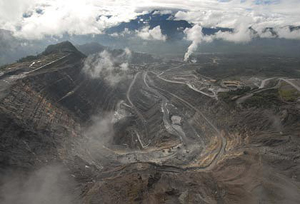
Barrick Gold, the world's largest gold mining company, has come under fire for attaching strings to a "remediation framework" offered to women raped by employees of its Papua New Guinea mine.
Following allegations of a series of gang rapes at its Porgera mine, Barrick devised a strategy the company says will help fulfill its promise to the surrounding communities: "We will uphold your rights and we will protect your dignity."
But a group of NGOs from Canada, the U.S. and the U.K. says that the resulting document, far from protecting rape victims, requires them to waive their rights.
The framework document stipulates that in exchange for remedies such as access to counselling and micro-credit, "the claimant agrees that she will not pursue or participate in any legal action against [Porjera Joint Venture], PRFA [Porgera Remediation Framework Association Inc.] or Barrick in or outside of [Papua New Guinea]. PRFA and Barrick will be able to rely on the agreement as a bar to any legal proceedings which may be brought by the claimant in breach of the agreement."
MiningWatch Canada's Catherine Coumans said the NGOs "do not believe women should have to sign away rights to possible future legal action in order to access the types of remedy Barrick is offering these victims of rape and gang rape."
NGO claims 'erroneous and misleading': Barrick
While some of the alleged rapists were company employees, others were members of the police assigned to provide additional mine security. But the NGOs say the material support Barrick provided to these police officers blurred the line between employees and non-employees, and they want the company to assist women raped by either category of security forces.
"We are also concerned that Barrick is not offering remedy to those women who have been raped and gang raped by members of police Mobile Squads who are being housed, fed and supported by PJV on PJV property," according to Rights & Accountability in Development's Tricia Feeney.
Barrick has issued a statement responding to these "erroneous and misleading" claims and arguing its remediation package "fully accords" with the voluntary UN Guiding Principles on Business and Human Rights.
The company offers community programs including "a variety of health, counselling, and medical care to victims of sexual violence" which are open to all members of the local public. And the filing of a claim does not affect a woman's legal rights. Any agreement over individual remedies, however, "settles the claim against the PJV and Barrick and the claimant may not then pursue further legal action against the companies." Barrick calls this limitation "the norm for companies in the practice of settling grievances."
Barrick named 'most sustainable' Canadian mining firm
In stark contrast to the NGO criticisms, Toronto-based Corporate Knights last week included Barrick Gold in its Global 100 list of companies that "squeeze more wealth from less material resources while honouring the social contract." And late last year, Corporate Knights anointed Barrick the most sustainable Canadian mining company.
"In the mining industry, strong sustainability performance is not just a nice-to-have -- it's an essential condition for survival as a business," according to Corporate Knights' Doug Morrow.
And yet, controversy has plagued Barrick projects around the world, from fatal shootings in Tanzania to shrinking glaciers on the Chile-Argentina border.
In 2011, its Papua New Guinea operation found itself in the international spotlight after Human Rights Watch released a report on the Porgera mine, filled with grisly details such as a woman forced by guards to swallow a condom used to rape two other women.
A couple of weeks later, Barrick's founder and chairman Peter Munk told the Globe and Mail that in Papua New Guinea "gang rape is a cultural habit." To which the man whose name adorns the University of Toronto's school of global affairs added: "Of course, you can't say that because it's politically incorrect." ![[Tyee]](/design-article.thetyee.ca/ui/img/yellowblob.png)
Read more: Rights + Justice, Labour + Industry, Gender + Sexuality









Tyee Commenting Guidelines
Comments that violate guidelines risk being deleted, and violations may result in a temporary or permanent user ban. Maintain the spirit of good conversation to stay in the discussion.
*Please note The Tyee is not a forum for spreading misinformation about COVID-19, denying its existence or minimizing its risk to public health.
Do:
Do not: