Temp workers say they fear retribution if identities known.
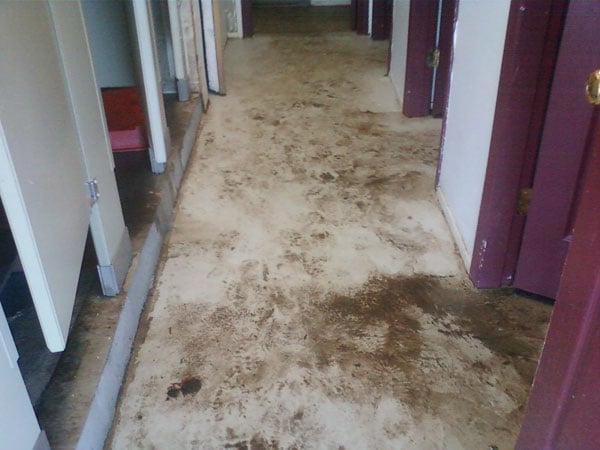
Photo of squalid bathrooms shared, Guatemalans said, by dozens of foreign farm workers in Okanagan.

-
Are migrant workers in BC getting a dirty deal?
-
BC Liberals never followed through after deaths of Sarabjit Kaur Sidhu, Amarjit Kaur Bal and Sukhwinder Kaur Punia.
-
Debate rises over how to lower abuse, and whether to make staying easier.
Under the harsh light that floods a fast food restaurant at Vancouver International Airport, two small, wiry, dark skinned men in work clothes looked tired, worried and out of place among the other travelers eating around them. Because they fear retribution at home, the two Guatemalan farm workers asked The Tyee not to use their real names in telling their story. So, call them Pablo and Jose. Nor did they think it was safe to reveal the name of their employer, believing that could lead to their identities becoming known. Speaking haltingly through an interpreter, they said their jobs in an Okanagan orchard, arranged though Canada's Temporary Workers Program, had become such a nightmare they were now returning home early. Within hours they would be back in their country amidst the rural poverty that had motivated them to come north in the first place.
"I got a feeling of desperation in my heart," said Pablo. "We had dangerous working conditions and inhuman housing. We didn't live in a normal house. Forty-four of us lived in a warehouse. The other eight lived in a trailer nearby."
Pablo's and Jose's stories were translated for The Tyee by Lucy Luna, a worker with the Agricultural Workers Alliance storefront office in Abbotsford. Luna, born herself in Mexico, works in the United Food and Commercial Workers supported AWA as an organizer, and met Pablo and Jose during an organizing trip to the Okanagan. She invited The Tyee to meet the two men as they waited for their flight home to Guatemala. The Tyee also obtained three photographs of the conditions at the orchard the men described.
Jose nodded in agreement as Pablo talked about the two squalid bathrooms that served all 44 of the Latin American men housed in the metal-sided warehouse and the single stove and sink that was the only kitchen provided for all the workers.
"Where we slept was made of metal sheets and there was no air conditioning, so the thermometer went up to 38 degrees Celsius," he said. Both men said the water provided to the workers at the orchard was unsanitary, looking milky and smelling bad. They described difficulty sleeping in the warehouse, and being roused at 3 a.m. to harvest fruit in the cool of the night. This arrangement presumably worked to protect the cherries from damage during the harvest, but left the two men and their co-workers sleep deprived and working at the top of tall ladders in the dark.
"It was so hot we could not sleep and because we worked at night starting at 3 a.m. and finishing at 1 p.m., by the time we got home to sleep the heat in the warehouse was inhuman and did not allow us to rest so we remained up until the heat went down, giving us a few hours sleep before starting the new day at 3 a.m.," said Pablo.
"Work was dangerous because we worked standing up on a ladder," said Jose. "We were in the dark, extremely tired and on top of that we couldn't see the ground."
Sometimes, he said, he could hear sounds at ground level that he took for bears eating the cherries that fell from the tree while he worked.
BC beckoned with promise
The two men had come to Canada once before, to harvest vegetables in Quebec in 2010. The next year they were not chosen by the Guatemalan agency that recruits workers for the Low Skills Pilot Project of Canada's guest worker program, so at first they were happy to be picked to come to B.C. this year. Although their hourly wage in Quebec was a bit lower than they were paid this year in B.C. orchards, Jose and Pablo said the combination of crowded, unsanitary living conditions, dangerous work and harsh, disrespectful treatment from their employer in the end made it impossible for them to stay.
"I came to Canada to be able to support my family," Pablo said. Like his companion, Pablo rents a small plot of land at home and farms it, generating just enough income to break even. The two men have nine children between them, and they have depended upon income from work in Canada to fill in the gaps created by their lives as subsistence farmers.
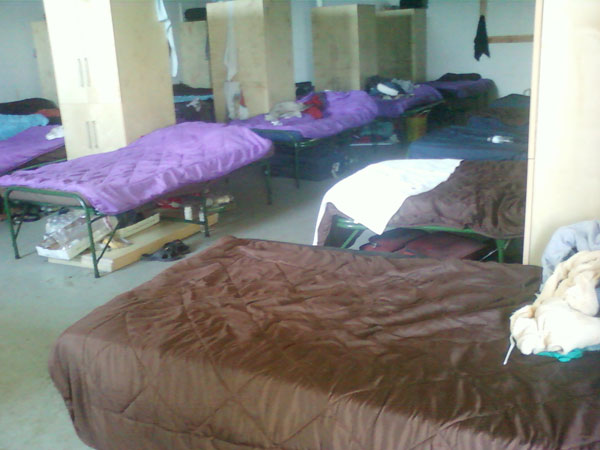
Heat was 'inhuman' in this warehouse where 44 farm workers bunked, say two Guatemalans.
While Canada has been bringing in temporary agricultural workers from the global south since 1966, the past decade has seen programs dramatically expanded, both in terms of the number of "guest workers" imported and the industries taking advantage of the programs and in terms of the number of source countries for the workers. Critics like the United Food and Commercial Workers, its Agricultural Worker Alliance and the Canadian Council for Refugees say that the programs are basically unfair, bringing in Third World workers to perform heavy, often dangerous work but denying them the right to stay and apply for permanent residence. And while they are in Canada, the critics say, the workers are often exploited by employers and unable to secure any protection from bad working conditions or abusive bosses.
'A perpetually vulnerable and exploited workforce'
According to a recent union-funded study, "in the past few years a disturbing trend has emerged within Canadian immigration policy which continues to fundamentally alter Canada's demographic makeup. This alteration is as a result of the drastic increase in the use of migrant workers. Under the current Conservative government, the federal Temporary Foreign Worker Program (TFWP) has expanded exponentially. The radical expansion of these categories encompasses workers in agriculture, food processing, manufacturing, construction, service, and hospitality industries, to name a few."
The report continues: "Moreover, to make up for the harsh inadequacies related to child care and the Canadian health care system, tens of thousands of workers are employed annually as Live-in Caregivers in private homes. According to Citizenship and Immigration Canada (CIC), in 2009 the number of permanent residents who entered Canada totalled 252,124. The number of migrant workers for same year was over 280,000. This data reflects a targeted shift from a governmental model favouring entry of permanent residents, whom would have equal access to legal rights and a path to citizenship, to migrant workers who are faced with precarious immigration status and more limited access to legal rights. The consequences of such a shift has inevitably created a perpetually vulnerable and exploited workforce."
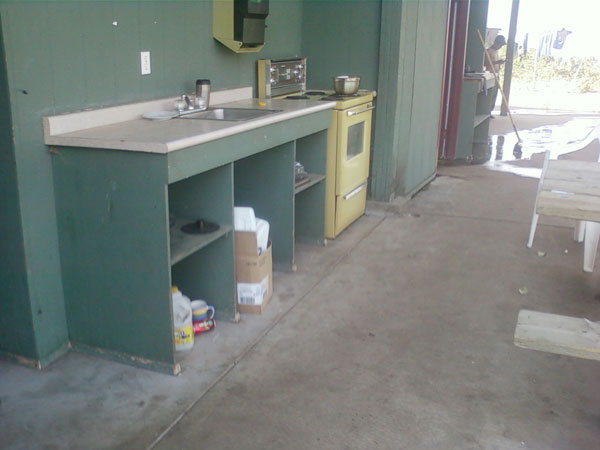
Kitchen facility in warehouse that housed Temporary Guest Worker Program pickers at Okanagan orchard.
The Tyee contacted Human Resources and Skills Development Canada, one of the two federal bodies jointly responsible for temporary foreign worker programs in this country to ask about how the kind of conditions Jose and Pablo described could be inflicted on workers. A media spokesperson replied by email, saying:
"The provinces and territories have primary responsibility for establishing and enforcing health and labour standards, such as safe working conditions, for all workers, including temporary foreign workers. However, both the federal and provincial/territorial governments have an interest and a role to play in the safe employment of temporary foreign workers. The Temporary Foreign Worker Program and the provinces and territories cooperate on measures and regularly share information to help improve the protection of temporary foreign workers. For example, both levels of government work in partnership to provide up-front information to employers and workers on provincial labour standards and to ensure that the working conditions offered to temporary foreign workers are consistent with Canadian standards."
That description doesn't match the experience described by two small, work weary and discouraged Guatemalan workers who arrived home early last week, having fled their Canadian employer just a few days before their former host nation celebrated Labour Day. ![[Tyee]](http://thetyee.cachefly.net/ui/img/ico_fishie.png)
Tom Sandborn covers labour and health policy beats for The Tyee. Find his previous Tyee articles here. He welcomes your feedback and story tips at tos@infinet.net.
14
Login or register to post comments
Van Isle
41 weeks ago
We, all Canadians, should be
We, all Canadians, should be ashamed. Our Governments allow this to happen and don't care. Just cheap labour policy. Imagine if we had no labour laws in this country, employers would treat the ordinary Canadian employee the same way if they could. Wonder what the Phil Hochstein's of this world have to say?
Fiat lux
41 weeks ago
Wealth can not be created
Wealth can not be created only taken from others, the environment and future generations.
The above is the story on "competitiveness", taught in our universities, which means slave labour, and environmental destruction to ensure "cheap foods" and high profits.
If Hitler's KZ camps were still operating today, the world's capitalists would flock to them to invest and "cut costs" to ensure their "economic efficiency" and to keep the stockmarkets booming.
Provided the inmates weren't Jews. All others are OK, like our "conservatives" now making secret "free trade" deal with India to ensure "cost efficiency" with the owners of 15 million slave labour kids to fill the shelves of Walmart and the rest of the multinational corporate mafia with "cheap goods" .
Ed Deak.
duffybear
41 weeks ago
This is not new
About 15 years ago, I was driving through the Okanagan and saw fruit pickers. To me, they looked like something out of "Now Let Us Praise Famous Men", which showed the lives of sharecroppers in the US in the 1930s. It struck me even back then that there is a good opportunity for an enterprising photographer to go around BC and take the kind of photos that were in that book. Dire poverty and abysmal conditions are still with us.
Phay
41 weeks ago
So why aren't we fixing it?
Because it is profitable, and in fact, Harper has made it legal to expand it through the CTFWP. If the writers had not said the Okanagan, I would have thought this was a description of work in Siberia or Inland China. How dare Harper chide other nations about human rights violations. And I bet Christy Clark knows all about this too.
You don't suppose these guys went home to tell the world of all the beauty of Canada. I wonder how welcome we would be in their country. If this continues, the only place Canadians will be safe is in Canada, and I sometimes worry about that.
MacKenna
41 weeks ago
But Flaherty said "there are no bad jobs"
Remember that one? Oh yes, and employers whine that Canadians won't work in some jobs. LIKE THIS YOU MEAN? Yeah, right. No Canadian would put up with it. But employers - some - eagerly wish for third world conditions here and the ongoing support to bring in foreign workers allows such abuse, as our neoconservative and neoliberal governments turn a blind eye.
Canadians must fight for what we used to stand for. A decent standard of living, equality for all workers. There is no dignity to be seen here and any employer who treats his or her workers this way should have any ability to import workers stripped.
cariboocooper
41 weeks ago
migrant workers
Please publish how much the companies pay to get the people here from other countries. Include how they get through customes/immigration, include how much is supplied for the workers ie housing/food/transport/health care etc so we can see what it actually costs. If the total compensation were offered in wages maybe you'd get people from Canada
pwlg
41 weeks ago
and on and on and on...
Seems 2 years ago, a large group protested outside the Canadian Embassy in Guatemala City for reasons described in this article.
Seems Canadian mining corporations get access to the minerals and the indigenous lands where they lie in Guatemala and Canadian companies in return gets to abuse temporary foreign workers in Canada. Is this what they call fair trade?
For further reading on the protest organized by Guatemalan based Justicia for Migrant Workers on September 1, 2010 in Guatemala City:
http://www.marketwire.com/press-release/Migrant-Workers-Protest-at-Canadas-Embassy-in-Guatemala-1312972.htm
jade
41 weeks ago
let's all just pay more for food
This problem is not simply solved with paying the workers more - it's related to the entire food system that relies on supply from another country (USA) and even allows that country to dump production subsidized food product into Canada. If that system were to end today, we might wind up with seasonal eating of local food processed by Canadian workers paid reasonable wages by profitable farmers operating viable farms.
Marysue52
41 weeks ago
Canadian workers are migrant workers in our own country already
Men (and many women) go thousands of miles from their families to find work with liveable wages. For the last 20 years, we've increasingly had to "compete" against migrant foreign workers, as well! Idiots will say insulting things like, "Canadians don't want to work..." and other crap. It's been my experience that there is NO job a Canadian won't do, but we want to be paid a liveable wage for doing it. But the foreign CEOs want to be paid more than God, and they siphon all the available money off the top--even before taxes (which they magically avoid)and even before the maintenance and infrastructure is repaired, etc.). There's nothing left for the small shareholder and the workers--and sometimes, not even enough to ensure the company's own survival.
Workers' wages--especially women's wages-- are going downhill quickly, and unions are pretty powerless (and clueless about how to proceed against this economic onslaught).
NAFTA alone cost us hundreds of thousands of decent-paying union jobs...and when union workers get less, the non-union workers get even less than subsistence.
Patricio
41 weeks ago
Must be really bad...
I lived in Guatemala for about two years and worked with returned refugees who had spent 16 years in Mexico. In southern Mexico, Guatemalan workers had a reputation as hard working and willing to do work that Mexicans wouldn't. This pretty much entailed backbreaking labour for about USD $3-4 per day... all this to say if a Canadian farm is causing some Guatemalan farm workers to return home, it must be truly horrendous conditions...
zalm
41 weeks ago
McKenna
nice one.
"But Flaherty said 'there are no bad jobs'"
I'm gonna send it to him with a link. Right now.
Jeffrey J.
41 weeks ago
Modern Slavery, Canadian Style
As corporate extremism increases every year, we are inundated with story after story of human exploitation and misconduct. At times, these disclosures evoke almost no emotional response due to the numbing effect of this increasing insanity.
This story broke through that miasma. That this kind of inhuman exploitation is occurring in BC, with business owners in suits actually benefiting from this misery, is really disturbing.
How deeply sad.
We have lost our way. Harper and Christy Clark and Gordon Campbell could care less. They had the power to stop it. But refused.
This is how evil is incubated in a corporate petrie dish. Just as it was perfected in the 1930's Europe.
And the rest of BC will wake up today, drive all day in traffic to work, and then maybe later, do some shopping. What a perfect closed system of ensuring obedience...
Thank Tyee for this very courageous coverage.
trtrebilcock@gm...
41 weeks ago
Pay
Why don't owners just pay Canadians fairly to do the job? Seems like a lot of rigarmorale to keep wages low.
Okanagan Orchardist
41 weeks ago
I could probably guess
Where these people were working. After all, there aren't that many cherry orchards in the Okanagan that could use that many workers.
I could also probably guess at the ethnic background of the orchard owners. These owners were, once upon a time, pickers themselves.
I've never hired pickers from outside the country. Most of mine are students, or were students from Quebec who came back year after year because the picking was easy (an 8-foot ladder, and you didn't have to stand on the top), the land was flat, it was near town so they could go to the bar afterwards. When picking cherries, you never had to start before 6 am and you quit by 12 or 1, depending on the heat of the day. Pay, well that was something else. Years ago I got maybe $.25 to $.30 cents a pound, so you paid the pickers .15 cents a pound, and after subtracting your cost of production, you found yourself in the hole -- again. I also have apples so that has helped even things out. But I (and my wife) still had to take an outside job to continue living my wonderful life. Life sure as hell is no bowl of cherries. :) But I wouldn't have it any other way, ALR or not.