
Despite industry safety assurances, EPA finds hydraulic fracturing fluids in drinking water.
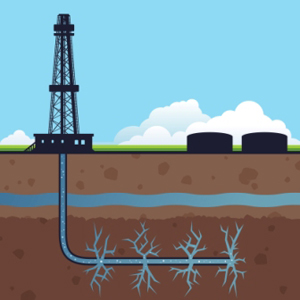
Hydraulic fracturing or 'fracking' forces chemicals into the ground to pry open trapped gas deposits.

-
-
And scientists, the military, and frackers themselves have known it for years.
-
Who finally tells us the nasty chemicals used for shale gas drilling in Western Canada? The US Congress.
An extensive study by the U.S. Environment Protection Agency (EPA) has concluded that highly toxic and cancer-causing fluids from shale gas drilling most likely contaminated shallow groundwater in Pavillion, Wyoming.
The findings, which strengthen the hands of those calling for a public inquiry on B.C.'s shale gas industry, contradict industry claims that hydraulic fracturing "is a proven technology used safely for more than 60 years in more than a million wells."
The controversial technology, now deployed for most oil and gas wells, blasts millions of gallons of water, sand particles and toxic chemicals into both deep and shallow sandstone formations in order to release small amounts of methane or oil over areas as great as 16 square kilometres.
The Liberal government of British Columbia touts shale gas as a "game changer" for the province and now heavily subsidizes the industry with low royalties, infrastructure giveaways, and large volumes of water from hydro dams, rivers, dugouts and aquifers in regions with poor data on baseline water quality.
The highly volatile industry, which wants to export the gas to Asia, now accounts for nearly half of all resource revenue in the province and nearly four per cent of provincial revenue in 2010.
1,000 cases of water contamination reported
The EPA investigation began after many residents of the small rural town, including a former Vietnam War hero, Louis Meeks, complained about loss of well water, objectionable taste and foul smelling odors.
The water contamination issues appeared after EnCana, Canada's largest gas company, fracked scores of vertical wells in the region more than six years ago.
Across the United States landowners have reported nearly 1,000 cases of water contamination in the wake of shale gas fracking operations according to the independent press group, Pro Publica. Scores of contamination problems have also been reported in Alberta.
After finding elevated levels of methane and diesel fuel in domestic Pavillion water wells in 2010, the EPA installed two deep groundwater monitoring wells to determine if the contamination was coming from deep or shallow sources.
The EPA's 121-page report found evidence of both. High levels of benzene, xylenes and gasoline and diesel compounds were detected in groundwater from shallow monitoring wells near industry pits for disposing of drilling and fracking fluids.
In the deep groundwater monitoring wells the EPA discovered a brew of toxic chemicals commonly used in hydraulic fracturing. The contaminants included benzene, toluene, ethyl-benzene, and xylenes (BTEX), diesel oil, which is used to make a liquid gel, heavy aromatic petroleum naptha, a solvent, and tri-ethylene glycol, another solvent.
"When considered together with other lines of evidence, the data indicates likely impact to ground water that can be explained by hydraulic fracturing," said the EPA report. Furthermore there didn't appear to be solid rock barriers "to stop upward vertical migration of aqueous constituents of hydraulic fracturing in the event of excursion from fractures."
The EPA also detected methane in both monitoring wells and local domestic water wells that came directly from the gas zone being fractured by EnCana.
The agency added that gas could have migrated up well holes into groundwater because steel piping to prevent such leaks (known as surface casings) "do not extend below the maximum depth of domestic wells in the area of investigation."
Industry has recently admitted that poor surface well casing, a chronic issue for the oil patch, could cause methane contamination of water wells in Pennsylvania and other locations.
A 2011 Duke University study found concentrations of methane in domestic water wells 17 times higher near shale gas drilling and hydraulic fracturing. It concluded that the practice polluted groundwater either via surface casing leaks or chaotic fractures that connected to water zones.
At Pavillion, Encana drilled its gas wells as deep as 372 metres or 1,220 feet. But local domestic water wells lie directly above the company's fracking zone at depths of 244 metres or 800 feet. Groundwater is the principal source of water for towns, ranchers and livestock in the region.
The EPA added that, "Citizens' complaints often serve as the first indication of subsurface contamination and cannot be dismissed without further detailed evaluation, particularly in the absence of routine ground water monitoring prior to and during gas production."
No link between drilling and contamination, says EnCana
The finding represents more bad news for EnCana, one of North America's premier gas barons. Even its stock tumbled by six per cent after the release of the EPA report.
Nearly a decade ago the firm pioneered hydraulic fracturing to blast open both deep sandstone formations and shallow coal beds in industrial like plays over large geographies sometimes known as "carpet bombing."
But the shale gas boom that EnCana helped to engineer ultimately delivered so much natural gas to market that prices crumbled. EnCana, which has amassed a land base almost as large as Nova Scotia (11 million acres), is now struggling to remain afloat by selling key assets such as a billion worth of gas processing plants in B.C. last week. It's also pushing hard for natural gas exports to Asia.
The company even tried to sell its troubled Pavillion leases last month for $45-million, but Texas based Legacy Resources backed out the deal even though EnCana said it would retain all responsibility for the outcome of the EPA's study.
Encana has denied any link between drilling and the contamination in Wyoming.
"The EPA's draft report and current view is based on a possibility, not a conclusion built upon peer-reviewed science. The cause of the compounds in the water remains inconclusive," said a company release.
"We live and work in the communities where we operate and we care about the impacts of energy development on the environment. We work very hard to ensure our operations do not impact groundwater."
For several years now EnCana has been at the centre of shale gas and water contamination controversies in rural communities across North America.
Two years ago its aggressive drilling practices in the poisonous Montney shale gas play (it contains hydrogen sulfide) made it the target of a bombing campaign around Dawson Creek, B.C., between 2008 and 2010.
Half a dozen highly coordinated attacks on EnCana pipelines sparked a multi-million dollar RCMP investigation that ultimately treated many local residents like Taliban suspects. The case remains unresolved.
In 2004 the Colorado Oil and Gas Commission fined the company $378,000 for fracking a natural gas well that leaked methane into West Divide Creek in Garfield County.
And this year a former EnCana and oil patch consultant, Jessica Ernst, launched a $33-million lawsuit against the company for shallow gas fracturing near Rosebud, Alberta that resulted in extensive contamination of groundwater with chemicals and explosive amounts of methane.
The statement of claim charges that EnCana, beginning in 2001, "negligently injected chemical fracturing fluids at high pressure into coal seams located at shallow depths below ground and near the underground fresh drinking water supplies of rural Albertans."
The claims have not yet been proven in court.
BC's big bet on shale gas
Earlier this year Alberta's energy regulator, the Energy Resources and Conservation Board, admitted that hydraulic fracturing could contaminate "useable water aquifers" with toxic chemicals in shallow zones and "is a recognized risk that must be managed because the fracturing operation is nearer the base of groundwater."
British Columbia, Canada's second largest natural gas producer after Alberta, has banked its economic future on the resource. Critics say the province has done so without any serious examination of its depletion rates, economic risks or environmental liabilities.
As a consequence Independent MLAs and rural communities in the Peace River region have demanded a public inquiry on a "game changing" resource that most residents of the Lower Mainland know nothing about.
Given that shale gas plays cover extensive land bases, consume vast amounts of water and industrialize rural landscapes for long periods of time, "shale gas is more like oil sands development than it is like traditional... natural gas development," explained lawyer Chris Sanderson at a recent B.C. Summit on shale gas last month.
Several speakers also noted that the industry could loose its social license if critical issues such as groundwater contamination, greenhouse gas emissions, surface water demands and air pollution are not addressed in a rigorous manner.
The United States Geological Survey has also identified the resources impact on earthquakes, landscape changes and aquifer quality as critical issues. It also identifies the final destination of ten of millions of gallons of fracking fluids (most remains in the ground) as a scientific mystery.
British Columbia's Oil and Gas Commission has drawn criticism for responding slowly to public concerns about shale gas. The commission was set up by a former member of the Canadian Association of Petroleum Producers. Its last director, Alex Ferguson, left the commission to get a higher paying job with Oklahoma-based Apache, one of the biggest shale gas extractors in the province. ![[Tyee]](http://thetyee.cachefly.net/ui/img/ico_fishie.png)
Award-winning journalist Andrew Nikiforuk writes about energy for The Tyee and others. Find his previous Tyee articles here.
17
Login or register to post comments
Fiat lux
1 year ago
Of course,we're reminded by
Of course,we're reminded by so called "economists" and "conservative" ideologues every day that the "efficiency" demands of imaginary money, "created" from the air overrule all physical realities and laws.
Just ask Harper, he received his Masters degree in "economics" on this.
Ed Deak.
pwlg
1 year ago
here's a vid that needs watching
The following video claims that Encana after a fracking operation is removing the plastic liner in a pit to "contain" fracking fluids and at the same time burying the fracking fluids with dirt.
http://www.youtube.com/user/DivideWatch?blend=2&ob=5
Encana was quick to shake off claims that it was contaminating groundwater in the Pavillion, Wyoming area. In September 2010 Encana released a statement that the company was not to blame for the contamination. However, the recently released draft by the EPA found chemicals in the groundwater, as Nikiforuk states, that came from drilling operations.
Specifically glycol and alcohol were found by the EPA's deep well monitors and these chemicals are not naturally occurring substances as Encana tried to imply to the media back in 2010.
From TradeTheTrend on Sep 9, 2010
"A spokesman for EnCana Corp. (NYSE:ECA), Doug Hock, said that government tests on 17 private water wells in Pavillion, Wyoming showed low levels of petroleum hydrocarbons, and inorganic substances that naturally occur, according to a Reuters report, which helped to prove that the company was not at fault for contamination detected by U.S. regulators.
What we do know is that Encana's strategic communications department has been instructed to use as it's first line of defense misinformation (disinformation) and denial.
Perhaps a poll should be conducted to determine how many BC residents have faith in the BC Oil and Gas Commission to monitor all fracking and conventional drilling operations in BC.
boondoggle
1 year ago
Bring on Class Action!
Our Petro-state has allowed these companies to pump millions of gallons of their "proprietary secret" poison into our groundwater for years. Thanks to the Committee on Energy and Commerce U.S. House of Representatives. April 18, 2011 report "Chemicals Used in Hydraulic Fracturing" The so-called "proprietary secrets" have been unveiled. In part, this report states "This analysis is the most comprehensive national assessment to date of the types and volumes of chemical used in the hydraulic fracturing process. It shows that between 2005 and 2009, the 14 leading hydraulic fracturing companies in the United States
used over 2,500 hydraulic fracturing products containing 750 compounds. More than 650 of these products contained chemicals that are known or possible human carcinogens, regulated under the Safe Drinking Water Act, or listed as hazardous air pollutants."
B.C. has little or no hydrological data in any of the areas where these companies are currently pumping millions of gallons of these poisons into the ground. Despite this fact, the Liberal government of B.C. is doing their utmost to promote this activity in some of the most pristine areas of our province. This can only be described as criminally irresponsible. How could any government legally responsible for the protection of our fresh water not only allow but encourage this horrendous environmental crime?
The merit of class action in this matter can not be understated.
RickW
1 year ago
Industry Claim
One fracking operation is likely fine, as would be two, or 20. But there WILL be a tipping point, and we are likely there.
gsarahs
1 year ago
Christy is hitching up to the wrong wagon!
"...the province now heavily subsidizes the industry with low royalties, infrastructure giveaways, and large volumes of water from hydro dams, rivers, dugouts and aquifers in regions with poor data on baseline water quality."
Having lived in a rural area for 15 years and had a 260 foot deep well, I am very aware of how important it is to have a clean water supply and adequate flow. Some of my neighbours were not so lucky. It is well known how many wells are being contaminated by fracking. These people who have these gas companies drilling below them are clearly risking their family's and livestock lives. If you can "fire" up your water, then maybe something isn't safe! Are we so hard up that we have to rape the environment, no matter what the consequences? Can this government stoop any lower? Of course!
borg
1 year ago
Stoop any Lower
As has been proven daily the BC Liberals will stoop so low that they can get under a pregnant snake and will actually try digging under that very same snake.
gerryrutherford...
1 year ago
Without doubt the fracturing
Without doubt the fracturing process is going to cause some long term problems in the areas it is used. However, I must point out a few inaccuracies in this article. First, the study cited was conducted in Wyoming where drillers had drilled vertically through sandstone at relatively shallow depths. Observations showed faulty, or inadequate concrete caseing around the drill hole and deeper where it passed through the ground warter supply.
In BC, most of the hydrocarbons are trapped in shale, a very different structure than sand stone. As well, the drilling almost always includes significant distances of horizontal drilling after drilling vertical to a desired depth.
So you can't necessarily use the details of the Wyoming study and apply it directly to BC.
Notwithstanding, what is going on in Northeast BC is pretty much a free for all for drillers and gas companies. They are using vast quantities of water and subsequently creating vast amounts of waste water and there is no plan in place other than to drill and ask questions later.
cw
1 year ago
Homeowners, here's a helpfulr tip.
If your tap water catches fire, let your utility provider know so they can add the extra heating effect to your bill.
jacksonupnorth
1 year ago
Thank you, Andrew
Thank you for showing to the rest of the world, what is happening in the sparsely populated north. There was once a veil of secrecy covering the tracks of this industry. Individual ranchers and farmers were powerless to stop the destruction of the environment. It is through exposure of the problems that we might find a solution.
doggone
1 year ago
I doubt even the Russians
Bother to pull the liners out of the ponds.
"Who are those guys?"
(Butch Cassidy to Sundance Kid)
Sask Resident
1 year ago
Lack of data
I agree with booddoggle, B.C. has little or no hydrological or hydrogeological data in any of the areas where these companies are currently working. One of the primary roles of senior levels of governments is to monitor and develop an understand of the environment whether recording rainfall or wind speed or measuring water flows and quality. Too bad that successive federal and provincial governments have cut monitoring programs with Paul Martin's cuts as the biggest but the BC NDP and Liberal governments being as bad. If you have no data, you don't know if things have changed!
pwlg
1 year ago
gerryrutherford and Sask Resident
I appreciate your understanding of the pitfalls of hydraulic fracking and the differences between geological formations and lack of adequate government oversight.
I found a peer reviewed study that was published by four professors at Duke University, "Methane Contamination of Drinking Water Accompanying Gas-Well Drilling and Hydraulic Fracturing".
http://www.propublica.org/documents/item/methane-contamination-of-drinking-water-accompanying-gas-well-drilling
This study was conducted using directional drilling in both the Marcellus and Utica shale formations of northeastern US.
They found concentrations of methane gas in all wells drilled even those where there has been no gas well drilling by conventional or fracking methods.
They found drinking water wells closest to the drill sites had 17 times more methane than those farthest away.
When Encana and other major gas exploration companies state that the chemicals found in people's drinking water wells are naturally occurring they are just providing disinformation when that "naturally" occurring chemical is found at 17 times greater than normal or naturally occurring. They know the difference between naturally occurring and that which is caused by their own drilling.
In NE BC we have very little oversight due to the remoteness of the drilling. If this drilling by hydraulic fracturing methods was in NE U.S. where human settlements are considerably more dense than NE B.C. we would have more data on water contamination and more opposition to what is taking place in our province.
Fracking is not new as it was first introduced in the 1940's and in BC this practice has been happening for years without proper oversight to determine impacts on the environment.
Eco Cities
1 year ago
Another video that investigates 'fracking'
This is a great video from the team at the Ecologist who investigated 'fracking' - it adds a different dimension to the story, more personal footage of locals whose lives have been ruined by the practice:
http://www.theecologist.org/trial_investigations/687515/us_natural_gas_drilling_boom_linked_to_pollution_and_social_strife.html
howard brown
1 year ago
well fracturing
As someone who worked in the drilling industry in the early sixties I can attest to the use of fracturing back then BUT it was done at much greater depths on vertical bores. The technology for shallow horizontal drilling did not exist then. To compare the possible environmental impact the current practice with that of 60 years ago is to compare apples and oranges.
TYRONE
1 year ago
Greed before Brains
It is absolutely incredible to see anyone inject these contaminants deeply into the ground without a care in the world!
If this technology is to be allowed to continue, only pure water should be used.
It is bad enough, that the process is a "mystery", without making it absolutely unacceptable by using JUNK to do the work.
Take away their permission to continue, until a 'clean' method is developed; and even then it is a highly questionable practice driven by greed.
igbymac
1 year ago
Fracking and its impact video; EPA employee
http://www.activistpost.com/2011/12/epa-admits-fracking-causing-groundwater.html
howard brown
1 year ago
alas, one more comment
Where does it end? I suspect not until the last nickel has been extracted from the petroleum industry, or there's a massive die-off in oil company board rooms from the toxicity of the ice in their martinis.