- Ms Kaye is a Tyee Builder. You can be, too.
- Mary Carlisle is a Tyee Builder. You can be, too.
- Prem Gill is a Tyee Builder. You can be, too.
- Nancy Flight is a Tyee Builder. You can be, too.
- Justin Everett is a Tyee Builder. You can be, too.
- John Westover is a Tyee Builder. You can be, too.
- Nora Etches is a Tyee Builder. You can be, too.
- Edward Henderson is a Tyee Builder. You can be, too.
- Bharadwaj Chandramouli is a Tyee Builder. You can be, too.
- Dean Chatterson is a Tyee Builder. You can be, too.
- Marius Scurtescu is a Tyee Builder. You can be, too.
- Robert Parkes is a Tyee Builder. You can be, too.
- James Murton is a Tyee Builder. You can be, too.
- Susan Doyle is a Tyee Builder. You can be, too.
- Vincent Strgar is a Tyee Builder. You can be, too.
- Helen Spiegelman is a Tyee Builder. You can be, too.
- Subir Guin is a Tyee Builder. You can be, too.
- Kimball Finigan is a Tyee Builder. You can be, too.
- Joanne Manley is a Tyee Builder. You can be, too.
- David Leach is a Tyee Builder. You can be, too.
Tories' Quick Trigger on Labour Disputes Dangerous, Say Experts
Air Canada intervention worries bargaining pros on both sides of table.
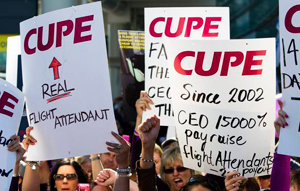
Strike's take-off aborted: CUPE members protest Air Canada during labour dispute.
Holiday travelers, rejoice -- there will not be a strike at Air Canada this season. Instead, thanks to a bit of legal jujitsu from the Harper government that blocked the union from walking off the job last month, the long-standing dispute between the airline's management and its aggrieved flight attendants was brought to a decisive end last Monday, with both sides settling on a contract.
Having nixed the possibility of a protracted strike, the government's intercession is likely to win the support of a public happy to have the whole mess cleared up before Christmas. But many experts warn the Air Canada affair marks an unprecedented and potentially dangerous overreach into a proven process of collective bargaining.
By nipping strikes and lockouts in the bud for the sake of the economic stability, they argue, the government threatens to unbalance a system of conflict resolution that has long served not only the interests of organized labour, but those of Canadian business as well.
An unusual choice
The dispute between Air Canada and CUPE, the union representing the flight attendants, began to get truly weird in the middle of last month. On Oct. 12, after the union membership voted down a deal cut between its leadership and the airline's corporate management for the second time, Minister of Labour Lisa Raitt formerly requested that the Canada Industrial Relations Board look into the issue.
It was an unusual choice. The CIRB is the quasi-judicial agency typically tasked with investigating alleged violations of Canadian labour law by federally regulated corporations and unions. But here, no obvious violation had been made. Instead, the minister made two distinct referrals to the CIRB, requesting why this labour dispute should be given special attention.
As long as the CIRB was looking into the two referrals, Raitt argued, CUPE was effectively barred from striking. While some have disputed the legal validity of this argument, it was enough to force the parties towards a quick resolution. Presuming that the government would not allow the dispute to end in a strike, the union leadership saw itself stripped of bargaining power.
Two weeks later CUPE and Air Canada agreed to settle ahead of the CIRB ruling through interest arbitration -- a process whereby a Solomonic third-party cuts a deal which both sides are then compelled to accept.
Last Monday, a deal was reached; Elizabeth MacPherson, the current chairperson of the CIRB, imposed upon the parties a contract previously rejected by the union.
'Monkeying around'
"This is what happens when amateurs monkey around with the system," said Dan Oldfield, senior staff representative of the Canadian Media Guild. "It's devastating, obviously."
Oldfield, who has fought on the union side of various labour disputes for three decades, spoke to The Tyee in late October, a week after CUPE and Air Canada agreed to settle through arbitration.
According to Oldfield, neither of the minister's referrals were appropriate or applicable in the case of the Air Canada and CUPE dispute. In her first referral, Raitt invoked section 87.4 (5) of the labour code, essentially making the argument that because some communities might rely on Air Canada service for emergency travel, a flight attendant strike at the airline could pose a threat to public health or safety. That is, that Air Canada flight attendants might constitute an "essential service."
Under the Canada labour code, "essential services" are prohibited from striking, said Oldfield. Paramedics, for example, cannot simply walk off the job en masse, but must have their grievances addressed through an arbitration process while they continue to carry on their duties. At most, the law may allow for a partial strike or a partial lockout, in which only the most basic and necessary services are provided.
But flight attendants at Air Canada do not fall into this rarefied category, says Oldfield.
"There's not a serious individual involved in industrial relations, either on the management or the union side, that would suggest that Air Canada falls into essential services," he says. "We're talking about flight attendants. The only issue of public concern would be who was going to fill the glasses of wine. And it's not like you can't travel even if Air Canada isn't flying. There are numerous options."
Industrial peace
As part of her second referral, Minister Raitt made a much broader argument. Raitt pointed to the fact that the flight attendants had twice voted down agreements reached between CUPE leadership and Air Canada management. According to the minister, this represented a breakdown of the collective bargaining process. Invoking her authority to "maintain or secure industrial peace" under section 107 of the labour code, Raitt’s position was that the parties had reached such an impasse the ministry must act on behalf of the economy.
"If you're going to affect the national economy and there's a significant public interest then the government will come in as that third party," said Raitt, explaining her decision during a CBC interview on Oct. 21. "We have demonstrated that in the case of the postal workers and in the case of Air Canada."
But according to Oldfield, a breakdown in negotiations does not warrant an intervention. In fact, he argues, if the government intervenes, assuring both sides that a strike will not take place, both labour and management have less of incentive to put any meaningful concessions on the table.
"What the workers can ultimately do is withdraw their labour and what the employer can do is lock them out," Oldfield explained. "There's a tension between the two parties -- you either get a deal or you don't get a deal and whatever decision you make, you live with it. But in this case, the government stepped in and offered a third option. So the workers are out there saying, ''Why should we take a deal we don't want? Screw it, we'll take our chances with a third party.'"
As Oldfield sees it, a key reason collective bargaining works is that both sides can threaten one another with mutually assured economic destruction. It is a messy process, he said but it's one that reliably produces sustainable resolutions.
Common knowledge
It's an opinion shared by Warren Edmondson. Edmonson should know. The former chairperson of the CIRB between 2004-2008 and, before that, the assistant deputy minister of labour starting in 1995, he is one of Canada's preeminent experts of industrial relations at the federal level.
According to Edmondson, it is a widely known among union and business representatives alike that the specter of binding arbitration only discourages negotiation on both sides. Worse yet, he warns, if the Ministry of Labour makes a habit of interceding to stop strikes through acts of parliament and referrals to the CIRB, unions may begin to question the neutrality of both federal mediators and board officials.
If either labour or business interests favored binding arbitration over collective bargaining as a means of resolving labour disputes, he says, either of those groups would have lobbied for such a change. The Canada Labour Code has undergone multiple revisions and modifications since its inception in 1985, he says. And before each overhaul, business and labour representatives were consulted. A move away from collective bargaining and towards arbitration was never suggested, he explained to The Tyee.
Instead of serving the interests of either business or labour, Edmondson speculated that the unprecedented intervention of the Labour Ministry into the airline industry serves a political purpose. Having averted a potentially prolonged and inconvenient strike, he said, the public is likely to reward the government in the short-term.
Oldfield also perceives a political motive behind the government's intervention.
"I think the government thinks it's representing the interests of big business," he says. "But whatever our disagreements are, most people who are dependent on the system -- and that's management and union -- need to be very concerned about this meddling. There are lots of people who come from the business side who will say exactly what I'm saying."
From the business side
George C.B. Smith is one of those people. Now a professor of industrial relations at Queens University, Smith is a former vice president at CBC/Radio-Canada, a former vice president at CP Rail, and the former senior director of employee relations at, of all places, Air Canada. In his 40 years of experience, he has helped management negotiate his fair share of strikes -- including a few at the airline.
Smith is appalled by the government's recent approach to resolving labour disputes.
"This is a gross perversion of the system," said Smith. "I don't think there has been any public policy debate about whether the CIRB should play a more substantive role relative to collective bargaining."
During the recent negotiations between CUPE and Air Canada -- but also during both the Canada Post lockout and the Air Canada ticket agent strike earlier this summer -- the Minister of Labour has taken an active and early interest in intervening for the sake of economic security, says Smith. While Smith does not dispute this strategy on legal terms, he says that this government has pursued a uniquely aggressive strategy of making threats, writing referrals, and tabling legislation to quash nascent work stoppages.
"Historically, this kind of intervention has only happened after a protracted strike or a lockout when there's been clear evidence that there has been economic harm," says Smith. "In this case, the strike didn't even happen so there wasn't the evidence of economic harm. In fact, WestJet, Porter, and other airlines had indicated that they would be taking up the slack."
The fact that Air Canada does not monopolize air travel in Canada, says Smith, is yet another reason to dismiss its characterization as an essential service.
"I can only imagine how West Jet and Porter are feeling right now."
'The dirty little secret'
Smith says that he has been surprised by the muted reaction from the business community. Echoing both Oldfield and Edmonson, he says that Canada's highly regulated collective bargaining process is the best forum to hash out grievances. Accordingly, criticizing the government's strategy as so much predictable union bashing misses half the story.
"Harper has put a very nice spin on all of this, as though the government was teaching the unions a lesson," says Smith. "In fact, that's very short-term thinking. Yes, it may restrict the union's right to strike in the short-term, but it also restricts business' right to compete in the long-term."
Smith says that in both the cases of Air Canada and Canada Post, management was willing to take a strike or impose a lockout. Management will only do this if the concessions they are trying to extract from their workers are worth the work-stoppage, he argues.
"If Air Canada doesn't get changes to that pension plan, they're going to go bankrupt again. If Canada Post doesn't get the change it needs to increase the efficiency of its operation, you and I as taxpayers are going to pay for that," says Smith.
While Smith believes that the recent arbitration ruling of Elizabeth MacPherson in favour of Air Canada was a "fair one," he says that as a general rule, management is unlikely to win those kinds of far-reaching but necessary concessions from an arbitrator.
"Underlying this all is the dirty little secret that everyone in the industry knows: arbitrators rely on business from both sides," Smith says. Because warring unions and companies must agree upon an arbitrator together, he explains, there is a strong incentive for the third-party not to stray too far from the middle of the road.
"So in a certain sense, the system is biased towards the status quo and against any kind of radical change in the collective agreement," says Smith. "This is the reason that most private-sector companies and unions do not resort to binding arbitration as the outcome."
'Brave new world'
"We've entered a brave new world here," says George Smith. Given the unprecedented nature of the current government's labour policy, he says he's hesitant to make any predictions of where all this is leading.
According to Lisa Raitt, the Ministry of Labour has and will continue to evaluate each national labour dispute on an ad hoc basis. Whether the government will choose to intervene, she explained on the CBC, depends on how dramatic an impact a strike or lockout will have on the Canadian economy.
But the Harper government having so far applied "new and creative interpretations" of the labour code to ordinary private disputes, Smith said he worries what the long-run consequences on labour relations will be.
In the short term, Dan Oldfield predicted that the settlements imposed upon the flight attendants, the ticket agents, and the Canada Postal workers will prove unsustainable. Deprived of the opportunity to fight over their respective interests, he said, employees and employers will return to a poisonous workplace environment with their grievances unaddressed.
"Does anyone for a minute think that the issues between Air Canada and its employees are resolved?" said Oldfield. "Does anyone think for a minute that the issues between Canada Post and its workers are resolved? They only get resolved through collective bargaining. They don't get resolved through imposition."
But on a larger scale, Oldfield worries that imposition will become the new standard operating procedure for the government. And once both management and unions come to expect that interference, he says, the institution collective bargaining will cease to function entirely among federally regulated industries.
"If this is a precedent, it's an extremely dangerous precedent," he said. "We have a system that's regulated, that the parties have by and large agreed to, and that in a significant majority of cases delivers. You want to throw that out? You want to go back to the law of West?" ![]()


37
Login or register to post comments
igbymac
27 weeks ago
Considering the Minister responsible
Minister of Labour Lisa Raitt, 43, mother of two, with a track record of academia and short stints in professional positions on her climb upward, is the consummate political animal. She is hungry like a wolf to advance, serving the power elite any way she can. I doubt there is much she wouldn't sacrifice for her career.
She is perfect for the Harper government -- the typical F-you politician.
Fiat lux
27 weeks ago
There won't be any strikes
There won't be any strikes under "conservative democracy", as there weren't and aren't any under their brother communists "people's democracies" either.
This is why they so much love doing business with and sending investments and millions of jobs to their ideological brothers in China.
Ed Deak.
RockyRacoon
27 weeks ago
Labour has to revisit it's historic roots
and early days of organization. The state pretty well enforced a sectoral and economics framework upon unions-in the attempt to get them out of the whole social change business. I know some trades wanted to remain independent but I think the more we have one big union the better. After all we have two contending classes making up this society-a large majority of workers and a small minority of super owners on a global basis. Labour needs to get together with unions in Brazil and South America as well. Canadian multinationals are have no more of a conscious than any other conglomerate and the devastation they wrought is criminal here and abroad.
RR
brunssd
27 weeks ago
Canada's Reagan Revolution is in progress
This is all of a piece with mandatory minimum sentences, "free-market" wheat board dissolution, environmental neglect, ignoring language requirements for appointees and austerity for everyone save the corporate donor class. Maybe Harper can re-establish the Imperial system of measure like Reagan did. It's gonna be pain and suffering for everyone not "Royal".
Van Isle
27 weeks ago
I don't think the CLC or the
I don't think the CLC or the BC Fed has the balls to try and stop the lunatics that we have in Ottawa and Victoria. This country is long overdue for a general strike.
Vox.Pop
27 weeks ago
The ECONOMY
Has anyone else noticed that we have a new deity in Canada - the ECONOMY? Nothing must disturb this new god, maintaining its growth is a new sacred task of all citizens, determining its wishes is the role of its new high priests - the economists. Governments can do anything they wish if it is seen as helping the ECONOMY. The fact that only 10% of our citizens benefit from this new god is irrelevant.
No one is any longer allowed to pay homage to the old god, Mammon - that is so old-fashioned and so declasse.
Christophe
27 weeks ago
You become a conservative because you hate people...
You become a socialist because you love people.
The little truism is still just as accurate as it was 50 years ago when I first heard it.
My father used to say that "the Tories would get us right back to the Dirty Thirties if they had the chance", and sadly, he was right too.
We need a strong economy to enjoy a decent standard of living, but the economy is not an end in itself; the decent standard of living and quality of life, is.
We can't live on love alone, nor can we live on bread and water. This whole process is sickening to behold. Canada is more like George W. Bush's America than George W. Bush ever dared The USA to be.
Stephen Harper is a cold-hearted bastard who would sell his own mother for tuppence.
Fiat lux
27 weeks ago
The problem with their claim
The problem with their claim of the ECONOMY is that what these frauds are pushing is not the real economy, but the legalization of gross exploitation and enslavement with the perceived power of imaginary money created from the air, they falsely call the ECONOMY..
Where the opposition, including the Occupy movement, are wrong is that the problem is not the "rich" or the "1%", but the theory that gives and legalizes for a certain self appointed ruling class unlimited stealing rights.
And it is our universities that promote it.
How in hell can any rational person believe, and agree, that the fate of the world should be decided in the gambling casinos of the stock and money markets, giving the players unlimited powers over humanity ?
Ed Deak.
Jerry Munro
27 weeks ago
Insanity Heaped Upon Insanity I...
First, I don't really give a rat's ass about what the "bargaining pros" of both "official" Labour and Capital think. I'm more concerned with what Joe and Jane Average is thinking, in and outside the trade union movement. 'Cause we know what's coming, what it's going to do to them and their standard of living, and in a general way, what is going to happen to working class thinking about the status quo. That shifting of working class loyalty has already begun, around Occupy and in other ways. And it's not likely to be pretty or gentle from a ruling class receiving end. My unwanted advice to them is, "Be very afraid."
First, we now know, the "Leader of the Free Capitalist World", Obama, is about to allow "some" further inflation (over what's already been happening to food and energy prices) to build in the economy. (The Province newspaper is already reporting on its front page this morning, that more and more people are stealing groceries in order to survive.) Which, as in late 70s, when Regan freed interest rates that wound up bringing in the greatest postwar recession to then, the entire capitalist world immediately followed, in the ensuing global competition for "investment capital" in interest bearing financing instruments.
Which similarly now with inflation, will not only be followed by capitalism everywhere, is going to occur in an environment where already working people's wages have been driven back and/or held down, and there is already little appetite for further bailing out Big Capital... after its Freddie Mack, Goldman-Sachs, and Bernie Madoff style derivative, pyramid and outright corruption "indebtedness" that brought capitalism down in 2008. Further inflation, while it may improve some corporate bottom lines somewhat and for a short time, is going to drive working class/consumer income and purchasing power share further back across that line in the sand already crossed. So you know that we are coming to a place and time where the working class, in or out of unions, is going to have no choice but to organize and respond big time.
But not only all this, which is serious enough for capitalism and its ruling class everywhere, it's also just been announced that there is going to be a buildup of US Marines at, at least one new base in Australia... as a signal of intentions to the growing power of China, of US preparedness to defend its global interests in the Far East. China has already reacted hostilely this morning, to this tightening military encirclement around it.
continued next post...
Jerry Munro
27 weeks ago
Insanity Heaped Upon Insanity II...
continued from previous post...
In short, what you have building here is first, the global collapse of the so-called "free market" system of capitalism, under pressure to retreat from a restive Middle East, and then to exacerbate all that, in an effort to resolve its economic problems and losing its Middle East Empire hegemony, increasing the war risk with Iran, China and Russia. Insanity is being heaped upon insanity. (The Second World War saved capitalism from the 1930s Great Depression,,, perhaps the thought is a new military buildup and war with China will again get some kind of an economy going for capitalism, and stave off total economic and Empire influence collapse. Even Harper seems in on it with a Conservative planned military buildup of his/our own. )
This is the stuff of class war and strikes for sure. It is also the stuff of world war and revolution... no goddamn doubt about it.
Fiat lux
27 weeks ago
Here's the origin of today's
Here's the origin of today's crime wave against humanity, by one of its inventors:
"The social responsibility of business is to increase its profits" by Milton Friedman in 1970
http://www.colorado.edu/studentgroups/libertarians/issues/friedman-soc-resp-business.html
Sooke
27 weeks ago
Air Canada is an essential service
Maybe not to the Canadian public at large, but it is to our political masters in Ottawa, Air Canada is the only national carrier with a separate business class.
Travel coach on Westjet?
Not bloody likely!
Christophe
27 weeks ago
The business of business is to make money, true.
But that should not include blood diamonds, and child slave-labour. Any society that has a gross imbalance of wealth is unstable. You end up with a nothing-to-lose group at the bottom and they start kidnapping, running drugs and child prostitution to get by.
Anyone who wants that should emigrate to any one of the dozens of countries where it is extant. We don't need it in AfCanada, thank you very much.
That said, I am still uncomfortable with some aspects of the anti-business sentiments expressed on the Tyee.
Anyone who is unhappy working in an organisation is free to start their own business. It isn't that tough, but you do have to work, and you don't have anyone working alongside you to pace yourself against. Most of the anti-business ranters sound like wankers who have never struck out on their own. They should try it. Of course they won't have a shop steward to whine to and they can't blame anyone else if they fail.
Jerry Munro
27 weeks ago
On being conflicted...
Ooooo, even Right Wingers here are starting to sound a tad confused and conflicted.
I have always said that the hard, serious right, at the lower ranks (brown shirt) level anyway, "generally" see the problem correctly. Where they diverge and strike the difference with us on the hard, serious Left is.... because of their ruling class sympathies and "wannabe" tendency, they wind up taking the exact opposite class serving positions. They are always looking for the right grounds for that collaboration. (This phenomena history, for example, is there at the rise of the Nazis in Depression era Germany, especially the history of the Brownshirts.) We on the Left, on the other hand, rising most typically out of the working class and especially its trade union movement, line up four square with the broad 99% working class interest. (True... not always appreciated by them, in all times and economic conditions, when grounds for illusions/ delusions are more extant, as briefly existed in the postwar "social democratic state of capitalism" period.)
In any case, some on this extreme "hard, serious Right" are clearly feeling a tad conflicted, like I say, and would rather we all went into some small Utopian business with them. :-) Time enough for that in a more worker "co-operative" friendly economy after the Revolution, after we've dealt with this Greed System. :-) lol
Meanwhile, you folks, some of you, wrestle on with your consciences. :-) Hopefully, you will eventually, before it is too late, arrive at a more fully correct conclusion.
Love, Peace and Revolution.
igbymac
27 weeks ago
Christophe, when you say
"the business of business is to make money, true." that doesn't mean it must be so.
Just consider if business was in business to make every employee's life better, or the nation a better place to live for everyone (not just the select few). There is no reason, theoretically, that within the same corporate framework the objective cannot be different.
Now, one historic argument for corporation is the advantage of the economies of scale, the efficiencies brought on by a corporate legacy since no individual or small group of financiers would effectively operate something like a trans- continental railway.
Personally, I think any such entity which needs this sort of scale MUST remain int he hands of the people alone, held in trust by the state. Further, I think any other holder of a corporation should be removed and either turned over to the state or shut down. There is no need for any individual or group of individuals to pursue such ventures for profit. Like the placard at the OWS stated,
“I’ll believe that corporations are people when Texas executes one."
Fiat lux
27 weeks ago
As a lifelong small private
As a lifelong small private enterpriser and business owner in BC since 1957, I would point out that the issue is not pro or con business, but con crooks posturing as businesses, ruining people's lives under the guise of "competition".
I have seen a lot of decent businesses ruined by them, including putting us on poverty street when a crook bought our long established business, but never paid for it by a dirty trick. The guy is long dead, but the business is still there, advertising "established in 1957".
Wars are not fought by people and countries against other countries, but by crooked governments, killing millions in the name of "patriotism". The same for businesses.
Ed Deak
RickW
27 weeks ago
Jerry Munro
Increasingly (and I might add desperately) less and less. With (if the stats are true)the average Canuck only a paycheque away from bankruptcy, we do not want anything to rock this fragile boat we find ourselves in.
So - down with the Occupy Movement; down with unions; down with environmental concerns; down with rapid transit & LRT's; down with alternate energy; and down with involvement of any sort.
More highways; more dams; more oil; more mines; more timber - but NIMBY.
igbymac
27 weeks ago
a little history on incorpation (US) from 1993
"When we look at the history of our states, we learn that citizens intentionally defined corporations through charters -- the certificates of incorporation.
In exchange for the charter, a corporation was obligated to obey all laws, to serve the common good, and to cause no harm. Early state legislators wrote charter laws and actual charters to limit corporate authority, and to ensure that when a corporation caused harm, they could revoke its charter.
During the late 19th century, corporations subverted state governments, taking our power to put charters of incorporation to the uses originally intended. ...
At first only white men who owned property could vote, and gaining the vote for every person has taken years. But as we were winning that struggle, corporate promoters were taking away our right to have a democratic say in our economic lives.
Corporate owners claim special protections under the U.S. Constitution. They assert the legal authority over what to make and how to make it, to move money and mountains, to influence elections and to bend governments to their will.
They insist that once formed, corporations may operate forever. Corporate managers say they must enjoy limited liability, and be free from community or worker interference with business judgments. ..."
LINK
igbymac
27 weeks ago
a little more from above ...
"Contests over charters and the chartering process were not abstractions. They were battles to control labor, resources, community rights, and political sovereignty. This was a major reason why members of the disbanded Working Men's Party formed the Equal Rights Party of New York state. The party's 1836 convention resolved that lawmakers:
legislate for the whole people and not for favored portions of our fellow-citizens . . . It is by such partial and unjust legislation that the productive classes of society are compelled by necessity, to form unions for mutual preservation . . . [lawmakers should reinstate us] in our equal and constitutional rights according to the fundamental truths in the Declaration of Independence, and as sanctioned by the Constitution of the United States . . .
This political agenda had widespread support in the press. A New Jersey newspaper wrote in an editorial typical of the 1830s: "the Legislature ought cautiously to refrain from increasing the irresponsible power of any existing corporations, or from chartering new ones," else people would become "mere hewers of wood and drawers of water to jobbers, banks and stockbrokers."
With these and other prophetic warnings still ringing in their ears, citizens began to feel control over their futures slipping out of their communities and out of their hands. Corporations were abusing their charters to become conglomerates and trusts. They were converting the nation's treasures into private fortunes, creating factory systems and company towns. Political power began flowing to absentee owners intent upon dominating people and nature. ..."
I offer this up because I fear few will bother reading what we all should know otherwise. Without this knowledge, the NDP, for example, is able to parade around under the false flag of a social democratic Party; likewise the CPC and Harper are not given full credit for being the authoritarian fascist front they really are.
one
27 weeks ago
Who didn't see it coming?
The mainstream media has consciously attacked working people for the last few decades. The last remaining 'hate' crime left in Canada.
Read the comments on any labour related article in the MSM/Globe and Mail/CanWest SHAW rags and one would conclude that Canada is populated by nothing but Warren Buffet types. In reality, the commenters are bitter, angry minions terrified with the thought of someone around them getting slightly ahead.
They just never can quite say it to your face though.
Jerry Munro
27 weeks ago
RickW and Smelling to High Heavens...
I don't know where you live brother, or under what circumstancew, but what you write above, I presume as a characterization of what working people think, isn't anywhere near what I encounter in my working class community every day. Which isn't to say that there isn't room for cynicism about all humans, 'cause there certainly is. Always has been, and yet... here we fucking are, the dominant species on the planet.
But at the same time, while working people are worried, even scared right now, as to what the future has in store for them and their families, I'm always amazed at how well they actually understand what is happening. And the polling data on public support for Occupy is in clear majority territory, of all the major one's I've seen.... 60 to 70%. Just like Canadians in their majority have been opposed to Afghanistan. It is merely a question of the electoral/democratic system being gerrymandered and skewed by Big Capital over influence, folks with too busy lives and too many bills, and todying politicians of ALL parties to the "process", when real push comes to real shove. (Exception.... Pat Martin. You NDPers draft him, I would be tempted...)
Cynical old men are a pain in the ass and a dime a dozen. The young and old out there right now around Occupy don't need them and are moving on... and their "can do" spirit is going to bring the rest of working class Canadians along in due course here. It's that or back to the dark, dank caves, because capitalism has reached its best before date, and is smelling to high heaven. like curdled, lumpy sour milk.
North of Hope
27 weeks ago
MP's and bargaining processes
The workers should have the same bargaining processes as MP's. The unions will go into contract talks with their employers. They will say this is what we want because this is what all our members say we want and we voted for this. End of discussion, the contract is finalized. The workers determined what they want and put it to their employer. This is the way the MP's work out their contract, they determine what they want, vote on it and the deed is done. Why shouldn't the same process work for all workers if it is so good for the MP's?
RickW
27 weeks ago
Jerry Munro
Can't dispute that, JM.
But......with one paycheque away from bankruptcy, MOST people will (however reluctantly) support unjust policies that let them keep their job, rather than take a chance.
The question I have is more along the lines of: where would the tipping point be that people would say to hell with it, and go with the rebellion? When are the cops going to side with the Occupiers?
I think we are a ways away from that.....
Jerry Munro
27 weeks ago
The Race Is On i... RickW
"I think we are a ways away from that....." RickW.
With which I agree, depending of course, how quickly the economic situation continues to deteriorate. (It is especially economics that motivates people of course, AND war.) Though I am convinced the system is already beyond that point of right wing policy consequence where they can realistically call it back... Which is going to increase the risk they will choose war and especially the militarization of the economy as the "final solution". (And this latter, despite its great dangers, for a whole host of reasons we can maybe get into another time.)
Right now, my experience is, and I think Occupy reflects this, people are in an advanced state of alarm. People, in this country, ARE losing their homes or barely making their mortgages, unable to pay off their Visas etc, those that are working are frequently not making enough and/or working more than one job (and still not making enough), there is a growing weariness in the population... but especially uncertainty. To now, because capitalism has been pretty resilient over the postwar period, folks have been waiting in hopes that it would righten itself, if they did not make too many demands on the system. That illusion is now gone, and there is a profound, almost paralysing pessimism undercurrent.
But for all that, the necessary critical mass, while a majority will express support for Occupy in polling and when asked, they are yet too timid, scared, afraid of community/family censure, loss of even marginal survival jobs to move and join the fray on the streets. We are however, I am convinced, at that hanging, suspended in mid air tipping point.
Much further sliding of the economy OR a sudden escalation in the war risk... both of which are almost certainties... We shall have to see.
Though in Nazi Germany pre-war, militarization of the economy did put everyone back to work, and settle the restive German working class, that had previously supported the largest Communist Party in Europe. And the signs are that in the US, and here in Canada, the militarization of the economy, along with the creation of a Security State, is being put on the table... are near certainties. Which brings up the other matter re the German experience... militarization of the economy and the creation of huge military structures, does tend to invite their use in due course.
continued next post...
Jerry Munro
27 weeks ago
The Race Is On II... RickW
from previous post...
This could all get very ugly before it is over.
Still, the US is already involved in wars all over the world, and Europe more and more as well, and THE US is now talking about putting... What was it? X thousands of Marines permanently stationed in Australia? ... Which is already a huge drain on the US economy and part of their huge indebtedness problem, more massive even than Europe's. Again which, as tends to be the case with economic militarization over an extended time, be an actual real drain on the economy, and further diversion of resources and "investment" away from what people really need.
We shall have to see my friend. It depends which develops the faster I suspect, the needs deficit and political understanding of the masses, or the militarization of the economy agenda, and how each effects the other. And whether or not in this current international climate, militarization will work exactly as it did in German. Which is probably the hope of this programmes creators.
Meanwhile, China, in reaction to its growing encirclement by an increasingly paranoid and desperate US Empire, might just decide to flood world markets with US money and treasuries it holds, out of sheer desperation of its own. Which in itself would be extremely interesting, and have huge destabilizing consequences for Wester capitalism... and China's. But especially for the US.
dorothy
27 weeks ago
There is that
"both sides can threaten one another with mutually assured economic destruction. "
While this is undeniably true, there is also a relationship of interdependence, which no union I have ever known will disregard for whimsical reasons. What you can read out of the fact that a proposal was voted down twice is that it fails to address something essential to one of the parties, in this case the workers.
Of course the union will take this interference to court. It is not the government's prerogative to think creatively such as the minister has done here. There are rules in international law as well as Canadian law that prohibits intervention of this kind. So we are talking about wasting taxpayer's money on hashing it out that someone's personal control-freak tendencies got mixed up in politics. Great! Stephen Harper wishes to protect an image of levelheaded and evenhanded approaches to problems. He should do his job with this minister. Soon.
dorothy
27 weeks ago
Of course
The system must go. It is fundamentally based on perpetual expansion, and we have just now discovered pretty broadly that we are on a spaceship, and perpetual expansion is not an option. People growth rates are declining everywhere. Exceptions being only Afghanistan and Sub-saharan Africa last time I looked. Declining population looms, and so this is not a 'recesssion' , but a contraction of the economy, from the basis. We are looking at a whole new scenario, and we must build a new model. Those who thought they had a good thing going are not going to take kindly to that, and so there will be trouble. What else is new? Someone wrote a book a few years ago describing this, titled 'through the bottleneck'. There are signs that 'they' understand this a little, such as Canada pension now giving a bonus for working beyond 65 up till 70, as there are not enough replacements for essential workers in just a few years. I don't think trying to be stronger in the military sense is so dumb, for if individual people steal food today, tomorrow we might face attempts at raiding. People in Scandinavia are already facing intrusions from Eastern Europe. People will come in cars and go on a stealing rampage, and then be gone before the damage becomes obvious. The bridge between Sweden and Denmark is the new challenge here. It is not the world we knew when we were children, but more like some hundred years back, before the rule of law was understood and appreciated. That rule of law is now starting to become outstripped by the deparation of some people's situation, and we need to realize this.
igbymac
27 weeks ago
RickW, because you asked
"When are the cops going to side with the Occupiers? ", here is a start.
http://www.commondreams.org/headline/2011/11/17-5
Of course most cops or soldiers aren't jumping ship 'til they have to shoot people they know. Then it becomes personal enough for them to pay some attention, rather than carrying on like the automatons they really are. But let's not get too specific here, since the general population is about as clueless. It's perhaps the only possible indication I see of a god: that s/he allows us to remain so stupid and still survive.
Jerry Munro
27 weeks ago
Igby and RickW
Igbymac addressed the question of RickW that I failed to. The reality is, in my view, this issue of the role of the police and military is a complex one, though these folks are largely part of the working class themselves, no doubt. There is the weight of a long, long history to be overcome here. Like the rest of wage slaves oppressed by this history of class societies, they attempt to keep their heads down and do their jobs, at least for as long as they can without "over resisting." (Though we all, or most of us, "drag our feet" as a "kind of resistance" in many subtle and less subtle ways.) It is part of the mechanisms that keep any status quo society functioning, even long after it has lost its objective usefulness to the species evolution.
The full reality is, we humans are still, I think, for all our claims of advancement, some justified, are still a relatively primitive species.
But we know that police and armies do change sides at critical insurrection moments. It is always a matter of at what moment. Generally it is late in the process, when there is a critical mass in the "popular movement", that begins to look like it can actually overwhelm them anyway. (Which survival instinct it takes to overcome their to there "self-interest" instinct and "ideological/cultural conditioning" that goes on all the time in the armed forces of the State.)
Only now in Syria for example, have the ethnic and class divisions in the army begun to divide it, and turn against itself. It was the same in Egypt, and likewise late in the process of the overthrow of the Shah, and in Russia 1918, only when it looked like the Czarist Army was about to be defeated by the Germans anyway, did they turn and support the Bolshevik Revolution. (Which is not to say that there is not "some" support all along.)
And it will doubtless be the final stage in this time too, in my view. Indeed, when you see the army and the police joining in and protecting the Occupy Movement of the coming period, or whatever more likely evolves to replace Occupy, you will know that the end of the status quo is at hand. For that, we almost certainly still have a long ways to go... certainly some years. :-) But the work of getting to there, has to go on now, clearly.
dorothy
27 weeks ago
To answer your question...
"Has anyone else noticed that we have a new deity in Canada - the ECONOMY?"
Yes, these people have:
http://www.empathicparenting.org/consumerism2.html
http://www.empathicparenting.org/money.html
...!
pianosaurus rex
27 weeks ago
Not that far off now
"Quote:
I'm always amazed at how well they actually understand what is happening
Can't dispute that, JM.
But......with one paycheque away from bankruptcy, MOST people will (however reluctantly) support unjust policies that let them keep their job, rather than take a chance.
The question I have is more along the lines of: where would the tipping point be that people would say to hell with it, and go with the rebellion? When are the cops going to side with the Occupiers?
I think we are a ways away from that....."
---------------------
Not that far away; recently in Albany the police refused to remove Occupy protestors.
There is also this fellow;
http://readersupportednews.org/news-section2/316-20/8473-focus-police-captain-joins-occupy-protest-arrested
and this one;
http://www.youtube.com/watch?v=4EKrXFcVyXE&feature=share&fb_source=message
Jerry Munro
27 weeks ago
pianosaurus rex...
Indeed, some modest fracture lines are there already, icluding the examples you give, which are always more revealing than might seem...'cause you know they are the tip of the iceberg.
And if one is paying attention to what is happening with Canadian military veterans of Afghanistan right now, and their quarrel with the government over their benefits, especially in the case of wounded and PTS, all the crack lines are there as well. We are just going to have to see as time goes on here, but, the more stress from popular resistance the police are put under, and the more the army is betrayed and lied to by the State it serves, you just know the fracture lines are going to deepen and spread out, spider-like.
RickW
27 weeks ago
JM
Without a Great Depression, it is unlikely there would have been a WWII.
Harper's "policies" are serving to create conditions not unlike the G.D., with either high unemployment and/or minimal income jobs, along with a reluctance to properly fund education, and to seemingly threaten our social security network - all are serving to create a 'labour pool' that will (at some point) jump at the chance to join the military as the 'only way out'.....
As The Man homself said: “History doesn't repeat itself - at best it sometimes rhymes”
Christophe
27 weeks ago
Flight attendants, monkeying around, common knowledge...
..the dirty little secret.
Is there a hidden code in this article? I am just quoting the paragraph headings.
Jerry Munro
26 weeks ago
Rick
You may be right Rick. We shall have to see. It is one of the risks of this extreme right wing period, no doubt. Economic collapse followed by militarization of the economy has been a historical pattern of capitalism, which it appears they are about to repeat.
What we have to find out is, is this generation any smarter than the previous one's who donned uniforms and went off to defend this or that Empire, mouthing the vacuous platitudes of "democracy" and a bullshit "free world". I think they are smarter, but I am not so confident that I would want to be placing any serious bets. I'll go say... a quarter. :-)
All is going to be revealed in the fullness of time brother. :-)
I know for sure these right wingers are just as dumb as the ones of previous generations... which is not a good sign, or grounds for optimism. :-)
Christophe
26 weeks ago
"All is going to be revealed in the fullness of time, brother"
Well, everyone over the age of 18 was free to vote yesterday and most of them didn't bother. Is that a conspiracy, or just a sad disgrace of an excuse for democracy?
Most of the abstainers are apathetic twats who have no idea how lucky they are. Sad, sorry apathetic twats who don't deserve the right to voteand they deserve a kick in the ass.
RickW
26 weeks ago
Christophe
You are making the case for citizens as sheeple - and sheeple will sustain the Harper "government" for the short term at any rate.