
- Ms Kaye is a Tyee Builder. You can be, too.
- Mary Carlisle is a Tyee Builder. You can be, too.
- Prem Gill is a Tyee Builder. You can be, too.
- Nancy Flight is a Tyee Builder. You can be, too.
- Justin Everett is a Tyee Builder. You can be, too.
- John Westover is a Tyee Builder. You can be, too.
- Nora Etches is a Tyee Builder. You can be, too.
- Edward Henderson is a Tyee Builder. You can be, too.
- Bharadwaj Chandramouli is a Tyee Builder. You can be, too.
- Dean Chatterson is a Tyee Builder. You can be, too.
- Marius Scurtescu is a Tyee Builder. You can be, too.
- Robert Parkes is a Tyee Builder. You can be, too.
- James Murton is a Tyee Builder. You can be, too.
- Susan Doyle is a Tyee Builder. You can be, too.
- Vincent Strgar is a Tyee Builder. You can be, too.
- Helen Spiegelman is a Tyee Builder. You can be, too.
- Subir Guin is a Tyee Builder. You can be, too.
- Kimball Finigan is a Tyee Builder. You can be, too.
- Joanne Manley is a Tyee Builder. You can be, too.
- David Leach is a Tyee Builder. You can be, too.
Early Election Would Mean a BC Lib Flip Flop
Christy Clark was deputy minister of government that passed fixed vote date law.
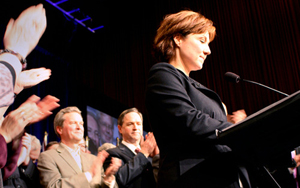
Premier Clark accepting BC Liberal leadership: Lacking a mandate? Photo: Justin Langille.
A decade ago, Christy Clark was deputy premier and education minister in a government that introduced the first fixed election date law in Canada. Today, as premier, she has said she's planning to call an early election, ignoring that fixed election law, with many expecting the vote as early as September.
To get a sense of what's at stake, it's worth considering what her government colleagues had to say back in 2001 about fixed election dates.
"The government believes that this reform will bring about certainty and predictability in our electoral process, with the result that government will become more responsible and accountable to British Columbians," said then Attorney General Geoff Plant during second reading of Bill 7, the Constitution (Fixed Election Dates) Amendment Act, 2001.
"The goal, if you will -- the subtext goal of this legislation -- is another step along the way to dispersing the power that is concentrated in the office of the premier under the present rules of our political system," Plant said in that Aug. 21, 2001 speech.
The bill was part of the 90 days of action outlined by the BC Liberal Party during the campaign that brought Gordon Campbell into the premier's office with a 77-2 rout of the New Democratic Party, then led by Ujjal Dosanjh.
Today, Plant says Clark is in a situation he didn't foresee at the time, and she can justify calling an election. But she could also justify not calling one, he said.
'Restoring public trust'
There was little debate in 2001 of the bill itself, and Clark's own thoughts on it were never committed to Hansard.
EARLY ELECTION POSES RISKS FOR CLARK, SAYS PLANT
Premier Christy Clark could justify calling an election, but there's much risk in doing so, said former Attorney General Geoff Plant.
While Clark has her strengths, the Liberals should not underestimate NDP leader Adrian Dix, a "formidable campaigner," said Plant.
"He will have interesting things to say," he said. He pause a second, then added, "He does have interesting things to say."
That might lead to more success for the NDP than they found with the moderate approach of former leader Carole James, who Plant said "diluted the content until it was kind of bland."
James, by the way, this week announced she'll run in Victoria-Beacon Hill in the next general election, whenever it is. -- A.M.
Campbell's comments appear in a press release. "This is a crucial step in restoring public trust and confidence, by making government more open and accountable," he said. "The timing of elections should not be manipulated for political or partisan purposes. Under this legislation, all British Columbians will know how long the government has to meet its commitments, and when they will be able to hold us to account."
Ida Chong, today the minister responsible for community, sport and cultural development, spoke about fixed election dates in her response to the throne speech. She called them "critically important" and argued that they allow politicians and their families to plan their lives.
"If you want all people of this province, every British Columbian who is eligible, to participate in the democratic process, to decide to seek public office, which is a true privilege and honour... In order for that to happen, they need to know that there are fixed election dates," she said.
Randy Hawes, the MLA for Abbotsford-Mission, said people waited a long time for the 2001 election to be called. "Everyone in the province waited not just this year but last year and the year before, and it dragged out an interminable time," he said. "It becomes very clear that playing with election dates is a game that's also gone on in this province far too long."
Fixing the dates was the right thing to do, he said. "I'm proud of the fact that that's the kind of reform that we're prepared to put forward for the people of this province."
Re-election strategy
In introducing the legislation, Plant was clear that there still needed to be some room for flexbility.
The lieutenant-governor could still prorogue or dissolve the legislative assembly "should a government be defeated in the legislative assembly on a vote of non-confidence" and call a general election immediately, he said. "Those are the traditional powers of the Crown. That is the traditional prerogative of the Crown, and nothing in this bill will undermine that basic rule of a constitutional democracy."
While there had to be provisions for what to do in the case of a non-confidence vote, where the premier failed to win the support of the majority of MLAs in the house, the idea was to get away from elections being called based on the political agenda of the premier as they had been traditionally.
"It would be nice to think that our political tradition shows an unbroken succession of premiers who exercise that authority only when it is in the public interest to call a general election," said Plant. "I don't think that is our political history. Rather, I think our political history indicates, at least in British Columbia, that premiers use their power to determine the timing of the calling of an election as an aspect of their re-election strategy.
"They can accelerate election dates if it suits their political strategy, or they can delay election dates if it suits their political strategy," he said. "In all of those cases where there is an argument about the use of the timing of an election for political purposes, there is at least an argument that the public interest in certainty and predictability in the conduct of public affairs has been subordinated to the private political interests of the premier."
Fixing the dates would help restore trust between the government and the electorate, he said. "When people are suspicious of the timing of an election, they become suspicious of the work their politicians do," he said. "I think that the passage of this bill will begin the process of undermining any legitimate rationale for that suspicion and will restore some sense of confidence that we as politicians are here to serve the public interest."
NDP ready with strong slate: Dix
Clark is yet to name an election date, but she has said she would like to go to the polls before 2013 and that she feels she needs her own mandate from the public.
"I think it says everything that nobody thinks they're going to follow the law," said NDP leader Adrian Dix during a June 24 discussion with The Tyee editorial board.
It makes sense that the Liberals would want to call the election early, giving Clark the chance to run on personality rather than substance, he said. "I think the public will view it with great skepticism. I view it with great skepticism myself."
If Clark really wanted to drive change, she could take two years to govern and demonstrate the kinds of changes she would like to make, he said.
However, Dix said, the NDP has the strongest slate of candidates it has had since 1991 and they're keen to face the Liberals in an election.
"From my perspective it would be good because we could get rid of this government 18 months early," he said.
Early election justified, says Plant
Plant said in a June 23 interview that while his comments a decade ago dwelt on what would happen after a non-confidence vote, Clark is in a situation where an early election could be justified.
"You want to create a space for all those weird and wacky situations democracies throw up sometimes," he said. "The question of whether it's necessary (to call an election) is for her to decide and also for the lieutenant-governor."
It would have been hard for Campbell, or a replacement who was committed to following the plan set out during the 2009 campaign, to justify calling an election, he said. Similarly, now that Prime Minister Stephen Harper has a majority government federally, he has no reason to call an early election.
"She's in a different place," said Plant. "The premier of British Columbia was not elected as premier in 2009... She doesn't have a mandate from the people to govern."
While to some extent she is following the agenda the BC Liberals set out in 2009, she also campaigned for the leadership on a "change" platform and has departed from some past policies, he said. "To whom is she accountable for the mandate of change?"
It would be easier for Clark to convince Lieutenant-Governor Steven Point and the public that an election is necessary were she to lose a confidence vote in the legislature, he said. But with the NDP recently picking Adrian Dix as a new leader and John Cummins now heading the Conservatives, she could argue the public needs a chance to decide who should govern.
"What I don't like is in a context like this we're putting the power back in the hands of the premier's office," he said. But that can be overlooked given the unusual circumstances, he said.
"The ultimate test of all public decisions is whether the electorate accepts them," he said.
Clark risks losing: NDP's Horgan
"I support fixed election dates," said NDP house leader John Horgan.
On a personal level, he was able to run in 2005 because everyone knew when the election was coming and it was possible to get his business and other affairs inorder, he said. "Had I not been able to do that... I may not have bothered to put my name forward."
If Clark calls an early election, it will put the lieutenant-governor in the position of having to decide whether to act on the wishes of the premier or the legislature, unless Clark finds a way to orchestrate her own defeat, he said.
"I don't know how you co-ordinate or achieve a defeat in the legislature when you have the majority of seats," he said. "It takes us back to a time I thought we had left behind."
Still, it's understandable why Clark would want to have an election, he said, noting she seems more comfortable on the campaign trail than she does governing. If she sticks around until 2012 she'll have to table a budget, he said. "She's a campaigner, not an administrator. Gordon Campbell was an administrator."
Horgan said he thought the public would likely forgive Clark for going to the polls early, as they twice forgave Prime Minister Harper for breaking his fixed election law.
The bigger risk for her is that she'll lose the election, and with polls showing the Liberals and NDP tied in public support, that's a real possibility, Horgan said. ![]()


23
Login or register to post comments
Conductor274
47 weeks ago
Lies and deceit
There's a large portion of the population that do not care if politicians lie to them, deceive them, promote hatred and division and govern based on the interests of a few to the detriment of many. It has become acceptable behavior from those who govern us. The younger generation are learning that unethical behavior is not only common place but it's acceptable. The riots in Vancouver are a good example.
Van Isle
47 weeks ago
How come the press doesn't
How come the press doesn't ask a some simple and straight forward questions to Clark; Whats the point of having a fixed election date law when the Premier can circumvent it? Is the Premier above the law?
freebear
47 weeks ago
Favourite foot apparel of the Crusty Clark!
flip flops!
de Falla
47 weeks ago
Vote of Confidence
Well, if the HST referendum is passed it could be seen as a vote of confidence by the electorate on a budget matter. A government should have to go to the polls then. But CC is more likely to go to the polls if the HST referendum is defeated. Through the looking glass!
Fiat lux
47 weeks ago
CC wants 4 years to sell off
CC wants 4 years to sell off BC with the help of Harper's majority. They both belong to the same ideological racket, under different labels to fool the public.
That's all there's to it.
Ed Deak.
Skywalker
47 weeks ago
After all their lies...
...they think no one will notice yet another flip flop.
puppyg
47 weeks ago
You gotta love Krusty. Greatest entertainer ever.
Clark has learned well that principles only get in the way of a good show.
pwlg
47 weeks ago
Geoff Plant full of contradictions, what else is new
Geoff Plant quotes from the article which are in direct contradiction of each other...
Excuse me, but the previous Premier, Gordon Campbell, rather than disperse the concentrated power of his office increased it while Plant was still an MLA and a Minister of the Government.
The budget under Glen Clark for the Premier's Office was under $10 million which caused the Opposition leader of the day, Gordon Campbell, to blisteringly criticize Clark for his extravagances but under Premier Campbell the Premier's Office budget increased to a whopping $32 million! And Plant, a member of the 'inner circle' of cabinet sat there and signified nothing.
Then Plant says Christy doesn't have a mandate from the public which shows his ignorance when it comes to democratic electoral practices.
Civics 101 for Mr. Plant:
The people of BC in 2009 gave their Members of the Legislature, their representatives, a mandate for four years as per the act Plant himself brought forward. In Canada we do not elect our Premiers or Prime Ministers, we only elect MP's or MLA's. It is the political parties who elect their leaders who become, if a majority of their party candidates are successful on election day, Prime Ministers and Premiers.
In the US the people specifically elect their Presidents, Governors, Attorney Generals and even in some cases their Police Chiefs. We do not do this in Canada.
I didn't elect Christy Clark for either her present MLA status or her as leader of the BC Liberal Party (Premier of BC). The BC Liberals have a mandate to govern as they received a majority of the seats of the legislature.
The people gave their MLA's a mandate to represent them in 2009 for 4 years Mr. Plant. No need for an early election.
If Plant was truly concerned a decade ago about the concentrated power in the Premier's Office then why would he suggest that Ms. Clark deserves a mandate from all the people of the Province and call an early election? Is Christy Clark the government of BC?
When people go into the polling booths they don't see Christy Clark's name on the ballot, unless they live in Point Grey, they see a list of candidates running for the position of Member of the Legislature.
We have allowed Plant and others, including the Mad Men who sell us politics, to distort our system of democracy (as poor as it is).
By suggesting such a distorted view of our democratic system Mr. Plant is confessing that his initial bill to stop Premiers from calling snap elections was nothing more than cheap politics.
There is a reason Salvador Dali stopped painting his surreal art. As Dali himself put it, "Life itself has become surreal".
The trademark of the BC Liberals since running the government for more than a decade has been that of deception and disingenuous acts! For Plant and Christy Clark, what else is new?
Falstaff
47 weeks ago
More lies from the right.
The fixed election date laws, both here in B.C. and nationally, are sanctimonious, meaningless nonsense, the product of utter ignorance about the parliamentary system. Harper, ever contemptuous of the political system, broke his own law. Clark, if she thinks it is to her short-term advantage, will do the same.
metacomet
47 weeks ago
Repeal the fixed-date election law
The fixed-date election law was a bad idea from the get go. It hasn't been able to meet the contingencies of either the House of Commons or the BC Legislative Assembly. Most of the last decade has had minority governments in Ottawa, not to mention Stephen Harper's prorogations. BC has been going through one of the biggest political upheavals in its history, setting precedence for the entire British Commonwealth (the successful Anti-HST Petition), one Premier resigning in disgrace, replaced with a new one after a by-election win but without a mandate from the all the people of BC. If there ever was a need for a general election, this certainly must be it. What superlative principle could possibly trump such an obvious need for an "early" election?
The Alliance (predecessor of the Conservatives) feigned righteous indignation when Jean Chretien caught the hapless Stockwell Day flatfooted by calling a snap election. "Unfair! We weren't ready!" they opined, behaving every bit the sore losers they were. It was this supposed unfairness they claimed to address by bringing in the fixed-date election law, characterizing the Prime Minister's power to call a snap election as "manipulative." But it was Day's ineptitude rather than any manipulation on Chretien's part that won the election for the Liberals, underscoring the importance of the Official Opposition, as government in waiting, being ready and able to assume power at any and all times, and at short notice. Our Constitution guarantees us a government that can pass legislation. The moment legislation fails to pass by a majority vote in the House, a new government is guaranteed. It's the Opposition's responsibility to be ready at all times to present themselves as an alternative to the current government, and it's their fault, not the system's or the PM's if they're not.
Gordon Campbell use the fixed-date law as an excuse to suspend sittings of the Legislature, his attitude being that everything was going according to his government's four-year plan, details of which would become available just before the next election, and that there was therefore no need for the Assembly to sit, even though many issues demanding urgent legislation exist. The four-year term afforded him time to execute an agenda of privatization that we now know to be not in the public interest, or corrupt.
Ironically, the fixed-date law bit NDP leader Carole James because she was so fixated on preparing for a set-piece battle at the pre-determined time, she wasn't ready to respond quickly and forcefully when the HST and BC Rail fiascoes unexpectedly fell into her lap. It cost her her job.
All the rationals for fixed-date elections can be lumped in with the other maxims and slogans of the neo-right: nobody wants elections, taxes are bad, government only gets in the way, trickle-down, etc. It's time to repeal this law, which is exactly what needs to be done before Christy Clark can call an "early" election.
anne cameron
47 weeks ago
ed deak
Absolutely spot on. As usual. I look for your posts, and enjoy them. I particularly enjoy the no-nonsense no-holds-barred approach.
We're dealing with a pack of phillistines, a mealy-mouthed bunch of hypocrites who won't hesitate to give away every last stick, rock, and drop of water in the province. Our grandchildren will pay dearly for the b.s. this congomeration of criminals is spreading.
Thanks for saying it like it is, Ed Deak. You really do "speak truth to power".
roady
47 weeks ago
what did you expect
from the BC fiberals... same ole same ole
Curt
47 weeks ago
The government believes that
The government believes that this reform will bring about certainty and predictability in our electoral process, with the result that government will become more responsible and accountable to British Columbians," said then Attorney General Geoff Plant during second reading of Bill 7, the Constitution (Fixed Election Dates) Amendment Act, 2001
Today, Plant says Clark is in a situation he didn't foresee at the time (I say b$hit), and she can justify calling an election. But she could also justify not calling one, he said.
(Flip flopping to suit the liberal agenda.)
Campbell's comments appear in a press release. "This is a crucial step in restoring public trust and confidence, by making government more open and accountable," he said
(Who are you kidding?).
"The timing of elections should not be manipulated for political or partisan purposes.
(Only when it suits your gang.)
Randy Hawes, the MLA for Abbotsford-Mission, said people waited a long time for the 2001 election to be called. "Everyone in the province waited not just this year but last year and the year before, and it dragged out an interminable time," he said. "It becomes very clear that playing with election dates is a game that's also gone on in this province far too long."
(And you want to change again, WHY?)
Plant said in a June 23 interview that while his comments a decade ago dwelt on what would happen after a non-confidence vote, Clark is in a situation where an early election could be justified.
(Ah yes, the change of story, again. Mr. Plant, are you not supposedly a lawyer, who foresees these things?)
"What I don't like is in a context like this we're putting the power back in the hands of the premier's office," he said.
(Well, since 2001, the Premier’s office has been the only power in this province. The other liebs are just his followers.)
Well Mr. Plant, enough of the games. You guys/gals just don’t get it. We’ve had enough of your manipulations, lies, deceit. People are tired of the games your lieberals continue to play, the word games, yes means no, no means yes, our budget is only ---- when we know it’s more than double that and the list just goes on and on.
So, today, what way do the lieberals want it? Fixed? Not fixed? No? Yes? Here we go again, new rules because we don’t like the ones we’ve made up in the past.
Sheesh.
Jeffrey J.
47 weeks ago
Anne Cameron & Ed Deak!
Anne Cameron & Ed Deak! Yes, yes, yes!. Exactly.
I couldn't have said it any better myself (literally and figuratively).
Merci beau coup.
DPL
47 weeks ago
Is there anything the BC
Is there anything the BC Liberals haven't flipped on? Christy fits right in, as she changes her position a couple times a week. BC voters sure put up with a lot of crap
freebear
47 weeks ago
More changing of positions than in a porn film!
Because most politicians will say anything to get elected; including "Families First" slogans!
As if other candidates and political parties are anti-family, or families last!
GaryH
47 weeks ago
I Have To Agree With Dix
NDP leader Adrian Dix said, "It makes sense that the Liberals would want to call the election early, giving Clark the chance to run on personality rather than substance. If Clark really wanted to drive change, she could take two years to govern and demonstrate the kinds of changes she would like to make."
There is really no surprise here; just another BC Liberal flip-flop and more lies.
Devon
47 weeks ago
Perspective
In all truth, whether you support or oppose the Liberals, the real reason that Clark can get away with this is the relative weight of the issue. If an election is called are you really going to vote against Clark (or any leader depending on your political stripe) because of the date the election was called? I definitely voted against Harper, but of all the issues I wanted to turn someone out on, the fixed election date, which I support in principle, was the least among them. Here's the solution: the legislation needs to be amended so that in cases other than a non-confidence vote, like a new leader being sworn in, a fixed date for an election for the new leader needs to be set up. Something like: if an incumbent leader steps down (or dies, whatever), the replacement must call an election after being put in place by their party no sooner than six months after that, no later than nine months, unless the regular fixed date occurs within the first six months. In other words, put in a clause or two that would give certainty back while allowing the voters to express the democratic will.
G West
47 weeks ago
@Devon...I'm not entirely convinced
I'm not entirely convinced that fixed election dates are compatible with parliamentary democracy. I wouldn't have a problem with a general undertaking that elections (except in cases where the government has lost the confidence of parliament) should only be held after the expiration of some set period of time - say 40 months and before the expiration of the full five year term.
Despite the manipulation value of allowing the incumbent party to set the date of an election under our current system I find the idea of fixed dates tends to create a cycle of electioneering that reminds me too much of the American program of almost continual election campaigns with short (one year) respites between them.
Your idea of an election requirement every time leadership changes seems too 'presidential' to me - the fundamental importance of parliment has already been downplayed significantly - putting more stress on the 'importance' of a leader doesn't seem to me to be such a good idea.
rantnic
47 weeks ago
It ain't broke so don't fix it!
The presiding party needs to be able to call the election when it is most advantageous for them. This is the way it has always worked the best for the reigning hierarchy, so it don't seem broke to me. Who in their rite mind would want to fix something that ain't broke?
sdgreen
47 weeks ago
There is no need for a 'fixed' election date.
Simply stated, the Constitution already has a 'fixed' election date built in. Why in earth do we need another?
The sense was that the governing party could somehow manipulate a positive election result by changing, presenting new laws or some other attraction. Frankly, politics is a game of 'one upmanship' where they all try to attract the attention of the electorate. Today, election platforms are total nonsense as NO party follows their stated position to any degree. It follows then that the date of a particular election within the timeframe of the Constitution is really illegitimate.
I would much rather see a law that requires a Political Party to produce a platform of what they will do and how, then be obliged to follow that plan to the letter; no deviations other than addressing emergencies like floods, fires and riots.
We must demand absolute substance from political parties NOT a bunch of maybe's or at a time that is their choosing.
The NDP is a classic example as what they use to stand for seems to no longer true. The Liberals or Conservatives are also wishy washy.
Bottomline, it is not the date of the election that matters but5 rather the substance that really matters.
shedding_light
47 weeks ago
Fixed or Not-fixed is beside the point...
The point, as I see it, is that however many weeks, months or years it lasts, a term of office is a time of unaccountability to the voters and citizens. We are impacted negatively by all the bad ideas and self-serving decisions we see from experience that politicians at every level of government have made...on our behalf! And we pay them handsomely for this...'service'?
I say we need to give citizens a meaningful vote...one they can place and change whenever they want. That's the key to accountability. Transparency will come, too, because those who are not open and honest will soon lose any votes they get.
I think voters will only feel empowered and motivated to do the work of following and participating in the issues that impact their lives and seeking solutions to the challenges we face in our communities if they experience in a concrete way that their representative is accountable to them and behaves accordingly.
Such a voting system would best be implemented by having permanent local electoral offices, where citizens could share and discuss information and ideas, meet and get to know each other and potential candidates. They could not only place and change their votes for representatives at all levels of government but also begin or learn about citizens' initiatives and vote on referenda whenever the voters decide certain issues need to be taken directly to the electorate.
If a change of representation needs to happen, the voters are the ones who should decide, collectively, when it is going to happen and who is going to replace the out-going person, not the Premier or the calendar.
How can we accomplish this type of electoral reform? The same way we successfully challenged the HST! We need to start a citizens' initiative to demand permanent electoral offices run by each community or neighbourhood, with votes recorded the way bank deposits are, and the ability to place and change our votes whenever we see fit.
I am convinced that most people will become diligent and thoughtful voters in such a system, and they will feel responsible for the decisions made on their behalf and motivated to find representatives that really do a good job for everyone, not just for those who contribute to or control their political party. We don't need political parties. We need cohesive and cooperative communities where people with different needs and priorities can work out ways to live well together and they can choose representatives to implement the voters' decisions, not the Premier's decisions!
zalm
47 weeks ago
Stimulating....
metacomet is very persuasive.
stepping_light features a wonderful dream. Would that we knew in advance how much hard work it would be. After all, under that model, there's no distinct public forum to hold lobbyists and those with significant and unbalanced power accountable in a singular event that gets all the juices for change flowing.
I would fear a kleptocracy more powerful than the one we have now. And, ultimately, the only real change that would occur would be at the point of a gun.