
- Ms Kaye is a Tyee Builder. You can be, too.
- Mary Carlisle is a Tyee Builder. You can be, too.
- Prem Gill is a Tyee Builder. You can be, too.
- Nancy Flight is a Tyee Builder. You can be, too.
- Justin Everett is a Tyee Builder. You can be, too.
- John Westover is a Tyee Builder. You can be, too.
- Nora Etches is a Tyee Builder. You can be, too.
- Edward Henderson is a Tyee Builder. You can be, too.
- Bharadwaj Chandramouli is a Tyee Builder. You can be, too.
- Dean Chatterson is a Tyee Builder. You can be, too.
- Marius Scurtescu is a Tyee Builder. You can be, too.
- Robert Parkes is a Tyee Builder. You can be, too.
- James Murton is a Tyee Builder. You can be, too.
- Susan Doyle is a Tyee Builder. You can be, too.
- Vincent Strgar is a Tyee Builder. You can be, too.
- Helen Spiegelman is a Tyee Builder. You can be, too.
- Subir Guin is a Tyee Builder. You can be, too.
- Kimball Finigan is a Tyee Builder. You can be, too.
- Joanne Manley is a Tyee Builder. You can be, too.
- David Leach is a Tyee Builder. You can be, too.
So Much Rain! Why Not Put It To Work?
Exasperated that our wet winters turn into water-scarce summers? Get your own 1000-gallon rain barrel.
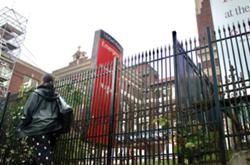
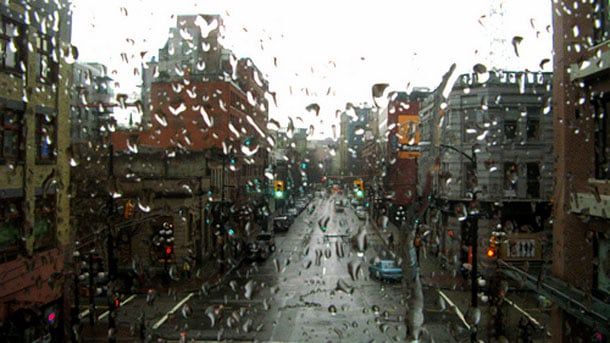
Cordova Street, Vancouver. Photo courtesy of it caught my eye via Your BC: The Tyee photo pool.
DANGER: Drinking this toilet water could be hazardous to your health.
That's the message required above every rainwater-flushing toilet installed at Vancouver's Olympic Village, where water is collected from the roof, stored in a giant holding tank, and pumped as needed for each flush.
The sign is necessary, because bringing rain indoors breaches a fundamental orthodoxy of the North American plumbing world: behind the walls, pipes carrying potable municipal water mingle with those carrying potentially unsanitary rain. On paper, building codes for Vancouver and elsewhere in B.C. do not currently allow the practice of indoor rain water plumbing. In a post-Walkerton regulatory environment, there is immense discomfort on the part of building inspectors at the prospect of mixing private and public water supplies. (See sidebar.)
In spite of this, there are about 25,000 rain water capture systems operating across B.C. today -- used to water lawns and crops, flush toilets and provide drinking water for people and livestock. There are about 5,000 rain systems on Vancouver Island and the Gulf Islands alone, in areas where seasonal droughts and dodgy well water make it a necessity.
As municipalities and cities explore ways to work with the deluge of water that falls from the sky (more than a metre of rain typically falls annually in Vancouver), the most promising use will be for irrigation of lawns and gardens in the near future. This could be good and bad.
"I have a worry that rainwater is starting to get trendy," says Bob Burgess, a B.C. rainwater harvesting pioneer and founder of The Rainwater Connection which designs and builds all sorts of rain capture systems. "More and more people are doing it, and doing terrible jobs of it. It may not be too long before we have our little Walkerton for rainwater."
Looking to the skies
A basic rain harvesting system captures water from a roof and channels it to a storage tank, where it is then pumped to where it is needed. Along the way, the rain undergoes any number of different filters and cleaning methods depending on the end use: to make it potable for drinking, it will require filtration and any combination of UV sanitizing and chlorine-injection; water strictly for watering plants will be cleaned less.
RAIN WATER: HEALTH AND ECONOMICS
The rain that falls across much of B.C. is very clean -- it's the roof that can be a source for contamination. Dirt, bird shit, and coniferous needles are often found there, the latter adding both acidity and discolouring tannins to the water.
Health concerns about capturing rain water persist because most rain systems are connected to a well or source of municipal potable water -- this is necessary to top up the storage tank with potable water in times of low rain or drought. This connection creates the potential to back-up untreated, potentially-dirty rain water into the potable supply. Concerns of just this are top of mind for municipalities and cities, and a reason why plumbing inspectors are often hesitant to approve such systems.
After Ontario's Walkerton disaster in of 2000 -- which killed at least six people when E. coli from cattle manure contaminated a municipal well -- regulators clamped down harder. The result has been strict rules about protecting the purity of municipal sources of potable water.
"If you allow Mr. Joe Public to connect his source of private [rain] water to the city, if everybody does that, there is no assurance that the domestic water that we all drink will be clean," says Vancouver-based engineer and building code consultant Kenneth Chow.
Estimated costs of rain water systems
According to Bob and Jean Burgess of The Rainwater Connection here's what you might expect to pay for a...
Basic one-family rainwater potable drinking system: $35,000 and up;
Basic rainwater toilet system (supplying about 75 per cent of yearly flushing): ~$5,000-$7,000;
Basic rainwater irrigation system, with one 1500 gallon storage tank, custom-designed and installed system with pump: ~$5,000
Big municipal fleets are among the early adopters: White Rock currently washes some of its trucks with rain, as does Vancouver; the Regional District of Nanaimo captures rain off two large Parksville recycling transfer buildings and uses it to wash their interior concrete floors.
Commercial greenhouses in places like Delta and Langley have already taken rainwater recycling to a high art: many operations capture and use rain for watering, then continually recapture from the soil, filter and reuse.
Toilet flushing with rain is more complicated, often requiring a separate indoor plumbing system to move it within the building, as well as time-consuming consultations with municipal building officials to get approval. (See sidebar.) Such projects often occur in big "green" building developments like the Olympic Village. Developers often earn points toward LEED certification for such water conservation measures, providing the incentive to go through all the trouble.
Then there are those who use rain water out of dire necessity -- usually for drinking. As early as the 1960s, farmers in the Lower Fraser Valley and on Vancouver Island started to notice their groundwater was being contaminated by synthetic fertilizers and manure. Burgess still gets regular calls from farmers looking for cleaner sources of water for their cattle, horses, and families.
Many rainwater drinkers started out like Burgess himself: he retired to a piece of land served by a bad well (he lives and works on Thetis Island in the Gulf Islands) -- and looked to the sky for solutions.
He says 75 per cent of the people currently using rain for potable water in B.C. have no choice; another 25 per cent have the option of drilling a well (with no guarantee of success), but choose rainwater. There is also a tiny but growing number of people who want to conserve water for the sake of conservation -- a move that also provides more control over the contents of the water. (See sidebar for ballpark rain system costs, including potable.)
A barrel of possibilities
Burgess says using rain for irrigation holds the greatest promise in changing how residential consumers and many municipalities consume and conserve water.
Each summer, the demand for treated water almost doubles across the Lower Mainland, due almost entirely to lawn watering, at the very time when rainfall is lowest. Peak summer water demand typically occurs sometime in July each year, when the masses are soaking their lawns to keep their grass green. It is this peak demand that drives the costs of our entire water system -- everything from budgeting water needs to determining the size of our pipes.
"The single best thing municipalities could be doing is providing the means for Mr. And Mrs. Smith to have a 1,000 gallon rain barrel full of water in July," says Burgess. He says ubiquitous rain watering systems, fitted with a simple fixture to allow rain tanks to be topped up with municipal water as needed at night, would solve the costs and strains of meeting this peak demand.
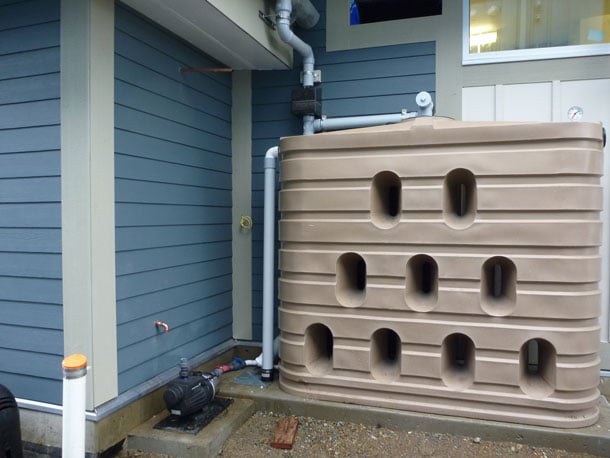
A high quality rain irrigation system: rain travels down the roof, through a black debris box (which filters out fir needles and organics) into the 520 (imperial) gallon tank. The tank has an overflow to storm water drain, and a first flush diverter pipe (to same drain) to flush away the initial water that comes off the roof during a rain -- which is the most polluted water.
Many others agree. As lawn sprinkling rules get more onerous, rain harvesting is going to start making more sense, says Bruce Hemstock, a principle at Vancouver landscape architects PWL Partnership -- which designed the Vancouver Convention Centre's 2.4-hectare "living roof." "Summers are starting to get a little longer and drier, and we'll get to a point where we won't be watering our lawns [with potable water] at all."
What needs to change?
Kenneth Chow says rainwater irrigation has a bright future, and he should know. Chow is a "building code consultant" with Pioneer Consultants -- basically an enabler who helped Olympic Village developers earn the "equivalencies" required to get rain water toilets installed and approved. He says using rain for irrigation is much simpler, cheaper and safer than trying to put it in toilets -- and you don't have to post those silly hazard signs either.
"If we use rain harvesting for irrigation, it's very low risk, and much easier to control the hygenics of the water... if there's a mistake, the consequences are minimal. A plant might get a little water with bacteria in it, but there's already lots of bacteria in the soil."
He says regulatory agencies need to sit down with experts and "publish" the basic rules that will govern how rain water systems are designed and built -- instead of evaluating each system on a case-by-case basis, and forcing developers and other aspiring rain harvesters to devise custom "solutions" every time.
Discussions to this end are already happening: last year the City of Vancouver engaged in talks with Metro Vancouver, industry and neighbouring municipalities exploring sanitation standards for rainwater. This includes adding chlorine to stored rainwater to protect municipal potable water supply -- in the same way we currently use chlorine to treat water for swimming pools.
Burgess has practical suggestions of his own. "Allow the use of [rain storage] tanks as tall as the legislated fence height, (like this one) and make it so they can go anywhere within a foot of the property line. That one little change would take away a whole bunch of hassles for people." ![]()


11
Login or register to post comments
airwin
1 year ago
Why keep summer grass green?
Homeowners here in Victoria are pretty smart; they let their lawn grass turn brown in the summer. This means much less time/energy spent on mowing the grass. And the grass seems to thrive on this treatment. When the fall rains come, the grass turns emerald green and grows like crazy.
Thus for me installing an expensive system to store and distribute rain water simply so I can mow the lawn more just makes no sense at all.
On the other hand, I can see the point of such systems for keeping a home vegetable garden going through the summer. Food is important, green grass is not.
Stewart MacKenzie
1 year ago
Is rainwater less pure.....
..... when it falls, or are collection and storage the issue?
I am having a hard time understanding how rainwater could be less safe than water standing in a reservoir. I assume therefore that the issue is storage and treatment, which is influenced by convenience and also by convention. People need to start thinking "out of the box" on issues like this and realize that getting greener without changing our social models and constructions is doomed to failure. The underlying model has been developed with an assumption of cheap energy, food, and other essentials; and will not be sustainable under future conditions.
The middle class in North America has been raised with the expectation that one should be able to own a home, drive a vehicle of one's own, and have a large "disposable income" even after all essentials are covered.
In other words we are spoiled rotten, and spoiled people are really bad at working together cooperatively in crises. Many if not most are not going to deal well with enduring the erosion of their standard of living and the destruction of their fundamental assumptions about the world they live in.
DavidN
1 year ago
True but...
The destruction of our environment by degrees doesn't registeer as a crisis. Not to humans.
Its easy to say we are spoiled and wasteful and all that. True but, we need to be pushed into doing what we must agree socially to be "right".
We must all agree that the lawns are not worthy of constant watering, and that subsidizing oil is not intelligent. And we must convince Harper's government that being ecologically conscious is better than waiting for the End Times.
A few years ago the airforce retiree down the street stopped scowling at me for letting my lawn grow uncut, turn brown and then go green again just like airwin says. I mow maybe 3 times a year in a nice hood.
Even the most conservative among us is starting to see the waste involved in maintaining outdated value systems, let alone lawns. Some will never change. They have to die of old age before the next people, hopefully more enlightened, can take their place.
Ride your bike and let your lawn go brown, plant a few vegys, they don't need a ton of water, plant things that match your environment and slowly those around you will feel free to do the same. Most neighborhoods just need one chicken to go free range, then the ones that are on the same verge will jump in. It is amazing how many people do the lawn thing out of a sense of convention.
It happened with our hood.
Then change happens, and yes, we are all spoiled rotten and stupid and self interested and all that. But we are human and that is a problem.
Crisis, what crisis?
Greg in Calgary
1 year ago
Great article - thanks!
Lots of helpful information here.
@Stuart M: I don't think there is much difference, unless there's a dead animal in your rainwater tank. What's different is that municipal water is treated, filtered and chlorinated before it's piped to your house. Rainwater might not meet standards for suspended solids & bacteria, just because municipal systems must meet fairly stringent standards, not because the rainwater is inherently unsafe.
I wonder what's going to happen here in Calgary, where we get ~400mm of rain annually (one quarter of Vancouver's precipitation, according to Wikipedia). There's a huge amount of lawn watering here, and people don't seem to be getting the message that we're overusing the existing sources of water.
OwlRol
1 year ago
Location, air and water
As food prices continue to climb, more people will consider turning those ridiculous unused lawns into vegetable gardens and replace decorative shrubs with fruit trees. To be prolific, they will need water wise mini irrigation systems, notably during hot, dry summers.
Stewart, I agree. Each home and community requires individual analysis rather than a one size fits all regulation that has been imposed more out of fear of litigation than real care for citizens.
But it is exactly that which must be clearly considered.
For example, the Lower Mainland gets its water from 3 relatively pristine north shore watershed reservoirs that are protected by very restrictive entry. Air and water pollution are minimal.
But roofs in the downwind airshed side, extending from east Vancouver and intensifying through the Fraser valley towards Hope, will collect all sorts of particulate matter and other pollutants, notably after a summer rainfall preceded by those "no outdoor exercise" pollution warnings.
I suppose that rainwater is still better than water drawn from pesticide or feedlot contaminated wells, but a few years ago the GVRD established water pipelines for those valley residents, much better than the other 2 options.
I wouldn't want to collect rooftop drinking water downwind from the Prince George area beehive burners or the Peace region oil and gas wells. Even that water for my vegetable garden would concern me.
On the other hand, with a little care, rooftop drinking water around Kimberly or Silver Star would be superb.
Stewart MacKenzie
1 year ago
Greg and Owl..
Thanks for clarification.
Access restrictions aren't always observed by wild animals or birds, dead leaves or mold spores etc. Ultimately, Vancouver's water supply all comes from rain, and may carry contaminants, which is the reason for all the treatments and chlorination etc.
Coming from a place where we still seem to have clear air, I can see how water falling through the soup hanging over everything from beyond Qualicum and Sechelt down to southern Vancouver Island, might be tainted. Perhaps a collection system should have a bypass valve for overly smoggy days.
It seems aside from drinking, rainwater if collected and stored carefully should be usable for most purposes,like gardens and lawns - which already get natural rainfall and require watering only if there is no rain.
We don't water our grass; we do water the garden and greenhouse.
More and more, people don't trust their tap water, or can't stand the chlorine taste and potential health effects.
Unable to access piped water, we have a well and holding tank system, with a reverse osmosis filter for drinking water.
Anyone buying water should look at these filter systems. They are much more economical over time, not hugely expensive, and easy to install under a sink. They take most, if not all, the chlorine out of the water. We supply anywhere from 8 to 12 people with drinking water from our system for around $125/year maintenance and filter replacement.
There are also UV sterilization systems around for homes. Some choose to use more than one system just to be sure.
As for the chances of the comfortable classes getting the message before a serious crisis occurs, here is another bit of data:
We go to the Kootenays every year to soak our aging and increasingly aching bones in hot springs.
Nearby, wealthy flatlanders drive huge $50,000 4 wheel drives carrying $20,000+ snow machines to the bases of mountains, then drive the snowmobiles straight upwards until they trigger avalanches which swallow them whole!
I'm unsure whether the prizes go to the ones who start the largest snow slides or the highest death toll!
I don't believe the concept of "environmental impact" has any place in the minds of these folks. If so, it is been drowned out by the endless and preemptive chorus screaming
"IT'S FUN!!!
The ultimate justification for the wasteful and self indulgent!
The enlightened in our modern and Googleable world, are far more enlightened than in past ages, if not nearly so wise.
The unenlightened are burning fuel for fun and watching dumb TV channels, and are more unenlightened than their predecessors -even if they are MBAs from Harvard!
BrianWhite
1 year ago
Victoria rainwater storage Freya Keddie
Our own rainwater guru is Freya Keddie
She was one of the first in Vic to really work to inform people about the issue. I think their tank is 1000 gallons. She was the trailblazer.
On the gulf islands you can find some of the companies which are expert on sizing your tank and on potable water from the rain. (Because rainwater storage for summer use is essential there).
Here they have started landscaping for rainwater storage for plants too. Raingardens, etc are cropping up all over the place.
One thing about rainwater storage is that it leaves more water in the rivers in summer for the fish (and it produces less runoff in the winter when the rivers are flooded.
http://www.urbanraincatchersgazette.ca is Keddie's site with lots of info.
mjscox
1 year ago
the second single-best thing they could do...
Would be to encourage people to get rid of their stupid lawns. I mean, what's the good of grass, now that its chewed up each year by crows, starlings, raccoons, etc? Plant vegetables, flowers, use low-flow drip irrigation, GET WITH THE TIMES, people. Lawns are wasteful. Vegetables are beautiful.
Owen_Dell
1 year ago
Does storing rainwater make sense?
Have a look at http://owendell.com/blog/general/roll-out-the-rain-barrels.
OwlRol
1 year ago
Cost & consciousness
(Fresh)water and energy are inextricably linked, be it photosynthetic and animal growth or tar sands and gas fracking operations. Some of us have realized our generous planet's limits on both.
But many are still in mid 20th. century mode as they drive their trailer hitched vehicles to recreate with more motorized toys, not just snowmobiles, but ATVs, speed boats and jet skis. Worse yet are those who drive to watch high fuel energy vehicles drive in repeated circles to see who can go fastest.
High testosterone and bombarding "lifestyle" ads combine to blind these people to the realities of the 21st. century.
In general, these are the same people who want the best looking lawns, vacation homes that stay empty for much of the year and tropical vacations more than once a year if possible (I was quite disappointed by the number of family and friends who flew south for 1 or 2 week island vacations this year, despite the recession - we need air travel for a variety of legitimate purposes, but some restrictions are required, (probably the worst example is the British top ender who flies from London to southern Spain and back every weekend). This lifestyle is now being pushed worldwide.
Likewise, we need snowmobiles and jet boats for legitimate purposes, but ooh, freedom of money to choose whatever one wants.
But it's pervasive in other ways. I was surprised to get bit by mosquitoes on a 10th. floor city apt. in june until I looked out and saw puddles of stagnant rainwater on surrounding flat, black tar roofs. Rooftop gardens were out and even a coat of white paint to reduce summer air conditioning use was out due to landlord costs. Some of the same people who spend on the aforementioned activities. Priorities!
David Suzuki, at 75, is getting more pessimistic for his grandkids' future. Me too. Too many forces asking us to put our heads in the sand.
doggone
1 year ago
Good article and comments
The first cistern I built (concrete, buried) in 1971, Okanagan, I remember the owner had a reticulating filter system to keep the water fresh. Have not seen that since. Since then I've been involved in building a number of systems mainly depending on initial filtration, storage and final filtration. Quite often we use aireation (sp?) to deal with sulfur smell and the storage is mainly installed to ballast a low volume delivery from a well.
One problem I have found no solution for is salt. As ground water reservoirs are pumped out in island localities the surrounding salt water will logically intrude - any information?