


 SHARE:
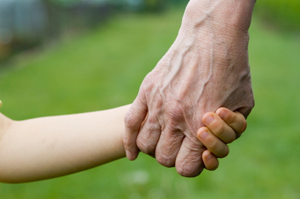
Eleven year old Grace sits back and surveys her grandmother across the sushi table with pity.
"She used to eat miso soup with a spoon," Grace says. "And I said, Nana, that's rude!"
"I didn't know!" Evelyn defends herself. Grace introduced her grandmother to octopus rolls and prawn tempura two years ago, just after moving into Evelyn's little apartment in East Vancouver.
Both dress up for dinner: the pint-sized Grace in a purpley plaid trench coat, Evelyn in a zebra print top picked out from a number of pressed shirts hanging over the bathtub, her second closet. Space is tight in the one-bedroom. Most nights, Grace takes the quilted double bed and 76-year-old Evelyn sleeps on the couch. BC Housing is helping them look for a two-bedroom. Soon, they'll have a place to hang up the pots and pans currently stored in the oven.
By 2006, more than 65,000 Canadian grandchildren were living with one or two grandparents. Nearly 10,000 of them live in B.C. It's an arrangement often created by trauma, though every story is different.
Evelyn and Grace, the self-professed "odd couple," have stuck together since Dec. 2008, after Grace's mother Angela died in bed. A mixture of pharmaceuticals and wine.
"We did go ahead and have a Christmas, it was a hard thing to do," remembers Evelyn. "We mentioned Mommy at the Christmas table. We talk about her just about every day. I think we'll just keep including her in our life."
There are any number of reasons why a child ends up in the care of a grandparent. Parents die. They get sick, physically and mentally. Addictions overwhelm them. Sour divorces consume their attention. Carol Ross, executive director of Parent Support Services of B.C., hears hundreds of stories. "Most often, it's some sort of sad upheaval," she says.
Few grandparents are wealthy. The emotional, physical and financial pressures on families are immense, and outside support is lean. And when the kids don't go home at the end of the weekend, grandparents begin to find themselves excluded from social events. Friends stop calling, and circles thin. Their lives are different now that mouthy, difficult grandchildren run the show.
A place to find support
Every other Monday, Evelyn attends her support group. They've popped up across the province, guerrilla-style, for grandparents raising grandchildren -- a demographic often termed "the underground child welfare system."
This night, the group gathers quietly upstairs in a local neighbourhood house. Downstairs, a boisterous prenatal class packed with big-bellied women is underway.
The table in the middle of the room -- for "boundaries," according to the group leader -- is decorated with a bouquet of yellow chrysanthemums. Ever the class clown, Evelyn interrupts to advise everyone that dried chrysanthemums in the cupboard ward off cockroaches. Her parenting advice is inspired, usually ending with the joke: "If that doesn't work, you could give him a good licking."
But tonight is her night to gripe: the endless parade of preteen girls crowding the apartment. Her inability to use the computer to search for bigger apartments. How Grace selfishly keeps her computer wizardry to herself. (Grace, with her trademark puckishness, created a Facebook page for Evelyn. "All these people from South America keep bothering me," Evelyn says, "and I have no idea who they are!")
"Gracie turns you off, or turns you out. But she doesn't like to receive the same treatment," she explains to the group, squinting towards the ceiling.
(If Grace were here, she'd tell the group that Evelyn's boy advice -- "What good is that, just sitting and smooching? You could have more fun playing with somebody outside" -- is decidedly insufficient. That her girlfriends constantly turn against one another, sketching the hated girl-of-the-week with her neck in a noose and an X through her heart. That she's terrified of starting high school.)
The theme of the night is heartbreak. One couple describes their five-year-old grandson's tantrums. He swings at his tiny grandmother's cheeks, seemingly for no reason, and recently broke the titanium frame of his 60-year-old grandfather's spectacles. He's been told his grandparents are his real parents, but is showing signs of skepticism.
One grandmother's daughter just took back a grandson she was raising, while another is forbidden by her son's former girlfriend from seeing her grandson, a boy she largely raised. The stories repeat: parents willingly dump their kid at grandma's place, erratically drift in and out, and suddenly, often cruelly, demand the child back.
Evelyn the sage sums it up: "They should be grateful."
More financial aid, fewer recipients
Just as many children in B.C. live with their grandparents as are cared for in the foster care system. For government, it's money in the bank. Foster kids cost nearly a thousand dollars a month, not including extended benefits or special care expenses.
Grandparents can receive government benefits, depending on the family arrangement. It isn't so bad for Evelyn. She receives $314 a month from the provincial government's Child in the Home of a Relative program (CIHR). That continues until Grace "ages out" at 19.
But starting last April, B.C.'s ministry of children and family development changed support programs, from the CIHR to the Extended Family Program (EFP).
"CIHR is limited and does not include an assessment of a child's needs or whether a placement is in the best interest of a child," responded Darren Harbord, public affairs officer of the MCFD. "It is because of these factors that we have capped applications and are winding the program down -- and developing other out of care options."
Grandparents that qualify for the new program stand to benefit greatly, receiving up to $554 per child 12 years and under, and $625 for children over 12. They may also receive a medical services plan, extended dental and optical benefits, or respite care.
But few do qualify. Between April and October of 2009, a thousand families qualified to begin receiving payments through CIHR. During the same period in 2010, only 315 qualified for the new program.
Why? For one, grandparents with custody or guardianship of their grandchildren are excluded from the EFP.
More frustrating is that the child's parent must give their permission for a grandparent to apply for the EFP. If the parent is missing or unstable, grandparents go without.
"It's like they filled the banquet hall with delicious food, and then made the door too small," said Barb Whittington, professor at the University of Victoria School of Social Work and author of Grandparents Raising Grandchildren: A Legal Guide, along with Carol Ross at Parent Support Services of B.C. and other contributors.
The new program offers a temporary fix. Unlike CIHR, grandparents with the EFP must be reviewed by the ministry every six months, and their benefits can be cancelled at any time.
The banquet's bouncers -- social workers -- aren't necessarily the best party promoters either. Whittington, a former social worker herself, says the amount of paperwork to put an EFP application through is so onerous, "they just put it at the bottom of their work pile."
The goal of the new program is "to reunite the child with their parents wherever possible," but that happy picture doesn't jibe with Ross or Whittington. For a few, the family will mend. But for most, reunification just doesn't happen.
"Mostly grandparents are just staying afloat," says Whittington. "People don't realize, we're not talking about something nice and cozy under the Christmas tree. We're talking about kids' lives, and having that sense of continuity, the sense that somebody cares."
Picking up precious pieces
"I would like to see every child assessed," says Sharrie, a support group leader in Delta, B.C. "We don't know what they've been dealing with. We're not professionals."
Sharrie raised two grandsons, with her oldest granddaughter drifting in and out of the house over time. She picked up the boys from a drug dealer while her daughter was in the hospital giving birth to a fourth child, an infant addict. Sharrie knew she couldn't handle the newborn, who ended up in a foster home.
One day, a caseworker phoned as Sharrie sat writing a grocery list for her New Years Eve dinner party. "'Sharrie? This is the ministry office,'" Sharrie replays, her voice steely. "'Your worker is on some flex days, won't be in until Tuesday. It's the beginning of a long weekend, and we want to get out of here by noon. Just want to know if the coroner has been in touch with you about your daughter.'"
They hadn't. To Sharrie, it was typical of the ministry, whose "left arm didn’t know what the right arm was doing."
The mother of two girls, Sharrie knew nothing about raising boys. It was clear they weren't used to routines, or even regular meals. At first, she found scrambled eggs hidden at the bottom of pillowcases. Rotten bananas began to appear in drawers. The boys struggled developmentally, and Sharrie poured thousands of dollars into advice, treatment and counseling. Their fears, insecurity and anger were not uncommon for kids in the care of a relative. Reports show these kids may also have emotional problems, disabilities, abandonment issues and low self-esteem.
Sharrie's grandchildren are grown up now. The boys are teenagers, and her granddaughter, who just turned 22, wants to be a child and youth worker, recently enrolling in a private career college to improve upon her grade nine education. Sharrie isn't worried; her granddaughter's last job as a telemarketer selling walk-in bathtubs was very successful. "She'll do what she has to do," Sharrie affirms.
And as for her oldest grandson, Sharrie only wants "to remain on this earth to see him successful, because he's the one that was the most damaged." The other grandson she raised is back living with who Sharrie calls his "bio-dad."
Now, Sharrie is moving into a big house with her other daughter's family. The door will be open to all her grandchildren.
'They've had to do it all on their own'
When Sharrie started out, there was nothing for grandparents raising grandchildren, save for what the government offered. So she dialed up the services herself. She built up networks, becoming a celebrity in the grandparenting community, and eventually a support group leader. Whisper her name, and other leaders are dazzled. "Sharrie walks the walk," they'll say.
Support groups deal with sticky subjects: preteen sexuality, the dangers of the Internet, an omnipresent fear of Alzheimer's. In a way, Sharrie is a navigator for grandparents lost in a sea of legal and financial puzzles, and sometimes mystifying child behaviour.
But some grandparents build up an incredible arsenal of skills. They kick at the drowsy bureaucratic welfare system, until it produces answers. They master legalese. Their exhaustion drives them.
Think raging grannies, with an edge of desperation.
"They've had to do it all on their own. It's incredible, the knowledge some of them have," says Joan Forbes, who runs a support group in Vancouver. Forbes didn't raise her grandkids. An "upsetting" news clip about grandparents raising grandchildren inspired her to put together the group. She arranges for speakers, like sex educators, to share insights with grandparents.
"We in a way are advocates, but I'm fumbling around," says Forbes. "I'm learning as I go."
In B.C., there's no one for those raising the child of a relative to ask for help. We could learn a thing or two from Washington State.
South of the border, Hilari Hauptman is in the business of grandparents raising grandchildren. She is the program director of the kinship navigator program, paid for by the state and research grants to help relatives raising kin. Ten full-time navigators work throughout Washington, providing the kind of assistance to grandparents raising grandchildren that Joan, unpaid, offers.
Since the program started in 1998, Hauptman's department produced a website, DVDs, resource guides, and now offer a training program called Parenting a Second Time Around.
It's changing minds.
"We hear less than we used to, that the apple doesn't fall far from the tree, and won't they just screw up their grandkids as well?" Hauptman says. "There's more respect from legislature. More connection and affirmation that they're not alone and this is hard work. But the needs are still so great."
For a province that touts glory, B.C. lacks champions. In Washington State, House Representative Eric Pettigrew is the hero, the key to getting the legislation for the kinship navigator program prominent and passed. Each Christmas, Rep. Pettigrew plays Santa Claus at the kinship care holiday party in Seattle. His mother raised eight grandchildren.
'What's going to happen when I die?'
Carol Ross of Parent Support Services sounds harsh on the phone, but is gentle and twinkly-eyed in person. A grandmother herself, work often crowds her mind. Her sister, also a grandmother, is a close ally.
"We both think about the fact that we're going to be dead," Ross says. "It's a fleeting thing, not a wise thing to dwell on, but it is realistic. You have this little moment of sadness, that you won't get to see your grandchildren grow up. But if you're caring 24/7 -- and some of these grandparents are in their 80s, some are great-grandparents that took on their grandchildren as tiny babies -- that feeling is so much more present. 'What's going to happen when I die? What's going to happen to my grandchildren?' So it's very, very different."
At 76, Evelyn is convinced that she is the oldest grandma in B.C. raising a grandchild.
She sits at the supper table, images of her daughter splayed all around the kitchen. Her gaze is on the window. Grace promised to come home right after school today, forgoing her usual stop-in at the Boys and Girls club down the street. Evelyn clutches her granddaughter’s forgotten keys, the blue lanyard and trinkets jingling as her knuckles grind.
There's usually a 10-minute window of calm. Grace never dawdles, normally shooting ahead of her sighing grandmother on walks.
"There's times that she gets cheeky with me, I'm not saying she's perfect," Evelyn says.
"She's started saying one swear word, but I hate that word. I say, 'Of all the swear words, do you have to say that one?' See that coming from a young girl? Why say that dirty word? Gracie says, 'Well, all the kids,' and I say, 'Nevermind! If all the kids jumped off a big cliff, would you go do it?' 'Oh no, I definitely wouldn't,' she says. You get her thinking. I'm not saying that she would never say that word again, she'd probably forget herself. 'Well what can I say, then?' she asks. 'Well, I guess you could say oh bugger.' 'Oh bugger?' she says, 'Well, that's kinda neat.'"
Evelyn laughs, and there's a call from outside, three stories down. It's Grace, yelling for the keys. Evelyn leaps up, suddenly 20 years younger, and cranks open the window.
"At first, I didn't know how I could stand it," Evelyn says. "But now, it would be terribly lonesome without her."
The keys sail out, landing in Grace's tight fist. ![[Tyee]](/design-article.thetyee.ca/ui/img/yellowblob.png)









Tyee Commenting Guidelines
Comments that violate guidelines risk being deleted, and violations may result in a temporary or permanent user ban. Maintain the spirit of good conversation to stay in the discussion.
*Please note The Tyee is not a forum for spreading misinformation about COVID-19, denying its existence or minimizing its risk to public health.
Do:
Do not: