
News

Report from the Edge of BC's Copper Rush

The province's northwest is slated for a mining boom. A visitor to those remote parts finds ambition and dread, natural wonders and billions at stake. Part one of two.

By Christopher Pollon, 13 Jan 2011, TheTyee.ca

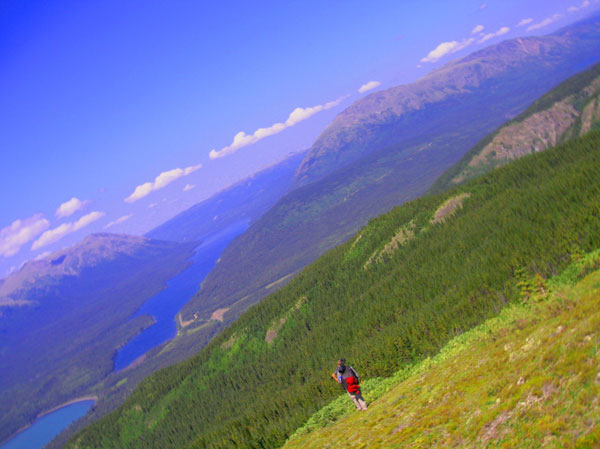
Photographer Paul Colangelo, Todagin mountain, Tatogga Lake

Photographer Paul Colangelo stands atop Todagin mountain looking north-west towards Tatogga Lake. Photo: C. Pollon.

Related

Way up above the headwaters of the Iskut River, in an alpine meadow bursting with August wildflowers, eight demon-horned rams appear suddenly.

The two parties -- two humans and eight Stone's sheep -- all freeze on the spot, eyes locked. Paul Colangelo, a wildlife photographer hoping for just this luck, drops to the ground, crawling over a ridge and out of sight.

The Stone's sheep he pursues are the charismatic mega-fauna of Todagin Mountain in the upper Stikine River watershed (see map below). Elite hunters from all over the globe come here every year, about 1,700 kilometres north of Vancouver, paying upwards of $30,000 for the opportunity to take down a single ram, a cull considered sustainable in these parts because the sheep are more abundant here than anywhere else.

They are equally numerous directly to the northeast, which also happens to be the site of Imperial Metal Corporation's ongoing summer drill program at its proposed Red Chris open pit copper/gold mine. The company has five drilling teams working all out, and word in the valley is they are finding more gold the deeper they drill; but as with everything I hear about mining ventures this summer spent exploring B.C.'s northwest, it's hard to separate fact from cash-lubricated fiction.

While Colangelo chases sheep, I climb to the summit to scan the valley below (see video, below): three cigar-shaped, impossibly-blue lakes connected by the braided, meandering Iskut seem to encompass the entire valley bottom. Skirting their edge is the single-track Stewart Cassiar Highway; out of sight to the east, not far from where I stand, are the collective headwaters of the Nass, Stikine and Skeena rivers.

I'm returning to this area after a year's absence, during which time the optimism has returned to the northwest mining and exploration community, thanks to a massive provincial and federal infrastructure subsidy that will see the electrical grid extended into this remote corner of B.C. Cheap grid power promises to make economical many of the low-grade copper deposits that have been known about for many decades, but "sterilized" due to remote geography.

The new power source will change that equation, opening the way for a potential wave of mining in these parts.

The Red Chris open-pit mine is among the most advanced projects in the region, and one that will draw nearly 40 megawatts from the power line to pulverize 30,000 tonnes of rock a day. Small by international standards, Red Chris promises to generate at least 250 full-time jobs over the next 30 years, but that's not all: more than 180 million tonnes of tailings and an estimated 300 million tonnes of waste rock will be created over its life, requiring acid-rock drainage treatment for at least 200 years.

And like the recently rejected Prosperity gold/copper mine near Williams Lake, it plans to bureaucratically "reclassify"fish bearing waters as tailings ponds, including the damming and diverting of streams. Unlike Prosperity, this project in the Upper Stikine watershed is likely a go.

"Todagin mountain is an epicentre to an area that certainly equals Yosemite or Banff in terms of its natural values and its potential as a destination for high-end travel and tourism," says author, anthropologist and National Geographic explorer-in-residence Wade Davis, who has lived seasonally on nearby Ealue lake for nearly 30 years.

"I find it just extraordinary," he says, "that someone can cobble together a company with less history than my dog and just by promising some revenue flow to the government, secure the right to transform a place for their own private gain for all time. It's even more remarkable that in the calculus that rationalizes the industrialization of the wild, there's not a single line item that takes into account the value of the land being left alone." [Hear the full interview here.]

Suddenly, a bustling mining centre

By sunset, Colangelo and I return to our headquarters at Tatogga Lake Resort and we're not alone. Located on the highway just minutes from the turn-off to Red Chris, this former hunting lodge has been transformed into a mining camp, complete with busy helicopter pad and floatplane base. A year ago, it was a quaint refuge for Swiss and German tourists visiting the backcountry; this year the scene is more reminiscent of the HBO series Deadwood -- overrun by scores of cussing, bone-weary contractor mappers, drillers, geologists, archaeologists and prospectors.

The scene is also evocative of the early 1960s, when an ambitious U.S. company called Kennecott Minerals performed a wide exploratory sweep of the Stikine country, discovering many of the copper deposits now being unlocked. At the time, the great American essayist Edward Hoagland visited this very region, describing "a frank new air of rapine" not unlike that of today:

"I... found the circle of wilderness taking a terrific pasting. The damning and flooding, the logging and road building, the hundred helicopter bases were leaching it from every angle."

Since my last visit, the change in tone of our host, a peroxide blonde, no-nonsense bear of a woman named Teena Wright, is most glaring. Last year she railed against how mining and the transmission line would impact the wilderness-dependent tourism businesses, particularly the guide-outfitters who have employed local natives and been sustained for 60 years by the sustainable resource of Stone's sheep.
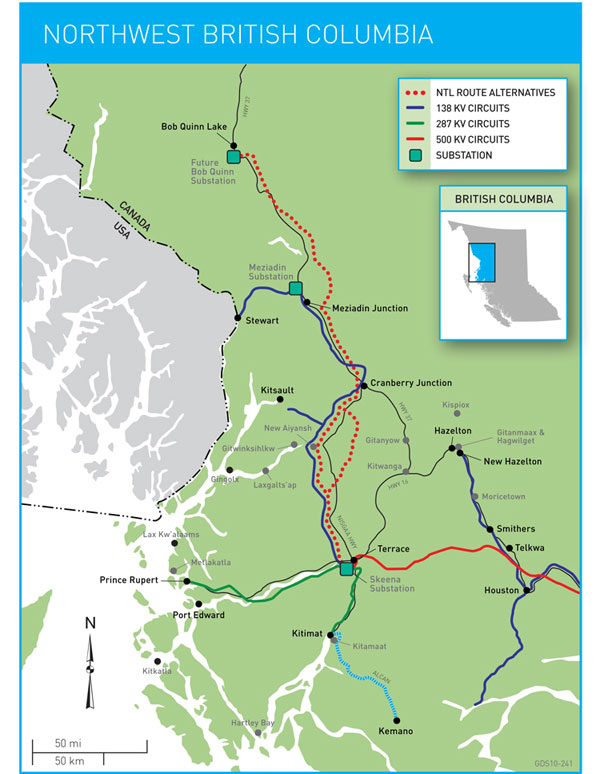
Stikine, Nass, Sacred Headwaters, Iskut, Red Chris Mine, map, northwest B.C.

Upper Stikine watershed, site of various mining proposals.

"The people who come here come for one reason," she said at the time. "There are no services, and there is virgin boreal forest. If it becomes a mini-Alcan, the [Stewart-Cassiar] highway becomes just another highway."

But in August 2010, flush with cash from the ever-expanding tent village in her RV campground, she echoes what I hear from other tourism operators on the Highway 37 this year. "The miners were the only thing that saved us this year."

Wright and her husband are doing more than just servicing the mining industry this summer, they are banking on it. Construction has begun on their new motel directly next door to the lodge, which should be completed before the power line or Red Chris are built.

Rumours swirl around the valley that Imperial Metals will continue to house its contractors, as they are now, down here on the highway, including a contingent of "hard to house" workers -- those indispensable by skill, but known as heavy substance abusers.

All of this despite assurances that Imperial's workforce will be kept up on the mountain and out of local communities. "The Project will be providing a permanent accommodation camp with sleeping, dining, recreation and support services for the permanent workforce of approximately 250-280 persons, of which approximately 125-175 will be on site at any given time," states a 2005 assessment report written while Imperial Metals made its way through a controversially streamlined environmental assessment (EA).

Despite this, an ad hoc town site is taking shape at Tatogga Lake, a 15-minute drive from the native village of Iskut, population 300. It's just like two years ago, when Imperial Metals received permission under a "notice of work" to build an exploration trail up Todagin Mountain: without an in-depth knowledge of traditional land use or authority from the village, the company punched a truck-sized logging road through instead.

Coming boom's winners and losers

At the epicentre of a future grid-powered boom, the native village of Iskut stands to profoundly benefit and lose, all at the same time. The Red Chris mine is about 18 kilometres away from town, but if this project somehow fizzles, there are plenty of much larger proposed open-pit mines nearby. There's Schaft Creek, Galore Creek and Kerr-Sulphurets-Mitchell, all in pre-application B.C. environmental assessment stage or beyond. This is not to mention Mount Klappan coal and Shell Canada's coal-bed methane play, both in the Klappan River drainage.

LISTEN TO WADE DAVIS ON SAVING THE STIKINE

The famous anthropologist speaks with Tyee contributing editor Chris Pollon on how the Red Chris Mine project is part of a potential transformation of a B.C. natural treasure, the Upper Stikine River watershed. Click here to go to audio.

A resource boom is certainly coming, whether the Tahltan Nation communities of Iskut, Dease Lake or Telegraph Creek want it or not: the question now is, what will the local people gain, and what will they lose?

Eskay Creek, an underground gold mine, came and went in the space of about 13 years, during which time the Tahltan were among the most prosperous native people in B.C., enjoying near full employment. But the native jobs tended towards truck driving, catering and chamber-maiding; by the time Barrick Gold called it quits in early 2008, Iskut had little to show for it.

"Eskay Creek left with billions, and everyone's out of a job now," said Oscar Dennis, an Iskut band member who rose to local prominence during the 2005 standoff against Shell Oil's coal-bed methane development.

If any combination of the proposed projects move forward, the Iskut band will bear a disproportionate share of the impacts on the ground; Mount Klappan, Shell's Klappan-Groundhog coal-bed methane project, and Red Chris are all located in their backyard.

The importance of this backyard to the subsistence of the locals in Iskut cannot be appreciated by most urban-centric Canadians. A 1997 study of the nearby Taku River Tlingit First Nation, which certainly applies here, found average-earning families consumed on average about 410 kg of moose, 105 kg of salmon, 24 kg of other fish, and more than 12 quarts of berries each year (these numbers are likely conservative). The study also found that traditional land use -- including the ready availability of wild foods -- in a large part made it possible and desirable for First Nations to live in such remote places, far removed from the mainstream amenities and opportunities of bigger centres.

Marie Quock, chief of the Iskut band, in Vancouver for business meetings when I call for her thoughts on Red Chris and the power line, would not comment.

Wade Davis, who says he supports mining when it is done well, recounts to me harrowing stories of his Iskut friends' tragic experiences of violence, substance abuse and hopelessness. He questions the long-term benefits of Red Chris to the locals.

"Are the people from Imperial Metals lining up to say how they will share revenue flows? Are they lining up to say they'll build a hockey rink in Iskut, are they lining up to create trust funds so the kids in that community can go to university as their own kids expect to go to university? I don't hear anything about that."

Imperial Metals president Brian Kynoch did not return calls.

For part two, click here. Learn what's on the table for the region's First Nations.  [Tyee]

29  Comments:

Login or register to post comments

  • morechatter

    1 year ago

    Yes look at all those wonderful new jobs

    Mining underground with the conditions the conditons are in not a welcome thought. It is similar where workers are blown up and burnt you alive on the rigs. Its all part of the job.
    With all the pollution that is being pumped into the ground with complaints on contamination and sickness is it really a good idea to top it off with water.
    And just think of all the extra taxes tax payers will have to pay as Mining companies profits start coming in. Are tax payers subsidizing the C02 procedure it has been what has been going on so far.

  • cboo44

    1 year ago

    THOSE EVIL BASTARDS !!

    Actually wanting to WORK and SUCCEED in what they have ventured ! They should be FORCED to demand taxpayer-funded compensation while they sit on their asses and cry.

  • Fiat lux

    1 year ago

    The only thing BC will get

    The only thing BC will get out of these parasitic ventures are short term jobs, ever dwindling benefits, incredible, permanent pollution, and reliance on fraudulent economics built on BS propaganda and ultimate self destruction.

    The purported tax benefits from these idiotic ventures won't even pay for road repairs and the damage caused by pollution from the long line of overloaded Diesel trucks we now have running day and night from the Polley Mtn mine, breaking up our roads, bringing back sewage for dumping in the open pits, poisoning the watershed for the future, blessed by the governments.

    We sell our resources to China, then buy back the products we could make right here in sustainable ways, giving productive employment to generations, so the new Chinese millionaire class can bring our own money back and buy the country from under our feet, making our braindead politicians and economists jump for joy over their "wealth creating foreign investment"

    What's the point wasting resources on the military and new fighter planes, when anybody can come in and buy and colonize the country with imaginary capital, "created" from the air ?

    What we need is more braintesting equipment for our universities, to discover the damage caused by the crap being taught in some of the departments in the name of "economics" and "sciences".

    Ed Deak, Big Lake, on the Likely road.

  • reallife

    1 year ago

    First Nations Income

    First Nations people no longer live on moose meat and berries alone. Visionary Taltan leaders such as Gerry Asp support resource development as a way for their people to reduce dependence on government handouts.

  • Fiat lux

    1 year ago

    Resource development is not

    Resource development is not the sale of resources for peanuts.

    And once the the local resource runs out, what are the workers to do?

    "Move where the jobs are?" in the brainiest Reform policy statement?

    Ed Deak.

  • Road Lice

    1 year ago

    Pictures of the area

    I am a former resident of Stewart and I have been promoting Northwest British Columbia as a destination for bicycle touring. I have posted pictures along the Stewart-Cassiar Highway (including the Tatogga Lake Resort) here:

    http://www.crazyguyonabike.com/doc/5881

    Here is the scenic highway into Stewart:

    http://www.crazyguyonabike.com/doc/page/?page_id=166701

    The area has great value as a tourist destination.

  • cboo44

    1 year ago

    Resource Jobs

    Pay a lot better than "tourism jobs", Ed. They support taxpayer funded services and privately operated services for everyone's benefit. As I tried to explain to Joe Alphonse, does he really want to have to drive to Kamloops for services that are now in Williams Lake, but won't be if our economy is not supportive of the people here? The older we get, the more we depend on local services. No good paying jobs, no population supporting those services. That goes for doctor's offices and the Big Lake Store and Fire Department.

  • frances

    1 year ago

    Worked all thru that area in

    Worked all thru that area in the 70s & can vouch that it is world class, spectacular and unique. What a shame to trash it.

  • Birch

    1 year ago

    For some reason

    too many people involved in industry and development cannot abide the notion that some significant places should be left alone. For want of a better phrase (and not to trash engineers), the "engineering mentality" can see value only in the products of technical transformation; the natural world holds no value but the possibility for "value-added."

    It's obvious that in the contemporary world we need metals, we need jobs, we need medical care, and so on. What is too often less obvious is that we also need wilderness, the untouched complexity that natural evolution generates, not to mention the natural services (water cleansing, pollination, genetic diversity, and so on) that it provides.

    It is a general truth that we see what we look for ("Seek and ye shall find."). If all we see in wilderness is another opportunity to cash out, usually through some hugely destructive intervention, it is because we have not yet learned to see the natural world's own perfections. We need to learn to see.

  • Sask Resident

    1 year ago

    Ed Deak

    Did you never move to find work? You must have been one of a very few, usually farmers. I've moved at least 6 times in my working life but my brother remains on the family farm.

    As for savings, that is the role of the people being paid a wage. Most resource workers that want to have their children go on to higher learning save most of their working lives and encourage their children to get jobs and save their money. Few can afford to pay their children's way. Same for first nations. The resource companies will give priority for jobs and training to locals so if they want to learn and work, the companies will hire them. Companies in the NWT and Nunavut are flying in workers from southern BC and Quebec since the local workers cannot be depended on and have inadequate education.

  • Sask Resident

    1 year ago

    Birch

    Leave the unspoiled wilderness for the few that can take advantage of it, either by being local, being rich or being an explorer. I call it just another type of NIMBY. The Inuit in Resolute Bay like to see rich American hunters arrive to hunt polar bears but the American government has banned the importation of polar bear hides to protect the bears, which is right? Just like the local lodge owner, economics change depending on what happens in the world.

  • Fiat lux

    1 year ago

    Cboo the tourism jobs, are

    Cboo the tourism jobs, are also dead end, as they,as they rely on the oil economy, coming to a crash one day.

    I started my first manufacturing business in Vancouver in 1957 and was employing skilled tradesmen at good wages for many years.

    When I had my shop on the lane at 7th and Cambie, there were all kinds of manufacturing shops within walking distance. B usinesses were opening up by the thousands all over the country. But we had tariffs on imports and nobody went hungry.

    Apart from a few in the Hastings area, there were no homeless. The first foodbank opened in "wealthy" Edmonton in 1981, when the present economic theory, now ruining the world, was forced on us by the multinational corporate mafia.

    Topped by the FTA, the NAFTA, and the WTO.

    Canada, the richest country on Earth now has almost a million people lining up at foodbanks, many employed in minimum wage, part time jobs, for the sake of "competitive efficiency" dictated by brainwashed economists and bought politicians.

    We had all kinds of products "Made in Canada", all wiped out by the fraudulent "free trade" treaties. Now our stores are full of crap made in Asian slave labour shops. Because, in the warped minds of our governments they're "cheaper", even with millions of people in our countries paying for them with homelessness and poverty.

    The sale of resources is not and income, but a conversion in any business accounting system. Not in economics, which have no debits. Everything is GDP and "income". No business could survive five minutes on this kind of accounting system, but politicians are pushing it.

    As far the benefits of the export of resources are concerned, the Polley Mtn mine opened up under the NDP and closed for years under the BCLibs. because of lousy prices, , wrecking our small community, when people were laid off and were forced to sell out.

    There's a very good chance, many real economists are warning about, that a worldwide depression could come any time, and we saw the forerunner of it in '08.

    The only efficient and logical economic system is built on the greatest degree of self sufficiency. My wife and I have learned our lesson many years ago and have been working toward it, now reaping the benefits.

    The same applies for all families, communities and countries. Globalization is a criminal fraud to collectivize the world's economy into the hands of a criminal element, similar to the Soviet system, now called "globally competitive free enterprise", raising costs, wrecking and killing tens of millions every year with starvation and easily preventable illnesses.

    The trucks from the so called Prosperity mine will have to drive some 800 km each way to the ports, blowing out fumes and wrecking the roads. And this is "efficiency" ?

    Ed Deak.

  • frank2

    1 year ago

    Wouldn't it be great if any

    Wouldn't it be great if any "development" proposal had to put in place a system under which the gainers would fully compensate the losers? Instead, governments WE elect give the go-ahead to promoters who make super vague promises and assertions about benefits to everyone -- with NO mechanism to ensure the losers are compensated. How can we continue to be so stupid?

  • Fiat lux

    1 year ago

    Sask....I've lived in 4

    Sask....I've lived in 4 countries and have 3 citizenships, my wife in 5 with 4.

    But not because of looking for jobs, but because of the criminal politicians who sold the ground from under our feet to crazy ideologies, like communism.

    I've lived in England for 7 years under the same address.

    Went to Vancouver in 1955, lived there until '79, had 2 jobs, laid off once, and quit the second time to start my own manufacturing business in '57. Now living at the same address for 32 years, having built the highest degree of self sufficiency, where we grow much of our food and build most of the things we need .

    The most efficient, sustainable economic system is based on the local production of the greatest variety of goods for survival and good life.

    Basically as we had it in the 50s and 60s, here in Canada. Imports and exports are necessary, but only to the smallest degree, as is commuting to jobs long distances, to jobs that could easily be done locally, especially with computers.

    What people should remember is that goods imported from Asia, are not "cheaper" in real terms, because our unemployed, commuting, long distance transport, poverty, loss of homes and families, the daily growing illness, like cancers, statistics are the best proof that this criminal system based on imaginary monetary figures is destroying the Earth and humanity. These are the real costs, but go unaccounted as liabilities, or real payments, in this fraudulent system.

    When I was young, no kids had cancers, or died of anything, and no women had breast cancers. Now 30 to 40% have it. These are all the unaccounted consequences of our stupid economic system.

    Our business partner is a master mechanic, and we have a large repair shop on our land. I'm driving a 31 year old Chev. 3/4 ton truck.

    My friend tells me that in 10 years there won't be any used vehicles to buy, because their computer systems will be dead and unrepairable.

    Our garbage dumps are full of imported, unrepairable junk that should have lasted several times their present age, now vehicles will follow them.

    And this is called "economic efficiency", because the buying of new junk to fill our dumps jacks up the economists' worthless GDP figures ?

    Ed Deak.

  • RickW

    1 year ago

    cboo44

    READ what Ed has to say, for cryin' out loud! Experience and history has shown that resource development is a short-term money grab. It puts money in the pockets of just about everyone except the areas being pillaged. All the local area gets are the salaries, but none of the profits. That's why the hinterland has been in a decline throughout all of Campbell's "Golden Decade".

    It isn't by coincidence that three of the BC Liberal leadership candidates are promising more attention for the north and interior. But what kind of attention are they talking about? Falcon has "promised" the O&G exploration companies carte blanche, and that the farmers and residents won't get in their way at all, no matter what happens.

  • Yanna Tan

    1 year ago

    Northern BC's Copper Rush

    I am always amazed at journalists who paint the landscape in such beauty-spirit speak as though those of us who were born and raised in these lands do not know the value of the land for ourselves.

    As a Tahltan I know there are places within our land we should keep from development. Unfortunately much of that decision making was taken from us when southerners created Spatsizi Provincial Park, Mount Edziza Provincial Park, Stikine River Provincial Park, Todagin South Slope Provincial Park.

    These lands were taken by environmental groups and turned into parks by Friends of the Stikine, BC Sierra Club and others without consultation with the land owners, the Tahltan people. I know this for fact because as a worker for the Tahltan Band between 1994 and 1996 I was shocked when new park boundaries were tacked up along the Stikine Canyon without our involvement or consultation and accomodation. This was done behind our backs and without respect to us.

    It truly amazes me when journalists like Christopher Pollon attack local businesses for adapting to their economic needs. Who said Tatogga Lake Resort was only for tourists? For as long as I can remember exploration companies have been using this site as a staging ground. Once more as a child I used to watch geologists board helicopters and fly off over the lake northward. That was 40 years ago.

    Mr. Pollon has a profession that can go anywhere in the world to practice because there will always be another media created "Serengetti" that needs saving. As for my people there is a reason why this is our land and that's because we are not a transient population. So we are taking advantage of the copper rush and making sure we have long lasting benefits from it. We have learned how to get better agreements from proponents. We have very sophisticated members with education in many disciplines.

    If environmental groups and their well placed journalists were truly concerned about our land AND our people, then they should join the line to build infrastructure in our communities. They would create trust funds for our children's education. After all they have raised countless millions on the backs of our name and our land for their campaigns and to pay their army of employees. They did so by depriving us and others from a real opportunity to use our land that creates wealth and opportunity for our people.

    Until they pay up for what they took away, they should all just shut up and go away! Including Christopher Pollon.

  • PeteL

    1 year ago

    Here come the 70's

    Frances worked all through the area in the 70's eh. But since he's done with working up there he think it should be just left to the critters and under-employed now?

    I have a friend that runs a lodge up there now, not in the 70's. Lives in the area all year round. He does more than just run his lodge though, because that doesn't pay all the bills.

    Last month he was telling me the folks in the Stewart area are so hungry for real steady work that if some one came calling to re-open the Cassiar asbestos mine you would have to hold back some of the locals from lining up to work there. Such is life when one is struggling to eak out a living in such a remote spot in in BC.

    He is very excited that there are potential mining plays coming up.

    I know another guy who's Dad was the guy who staked out Eskay Creek. His Dad worked hard his whole life and died fairly young leaving my friend a ton of penny shares in the still speculative Eskay Creek mine. Finally the mine was developed. Buddy sold his now valuable shares for a small fortune. When he sold those shares he opened up a resort in the South Okanagan. Yes, tourism derived out of a mining investment.

    I don't want to think about the carbon footprint for all of us who drive hundreds of kilometers to enjoy that lake, water sking and wine.

    Folks like my friend live up in the Stewart region because they love the land. They struggle to stay there and they are hopeful that they might finally make some money. Enough money to realize the dreams we all have. And enough time on their hands to sit in front of a computor and complain about a development that is a 26 hour drive from Vancouver where we do most of the complaining. Its a pretty damn big province we live in isn't it? Its going to cost a bomb to put a fence around the whole thing.

    Anybody besides Frances been up that way lately?

  • Fiat lux

    1 year ago

    Yanna....Work toward local

    Yanna....Work toward local self sufficiency, where you make most of the things you need within and for local use.

    This has been the way of life for humanity for a million years and the easiest to do now with the tools, equipment and resources available for local production.

    When I was teaching woodworking in nightschool in Williams Lake about 30 years ago, before Bill Bennett stopped all non credit programs, good many of my students were FN and I've done my best to inspire them to make things for themselves, in their communities.

    No idea whether I succeeded to any degree, but clothes, furniture, etc. many other things can and should be made locally for local use.

    When the ore runs out in these screwballer open pit schemes, what will remain of the communities who became hooked to the money from the jobs, so they can buy junk made in China ?

    Even the few years Mount Polley was off has caused great damage around here, ruining people's lives.

    Ed Deak.

  • kootenay

    1 year ago

    I grew up in Kimberley BC

    I grew up in Kimberley BC where the Sullivan mine ran for 100 years, the surrounding area was beautiful and we enjoyed an awesome life.

    When the mine shutdown I moved to Trail to work at the smelter, another operation that has been in existence for more than 100 years. The surrounding area is beautiful, its an awesome place to live.

    Mining and smelting can exist in all areas of province if the proper precautions are taken. The problem is our governments, provincially and federally, aren't interested in restricting corporate profitability and aren't insisting that new developments respect the environment they are working in.

    Say what you want about mining and smelting, you can't live without it, but it can certainly be managed better.

  • snert

    1 year ago

    Road Lice

    Quote:
    The area has great value as a tourist destination.

    Just FWIW tourism is not a green industry in any form.

    Also I've spent time working at Cassiar and travelled a bit within this huge area. If one can't find a place to get an unsullied view then one has a problem.

    Tourist considerations are a non issue as far as I'm concerned. There's enough room for everyone.

  • RickW

    1 year ago

    snert

    Quote:
    There's enough room for everyone

    So which tailing pond would you like....?

  • RickW

    1 year ago

    Ed

    Making a chair just isn't as sexy as collecting enough cash to fly off to Vegas or Disneyland..............

  • snert

    1 year ago

    RickW

    It doesn't matter as long as it's built properly and there's a valid restoration plan in place.

  • Jerry Munro

    1 year ago

    Again, Choice or No Choice...

    "Yanna....Work toward local self sufficiency, where you make most of the things you need within and for local use.

    This has been the way of life for humanity for a million years and the easiest to do now with the tools, equipment and resources available for local production." Ed Deak

    Hear, hear. Cheap oil energy, especially from the 3rd world, for which there is no Green energy model yet to replace it, more than anything else drove the immediate pre and postwar decades of capitalist mega-development...in resource exploitation, labour productivity, urbanization and the immigrant population explosion, especially in the US. Unless there is something that appears over the horizon, safe and clean to replace it, cold fusion not a reality, yet at least, this period of corporate capitalist mega-development may be about to implode in on itself. Mega highly mechanized, fossil fuel intensive agriculture no less than energy intensive mining mega-development are all vulnerable, no less than the plastics industry etc..

    Demand from China right now is especially driving commodities. It still much needs to sell much of its production to the rest of the world however, and capitalism everywhere else, but especially the US and Europe,for a host of reasons having to do with their own de-industrialization vulnerabilities and ruling class corruption, is in a deep state of crises and decline. Which is destined, has already, begun to effect the Chinese economy.

    We shall soon enough see, of course. But it is highly likely yet that the co-operative over the competitive, and the self-reliance over global corporate capitalism dependence model will yet be the only realistic option. Hands down, with little to know choice, if the species is to go on from here.

  • RickW

    1 year ago

    snert

    Quote:
    It doesn't matter as long as it's built properly and there's a valid restoration plan in place

    You mean, like Britannia Mines, where about all of the "benefit" garnered by the government went into getting rid of the pollution? How can a "valid restoration plan" be enforced (at no cost to the taxpayer)when companies have the option of going bankrupt to get out of that cost?

    It's easy enough to say "valid restoration plan", but let's see the nuts 'n' bolts of the plan. For instance, how about a 25% holdback on profits, to be held in some sort of escrow account, and paid out over 50 years after the mine (or whatever) ceases operation, providing there is no contamination?

  • Marysue52

    1 year ago

    living on government handouts?

    Lordie, Lordie, Realife! First Nations lived without government handouts for thousands of years. They lived in harmony with nature, and mostly in harmony with each other, for they had the grace not to overpopulate themselves beyond the land's ability to provide. Asians, Middle Easterners, Africans and Europeans and their descendents should have done the same. But oh no! Our idiot ancestors overpopulated their own lands and then took a boat to here and promptly overpopulated this part of the world, too. We are such dummies. We need to go back to the First Nation ways. They were right and we are wrong. Community living and sharing, economic and social equality, where you are always your village, no matter where you go.

  • North of Hope

    1 year ago

    @ Marysue52

    You say, "Our idiot ancestors overpopulated their own lands and then took a boat to here and promptly overpopulated this part of the world, too."
    Actually in my case, the idiot ancestors were kicked off the land and sent to Canada (the Clearances.) We were given or took from First Nations the land they lived on. I agree with the rest of your comments, but some of our ancestors did not have a choice about coming to North America.

  • snert

    1 year ago

    RickW

    Quote:
    It's easy enough to say "valid restoration plan", but let's see the nuts 'n' bolts of the plan. For instance, how about a 25% holdback on profits, to be held in some sort of escrow account, and paid out over 50 years after the mine (or whatever) ceases operation, providing there is no contamination?

    Well, you took the first step. Congratulations are in order. If more people like yourself took that step instead of just saying no then things might actually get done.

    Now, wasn't it easy?

  • reallife

    1 year ago

    @MarySue52

    Aboriginal people may have lived for thousands of years without government handouts but they have no desire to live entirely off the land any more. Even a simple convenience such as a gas stove to replace an open fire requires money. This can only happen without government handouts if, as I previously noted, leaders are willing to embrace industry.

    • The discussion for this story is closed. No more comments can be added.