
With Olympics Came New Laws to Sweep up Homeless
Four recent host cities criminalized and removed street dwellers leading up to Games.
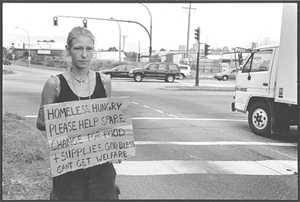
Boundary Road exit, Vancouver. Photo by Elaine Briere
The controversial Assisting to Shelter Act has not been approved yet, but critics say the proposed provincial law has a familiar, and troubling, ring to it.
Vancouver could be joining a long list of Olympic host cities that passed legislation close to the Games allowing governments to clear the streets of the poor, homeless and addicted just in time for the tourists and cameras to arrive. The act would give Vancouver police the power to force a person to seek shelter when an extreme weather alert is issued. If there is no room at city shelters, people will be put in a jail cell.
The B.C. government maintains the act is not intended for Olympic purposes, but to prevent deaths like that of a homeless woman named Tracey who died last December when a candle she lit to stay warm caught her on fire.
But anti-poverty and anti-Olympic activists are not convinced. They point to examples of legislation and ordinances passed in previous host cities, and one future mega-event, used to criminalize homelessness. Here are some:
1988 Winter Games, Seoul, South Korea
After the Urban Redevelopment Law (Public Law #3646) was passed under the guise of city beautification, 48,000 buildings housing 720,000 people were destroyed between 1982 and 1988 for the purpose of building highrise apartments and commercial buildings. Ninety per cent of the dislocated people could not afford the new housing, and many were forced to live in shantytowns erected in church parking lots and other open spaces, which were often subjected to eviction by police. Closer to the Games, homeless people and street peddlers were also rounded up and removed from the city for "beautification."
1996 Summer Games, Atlanta, GA, USA
City officials in Atlanta used a combination of new and old legislation to criminalize homelessness in the city. From 1995 to 1996, over 9,000 homeless people, predominantly African-American men, were arrested for crimes such as sleeping in a park or on the street (Chapter 110, Article I, Sec 106-12, passed in 1996), entering a vacant building without permission (city ordinance Chapter 106, Article II, Sec. 106, passed in 1977), entering a parking lot without owning a car parked there (Chapter 106, Article II, Sec. 106-57, passed in 1996), and urinating or defecating in public (Chapter 106 Article IV, Sec. 106-130, passed in 1977).
The city claimed these laws were passed to make the city a safer place to be during the Games. Those arrested during the Games were held for trial until after the event was over.
Homeless Week Events
The Tyee will be spotlighting various Homeless Week events all week. Here are some to keep in mind:
All Week
Maple Ridge -- Pitt Meadows -- School District #42 Food Drive
Non-perishable food donations will be collected in our local schools during the week of Oct. 12 to 16. All donations collected will be used to support the local Friends in Need Food Bank.
Tri-Cities -- Library displays about people who are homeless and their stories
Oct. 13 to 17 at the Port Moody and Terry Fox Library branches.
Nelson -- Buskers Raising Money for Food
Watch out for buskers playing to raise money for Nelson's Food Cupboard and Our Daily Bread, two great organizations that provide food for homeless and low-income people. Our goal is to raise at least $500 during the week, so please give generously.
Wednesday, October 14th
Nelson -- Film and Community Forum
Where: TNT Theatre at the corner of Ward and Carbonate St.
When: 7 p.m.
Free screening of Love and Fearlessness by Andrew Ainsley, about the fight of Victoria's homeless community to sleep outside without being arrested. Followed by a community forum featuring Mayor John Dooley, Randy Thiessen, mental health and addictions team leader at Interior Health, and Klee Hunter, manager of Stepping Stones emergency shelter and Ward St. Place, and others.
Nelson -- Street Theatre Action
Where: Hall Street south of Baker Street
When: 4 p.m. - 6:30 p.m.
Watch out for local high school students performing street theatre with refrigerator boxes! Decorated with statistics about homelessness and poverty, doing slam poetry, singing, and acting out their feelings and thoughts about homelessness in our region. For more information contact Jamie MacBeth 250-505-5506.
Whitehorse -- Finding Home: How Do We Get There?
Where: Westmark Hote
When: 7 p.m.
Public presentation by Dr. Bernie Pauly, assistant professor in the school of nursing at the University of Victoria. A former member of the City of Victoria Mayor's Task Force on Breaking the Cycle of Homelessness, Addiction and Mental Illness, she on the Victoria Cool Aid Society board and is on the board of the Greater Victoria Coalition to End Homelessness. Her research focuses on the promotion of health equity with a particular focus on homelessness and substance use.
Vancouver -- Public Concert and CD launch
Where: St. Andrew's-Wesley United Church, (Burrard and Nelson)
When: 8 p.m. (doors open 7:30 p.m.)
This concert and CD launch are part of the efforts of First United Church and End Homelessness NOW to promote awareness and seek positive solutions to ending homelessness in Vancouver. Featuring performances by the Vancouver Chamber Choir, Linda Lee Thomas, Diane Liens, Jodi Proznick, Bill Coon, Jesse Cahill and many more local jazz and classical artists. Admission by donation.
Mayor Gregor Robertson will be on hand to present the City of Vancouver/End Homelessness Now "Local Hero Awards" to organizations in BC who are working to end homelessness.
Thursday, October, 15th
North Vancouver -- Film and Panel Discussion: "Something to Eat, Someplace to Sleep, and Someone who gives a Damn"
Where: John Braithwaite Community Centre, 145 W. 1st Street.
When: 5 p.m. to 8 p.m.
Surrey Central Skytrain station
Pacific Community Resources, Surrey Youth Resource Centres (SRYC) is holding a Youth Homelessness Awareness event at the Surrey Central Skytrain. The event is in conjunction with Translink and the IRAYL Program and will have visuals and information.
The Metro Atlanta Task Force on Homelessness later uncovered pre-printed arrest citations that had "male, African American, homeless" typed on them, with the name and crime left blank. They later used these and the arrest warrants of the 9,000 homeless in a Federal Court suit they brought against the city. The court granted a temporary restraining order and a preliminary injunction against the city, ordering them to “cease and desist” arresting and harassing homeless people without probable cause.
Those not arrested were encouraged to get out of town. Traveler's Aid, a non-profit organization dedicated to helping travelers and relocating people, distributed one-way bus tickets to poor and homeless people to get them out of the city, and even out of the state. The Fulton County government provided $750,000 to fund this venture.
Woodruff Park in downtown Atlanta was privatized under a contract with Georgia State University, and underwent renovations to discourage the homeless from frequenting the park, including the installation of benches with steel armrests, which made it difficult to sleep on them. University security patrolled the park, and ticketed charity vans distributing food to the homeless.
2000 Summer Games, Sydney, Australia
The Homebush Bay Operations Act and Regulation passed in 1999 to cover Homebush Bay, the site of the Olympic Village and Park. Police and other officials were given the power to remove people from the area for vague reasons such as causing “annoyance or inconvenience” or using indecent language.
The Sydney Harbour Foreshore Authority Act passed in 1999 protected Sydney Harbour, an Olympic site and a hot spot for tourist activity. Police and other officials could remove people for skateboarding, rollerblading, panhandling or attempting to sleep in the area overnight. Both laws required warnings to be issued prior to arrest.
According to Centre on Housing Rights and Evictions' publication The Impact of the Sydney Olympic Games on Housing Rights, these laws did not have a significant impact on the homeless population. Then police commander Donald Graham expressed his view that homelessness wasn't a crime and that the homeless had every right to be on the streets.
But some laws had a lasting effect on the homeless population even after the Games wrapped up, according to Helen Lenskyj, author of Olympic Industry Resistance: Challenging Olympic Power and Propaganda.
"Sydney Harbour Bridge area has been successfully privatized, and there used to be about 70 homeless people living and sleeping in a park fairly close to the harbour near the Opera House," she says.
"Sydney Harbour Foreshore's legislation is the pertinent one that's empowering private security and police to get rid of what they see as undesirable people in their tourist area, particularly for New Year because that's when the big fire works display is happening on the Harbour Bridge."
2004 Summer Games, Athens, Greece
Law 2730/1999 concerning the planning, development and construction of Olympic works gave the government the power to expropriate land for Olympic use. Anyone living on this land was supposed to be given 24-hour notice to vacate, or face eviction. Houses or businesses on expropriated land were given up to 10 days to vacate the area.
But the law was disproportionately used to break up Roma shantytowns, regardless of whether or not the land was actually needed for Olympic use. For example, in July 2000 the town of Aspropyrgos bulldozed several Roma shacks, while the nearby town of Ano Liosia evicted Roma families from their tent settlement, offering them $100,000 drachmas (US $266) as compensation. Their tents were then destroyed.
In both cases, municipalities claimed the land was needed for Olympic use, despite the fact the International Olympic Committee had made it clear in 1999 that no Olympic facilities were to be built there. The displaced Roma people were relocated to land outside the municipalities.
In all, hundreds of Roma were relocated under the pretense of the needing land for the Olympic Games.
There were rumours that Greek court prosecutors were issuing decrees to commit homeless people, drug addicts, alcoholics and people with mental illnesses to asylums for the Games. While no legislation was passed concerning this practice, in June 2004 staff from the Dromokaition psychiatric hospital went on strike to protest the number of alcoholics, drug addicts and homeless people forced into their care.
2010 FIFA World Cup, various cities, South Africa
The city of Durban, one of many in South Africa hosting World Cup games next year, is home to 14 shantytowns encompassing 5,000 to 7,000 people each. The African National Congress government is offering shantytown residents housing if they move 50 kilometres outside of the city, but the Durban Shack Dwellers Movement, which represents all 14 communities, claims when people arrive there is no housing and they end up living in transitional camps while awaiting housing.
Government legislation encouraging the destruction of shantytowns includes the Slums Act, passed in 2006, which states if you resist eviction you will be fined 20,000 rand (US $2,704.53) or sentenced to five years in jail. Thousands of people have reportedly left the shantytowns already.
On Sept. 26, 2009, a group of 40 men allegedly attacked one of the shantytowns, killing two people. Eyewitnesses claim the men were affiliated with the African National Congress government.
Timing an accident?
The City of Vancouver passed a series of Olympic bylaws this summer, the most controversial being the sign bylaw, requiring all signage criticizing the Games to be removed. But the city maintains no new legislation will be passed before the Games, and when it comes to police interaction with the city’s significant low-income and homeless population, it will be business as usual.
"It's my understanding that the Vancouver Police Department will be operating the way they are now," says Marnie McGregor, project manager with the city's communications department. "There's no other bylaws."
But critics like author Helen Lenskyj say that if history is any guide, the timing of the proposed Assisting to Shelter Act in B.C. is no accident. "The Olympics is the only thing it's related to," says Lenskyj. "I'm sure there's been deaths [of homeless people in Vancouver] every year and nothing has been done, and if it was that urgent, why not do it last year?" ![]()


Gary
14-10-2009
No Surprise
Back when this government announced they were purchasing hotels "for homeless shelters" I commented that these rooms would be used to "shelter tourists" not the homeless and that they would find a way to hide the homeless.
"The B.C. government maintains the act is not intended for Olympic purposes, but to prevent deaths like that of a homeless woman named Tracey who died last December when a candle she lit to stay warm caught her on fire."
Another lie perpetrated by the Campbell Cabal.
leftofcentre
14-10-2009
...and some people have no gratitude...
God forbid people with money should do anything audacious like Gratitude Week to help actually house the homeless.
In the end, it will be the people like who build society who solve the homeless crisis...not the whiners who try to tear it down.
Jeffrey J.
14-10-2009
Astroturf defined
It's always good to see people interested in what counts as genuine activism. Unfortunately, 'astroturfing' has grown by leaps and bounds, blurring the line between people who want to change social policies (like taxation rates, spending on social programs etc) and people who have other agendas. It's not always easy to see the differences, but it is very, very important.
A good definition of 'astroturfing' is this:
"A basic explanation would be, if a grassroots movement is the collective efforts, on a local level, of dedicated people donating their time and efforts to further the cause of a political party or to help a candidate get elected, because they deem it to be good for the many, then Astroturfing (Astroturf being an artificial grass) is an artificial grassroots movement, one that is made to appear as though it is a real grassroots movement, but it is usually done to satisfy the desires of people or parties with interests, such as lobbyists or PACs, or other such group(s), and most often not at a local level.
The goal of such a campaign is to disguise the efforts of a political or commercial entity as an independent public reaction to some political entity—a politician, political group, product, service or event. Astroturfers attempt to orchestrate the actions of apparently diverse and geographically distributed individuals, by both overt ("outreach", "awareness", etc.) and covert (disinformation) means. Astroturfing may be undertaken by an individual pushing a personal agenda or highly organized professional groups with financial backing from large corporations, unions, non-profits, or activist organizations. Very often the efforts are conducted by political consultants who also specialize in opposition research."
A recent book on this important topic is Thinker, Faker, Spinner, Spy, "a collection of essays on the contemporary role of the public relations industry that follows the legacy of the Creel Commission. The co-editors of the book, William Dinan and David Miller also wrote the first essay, which lays the foundation of how the PR industry is an assault on democracy. They identify 6 main charges against the PR industry:
1) It is overwhelmingly carried out for vested powerful interests, mainly corporations.
2) It is not open and transparent about its means or even about its clients and the interests it is working for.
3) It characteristically involves deception and manipulation.
4) It does not engage in democratic debate, but rather seeks to subvert it in the interests of its clients.
5) Corporate social responsibility (CSR) and other 'ethical' activities are all subordinated to corporate strategy.
6) PR has played a crucial role at the cutting edge of corporate power in the neoliberal revolution."
http://www.spinwatch.org/reviews-mainmenu-24/book-reviews-mainmenu-23/4559-thinker-faker-spinner-spy-corporate-pr-and-the-assault-on-democracy
Great article.
SicPreFix
14-10-2009
Jeffrey J.
Man, you are my hero. Yet another excellent, intelligent, researched and referenced post. Thanks.
Bob Watts
14-10-2009
Test has already started.
The experiment of forcing the homeless into shelters started about 4 years ago in a remote BC town. Welfare directed by the Liberals was forcing Disabled welfare clients into homeless shelters while traveling on medical appointments to Campbell River, A very distraught Disabled couple when to the Campbell River Mirror newspaper and fought off the government. As I remember this couple had a young child. Welfare stopped this practice immediately. Interesting that 3 beds in a shelter at $91.32 per night equals $273.96 per night. For that kind of money in Campbell River you could get the best room in town plus a steak and lobster dinner. WOW! To keep a family of 3 in a shelter for one year is $99,995. From what I’ve heard this couple went back to staying at low cost motels and saves the taxpayer (that’s me) about $200 per night.
Thank you for fighting off our idiot leaders.
What the hell is the cost going to be for removing a homeless person for about 3 weeks?
Lets rent out a couple of Mexican resorts, fly the poor there and save a few truck loads of cash. I’ll volunteer as a chaperone, LOL.
mary jane
14-10-2009
idiots at work
gordo and gang are as careless with the lives of the seniors, poor and disabled as they are with the homeless. The fiberals have cost many people their lives over the years leading up to this horror show called the olympics. Why not take care of those who need it and to hell with the little boy games Shut them down NOW. OR give evryone who is homeless basic welfare for the winter it won't any more but will give those who are homeless a place to cook keep clean and employment ready How horible it would be if gordo and gang found clean and fed people might find work. I am waiting for the province to shut down or go on strike over this and the hst
happy
15-10-2009
location, location, location...
Yes, the Boudary road exit, a favourite spot for the jobless to pass the day with their heart wrenching signs. Constant heavy traffic held hostage by stoplights and free transportation(Skytrain)close by to wisk you back to the DTES party at the end of your "shift" At least you don't have to shoo them away anymore when they mess up your windshield with their squeegeees, thank you BC government.
Obviously I'm not biting on this one. The sign says it all. Can't get Welfare? I'm no authority and please correct me if I'm wrong, but as far as I know the only reasons for that are 1)you aren't destitute(enough)or 2)there is a waiting period for out of Province newby's. And if its point 2, then I refuse to made to feel "guilty" of not providing free food and shelter to someone who can get the same from wherever they came from east of the Rockies.
And Frank...I normally don't disagree with you on much because you can see things for what they are, but your statements about homelessness being a recent development caused entirely by the Gordo gang are utter bunk. You're from Saskatchewan, right? My parents both grew up in the East End and way back then the DTES was called Skid Road. My dad worked his entire life in a factory just off Powell and I put in a year there after high school. Believe me, and I'm sure GWest will back me up on this, there were homeless then. Lots. The only things thats changed is it was booze and heroin back then, now its booze and crack, meth, and all the other good stuff.
Sure, theres more homeless today - in gross numbers. Theres more of everything. I'd like to see an article that breaks down the homeless problem. Eg, whats the percentage of homeless now as to say, lets use 1995 as a baseline, and what percentage migrated to the DTES from elsewhere.
I'm willing to bet the answer to me second question would be close tp 100%
G West
15-10-2009
happy
It's an old picture....Tyee used it before and at the time someone pointed out that the subject was 'not even homeless' at the time – big deal…lots of times a picture ISN’T worth ten thousand words…..
I kid you not!
As for the situation - it's a lot worse now, as the BC Auditor General's Report and several yearly 'homeless counts' (don't you love euphemism?) have shown...
I don't really think it makes much difference where people happen to have come from, do you?
And if you, or anyone does, I have a perfect riposte for ...we're all living on someone else's land....have been since the get go, unless you happen to be status Indian....
Dodging the necessity for action and avoiding the reality of the craven way the current government steps up to its obligations is just lame.
As for addictions and their consequences, if you think the DTES is the only place they’re a ‘real’ problem I have news for you.
As this article points out, BC isn’t the first Olympic venue to use the games for somewhat ‘less than noble’ purposes…
G West
15-10-2009
But you are correct
Homelessness is NOT an new issue - it IS an increasingly more prevalent one...and that, given the general economics of the time, is inexcusable.
How long ago was it that the Federal Government promised to eliminate it?
Frank
15-10-2009
happy
"but your statements about homelessness being a recent development caused entirely by the Gordo gang are utter bunk."
"Sure, theres more homeless today - in gross numbers. "
That's the point. The numbers of homeless have climbed and as others have said, it is no longer confined to the downtown east side.
"The only things thats changed is it was booze and heroin back then, now its booze and crack, meth, and all the other good stuff."
That's not all that has changed. The homeless themselves are no longer the exact same demographic as it was back in the 50's.
The thing is, so why are there so many more homeless now? Could it be less housing being built by governments?
Other jurisdictions seem to think that that is the issue. I would assume they know as much about the problem as Minister Coleman, perhaps even moreso.
"You're from Saskatchewan, right?"
Yes. But my family is from BC. I was born here, as was my mother and my grandfather. I moved back here after Grant Devine and the Conservatives wrecked Saskatchewan.
"I'm willing to bet the answer to me second question would be close tp 100%"
And I'm willing to bet it isn't.
happy
15-10-2009
West
No big deal that the picture is completely misleading?
Wow, if the Sun did something like that it would be considered neo propaganda and another example of MSM bias. But we've covered that... move on happy.
And yes, I do think it makes a difference where you come from. If you are down and out in Manitoba or New Brunswick, I can't understand picking up and making the trek to BC. It makes no sense. BC is "high rent" so to speak, right? You'd think it would be the last place in Canada for the less fortunate to head to in the search for a better life. Why don't they go to Saskatchewan? Better job prospects than here and far cheaper accomodation.
I think we know the answer.
True, what about the Feds. We know that Natives are very over represented when
the "counts" are carried out. What a can of worms, where does Ottawa's responsibilities end and Victoria's take over?
And no, I didn't say the DTES is the only place where addictions are prevalent. I will say its a big black hole where the illegal "addicition industry" is the main game in town. Just about everyone in Canada
has heard of that. The poorest Postal Code in the country as the MSM regularly reports.
So why would you willingly relocate there. From anywhere, be it Timmins or Terrace.
Frank
15-10-2009
happy
"Why don't they go to Saskatchewan? "
Actually, there's a lot of poverty in Saskatchewan and Manitoba too. They don't all move to Vancouver.
"and far cheaper accomodation."
Rents in Saskatoon (for example) are really quite high considering the wages. Its considered to be a "crisis" there. I read the Star-Phoenix and Leader-Post whenever I'm up to stomaching their right-wing drivel.
Frank
15-10-2009
Welfare
And, you can be refused welfare for other reasons than not being considered destitute enough.
Perhaps the ministry figured they didn't meet "employment obligations"?
Perhaps they didn't know their S.I. Number? Or didn't have enough ID?
Perhaps they've been on a reserve?
Maybe they've been attending a school?
Some have been refused simply because they weren't 19. Gee, I wonder what an 18 year old that's been refused welfare will end up doing on the streets?
Maybe they haven't made $7,000 a year for two years? (A law unique to BC)
Maybe they have to beg for food money while waiting for the Liberal's "waiting period" to expire?
You may think there's only two reasons for people being refused welfare, but under the BC Liberals a lot more reasons to refuse someone money have been invented.
VivianLea Doubt
15-10-2009
intelligent side of centre
It is clear that “Gratitude Week” is more a symbolic than real event, but that said, I have no particular objection to using the symbolism to help raise awareness. What Jeffrey J. calls “astroturfing” I call ‘charity’ …and to expect charity to resolve a problem of such magnitude is the height of ridiculousness. It is ‘charity’ when you choose an individual (or group, or project, etc.) to give to, ignoring legitimate others. It is ‘charity’ when you place people in homeless shelters, rather than housing. And it is ‘charity’ when the donor decides what is needed, rather than the needs of the donee that dictates. Nothing could be more clear than that ‘charity’ is about making the donors feel good, not about solving problems.
Solving societal problems by making choices is precisely the role of government. The ‘taxpayer’s’ money is OUR money – who else does it belong to? Here in my community the provincial government uses OUR money to place one person in a shelter bed for a total of about sixty nights, when that same amount of money would rent a one-bedroom apartment for ONE YEAR. Study after study after study confirms that homelessness costs ‘taxpayer’s’ more than the provision of housing, and the conclusion is self-evident: that different choices by our government could, indeed, lead to real solutions at a lesser cost.
Could it be that ideology is getting in the way of real progress? Or the numb indifference of the electorate?
Tom Lal
15-10-2009
Shame on the homeless
In 1967 the city of Montreal played host to the 67 worlds fair.
At that time the City of Montreal had a mayor named Jean Drapeau.
It seems that Monsieur Drapeau must have been a futurist in that he directed the police to wander Montreal's streets and assist long haired Male youths in obtaining hair cuts.
The city of Montreal even erected large walls around Montreal slums to block the view so that tourists would be screened from viewing such undesirable places
It seems we now see the Vision that Vision and the Provincial Libs hold for our city.
happy
15-10-2009
And around and around
we go. Point counter point. Its not solving a thing, is it.
As far as many(here)want, the answer is to throw LOTS more money at the problem. Did that work in the 90's?
Why was the NDP forced to tighten up the requirements for Welfare back then? What was the percentage of recipients back then? It was quite high as I recall. How many recipients were kicked off the rolls back then by Joy after the Welfare budget was getting out of control, mostly due to the NDP "open arms" policy. Just rolled in from Edmonton on the bus? No problem, heres a cheque.
So moneys not the answer. The answer is to (IMO)define who REALLY deserves it, such as the disabled, and they should recieve enough to lead a dignified life.
The above picture just says it all for me. A Freeloader. Someone who takes from the System, therefore leaving less for those who the System was designed to help.
When I see an accountable System that can show me that my tax dollars are going to those who, for whatever reason, are unable to provide for themselves, then I have no problem with giving some more in taxes to help.
I have a major problem with the status quo. Its not working, it didn't work in the 90's.
We need a new approach.
Frank
15-10-2009
happy
"The answer is to (IMO)define who REALLY deserves it"
In other words you don't think there should be a safety net. Campbell agrees. I think several of us on the Left would also think it would be fun to watch capitalism try and survive without a safety net for people.
"So moneys not the answer."
I wish you, and our partying premier, had said that about the Olympics.
As for the 1990's, homelessness was less, child poverty was less. Wasn't because they had a bigger budget, they were just better managers.
Frank
15-10-2009
By the way
"The above picture just says it all for me. A Freeloader. Someone who takes from the System, therefore leaving less for those who the System was designed to help."
According to her sign she's not taking anything from the system.
VivianLea Doubt
15-10-2009
doesn't wash...
Well, if the girl is not a freeloader, she could be a "slut"...(see Vanessa's article).
Really, she could be anything as long as we only know her from a picture. In reality, however, research shows that welfare fraud rates are rather low - and have not changed much, according to the available studies. And again, by far the overwhelming majority of studies show that homelessness is more expensive for taxpayers' than alternatives. Shelter beds cost more than apartments, emergency care and services such as policing cost more... any reasonable internet search will turn up these studies.
One could imagine how the homeless problem might have been transformed had we thrown the money for the 'games' into it...But it is all about choices, isn't it? But to pretend those choices are based on sound, prudent financial management is complete and utter horseshit.
happy
16-10-2009
There seem to be two main themes here
One, that the Libs are cold hearted monsters when it comes to the Welfare file.
To which I ask: What Government was it that instituted the 90 day waiting period for new applicants?
And: What Government was it that actually went on TV to address a growing problem with "welfare cheats and deadbeats"
Hint - they were both in the 1990's
Secondly, that the Olympics are a Lib payoff to their Corporate Masters and will benefit only the Elites and harm the poor.
To which I ask: What Government was it that dreamt up and launched the Olympic bid? And has supported it in every election since?
Hint: shouldn't need one unless you're a Revisionist. I've noticed quite a lot of that....
Finally West, I do support the Tyee. I look at the advertizing, which I imagine is their main source of income. If ever I need a divorce lawyer or am looking for waterfront property in the Gulf Islands I know where to come.
G West
16-10-2009
Guess you missed this happy:
Sorry, that's just the way it is - I was as critical of the NDP when they pulled funding for people on welfare too - the fact there was no Tyee around at the time meant I had no place to register that opinion - except with my MLA at the time.
As for supporting Tyee - you do it by sending them a $50.00 cheque every now and again when there's a drive for donations - it's not difficult, they'll even take your Visa in a secure transaction.
As for the comparisons between the two governments I don't think that'll wash either - for reasons you're clearly smart enough to understand.
happy
16-10-2009
Wrong West
The Olympics are Canada's baby. They have quite a large say actually. And a large amount of casharoo invested.
To try to pin it on Campbell is what is really lame. He ran on it and was elected. The NDP ran on it and lost.
Cheers, my Queen (of Surrey) awaits
Frank
16-10-2009
Homeless in BC
'Stunning' increase in number of Greater Vancouver homeless
Greater Vancouver's homeless crisis continues to grow at a "stunning" and "shocking" rate, with a 373-per-cent increase in street homelessness since 2002.
http://www.canada.com/theprovince/news/story.html?id=12d1dfbd-1395-490c-836e-4ba794c7167f
Frank
16-10-2009
Welfare
Staggering numbers of people kicked off, even more refused benefits when they applied.
And of those remaining whom even this government couldn't find a reason to cut off completely saw their benefits cut.
And the people of BC voted for them 3 times.
Frank
16-10-2009
Child poverty
And of course it doesn't take an Einstein to figure out our record levels of child poverty are due to the Liberals attitude towards poor people. They don't care how many kids they hurt and neither do the 70% of BCers who didn't vote to get rid of this government.
Frank
16-10-2009
More BS
Of the $7 billion or so in Olympic related spending most of it had nothing to do with Clark's original bid.
It was Campbell that decided all these other projects should be part of our "cherished Olympic legacy" and then proceeded to shovel billions of taxpayer dollars to his political base.
Payments to P3s for toll bridges? No problem for Gord, he can slash funding for abused women and kids to pay for that.
G West
16-10-2009
Sorry Hap
I disagree.
Canada never voted for the Olympics - neither did BC - the only people who got to vote in the referendum were?
But you know the answer.
The Olympics are Campbell's baby. Period.
crh
17-10-2009
democracy denied
Campbell assured the yes vote for the Olympics by denying a vote to all residents of BC. By only opening up the vote to the residents of the city that will be benefiting from the goodies brought on by these games guaranteed a yes outcome. Shrewd move.
This makes the games Campbells baby. If I was allowed a vote, it would have been a big NO. And so would the majority of BC'ers.
Frank
17-10-2009
BS
Supporting the 2 week Olympic party rather than using the money to fund kid's sports programs, keeping operating rooms open, building new housing, helping kids with learning disabilities and raising the welfare rates for the poor shows pretty clearly where one's priorities lie.