
Tahltan in Standoff with Province over Hunting Rules
Government refuses to negotiate while barricades are up.
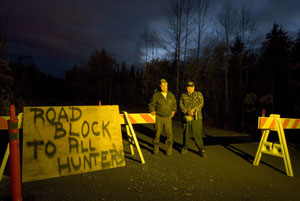
'Protecting our moose': Tahltan blockaders at Eight Mile. Photo: Paul Colangelo
It's a crisp mid-October day and moose brisket simmers over an open fire at the site known as Eight Mile on the Telegraph Creek Highway. A black pickup rolls to a stop at the orange barricade and Fred Moyer springs to attention, rushing his lanky frame over to the vehicle. Raised voices and occasional laughter emerge from the quad-toting couple. Eventually the pickup reverses, turns, then roars back toward Dease Lake.
Moyer's shoulders sag as he returns to the fire. He's just turned away his cousins.
"I even turn our own people away. I say, 'If I can't go hunting, why should you?'" he says. "It's sad, but it has to be this way."
Members of the Tahltan Nation say they will continue blockading two major hunting areas in northwestern B.C. until Environment Minister Barry Penner agrees to discuss what the nation describes as unchecked hunting in its traditional territory.
However, in a meeting held Wednesday, the Tahltan were told by government spokespeople that the province would not negotiate while barricades are in place.
'This isn't just about moose'
"They told us that the minister and senior level officials aren't going to meet with us until the barricades come down. We said, that's impossible because we're practising wildlife management," Tahltan Central Council chair Annita McPhee says, adding that the government said it will cut funding for social or cultural proposals while roadblocks are up. "I just said, what's one thing got to do with the other? Are you trying to punish us for protecting our moose?"
An hour south on Highway 37, Iskut residents are occupying a second blockade at the Klappan Road turnoff. Erected four years ago when the Klabona Keepers Elders Society fought to keep Royal Dutch Shell from exploring for coalbed methane in the area known as the Sacred Headwaters, activity at the turnoff was almost non-existent until round-the-clock blockading began again in late November.
While hunters and coalbed methane might appear worlds apart, they share a common threat to the Tahltan's partially subsistence lifestyle.
"This isn't just about moose," Moyer's mother, elder Lillian Campbell, says around the Eight Mile campfire. "It's about bears, it's about wolves, it's about salmon -- it's about our culture."
Campbell was a key player in the nine-month elders' sit-in that took place in the Telegraph Creek band administration office nearly five years earlier to protest then-chief Jerry Asp's cozy relationship with industry and government. Known as Tiger Lil, she was arrested at the Iskut blockade in 2006, although charges against her were subsequently dropped.
Unlike past disputes that saw the Tahltan Nation divided, the hunting blockade has the support of the Tahltan Central Council and local band councils, McPhee says.
Around the campfires at Dease Lake and Iskut, the blockaders tell stories about carcasses left with their racks removed; they talk about the drop in moose populations over the past 30 years; they talk about what they believe is a lack of solid science to accurately determine current moose numbers. And they talk about what they see as a removed government that appears willing to reap northern resources without giving back to residents.
"We're trying to save our land -- not just for us, but for the kids, the babies and the unborn," elder August Brown says. "It's not for us, it's for the young people. Not just for the native people, it's for all people."
Hunters, First Nations say science lacking
For the most part, blockaders say the hunters they turn away have been sympathetic to the closures. Management units within Skeena Region 6 -- the province's northwestern quadrant stretching from Stewart to the Yukon border -- carry the longest open seasons in the B.C., from mid-August until mid-November. Hunters from across the province, particularly those turned down for limited entry licences elsewhere, converge on the area during the moose rut, when the animals act like love-starved lunatics.
When the blockade went up earlier this month, it took mere days for resident hunters to clear out of the area, providing a swift blow to hunting-reliant businesses like Tatogga Lake Resort, located a kilometre from the Klappan turnoff. Stopping in at the lodge after eight days hunting the Dease River, Eckard Mendel, vice president of the Bulkley Valley Rod and Gun Club in Smithers, blames the conflict on a lack of reliable population counts.
"As a hunter and on a personal basis, I have the most to lose if I don't establish that there's sufficient animals to be hunted," Mendal says. "We need to find methods so that there's an opportunity for harvest based on scientific information."
Upgraded highway helps hunters
Shortly after the blockades went up, the Stikine River at Highway 37 became a popular access point for boating hunters. Although the area has since cleared again, Terrace residents Paul Hanna and Dave Clunas pack supplies into their boat on the Stikine riverbank. The pair has limited entry licences and plan to head about 80 kilometres up river.
"These guys' concern up here, it's a pretty legitimate concern," says Hanna, who adds he has been amazed by hunting harvest numbers published for previous years. "The numbers are staggering."
As Hanna points out, recent upgrades to Highway 37 provide easier access to the region. Similarly, Royal Dutch Shell sunk $8 million last year into upgrading the Klappan Road -- originally constructed as a rail grade back in the 1970s -- to uphold its tenure in the area, facilitating access into the Klappan area. "People did come before, but not in droves. I think access is a really mixed blessing for northern communities," he says.
Ministry refusing to budge
Within the five management units encompassed by the Tahltan territory, the Ministry of Environment says 166 moose were harvested in 2007, a number it says represents a "small fraction" of what is taken throughout Skeena Region 6 annually. Also in 2007, 527 hunters, representing 4,249 hunting days, visited the Tahltan territory, compared with 4,200 hunters spending 29,500 days in the Region 6's total 29 management units.
Despite Tahltan assertions that the last population study for moose in the area was 1982, the Ministry of Environment insists that data from about seven inventories completed in the Dease Lake area since 1978, including one in the Klappan in 2001 and in Spatsizi Plateau Wilderness Provincial Park in 1990, show a healthy moose population for the area.
A ministry spokesperson confirms that decision-makers won't sit down with the Tahltan until barricades come down.
"The Minister will not meet with the Tahltan Nation while roadblocks are in place," Suntanu Dalal says. "At this time, there are no formal moose hunting regulation change proposals being considered within Tahltan traditional territory."
In the meantime, Moyer busies himself fortifying a lean-to next to the fire for the elders, one that will likely last into next season, and talks about a third blockade at the Jade/Boulder Road just south of Dease Lake for next year. ![]()


18
Login or register to post comments
snert
2 years ago
Blockade the highway to Telegraph Creek
That might loosen things up a bit.
Fiat lux
2 years ago
Moose are not "harvested",
Moose are not "harvested", they're killed.
This harvesting nonsense is PR crap to cover up the bloodstains. Trophy hunting is mental illness.
The killing of animals for food and control is necessary, we're butchering every year, will be later this month, but for fun. Anybody who enjoys killing is sick in the head.
Ed Deak.
Fiat lux
2 years ago
Correction: Should be
Correction:
Should be "not for fun".
Ed Deak.
crh
2 years ago
I don't expect anyone
in government to not mess this up. I say keep up the blockade and thank you.
Soc
2 years ago
We should all support the
We should all support the Tahltan's right to their culture and their livelihood. What they are doing is brave: demanding real answers for the conservation of their way of life and of our wilderness, rather than the easier route of short-term over-exploitation.
Curt
2 years ago
I don't know why ANY
I don't know why ANY aboriginal group would want to talk to these liars and thieves. Do any nations really believe this government is there to make their lives better? Just look at their past and see what's happened. The broken contracts, lying to everyone whether it's about healthcare, education, homelessnes/poverty, children in care, seniors, and the list goes on. Provincial debt is only 495 million !!! No, 3 billion.
Why any group would get involved with these hypocrits makes me shake my head.
If you see where so many of their friends have ended up, i.e. Nakim Energy, Plutonic Power. All friends of this government sitting on the boards.
Forget about Penner, he's just another sitting stooge.
Van Isle
2 years ago
!st of all, everyone is
!st of all, everyone is gotta get it into their head that this government doesn't negotiate, they dictate. They know that they have the bigger stick and they don't like to lose. Just wonder when the professional liars will get into the act with such drivel such as 'innocent people are being held hostage'. They'll also try and find some Tahltan's who are against the blockade and have discontent within. When the cops go in with their riot gear and is flashed on the 6'oclock news the average slick in the city (who has probably never heard of Telegraph Creek) is happy that those malcontents have been put in their place. Then the politians wait for the results of the latest poll.
Van Isle
2 years ago
Remember Gustafson Lake?
Remember Gustafson Lake? That was all about political/public relations.
lynn
2 years ago
Well said, Curt
Well said, Curt.
This isn't a government, it is Real Estate BC Inc.
That's all the Tahltan First Nations mean to them - a way to access and control land that they can't access by any other means.
When they don't get what they want they threaten and bully:
"adding that the government said it will cut funding for social or cultural proposals while roadblocks are up."
(My gawd, now they are stealing the last penny from seniors in this province. No consultation with families, stealing from those suffering from dementia that have no idea how they are being robbed. What a disgusting disgrace they are as human beings.)
This government needs to be shunned by us all.
I agree with crh, keep the blockades up...and thank you.
roady
2 years ago
good for you tahltan first nation!!!
stand strong and stand tall!!
CourtGQuinn
2 years ago
"Moose Factory" funny name for town...
Wikipedia: "moose"
"Dr. Valerius Geist, who emigrated to Canada from the Soviet Union wrote in his 1999 book Moose: Behaviour, Ecology, Conservation:
"Those who care most passionately about moose are—paradoxically—hunters, in particular people who live in wilderness and rural communities and those who depend on moose for food. In Sweden, no fall menu is without a mouthwatering moose dish. The Swedes fence their highways to reduce moose fatalities and design moose-proof cars. Sweden is less than half as large as the Canadian province of British Columbia, but the annual take of moose in Sweden—upward of 150,000—is twice that of the total moose harvest in North America. That is how much Swedes cherish their moose.""
Not sure if there's overhunting...perhaps the Tahltan do have justified concerns about people visiting their lands for a few days simply to hunt. Perhaps moose meat should be eaten more by "southern" Canadians....but there's no need/reason for everyone who wants to taste moose to drive hundreds of kilometers north. The Tahltan should have a moose meat/jerkey company that "harvests" in a sustainable manner. If a pound of beef jerkey sells for $10 at 7/11....why isn't their a similar moose meat alternative? Why isn't moose meat eaten more by southern Canadians? Perfect opportunity for First Nations to brand an organic food company. Unlike beef from cattle...moose meat can be "grown" and "harvested" naturally. Heck, just the amount of moose on Newfoundland (introduced species apporx 100 years ago)...could probably feed every Canadian at least a few moose meat meals every year in a sustainable manner.
Fii
2 years ago
Cheers to that
"It's about bears, it's about wolves, it's about salmon -- it's about our culture."
Intention Pure
2 years ago
Government accoutability
Thank you Tahltan First Nation. Protest and shaming the current government is the only way to get their attention. Your Nation has the support of the general community. Nature will be protected from human short-sightedness. Thanks to everyone who is brave enough to say it like it is. Now we only have to have the actions to follow our words!
jwstewart
2 years ago
Gee, it sounds like...
The hunters and outfitters and those others affected by the blockade are not the least bit offended by the "inconvenience" and loss of livelihood. I'm curious why the author was unable to find one lone disenting voice?
As for carcasses being left in the bush, this is clearly a violation of hunting regulations. Allowing wild meat to spoil is a criminal offense.
But then, so is blockading roads, isn't it?
How come there's a double-standard? Which laws are ok to break? And who gets to decide?
And the entirely lawful killing of wild animals is somehow morally & psychologically inferior to the entirely lawful killing of caged animals? Assuming the end result is the same, cooked meat, I would vote for the wild game killing as fairer since the animal has a chance.
Nonetheless, the real issue is one of sustainable wildlife management. If they beleive the hunt is not sustainable, why aren't these protestors acting lawfully, protesting on the Ministry's doorstep?
PS - CourtGQuin - I do beleive selling wild meat is illegal for both First Nations and licensed hunters. A hunting license is required to possess wilde meat, of FN's can do so without a permit for personal use.
G West
2 years ago
Really jwstewart?
Allowing wild meat to spoil is a criminal offense.
Could you point me to the section of the Criminal Code of Canada where this offence is covered?
I'm not familiar with it.
alive
2 years ago
Cull 'em
Penticton finally decided to cull some of their "wild" animals: the swans that has pestered the lakes for decades.
Other areas have different problems, on the Island it is deer that jump out in front of vehicles at night and generally destroy anything you plant in your garden.
Maybe we could fence our highways, or maybe we could stop trying to play God and "protect" whatever animal that we feel looks cute?
jwstewart
2 years ago
GWest
I don't have a reference to the criminal code, I simply use the BC Wildlife regulations..which state
It is unlawful to:
to kill wildlife (with the exception of
grizzly bear, cougar or a fur bearing
animal other than a black bear) and fail
to remove from the carcass the edible
portions of the four quarters and loins
to the person’s normal dwelling place
or to a meat cutter or the owner or
operator of a cold storage plant.
Located Page 18, paragraph 17
http://www.env.gov.bc.ca/fw/wildlife/hunting/regulations/
Maybe I'm simplistically interpreting "unlawful" to mean "criminal". If so, my apologies, but it is a punishable offense.
G West
2 years ago
If it's not in the criminal code - it's not a 'criminal' offence
Maybe it should be....I suspect the burden of proof is pretty high.
Anyway, I breezed through my Martin's and couldn't find any reference ...the fact the wildlife regs don't seem to be aware that other animals (bears, cougars, rabbits etc) are also edible is kind of curious because the regs only apply to the hide for those animals...
Unlawful is certainly accurate...and no apology necessary.