News

Rescuer of Stolen Bikes Slips into the Shadows

Gord Blackwell became a hero to grieving bicycle owners like me. Why did he quit?

By Christine McLaren, 29 May 2009, TheTyee.ca

biketheft.png

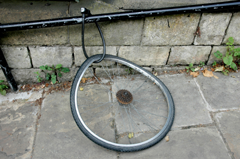
Just another Gotham City statistic.

It was a beauty. A cobalt blue Nishiki bullet; a road jet built for speed and practicality. Sure, its paint was faded and scratched. But that bike was my baby. And in a second it was gone. Ripped from the fencepost of my own backyard.

An hour later, as I scoured the Downtown Eastside, Vancouver's bazaar for stolen cycles, a man standing in a back alley doorway scoffed at my naivety: "A bike? If it's not welded or bolted to the ground, you don't stand a chance in this city."

He wasn't far from the truth. In Vancouver alone over 1700 bikes had been reported stolen in 2008, police would later tell me. That is roughly one for every 340 people, with scores more probably going unreported. Even Toronto, a city over four times the size of Vancouver, reported only one bike stolen for every 540 people.

Sgt. Mike Linde of the Vancouver Police Department's Anti-Fencing Unit cites the obvious reason for high bike thefts: Bikes are plentiful in Vancouver's climate. But so is drug abuse and homelessness, which police point out are the reason for B.C. having the highest rate of property crime in the country .

This is the Gotham City of bike theft, I thought. And here I was at the center of it with no one to help.

The police were merely a formality. Even though 1000 bikes were recovered by the VPD in 2007, over 600 of those were sold off in the annual VPD auction, leaving an abysmal return rate of under 25 per cent. With my beater bike low on their priority list, I was doomed.

"Call Bike Rescue," a friend suggested.

"Bike what?"

"Bikerescue.org."

Was there such a hero out there in Gotham City? If I sent out a plea for help, would anyone respond?

"With any luck, I'll be giving you a call in a few days," said the man's voice on the other end of the line.

I was saved. Or so I thought.

Origins of a bike rescuer

Rumour had it that Gord Blackwell created Bike Rescue in the wake of personal loss. After becoming a victim of bike theft himself and seeing the non-existent response from the police, he decided to take the problem into his own hands.

Bike Rescue, the website claimed, "is all about getting stolen bikes back to their owners, assisting victims of bike theft with replacement bikes," and “moving towards doing more education & awareness of the bike theft problem and prevention tactics."

The formula was simple: stealth the broken city for"“too good to be true" deals, then buy them. Victims of bike theft could report a stolen bike through the website and if Blackwell and his Bike Rescue crew found it, they gave it back free of charge. If no one claimed a bike they had bought, they sold it, walking a fine line through a grey zone of the law, one that states that it is illegal to purchase stolen goods.

The website claimed a "great working relationship with the Vancouver Police Anti-Fencing Unit and the Coquitlam detachment of the RCMP," lending the operation a sense of legitimacy. I made some phone calls, and felt less sanguine.

Coquitlam RCMP had heard of the site, but claimed to have had no working contact.

My pal Sgt. Mike Linde laughed with surprise at the assertion before sternly denying it: "We had no official working relationship. Not at all."

The dark side

The first page of Google yielded news reports and message board claims that Blackwell had fraud convictions in several provinces. One article by CTV in 2008 suggested police were considering charges against Blackwell for the sale of stolen goods.

On one message board, a person identifying himself as Bike Rescue made an appearance explaining that the fraud convictions were for writing a series of bad cheques to major retailers across Canada. "I was charged, pleaded to no contest, found guilty and sentenced. I was 29 years old when that was happening and I now turn 40 next month. I have not only gotten on with my life, but often I have referred to this project as 'doing the penance of my choice.'"

I did some more digging. Some groups I contacted said they simply refused to associate with Blackwell.

The Vancouver Area Cycling Coalition refused to even talk about him.

A local charity, Our Community Bikes (OCB), agreed in a collective meeting not to take donations from him and asked him not to have their name appear on his website, where Blackwell nonetheless claimed to have donated bikes to them.

They said it was for the same reasons they wouldn't take bikes from the police auctions: if you don't support theft, why take stolen merchandise?

"What he's doing contributes in a secondary way to bike thieving," said Johann Groebner of OCB. "It becomes a secondary market. Whether or not some bikes get given back to their owners, it creates a market basically for bike thieves. Even if it's with the right intention, it still creates a market."

Hero worshippers

Still, Blackwell claimed to have returned over 200 bikes, and for every skeptic I encountered, an equally enthusiastic fan cheered Bike Rescue on. Not only that, they proved that there was at least some truth to his claims.

It was barely light out when Justin Tilford's neighbors saw two thieves make off with his and his wife Lisa's recumbent hand bikes from behind two steel doors. A former bike shop owner and avid cyclist now confined to a wheelchair since a biking accident 12 years ago, Justin had shelled out $12,000 for the highly specialized bikes that they used for everything. Just months before they were stolen, Justin and Lisa had spent their honeymoon on a cycling tour of the sunshine coast and the gulf islands.

The couple had appeared on television about their loss, and blogged in the online bike community, but didn't expect anything back. Justin had previously lost two wheelchairs, another handbike and a car to theft, and had never had anything recovered. "We reported it to the police, but due to past experience, I see that as more of a formality than anything. It's not going to really do anything."

So Justin was elated when he received a random phone call at work from Blackwell, saying he had the bikes.

"He introduced himself and said he had our bikes," said Tilson. "He said he'd bring our bikes back, and we could pay him something if we wanted to, but we didn’t have to."

Blackwell said he had called around to find the bikes and paid $700 for them. He said he couldn't get them the first time he tried because the person who had them was in jail for a different crime.

Other photos appeared on the Bike Rescue website, and recently in Mountain Bike Action Magazine, depicting owners happily reunited with their bikes.

"I think it's awesome. The police aren't doing it," said Tilson. "His intent, from when I met him, seems sincere -- to want to make a difference -- and for me he made a huge difference, so I can't slag him at all. I only have praise."

And I couldn't help but feel a twinge of envy, imagining myself in his place.

Vanishing act

But the next day my hopes skidded when I called Blackwell and he dropped the news.

"I decided an hour ago I'm shutting Bike Rescue down. You're the first person I've said it out loud to." He said he couldn't tell me why. "Bike Rescue as it is right now, will no longer exist," is all he would say.

And just like that, he was gone. My eyes nearly welled with tears as I hung up the phone. Whatever ethical or legal critique could made against Blackwell, I was the victim of a crime, and he was someone who might have avenged my loss.

Superhero or villain, Bike Rescue had been doing the job the cops could not -- or would not -- do themselves.

Bait for crooks

Justin Tilson and a friend from Free Geek, a volunteer computer recycling hub and nexus of some of Vancouver's most technologically gifted, discussed a plan involving bait bikes, GPS and a few video cameras.

"It wouldn't be that hard to catch them if the police or someone else wanted to put some resources into it."

Since 2003, the Ministry of Solicitor General, Police Services Division and ICBC have spent over $1 million on the IMPACT anti-auto theft program, and car theft has dropped 47 per cent. But bike theft doesn't cause nearly as much of a dent in insurance companies as auto theft, as most bikes are uninsured.

But other countries have made it a priority. In 2008, the Dutch government launched a $1 million crackdown on bike theft. It included the National Bike Register, which the police are required by law to keep up to date. It can be consulted online and contains data on every new bike sold in Holland, so dealers and consumers can check online to see if the used bikes offered to them are stolen. Every new bike sold in Holland is also equipped with a built-in anti-theft chip, which the whole police force can access through electronic reading devices.

Beijing did a crackdown as well, cutting their bike thefts in half, and Oxford created a special bike theft task force, like a smaller version of B.C.'s auto theft task force.

Vulnerable and alone

Either way, even the hardest skeptics admitted what Blackwell did was better than nothing.

Even Groebner of Our Community Bikes. "If I didn't have those questions, I'd think it was actually a pretty awesome thing he was doing," he said. "The police don't do it, so you're damned if you do, damned if you don't. In the end, maybe people will always steal bicycles, and if he's really returning some of them, maybe that's awesome."

Maybe there is no answer to that ethical dilemma. Gotham City's police never did decide if Batman should be trusted. All I know is that now I sit on the corner of the street watching the wind rip through the flannel sleeves of hipster bikers whistling by, and know that I'll probably never see my blue beauty again.

Last week I came home to find my housemate in tears because her bike had been stolen from the backyard. She asked what she should do. I said I didn't know.

Gord Blackwell, formerly known as Bike Rescue, has disappeared into the shadows of B.C.'s Gotham City, a cyclist's nightmare, and we have no one left to call.

Related Tyee stories:

 [Tyee]

16  Comments:

  • Stump

    29-05-2009

    Stolen goods

    Worth noting that even the police couldn't keep a program to return stolen goods back to their owners (Propertycop) up and running due to lack of support.

    Also, it's too bad this article didn't take a harder look at who benefits from stolen goods. It's not just pawnshops and junkies. Arguably, charities, bike shops, and the police themselves have good reason to leave the status quo be. I'm not suggesting they encourage bike theft, but there's very little benefit to all three groups in reducing the incidence of bike theft.

    Some insurance companies won't insure bikes. Meloche Monnex will, if anyone is looking for company that will cover a bike worth insuring.

  • Stump

    29-05-2009

    forgot to include a link

    same topic, as covered by Momentum magazine when BikeRescue and Propertycop were both still running.

    http://tinyurl.com/mj6yu6

  • BillMelater

    29-05-2009

    rfid tracking devices

    Do you really want the police state to know your whereabouts at every moment of the day? I'll choose the lesser of two evils, thanks.

    After being literally laughed at by the local coppers when I enquired about the likelihood of my stolen bicycle being recovered, I now understand that the only safe place for a bike worth more than a buck 'n a half is U.T.A.*

    *Under the Ass

  • Stump

    29-05-2009

    interesting stats

    1700 bikes reported stolen
    1000 picked up by police
    600 sold at auction

    The police can return your bike if the owner takes the common sense precaution or recording the serial number and reporting the theft.

    There's no compelling reason at this time for anything to be done to change the situation, unless people make it an issue (demand better from both the police and the insurance companies) and take a small portion of responsibility to know their bike's identifying #.

    The only times I've ever had bikes stolen, it was my own fault (partially) for not locking it properly or leaving it unlocked.

  • Stump

    29-05-2009

    "of recording" the serial

    "of recording" the serial number

  • rac

    29-05-2009

    Don't Blame the Victim Even if They are You

    "The only times I've ever had bikes stolen, it was my own fault (partially) for not locking it properly or leaving it unlocked."

    Enough of blame the victim. While you may have been able to prevent the theft by locking your bike better, it is not your fault. It is the fault of the person who stole the bicycle.

  • jwstewart

    29-05-2009

    One cop?

    Seems to me there should be at least one cop dedicated to bike theft.

    If there was 700 bikes auctioned, that should pay for one cop and a TrackStick to setup a sting operation to see where these things are going.

  • Stump

    29-05-2009

    Where the money goes

    The money from the auction goes to charities. So, nobody really wants to come out and be the bad guy that points out the funds raised by the police auction is essentially the proceeds of crime diverted to good causes.

    I don't think we are likely to the money going back to prevention or detection of bike theft any time soon.

  • alive

    29-05-2009

    it works, in a fashion

    my stolen bike was found by a fluke, when the cops stopped a suspect for a different reason.

    I did get it back, (somewhat modified) long after I had bought a replacement bike.

    I asked them if they now would question the thief about the other items he stole that day, and met with a stonewall,
    like that is not our department!

    Surprise surprise there is no communication between police departments.

  • why_knot

    29-05-2009

    Stolen Bikes

    Being an Albertan, I am the ultimate cynic. Therefore I must ask, is there a chance that this bike 'rescuer' was actually arranging the thefts, anticipating that theft victims of relatively expensive bikes might be all too willing to make donations to the 'hero' that reuinites them with their lost valuables?

  • Fish-counter

    31-05-2009

    Why would the RCMP be interested in bike theft?

    It offers them absolutely no chance to wear SWAT uniforms. The cops love to put on their SWAT unifirms. They SO sexy and it makes for good TV.

    I had my mountain bike stolen right out of my minivan. That vehicle was broken into three times in one year. The cops weren't interested.

    They are more interested in hiding in bushes so they can give tickets to bike riders for not stopping at stop signs. In spite of the fact that bikes are not motor vehicles, they are trying to treat them as such. The reason they are doing it is because they love to KICK ASS. They love to show who is boss, by ticketing people who are minding their own business.

    Never mind the crime wave and the 20 fatal shootings in Vancouver, the RCMP are targeting people who don't wear their crash helmets. They would rather antagonise the public than put criminals behind bars. And wearing SWAT uniforms makes them look like heroes. Childish isn't it?

  • Vancouver Shawn

    31-05-2009

    Stolen Bikes

    I am a non-violent person but I find myself fantasizing about it when I see a crack head riding a $2,000. bike after a couple of friends had their double-locked bikes stolen from in front of my building. A bait bike program sounds like a good idea to me.

  • Stretch

    01-06-2009

    Where the $ goes

    "Worth noting that even the police couldn't keep a program to return stolen goods back to their owners (Propertycop) up and running due to lack of support."

    That program was started by a VPD officer on his own time with his own dime. The VPD and RCMP had nothing to do with it. He saw a need for such a thing and knew how to integrate it into the way police operated, but no long-term funding was to be had. Government wasn't interested, and the little private funding he could get turned out to be not enough. It's a real shame too because it was the most in-depth registration system possible, and was a direct challenge to the fundamentally flawed and hostile system that the VPD currently use.

    "The money from the auction goes to charities."

    A portion of it might, but the majority goes into the city's "general funds" which goes to pay for things like... VPD operations. Draw your own conclusions.

    Up until the early 80's, the city of Vancouver had a bicycle registration system in place. Then, it was dropped as a cost-cutting measure. Bike theft is now at a pandemic level, yet city hall and the police haven't moved beyond the most primitive of methods to deal with it.

    As Stump has posted, protecting yourself is the best line of defense. Write your make, model, size, colour, and serial number down. Have a bike shop help you find it if you can't locate it. Report your bike as being stolen to the police - both the VPD and the RCMP in the surrounding region. Assume they don't talk to each other, because when it comes to bicycle theft, I'm fairly sure they don't. Since bike theives are stupid losers, the chances of your bike being recovered actually aren't too bad.

  • Stretch

    01-06-2009

    Also...

    Also, buy a good lock... and USE it. Trust no one at any time. Once they're on your saddle, it's game over.

    And keep your bike indoors if it's at all possible. There are all kinds of slick storage systems out there for bikes these days. Have a good talk with your landlord if they've got a problem with that.

  • Stump

    01-06-2009

    Propertycop

    Fair comment Stretch and I agree that propertycop had a lot of potential. I know Mr. Brierley spearheaded the program and deserves full credit for that. However, my understanding was that he did so with the full support of the police and the site's own information seems to indicate such.

    "General Information
    The Propertycop program is a free and far reaching community policing strategy which is administered by the non-profit Propertycop Property Registration and Recovery Society. It comprises partnerships between the public, Police and retailers, in order to recover stolen property. Property that may be registered includes bicycles, and electronic goods. In this partnership, all parties play an equally important role."

    I would agree that the program could have been invaluable in combating theft of things like bikes, cameras, and other portable consumer goods. Why the VPD or RCMP and other 'partners' chose not to find funding for the program remains a mystery to me.

  • Kits47

    01-06-2009

    City Police and Bike Theft

    VPD make it crystal clear that they have zero interest in doing ANY investigation regarding bike theft and the crimes associated with bicycle theft.

    My son's $5000+ downhill bike was stolen by break & enter, into my well secured garage. The bike was being advertised for sale, online and in various bike publications. It was in my possession since my son lives in a small community and the presumption was that GV area was the most likely place the bike would find a buyer. None of the advertising disclosed the location of the bike, beyond the fact it was in Greater Vancouver. My son did not use his last name, in the ads, so there was no way for anyone to track the bike to my Kitsilano home. Only one person showed sufficient interest that my son gave him my address and phone number, to arrange a viewing of the bike. A person showed up, as agreed, checked out the bike and test rode it. He said he was interested and used my phone to talk with my son to come to a final sale price. He explained he needed to get an advance on his next paycheck to pay for the bike and would return two days hence to complete the deal.

    The following night there was an unsuccessful break-in attempt on my garage. It was reported and a case number assigned, by phone. A month and half later some one succeeded in destroying the door and frame and stealing the bike. To take the bike, the perpetrator had to pass my work bench with several, literally brand new, power tools on it. Then had to negotiate around my SUV, to the opposite corner of the two car garage and find the bike totally obscured from view, in the center of a large pile of empty cardboard boxes. A considerate thief, I have to add, as getting the bike out required lifting it over the hood of my SUV, achieved without getting a scratch on it!

    A report was filed and an officer attended. In spite of the bike's value and all the identifying information provided about the only person who had seen the bike and where it was kept, I was told there was no point in checking for finger prints and little hope of recovery. A couple of days later, I discovered the crowbar used in the break-in, sitting on one of the boxes beside where the bike had been stored. I was told there was no point in finger printing the device and no interest in taking it into evidence.

    My son had several communications with Blackwell regarding his bike. I believe Blackwell was, at the very least, the source of information regarding the frame, (only), of the bike being turned in to Vancouver Police, a few months later.

    Having experienced this, it is patently clear that there is simply no interest in combating bike theft, by city police. The violent and forceful entry on private property seems to be equally dismissed as irrelevant. Who benefits, I won't speculate. However, when bikes are running in the five to ten thousand price range and attendant property damage of one to two thousand, one wonders just what the city police do investigate.

  • The discussion for this story is closed. No more comments can be added.