

 SHARE:
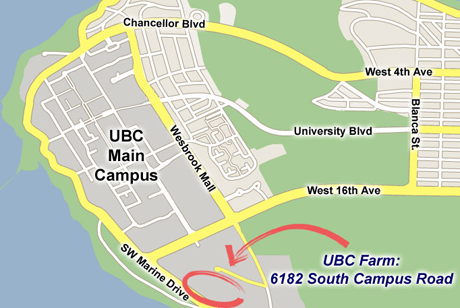
The University of British Columbia should hang on to at least some of the agricultural oasis in its midst, says an independent land-use study released earlier this month.
But those working to preserve the UBC Farm want to see UBC expand its vision for the 24 hectares that is Vancouver's last working farmland. They say UBC could use its farm to produce some of its own food, not only educating but sustaining its students.
Challenging that vision are some hard numbers. The UBC Farm real estate is said to be worth $200 million at a moment when UBC faces a budget crunch, and while top university administrators say the farm is safe from bulldozers, in planning documents the verdant patch is labeled "Future Housing Reserve."
Sustainable lessons
When UBC was founded a century ago, agriculture was central to its mission. "The university founders were very interested in the future of the food supply," explained Mark Bomford, the UBC Farm's program coordinator, at a planning forum last month. "They saw this wonderful fertile region in the Fraser Valley. Making their projections, they said that in the next hundred years this was going to be home to about 150,000 affluent farming families that would provide Vancouver with its food supply, as well as the larger province."
Today most Canadians are disconnected from the origins of their food. But one in four British Columbians live within a 45-minute drive of the UBC Farm, which offers many ways to learn about food production and sustainability. In addition to academic programs, the farm has programs for school children, three different aboriginal community gardens, an internship program, a weekly market during the summer, a Community Supported Agriculture (CSA) program, volunteer opportunities and community events.
An operation the size of UBC Farm isn't going to make a dent in regional and global food security, notes Andrew Riseman, professor in UBC's Faculty of Land and Food Systems. Even on a purely plant-based diet, the five hectares currently in production at the UBC Farm would fulfill the food requirements of a very small number of people -- but that's an important lesson in itself, Riseman says. "The question is not how much of the UBC Farm should be retained but rather how much of the athletic fields and how much of main mall should be turned into farmland," says Riseman.
A developing development
The fate of UBC Farm remains complicated because UBC's Vancouver campus is subject to two different planning processes: the Vancouver Campus Plan, which plans academic-related land use, and the Official Community Plan, which is overseen by Metro Vancouver, and oversees residential land use.
This split is due to controversy that arose during the construction of UBC's first market housing development, Hampton Place, in 1989, which netted $216 million for the university's endowment. Responding to criticisms about the lack of information, lack of public process and the fact that the new residents of Electoral District A would not be subject to municipal taxes for their demands on municipal services, Metro Vancouver intervened in 1994.
The result was the establishment of a municipal-style Official Community Plan specific to UBC. This document guides the large-scale campus development planned for the next 30 years. It ensures that plan conforms to the Metro Vancouver's Livable Region Strategic Plan and requires a process of public consultation. This plan renamed the farm land, the "Future Housing Reserve" and outlines the transformation of the more than 90 hectares of south campus land into an "urban village in the woods. Metro Vancouver adopted the plan as a bylaw in 1997.
UBC has committed to accommodate a share of regional growth and become more self-contained, and therefore plans to be home to a population of 18,000 by 2021 and 24,000 once development is completed in 2030. The south campus neighborhood alone is planned to add 7,760 residents.
And in order for any of that residential development to proceed, the Metro Vancouver-UBC joint committee, which has equal representation from the UBC board of governors and Metro Vancouver, must first approve it. In the case of land with an institutional designation, like the UBC Farm, it must first be shown to be fall outside of the university's academic mission and re-branded as non-institutional land.
Current growth
The UBC Farm is assured a continued place at UBC, according to Stephen Owen, vice president of External, Legal and Community Relations. He says the term "'Future Housing Reserve' is an unfortunate term that has caused undo concern" about the future of the farm. Owen says he and UBC president Steven Toope choose to refer to the farm's area of the south campus as "academic precinct" to acknowledge its value for teaching, research and community service.
Many community members and farm advocates acknowledge that Owen and Toope are allies of the farm. However, concerns persist about the farm's future.
This past winter, it was announced that the future of the UBC Farm would be determined by UBC's Vancouver Campus Plan -- even though the process of revising the 1992 Main Campus Plan had already been underway since 2006 through the Official Community Plan, which was overseen by Metro Vancouver.
In response to the unexpected announcement, the student and community group Friends of the Farm started the Save the Farm campaign earlier this year to raise awareness about impending development and put pressure on UBC to preserve the farm.
"This is actually one of those really fun campaigns where nobody is against what you are doing," says Friends member Andrew Rushmere. The group circulates its petition to save the farm at many Vancouver community events. "Every single person that comes up to the table, without fail, is supportive of saving the UBC Farm," says Rushmere.
Still, the future of the farm hinges on its ability to prove itself as academically valuable. Since 2001, the number of students using the farm has on average grown by 50 per cent. The past year saw 2,250 students, faculty and staff making use of the farm for the purposes of 41 different for-credit courses representing 14 of the 25 faculties, schools and colleges at the university.
But fueling the uncertainty about the farm's future is a development already underway. Wesbrook Place, currently under construction, greets workers and visitors on the way to the UBC Farm. The plan for south campus elaborated in the OCP and CPP is for a complete community with a "neighborhood-oriented grocery," resident-focused retail, elementary school, community center -- without any mention of agricultural land.
Hope sprouts
In 2006, the independent consulting firm Lees + Associates, which specializes in cemetery and memorial planning, was commissioned by the Faculty of Land and Food Systems to assess the long-term academic and research needs for the farm. The report, originally expected by 2006, was released last week. The report emphasizes the importance of retaining eight hectares of south campus for agricultural use.
Bomford notes that "the report focuses on a subset of the farm's functions that relate to the faculties of Forestry, Land and Food Systems, and the Department of Botany, while giving little consideration to the 11 other faculties, schools and colleges using the site." Of greater concern to farm supporters is that the Lees report only considers the value of the intensely cultivated areas, while disregarding the more than 10 hectares of habitat areas contained on the farm's land.
Preservationists argue there are many ecosystem benefits to be had from the surrounding forest, including water filtration, pest and disease control, wind and erosion reduction and microclimate control. "A lot of people come here and say that there is just something magical about this spot -- people who are otherwise rationally minded just can't explain it. There is just something about this place that is special," says Rushmere,
Decision in a year
According to Bomford, the vast majority of farm supporters are not anti-development, but wants to see UBC using smarter planning principles as it makes room for more people and activity on campus. "I'm in total agreement with the vision for a university neighborhood which is a complete campus community for people to live and work. Instead of having a stream of cars moving back and forth everyday, we have something that is a bit more self-contained, and something that can bring life, vibrancy, and diversity to campus"
Bomford and his allies want UBC to maintain all 24 hectares of farmland and connect it with the surrounding planned community. In 2001, this was the topic of Derek Masselink's Master's thesis in landscape architecture. While not accompanied by an economic analysis, he argued that it is possible for UBC to meet its on-campus population targets and keep the entirety of the farm. This would require a big shift in what is currently planned for south campus.
In one year the UBC Board of Governors will decide on the fate of the UBC Farm. At least one powerful voice at UBC encourages hope that the forest will be retained. Vice-president Owen believes the "very likely result will be that the 10 hectares of forested lands will be deferred for another decade."
Related Tyee stories:
- Change of Guard at UBC
Stephen Toope dug up the truth about Maher Arar. Now he's UBC's president. A Tyee interview. - Home Cost Crunch: UBC's Role?
As real estate inflation tears Vancouver's social fabric, what's a university to do? - So, You Want to Be a Farmer?
Podcast: Who will help raise Canada's food? Why not you?
![[Tyee]](/design-article.thetyee.ca/ui/img/yellowblob.png)
Read more: Environment, Urban Planning + Architecture




Tyee Commenting Guidelines
Comments that violate guidelines risk being deleted, and violations may result in a temporary or permanent user ban. Maintain the spirit of good conversation to stay in the discussion.
*Please note The Tyee is not a forum for spreading misinformation about COVID-19, denying its existence or minimizing its risk to public health.
Do:
Do not: