News

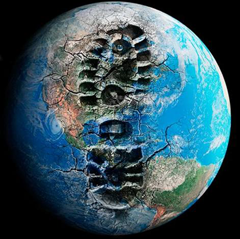
Canada's Rich Stomp the Planet

Their eco-footprint is more than double nation's poor: study.

By Tom Barrett, 24 Jun 2008, TheTyee.ca

Footprint on Earth

Canada's footprint: third largest.

The richest 10 per cent of Canadians have nearly two-and-a-half times the environmental impact of the poorest 10 per cent, a new study says.

And, the study argues, climate change policies that ignore this disparity will not only be ineffective, but will make income inequality worse.

The Canadian Centre for Policy Alternatives study concludes that "the consumption of high-income Canadians is having a very real and damaging effect on the environment."

The study found that the per capita ecological footprint of the richest 10 per cent of Canadian households is 66 per cent higher than the national average.

The study was written by Hugh Mackenzie, an economist with the centre, Hans Messinger, a Statistics Canada senior advisor and consultant, and Rick Smith, of Environmental Defence.

They divided Canadian households into 10 equal groups, or deciles. The top decile is the 10 per cent of Canadian households with the highest incomes; the bottom decile is the 10 per cent with the lowest incomes.

Statistics Canada data were used to calculate each group's consumption -- how much they spend, and what they spend it on. These figures were then converted into an estimation of ecological footprint -- each group's impact on the environment.

Canada's footprint third largest

The authors say this is the first study to look at the size of Canadians' eco¬logical footprint by income categories.

Overall, it notes, Canadians have a disproportionate impact on the globe.

Canada's ecological footprint is the third largest in the world, it says, tied with that of Finland. Only the United States and the United Arab Emirates have larger footprints, the study says.

And, it says, "Canadians at every income level are contributing to global warming. Even low-income Canadians have a greater impact on the environment than most of the world's population."

However, it's those at the top that have by far the largest impact. The size of a household's footprint "grows systematically" as income rises, the study says.

That goes for every category of consumption except for food.

Eating: the 'great equalizer'

"In ecologi¬cal footprint terms, it turns out that food is the great equalizer," the study says.

On average, it says, we all eat more or less the same amount. The rich tend to eat better, if not more, but "quality" foods like choice cuts of meat and vintage wines "demand only marginally higher land use than lower priced products," the study concludes.

"For about 70 per cent of Canadians, food is the most significant con¬tributor to their household's ecological footprint," the study says. "It is only for the highest-income 30 per cent of Canadian households that the housing footprint exceeds the food footprint."

In housing and transportation in particular, the top 10 per cent has a footprint that is several times larger than the footprint of lower-income and lower-middle-income Canadians. It's even significantly greater than the footprint of the second-highest income group.

Much of the impact of low-income and middle-income Canadians comes from consuming the basic necessities, food and shelter. The disproportionate impact of the rich was the most apparent in the study's other categories of consumption: services, goods and mobility.

When it comes to consuming services, the top 10 per cent had a footprint 2.7 times that of the lowest 10 per cent. For goods, the top group's footprint was 3.75 times that of the lowest group's.

High flying affluence

And in the category of mobility, the top group's footprint was a whopping nine times that of the bottom group. As the study notes, the rich drive and fly a lot more than the poor.

The study also puts Canadians' environmental impact into global perspective.

The average footprint of the lowest 10 per cent of Canadian income earners is still three times the average foot¬print in China -- and more than seven times the average footprint in India, the study says.

The world has come to accept that "as citizens of a wealthy, consumer-oriented society, Canadians contribute disproportionately to the global warming phenomenon and must expect to contrib¬ute disproportionately to the solution."

Make income a policy factor: authors

But there has been little mention of similar imbalances within Canadian society, the study says.

"Indeed, the implicit message in the One Tonne Challenge -- the former federal government's advertising attempt to get Canadians involved in greenhouse gas re¬duction -- was that all Canadians are equally responsible for global warming. The findings in this study indicate the burden of proof lies heavily at the feet of the rich¬est Canadians among us and public policy should reflect that imbalance."

One example lies in the area of housing, the study says.

"Low- and lower-middle income Canadian households are far more likely to rent rather than own their housing. As tenants, they are gener¬ally not in a position to make decisions with respect to the energy efficiency of their homes because they are not responsible for the capital investments required to give effect to those decisions.

"In many cases, tenants are not even in a position to con¬trol the temperature in their rented homes."

The market and its limits

Relying on market-based solutions to lower greenhouse gas emissions therefore won't have much effect on the rental housing market, the study argues.

"Because energy costs are generally incurred by landlords and passed through to tenants, whatever economic incentives are created by mar¬ket measures in the rental housing market will generally be created at the wrong place.

"And to the extent that landlords are forced to make environmental improve¬ments, they will simply pass the cost on to their tenants by raising their rents -- a practice that would exacerbate income inequality in Canada and unfairly penalize lower-income households."

Ignoring "the underlying relationship between ecological impact and income" could produce "the worst of all policy worlds," the study says.

"In short, if we fail to incorporate differences in environmental impact that are systematically related to income, we risk creating an ineffective policy that has the side effect of imposing disproportionate costs on the low- and moderate-income Canadians who have contributed the least to the problems we are trying to address."

Related Tyee stories:

 [Tyee]

91  Comments:

Login or register to post comments

  • Tired of the Li...

    3 years ago

    Even the poorest 10%

    So the poorest 10% are not doing their bit to help the environment, I knew it they are nothing but a bunch of slackards and do nothings. Looks my rich friends and I will have to once again step in and take responsibility for the inadequacies of the poor.
    It is not fair we must take responsibility for a growing and healthy consumer market; the least the poor can do is make a few sacrifices to help the environment.

  • alive

    3 years ago

    same old

    Is this supposed to be news?
    To the poor it has been obvious for a long time!
    The trouble is that only the really poor are prepared to stage a revolution, the rest of us still have it a bit too comfy, thank you!
    However if we elect Gordo one more time, I am sure he will manage to convince more of us that we are not the chosen ones, and that we will suffer more and more as time goes on.
    All we see here is talk and more talk, each poster agreeing that we are going to hell in a handbasket, but not ready to figth where it counts.

  • realisticman

    3 years ago

    Let's target the rich

    Let me see now, the richest 10% of BCers, that's 417,700 rich fat cats! In a world of, what, 6,700,000,000. What's that, something like .0000001% of the world's population, or whatever. Meaningful, eh? Just like looking at the stars on a clear night and saying, if only one star disappeared.

    Let's send money to The Canadian Centre for Policy Alternatives so they can do more meaningful studies like this one.

    Buses burn lots of fuel. Why don't we just have the drivers wait until their bus is at least more than 2/3rds full. It seems such a waste otherwise. Ban school buses too. Let them walk the way we all used to.

  • rac

    3 years ago

    Improve Public Transit and Cycling

    So lets really improve public transit and cycling. This will help stop climate change and provide better transportation for everyone, especially those without much money.

    Kind of a silly argument anyway. Fighting climate change will help the environment in other ways as well. The poor suffer the effects of pollution and environmental damage more than the rich so creating climate change is also regressive.

  • rac

    3 years ago

    Time for the Rich to Show Leadership

    Enough said.

  • realisticman

    3 years ago

    rac

    Quote:
    The poor suffer the effects of pollution and environmental damage more than the rich ...

    Sure, everyone knows that the poor breathe more than the rich.

  • rac

    3 years ago

    realisticman

    The poor get stuck living by highways, waste dumps, factories, etc.

  • G West

    3 years ago

    Oh I think Canadians do 'plenty' of damage

    Overall, it notes, Canadians have a disproportionate impact on the globe.

    Canada's ecological footprint is the third largest in the world, it says, tied with that of Finland. Only the United States and the United Arab Emirates have larger footprints, the study says.

    And, it says, "Canadians at every income level are contributing to global warming. Even low-income Canadians have a greater impact on the environment than most of the world's population."

    However, it's those at the top that have by far the largest impact. The size of a household's footprint "grows systematically" as income rises, the study says.

    That goes for every category of consumption except for food.

  • G West

    3 years ago

  • realisticman

    3 years ago

    Canada has high ranking...

    ...but it won't last long. The Chinese are buying more than 17,000 new cars every day of the year. India has less car ownership than China, 8 in 1,000 compared to China's 20 in 1,000, but ownership is expected to double in India in the next couple of years. In fact, today Ford announced a $500 million investment in auto production in India.

    What will they want next, electricity?

    There are over 2 billion in the world without electricity and we all know the rate of power-plant construction in the third world. What is now, 1 or 2 a week?

    Canada's tiny population can rest assured that it's not important and will soon drop off the charts.

  • Jeffrey J.

    3 years ago

    With Power comes Responsibility

    Canada used to pride itself on exercising moderating influences in the global community. It also treated its own citizens very well. We could be even more effective now, when new issues are present which are amenable to creative solutions. Alas, under the born-again Harper regime, creativity and responsibility is out. Hard line extremism is in. Yet, most Canadians want to help. That's what's so cool about being Canadian. Inspite of our government being hijacked, we are still a very good group of people. Lets hope we can continue to make a difference. Great article.

  • redunk

    3 years ago

    On the top of Grouse

    On the top of Grouse Mountain in the district of North Vancouver last week, the former premier of British Columbia Mike Harcourt said we need to create policies to live in balance with the earth's carrying capacity to stop using the equivalent of 7 earths.

    But if the dude with the cart collecting bottles in your garbage is living outside the earth's carrying capacity. Some one please tell me where a rational policy can result from this analysis?

    It may be true, but what do you do?

  • G West

    3 years ago

    Certainly

    Increasing global economic colonialism won't change much without a significant change in moral responsibility. There is no sign of a revolution in that area to match the degradation that goes with consumerism and waste.

    The system which was meant to serve Canadians well - and generally did so in a reasonably equitable way until the 1970s - has been turned into a monster which exacerbates inequality (both here and around the world), wastes resources and turns people into beasts who care about little more than themselves and their short term pleasure.

    Certainly the poor of India and China have nothing positive to look forward to if the values and standards the West believes in are any indication.

    Rural peasants simply move the location of their slavery from the land to urban slums and the wealthy 2 - 3 percent pretends they've achieved something positive and good.

    They haven't and the majority of the world's citizens as well as the environment will continue to degrade and suffer: Both here and around the world.

    Canada could help - sadly, its official line never lives up to the idealism of a few of its citizens. Given the ‘leadership’ and the lies they’re sold it is a wonder there’s any ideals left.

  • Stump

    3 years ago

    who bad math leads to worse information

    R/man:

    With Canada sitting at roughly five hundred cars per thousand, India's dozen cages per person (stats from wikipedia FWIW), and your ludicrous suggestion that the market for cars could double every two years, it would take more than a decade for India to break the 400 cars per 1000 mark.

    As I noted above, the idea that that kind of growth in car usage is likely or possible is at best stupid, at worst, an indication of utter ignorance.

    I won't even go into the fact that all those auto-mad Indians probably won't be driving the super-phalluses and soccer-mom buses that infect our roads with rudeness, pollution, and best of all, random, preventable deaths, but instead will opt for smaller, more efficient vehicles.

    Comparing apples and oranges in such a way forces me to assume you are pushing an ideology rather than applying any combination of logic, common-sense, or rational thought before sharing your point of view.

    It does nothing to the debate but up the signal to noise ratio. Don't be static when we need content.

  • snert

    3 years ago

    And your math is more meaningful?

    Canadians energy consumption is an insignificant blip in reality. It may be one of the highest per capita but if all Canadians ceased to exist tomorrow the world would not notice. We could, however, make a huge impact by just not exporting our coal and oil.

    It's interesting to note that wealth keeps getting dragged into these discussions as if those less well off would somehow run the world differently. I think not, given half a chance they would behave the same as anyone else.

  • SharingIsGood

    3 years ago

    India's Air Cars - Tata motors

    Further to Stump's post above:

    From: India's Tata backs air-power car
    By Roger Harrabin, Environment analyst, BBC News

    Quote:
    The OneCAT will be a five-seater with a glass fibre body, weighing just 350kg and could cost just over £2,500.

    The project is being backed by the Indian conglomerate, Tata for an undisclosed sum. It says the technology may also be used for power generation.

    The car will be driven by compressed air stored in carbon-fibre tanks.

    The tanks, built into the chassis, can be filled with air from a compressor in just three minutes - much quicker than a battery car.

    Alternatively, it can be plugged into the mains for four hours and an on-board compressor will do the job.

    For long journeys the compressed air driving the pistons can be boosted by a fuel burner which heats the air so it expands and increases the pressure on the pistons. The burner will use all kinds of liquid fuel.

    The designers say on long journeys the car will do the equivalent of 120mpg. In town, running on air, it will be cheaper than that.

    Analysts say the fact that the project has the backing of an internationally well known company such as Tata makes the idea much more marketable.

    The Indian company - which will put the finishing touches to the engine - says it is even considering using the technology for power generation.

    http://news.bbc.co.uk/2/hi/science/nature/7243247.stm

    We are fools for not developing similar things. The gas tax should be going to build a made and designed in BC compressed air car. We could employ displaced forestry workers by giving them meaningful work.

  • Fiat lux

    3 years ago

    There are no "market based

    There are no "market based solutions" because the markets are controlled by the mafia of oligopolies and monopolies.

    Money is the licence to control energy, therefore the more money, the more control and the more chances for the misuse of that control.

    How about the incredible damage caused by the compulsive hysteria of travel, especially of air travel, or the collectivization of economic activities forcing long distance commuting, and, most of all, the replacement of individual workers with huge inputs of other forms of energy, to remain "competitive"?

    When will economists finally discover the cold hard fact that all forms of competition are increasing real costs and that economic competition is suicidal self destruction, because the constantly increasing demands for more and more energy, to remain competitive, must, ultimately, destroy the the competitors, as it already happened thousands of times in history?

    Ed Deak.

  • realisticman

    3 years ago

    Stump

    Quote:
    your ludicrous suggestion that the market for cars could double every two years,

    Do you know the meaning of the word 'ludicrous'? Read what I wrote again and see that your math conclusion is actually ludicrous.

    Quote:
    The numbers are staggering.

    Still only 8 in 1,000 people in India own a passenger car. In China, it's about 20 but in Japan and the United States, it's at least 450 cars per 1,000 people.

    Every day, about 17,000 private vehicles are being added to China's already congested roads, while Indian passenger vehicle sales are expected to rise by almost 50 percent over the next three years.

    http://www.stuff.co.nz/stuff/4595235a30.html

    Quote:
    BMI now projects total sales of 1.775mn units in FY2007/08, although we expect sales to recover over the next five years if interest rates can be lowered. BMI also believes that the commercial vehicle segment could play a pivotal role in rescuing the slide, based on a number of new joint ventures announced in recent months. Volvo Bus Body Technologies India, a 70:30 joint venture between Sweden's Volvo and Jaico Automobile, has set up a new production plant to produce completely built buses for export as well as domestic sale. The bus segment has also seen a tie-up between domestic manufacturer Tata Motors and Brazil's Marco Polo to build the world's largest integrated bus plant in India.

    Despite the slowdown in sales growth, India still ranks joint second in BMI's Business Environment Ranking for the automotive industry in the Asia Pacific region. Vehicle ownership is low, creating potential for further sales growth, although with so many manufacturers already establishing production operations and the industry running at a high level of capacity utilisation, the opportunities for entering the market as a producer could be limited. In the meantime, India's production of CBUs is expected to rise by 63% over the forecast period, which means India's output growth is above average for the region and the market scores highly as a result.

    Maruti Suzuki, which led the market in FY2006/07, posted growth of 18% over the first six moths of FY2007/08, largely thanks to heavy discounts and the launch of two new models – the Swift compact and the SX4 sedan. In this period, however, Maruti was pipped to the lead by US giant General Motors (GM), which more than doubled its Indian sales on the back of its two new Chevrolet compact models, the Spark and the Aveo U-VA. GM's sales for the six months to September 2007 rose by 140% y-o-y to 20,695 units.

    http://www.businessmonitor.com/autos/india.html

    Whatever math one applies that's still 4,863 new vehicles in India every day of the year.

  • realisticman

    3 years ago

    Sharing

    Sure let's look into building a 'Nano' here. Will you look into the practicality of it. I must admit I'm finding it a bit difficult to see how we could sell it. What price would it have do you think? Could a BC car compete with the imports?

    I see that labour costs in Canada are $23.7 per hour, as opposed to $0.9, in India (2005).
    http://www.steelonthenet.com/labour_cost.html

  • Yammer

    3 years ago

    Poor people don't buy Smart cars

    Good practices are expensive.

  • mopled

    3 years ago

    CO2 Wrong yardstick

    "The AGW-hypothesis asserts that increased greenhouse gases (GHGs) – notably carbon dioxide – in the atmosphere will cause the globe to warm (global warming: GW), and that anthropogenic emissions of carbon dioxide are increasing the carbon dioxide in the air with resulting anthropogenic (i.e. man-made) global warming (AGW).

    I think a clear distinction needs to be made between
    (a) the science of AGW, and
    (b) the perception of AGW - and the use of AGW - by non-scientists.

    The science

    The present empirical evidence strongly indicates that the AGW-hypothesis is wrong; i.e.

    1.
    There is no correlation between the anthropogenic emissions of GHGs and global temperature.
    2.
    Change to atmospheric carbon dioxide concentration is observed to follow change to global temperature at all time scales.
    3.
    Recent rise in global temperature has not been induced by rise in atmospheric carbon dioxide concentrations.
    The global temperature fell from 1940 to 1970, rose from 1970 to 1998, and fell from 1998 to the present (i.e. mid-2008). This is 40 years of cooling and 28 years of warming, and global temperature is now similar to that of 1940. But atmospheric carbon dioxide concentration has increased at a near-constant rate and by more than 30% since 1940
    4.
    Rise in global temperature has not been induced by increase to anthropogenic emissions of carbon dioxide.
    More than 80% of the anthropogenic emissions of carbon dioxide has been since 1940, and the increase to the emissions has been at a compound rate of ~0.4% p.a. throughout that time. But that time has exhibited 40 years of cooling with only 28 years of warming, and global temperature is now similar to that of 1940.
    5.
    The pattern of atmospheric warming predicted by the AGW hypothesis is absent.
    The AGW hypothesis predicts most warming of the atmosphere at altitude distant from polar regions. Radiosonde measurements from weather balloons show slight cooling at altitude distant from polar regions.

    The above list provides a complete refutation of the AGW-hypothesis according to the normal rules of science.: i.e.
    Nothing the hypothesis predicts is observed in the empirical data, and the opposite of the hypothesis' predictions is observed in the empirical data.

    But politicians and advocates adhere to the hypothesis. They have a variety of motives (i.e. personal financial gain, protection of their career histories and futures, political opportunism, etc..). But support of science cannot be one such motive because science denies the hypothesis.

    Hence, additional scientific information cannot displace the AGW-hypothesis and cannot silence its advocates (e.g. Hansen). And those advocates are not scientists despite some of them claiming that they are.

    Richard S Courtney,DipPhil, a UN IPCC expert reviewer and a UK-based climate and atmospheric science consultant

  • G West

    3 years ago

    This Richard S Courtney?

    Richard S. Courtney was a Technical Editor for CoalTrans International (journal of the international coal trading industry) who lives in Epsom, Surrey (UK).

    Source Watch even seems to indicate there's some doubt about his academic qualifications; he's listed as a “business” member of the ESEF.
    He also had a previous incarnation in the 1990s as a Senior Material Scientist of the National Coal Board (also known as British Coal) and a Science and Technology spokesman of the British Association of Colliery Management.

    Now why do you suppose he'd be a climate change skeptic?

  • Stump

    3 years ago

    math is hard

    Hey EDITED FOR PERSONAL INSULTS -- TYEE MODERATOR R/man:

    A fifty percent increase in three years, is not the same as doubling in two. Figure (pun intended) it out.

    By whatever measure you choose to use, the issue always returns to taking personal responsibility for your impact on the environment, instead of trying to hog as much resources as you can -- with the rationale that someone is going to, so it might as well be you.

    Doing so in the face of evidence that shows the negative impacts both on yourself, others, and your future points to an addiction.

    Maybe we need labour camps in Prince George so all the car-junkies can shake that monkey off their back by walking everywhere? Its certainly the type of solution you've presented for other scenarios involving an irrational attachment to chemicals.

  • Stump

    3 years ago

    it's

    it's certainly... yada, yada, yada

  • mjscox

    3 years ago

    another footprint

    This article, in the Toronto Star:
    http://www.thestar.com/printArticle/447808
    which warns how near the tipping point we are, and that once reached, there will be no going back.

  • SharingIsGood

    3 years ago

    R-man

    I didn't say build a Nano.

    I was talking about an MDI car (or similar) that would run on compressed air. Follow the link I gave you above.

    Most city drivers could run it on a nickel or less per day. With the yearly savings in fuel (and on the environment) people could easily afford one for $10,000 - $15,000.

    It is my belief, R-Man, you like to argue more than you like to think about what others are saying. For you, it seems to be all about arguing for maintaining the status quo (or worse).

  • politico

    3 years ago

    Noi kidding

    Good to see the debate finally come around to the class war causes.

    Links and forum to comment on this and other columns at:
    http://www.multinationalmonitor.org/editorsblog

    High Flyers and Soaring Inequality
    By Robert Weissman June 24, 2008

    Private and corporate jet sales are taking off, reflecting an increase in the extreme concentration of wealth in the United States and around the world.

    Worldwide sales of private jets have more than doubled since 2003, to $19.4 billion in 2007. The number of jets sold increased 28 percent between 2006 and 2007 alone, and sales are up sharply in the first quarter of 2008. Corporate jet ownership has increased by about 70 percent since the early 1990s. Demand for private jets is so high that a used jet bought in 2006 can now be sold at a handsome profit.

    But where luxury items like a fancy bottle of wine or a Picasso painting are simply a private extravagance, private jet use imposes real costs on everyone who isn't a high flyer -- and on the planet. The costs are documented in "High Flyers: How Private Jet Travel is Straining the System, Warming the Planet and Costing You Money," a new report issued today by the Institute of Policy Studies and Essential Action (an organization I direct). (See: )

    Soaring private jet use reflects and is emblematic of skyrocketing wealth inequality, in the United States and globally. Private jet sales grew in parallel with commercial air travel until 1997. Then as wealth inequality began to ascend to stratospheric levels, so did private jet use.

    But do try to keep it real.......

    Carbon Cuts are just a fantasy
    June 24, 2008

    VANCOUVER -- I have bad news for Stéphane Dion. Out here in B.C., the people are revolting. Gordon Campbell's much-applauded carbon tax was pretty popular in February. But now, as people are being hammered by record gas prices, the enthusiasm has cooled. A new poll says a whopping 59 per cent of British Columbians now oppose the tax - and it hasn't even kicked in yet.

    Beware the fickle voters. Everyone loves carbon taxes, until they have to pay them. But there's a much bigger and more serious reason for people to be skeptical of carbon taxes, cap-and-trade plans, green shifts, offset schemes and all the other policy proposals that have fuelled such mind-numbing debate. The reason is that they won't work. And you don't have to be a climate-change denier to see why.

    http://thetyee.ca/News/2008/06/24/CanFootprint/

  • politico

    3 years ago

  • realisticman

    3 years ago

    Stump

    Quote:
    The number of vehicles sold in India during the 2006-2007 fiscal year was about 1.4 million, but industry executives expect sales to double to 2.8 million by 2010 and triple to 4.2 million by 2015.

    http://www.ns.umich.edu/htdocs/releases/story.php?id=5978

    Forget the New Zealand piece. Does this work for you? 1.4 + 1.4 = 2.8, ie. double and triple by 2015.

    Whatever the stats show it's big increases in vehicles in Asia. Maybe we should blog on an Asian site, Stump, and tell them that their personal impact on the planet is at stake and the right thing to do is hang on to their donkeys or bike to work.

  • cocean

    3 years ago

    Renting and thermostats

    That many (low-income) renters cannot control the heat in their units is a point worth expanding.

    I'm one of the working poor, a renter and because of my low income must stay in this building.

    Why? Because my employment is here, the vacancy rates in much of BC are between 0 and two percent - locally, it's 1.3 percent - and rents to new renters in this community have ballooned by 40 percent over the past two years.

    My former landlady, who managed this building for 11 years, refused to turn off the building's furnace during the summer and kept the thermostat at 24C/75F all year round.

    When asked why by irate tenants, she responded: "Because the little old lady on the first floor will be cold." Methinks it was the little old (land)lady whose comfort she was concernd about, since tenants on the top floor - old and young alike - complained about the heat and petitioned her to turn the darn thing off! (We get lovely cool nights here, but our units never got a chance to cool off.)

    We cynically concluded that this practice was intentional, to force 3rd-floor tenants to move out so the rents could be jacked up to new residents.

    Fortunately, we just got a new landlady and she's more considerate of tenants. Still, the building isn't designed with individual thermostat control.

  • realisticman

    3 years ago

    politico

    You are so right, and this week it's boomed again. Shouldn't these Canajun guys be making composting toilets and tricycles instead? Have they no feelings of guilt!?

    Quote:
    Bombardier Secures Order For 110 Learjet 60 XR Aircraft
    WEBWIRE – Monday, June 23, 2008

    *
    Firm order for 25 aircraft and 85 conditional aircraft

    Bombardier Aerospace today announced a significant business jet sale as an undisclosed European customer placed an order for 110 Learjet 60 XR aircraft, of which 25 are firm and 85 are conditional aircraft orders. The transaction for the firm order is valued at approximately $340 million U.S. and the total value of the contract, if all conditional orders are confirmed, will be approximately $1.5 billion U.S., based on the 2008 list price of a typically equipped aircraft. Deliveries are scheduled to begin in 2009.

  • Stump

    3 years ago

    personal responsibility

    I can't force people to behave a certain way. I can only adapt my own lifestyle to the realities of our world. This provides an example to others that change is possible... and that life doesn't go down the toilet because I don't have a car available to me every hour of the day, or jet away for vacations twice a year.

    What you are suggesting is as ludicrous (there's that word again) as a parent who smokes forbidding their child to smoke.

    The "Do as I say, not as I do" approach is no way to go through life.

    Someone asked you if the other day R/man if you admit when you are wrong. You said you do. But, you're wrong on this point (doubling car use), and instead of copping to it, you're prevaricating.

    How can you learn anything if you won't admit to an error?

    The problem isn't the people of Asia buying cars in the future... it's the people of North America, Europe, Australia, et al who think a car for every two people and Mcmansions to house an average family is somehow our birthright, or something we've earned rather than expropriated.

    Common sense won't sway you. Science won't change your mind. Why bother engaging you at all? The only reason is because your position is so easy to refute that one can hope others who aren't wearing blinders might look around and figure out the solution, if adopted early enough, actually represents an improvement in our lives, not a millstone we need carry to our graves.

    EDITED FOR PERSONAL INSULTS -- TYEE MODERATOR

    Have a nice day.

  • gglave

    3 years ago

    You need to be rich to go green...

    In many cases you need to *be* rich to go green. There are many things we could do to improve our 'green' footprint at home. Why don't we do them? Because we're not rich.

    We can't afford to replace the windows in our house. We can't afford to put better insulation in the walls. We can't afford a hybrid car. We can't afford solar panels. We can't afford more efficient clothes and dish washers or a more efficient clothes dryer. We can't afford geothermal heat... The list goes on.

  • Stump

    3 years ago

    in my impotent rage

    at the people who are trashing my kid's planet, I mixed up my your/you're spellings.

  • mopled

    3 years ago

    Ad hominem GW

    And Gore doesn't have an investment in AGW?

    Speaking of investments, before we invest heavily in this false paradigm, we should perhaps do due dilligence. That means examining all evidence. When observations conflict with theory, it's usually time to re-examine theory. AGW wasn't even at the level of theory. It is a failed hypothesis as clearly sumerized by Courtenay.

    James Hansen's "tipping point" is just more of the man's BS(bad science). He has been caught "adjusting" the ground based data upward.
    http://icecap.us/index.php/go/joes-blog/correct_the_corrections_the_giss_urban_adjustment/

    So the revelation below, about his first congressional hearing, is hardly surprising given his willingness to go along to get along. "He even campaigned for John Kerry, and received a $250,000 award from Theresa Heinz-Kerry's charitable foundation -- two events he maintains are unrelated. If I had done anything like this when I worked at NASA, I would have been crucified under the Hatch Act." Roy W. Spencer (he tells how he was muzzled during Clinton/Gore)
    http://newsbusters.org/blogs/amy-ridenour/2008/06/03/media-double-standard-global-warming-censorship

    "Frontline interviewed key players in the June 1988 Senate hearing at which then-Senator Al Gore rolled out the official conversion from panic over “global cooling” to global warming alarmism. Frontline interviewed Gore’s colleague, then-Sen. Tim Wirth (now running Ted Turner’s UN Foundation [note:which funds the IPCC]). Comforted by the friendly nature of the PBS program, Wirth freely admitted the clever scheming that went into getting the dramatic shot of scientist James Hansen mopping his brow amid a sweaty press corps. An admiring Frontline termed this “Stagecraft.”

    They picked the usually hottest day in the year for Hansen's appearance before Congress the first time and opened the windows of the hearing room so the airconditioning wouldn't work.

    http://planetgore.nationalreview.com/post/?q=MmIyM2VmYmVhNGU1NTJlZWI1ZTE0ZGIzZTIxOTkzMjE=

    It's a scam folks.

  • Stump

    3 years ago

    Newsflash!!!!

    Quote:
    Comforted by the friendly nature of the PBS program, Wirth freely admitted the clever scheming that went into getting the dramatic shot of scientist James Hansen mopping his brow amid a sweaty press corps. An admiring Frontline termed this “Stagecraft.”

    This just in! Some people know how to give a good presentation! Next on News of the Terribly Obvious! Exclamation Points! How a simple line and a dot can add zing to your writing!!!!!!

  • realisticman

    3 years ago

    Stump

    Quote:
    But, you're wrong on this point (doubling car use), and instead of copping to it, you're prevaricating.

    Isn't 1.4 + 1.4, 2.8. How am I wrong?

    Quote:
    You're attitude is one of cowardice and abdication of personal responsibility. You sir, and all of your ilk, are the problem. Your opinions are ill-informed and suffused with greed. Quite frankly, it sucks to be you.

    How do you know what I think or am doing? How do you know whether I plant trees or even if I drive? Virtually everything I've written here is a report from academic or corporate sources.

    As Stuart Brand said on the back of his 1969 Whole Earth Catalog, under a photo of planet earth, “We can’t put it together. It is together.”

  • G West

    3 years ago

    Huh!

    It's ad hominem to point out someone YOU quoted isn't quite the paragon you implied he was?

    I'm sorry, but I don't think so - on 'scientific' matters it isn't just a question of what you say - but the credentials and background you bring to the debate.

    I think other readers have a interest in knowing about the people who are being put forward as 'experts'.

    As for Al Gore, he's a politician - I never use him as a scientific source - do you?

  • realisticman

    3 years ago

    GWest

    Quote:
    As for Al Gore, he's a politician - I never use him as a scientific source

    Glad to hear that Garth. He's had his 15 minutes, eh.

  • Stump

    3 years ago

    hard to know where to start

    R/man:

    You began with:

    Quote:
    India has less car ownership than China, 8 in 1,000 compared to China's 20 in 1,000, but ownership is expected to double in India in the next couple of years.

    Wrong if we go by your next claim:

    Quote:
    Indian passenger vehicle sales are expected to rise by almost 50 percent over the next three years.

    maybe this statistic is the one?

    Quote:
    In the meantime, India's production of CBUs is expected to rise by 63% over the forecast period,

    Still not double in two years though.

    Just admit your first statement is a load of fear-mongering bollocks and get on with justifying inaction on the part of developed nations wouldja?

    Quote:
    How do you know what I think or am doing? How do you know whether I plant trees or even if I drive? Virtually everything I've written here is a report from academic or corporate sources.

    My bad. I apologize. You see, I thought the statements you posted were reflective of your thoughts and opinions. Then I obviously made a second error by assuming you walked the talk.

    Maybe it would make it easier on us ignoramuses if you could somehow flag the stuff you post that DOESN'T reflect your p.o.v.? I have this bad habit of assuming people rarely walk around touting philosophies that are at odds with their own beliefs.

    Since I've clearly misjudged you, pray tell, how many kilometres did you drive last year? When was the last time you flew in a plane and for what reason? If I can't judge your lifestyle by your words, you'll have to provide some evidence (albeit un-verifiable) that your posts aren't reflective of your (in)actions.

  • realisticman

    3 years ago

    It's not fearmongering

    It's not fearmongering nuffink mate, they're all quotes, aren't they? I notes and attributed all the sources. If you're feared that's up to you.
    http://www.ns.umich.edu/htdocs/releases/story.php?id=5978Quote:

    The number of vehicles sold in India during the 2006-2007 fiscal year was about 1.4 million, but industry executives expect sales to double to 2.8 million by 2010 and triple to 4.2 million by 2015.

    Your quote:

    Quote:
    Maybe it would make it easier on us ignoramuses if you could somehow flag the stuff you post that DOESN'T reflect your p.o.v.?

    There's no reason to do that. I pose factual findings to further the debate and give a realistic perspective to what I read here; and elsewhere. A decent discussion is frequently sprinkled with seemingly contrarian opinions if only to refine the stance of one party by the helpful reminders from another.

    As for your request for my travel statistics, it won't be forthcoming because my personal and business affairs in their amplitude, for a hoped just adjudication, would only clog this forum. Since you admit to misjudging me once how could I risk it twice.

  • Eddy Haskel

    3 years ago

    Going Green Keeps Money in your Pocket

    I went green about ten years ago and it's paid off big. I still look for ways tp improve. Getting rid of the motor vehicle was a big step forward and has saved 5-10 thousand dollars anually, that's after tax dollars BTW. You can always rent a car if you really need one for your road trip. And I don't need a clothes dryer, I hang them up in a drying room. The clothes last longer because they don't tumble for hours on end. I hand wash dishes, no problem and it seems to save time. My hydro bill is always less than twenty dollars a month because I'm not glued to the telly or my computer.If anyone thinks they need all this electronic and travel hype in their lives, they are sadly mistaken.

  • Stump

    3 years ago

    banging my head against a brick wall

    Quote:
    The number of vehicles sold in India during the 2006-2007 fiscal year was about 1.4 million, but industry executives expect sales to double to 2.8 million by 2010

    is not the same as:

    Quote:
    India has less car ownership than China, 8 in 1,000 compared to China's 20 in 1,000, but ownership is expected to double in India in the next couple of years

    Which btw was NOT a statistic for which you provided a source. Nor is it a "factual finding". It's an estimate. So, I count three strikes for you on that at bat.

    Quote:
    As for your request for my travel statistics, it won't be forthcoming because my personal and business affairs in their amplitude, for a hoped just adjudication, would only clog this forum. Since you admit to misjudging me once how could I risk it twice.

    I don't think I've misjudged you one bit. Well, I did think sarcasm might not fly quite so high over your head I suppose.

    Either you stand for what you say, or you don't. [OFFENSIVE COMMENT REMOVED. -MODERATOR].

  • morechatter

    3 years ago

    I'm very worried about are little planet

    And who could blame me. Our leaders are exploiting are concerns for the environment along with big business because thats what its adding up to. How is the tax to be effective if its those that got who do the harm as the rest of us only use energy to survive? Where is the benefit to the environment? Unfortunately there isn't if the stats are right. Its adding up to cash breaks for the rich and more cash for lucrative government contracts and advertising. What about the Oil Sands Project in Alberta and its negative impact on the environment and what are governments plans on off shore drilling now that is a BIG BLACK FOOT for Canada's part in ensuring further global pollution. And the haves don't want to get on the bus with the have nots in fact they don't do the bus. So who is the transportation system for? Well the haves who have billions of dollars of the publics money and getting more of it thanks to the carbon tax. Money talks and BC walks but the only guy walking is the guy who can't afford the bus. I say No to OFF SHORE DRILLING and further TAR SANDS is where the rich need to start paying the price. We need energy alternatives, yesterday.

  • morechatter

    3 years ago

    Oh yes war must be hell

    and it sure must suck up a lot of energy? Say no to war not only is it killing our men and women its also killing our enviroment. What do you recommend sticks, or maybe hey should just get on a bus and get the hell out of there.

  • realisticman

    3 years ago

    Stump

    I apologize, I did not reference the statistic the first time I wrote it, only did I later. I also apologize for being unable to make statements and give exact numbers for 2010 for they can obviously only be estimates.

    Do you know the Wuling Spark?

    Quote:
    SAIC-GM-Wuling Automobile Co. is adding new capacity in its hometown of Liuzhou. Besides a new production line, throughput is being increased in "all critical areas, from the body shop to the paint shop," says General Motors spokesman Henry Wong.

    The joint venture is also building new manufacturing and engine plants in Qingdao in the northeast China province of Shandong. Previously, it had shipped vehicles from the Liuzhou plant for assembly in Qingdao.

    The new capacity at both locations is scheduled to be up and running in the second quarter of 2008. At that time, the joint venture will have a total capacity of 876,000 units annually, including 586,000 in Liuzhou and 290,000 in Qingdao, says GM.

    No opinion, just interesting.

  • morechatter

    3 years ago

    One More Stomp on the Environment

    TILMA, signed by CAMPBELL AND KLEIN

    Under TILMA any policies brought about by provincial or local governments directed at helping the environment or the health and well being of the communities can now be seen as veiled barriers to trade or investment leaving the public pursue wide open to corporate lawsuits. And if that is not insult to injury an unelected TILMA panel can slap a five million dollar fine, again, again, and again until government is forced to give up polices detrimental to public well being. Nobody else wants to touch it with a ten foot pool but then these premiers don't have oil and gas exploration happening in their provinces either or heavy investments such as both these premiers.

  • ME2

    3 years ago

    How about a realistic approach for a change??

    I think the consensus on these Tyee threads is finally arriving at the recognition that in terms of reducing CO2 emissions, there is little that can be done to economically achieve this goal.

    And so the Globe & Mail article by Margaret Wente offered above by Politico (yes, I know Wente et al's political objectives, but one's opponent is not always wrong) should be taken to heart by Warmists.

    Although we appear ready to spend billions to reduce emissions with very little chance even for stabilisation, it should be obvious to anyone that far, far more would be accomplished if the same amount of money was spent on the development of non-polluting sources of energy.

    We know that in the case of solar energy for example, efficiency becomes a question of scale, with the more units produced, the lower the unit cost. Relying upon "The Market" to achieve this is only wasting valuable time, for the Corporations want less, not more, competition.

    This is clearly a case for government investment (not subsidy, thank you) and that just like the public investment in the oil sands - which neocon pundits maintained was throwing money away - our present lack of success is only a lack of capital for investment.

    Neocons will oppose this, of course, and they will be firmly supported by the Oilcos which know that they will only continue to get richer as we pursue our present feckless course of illusory "action".

  • SharingIsGood

    3 years ago

    In full agreement ME2

    I have been suggesting such things for years.

  • Stump

    3 years ago

    cars in Asia

    R/man:

    I guess I just don't really care if India and China want to make the same mistakes we've made. It sucks for us all to be sure, but we have no moral authority to chastise them when we are doing so little on an individual basis here in our own country. I believe shifting focus from our problems to theirs achieves nothing except to mask our unwillingness as individuals to make the significant changes necessary for real progress w/r/t climate change, pollution, congestion, and needless human suffering here at home.

    It's a bit strange to me to hear people crying foul when the skinny guy at the next table goes back for a second bowl of rice at the all-you-can-eat buffet while we're chowing down on our third plate of abalone.

  • mopled

    3 years ago

    Freeman Dyson in NYRB

    The Royal Society recently published a pamphlet addressed to the general public with the title "Climate Change Controversies: A Simple Guide." The pamphlet says:

    This is not intended to provide exhaustive answers to every contentious argument that has been put forward by those who seek to distort and undermine the science of climate change and deny the seriousness of the potential consequences of global warming.

    In other words, if you disagree with the majority opinion about global warming, you are an enemy of science. The authors of the pamphlet appear to have forgotten the ancient motto of the Royal Society, Nullius in Verba, which means, "Nobody's word is final."

    All the books that I have seen about the science and economics of global warming, including the two books under review, miss the main point. The main point is religious rather than scientific. There is a worldwide secular religion which we may call environmentalism, holding that we are stewards of the earth, that despoiling the planet with waste products of our luxurious living is a sin, and that the path of righteousness is to live as frugally as possible. The ethics of environmentalism are being taught to children in kindergartens, schools, and colleges all over the world.

    Environmentalism has replaced socialism as the leading secular religion. And the ethics of environmentalism are fundamentally sound. Scientists and economists can agree with Buddhist monks and Christian activists that ruthless destruction of natural habitats is evil and careful preservation of birds and butterflies is good. The worldwide community of environmentalists—most of whom are not scientists—holds the moral high ground, and is guiding human societies toward a hopeful future. Environmentalism, as a religion of hope and respect for nature, is here to stay. This is a religion that we can all share, whether or not we believe that global warming is harmful.

    Unfortunately, some members of the environmental movement have also adopted as an article of faith the be-lief that global warming is the greatest threat to the ecology of our planet. That is one reason why the arguments about global warming have become bitter and passionate. Much of the public has come to believe that anyone who is skeptical about the dangers of global warming is an enemy of the environment. The skeptics now have the difficult task of convincing the public that the opposite is true. Many of the skeptics are passionate environmentalists. They are horrified to see the obsession with global warming distracting public attention from what they see as more serious and more immediate dangers to the planet, including problems of nuclear weaponry, environmental degradation, and social injustice. Whether they turn out to be right or wrong, their arguments on these issues deserve to be heard.
    http://www.nybooks.com/articles/21494

  • Frank

    3 years ago

    realisticman

    Quote:
    Canada's tiny population can rest assured that it's not important and will soon drop off the charts.

    Does this mean you were for the carbon tax but now that you've done the math and realized that taxing domestic consumption in a tiny market while shipping mass quantities of energy to other jurisdictions is hypocritical?

    Or is your actual position that it is good for the planet if we tax our own energy consumption while selling as much as possible to others who don't?

  • ME2

    3 years ago

    Mopled

    Your article states :

    "Environmentalism has replaced socialism as the leading secular religion."

    Not so, the two are mutually supportive, since they both pursue the rights of the whole, rather than those of the few.

    Nor are they "religions", secular or otherwise.

    That said, Mopled, the article was right on and well worth posting.

  • G West

    3 years ago

    Yes, Thanks mopled

    I enjoyed Dyson's review when I read it last month.

    I especially agreed with this:

    The worldwide community of environmentalists—most of whom are not scientists—holds the moral high ground, and is guiding human societies toward a hopeful future. Environmentalism, as a religion of hope and respect for nature, is here to stay. This is a religion that we can all share, whether or not we believe that global warming is harmful.

    Unfortunately, I'm not as sanguine about the prospects of technology and genetically modified carbon-eating trees as a solution to our C02 problems as he is.

  • Frank

    3 years ago

    Saving the whales

    What it comes down to is that the Liberals want to treat the "carbon" problem the same was as they treat the homeless problem, the child poverty problem etc. They'll pretend to be doing something about things that continue to get worse.

    This tax should not be justified on the basis of "at least its a step in the right direction" because its the same view of treating but not fixing that makes so many social problems so enduring. They never go away, we just get used to them. The Liberals see the climate going the same way. 2 cents isn't meant to treat anything except the demands of the enviros. Doing something would have meant real change but for every other ministry its business-as-usual.

    Its all politics and the reaction from mainstream media was predictable but the reaction from enviros has been disappointing.

  • mopled

    3 years ago

    We agree on trees

    Sharing a religion is scarey to me as a former RC. We all know the corruption possible.

    I don't mind sharing a philosophy though.

    But all of that should be separate from science, which is about observations. One has to be very careful to keep faith out of the picture.

    http://www.paulmacrae.com/?p=54

    Macrae has a recent piece on the geological observations.
    "Over the past 4,000 years, the planet has also experienced warm and cool periods, again quite naturally. In fact, warm times seem to recur on a cycle of about 1,000-1,500 years, as Figure 3 shows.5 The 20th century’s warming appeared pretty much in line with this millennial cycle.
    Warming every 1,000 years
    Figure 3. Warming every 1,000 years or so. Source: R.M. Carter

    Going back 8,000 years or so, we encounter the Holocene Optimum, which was 2-3 degrees Celsius warmer than today’s temperatures — naturally.

    Let’s expand our view once again, to the past 450,000 years (Figure 4). What do we see? A roller-coaster ride of glacials (cold times) and interglacials (warm times), on a cycle of about 100,000 years"

    http://www.paulmacrae.com/?p=62

    I like frugality as a way of life and restoration of streams and cleaning up our junk. But I do not want a phony religion running my life.

  • realisticman

    3 years ago

    Frank

    Quote:
    Or is your actual position that it is good for the planet if we tax our own energy consumption while selling as much as possible to others who don't?

    They do Frank. Although I haven't studied it enough to pronounce categorically.

    Quote:
    BEIJING, July 19 (Xinhua) -- China will impose export duties on some aluminum products from Aug. 1 in a bid to reduce energy consumption and pollutant emissions, according to the Ministry of Finance (MOF).

    The government will levy a 15-percent export tariff on non-alloy aluminum rods and poles and scrap the five percent import duty on electrolytic aluminum, the MOF announced on Thursday.

    It said the move aimed to "further restrict exports of high energy-consuming and polluting resources products and encourage imports of raw materials".

    This is the latest measure to rein in rapid growth in the high energy-consuming and polluting industries, including metals. The government has already announced rises in the resources taxes on lead, zinc, copper and tungsten ore by three to 16 times from Aug.1.

    http://au.china-embassy.org/eng/xw/t342616.htm

  • G West

    3 years ago

    Ummm! They have a very long way to go

    Please click on the links to see the whole series on China and the environment:

    http://www.nytimes.com/interactive/2007/08/26/world/asia/choking_on_growth.html

    Not a pretty picture

  • SharingIsGood

    3 years ago

    MLA ecological footprints

    I wonder how big the footprints of our MLAs are. How many houses do they heat? How many offices do they keep? What modes of tranport, how far, and how often. Total KM in a jet, or a helecoptor, a limo etc.? Trips to California, to Hawaii, etc.? What types of food do they eat, and from where does it come? Do they recycle? Do they turn down the thermostat?

    How many of them say: do as I say, not as I do? How many of them walk the talk?

    Campbell (he's one of the tope 10%) caring about the environment - what a joke!

  • realisticman

    3 years ago

    Lower Carbon Taxes for High-Rises

    People living in Yaletown and Coal Harbour should be paying less carbon taxes because these types of high-rise structures contribute much less GHG emissions than sprawled low-rises and single storey houses. Clearly, whether they are rich or not these dwellings are the least enviro-damaging.

    Those in the country and remote areas generate the most.

    Quote:
    Comparing High and Low Residential Density: Life-Cycle Analysis of Energy Use and Greenhouse Gas Emissions

    http://scitation.aip.org/getabs/servlet/GetabsServlet?prog=normal&id=JUPDDM000132000001000010000001&idtype=cvips&gifs=yes

    The results also show that low-density suburban development is more energy and GHG intensive (by a factor of 2.0–2.5) than high-density urban core development on a per capita basis.

    Quote:
    Land Lines January 2008
    Planning for Climate Change (Land Lines Article)

    Author(s): Condon, Patrick
    Publication Date: January 2008

    http://postcarboncities.net/node/2565

    Clearly an across-the-board reduction in CO2 production will require a more carbon-efficient relationship between transportation and land use, and in the industry and infrastructure that support them. If 60 percent of new development were compact as opposed to conventional sprawl, the total aggregate reduction in national CO2 production over trend would be in the order of 10 percent.

    In the latest issue of Sustainable Architecture & Building Magazine, Jimm Taggart, MRAIC writes of Vancouver, "...1.5 tonnes per person per annum for the densely populated downtown core, an six tonnes per person per annum for the single-family neighbourhoods...". Sam Sullivan's Eco-Density is favoured by the experts.

    If one has carefully saved money all one's life and therefore become richer than others you shouldn't be punished for that.

    The CCPA is just waving the usual hate-the-rich banner.

  • G West

    3 years ago

    The rich are rich not because they're savers

    In the main the rich are rich because the tax system and the phony market economy is horrendously tilted in their favour - that's all.

    With the odd exception, the rich have gotten richer in the last 30 years and the poor have gotten poorer - as every statistic in both the US and Canada show.

    George Carlin, who will be missed, put it as succinctly and accurately as anyone:

    "The real owners are the big wealthy business interests that control things and make all the important decisions. Forget the politicians, they're an irrelevancy. The politicians are put there to give you the idea that you have freedom of choice. You don't. You have no choice. You have owners. They own you. They own everything. They own all the important land. They own and control the corporations. They've long since bought and paid for the Senate, the Congress, the statehouses, the city halls. They've got the judges in their back pockets. And they own all the big media companies, so that they control just about all of the news and information you hear. They've got you by the balls. They spend billions of dollars every year lobbying -- lobbying to get what they want. Well, we know what they want; they want more for themselves and less for everybody else,"

    That's the simple, unvarnished, truth.

  • Stump

    3 years ago

    punishment

    Quote:
    If one has carefully saved money all one's life and therefore become richer than others you shouldn't be punished for that.

    In all seriousness R/man, can you point to an example of rich people being 'punished' for their wealth in everyday life?

    Going further, can you point to an individual for whom 'careful saving' is the basis of their wealth?

    I'd like to get a sense of the cohort for whom I should be weeping bitter tears, over the injustices from which they suffer!

  • realisticman

    3 years ago

    GWest & Sharing

    Quote:
    In the main the rich are rich because the tax system and the phony market economy is horrendously tilted in their favour - that's all. With the odd exception..

    IN THE MAIN. Yes, in the main. What about those that have saved? I know many who save scrupulously, live within their budgets and have paid down their mortgages religiously and would now be sitting on million dollar valued properties. Should they be punished?

    Quote:
    Going further, can you point to an individual for whom 'careful saving' is the basis of their wealth?

    Yes I can. After raising children they also work now in their retirement volunteering and helping others. Are they fools for having done so and now deserve punishment!?

  • G West

    3 years ago

    No one ever said anything about punishing

    I'm just pleased you don't disagree with the general proposition.

    Most of the people you're talking about, if they now have a property worth a million dollars in this market, have all their assets tied up in their home.

    A home which would not be worth a million dollars without the other nonsense which, as I said, I'm pleased you agree with me about.

    All of the other people in this society who have not benefited from the scams and the tax dodges don't deserve to be punished, do they?

    Homes are places for families to LIVE - they should not be much else and capital gains, including from the sale of homes, should be taxed exactly as other income is taxed.

    One either believes in justice, equity and a level playing field or one doesn't.

    That doesn't mean punishment for anyone - it ought to mean some kind of fairness for all; the majority of people did not ask for the market neo-con revolution which has created this mess.

    This country is heading into a recession and the people who are going to be hurt are not the individuals you're talking about.

    Sorry. That's the situation, as I see it.

  • RickW

    3 years ago

    Sitting on a million-dollar property.....

    ....doesn't mean you have a million dollars to spend now, does it...?

  • Stump

    3 years ago

    if I had a million dollars

    Quote:
    Are they fools for having done so and now deserve punishment!?

    What is this punishment you keep referring to?

  • ME2

    3 years ago

    Is honesty outdated?

    Thnk you for your posting above, Mopled :
    http://www.paulmacrae.com/?p=62

    - Which is the only explanation for climate change - so far - that makes any sense to me.

    That said, I freely admit that I don't have the scientific background to understand or even challenge the plethora of data Warmists have assembled to support their HYPOTHESIS.

    And I take considerable comfort in knowing that it is very unlikely that even .001 % of Tyee readers have the required expertise either, instead choosing to believe what they are told by their selected gurus.

    And so we find the "religious" aspect of environmentalism Freeman Dyson wrote of, in which CO2 induced GW becomes dogma, while comfortably nested within and seemingly supported by quoting a wide range of legitimate but only vaguely related environmental insults.

    As I've pointed out before, it was this so very obviously opportunistic jumping upon an already successful anti-oil bandwagon that set my bullshit detectors jangling.

    And so once again, as we see another growing division within the enviro movement, we can see the inherent fallacy in the "End justifies the means" argument of the anti-oilers, and once again the sure unfolding of "The law of unforseen conseuences"

  • realisticman

    3 years ago

    Punishment

    I read the CCPA study.

    Quote:
    A strategy that ignores the underlying relationship between ecological impact and income threatens to achieve the worst of all policy worlds: an ineffective strategy that has a substantial negative distributional impact. In short, if we fail to incorporate differences in environmental impact that are systematically related to income, we risk creating an ineffective policy that has the side effect of imposing disproportionate costs on the low- and moderate-income Canadians who have contributed the least to the problems we are trying to address.

    ...

    These findings are significant for the design of Canadian policy. They suggest that policies aimed at cleaning up Canadians’ environmental act should take explicit account of the differences in environmental impact by income class.

    Get the idea?

  • G West

    3 years ago

    Ah Well

    The Campbell Tax and the pander payments, tied to reductions in tax rates, will ensure that lower income earners (retirees or families or single parents on minimum wage for example) won't receive any reduction in their taxes - because they don't pay any now.

    But they will get hit, in ways that the pander payments won't offset, by the additional costs associated with the already large increases in costs of food, transportation, heating and the rest. The ratio of the 2.4c/ltr fungible Campbell Tax to the already 40%+ increase in the cost of gasoline in the last 6 months and attendant petrol-influenced products and services which are also spiraling in cost will certainly see to that.

    Not only does the Campbell Tax NOT do anything whatever positive in terms of reducing C02 production, it manages, as all Campbell projects do, to be a further drain on the 'class' of people Campbell detests while ensuring that his friends will:
    a) not have to change their lifestyles at all; they will keep flying and wasting and showing off, and
    b) they will attempt to maintain and enhance their position as a societal elite; and
    c) have a perfect excuse for demanding higher levels of already unconscionable profits at the expense of 'real' people who do real things and actually create something.

    I certainly agree that effective environmental change has to hit far harder and more effectively at the sector which has created the insanity of the last 30 years. This Campbell Tax certainly doesn't do it, any more than any of the other market-based criminal systems already created to enhance the position of the 'owners' at the expense of the 'owned'.

    What really surprises and disappoints me is how easily individuals such as Andrew Weaver have fallen for this nonsense and turned themselves into Campbell’s attack dogs.

  • SharingIsGood

    3 years ago

    realisticman

    Rman names me in the haedline then says:

    Quote:
    IN THE MAIN. Yes, in the main. What about those that have saved? I know many who save scrupulously, live within their budgets and have paid down their mortgages religiously and would now be sitting on million dollar valued properties. Should they be punished?

    I don't know why you brought me into your argument. I have worked and saved and paid down a mortgage all of my life. Neither I nor my many brothers and sisters had a silver spoon with which to eat our morning gruel. I had to work and pay my way through university degrees before any saving/property buying could begin. I did without toys and expensive vacations; and I didn't make my money through fluking or flipping properties. I have paid my taxes and I have been an active community person. I sit on the executive of more than one non-profit society. I give. As I move comfortably toward what looks to be a comfortable retirement (replete with topped-up RRSPs), I don't intend to stop serving humanity and the planet.

    I don't believe that a person should be heavily taxed on property unless they own a good deal more than a family home. I do believe in graduated income taxes.

    I do believe that the province belongs to the citizenry and not some bunch of selfish corporate theives who look for ways to divvy our resources up between themselves. I don't believe that the resources of the province should be shipped off without value added and paid to workers who put it there. I don't believe that a person who owns a comfortable home plus more than a million dollars worth of liquid assets/real estate deserves to have tax breaks created for his investment/dividend income. I do believe in heavy inheritance taxes and all private sector workers (over time) gaining shares in the companies they work for. I do believe in a reasonable minimum wage.

    Though I have worked hard toward retirement the tried and true way, I still believe that most working people try their best with the mental, physical and emotional resources available to them. Workers don't need the extra burden of having a government help wealthy people continually take more capital than what one reasonably needs to live a healthy and comfortable life.

  • Stump

    3 years ago

    punishment again

    Actually, I still don't "get the idea" because you won't spell out what this "punishment" is.

    The rationale that the more you use, the more you pay (I assume you're not questioning the finding that wealth equals more consumption) is not a punishment.

    Frankly, this state of affairs we face has been obviously on the way for at least a decade. If you haven't been adapting yet, especially if you're a person of means, then it's hard to imagine why the government or the general populace should feel beholden to cushion your fall.

  • Stump

    3 years ago

    punishment again

    Actually, I still don't "get the idea" because you won't spell out what this "punishment" is.

    The rationale that the more you use, the more you pay (I assume you're not questioning the finding that wealth equals more consumption) is not a punishment.

    Frankly, this state of affairs we face has been obviously on the way for at least a decade. If you haven't been adapting yet, especially if you're a person of means, then it's hard to imagine why the government or the general populace should feel beholden to cushion your fall.

  • realisticman

    3 years ago

    SharingIsGood & GWest

    Excuse me. I was quoting and should have directed my comment to GWest and 'Stump'.

    Here's another one for GWest from the sadly departed George Carlin:

    edited

    Quote:
    The planet has been through a lot worse than us. Been through all kinds of things worse than us. Been through earthquakes, volcanoes, plate tectonics, continental drift, solar flares, sun spots, magnetic storms, the magnetic reversal of the poles...hundreds of thousands of years of bombardment by comets and asteroids and meteors, worlwide floods, tidal waves, worldwide fires, erosion, cosmic rays, recurring ice ages...And we think some plastic bags, and some aluminum cans are going to make a difference? The planet...the planet...the planet isn't going anywhere. WE ARE!

    We're going away. Pack your shit, folks. We're going away. And we won't leave much of a trace, either. Thank God for that. Maybe a little styrofoam. Maybe. A little styrofoam. The planet'll be here and we'll be long gone. Just another failed mutation. Just another closed-end biological mistake. An evolutionary cul-de-sac. The planet'll shake us off like a bad case of fleas. A surface nuisance.

    You wanna know how the planet's doing? Ask those people at Pompeii, who are frozen into position from volcanic ash, how the planet's doing. You wanna know if the planet's all right, ask those people in Mexico City or Armenia or a hundred other places buried under thousands of tons of earthquake rubble, if they feel like a threat to the planet this week. Or how about those people in Kilauea, Hawaii, who built their homes right next to an active volcano, and then wonder why they have lava in the living room.

    The planet will be here for a long, long, LONG time after we're gone, and it will heal itself, it will cleanse itself, 'cause that's what it does. It's a self-correcting system. The air and the water will recover, the earth will be renewed, and if it's true that plastic is not degradable, well, the planet will simply incorporate plastic into a new pardigm: the earth plus plastic. The earth doesn't share our prejudice towards plastic. Plastic came out of the earth. The earth probably sees plastic as just another one of its children. Could be the only reason the earth allowed us to be spawned from it in the first place. It wanted plastic for itself. Didn't know how to make it. Needed us. Could be the answer to our age-old egocentric philosophical question, "Why are we here?" Plastic...

  • realisticman

    3 years ago

    Stump

    Here's the nub;

    Quote:
    if we fail to incorporate differences in environmental impact that are systematically related to income, we risk creating an ineffective policy

    The CCPA is lumping all high earners together irregardless of their personal behavior and demanding that this be the criterion for formulating policy. They're suggesting targeting one group as a collective based on their earnings and lessening the impact on the other simply because of what they earn.

    They're saying that based on circumstantial evidence it's not what you do in your overall life that's important, it's what your profession pays you that should be the deciding factor.

  • dorothy

    3 years ago

    The headache again...

    I am getting more and more confused at this debate. Will someone please define 'rich' for me in the context of it?
    I learned in grade school, that pastries and jokes can be rich, and people may be wealthy, but that is another issue altogether. All this talk about gains, and whether they are ill-gotten or not is BS. Jord does not care how much dough you have in the piggybank, or how it got there, but how hard you tread on her and her children. Sometimes dumb, immoral people get more money than they can handle, and then they may cause mayhem, but some 'rich' people are among the civilized, and they may show a deal of humility in their dealings with the non-renewables. We must, I think, how much of a headache this may be, find a way of viewing each case on its merits and build that into our approach. I know, I know, this will require real leadership, and oh, that headache again....

  • ME2

    3 years ago

    Dorothy

    The problem of "who is carrying their fair share of the load" can be solved in large part through tax deductions for charitable donations,.

    But that, as you say, depends upon leadership, and trusting that the Campbells of this world don't designate all their good buddies as "charities" - the few he hasn't already done so with, that is.:-)

  • G West

    3 years ago

    What one does in one's individual life isn't important

    To anyone outside of a small circle of friends.

    Monetary success is meaningless when it comes to quality.

    Jesus Christ had NO wallet and how many times did Frank Lloyd Wright and Arthur Erickson declare bankruptcy?

    Thanks for the Carlin - I think the world's in a bigger mess than he does but in the end, whether we screw it up or it does us in is really not very significant.

    Whether natural disasters or wars and selfishness have killed more people and ripped up more of the environment really doesn't matter.

    In my view we have a small chance to stop behaving badly - for the first time in history (in my opinion) mankind finally has the ability to make a real difference for the whole world. We, finally, have the ability amd means to create and organize on a world-wide basis.

    And what have we done with it? Simply become more selfish, murderous, greedy and wasteful.

    I'd say we've done less than nothing - especially if you count the multi-player 'games'.

  • realisticman

    3 years ago

    Individual Responsibility

    I was, actually, referring to what one does in relation to how the tax department sees one.

    Here's one version of the future:
    http://video.on.nytimes.com/?fr_story=84fd892bc8475ea4b0756a1e32c8eb78457b902e

  • SharingIsGood

    3 years ago

    r-man: nice clip

    I like the vision of Masdar: it looks like a great oasis for those who will be permitted access. I am curious as to what happens to the "great unwashed", the emotionally disabled and those with learning problems? Will they be permitted access and allowed to feel comfortable in such a city, or will it be by invitation only? Will people be expelled out of the walls if they don't measure up to the city leaders/planners expectations?

    Many people on the Tyee have argued for planning/infrastructure development in Vancouver that meshes well with the kind of thinking behind the city in the NYC clip. That is why there is such strong opposition to twinning the Port Mann Bridge. After all, why create more of the same when one can build better.

    There is so much more that one can do/have if one takes an integrated/holistic approach to living within the environment. We need leaders of vision. We need leaders who are willing to share the power and resources of the province with the citizenry by building useful/thoughtful infrastructure. Gordon Campbell has not been that kind of leader. Gordon Campbell gives our resources away as he builds polluting highways and subways that will not be used. Gordon Campbell talks environment while he sells off whole old-growth forests without adding any value to the timber. Gordon Campbell is replanting fewer trees though logging more. Gordon Campbell is a manipulator, he is not a leader.

  • realisticman

    3 years ago

    Sharing is Good

    Quote:
    Gordon Campbell is replanting fewer trees though logging more.

    How many more should be planted?

    Quote:
    PREMIER CELEBRATES SIX BILLIONTH TREE PLANTED IN B.C.

    April 17, 2008

    KELOWNA – Premier Gordon Campbell and Forests and Range Minister Rich Coleman were joined by local community and industry leaders in a ceremony today to celebrate the planting of the six billionth tree in British Columbia since reforestation programs began in the 1930s.

    The six billionth tree is a ponderosa pine, a native B.C. species and ecologically suited to growing in the Okanagan. It took 51 years from the time the first seedling was planted in British Columbia in 1930 to the first billion milestone in 1981. The second billion mark was reached in 1989, the third billion in 1993, the fourth billion in 1997 and the fifth billion in 2002. In the 2008 throne speech, government committed to pursue a goal of zero net deforestation. In addition, the Forests for Tomorrow program will plant an additional 60 million seedlings over the next four years.

  • Stump

    3 years ago

    boohoo

    Quote:
    They're saying that based on circumstantial evidence it's not what you do in your overall life that's important, it's what your profession pays you that should be the deciding factor.

    Welcome to the world. Life's a bitch when the values of capitalism and the free market bite you on the ass. Reap, sow, blah, blah, blah.

  • Stump

    3 years ago

    Carlin

    I swear to God the next person who posts that tripe is gonna get a visit from me so I can rip the goddamn internet connection out of their wall.

    It's not original or insightful. We're all gonna die one day but the Earth will still orbit the Sun. No fucking-shit Sherlock.

  • realisticman

    3 years ago

    Stump

    Quote:
    Life's a bitch when the values of capitalism and the free market bite you on the ass.

    Thank you for your thoughtful comment, Stump. Never before have I read the recommendations of the Canadian Centre for Policy Alternatives categorized quite so clearly and in such a pithy manner.

  • Stump

    3 years ago

    If this were baseball

    that'd be a swing and a miss r/man.

    Weeping for the well-off has never been my strong point. You can have that territory with my compliments.

  • SharingIsGood

    3 years ago

    replant the pinebeetle forests

    Realisticman asks:
    "How many more should be planted?"

    I believe the billions of trees that are being taken down through logging the pinebeetle forests.

    Perhaps the premier, who did nothing to stop the pinebeettle nor mitigate its effects, could replant the forests he probably counts as dead and salvage wood in getting his figures. The premier has increased logging but decreased replanting during his reign. This year, of course, logging should go down a bit. The Americans are not building, nor buying.

  • ME2

    3 years ago

    RE PREMIER CELEBRATES SIX BILLIONTH TREE PLANTED IN B.C.

    Replanting the forest in the manner it has been and is being done is only papering-over past mistakes. The illusion that man-made "green-up" recreates the natural forest environment is only an attempt to validate the illogic of past and present forest management.

    A forest is not a "farm" which can be grown in short rotations like a crop of wheat for the "primary production of fibre."

    Our forests have evolved over time to produce the maximum biomass possible, and the so-called "weed species" contribute to the overall health of those species we value.

    And anyway, once the vast Russian Taiga comes into full production, it won't matter whether or not the Yanks buy our lumber - they'll be buying from the Russkies too.

  • RickW

    3 years ago

    R/Man

    Quoting George Carlin's shtick is like saying there's no use making the bed, no use washing, not much use doing anything, 'cause we're all gonna die anyway.

  • gassyandy

    3 years ago

    BLAME

    Ya lets just blame it all on the poor eh, why not they are too busy trying to survive day to day that they don't have the time to fight back...

    REALLY... after reading the above comments I can only say that I am disgusted and now I need a beer to get rid of the bad taste it has left in my mouth...

  • dorothy

    3 years ago

    It's the in-between that counts...

    "...not much use doing anything, 'cause we're all gonna die anyway."

    The logical connection attempted made here has never sat well with me. We knew from the outset, didn't we, that we're all gonna die. We also know that we can't take it with us - any of it. ERGO, the parameter we are left with and can indeed control, is what we leave behind. Let's make it good, shall we?

  • ME2

    3 years ago

    Dorothy

    A long time ago I heard the following words - or something close to them -

    "We come into this world owing to those who've gone before us, and the only way that debt can be paid is to those who will follow"

  • RickW

    3 years ago

    dorothy

    Quote:
    We knew from the outset, didn't we, that we're all gonna die.

    That's just the thing, dorothy. Each generation born is somehow gonna be "different" and "better" (sort of like the Olympics ditty: "Citius, Altius, Fortius" -- faster, higher, stronger)

    Yet, we're damned lucky if we can actualy measure up to what has come before.

    PS Too bad they stopped comments on the thread "The Battle for the Commons" It was beginning to get interesting........

    • The discussion for this story is closed. No more comments can be added.