
Money for single UBC subway line could pay for region laced by light rail.
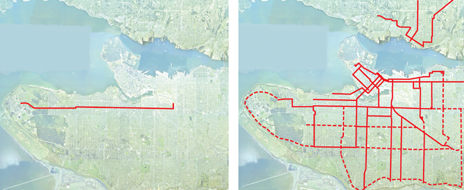
Map on left shows the conceptual location of the $220-million-per-kilometre Broadway SkyTrain line proposed by the province. On the right is an illustration of how much tram infrastructure you could install for the same price. Map shows heritage streetcar routes as solid lines, and a conceptual expansion of that historic system in dashed lines.
The planned SkyTrain subway spur along Broadway and out to the University of British Columbia campus will cost taxpayers 15 times what it would take to build a tram line along the same route.
In fact, for the $2.8 billion cost of the single 12 kilometre SkyTrain tube from Commercial Drive to UBC, Vancouver could build 175 km of tram lines crisscrossing the city and beyond.
That is the finding of a study led by Prof. Patrick Condon of the UBC Design Centre for Sustainability. His team based their calculations on the recent experiences of Portland, Oregon, and various European cities with light rail transit.
"This study demonstrates that the money needed for one 12 km subway line would be more than enough to rebuild and substantially expand the region's entire historic streetcar system," state the authors, noting that Vancouver and surrounding communities were built along trolley lines dating back to 1890.
Portland success story
But isn't Vancouver now too congested with traffic to make room for street cars on major thoroughfares?
Not if your guide is Portland, which is about the same size as Vancouver and in the last decade has installed tram lines along former street car routes long ago abandoned to busses and autos. Not only did Portland's trams not clog traffic, they stimulated real estate development along their routes, which vitalized neighbourhoods, sparking a building boom that created more tax revenue for the city.
"Within a one-block distance from the streetcar, new net development increased more than three times as rapidly as in any other block-distance," the report's authors calculate.
The demand for cost efficient public transit in Portland came directly from voters, who shot down a bond measure that would have funded a more expensive system. That message from the citizenry caused planners to seek out tram technology that is two thirds cheaper than more common light rail options and vastly less expensive than the SkyTrain system.
Portland tram trips are much slower than SkyTrain, but could be made speedier than automobile travel by coordinating street light changes as the tram travels through intersections, and by giving the tram a dedicated right of way over parts of routes, say the report's authors.
Slower can be better
The tram's pace may be better suited to the cross town UBC run than a faster subway with fewer stops, the authors assert.
"A high speed system is best if the main intention is to move riders quickly from one side of the region to the other. Lower operational speeds are better if your intention is to best serve city districts with easy access within them and to support a long term objective to create more complete communities, less dependent on twice-daily cross-region transit trips."
The report doesn't portray the SkyTrain as a white elephant -- nor is it the all purpose solution to big city transportation needs.
European cities such as Berlin, Vienna, Paris and Dublin offer a model of how to balance "expenditures between high speed trains, subways and light rail, and cheaper and lighter tram systems to serve more complete urban districts."
"There is no doubt that such a system would not be as fast as a subway," concludes the UBC team. "However based on the Portland experience, the benefits may be an improved quality of life in many neighbourhoods, an improved investment climate for higher density homes and job sites, enhanced access for citizens within their own districts and to other parts of the city (especially for the rapidly expanding seniors' demographic) and a substantially reduced cost per ride.
"As our region pushes towards a goal of 80 per cent reduction in per capita greenhouse gas production, it behooves public officials to look carefully at how taxpayer dollars can be most effectively used towards the creation of a very different pattern of transportation than the one we know today. A return to a pattern known before the rise of the automobile may merit a careful re-examination," wrote the authors.
'Take a hard look' urges prof
The $2.8 billion earmarked for the SkyTrain subway line to UBC is "a huge amount of money for a line to serve just the west side," Condon told The Tyee.
"The good news is we have time to figure out how to best use our limited transit money to make a more sustainable city. Portland has used very modest transit investments to make their neighbourhoods better places to live and work; transit for neighbourhoods, not simply through them. We should take a hard look at their experience before it's too late," said Condon, who holds the UBC James Taylor Chair in Landscape and Liveable Environments and is helping to develop a sustainable town for 15,000 residents in Surrey.
The report, co-written with Condon by UBC Landscape Architecture students Sigrid Gruenberger and Marta Klaptocz, can be read here.
Related Tyee stories:
David Beers is founding editor of The Tyee.
254
Login or register to post comments
snert
5 years ago
Wonderful Idea
Except at grade tram lines make a lot less sense than buses.
brian gough
5 years ago
We have lots of time
I agree 100%--But we don`t have to worry because as long as the BC liberals are in charge nothing will happen!
The canada line was built for the 2010 money pit games.
The evergreen line should have been built long ago.The 400million given towards the line was merely replacement money that the bc liberals borrowed from translink for the canada line.
So therotectly the liberals have given nothing for the line.
2014 completion date,providing it starts this year,mark my words it will be delayed until after the election(where have I heard that before)and if the bc liberals get in it will never happen.
The provincial goverment was hoping that translink would make a fortune as land developers,well that boat has sailed,housing market is now on the plunge.
Having said that,the only other option for translink to raise money is--You`ll love this,property taxes,fare hikes,and a GAS TAX!
For all you who haven`t read bill 43(greater vancouver transportation amendment act) Translink cannot,I repeat cannot choose one of those items it has to by LAW do all three at once(mind boggling)
By law it has to raise gas taxes by 3cents a liter,raise fares,and property taxes all together! What devious mind would write an act like that! You guessed it GORDON CAMPBELL!
If people actually read the legislation that this goverment has written they would run the liberals out of town!
Grumpy
5 years ago
Snert, et al.......
.......... well at last someone at UBC has been reading Grumpy's posts about LRT, for this is exactly what trams are - LRT.
At grade trams, operating on routes with ridership exceeding 2,000 persons per hour per direction, are cheaper to operate than buses. One tram (1 driver) is as efficient as 6 buses (6 drivers) and for every bus or tram operated one must hire at least 3 additional people to drive, maintain and manage them.
Trams, operating on-street, need not be all that much slower than a light-metro like SkyTrain and with careful placing of reserved rights-of-ways, stops, and priority signalling at intersections, the commercial speed of a 'tram' would almost match SkyTrain.
The key is station spacing and on-street operation. Modern trams would stop every 400 to 600 metres, much more convenient than a SkyTrain subway. It is not speed of a transit system hat is the prime attractor of ridership, rather the overall ambiance of the system and with modern LRT, operating on-street, easy to use, with frequent speedy service is a proven model in attracting new ridership.
Quote:
"A high speed system is best if the main intention is to move riders quickly from one side of the region to the other. Lower operational speeds are better if your intention is to best serve city districts with easy access within them and to support a long term objective to create more complete communities, less dependent on twice-daily cross-region transit trips."
This is very dated thinking and I am sad that the UBC types have not investigated the now famous Karlsruhe 'Zwei-System LRT, where one vehicle acts as a tram (operating on-street); as a light rail vehicle (operating on a reserved rights-of-ways); and a commuter train (operating on the mainline railway).
In Karlsruhe one can board a tram in the downtown and alight in downtown Heilbronn, on-street, some 150 km. later, all in the came vehicle (and sip a beer or a coffee in a 'bistro' car!). Tram-train is now operating in several European and US cities!
A note on capacity:
In Karlsruhe Germany, pairs of coupled articulated trams, operating on-street, at 45 second headway's, offers a capacity of about 25,000 persons per hour per direction during peak hours!
It seems to me that Bombardier Inc. the owner of the proprietary SkyTrain light-metro system and in the past donating several millions to UBC, gave the report 'academic chill' about largely obsolete and orphaned SkyTrain.
SkyTrain, which has now cost the taxpayer $5 billion, is a white elephant, a hugely expensive metro system that has done little to alleviate traffic congestion in Vancouver. Not one SkyTrain system has ever passed public scrutiny in the USA. Fact is, SkyTrain was made obsolete by modern light rail.
Grumpy
5 years ago
Seeing is believing.
Karlsruhe Zwei-System LRT or trams on the mainline!
http://www.youtube.com/watch?v=NsdJPaih0Fw
A coffee anyone, a Bistro tram caters to all!
http://www.youtube.com/watch?v=Izr4WOQ4_UY
Lisbons trams, narrow streets and 13.7% grades!
http://www.youtube.com/watch?v=_YiHO5jZYY4
A Strassburg "Jumbo', capacity 350 persons.
http://www.youtube.com/watch?v=gckN2ANG_zc
A lawned rights-of-way on a former multi lane street. Could be Broadway.
http://www.youtube.com/watch?v=MxygWFge3MA
Trams are quiet!
http://www.youtube.com/watch?v=Z01XYag1wuM
Trams in the city.
http://www.youtube.com/watch?v=PHwV-ZlBW8Q
A city tram in the mountains; or - where is the density?
http://www.youtube.com/watch?v=9SGa9FpGbPY
Luke Skywalker
5 years ago
Strategic, Tactical, and Operational Transit...
Vancouver's Broadway transit corridor is likely the most congested in Metro Vancouver.
It's the "Port Mann Bridge" of transit.
Extending the Millenium Line westward along the Broadway corridor (10th Ave.) will certainly take care of that congestion.
More importantly, Broadway is a strategic corridor requiring higher-capacity and faster transit connecting with the existing quasi-regional Skytrain network.
Planning must also look forward to the future and the additional population growth.
As for tram lines, the City of Vancouver's planned South False Creek/Downtown proposals are a good start.
Grumpy
5 years ago
Nope!
You make a very common mistake that a subway will take traffic off Broadway, it won't.
According to TransLink, 80% of SkyTrain's customers take a bus to SkyTrain and there is little evidence that the light-metro has attracted the motorist from the car. A SkyTrain subway to UBC, would only give current bus riders a very expensive trip.
Broadway is a natural for LRT/tram operation, as it would be cheaper in the long run to operate trams on the route instead of buses.
Speed is a non issue, because speed is obtained by eliminating stations; eliminating stations curbs ridership.
LRT having a combination of reserved rights-of-ways/on-street operation, priority signaling at intersections, much shorter dwell times (15 seconds)and on-the-pavement service, would obtain commercial speeds approaching that of SkyTrain. Also, please remember the time for the transit customer to reach the trains in the subway and to exit again. In Paris, it was just this sort of calculations that started new tram construction in Paris France.
LRT/trams are the public transit mode of the 21st century. Light-metro's like SkyTrain and RAV are yesterday's transit systems, built for yesterday's transit planning.
johndwyer3000
5 years ago
buses
I agree with Snert buses are the best way to go. Buses are by far the most cost effective, flexible option. Put the latest articulated buses, some double deckers, on all the main streets and coordinate them with traffic lights the way Prof. Condon pictures for the street cars. This way the bulk of the cars can be off the streets in several years. And yes, the Liberals and likely the NDP aren't going to do it without some form of public uprising over the back-breaking expense of skytrain/subway technology. Skytrains are designed to maximize payout for big 3P consortiums with comparatively limited results in moving cars off the road. Ergo Translink doesn't even consider a bus option to go both ways around Burnaby Mountain for the Evergreen line, just spend a billion on the one route. The main difficulty with the expanded bus option is addressing the blow the steep decline in auto use it would pose to the regional and national automobile industry - something neither the NDP, from a labour perspective, and the Liberals, from a capital perspective, are willing to do.
Grumpy
5 years ago
Trams carry freight
In Europe, several cities are experimenting carrying containerized freight by tram.
http://www.youtube.com/watch?v=op7rF7DeXt4
Grumpy
5 years ago
Buses are not cheaper to operate on heavily used routes
Because there is a rabid anti-LRT lobby at TransLink, the real reasons for building LRT have been ignored.
When ridership on a transit route exceeds about 2,000 persons per hour per direction, trams become cheaper to operate than buses.
Even a simple tram, operating on-street, with no signal priority at all, is about 10% faster than a bus and is as efficient as 6 buses. LRT is built for economy and the fact that trams/streetcars have proven to attract the all important motorist from the car!
For more info on modern public transport, try the Light Rail Transit Association's web site at
www.lrta.org
Luke Skywalker
5 years ago
Au Contraire
IMHO, you seem to be confusing regional/thru traffic westward to and including UBC along an extension of the regional Skytrain (Millenium) line along the Broadway corridor (proposed 10th Ave.) with existing Broadway-centric local traffic.
Furthermore, trams would just replace buses along Broadway along the same stops, at the same speed, interfering with the same existing (not future) traffic congestion.
BTW, Skytrain has a commercial speed of 80 km/hr, which neither lrt or tram could ever achieve along Broadway, notwithstanding Skytrain's higher capacity.
I do agree, though, that lrt as well as trams have their place in future Metro Vancouver transit but not along Broadway!
G West
5 years ago
Excellent article David
Good posts Grumpy.
Trash the buses; forget the Broadway line - bring on European style trams - and the sooner the better.
If, instead of the money-laundering carbon tax (the Campbell Tax), the provincial government actually wanted to find a way to stimulate and encourage transit and discourage the automobile and reduce C02 then the revenue from the Campbell tax would not be pumped, by law, back to the taxpayers - instead it would be funneled - purposively and methodically (and using the borrowing power of the government as necessary) into the kinds of changes illustrated in this article.
Not just in Vancouver but, mutatis mutandis, where practicable, everywhere in the province.
I welcome respectful comments to my posts at Tyee.
G West
SharingIsGood
5 years ago
grumpy wins
I am ever so glad UBC has signed on to what Grumpy has shown us for years. The rest of the world has figured out that Light rail is the way to go. Back to the future. Once the light rail tracks are laid, we can think about powering the little trains on compressed air. Compressed air would be very easy to amass with some helical turbines right on the Fraser. But who would pay into the oil companies or the electric companies if we get energy for free?!
Liberal shills better lay-off of this one. You can't win the argument. Your foolish emperor is in need of a wardrobe. ABC - give me Anyone But Campbell.
SIG
brian gough
5 years ago
All good ideas
Tranlink(skytrain) is way too expensive,buses would work well while lrt is being built.
The big problem is no one really wants to get cars off the road.
I would guess that 25% of all jobs are related to the automobile.
Definitly light rail is king,everyone knows the big earthquake is due to hit the pacific northwest (they average over 8 on the ricter scale,and happen roughly every 500 years,the last one was about 400 years ago)
When that ricter 8 quqke hits you can kiss all those skytrain lines goodbye!
With light rapid transit it can be rebuilt cheaply and fast,beats the hell out of 20 billion in skytrain vanishing in 2 minutes.
Luke Skywalker
5 years ago
And Public Opinion... Broadway Rapid Transit
From a 2000 Marktrend poll:
There are two areas that residents feel should have the most influence on the decision process: "how well the solution meets long term needs" and "how efficiently it moves riders".
Specifically, at least two-thirds of residents consider it very important (rating of 8-10 out of 10) that the rapid transit option chosen meets long term capacity needs and efficiently gets riders from point A to point B.
When each option is tested individually, residents show considerably more interest in introducing SkyTrain + RapidBus to the Broadway corridor than using RapidBus only or Light Rail Transit.
Indeed, about eight in ten find the SkyTrain + RapidBus option appealing, including one-half who consider it "very appealing". By comparison, only about one-quarter find either RapidBus or LRT "very appealing".
Again, attitudes are remarkably consistent between those who live in theBroadway corridor and the "rest of the city".
And appealing is what takes people out of cars and into transit.
http://vancouver.ca/ctyclerk/cclerk/000316/marktrend.pdf
jimmy_laroux
5 years ago
Excellent article,
Excellent article, Tyee!
The idea of building a subway through a low-density suburb, with almost non-existent growth, and a population zealously opposed to any zoning changes, is so monumentally stupid that it beggars belief that it is being proposed seriously.
Only in BC :)
jimmy_laroux
5 years ago
Luke
Luke Skywalker:
Oh really? Do you have a source?
Absolutely. I agree. It needs a tram :)
No. The trams should run in their own right of way.
Skytrain has a maximum speed of 90 km/h. The average speed is much lower (less than half, if memory serves...).
http://www.skytrain.info/Safety_Security.htm
Wrong gain. Broadway is an ideal location for LRT, and a profoundly foolish place for a subway.
snert
5 years ago
Buses are
infinitely more flexible.
That's why I feel a limited number of high capacity lines make more sense than a grid of trams.
ME2
5 years ago
Brian Gough
So much going on in this very interesting thread.
Tell us more about Bill 43, Brian.
Moat
5 years ago
Grumpy…you take some fact then mix it with fictional rant.
The premise of this article is really good. A tram rather than Skytrain technology should cover the UBC area. A subway (or tram with a right of way) should cover the rest of Broadway, for reasons of what Luke Skywalker has alluded to.
Like most people, I want the fastest and safest route from Point A to Point B. Skytrain is the safest and fastest way to get from Surrey Center to Downtown Vancouver during any rush hour. It has been that way for years. Arguing whether it goes 100km per hour or 90km per hour is silly because there are so many stops.
Here’s where I think the article goes wrong…
Whoa… like comparing an orange to a grapefruit. Portland downtown is much smaller than Vancouver – especially in terms of density. I have spent days and days walking through it. I don’t even bother taking the tram.
And secondly…. has the tram had a positive influence reducing sprawl? Not from what I have seen. Portland is still a freeway and sprawl city. Compare the density of Portland and Vancouver.
Calgary? They went with trams…. what has it done to stop sprawl? Rant all you want about light rail in Calgary…. it has done little to stop sprawl.
Now to address Grumpy….and his fiction
Time and time again, Grumpy makes this lie. The Detroit People Mover? JFK Airport? I don’t get it… I have called you out on this before.
And then Grumpy attacks Bombardier again and again… with quotes like…
Bombardier has a Flexity line that clearly represents your light rail. RAV is not being done by Bombardier… but rather a competitor.
The Portland MAX line originally used Bombardier’s cars. And wait, the cars of your ever mentioned Stadtbahn Karlsruhe sure look like they could be from Bombardier’s Flexity line. Bombardier makes any rail system we want… and they have not been treated that well by Gordo and co. Sorry, Grumpy, Bombardier was not the big winner on the RAV line.
I am going to agree with Luke Skywalker here…
Luke Skywalker wrote…
Agreed. Let’s give trams a go BUT only if they have their own right of way… let’s give subways a go…. put them where they make sense in terms of time savings, convenience, and money.
Mind you, while we fight over Light Rail vs. Skytrain… they continue to plan the twinning of the Patullo bridge… get ready for the North Fraser Perimeter Road.
snert
5 years ago
Google Earth
Backs up this statement. Go to Layers/Places of Interest/Transportation and turn on Trams.
zalm
5 years ago
More $$$$
Well,I was going to take issue with a few of Grumpy's facts without destroying his premise, but moat has already started that process, so there's no need.
So, moat, you were fine until you began to promote the subway. There is no call for a subway in Vancouver - our densities do not support it by any means. Subways only begin to become cost-effective when you rise above 50,000 person-movements per hour. Anything below that and you are wasting money, based on their excessively-high capital cost. The savings for operations and maintenance of subway cars and engines is lower per-train than for buses or trams, but when calculated per-person-moved, it is nearly exactly equal. And when capital costs are added, subways are more expensive than personal vehicles, which is what we're trying to get away from.
So, by all means, transit should follow the orderly progression from lower density to higher density, from buses, through trams to subways, but let's not get ahead of ourselves here. We might all desire to ride a subway to work, play or home, but we can no more afford it than we can afford to go to the moon every year on vacation. It is unbelieveably expensive, and when you look through Translink's books with someone experienced at evaluating costs and benefits, such as a CA or a transit engineer, you start to see how these facts have been hidden.
Never forget what George Puil said in 1997 and again in 2000 - "Skytrain (read, subway) - is an engine of real estate development. It is not meant as a people-mover and was never intended to be such." This was the thinking from the Chair of Translink based on staff reports, and it is entirely accurate.
zalm
5 years ago
That said...
Grumpy, I was on Karlsruhe's S-bahn to Durlach from the Bahnhof in 2006 to visit the wife's relatives, and it was a two-car affair no bigger than the B-line. OK, well maybe 5 seats bigger. It never got over about 40 kmh, and that was on the flat near the freeway. It spent most of its time around 20 kmh, and cyclists have to watch out crossing the tracks to make sure they're not trapped in the ruts. Things you don't ordinarily think about....
So I'm not sure what you're talking about when you say trams are 6 times as efficient as buses. Or nearly as fast as a subway on a dedicated line.
It's not as fast as subways, and it's not more efficient than buses, and you shouldn't say so without proof. You keep telling me to read a certain transit book which I haven't found yet, but the ones I keep finding don't mention anything of the sort.
KVW is a great system - multi-modal, long-range, great transfers to buse or Deutsche Bahn, great choice. Works well for Karlsruhe-Heilbronn where it's a homegrown system. But no attempt should be made to transplant it here. We are a quite-different city and country than Karlsruhe, Germany. We need to take their principles, and design our system from the ground up to serve us effectively and efficiently, and that means starting out with the cheapest options (buses) until we figure out what else will work better for a reasonable investment.
$200 million per km to move no more than 10,000 pph is not a reasonable investment - we both know that. But we don't have all the other modes that Karlsruhe has either, in order to provide choice, so we need to step carefully and design our own system without getting locked into one mode of thinking and one mode of transit.
brian gough
5 years ago
More bill 43 facts
"Greater vancouver transportation authorisation amendment act"
Translink was given power to toll every bridge and crossing in the GVRD and beyond.
Tranlink was given powers to over-ride municipal goverments.
Translink was given power expropiate land and to land bank.
Translink decisions cannot be overturned,also translink can proceed with any project even if its before a court of appeal.
Translink board of directors was chosen by the group of mayors but the list of people they had to choose from came from KEVIN FALCON
The directors are made up of members of the VANCOUVER BOARD OF TRADE--ACCOUNTANTS--MEMBERS OF THE GATEWAY PANEL-
Translink members are all business oriented and hand picked by KEVIN FALCON
Translink was given power to shift the tax burden from business to home owners.
With the power to land bank and choose routes and transit hubs with a wink and a nod these business oriented members can make people rich.
The bottom line with bill 43 is--To deflect translink decisions from the bc liberals(even though CAMPBELL and FALCON ARE CALLING THE SHOTS)
It also rewards this hand picked board with juicy renumeration.
The board of the bought and paid for flunkees does not have any --ENGINEERS--CITY PLANNERS--TRANSIT EXPERTS--TRANSIT RIDERS--ENVIROMENTALISTS--
For those not paying any attention there was another "CROWN CORPORATION" created last week--"The port mann twinning investment amendment act"
When FALCON was asked in the bc legislature what the purpose of this corporation was FALCON replied--"To count the toll money and return the money to the private toll company" he went on to say "that was the only wat to keep the toll money from co-mingling with other revenue"
FALCON was asked how much the new corporation would cost by the ndp member(renumeration,office staff,office space etc etc) he responded over and over again "minimal"
This is another translink type board of appointees.
You`ll love this one, The section on conflict of interest in this bill-Members of this corporation can have finacial relations to the private tolls and can make money on it,they merely must divulge their interests in writing.(There are many more devils in the details)
Grumpy
5 years ago
And now the real story
There are some very misleading quotes in many posts, here are the facts.
SkyTrain's commercial speed is about 45 kph it's maximum speed is 80 kph., most LRV's maximum speed are between 80 to 90 kph.
SkyTrain doesn't have higher capacity than LRT, never did. The SkyTrain lobby has just never told the truth!
Trouble with these surveys is that the public have never been told the truth about LRT and that the questions are slanted against light rail. In fact these surveys are not worth the paper they are printed on.
Moat, I take it you are Bombardier Troll. becuase I have not mentioned Detroit's ICTS and JFK's ART system was a private deal between the Port Authority (which operates JFK), Bombardier and the Canadian Government, there was no public oversight! The state of New York was livid over this deal.
I am not anti-Bombardier (do you have stock in the company?) but anti light-metro which SkyTrain is. We do not have the ridership for a subway (that needs about 15,000 pphpd to sustain it), but we do have the ridership for a modern tramway down Broadway.
Moat -
God man, don't you take off your rose coloured glasses, have a look up the valley, massive sprewl.
Transit doesn't stop urban sprawl, this is a myth; public transit is to move people, effectively and affordably, SkyTrain light-metro can't do this.
Why is it that city after city is building with LRT and SkyTrain has been relegated to a very few politically prestigious airport lines. Vancouver is the only city in the world that strictly pursues light-metro as a public transit mode.
Grumpy
5 years ago
Karlsruhe - Germany's Product of the year
Some reading on Kalsruhe's Zwei-system LRT, now being called tram-train. The concept is ideal for Greater Vancouver and if applied here, one could board a tram in Chilliwack and alight in UBC! Tram-train philosophy is being applied to many cities in Europe and the USA.
http://web.presby.edu/~jtbell/transit/Karlsruhe/
http://www.railway-technology.com/projects/karlsruhe/
http://www.lrta.info/articles/art0012.html
http://www.eaue.de/winuwd/85.htm
Grumpy
5 years ago
A question of capacity from the LRTA
CAPACITIES of different modes of
transport are generally quoted as
0-10 000 passengers per hour for bus,
2000-20 000 for light rail, and 15 000
upwards for heavy rail.
➢ In most applications where light rail is an option
the required Capacity will be much less than the
maximum. Capacity is only one reason for its
selection over other modes -environmental
considerations can make light rail an attractive
option even at the lower capacity levels.
➢ Maximum capacity is only likely to be required
for a few hours during peak hours, and even here
there are likely to be variations both day by day
and within each hour. The capacity required
originates from the route's social characteristics.
➢ As for the vehicles, buses have a comfort
capacity equal to the number of seats, and a
maximum capacity equal to seats plus standing
load.
➢ In the case of trams, it is more complicated.
The nominal maximum capacity is calculated at
four passengers per square metre of available
floor space (a reasonably comfortable level), plus
the number of seats.
➢ As trams are designed to carry a large standing
load, the ratio of standees to seats is quite high.
The standing area is also important for the carrying
of wheelchairs, pushchairs, shopping and
sometimes bicycles. Some manufacturers quote
maximum capacity using 6p/m2 while a figure of
8p/m2 is used as a measure of crush capacity.
This last figure is also employed to determine the
motor rating of the vehicle.
➢ A further complication is that even when there
are seats available, some passengers prefer to
stand. This may be because they are only
travelling for a few stops, that they want to stretch
their legs, or may just prefer to stand.
➢ A tram's comfort capacity can therefore be
considered as the number of seats, plus the
voluntary standees who may amount to up to
10-15% of the nominal maximum number of
standing passengers.
Grumpy
5 years ago
A Question of Capacity part 2
ELASTICITY
➢ It is the difference between the average
passenger load for any particular time and the
crush load which gives light rail its Elasticity
Factor, allowing it to cope with variations in
conditions such as sudden surges or emergency
conditions.
➢ Standing is made more acceptable by the
design of track and vehicle, reducing the forces
acting on the passenger to a minimum. This
makes for a smooth ride, as well as ensuring ease
of access, good support and the ability to see out
without having to stoop.
➢ Where a route is mainly urban with short
journey times, the number of vehicles required
should be calculated on the nominal maximum. On
longer journeys outside the central area, a lower
level may be more appropriate, dependent on the
route's characteristics. Even on rural sections, th
ere are likely to be a a number of short distance
riders, and the loading factor will increase nearer
to the urban area.
COMPRESSIBILITY
➢ While it might be thought desirable to offer
every passenger a seat, it is in fact the ability to
carry high loadings in a confined area (the
Compressibility Factor) which enables light rail
to achieve many environmental benefits, allowing
large numbers of people to be carried without
harming, and often improving, the features of a
city.
➢ It is city centres where several routes combine
that the most capacity is required. A typical
situation could be a pedestrian street with six
routes operating at 10-minute headway giving 36
double coupled trams per hour each with a
capacity of 225. This gives a nominal capacity of
16 200 passengers per hour which can be
increased to 25 200 pph in extremis without extra
vehicles. Light rail is unique in this ability to
operate on the surface with its capacity without
detracting from the amenities which it serves.
➢ A further factor in setting the resources
required is the need to lure motorists out of cars.
The more difficult the traffic conditions, the higher
the loadings will be acceptable. It is however
important that crush loads are not allowed for more
than the shortest of periods on an infrequent basis,
both to maintain customer satisfaction and prevent
elasticity of the system being compromised.
➢ It is vital that public transport can cope with
sudden changes in demand, such as extreme
inclement weather or air quality violations which
can cause private traffic to be halted. This is where
the elasticity inherent in light rail is so beneficial in
enabling an instant response in an economical
fashion. A tram may be crowded, but its infinitely
better than having to wait in the snow of smog until
extra vehicles are brought into service.
➢ It is this unique combination of Capacity,
Compressibility and Elasticity rather than
capacity alone which makes light rail so successful
as an urban transport mode.
➢ Note Statistics are based on Karlsruhe, using
GT8-l00c/2 cars.
Stump
5 years ago
Riddle me this?
Why is it that when people say they have to use their car to travel, it's because transit only goes certain places that don't coincide with their destination, but when asked what kind of transit they want, it's a fixed system only serving certain areas?
People may know what they want, but it seems they aren't quite clear on what they need.
Much of our traffic congestion is due to bad drivers and accidents (overturned semi blocking traffic today in Poco).
We need to accept the fact that cars are a terrible transportation solution in urban areas and give folks an extensive, connected public transit system.
Translink should also improve their website. Figuring out which bus you want and when it's coming takes way too long and navigating their site is not very intuitive.
Further, those gun-toting Transit Cops should also be riding the buses. It'd be nice to pick up my six-year old from school and ride the Broadway Corridor w/out hearing some baggy pants yob going on about the motherf*ckin' chronic he and his bitch were smoking last night and how he's gonna kick So-and-So's ass for calling him a fag.
But a massive shift to public transit won't be too impressive to the New Car Dealers or the Road Builders would it Luke Skywalker?
Grumpy
5 years ago
House cleaning
A Karlsruhe GT8-l00c/2 three section articulated car has a capacity of about 225 persons; a B-Line 2 section articulated bus has a capacity of 110. Two GT8's would have a maximum capacity of 450 persons. or put another way it would take 4 artic. buses (4 drivers) to match the capacity of a coupled pair of LRV's (1 driver). Wages account for about 70% of operating costs of a transit system.
Brian G. excellent posts on Bill - 43 If only the public knew the real truth about Bill - 43........but only about 11% of the regional populace use public transit! The rest don't really care.........until the TransLink portion of property taxes exceed $500!
Booker
5 years ago
Fast
I'm in favour of a cheaper system as long as they can make if fast. If it takes an hour to cross a small city like Vancouver, that's too long, and it's not going to get many people out of their cars. Rapid transit needs to be rapid.
NicS
5 years ago
Bus Rapid Transit or BRT
Although BRT is reputed to be more expensive in the long run than light rail, in the short term it can be very cost effective to set up and the layout for "transit only lanes" with pullout stops for other units to pass can later be integrated with light rail. As well, our current bus fleet could easily be integrated into this type of system. Check out this video
Bogota Part 2: Transmilenio Bus Rapid Transit
David, thanks for another informative and relevant post.
Grumpy
5 years ago
NicS..... & Booker
.....where has BRT worked?
Not in Ottawa, where ridership dropped over 15% on their transit system when they introduced BRT.
Not in Adelaide, where after over a decade of operation their BRT ridership stayed the same as non BRT ridership.
Not in Essen, where after 27 years of operation BRT ridership stagnated, unlike neighbouring LRT lines where ridership grew.
One can't compare South American bus systems with North American because the wages paid in South America are a fraction of what is paid here and wages account for about 70% of operating costs.
The World Bank, until recently, would not fund 'rail' projects in third world counties, but readily funded highways, needed or not. Thus much transit info from South America is skewed to 'rubber on asphalt' solutions.
There is no such thing as rapid transit because transit, either road or rail, is as fast as the number of stations/stops per route km. and the quality of rights-of-way.
Light rail, with stops every 400 metres to 600 metres apart, with 15 second dwell times (Skytrain is up to 1 minute at some stations), operating on reserved rights-of-ways, with signal priority at intersections has proven to match the speeds of a much more expensive light-metro.
In fact modern LRT has made light-metro obsolete, but don't tell that to the SkyTrain Lobby or TransLink's Board of professional; unprofessionals!
Grumpy
5 years ago
LRT is cyclist friendly
Most European tram operators emplace a rubbery, resilient strip in the flangeway to prevent upsetting bicycles. Seattle's streetcar folks refused Grumpy's advice and had several cyclists run afoul of the flangeway. I believe they are now following European practice.
Most cycle routes in European cities parallel LRT/tram routes.
Stump
5 years ago
an hour (you wish)
In rush hour an average cyclist can match a car's speed along 16th Ave from UBC to Main Street within a few minutes (30 - 40 minutes). If you can get from one end of Vancouver to another anytime during the day in a time frame significantly under an hour, you'd have to speed to do so.
You're also failing to add the amount of time it takes to pay for the vehicle, which sits idle most of the time but still has to be paid for (0 k/mh). Ivan Illich did some excellent work in this regard and I recommend his work to anyone seeking to better understand the false economy of private vehicle ownership.
City Person
5 years ago
Cherry Picking
Cherry picking is when you have a point of view and then go find a study that proves your point. UBC is the ideal place to do this because their library has an excellent cataloging system. I have been noticing more and more cherry picking since university libraries went on line. I could cherry pick plenty of papers that tell the exact opposite to the one in this story.
I have to admire Light Railers. They are a dedicated, albeit dwindling, lot. They are invariably retired gents who show up at transit meetings in bib overalls and engineer hats. Many have little trains in their back yards and choo-choo- their grand kids around on them. They were a constant headache when the initial hearings for Skytrain were held in the early 1980s. Since then, their pot bellies have kind of reduced their numbers. I used to think their smoke breaks were a convention of retired CPR employees. Come to think of it, many were. They did a good impression of the smoke bellowing out of a steam train, too, which, by they way, they also advocated a return to.
But I digress. Transit planners, and politicians are not planning for today. They are planning for fifty years from now. If you want to see a good model of transit, have a look at the TTC, the first fully independent transit authority in North America. Comparing Vancouver to European cities is also off base; all have population densities that are much higher than ours, all have high carbon taxes and all have made concerted efforts to keep cars out of cities.
Vancouver is going to densify. It is already happening. Planners are jacking up the price of parking. Gasoline prices are getting people out of cars. The number of cars has peaked in the Lower Mainland. Ridership is steadily growing.
Fifty years ago, planners had the foresight to leave the trolley lines. We are now reaping the benefits of this. But, conversely, it doesn't make sense to rip up the streets and reinstall tracks. The long term plan is to remove parking from major thru streets like Broadway and run more trollies. Business will scream about it but hey, anytime anything changes, people scream about it.
One size does not fit all, although many lobby groups feel it does. Some want bikes only, some want light rail, some want to do nothing. And of course, nobody wants it built in their back yard, either. Governments have to do what is right for the majority of the population fifty years from now. This means they actually have to listen to urban planners and transit enginners.
That is why in Toronto we see a mix of buses, street cars, subway and conventional trains. That said, Toronto has one regional government, an established transit authority and a much higher population density than we do.
But the Light Railers will never give up because they feel their solution is the best and only one.
Luke Skywalker
5 years ago
Trams (Streetcars), LRT, Skytrain, Subway...
To differentiate:
1. Trams are streetcars that typically share the right-of-way with road traffic (Toronto and Vancouver's proposed system comes to mind);
2. LRT has its own right-of-way but is not "freeflow" in that it is not "grade-separated";
3. Skytrain is a hybrid between LRT and a subway in that it does have higher capacity and travel times than LRT and is "grade-separated", yet it does not have the higher capacity of a subway;
The debate over the Evergreen Line was between LRT and Skytrain.
And Skytrain was chosen for the following reasons:
· will enable faster travel time – almost half the time from Coquitlam Town Centre to Lougheed Town Centre (12.6 minutes versus 23.6 minutes for LRT on the Northwest route, for example);
· has more frequent schedules – every three minutes versus five minutes for LRT;
· will easily integrate with the current rapid transit system, notably the Millennium Line.
http://www2.news.gov.bc.ca/news_releases_2005-2009/2008TRAN0006-000141-Attachment1.htm
As for the Broadway Corridor, that is a strategic route, which requires more than just streetcars (busses on rails) or LRT on 10th Ave. (with road crossings).
A grade-separated Skytrain extension to ~Alma is warranted (above-ground or below)but perhaps rapid bus from there to UBC is more logical from a financial perspective.
I will re-iterate, that just like European cites, Metro Vancouver needs it's "strategic" lines (Skytrain in this instance), its "tactical" lines (LRT), and it's "operational" lines (trams/buses).
Grumpy
5 years ago
Funny thing guys........
......... since SkyTrain was first marketed in the late 1970's only 5 are in operation, during the same time, over 110 new LRT systems have been brought into operation. Only in Vancouver, does SkyTrain hold any sway. It is the SkyTrain lobby that peddles mediocrity.
In the USA, no SkyTrain has passed public scrutiny.
Stump
5 years ago
50 years? An eyeblink
They should think about a hundred years from now, when most people will work from home and mass transit systems that only go back and forth from suburbs to city centres will have evolved into useless white elephants.
Show some vision. Employ some people. Put a thousand hybrid mini-buses on the streets and we'll be taking the first step to good transit everyone can use, instead of mediocre transit a few are forced to use.
Grumpy
5 years ago
Luke, I'm glad you brought up the Evergreen Line........
........business case because if that was released in the USA, the authors of such a report would be before the courts for intentionally trying to deceive the public.
The following is from Geral Fox, who is an internationally respected trnasportation consultant from Portland.
The Evergreen Line Report made me curious as to how TransLink could justify continuing to expand SkyTrain, when the rest of the world is building LRT. So I went back and read the alleged "Business Case" (BC) report in a little more detail.
I found several instances where the analysis had made assumptions that were inaccurate, or had been manipulated to make
the case for SkyTrain. If the underlying assumptions are inaccurate, the conclusions may be so too.
Specifically:
Capacity. A combination of train size and headway. For instance, TriMet's new "Type 4" Low floor LRVs, arriving later this year, have a rated capacity of 232 per car, or 464 for a 2-car train. (Of course one must also be sure to use the same
standee density when comparing car capacity. I don't know if that was done here). In Portland we operate a frequency of 3 minutes downtown in the peak hour, giving a one way peak hour capacity of 9,280. By next year we will have two routes
through downtown, which will eventually load both ways, giving a theoretical peak hour rail capacity of 37,000 into or
out of downtown. Of course we also run a lot of buses.
The new Seattle LRT system which opens next year, is designed for 4-car trains, and thus have a peak hour capacity
of 18,560. (but doesn't need this yet, and so shares the tunnel with buses). The Business Case analysis assumes a capacity of 4,080 for LRT, on the Evergreen Line which it states is not enough, and compares it to SkyTrain capacity of
10400.!
Speed.
The analysis states the maximum LRT speed is 60 kph. (which would be correct for the street sections) But most LRVs are actually designed for 90 kph. On the
Evergreen Line, LRT could operate at up to 90 where conditions permit, such as in the tunnels, and on protected ROW. Most LRT systems pre-empt most intersections, and
so experience little delay at grade crossings. (Our policy is that the trains stop only at stations, and seldom
experience traffic delays. It seems to work fine, and has little effect on traffic.) There is another element of speed, which is station access time. At-grade stations have less access time.
This was overlooked in the analysis.
Also, on the NW alignment, the SkyTrain proposal uses a different, faster, less-costly alignment to LRT proposal. And
has 8 rather than 12 stations. If LRT was compared on the alignment now proposed for SkyTrain, it would go faster, and cost less than the Business Case report states!
Grumpy
5 years ago
Gerald Fox part 2
Cost.
Here again, there seems to be some hidden biases. As mentioned above, on the NW Corridor, LRT is costed on a different alignment, with more stations. The cost difference between LRT and SkyTrain presented in the Business Case report is therefore misleading. If they were compared on identical alignments, with the same number of stations, and designed to optimize each mode, the cost advantage of LRT would be far greater. I also suspect that the basic LRT design has been rendered more costly by requirements for
tunnels and general design that would not be found on more cost-sensitive LRT projects.
Then there are the car costs. Last time I looked, the cost per unit of capacity was far higher for SkyTrain. Also,it takes
about 2 SkyTrain cars to match the capacity of one LRV. And the grade-separated SkyTrain stations are far most costly and complex than LRT stations. Comparing 8 SkyTrain stations with 12 LRT stations also helps blur the distinction.
Ridership.
Is a function of many factors. The Business Case report would have you believe that type of rail mode alone, makes a difference (It does in the bus vs rail comparison, according to the latest US federal guidelines). But, on the Evergreen Line, I doubt it. What makes a
difference is speed, frequency (but not so much when headways get to 5 minutes), station spacing and amenity etc.
Since the speed, frequency and capacity assumptions used in the Business Case are clearly inaccurate, the ridership estimates cannot be correct either. There would be some advantage if SkyTrain could avoid a transfer. If the connecting system has capacity for the extra trains. But the
case is way overstated.
And nowhere is it addressed whether the Evergreen Line, at the extremity of the system, has the demand for so much capacity and, if it does, what that would mean on the rest ofthe system if feeds into?
Grumpy
5 years ago
Gerald Fox part 3
Innuedos about safety, and traffic impacts, seem to be a big issue for SkyTrain proponents, but are solved by the numerous systems that operate new LRT systems (i.e., they can't be as bad as the SkyTrain folk would like you to believe). I've no desire to get drawn into the Vancouver transit wars, and, anyway, most of the rest of the world has moved on. To be fair, there are clear advantages in keeping with one kind of rail technology, and in through-routing service at Lougheed. But, eventually, Vancouver will need to adopt lower-cost LRT in its lesser corridors, or else limit the extent of its rail system. And that seems to make some TransLink people very nervous. It is interesting how TransLink has used this cunning method of manipulating analysis to justify SkyTrain in corridor after corridor, and has thus succeeded in keeping its proprietary rail system expanding. In the US, all new transit projects that seek federal support are now subjected to scrutiny by a panel of transit peers, selected and monitored by the federal government, to ensure that projects are analysed honestly, and the taxpayers' interests are protected.
No SkyTrain project has ever passed this kind of scrutiny in the US.
Victoria
But the BIG DEAL for Victoria is: If the Business Case analysis were corrected to fix at least some of the errors
outlined above, the COST INCREASE from using SkyTrain on the Evergreen Line will be comparable to the TOTAL COST of a modest starter line in Victoria. This needs to come to the attention of the Province. Victoria really does
deserve better.
Please share these thoughts as you feel appropriate.
Grumpy
5 years ago
Actually City person......
......I am not cherry picking (the SkyTrain lobby does that), but stating actual operational fact about light rail. With over 600 transit systems in the light rail family operating around the world and the most built 'rail' transit mode around the world, modern LRT is the transit mode of the 21st century.
The problem in Vancouver is the that the mainstream media has never reported accurately on transit, especially SkyTrain! And mostly repeat TransLink news releases, as sent, with no investigative reporting.
A lie repeated, becomes fact.
SkyTrain is a light-metro, which were/are a class of proprietary transit systems marketed around the world from the late 60's to now, but only about 25 light metro systems, including SkyTrain and its various names ICTS, ALRT (2 versions), ALM, and now ART and VAL,)have been built.
During the same period, over 110 new LRT systems have been built and over 150 more are either under construction or in advanced stages of planning.
LRT made the much more expensive light-metro's obsolete because they did not offer higher capacities, rather they increased fares and stunted ridership growth.
The same can be said for SkyTrain; The light metro is so expensive, too expensive to extend to the Fraser Valley, that it spawned the $4.5 billion Gateway highways and Bridging plans!
Like the holocaust deniers, the SkyTrain lobby keep turning out hype and hoopla, but no credible facts. They are afraid of scrutiny and keep repeating lies so often that for many, they have become fact.
Michael
5 years ago
Charlton Heston
I think the subway movement needs its own version of Charlton Heston to hold a model skytrain above his head and yell "not from my cold dead hands."
I live in New West and work in Vancouver. The Skytrain is awesome. It is fast and A REASON NOT TO DRIVE. Grump, Stump et al would prefer we all wear hairshirts and trundle along in street level trams. Have you seen the vehicle projections for Greater Vancouver over the next few decades? You are delusional if you think our roads are going to provide any type of reasonable commuting alternatives, rail, bus or whatever.
racc
5 years ago
Census Proves SkyTrain and Buses Work
Grumpy, time to give it up. The census proves once and for all that SkyTrain and buses are effective.
From 1996 to 2006, the number of people in Burnaby commuting by transit soared by 10,000 from 13,000 to 23,000. In New West, the increase was 3,100, from 4,800 to 8,100. In the Cities of Vancouver, Burnaby and New West, the cities with the most SkyTrain stations, the transit mode shares are all over 25%. This beats Calgary which is at 15% and Portland which is at 13%. Seattle, at 17% even beats Portland.
Regionally, Metro Vancouver is at 16.7% ahead of Calgary at 15.6%
Take a cue from Hillary and give it up already. You've put up a good battle, but it is time to move on. I suggest focusing on promoting street cars and LRT where it makes sense, but stop trashing SkyTrain.
In spite of or maybe even because of your trashing of SkyTrain, we seem to be getting more and more of it.
Stump
5 years ago
Michael
If you want to be packed like a sardine into a metal tube high above the ground that offers little or no facility to adapt to changing demographics, natural disasters, or equipment malfunction, that's your business.
Modular, flexible systems (such as buses) are far more adaptable, not much slower, and far cheaper.
brian gough
5 years ago
Hey Stump
[COMMENT DELETED. -MODERATOR.]
Let them have their skytrain,the evergreen line,the ubc line, an extension to the valley,by the time they get it they will be old and grey and harping the goverment for those 5000 long term care beds promised in 2001
City Person
5 years ago
They never give up
racc, Light Railers never give up. They are incredibly persistant. There are fewer of them around now because they are heading for the final station. They are a main reason that most transit decisions have to be done in camera.
Stump, one size does not serve all needs.
Brian, the topic is transit.
Dave2
5 years ago
Where do UBC students come from?
>A high speed system is best if the main intention is to move riders quickly from one side of the region to the other.
Which, in the case of UBC, is indeed the intention. A visit to Broadway and Commerical between September and March certainly proves that that point. These students are not coming from Point Grey.
Grumpy
5 years ago
Rac..........& Stump.......
........I don't see SkyTrain anywhere mentioned in the census, but one question: "What was the population increase in the same decade?
The last figure I saw was about 11% of the region's population use public transit.
Also interesting to note, Calgary's LRT actually carries more ridership per day than our SkyTrain.
What is lacking in Vancouver, is an annual or bi-annual independent audit of the transit system by the Auditor General, only then would the public get a true picture of how our transit system works.
Most other countries do this, except BC and I wonder why.
Brian G. has a good point, the money spent on subways comes from other areas including health care and even the NDP grudgingly admitted that funding for the Millennium Line came, in part, from the education budget.
Remember also, there is only one taxpayer.
Stump, to further your post. I attended an earthquake seminar some time ago and during the presentation the speaker went on on how after an earthquake SkyTrain would probably be the only means of transport. Thinking it a very strange comment I asked the question: "Since the greater portion of SkyTrain is elevated and running on a viaduct and due to the viaducts construction, if one of the guide-ways slipped off its bearings and collapsed to the ground, it would take not days, but many weeks to get Skytrain into operation again. Further if the shaker were to exceed & on the Richter scale and many more guide-way portions slipped off their bearings (like the Bay Bridge in San Francisco), it would take many months to get SkyTrain operational."
The speaker sat there dumbfounded and only blurted "it would never happen", and the Titanic was unsinkable!
Budd Campbell
5 years ago
GATEWAY AND TRANSIT
"The same can be said for SkyTrain; The light metro is so expensive, too expensive to extend to the Fraser Valley, that it spawned the $4.5 billion Gateway highways and Bridging plans!"
I agree with Grumpy that Skytrain is an expensive system, particularly because of it's dedicated, elevated or submerged guideways. If one is going to spend that kind of money on ROW and track, one ought to be running much faster rolling stock.
The bit about Gateway I find tiresome, though. It's just more of the usual Vancouverism baloney ("once in a world, a city like Vancouver!"), and kind of idiotic, end of the road exceptionalism that presumes that everything can be different here if we just wish it so.
The most amusing thing about the Gateway versus transit debate is that it falls into an old pattern of refusing to recognize that buses run on roads, and that it's physically impossible to have a good bus system without a good road system, just as one cannot have good rail without good tracks.
And then there's the cost. $4.5 billion for Gateway is said to be soaking up all the money that could be spent on transit. So then Premier Campbell says he will spend more than three times that, $14 billion, on a variety of transit projects. And transit advocates are somewhat please, saying it's a good start. OKay. What would a full program be? Would $28 billion do it? Would $56 billion?
As long as Metro Vancouver remains a collection of rival municipalities there can be no rational, unified discussion of transportation and land use policies. The first step is for the BC Govt to do what Premier Mike Harris did in Toronto, forcibly amalgamate the entire GVRD into a single, fully integrated municipality.
Grumpy
5 years ago
Funny thing that......
.........if high speed were the main criteria for public transit, why has Skytrain not found a market?
The answer is that speed alone is not the main criteria for a transit system, but the overall ambiance, which includes ease of use, reasonable fares, and the all important seamless (no-transfer) journey.
The assumption that SkyTrain is faster is based on a myth. Because SkyTrain has fewer stations (which means the transit is inconvenient) more people would have to take a bus and transfer (one can lose upwards of 70% of potential ridership per transfer)and maybe transfer again.
The overall time taken using LRT and the light-metro are comparable. Thus on-street LRT, operating in an environment that makes it easy to use (increased ridership) has proven to be the 'best bang for your transit buck'.
Only in Vancouver does this overwhelmingly vehement anti-LRT rant take place, mainly by people who no little or nothing about the science of modern public transport.
mjscox
5 years ago
commonsense dictates at grade system
While I understand the advantages of a higher speed system, either underground or elevated, isolated from pedestrians and traffic, a system that does not require drivers and is thus more "strike-proof" and less costly, perhaps, to run, a streetcar system is actually better suited to West Broadway. Unlike the Cambie corridor, there are shops and professional offices on almost every block, thus having multiple stops rather than the few major subway/skytrain stations would serve the merchants and residents better.
Furthermore, a streetcar system would take less time to construct, minimizing merchant and resident inconvenience; the multiple stations will encourage investment and business activity along the line, rather than in a zone around each subway station; it would be a highly visible, tourist and resident friendly system that showcases Vancouver's modern, multi-level approach to transit; it would be bicycle friendly; and it could, in turn, stimulate streetcar expansion into other areas of the city.
As it stands now, the Canada Line, while an excellent means of getting in and out of the city/airport/Richmond, is not going to stimulate growth between the stations. Also, there is no way, politically or economically, that Translink and its political masters can build a subway or elevated line, along the west Broadway corridor, without incurring heavy political cost from the residents and merchants. In fact, I would bet even a bored tunnel, with its necessary station construction and access points for materials, would be unacceptable. But a streetcar line would take 1/3 the time, per section, or less, to construct.
Get rid of parking on Broadway (it's a nuisance anyway, even if a merchant convenience), put in east and west bound rail lines, using the same trolley lines already in place; add bike lanes and two car lanes, with priority to streetcars, and you'll get a system that is efficient, effective, and acceptable. To get students to and from UBC faster than a multi-stop streetcar, keep the dedicated B-Line diesel/hybrid buses.
racc
5 years ago
Census Data - Read it and Weep
Here they are Grumps, for Burnaby at least. You can find the rest here as well.
http://tinyurl.com/6s4esf
http://tinyurl.com/62pd89
http://tinyurl.com/5jvrpk
http://tinyurl.com/6bv447
[LONG URLS REPLACED BY USING THE TINY URL REFERRAL SERVICE. LONG URLS BREAK THE LAYOUT OF THE PAGE. -MODERATOR.]
If you look at the census data, it is the municipalities where the Millennium Line was built that have the largest increases in transit use. Yes, the census does not say it was SkyTrain, but what else could it have been, it certainly was not LRT.
Your claim that SkyTrain has not been effective simply has no basis in fact.
What matters is transit usage here, not whether or not other cities are using SkyTrain or not or what some study 30 years ago said.
Dave2
5 years ago
>Skytrain has a maximum
>Skytrain has a maximum speed of 90 km/h. The average speed is much lower (less than half, if memory serves...).
About half, if you divide the stated distance by the stated travel time between Waterfront and King George it works out to about 45 km/h. The Portland streetcar's "average" speed is 16 km/h according to the document, about the same speed as the larger MAX system achieves when it's running through downtown.
City Person
5 years ago
Street Cars on Broadway
Since Broadway already has electric buses, it doesn't make economic or transportation sense to rip up the middle lane and install tracks.
It makes more sense to eliminate parking on the curb lanes and make them bus only. Then add more buses as needed. This would cost fractions of a street car line.
Budd Campbell
5 years ago
THE VIEWS OF PATRICK CONDON
Those readers who want more background on Prof Patrick Condon's views of urban transport and land use issues may wish to review this presentation from 2004. Titled "Canadian Cities, American Cities, Our Differences are the Same", it puts forward the view that the US interstate highway system eroded real estate prices in central cities and encouraged sprawl in the suburbs. Condon believes this is quite undesirable and puts forward the example of two families, one in St Louis and the other in Vancouver, on pages 13 asnd 14 of his presentation. It's worth reading, and worth thinking about.
http://www.fundersnetwork.org/usr_doc/Patrick_Condon_Primer.pdf
City Person
5 years ago
I might add
I might add that there are uses in the Lower Mainland for street cars. The most obvious would be a line on West Pender across the Lion's Gate to West and North Vancouver, with a loop down Burrard and along Pacific, connection to Main Street Skytrain.
However, it would be politically impossible due to resistance from West Vancouver and Yaletown residents.
Grumpy
5 years ago
This is how Broadway would look........
........if LRT were to be built. 2 lanes for the light rail reserved rights-of-way, two lanes for traffic and two lanes for parking for merchants. In some areas, light rail would operate in mixed traffic, as a streetcar. Commercial speed, depending on the number of stops, would be 25kph to 35kph.
With LRT on Broadway, all bus service would be eliminated as the new LRT/tram service would have convenient stops. Thus as ridership increases, operating costs would stay the same.
RAC, I read your stats but I still don't see SkyTrain mentioned. Your assumptions seem to ignore population increase and more transit services offered.
A note on Portland:
Portland's LRT and streetcar systems do not have signal priority in the downtown core. As through traffic is small, there is little inconvenience.
jimmy_laroux
5 years ago
Luke Skywalker: Quote:1.
Luke Skywalker:
Wrong. Plenty of trams run in their own right-of-way.
It is indeed depressing that Ken Hardie and Translink are this incompetent. I think we should hire the C-Train folks (the C-Train manages to run at 75% of the speed of Skytrain) or some Germans to build our transit system.
Utter rubbish. The B-line system alone is adequate at the moment (although they need more buses at peak hours).
Haha! This is the most ridiculous thing you've yet written on these threads, and that's an impressive feat! 230+ million $ per km to serve a suburb, to serve the 25 000 people per day currently served by the B-line? 230+ million $ per km versus a tenth of that for trams? And most would be going to UBC anyway, and you'd have them get all get off the subway at Alma and pile into a bus?
Haha! "Tactical" and "strateigc"? Give me a break! Where do you get this stuff? But seriously, building a subway to UBC is like swatting a fly with a bazooka. The result would be the same ridership as the lrt/tram alternative with an order of magnitude higher capital cost, and a far less flexible system.
Stump
5 years ago
earthquakes and Skytrain
It wouldn't even matter if the earthquake were just a mild one. If the stations don't survive, how will people board the 'unsinkable' train?
When one suicidal person can screw an entire transit system, it calls to mind a popular saying here on the Internets....
"You're doing it wrong."
Skytrain (which I use with reasonable regularity, but less so than buses) has too many downsides to have its minimal advantages be worth the much larger expense.
We should stop pretending it's about transit and admit what Skytrain is for: social engineering to facilitate real estate development.
Meanwhile old folks are forced to stand on buses because Coast Mountain doesn't have enough buses nor the common sense to put conductors on buses to enforce a modicum of civility from some of the louts who make the experience so negative for most people that wasting money and time on a car seems a better alternative.
About as shortsighted as sending our tax dollars to German shipbuilders.
racc
5 years ago
More Census Information
OK Grumpy, here is some more information:
According to the census, the transit mode share in Burnaby rose from 16.8% in 1996 to 25% in 1006. The number of people commuting by transit increased by 10,030 while the number of people driving increased by 2,770. Clearly the transit growth is much greater than the population growth. If it is not due to SkyTrain it is due to buses. Either way, it strikes down the myth that only LRT will encourage dramatic increases in transit use.
racc
5 years ago
Street Car Construction More Disruptive
mjscox
A street level system would likely led to more disruption for businesses, traffic and most importantly transit. After the disaster on Cambie, there is no way that they would do cut and cover along Broadway so the only option is to do a bored tunnel, likely along 10th. LRT and street car construction causes major disruption for up to two years. Not sure even where the buses would go during that time.
A bored tunnel would not be more expensive than cut and cover. The main reason for the cut and cover along Cambie is that they could guarantee completion by the Olympics, not because it was cheaper than boring.
jimmy_laroux
5 years ago
Dave2: Quote:About half, if
Dave2:
According to the study, Skytrain travels at an average of 40 km/h, whereas the Edmonton and Calgary systems run at 30 km/h. Not bad, for one tenth the capital cost.
brian gough
5 years ago
Too expensive
Just look what happened to CHINA in that earthquake,dams failed,mountains came down the earth heaved,no one will insure skytrain for earthquakes.
Richmond will liquify and anything of weight will sink.
I personally don`t want to roll the dice with 20 billion dollars worth of skytrain.
LRT could be up and running in a matter a couple of years.
If the big one hits LRT can be fixed in a matter of weeks not decades.
ThePosse
5 years ago
Horse and Carriage
I figured if Translink bought approx. 2000 carriages for these routes, bought 4000 draft horses, hired 100 pooper scoopers on quads and turned the PNE grounds into stables they would ;
- save $30 bil over 20 years
- rack up large carbon credit balances
- turn many so-so lawns in Vancouver into lush green free fertlizered lawns
- would create min. 2200 full time jobs
- reduce smog significantly
- create new tourist industry
There are too many people with too much time on their hands in Vanouver.
One city (Metro Vancouver).
One police force (NOT RCMP).
One transit rail technology (ALRT).
They still haven't even got the ALRT perfected. The train signs are too small and confusing (VCC Clark/King George) the Metrotown walk way is far too small and crowded etc etc etc.
Now introduce LRT into the mix. Get the picture? Bring on the horses!
Grumpy
5 years ago
RAC............
..........despite all you say, Translink can't prove a modal shift from car to SkyTrain.
As for businesses along the LRT route, well for a little disruption (far less than the Cambie St. merchants, businesses along a surface LRT route see about a 10% increase in business. Unlike a subway, street merchants store fronts become a billboard.
Construction of a tramway is by block by block. Modern track laying techniques (not yet in general use in North America) make minimal disruptions. It takes about two years to complete a LRT line, so the disruption in front of ones shop may take only a few weeks.
In Portland merchants fight to have LRT come down their street.
racc
5 years ago
Seems Pretty Clear
SkyTrain goes in along with bus improvements. The number of people and percentage of people using transit skyrockets. It seems pretty clear. What else would have caused this?
Grumpy
5 years ago
RAc........
......the fact is ridership on public transit has just kept pace with population. But as SkyTrain isn't mentioned in the reports you state, you make a very naive assumptions.
racc
5 years ago
The Facts
In Burnaby, between the 1996 and 2006, the percentage of people commuting by transit increased from 16.8% to 25%. This proves that transit growth was much greater than population growth. How else is transit increasing in Burnaby than by increased SkyTrain or bus usage? Tell me.
Even in the region, the transit mode share increased from 14.3% to 16.5% in spite of major under-investment by the province.
jimmy_laroux
5 years ago
racc: Quote:The census
racc:
The question you ask should not be "has ridership increased since the Millenium line was built?" The question should be "has Skytrain provided the most cost-effective transit solution?" It has not. The Millenium line hasn't even meet its ridiculously low ridership expectations.
And BC spent 1.1 billion $ to get a, in your words, "soaring" increase. If lrt could attract a similar ridership with a fraction of the cost, wouldn't it be the better choice?
Or better yet, if BC had spent 1.1 billion on lrt, what ridership would they have gotten? This is the point the UBC report in this article is making. The GVRD could have an enormous lrt network for 2.8 billion $.
You mean like the GVRD?
Oh, and incidentally, please provide a source for your "soaring" (ha!) numbers.
jimmy_laroux
5 years ago
racc: Quote:A street level
racc:
More transit provides a disruption to transit? Wha... And businesses? In what way?
Construction would probably proceed in sections. I'm not sure that I would characterise a construction over a couple of blocks along Broadway "a major disruption"...
Maybe this is just crazy talk, but I'd suggest going around the construction.
I doubt that. What's your source?
Budd Campbell
5 years ago
GEE STUMP, NO KIDDING!
"We should stop pretending it's about transit and admit what Skytrain is for: social engineering to facilitate real estate development."
You know, Stump, I have tried to say in the past that most of what passes for transportation debates in Greater Vancouver, be it transit or highways, are really governed and driven by real estate considerations. But for some reason people don't believe me.
Refering to your earlier post, I don't agree that the passage of time will deplete the suburban communities and render longer distance trains such as the WCExpress obsolete. Indeed as time passes we will need more and faster trains connecting over longer distances throughout the GVRD and into the Fraser Valley and north to Squamish-Whistler.
jimmy_laroux
5 years ago
City Person: Quote:I have
City Person:
That's just pathetic. But, I suppose, if facts don't support your point of view, it's time to cast aspersions.
What wit!
Thank you. Truly a revelation!
Excellent point. So if they are not building subways, even with higher population densities, why should Vancouver
In a few tiny pockets. Most of Vancouver is single family housing, particularly the West Side. And I don't see the West side turning into Yaletown within the foreseeable future. And you want to build a subway through that? If the zoning in Point Grey were to change right now to that of the West End, you might have a case.
But you don't, of course.
racc
5 years ago
OK Jimmy
Jimmy
The source is the 2006 census:
http://tinyurl.com/587tb3
and 1996 census:
http://tinyurl.com/6njzr2
[BECAUSE THE URLS WERE MAKING CREATING A LAYOUT PROBLEM, WE SHORTENED THEM USING THE TINY URL SERVICE. -MODERATOR.]
There is really no compelling proof that LRT in North America can attract similar increases for less money. Sure, there maybe some segments of LRT that perform better, there are many that perform much worse.
I doubt with increases in construction costs, that the network would be anywhere near as large as suggested in the article and the "research" paper.
Portland's street car only has 9,800 passengers per day in a dense downtown area. The Millennium Line is over 70,000 per day now through a suburban industrial area.
Charlotte's LRT is at 13,000 per day. It was build at a $427 million (2005 dollars). Much more expensive per passenger than the Millennium Line.
While the initial segment of Calgary's system was inexpensive, they are seriously considering a $2 billion tunnel downtown due to capacity issues. The latest expansion of Calgary's system is $700-million, 8.4-kilometre. Cheaper than SkyTrain but not by that much.
Again, Portland's system was inexpensive for the first segments but the cost for subsequent segments has been much more expensive. Their ridership is only 100,000 per day as opposed to over 220,000 per day for SkyTrain.
Regarding the cost of tunnelling. It was someone involved in the process. You could ask any engineer though.
You get what you pay for.
Regarding business disruption caused by LRT, just google it. LRT causes as much drama as SkyTrain.
jimmy_laroux
5 years ago
racc: Quote:There is really
racc:
Really? Calgary? Edmonton? What about the rest of the world?
That's downtown Calgary. Not Point Grey or Burnaby or Cambie or even Broadway and Granville. And anyway this is the beauty of lrt. It run at-grade, until some section become to congested. Then those section can be raised or tunnelled. With Skytrain the entire line much be grade-separated.
This expansion is much more like skytrain than the previous lines they've built. It will be grade-separated over most of its length.
http://www.calgarytransit.com/pdf/west_lrt_2007_report.pdf
Ha! "Ask an engineer." In other words, you were talking through your hat.
As much disruption as what? Cut-and-cover or elevated?
racc
5 years ago
Do Your Research
Not sure if I would point to Edmonton's system.
Edmonton's system is only 12 km long, while Calgary's light-rail system covered 42.1 km for about the same cost. As a result, by 2006 Edmonton's LRT ridership was relatively static at 42,000 per day, while Calgary's was over 250,000 and growing rapidly.
The point is that in North America, the only system that performs better than SkyTrain in terms of ridership is Calgary's. The rest don't look so good in comparison with SkyTrain in ridership.
Thus there is little reason to think that LRT would have performed better than SkyTrain in terms of ridership or cost per new rider.
There is a reason why Condon's" research didn't mention ridership of street cars. It is because it would have blown a huge whole in his "arguments.
See for yourself, check out http://tinyurl.com/2xdkbw
If you did, you would be doing more than the authors of the "research".
Luke Skywalker
5 years ago
Trams (Streetcars)... LRT...
The map in the article above illustrates what a high-capacity extension of the Millenium Line along Broadway could also pay for...
Namely, the original streetcar system within the City of Vancouver plus additional streetcar lines within the City of Vancouver, all of which are currently and effectively served by the bus system.
The City of Vancouver also has a streetcar initiative underway within the downtown/False Creek area:
http://tinyurl.com/6cbbe9
These streetcars (or if ya wanna call 'em trams) would serve "local" Vancouver-centric transit as opposed to the "regional" context of the Broadway Millenium Line extension, providing continuity to the existing regional rapid transit system.
That said, the streetcar (trams) is not LRT.
For those that suggest LRT would be cheaper and would be equivalent to a "grade-separated" Skytrain system think again.
Where would one place the dual tracks "at grade level" along the existing corridors for LRT? That "grade separation" represents the majority cost differrential for Skytrain.
A huge number of LRT crossings over roadways would need to be constructed resulting in further congestion along arterial corridors... and a huge number of low-volume cross streets would need to be closed off, which might not be agreed to by the affected municipal jurisdiction.
That in itself would result in slower speed volumes for LRT.
And unlike Calgary and Edmonton, with their abundant land masse and preserved corridors, much of Metro Vancouver is not as lucky in terms of where LRT would need to go.
Streetcars or even LRT "within" areas such as parts of built-up, higher density Surrey, Burnaby, Richmond etc. would make sense in conjunction with buses as part of a feeder route system to the regional Skytrain system.
Stump
5 years ago
The end of the commuting age
Budd said:
You've misunderstood my point Budd. I don't think there will be a mass exodus from the suburbs. I just don't think there will be the daily commute on the scale we see now.
Service workers will probably live in a festering sh*thole of ghettos ringing the core. The economic elites will either live right downtown in revitalized and gentrified neighbourhoods, or on the farthest reaches of the suburban areas outside the city. How other people get to work will neither concern nor interest them.
The office drones and white collar workers will literally 'phone it in' in terms of work, spending most of their working days at computer terminals in home offices, their productivity monitored by central scrutinizers observing them through webcams and keystroke logging programs.
This scenario makes economic sense for employers and employees, environmental sense in that it slashes the amount of commuters, and livability sense too, because who needs to waste two hours a day stuck in traffic?
I agree that fast trains from the outlying areas will be necessary, but I doubt we will see the peak ridership rush hours currently experienced. The idea one must get dressed and go somewhere to perform tasks that mostly consist of thinking and typing rather than performing said tasks at home in sweatpants is both efficacious and appealing to most of us (speaking as someone who's ahead of the curve in this respect).
Grumpy
5 years ago
Fast trains.............
........only work well if everyone in the burbs commute to downtown Vancouver - they don't. If one has to take a bus or take a bus from, or both, fast trains lose their appeal because the overall commute takes so long. The car becomes more efficient.
Example: My wifes cousin lives a 15 minute walk from King George SkyTrain station and works at YVR. She drives and her commute takes from 35 minutes to 60 minutes depending on the time of day.
She is on call and has a 90 minute window to get to work. She takes the car.
If RAV were to be in operation her commute would be a minimum of 90 minutes, full trot - 15 minutes to KG station 45 minutes to downtown Vancouver and another 30 minutes to get to her work. But many of her shifts end a midnight or 1 AM, no transit after that, so she will not take transit and will always rely on the car. A great portion of YVR workers work the same hours.
Also, I believe more people commute out of Vancouver's downtown than in and many work in areas with little or no transit.
And here is Condon's premise: Why spend $3 billion on a subway that for the same amount of money create an European style LRT/tram network to service as many areas as possible, providing an efficient and affordable LRT/tram network. This is modern public transport philosophy practiced in Europe for the past 2 decades; it works and works well.
As one transit expert who was involved with the RAV p-3 swindle commented to Grumpy about transit planning in Vancouver:
Moat
5 years ago
Zalm!
zalm wrote:
It is not that I am for subway everywhere. I think that in a few key places it would be useful, less disruptive, fast, and safe. The only issue I have with a subway is that it is a little too far from the fabric of the city.
I do support trams. But I also recognize what Skytrain has done. We should take note as to why people like it. Fast, safe, efficient, and does not get in the way of pedestrian or automobile traffic.
A tram to the airport down the arbutus corridor would have been cheaper and better. Total agreement.
Moat
5 years ago
Grumpy.... this thread is bad for you.
Grumpy wrote:
Hey... I have come clean. I own a few shares in Bombardier, like just over 1000. Not very much at all. I have mentioned this before. I was tempted to sell them all today. When buying the shares, I did a little research in the company..... so that is why I respond to some of your misleading posts.
Ok, well nothing stops sprawl... but the Skytrain system has slowed it. People, once they got over the Skytrain/Crime association, have decided they want to live near it.
Ah, so if the transit systems in Portland and Calgary don't reduce sprawl and the construction of roads.... then what is the point of building trams in these places?
27 minutes from via Skytrain Downtown New Westminster to Downtown Vancouver is fast, cheap, and safe.
racc
5 years ago
Not sure if your friend
Not sure if your friend would be any better off with a LRT network. I can't see it operating late at night.
First you have to make the case. Condon's work is even worse than the business plans put together by the province. He made no attempt to show that the new passengers kilometres attracted to the network of street cars would be greater than that of the UBC Line. The choice of Portland's streetcar with its really low ridership was bizarre. If it is a good idea, shoddy work work like this does not help the case.
What we really need in this is some unbiased research.
Grumpy
5 years ago
Portland's LRT is now
Portland's LRT is now carrying over 110,000 passengers a day, more than was projected. The difference between Portland and Vancouver is that Portland doesn't try to cram every bus rider onto the MAX to artificially inflate ridership.
And to Moat, this offering, public transit either bus, LRT or metro is to move people, not prevent urban sprawl and until TransLink actually plans transit to move people, affordably and efficiently, silly and expensive metro will always be planned in the hope that 'this time, we got it right'.
Moat
5 years ago
For Grumpy...
grumpy wrote:
Skytrain carries double.
As for sprawl...the transit lines, whatever they may be, go hand in hand with density planning.
A few people on this site do have an irrational fear of height when it comes to constructing towers. But I will take a residential tower in my neighborhood if it means protecting farmland in Richmond.
Ah, but I get off topic.
racc
5 years ago
Transit Usage in Vancouver Twice that of Portland
Grumpy, I'd stick to Calgary if I were you. According to the 2005 census City of Portland only has 34,000 (13.3%( residents commuting by transit while Vancouver has 70,000 (25%) residents commuting by transit according to the 2006 census.
Whether or not people are "crammed" on SkyTrain is not really relevant for this discussion. The City of Vancouver transit mode share would still be almost double that of Portland even if those people stayed on buses. Face it, the combination of SkyTrain and buses can be and is much more effective than LRT.
panamajack
5 years ago
The Future will include both ...
Congestion will never be solved: it's a reality of increased density.
As Grumpy has wisely stated though, the real question is how to increase ridership and the enjoyability/safety of the transit system. People, particularly women, seem to prefer on-the-ground systems, and as it takes away driving space it has proven to be very effective in frustrating drivers (by increasing congestion) out from their car and into cycling, walking, transiting.
Not politically popular though ... an expert from Bombay was recently at UBC explaining how a project in that mega city to create rapid bus lanes via sacrificing car-lanes has resulted not only in increased ridership but also calls for his head by opponents (the chauffeured upperclass and truck drivers).
kurt
5 years ago
lack of vision
The only reason Vancouver has to go to subways/skytrains is because the land is so damn expensive today and no one had the vision to set aside the right of way 100 years ago. In contrast the majority (about 70%) of London's Tube is actually at ground level. For example my family's London neighbourhood of Brent, currently served by what's known as the Tube's "Jubilee" line that goes downtown to Westminster and beyond, had the rail line established in 1880 when the Brent area was selected as a new suburban core for the downtown workers. At that time the population of Brent was negligible. Ergo, the Jubilee line was cheap to build and is sacrosanct; no one can drive any vehicle or whatever into a train or interfere with the Tube's operation along the Jubilee. Typically, Vancouver is doing retro work to do this, and the cost is prohibitively expensive.
Also, what's wrong with buses and trolleys? They definitely have their place and are much more versatile than LRT.
SharingIsGood
5 years ago
Vancouver streecars
From 1890 to 1955 Vancouver had an excellent light rail system.
http://www.tundria.com/trams/CAN/Vancouver-1940.shtml
Things looking a little better for the future Vancouver streetcars:
http://www.straight.com/article-135769/streetcars-named-vancouvers-desire
zalm
5 years ago
Census figures are wrong somehow
Racc, there's a problem with the census figures and the way you use them. They don't match the figures provided by Translink for their board reports.
http://www.translink.bc.ca/files/pdf/plan_proj/ThreeYr05-07Strategic.pdf
http://www.translink.bc.ca/files/pdf/plan_proj/10year_project.pdf
http://www.translink.bc.ca/files/polls_surveys/Section_4.pdf
(Transport 2021 is no longer available on the website of Translink - I have my own hard copy in files)
In 1993, BC TRansit's major planning document Transport 2021 projected a transit penetration rate (total population who regularly use transit to and from work or school) at 16.7% in 2021. The existing figure for the GVRD was 10.3% in 1993.
After missing their targets continually, especially for Skytrain which has continually missed target, usually by the slimmest of margins, but nevertheless MISSED TARGET.... in 2005 Translink decided to stop posting statistics on the transit penetration rate, and instead redefined transit riders as those who use transit at least once a month a majority of months in the year. Magically, transit ridership went up to as much as 58% of the population of the GVRD. This is the only statistic that is reported now, along with rate of growth.
Now don't forget, that's with 100 fewer buses and only 30-odd more Skytrain cars than they had in 1993.
In 2004, the last performance plan to mention a transit penetration rate was the 2005-7 Strategic Plan, which noted in 2003 the transit penetration rate was 11.7%. Since then, ridership has increased by between 4.4 and 5% annually, when set against a population increase of between 1.2 and 1.4% annually to the region of 1.98 million people (2003), calculates to a transit penetration rate of 12.4% in 2008.
This is based on Translink's figures. I think your census figures are wayyyy off. You should ask a few questions: What are the census figures based on? Hopw were the questions asked? What qualifies people as transit riders in the census? Once a week? Once a day? Once a month?
By the way, assigning the transit increase to Skytrain as you have done is bogus. No new cars have been added to the system since the Millennium line was started up. You can't say more people are taking Skytrain if you haven't added more capacity. However, about 60 more buses have since been added - is this where some of the people went?
zalm
5 years ago
Grumpy
Thanks for the info on Karlsruhe's cars, but the line I was on (Linie S-2) was a 2-section - so I'm not sure what that was.
Nevertheless it was a great trip. Dusseldorf to Thomashof (near Durlach) in just over 2 hours, multimodal by DB train, KVW tram, and bus for the last couple of km, convenient and less than 150 Euro (1st class) for the two of us.
I used to drive when I travelled there, until they deregulated the trucking industry. Best part of the trip was passing the 5-km-long staus at Mainz, Mannheim and Karlsruhe to get there. Whatever in the world Cityperson is talking about Europe keeping cars out of cities,I haven't a clue. Except for London and Paris inner city, the rest of Europe is irrevocably wedded to their steering wheels. It's only the relative convenience of transit that has made it competitive and popular.
Those who think the Port Mann is bad need to travel the A-3 or the A-5 on a rainy Monday. Longest one I was ever in (12 km) outside Stuttgart took me more than 2 hours to get through.
zalm
5 years ago
Moat
I hear you, but I don't think you heard me. Subways only become cost effective at 50,000 passenger-movements per hour (pph) and above. None of our Skytrain lines are/will be more than 7,000 pph for the foreseeable future. The most recent Ten-Year plan forecast 10,000 pph on the Expo line in 2013, but as I stated in previous posts, Skytrain has a way of not meeting its targets.
50,000 pph will require an increase to 8-car trains on a 1-minute schedule! How likely is that?
Don't forget, you have to amortize the cost of the railbed as well, even though Translink deliberately does not cost it into its statistics (although it does in its annual audits only because it HAS to). That means the $200 million per km investment has to carry a large number of passengers to be cost-effective. I'm not sure what trams would cost, but buses at an estimated $3 million per km (vehicles, shelters, operations and maintenance) are a lot more effective and efficient at the densities we run at.
Or, easier to understand, Skytrain averages 78 boardings per car per hour every minute it's in service. Buses average 55 boardings per vehicle per hour. Same $2.50 fare. But the operating cost per ride including amortization is $5.50 on the bus and $48 on Skytrain.
It's OK for you to say you like the look and feel of Skytrain, but don't try to pretend it's a necessity. It's always been a Cadillac for what the demands are here in Vancouver.
echman
5 years ago
Reason for Skytrain
The main advantage of a Skytrain line (below ground or elevated) is its non-interference with street traffic.
Tram lines run into problems because they take away from existing street space to make way for the tram line.
On St. Clair West in Toronto they have an old tram line. There was a lot of discussion about how best to operate a street level tram. At first cars could drive along the tram line, so if there's alot of traffic the tram is no quicker than a bus or car because the tram could get stuck in the traffic (unlike a skytrain line which doesn't have to worry about car traffic).
After awhile they decided to make the tram line car free, which lead to huge debate in the community. Businesses worried about losing drive by customers due to a decrease in parking spaces.
Vancouver has already done a great job of restricting space for cars compared to other Canadian cities. We could do with some traditional subways, because they are faster then trams for getting people across a region. The price is steep but worth it.
Trams are buses on rail lines, which begs the question how much would it cost to add in bus line to all the places on the maps shown above. I bet it's cheaper then installing trams.
Installing a Skytrain/Subway is faster and better in the long run for the Commercial to UBC route. build tram line or rapid bus lines off of the main stations on the line.
Grumpy
5 years ago
Street traffic
The great excuse for SkyTrain - street traffic. If the tram operates as LRT, on a reserved rights-of-way, the street traffic issue disappears!
The concept of the reserved rights-of-way instantly made light-metro (SkyTrain, VAL, Monorail) obsolete. This echoed in the fact that the sales of light-metro around the world are almost nonexistent.
Subways are not the answer and experience in Europe has shown that. Subways are built only when ridership, in excess of 15,000 pphpd, demands such expensive segregated rights-of-ways.
The regions 3 light-metro lines were forced upon the region with little or not public scrutiny, abetted by bogus transit studies. and strong political influence.
If Paris, a heavily populated and dense city, modern on-street LRT is deemed feasible and desirable, then the planners here should get 'with it' and plan for it here.
A SkyTrain subway to UBC, with widely spaced stations, will not attract as much ridership as a on-street LRT/tram system with stops every 500 to 600 metres.
With gas fast approaching $1.50/litre, we need to build a 'rail' network for the region as fast as possible. By comparison Portland has 4 LRT lines & 1 streetcar line, 1 LRT & 1 streetcar line nearing completion, 1 LRT line in planning, and 1 LRT line pending approval. LRT is being built at about 1 line every 3 to 4 years.
Compare here where light-metro lines come about 1 a decade.
Not know generally by the regional public, Vancouver's transit planning is seen as a kind of a joke, reserved for 3rd world countries where the local potentate builds hugely expensive 'show case' light-metro lines to satisfy is personal 'penis envy'. and not to solve local transit items.
Grumpy
5 years ago
Kurt....
...Why do you think they build LRT on-street? The taxpayer owns that, no land costs!
racc
5 years ago
Read the Reports
zalm
Please read the reports just think about just a little bit. http://www.translink.bc.ca/files/pdf/plan_proj/ThreeYr05-07Strategic.pdf was written in 2004 two years before the 2006 Census and four years before the numbers where released a couple of months ago so of course they were not included..
The census figures are collected the same way for cities across Canada so they are useful for comparison. They may not match TransLinks numbers that were collected using different methods.
Bottom line is that Calgary has a smaller percentage of people commuting using transit. Metro Vancouver is at 16.7% ahead of Calgary at 15.6%. Calgary has the best performing LRT in North America. The rest are much worse and most are far less cost effective than our SsyTrain system. That's the facts. So much for the myth that LRT is better at attracting passengers than SkyTrain and best.
mikey d
5 years ago
I highly doubt other
I highly doubt other students at UBC would want to connect to UBC using LRT. Wouldn't this line include a major point destination (UBC) and connect to three other major transportation lines (Canada Line, Millenium Line, Expo Line)? The majority of passengers aren't going to care how they get there - as long as they get there quickly.
A reason for Calgary's success with LRT is in their land configuration. A central city core with arms reaching out to the suburbs and no land restraints (where a dedicated right of way wouldn't be as much of a problem as in Vancouver where, uh, it has a BUILT UP grid) is efficient in transporting everyone to the core.
LRT and trams are great to complement an existing transit backbone. They would work well in funneling people AROUND downtown and existing town centres where people aren't only trying to get from Hub A (Expo interchange/extreme point 1) to Destination B (UBC/extreme point 2). LRT works well to SUPPORT the system (a great example is Hong Kong's LRT in the suburbs connecting to West Rail and the trams running ABOVE the subway). If it "works so well" in urban situations, then let's see you use the tram in Hong Kong over the subway to get to the same destination.
The fact is, the Broadway corridor is going to densify. Instead of building a shoddy system now (LRT) and having to build a better one later (underground ALRT/subway), why not just build it now?
Also, as the for the not-so-wise comment about SkyTrain capacity being less than LRT - what a joke! Anyone who can honestly say that a train running ON THE STREETS next to cars can carry more than a separated underground Skytrain has got to be joking. You can easily saturate the number of train movements per hour running LRT as it's going to interfere (yes, INTERFERE) with road traffic. With SkyTrain, you can run trains with headways of 90 seconds and with longer trains. With each Skytrain car being able to carry more than a LRT car, anyone who knows basic math will realize that a Skytrain system will move more than a LRT system.
If I wanted to take a slow, uncomfortable ride through undedicated right of ways to get to UBC, I'd just take the bus.
SharingIsGood
5 years ago
with all due respect
racc
Comparing Vancouver with Calgary is comparing apples and oranges:
Calgary has approximately 1.1 million people in the greater metropolitan area. http://en.wikipedia.org/wiki/Calgary
Metro Vancouver has about 2.25 million people.
Calgary can build out in every direction from its heart.
Vancouver can go basically east and west.
Vancouver is more congested and it costs more to park in Vancouver. There are but a few bridges some sea buses and a tunnel into Vancouver. Calgarians have the entire grid. It is easier for Calgarians to use their cars.
Further, really cold winter weather and really hot summers makes using public transport less attractive for many people in Calgary. Many would sooner pre-heat their car, and jump in.
Here, I make an assumption. BC has attracted more earth-friendly thinkers than one finds in the Dallas-style city of Calgary. People in BC would never stand for what the Albertans are doing with the tar sands and the Athabasca river system. Unlike Albertans, more people in BC may use public transit because it is better for the environment. Getting people onto Light Rail and off of rubber-tired vehicles would be even more attractive to eco-friendly Vancouverites and visiting tourists alike.
LRT systems have aesthetic value. I know that I enjoy riding on an LRT systems much more than on buses, skytrains, or subways. And, really, isn't part of life about enjoying one's journey. Let's build things we enjoy.
mikey d
5 years ago
"LRT systems have aesthetic
"LRT systems have aesthetic value. I know that I enjoy riding on an LRT systems much more than on buses, skytrains, or subways. And, really, isn't part of life about enjoying one's journey. Let's build things we enjoy."
According to your logic, we should build more roads since people enjoy using their private cars more than they do taking transit.
No thanks.
SharingIsGood
5 years ago
public transit - mikey d
I think that we are discussing the designing and building of an affordable public transportation system that is both, eco-friendly and that people will use. If people dislike something they will look for ways to avoid it.
Building more roads has nothing to do with my logic, but since you bring up the topic:
People dislike paying high prices for fuel, paying high parking fees, traffic jams and pollution. If a public transit system can be made more enjoyable and affordable than a polluting personal transportation device, then people will use it.
panamajack
5 years ago
Grumpy ...
While I mostly agree with you, stating "Vancouver's transit planning is seen as a kind of a joke, reserved for 3rd world countries" is utterly ridiculous.
Such language demeans your argument to the level of an internet troll.
Transportation experts I've talked to, while still LRT advocates, still think Translink is a decent system, just not terribly cost effective.
panamajack
5 years ago
Rapid Bus vs LRT
Grumpy, you've mentioned the disadvantage of having metro stations too far apart .... but what about the current system along the Broadway Corridor?
Don't B-line stops currently approximate where the Millennium Line extension stations will be (VCC, Main, Cambie, VGH, Granville, [Arbutus?], MacDonald, Alma, Sasmat, UBC?)
I
Grumpy
5 years ago
A joke..........
........after the RAV fiasco, the international transit fraternity saw first hand how utterly corrupt the process was. Vancouver was seen as a joke and still is.
What Transit authority would spend $2.5 billion on a 21 km. subway to move no more than 5,000 pphpd? Only in third world countries does this happen. Take off you rose coloured glasses and see how sill our transit planning is:
1) An unelected transit board with no transit experience and no public oversight.
2) A planning process that doesn't consult with the public.
3) A continues support of a transit mode (light-metro or Skytrain) that is seen as an obsolete transit mode.
4) A transit system that no one has copied. (A note to the Portland naysayers: At least Portland's LRT has been used as a template with US Cities)
5) A Transit authority that doesn't recognize that LRT is not a heavy-rail railway or a poorman's metro.
Now Mikey d.
This is one of the silliest quotes yet, if LRT serviced UBC, student would take it, really your logic completely escapes me.
As I stated before, building with LRT is economy, as when ridership exceeds 2,000 pphpd on a transit route, LRT/trams become more cost effective to operate than buses.
The reason is simply 1 modern LRT/tram vehicle (driver) is as efficient as 6 buses (6 bus drivers) and for every bus or tram operated one must hire at least 3 people to operate, maintain and manage them.
On a route requiring 60 buses (60 drivers)only 10 trams (10 drivers) may be needed, thus the total employees needed for the bus route would be 180 persons versus 30 for the LRT/trams. With wages about 70% of operating costs of a transit route, the savings over a 25 year period are huge! Also 1 LRT/tram lasts 40 to 50 years, while buses last about 15 years.
The heavier used route (Broadway) would be far cheaper to operate with LRT, rather than buses. Metro, with their massive construction costs need about 15,000 pphpd to justify construction.
Dave2
5 years ago
Jimmy, the 40 km/h average
Jimmy, the 40 km/h average speed is correct only if you include the layover time. In service, the average speed is indeed 45 km/h
http://www.vcn.bc.ca/t2000bc/learning/vancouver/operating_stats.html
To be fair, it's unlclear if the Portland Streetcar figure of 16 km/h includes layover time or not. Regardless, Sktyrain can achieve speeds of 80 or 90 between stops depending on the source; and there's no way LRT down the middle of Broadway is going to able to travel anywhere near that speed... and if there's to be stops every 500 - 600m, you might as well stick with buses.
racc
5 years ago
Get Your Numbers Right
Grumpy
The Canada LIne is under designed but at least get your numbers right. The capacity of the line is 12,000 ppdph and expandable to 16,000 ppdph when the platforms are extended to 50 metres. Not great, but better than what you state. It is $2 billion for 19km as well.
Broadway will likely be at 15,000 pphpd by the time the UBC Line is finished.
racc
5 years ago
SkyTrain Much Better than Portland LRT
So what if Portland is being used as a templete. LRT systems in the states are getting a fraction of the ridership that SkyTrain is. On many systems, the cost per passenger is much higher than SkyTrain. LRT is just not working as well.
At 7153 passengers per mile, SkyTrain has over 3 times the passengers per mile than Portland and is higher than all other street car and LRT systems in the states except Boston.
1 Boston 9,196
2 Houston 5,333
3 Buffalo 3,063
4 Seattle 3,000
5 Minneapolis 2,533
6 Los Angeles 2,285
7 San Diego 2,213
8 Portland 2,173
9 Salt Lake City 2,089
10 Tacoma 1,938
11 Newark 1,924
12 Denver 1,797
13 Philadelphia 1,782
14 San Francisco 1,650
15 St. Louis 1,591
16 Sacramento 1,450
17 Jersey City 1,404
18 Dallas 1,305
19 San Jose 1,063
20 Baltimore 1,037
21 Pittsburgh 1,024
22 Charlotte 906
23 Cleveland 760
24 Memphis 388
25 New Orleans 367
26 Tampa 348
27 Little Rock 136
28 Trenton 113
29 Kenosha <50
30 Galveston 19
http://tinyurl.com/2xdkbw
Romeogolf
5 years ago
Woodenheadedness!
It truly boggles the mind at the really lame arguments trotted out here against 175 km of tram for 12 km of SkyTain, especially the whining about trams taking road space away from cars (that's the point!). Just look at the map, and it's obvious how much more service would be provided.
Grumpy keeps on asking the same question and not getting an answer: If SkyTrain is such a wonderful, cost-effective, efficient system, why aren't there more throughout the world?
Clearly, you don't know Hong Kong very well mikey d. Hong Kong's trams and LRT were built BEFORE the MTR lines running below them, not after, in support of them. Once the population density justified building a subway, it was built. The 1904 Hong Kong Island tram line still operates and is not wanting for passengers. Depending on where one lives and how far away one's destination is, taking the tram is faster than the MTR when you consider the amount of time taken to get to the station, down to the platform, wait for the train, travel time, then back to street level.
Hong Kong has the population and density to offer a wealth of transportation choice. Vancouver doesn't. But if we want to get a large number of people out of their cars to be able to significantly reduce our greenhouse gas emissions, then we have to find the most cost-effective means to extend convenient transit service to the greatest number of people in the Lower Mainland in a reasonable time frame. Five SkyTrain-type projects mean you cannot provide even decent basic bus service in the suburbs for decades. That is utterly incompetent!
JIm
5 years ago
Recently I was in two of the
Recently I was in two of the cities mentioned as having a great mix of public transit options, Berlin and Vienna. The article is right they are great, but they both have subway systems. They both also have elevated train systems similar to Skytrain in nature. Not a bombardier creation, but elevated trains that don't interfere with traffic. This combination was fast and efficient.
The place I found with the most prevalent at grade LRT like Grumpy harps on was Amsterdam. Amsterdam is a very unique city with next to no car traffic so dedicated lanes and right a ways were no problem. The kicker is they're building a brand new subway line to compliment their transportation network. Hmmmmm.
racc
5 years ago
Street Cars not Effective
Problem is that streetcars have not been proven to be effective in North America. Just look at the last post. In general, you likely get fewer new passengers per dollar spend with street cars in North America than with SkyTrain.
Bottom line is street cars and SkyTrain is complimentary. They can work together. Instead of having the endless battles, lets work together to get both. Fighting SkyTrain has not been effective in getting LRT. Likely it has had the opposite effect because people like Grumpy keep insulting the very people that need to be convinced to build LRT and street cars. It is a very poor strategy that has failed spectacularly.
Poorly done studies like the one referred to in this article don't help much either.
Grumpy
5 years ago
racc.....B.S. baffles brains
If Skytrain is so good, why doesn't anyone build with it? Why if Vancouver's SkyTrain system is so wonderful, why doesn't anyone copy us.
Fact is, SkyTrain is a yesterday's transit solution for yesterdays problems.
SkyTrains high ridership is due to the fact TransLink tries to cascade as many bus riders onto the metro as they can, good god, they even terminate the Main St. Bus at Main St. Science world, so a few thousand more people can be counted as riding SkyTrain
Amsterdam is building another subway line (a very expensive subway line) due to the now anti-tram politicians on their council. racc you would fit right in, why not move there.
The notion that:
is utter nonsense. and talk about poorly done study, not one Translink study would have passed any type of peer review.
You want SkyTrain old chums. Well welcome $5.00 one zone fares and $1000 property tax hikes and the splitting of Metro Vancouver so those cities and munis with SkyTrain, pay for SkyTrain and those who do not, will not.
So easy to support Skytrain when everyone else pays for it.
Grumpy
5 years ago
racc......
RAV is now $2.4 billion and climbing and those easily extended subway stations, just about $5 million per station more to extend them.
Also Translink increased capacity of RAV, by artificially increasing car standing capacity from the industry standard of 4 persons per sq. metre to the theoretical 8 persons per sq. metre.
On and on it goes........................
mikey d
5 years ago
Quote:On a route requiring
So you've established LRT > bus.
Two points:
ALRT (Skytrain) requires no drivers. So wouldn't the savings be even GREATER?
Since you're looking into the long term: Skytrain in the long run WILL be more cost effective. If demand ever increases past 15000ppdph, how would LRT cope with it? Once the streets are saturated with LRT cars and private automobiles, you can't add any more in service. Even Calgary eventually plans to replace the downtown portion of their system underground.
As for the LRT comment, if there are no buses, of course they will have to take LRT. If they had an option of shaving off, what, 10 min (if not more) of their travel time, they would take Skytrain.
It doesn't really matter WHEN they were built. It still serves the point that the tram/LRT is great for CONNECTING close-by communities but they are definitely NOT the backbone of the transportation infrastructure TODAY.
The tram offers a cheaper alternative than the subway. (shrug) The original population density of Tung Chung did not warrant building a rail line, but it was planned to grow.
Well, sure, if you're only planning to go one block. If you've taken the tram from North Point to Central, I assure you you can beat the time by using the subway. It doesn't take an hour by subway (even if you include the, what? 3 minute headways between subway trains?, and the platform access time) to get from NP to Central. Unless you purposely walk slower than normal, of course.
LRT is great for the Fraser Valley suburbs where the density really doesn't justify a Skytrain line. The Broadway corridor isn't going to stagnate unless the Bubble bursts, and will eventually grow to a point where using a car will still be faster than using LRT.
This is almost like that time where it was LRT vs. ALRT/underground with the Canada Line. At least back then, those favouring LRT really had a case (the Arbutus rail corridor is already there), whereas now, there are no existing right-of-way set aside for LRT.
mikey d
5 years ago
By the way, I'm not
By the way, I'm not anti-tram or anti-LRT. I think it's great to have both "heavy light rail" and light rail systems. The Downtown Vancouver/False Creek tram/streetcar plan is an AWESOME way of funneling people around downtown while connecting to the BACKBONE of the region, the Skytrain system.
Oh, and $2.8 billion will not pay for 175km of light rail in Vancouver. Consider that the LRT version of the Evergreen line escalated to $1.25 billion dollars for just 11km of light rail.
Romeogolf
5 years ago
Timing Does Matter (The Economic Thingy)
It does matter when they were built. Would you spend billions of dollars putting in a subway/ALRT backbone in a city when analysis tells you that there won't be sufficient ridership to pay for it in decades? That would be totally incompetent.
Why do you think the suburbs have lousy transit service now? Why is TransLink not encouraging people to use transit -- anything but? They don't have the money because the Libs have saddled them with a handicapped funding formula and will only give them the big bucks for select megaprojects of their choosing.
Why is it that we don't utilize existing right-of-ways like the Interurban or the Arbutus Line? Might it be too efficient a use of money that it doesn't get the media splash $14 billion commands? Might it be that too many people would actually use those services and not support the New Car Dealers and Road Builders?
I didn't say 175km of LRT; I said "tram." The Evergreen Line is not the tram technology Condon is talking about.
Mac Fish
5 years ago
Skytrain vs Subway vs Light Rail
All I can say is thank heavens that the Skytrain system we have was not built as a ground level nightmare that light rail would have been. Think of the few rail level crossings that now exist in Metro Vancouver and the back ups caused in traffic by them. Just picture every intersection being brought to a halt every 5 minutes by a ground level train!
Advocates of light rail either don't care about this resulting chaos or are blind to the facts. It may serve some useful purpose in some areas but not in congested downtown areas.
All these supposed cures for our traffic ills seem to emanate from people who live probably in the West End or Kits who have no clue as to the difficulties faced by the commuters who are forced to live in the Burbs by economic conditions.
I believe as do countless others that Skytrain was a wonderful idea. It interferes very little with other ground transportation even during construction. The support towers take up very little space. Thats what the RAV line should have been all the way and would have been except for the politicos and bureaucrats sucking up to the elitists on the West Side!
My belief is that Subways are probably almost as undesireable as Light Rail. They are hugely expensive, chaotic to urban life and commerce during construction and take far too long to build.
Luke Skywalker
5 years ago
Streetcar/Tram Costs
I didn't say 175km of LRT; I said "tram."
Using the proposed City of Vancouver streetcar/tram network as a cost template:
To complete Phase 1 (Granville Island to Waterfront Station) will require an investment of $100 million
http://tinyurl.com/6ohf3u
http://tinyurl.com/58d83q
That equates to $20 million/km for Phase 1 of the proposed Vancouver streetcar/tram system.
Extrapolating that $20 million/km figure over 175 km, the figure becomes $3.5 billion.
Basically along the same routes served by the current bus system. Back when the streetcar was phased out in the 1950's the phrase was "from rails to rubber".
Now with another $3.5 billion for streetcars in the City of Vancouver as suggested in this article... "from rubber to rails"?
SharingIsGood
5 years ago
apples and oranges racc
Again, with all due respect, racc, I think when you are comparing the ridership numbers found on LRT systems with the ridership one may get in a Canadian city is another apples and oranges comparison.
American cities are known for their violence. Public transit routes in the USA are scarey affairs. I've ridden busses, trains, subways, LRTs and elevated trains in several American cities. I never felt safe in any except the subway at the Atlanta airport. There, I knew that people had been screened for weapons and that there was no real escape (cameras and security everywhere). I believe that many Americans feel the same way.
Further, the Americans are in love with their cars. Since the first Model T rolled off the assembly line, they have had their personal identiy and national identity tied to the car. Many Americans believe that it is their right to invade sovereign countries to take the oil.
Grumpy
5 years ago
Strange as it seems......
.......SkyTrain's operating cost are about double of that of Calgary's LRT and Calgary C-Train carries more people! LRT does has drivers, but not attendants, the mass of signalling engineers (to keep the automatic railway operating), armed police, and a host of other employees not employed by light rail operators.
As for LRT, operating on-street, causing driving chaos, that's a anti-LRT myth, sorry old things, not much truth to that one. (see Gerald Fox's letter earlier in this thread)
Funny thing, no one outside Vancouver shares your views, in fact SkyTrain has had at least 5 name changes to try to find a market for it.
First known as Intermediate Capacity Transit System - 2 sales, Toronto (forced onto the TTC by senior governments) and Detroit (a 4.5 single track loop); then changed to Automated Light Rail Transit (forced onto the GVRD in a crass political deal with Ontario); then changed Automated Light Rapid Transit (wasn't LRT) no sales; then changed to Automated Light Metro, no sales (Lavalin went bankrupt while trying to build it in Bangkok); now bought by Bombardier Inc. SkyTrain is marketed as Automated Rapid Transit, 1 sale to the NY Port Authority (private deal) and 1 sale to Kuala Lumpor (which already had an elevated light metro but senior politicians wanted a driver less system and the current company supplying the existing light metro were not allowed to bid on the project! so impressed were Kuala Lumpor transit authorities with ART that they built a monorail for their third line); and one airport line in Korea (under construction).
During the same period, well over 200 new LRT lines have been built, or are under construction or are in advanced stages of planning.
Over and over again I hear the same drivel that SkyTrain is great, well if it is, why hasn't it found a market? It has had almost 30 years to do so!
Mind you, if one want a good LRT system:
RULE #1:
Do not let BC Transit anywhere near the project!
mikey d
5 years ago
Quote:It does matter when
Incompetence would be building a subpar line that cannot accommodate future growth. Why do you think the Expo line is bursting at its seams? It carries roughly 150 000 passengers daily, so that's about 10000pph (average). At peak hour, this number is definitely higher. Luckily, the platforms can be extended to accommodate growth, unlike the Canada Line platforms, which will definitely be a problem 20- to 30- years down the road.
Where are these "analysis" that the Broadway corridor won't ever be able to attain ALRT-level ridership? The Broadway corridor is densifying, as is the University of British Columbia, and as long as there is enough room to handle all the passengers at the stations, >10000pph is not unattainable.
Sorry, my bad. You're right in that the article (and you) mentioned tram, not LRT.
Those corridors should be utilized by some sort of rail-based technology. Tram (or possibly LRT) would be great for the Arbutus corridor as a means of SECONDARY transit alternative.
Yeah, that number includes Phase 0 (Granville Island to Science World), does it not? Also, you have to take into account that the rest of Vancouver is not a prairie plain.
Another point to mention is that if the technology of the Millenium extension is the same as the Millenium/Expo lines, then it would create a seamless system (depending on the Evergreen Line technology) from UBC to Coquitlam. Why anyone would WANT to sever the system at Broadway Commercial from ALRT to a low-capacity tram (or LRT system) is beyond me.
racc
5 years ago
Apples and oranges
SharingIsGood
Agreed, it is apples and oranges. Tell Grumpy and Condon that. I'm posting the American figures because they keep bringing Portland up as the model that other American cities are following. So Grumpy, stop bringing the American systems as proof of the success of LRT because they are not. If anything, they are proof that LRT is not as good at attracting passengers as SkyTrain. You get what you pay for.
racc
5 years ago
Poor Way to Estimate
Luke:
You really can't use that to estimate the cost of a network throughout the city. A good portion of the line would be on a separated right-of-way, the old rail bed, so the cost for this section would likely be cheaper than that of a that would have to be build in a street. In addition, the road through SEFC is being built to accommodate the street car. Bottom line is that it will likely be more than $20 million per km.
Grumpy
5 years ago
House cleaning part 2
A quote from an earlier post:
150,000 passengers a day = 75,000 each way, a number easily accommodated by LRT. LRT can also carry double this number.
Also forgotten by the subway folks is the high cost of maintenance of the subway infrastructure; water egress and the corrosive atmosphere inside the tube make for very expensive repairs. Both Toronto's subway and London's tube were hit hard financially with huge maintenance costs.
But here is something else the SkyTrain/subway folks also forget, for the cost of one east-west subway at least 3 LRT/tram lines can be built (not to mention North south lines as well). The maximum capacity (unobtainable today) of the Millennium Line is 26,000 pphpd (Bombardier Inc.); 3 LRT/tram lines would have the combined capacity of over 60,000 pphpd! More than enough capacity for the next century!
LRT cost:
Depends on the quality of rights-of-way and track laying method, but in Spain LRT is being built for about $6.25 million/km.!
16 October 2006
If the Spanish can build LRT cheaply, why can't we?
Luke Skywalker
5 years ago
Grumpy....
If the Spanish can build LRT cheaply, why can't we?
Using a similar analogy, Saskatchewan is twinning *rural* Hwy 1 at a cost of $1 - $1.5 million/km to an expressway standard.
OTOH, BC is twinning 25 km of *rural* Hwy 1 at a cost of $40 million/km to the same expressway standard.
Now I know the reasons behind those huge cost differentials for the same construction and highway standards, but in that same vein...
If Saskatchewan can twin Hwy 1 cheaply, why can't we?
Grumpy
5 years ago
Luke, your analogy is deeply flawed
......by using Broadway we could build LRT for about the same price as Spain. You see, that is the key. Transit on-street, where the customer wants it.
What we lack here is the political will to build cheap rail transit, but in an age of $1.50/litre or more gas and a very dodgy economy, maybe the time for the tram has arrived.
Luke Skywalker
5 years ago
Grumpy....
IMHO, Broadway is a strategic corridor from a regional perspective and the extension of the existing Millenium Line provides continuity
to the existing strategic skeletal system.
Whether that Millenium Line extension is elevated along 10th Avenue (cheaper) or bored (most expensive) is another debate altogether.
Broadway is also the major east-west thru corridor mixing "thru" transit riders with "local" transit riders. In that same vein, the Canada Line represents the major "thru" corridor for north/south transit users.
Utilizing LRT would be akin to removing the interchanges along Hwys 1, 99, and 91 and replacing 'em with traffic lights. Makes no sense at all.
As I stated earlier, streetcars for localized transit is also an excellent idea as represented by the City of Vancouver's proposal.
A further upgrade to LRT in other relatively higher transit useage areas is also warranted all over the region.
Streetcars and LRT would obviously act as "feeder routes" for the skeletal strategic Skytrain system currently in place.
But streetcars or a higher capacity "at grade" LRT doesn't make any sense along Broadway at all. Really.
mikey d
5 years ago
Quote:150,000 passengers a
Where are you pulling these numbers from?
Let's take a look at the next system that's going to be built IN THE REGION (not Portland, not Spain...): the Evergreen Line.
http://www.translink.bc.ca/files/pdf/EvergreenLine/Evergreen_Line_-_Backgrounder.pdf
Skytrain (whether above or below ground) has a maximum capacity of 10400pph or roughly 156000ppd (15 hour day). LRT has a maximum capacity of 4080pph or 61200ppd. This is both ways, which means that in order to achieve 300000ppd or 150000pph, you would have to have FIVE trains to achieve what Skytrain does with TWO.
WRT LRT vs. (above-ground)Skytrain, LRT has a 50% higher annual operating and maintenance cost. As much as the Millenium Line extension should be underground, an above-ground system would defeat your whole argument out of the water.
I don't know how or why you're combining the LRT and tram stats together. Tram is not LRT.
Not to mention having three East-West tram lines would dissect the North-South road grid. One disruption every few minutes is bad enough, but three lines at different places? Unless you grade-separate the right-of-ways (not to mention expropriating the land NEEDED to acquire the right-of-ways), you're probably stuck with less lines than you like to think would come out of $2.8 billion.
If the tram route ISN'T grade-separated, then the frequency of the trams would be compromised. Why would anyone traveling from Broadway-Commercial to UBC want to take a slow, useless alternative when what they want is a fast way to reach the campus without using a car (which can be achieved with Skytrain/subway)?
Also, everyone thinks funding is going to come out of "the taxpayer". Isn't Translink branching out a real estate development arm (not dissimilar to Hong Kong's MTR Corporation's system) to densify around future (and possibly even existing) stations as a means of raising capital AND increasing ridership?
In the end, Skytrain/subway would be win-win if the real-estate portion ever flies off, and Metro Vancouver would be blessed with a REAL transit backbone instead of a slow tram that will need to be replaced ten years from now.
Grumpy
5 years ago
The problem I see is a ..........
........... grand ignorance of LRT/tram systems. Trams are not feeders to a metro, rather an independent system that caters to transit routes with ridership between 2,000 to 20,000 pphpd.; it is not a poorman's SkyTrain.
The daily papers, nor the electronic media have never offered a factual story on light rail, relegating it as a historical curiosity.
Broadway is the one route where a classic tram system would make sense. Cheaper in the long term to operate, faster than buses and convenient stops would be a winner.
A decade ago I was in contact with a representative from Adtranz (which I believe is now owned by Bombardier Inc.) and how he contacted me is a story in itself!
What he told me was stunning. A classic European LRT/tramway from BCIT to UBC via Broadway and a second line to Stanley Park, would, he thought, double the present ridership on the two routes, so much so that the 2 routes would generate enough revenue not only to pay it's operating costs but its debt servicing costs as well.
The 2 route line would operate at a profit, meaning a private concern could build and operate it without any subsidy from the taxpayer.
No one from TransLink would talk to him!
Luke Skywalker
5 years ago
Grumpy....
You still don't seem to understand the difference between strategic corridors and localized corridors and as for streetcars (trams) being faster than buses well... I digress.
Perhaps a salesman for a transit system???
Sure, just looking at the existing transit ridership along the Broadway corridor... I'd invest myself considering that it's a high-transit corridor (probably the highest in Metro Vancouver without a Skytrain equivalent).
But that still does not look at the overall public interest from a strategic perspective that I've previously mentioned above.
No one from TransLink would talk to him!
I'd bet that the City of Vancouver would love to talk to him considering that it requires ~ $100 million to kick-start its proposed streetcar (trams) within the downtown penninsula and environs!
mikey d
5 years ago
Quote:........... grand
(shrug) You could argue that buses aren't feeders to a metro either, as their ridership levels aren't within the threshold needed for heavier rail.
The fact is, trams DO move people around who may not even hop on a Skytrain at all, but the bottom line is that it is made so that the connections are viable. If someone from Metrotown wanted to go to Stanley Park, they would take Skytrain to Waterfront Station and then hop on a tram thereafter. They would probably not use a TRAM to travel from Metrotown to Stanley Park (which would probably require interchanges anyway) as it's not a time-efficient method.
Broadway is the one route where a classic tram system would make sense. Cheaper in the long term to operate, faster than buses and convenient stops would be a winner.
I think many pro-Skytrain advocates (for the Millenium Line extension) aren't arguing that LRT works - it does; just not on that route. LRT works in the Fraser Valley where dedicated ROW on-ground is cheap to achieve, without too much grade separation. The Downtown Vancouver streetcar plan works as it's, again, connecting COMMUNITIES to close, nearby attractions and places of interest. It also connects to the SKYTRAIN system where, if they wanted, they could easier and dare I say quickly to other parts of the region, whether it is Richmond, Coquitlam, or Surrey and beyond.
The 2 route line would operate at a profit, meaning a private concern could build and operate it without any subsidy from the taxpayer.
My guess at why no one listened to him is that he had no actual data to support his conclusions.
Here are a few questions for you to answer:
1. Where would the dedicated ROW for a tram OR LRT go along the Broadway corridor?
2. What impact would it have on existing (and future) traffic?
3. How frequent can the trains run before it reaches a saturation point?
4. How would a car occupant, going faster than a tram mired with existing traffic, be stimulated enough to consider ditching his car for transit?
Grumpy
5 years ago
Answers
Answers:
1) In the median where the original tram track were.
2) Traffic would be reduced by one lane of traffic or about 1,200 pphpd. This will be replaced by a tram route with a potential of 20,000 pphpd. This is the fulfillment of the Push - Pull theory of transit.
3) Trams can run at 30 second headways.
4) If the tram is operating on a reserved rights-of-way (a rights-of-way reserved exclusively for LRT/tram operation and can be as simple as an HOV lane with rails), it will be the car mired in traffic and the tram passing the car.
With $1.50/litre gas prices & higher parking costs a tram network, including a Broadway route would attract many motorists from the car.
This gentleman was a transit expert who worked on many new LRT lines. The sad fact was TransLink didn't want to hear facts and went happily along squandering the taxpayers money on mega projects.
Funny thing though, in the us, he was well treated. Until the public realize how insidious the anti-LRT lobby is within TransLink, hugely expensive metro projects will be the flavour of the decade.
Any idiot can build a metro, with $2 or $3 billion to play with you just hire experts to build it; it takes real intelligence to build cost effective LRT.
Luke Skywalker
5 years ago
Grumpy...
But Translink previously f[l]avoured LRT for the Evergreen Line and it even went to the EAO for certification!
http://tinyurl.com/5fqk7m
racc
5 years ago
What Facts?
This is why the LRT Lines in the States typically get a fraction of the ridership that SkyTrain does? People looked at actual ridership numbers for LRT and streetcars in the States and figured that SkyTrain attracts more ridership. You get what you pay for.
The facts from the states make a great case for SkyTrain.
Grumpy
5 years ago
Sounds like you are speaking......
TransLink-speak gibberish Luke.
Studies have shown that a simple streetcar, operating on-street with no signal priority is 5% to 10% faster than a bus operating on the same route. Faster acceleration and deceleration and quicker dwell times add up over a 8 or 9 km. journey.
Trouble is the studies have been done, the facts are there and is the main reason that modern LRT/trams are the number one choice of transit planners around the world.
Sorry old chums, the SkyTrain lobby reminds me of the flat earth society. Notice there is no SkyTrain or light-metro debate going on elsewhere, because the world has moved on, SkyTrain/light-metro lost that debate 25 years ago, only no one has told Vancouver.
racc
5 years ago
TransLink's Business Case
The business case that TransLink did basically said that SkyTrain is a better value than the LRT but we don't have the money to build SkyTrain so we'll build LRT instead.
When the province made the commitment to decrease GHG emissions, they look at this, put in their new goals for transit ridership and figured out that paying the extra for ALRt was a good idea.
Many people at TransLink don't like SkyTrain that much. It seems to be the province that likes it and is willing to pay extra for it.
Luke Skywalker
5 years ago
Ohhhhh Grumpy...
I was travelling by vehicle in downtown Toronto with the streetcar stuck behind me along the way and you are sayin' that the streetcar would be faster than a bus (or my car in the same lane)?????
Come on! lol
Romeogolf
5 years ago
Future Growth
Of course you can! That's a far enough trip. Wanchai to Central is a different story; a minibus would beat it too.
Because they don't have enough cars, perhaps?
Let me clarify something. I'm not against building a subway or ALRT along a route if it can be properly demonstrated by someone with recognized transit credentials that there will be sufficient ridership within a reasonable timeframe to justify its construction with a financing model that will adequately pay for it. That goes the same for any other mode.
In this respect I'm not saying using a tram as a the technology for a transit backbone. What I am saying is that there is a sequence one goes through in delivering transit service. How and when that sequence progresses depends on growth and development. I.e. in the case of Hong Kong, the New Territories LRT was built long before the West Rail Line. Why?
Getting back to the point of the article... For those of you who are fixated on ALRT for Broadway and the Evergreen Line, what do you say to those people in the suburbs and the Valley who have nowhere near the amount of transit that Vancouver did at a similar population? Wait another 20 years until we have enough money?
How are you going to reduce the region's greenhouse gas emissions if you can't even afford to have POTS in high growth areas that are expected to grow much more than Vancouver in the next 20 year? How are you going to create sustainable communities if all you've spent most of your budget on is a backbone?
Romeogolf
5 years ago
Anecdote Trumps Study
One anecdotal example nullifies the findings over a broader period of time? Now I'm cracking up! You'll have to do a lot better than that, LS. Something a little more scientific, please.
Romeogolf
5 years ago
"Great" SkyTrain Case
Hmmmm... Remind me why there are so few of those systems in the entire world, never mind North America? That question never seems to get answered.
Luke Skywalker
5 years ago
Romeogolf
Huhhhhhhhh????
Well at least you have your *scientific* Condon study in the article above! lol
Romeogolf
5 years ago
Not good enough
Meaning you've got nothing; didn't think so.
fol
mikey d
5 years ago
Quote:1) In the median where
Whether you like it or not (and I know I don't), Broadway IS a busy street and suddenly removing (at least 1) lane for eternity is probably the most short-sighted thing anyone in transit could possibly do. This would in theory decrease the amount of cars on Broadway - problem is, these cars will just be displaced elsewhere.
Can you please quote a link for your source? I tried finding where trams can achieve a potential 20000 pphpd.
Yes, trams "can run" at 30 second headways (in fact, they can probably even run from "bumper to bumper") but there are obvious safety concerns. What you don't understand is that by dedicating (at least one) lane on Broadway, while total car volume WILL decrease, the amount of vehicles on the road (again, one tram train takes road space) will still stay relatively the same.
Unfortunately, what happens if a car holds up a tram? That whole direction would be backlogged, should frequency ever reach your quoted time of 30 seconds. While buses aren't necessarily better than trams, they are maneuverable in and around traffic. Trams are stuck on RAIL, and with a busy corridor such as Broadway, why would ANY transit planner (in their right mind) put up such a potential headache?
The only way to prevent this is by dedicating a completely-separated ROW (sort of like Richmond's old B-Line ROW), but then this will reduce further lanes for cars, which would just displace elsewhere.
Over 65% of (Metro) Vancouverites still use their car whether we like this or not. By offering an alternative (tram) that provide little, if any, incentive for saving time, people aren't going to change their gas guzzling ways (and until the price of gas reaches over $2.00/L, people won't care)
(Oh, and even with controlled intersections, the tram still cannot reach the speed of ALRT/grade-separated transit)
mikey d
5 years ago
Quote:Of course you can!
So you're saying from Broadway-Commercial and Broadway-Granville to UBC is NOT a far enough trip?
12km (Commercial -> UBC) is at least the length from Central to North Point, so I don't see what we're arguing here?
Maybe you do actually understand this and I'm not just repeating myself but:
LRT in the North-west Territories was built to connect Tuen Mun, Yuen Long and Tin Shui Wai, correct? What West Rail did was CONNECTING these New Towns to Kowloon (and eventually Hung Hom and onto Central). They weren't built to serve the same purpose; in fact the system is now integrated so that LRT feeds into West Rail FOR THOSE PASSENGERS WISHING TO TRAVEL INTO KOWLOON OR HONG KONG.
Let me establish these points and see if [you guys] agree or disagree:
1. UBC is a major node of employment and hub for transit (in excess of 50K students, faculty, and staff) and the main destination point
2. Broadway-Commercial interchange is heavily used with many many passengers waiting to use the 99 B-Line (which is considered an express route).
3. Broadway itself is a busy street, with employment nodes (near City Hall)
4. The current mode of technology of the Millenium Line is ALRT. Extension of this Line (and the completion of the Evergreen Line) will allow seamless travel from UBC to Coquitlam.
5. Trams make frequent stops. This in turn increases travel time (for those wanting to get to UBC), which reduces its appeal
6. Trams and LRT can be used in conjunction with an ALRT line - additional N-S (such as the Arbutus corridor) could be utilized for future expansion.
7. The predicted usage of the system in 1999 from a report from the city of Vancouver indicated that the corridor would have in excess of 150000ppd. This was in 1999, before density spread elsewhere to the rest of the region from downtown and before Translink's new property chapter.
Grumpy
5 years ago
racc Be-X had a .........
........ good business case too. Only in Vancouver does SkyTrain has better value than LRT ........ Hmmmmmmm ..... could it be that the study has been skewed to favour SkyTrain? Has TransLink's business case been independently peer reviewed? Did you read Gerald Fox's letter I posted?
And for all you LRT/tram naysayers, LRT can carry over 20,000 pphpd if need be, try the LRTA's web site @ www.lrta.org and read & learn.
Funny thing though, for all the hype and hoopla, SkyTrain has never carried much over 9,000 pphpd.
Again I ask the is question: "DESPITE BEING ON THE MARKET FOR OVER ALMOST 30 YEARS, IN AN ERA OF MASSIVE INVESTMENT IN PUBLIC TRANSPORT, WITH ONLY 6 SYSTEMS SOLD (2 BEING IMPOSED ON THE OPERATING AUTHORITY) WHY HASN'T SKYTRAIN FOUND A MARKET? WHY HASN'T THE OWNER OF THE PROPRIETARY SKYTRAIN EVER LET IT COMPETE AGAINST LRT IN AN OPEN AND HONEST BIDDING PROCESS?"
Grumpy
5 years ago
A note on the Tuen Mun LRT
The largely at-grade/on-street Tuen Mun LRT carries 25,000 pphpd in the peak hour, using pairs of non articulated cars! Some feeder line!
Stump
5 years ago
Wrong premise breeds wrong solutions
Everyone in charge seems to be missing the point... and in the process getting us to debate which bad solution is better.
Currently buses work for metro areas. If they didn't, they wouldn't be full. So, OK fine then. We need more, but they're clearly working.
What we need is to get some better transit in the suburbs. What that requires is transit that circulates through communities before and esp. after work.
The way to make this happen is to have smaller, more numerous green technology buses that run from outlying areas to employment-rich areas in the morning, circulate the core in the day-time, and then in the afternoon/evenings return to the 'burbs to circulate through neighbourhoods so that kids can get themselves to music lessons, sports practices, people can hit the local shopping mall for groceries, or even head down to their local pub or restaurant for a meal or drink without running the risk of a DUI.
This would create employment, be modular and flexible, and capable of responsiveness to changes in the marketplace. Further, it allows for redundancy, so that one bus or skytrain malfunction doesn't cascade into system-wide travel hassles that put people off using transit... and allows the system to serve areas that don't have enough population to warrant large buses or fixed links.
Additionally, each mini-bus could carry a couple of bikes, just like full-size buses, with the advantage being that the odds of the bike rack being full are lower (more buses, fewer people) further encouraging the multi-modal travel that represents the easiest way for people to connect their home to their destination w/out having to put buses on every single street in the region.
The strike issue is a red herring easily netted. Make public transportation an essential service and mandate a fixed length of time for collective bargaining, moving to mediation and then arbitration if a deal can't be reached.
Grinding bus drivers, who to my mind are the unsung heroes of our city, for wanting a living wage, workplace safety, and the occasional piss-break is just OUR gov't once again putting ideology ahead of efficacy.
Someone said upthread that with Skytrain we get what we've paid for. I disagree. Bombardier might agree, having its sycophants in all the right places, but the average punter wants a place to sit down after a day at work. Not having someone's crotch in their face would be nice too.
If we can build publically-subsidized road space for the have's to cruise in comfort with three extra seats minimum in their single occupant vehicles, expecting 18 inches of minimally padded ass-space in exchange for two bucks and change is perfectly reasonable.
But, I'm sure everyone would much rather debate what kind of hammer is best suited for brushing your teeth!
Skookum1
5 years ago
buses vs trams
snet & Johndwyer3000:
Easy for you to say. Do you ride buses on a daily basis? Herky-jerky, stop and start, standing-room-only, uncomfortable seating, no leg room or head room. Yeah, "a lot more sense" than at-grade rail lines but only if you're an automobile driver or cyclist who doesn't like the trams. For transit riders, trams are FAR preferable. At least, that is, if they're not subjected to a twenty-year advertising campaign about how much buses are better than transit systems the government doesn't want anyone to consider implementing because of the pissy attitude towards usable, comfortable transit by right-wing ideologies, which view them as a waste of money on the poor.
I'll take Portland's or Calgary's at-grade track systmes over Vancouver's buses and the low ceilings and narrow aisles of SkyTrain ANY DAY - BUSES SUCK!!. Anyone who rides the 9 or 135 or 106 or 146 regularly knows how much; even the B-lines sucks, but at least it's fast and you dno't have to be on it long (provided traffic on Broadway or Broadway is actually moving).
Every time someone starts making sense about trams, guys like snert come forward with the bus-company mantra "buses are preferable to at-grade rail/trams", one of those "repeat it often enough" lies that have amazing resilience despite being completely unfounded in experienced reality. Must be part of the spin doctor training kit....
How much has Bombardier donated to the BC Liberals, also? It's no secret that the original Skytrain company donated zillions to Bill Bennett's 1983 election campaign, by the way....as part of Ontario's Big Blue Machine's collaboration with the Socreds to do an end-run on the NDP.
By the way, how come the city is talking about a West Broadway-UBC line when the promise to the Tri-Cities/"Northeast Sector" was next-up after the useless but highly political choice of the Richmond RAV line built first (when it wasn't supposed to be)? Seems like the rich areas continue to get transit expansion, even though rich people won't use it, and the areas that really need it don't get it because they don't have the same political clout. What's with that? Oh, don't remind me, I remember now.....
Skookum1
5 years ago
missing from the map
Don't forget that the tram lines were augmented by extensive water taxi/ferry services out of Gastown to North Shore ports and those even farther afield (Bowen, Indian Arm etc). And the BC Rail line, then the PGE, was used for local tram service out at least as far as Horseshoe Bay. A certain dotted line on the map is of course the Lulu Island & Steveston Railway, or was (West Boulevard/Arbutus/7th).
The dinky little trolley that that Dwyer3000 guy hyped somewhere above as a "good start" is a joke by comparison to what else there could/should be. As a line, it would have ben a lot better if two things hadn't taken place:
1)the demolition of the old Lulu Island Railway bridge over False Creek (between Granville and Burrard Bridges)
2)the expansion of Starbuck's near the entrance to Granville Island, resulting in the ripping out of usable track which would have connected the East Side to the West Side.Its current route is of use to tourists only; and short of rebuilding hte False Creek bridge Kitsilano-bound customers on that line have to go all the way around Science McWorld, which is anything but a good start on a meaningful tram/trolley system
Come to think of it, it would have ben a good idea to leave some of the tracks in waht is now Yaletown/Pacific Place. Apparently they didn't think about that when planning the area, which considering taht its site had been the site of a world exposition dedicated to transportation is an amazing oversight. Well, more typical than amazing...."thinking after teh fact".....
Stump
5 years ago
Buses don't suck
but not enough buses sure does.
SharingIsGood
5 years ago
Skookum1 asks why...
Quite rightly, Skookum1 asks:
I think that the answers lies with why the wealthy want the RAV line built.
1. They will have less traffic from the airport and the Twassen ferry filling their streets - especially those offensive busses.
2. This provides a means for domestic servants to come and go without their having to own a vehicle, thus clogging up the wealthy people's streets with those busses and older unattractive vehicles.
3. A fresh new subway will advertise the city in a different light for the visitors that come for the Olympics and the developers' marketing of a city as modern and clean for jet-setters. Wonderfully, this will push real estate prices higher and more unaffordable for working British Columbians. Note that the line does not travel up and down E. Hastings or out to the poor folk.
4. Subways are better because then you don't have to see the few working people that might be riding them.
5. the first big quake that comes means the contractors will get to build it all over again with more cheap imported labour.
SharingIsGood
5 years ago
buses do suck
I've ridden many buses. I know for a fact that they are far less enjoyable than LRTs to ride in. Aren't we trying to have an enjoyable life and a beautiful city? There is nothing aesthically pleasing about riding a bus.
Romeogolf
5 years ago
Our Buses Suck
I'll take a tram over a bus any day, Stump. If you're taller than 5'8", the leg room is not there unless you are sitting in a sideways-facing seat or standing. Typically, most drivers accelerate and brake hard, jerking you around. This is more than annoying in a packed bus.
Stump
5 years ago
the problem is not the buses
If there were more buses, the drivers wouldn't have to race (accelerating and declerating quickly) to meet their timing, and there'd be more room to space out the seats.
We already have roads that are woefully under-capacity, let's use them before building more, very expensive modes of travel.
happy (not verified)
5 years ago
The rich areas?
"Seems like the rich areas continue to get transit expansion, even though rich people won't use it, and the areas that really need it don't get it because they don't have the same political clout."
You mean those elite wealthy gated communities of Surrey, New West, Burnaby, East Van...?
Exactly which "poor area" needs a new transit line first?
rac
5 years ago
Spain Builds More Cost Effectively
In Spain, they do a much better job of managing projects. For example, in Madrid, they are building their Metro system consisting of bored tunnels for $80 million per km as opposed to $233 per km for the UBC Line.
rac
5 years ago
Barely Half of People Drive to Work
mikey d
According to the 2006 census, only 51.5% of Vancouver residents drive to work while another 6% are passengers.
With the high gas prices, it is probably already under 50%.
With the opening of the Canada Line and the UBC Line, it will probably drop to less than 40%.
It is better to put transit underground and use street space for wider sidewalks, bike lanes and cafes rather than for cars or trams. This is what they do in the big European cities. It is really nice.
rac
5 years ago
UBC Line not First
Unfortunately, the province is fast tracking road building. The Evergreen Line is not scheduled to be complete until 2014 while they say the UBC Line will be completed by 2020. It is not leapfrogging the Evergreen Line. Planning a line does take awhile though.
Skookum1
5 years ago
Spain and Skytrain
And that's without under-market Mexican labour....a continuation of the grand tradition of undercutting local labour dating to the imported under-market railway labour contract which made Confederation possible...and were by the way Ottawa's idea, and the CPR's, not BC's, though BC gets blamed for it...who knows, maybe Spain used imported Moroccans and Algerians, but I doubt it given Spanish labour politics....
As for Surrey, the original Skytrain line replaced the busiest transit corridor - which though mostly old trolley lines was working well (crowded like hell in rush hour); the Surrey FastBus connections, which as I recall it was the NDP who extended in the mid-70s, went via the freeway mostly).
When Skytrain went in it screwed up the usefulness - and schedules of all the Burnaby bus lines incredibly; making lots of money for certain individuals who'd been in the know and had snapped up real estate in advance of the line's announcement; shades of the Coquihalla in the same light. And North Surrey and New West have money; you don't see it at sidewalk level, but the money/clout in Surrey is considerable, likewise Burnaby/New West. Not as ostentatious as Kerrisdale or Point Grey or Shaughnessy - well, bigger yards and higher fences, often in deliriously bad taste; one day art historians will analyze Surrey kitsch as an architectural and design.
The money on the first phase anyway was directly made by campaign contributions, securing the contract, though I doubt a useful paper trail can be found, though the moral stink is all over it. it's the expansions where who-had-the-money came into it; how else to explain the mysterious prioritization of Richmond; likewise the sudden shift of the skating facility from Burnaby Mountain to the "Casinoside" area of Richmond. As if Burnaby Mountain's subsidence problem were an issue compared to Richmond's subsidence problem...
...but back to Skytrain: the Burnaby line - "the Millennium Line" - a marvel of poor infrastructure design, despite the fancy stations - no track interchange at Broadway, and stations which were deliberately put away from already-busy areas; even Lougheed Mall's station isn't integrated into the mall; Metrotown's only is because of the location of the right-of-way through there. Yes, those stations and the line location through the Burnaby Valley (er, the Spring Creek and Brunette Valleys, actually) were the result of community involvement/opposition, but it's interesting to maybe look up who had the parcels of land where teh stations wound up at, which of course all wound up being large parcels because it's mostly an industrial/commercial area....not your typical NDP donor, no. Or poor person, either.
Skookum1
5 years ago
Rail in the Valley
Time to dust off the old interurban line, at least from North Surrey/Scoptt Road if not New West or Braid - conveniently near all the major shopping centres, likewise in Langley and Abbotsford, as was proposed a few years ago but shot down because of neighbourhood opposition. Go figure.
Mission and New West, like North/West Van, are ideally for gravity-powered/assisted lines. This gets back to what I was saying elsewhere about moving away from automobile-oriented development; where new developments would be local-trolley oriented, with densities around stations that preserve the landscape and enhance community; I'm thinking of Silverhill/Silverdale - too late, auto-development plans already approved - but more of eastern Maple Ridge, about to be mown by the tract-developers bulldozers if nobody comes up with another way...likewise Stave Falls. Nowhere near subdivision or big proposals yet, so maybe long enough in advance to try something new. Not that I'd like to see the current tranquility of Hayward Lake messed up, but the old Stave Falls Branch right-of-way is still open nearly all the way to "the corner" (287th & Lougheed), where the old Ruskin CPR station used to be, with its interchange for the line to Stave Falls, and Stave Lake (the old grade ramped up to the level of the new reservoir, serving Stave Lake Cedar and other mills). All long in the future and not a priority area now; but the thinking has to start now. Maple Ridge in particular has excellent terrain to rethinking itself around local rail. Even Alouette Lake is accessible via the old hydro/logging railway grade; one thing to have horse trails, another to have rail rights-of-way....and new development concentrated in villages linked by rail, still serving rural neighbourhoods in between...nice idea, they do it in Europe all the time....
Skookum1
5 years ago
PoCoMo LRT promise and more valley
Weren't LRT lines originally going to stand in for Skytrain until the Evergreen Line got built? i.e. using current track from New West/Lougheed, looping around to Port Moody and of course connecting to the WestCoast Express; all makes too much sense, I guess that's why they didn't do it. Broken promises are usually broken for a reason; what exactly the reason for shelving that forever and a day is maybe vague, but the result is the same. More talk of Skytrain to alleviate traffic; instead of designing traffic out of the system by redesigning society and community by the way new areas are built....probably a lot of money in it, and a lot more bang for your buck.
or maybe I just like trains.
Chilliwack-Sardis is also laid out well for rail, Abbotsford too, though both are a bit of a lost cause to car culture already. Don't forget an old passenger service used to run Bellingham-Everson-Lynden-Sumas-Huntingdon-Abbotsford-Matsqui-Mission, which was also on the route of the old Seattle-to-Vancouver run before the bridge at New West - and would be great for cross-border shopping, no?). The Central and Upper Valley has lots of grades and rights-of-way and room to rethink the future, and the Southern Railway (the old BCER) could probably benefit from track leasing for a Vancouver/New West/Surrey-to-Chilliwack Express (wherever it would start from, though I'[ll betcha an immediate rush-hour service between Abby and Chilliwack would be popular, given typical traffic and weather problems on Highway 1). Oh, but an RER like Paris' exurban right down the centre of the freeway has been talked about before - to no avail of course - for both Highways 1 and 499. I remember in White Rock's case it was the good burgher's' worry about noise from the train; as if 499 weren't noisy itself.....and if it were the Cascadia MagLev proposed for Portland-Seattle, the line would be relatively silent, other than wind noise....
Back to the Vancouver-area map; the North Van lines are only those that existed; an Edgemont-Capilano line, roughly the route of the 232, is doable, likewise a Cap Road line. Rich people need trolleys too.
Moat
5 years ago
Stats? For Zalm again...
Zalm, I am listening, and even understanding a little bit.... but these numbers being thrown around really don't work, because we can always pick and choose our stats and put the best (but not honest) case forward.
Although you have given stats on how much Skytrain is per rider, you neglect to mention how much ICBC money has been saved by having an system that functions independently of automobile traffic. By nature, driver run systems or systems that run at street level have "at fault" accidents that cost millions per year.
But I suppose that does not figure into the equation of those statistics that are thrown around.
Many of us Skytrain/Subway defenders have repeatedlystated that we are NOT anti-light rail. I really don't care if we ever purchase Skytrain technology again. I just think it was the right choice at the time.
We just want the right systems in the right places for the right reasons. Light rail from 4th and Alma to UBC.... go for it. Street level light rail at Granville and Broadway clogging stuff. Yuck.
Most of us here agree... we want more stuff on rail to move us around.
jimmy_laroux
5 years ago
rac: Quote:Not sure if I
rac:
Edmonton's line is much shorter than Calgary's, so of course it will have a lower ridership.
Of course there is! LRT is vastly cheaper to build, is more easily extended, is nearly as fast. The Calgary system is an excellent example.
jimmy_laroux
5 years ago
Luke Skywalker: Quote:Where
Luke Skywalker:
On the street, obviously.
What are you talking about? You have no clue. LRT would cross nearly all streets at-grade (except perhaps some steets with exceptionally hight traffic volumes).
Some small streets might, but so what?
Haha! That doesn't even make sense. What is a "speed volume"?
Luke Skywalker
5 years ago
Grumpy...
As you stated, the problem is not only the "proprietary" nature of the Skytrain system, but also the "linear induction", "driverless" nature of the system.
The question is NOT Skytrain, the question is "grade-separated". That's the "key" point! Since "Skytrain" technology was chosen for "grade-separated" transit in the early 1980's... ergo it makes no sense to discontinue with same.
The Skytrain extensions provide a "seemless" continuity to the overall "strategic" transit system.
That said, the Canada Line is not proprietary, linear-induction, driverless technology and does not need to be since it does not require "seemless" continuity in terms of system extension.
That's just the way the world turns. ;)
Luke Skywalker
5 years ago
Ohh Jimmy....
So ya wanna place LRT, not streetcars/trams, but "LRT" along the "street"???? lol
Cool! Just gonna make another huge traffic mess and disuade users.
What are you talking about? You have no clue. LRT would cross nearly all streets at-grade (except perhaps some steets with exceptionally hight traffic volumes).
Sheesh, LRT crossings "over", "across", "sideways"... What's the diff? Of course, its "at grade"! lol
Haha! That doesn't even make sense. What is a "speed volume"?
Slip of the tongue... should read "slower speeds"... a little common sense would ascertain that!
But then that's why you are ...well... Jimmy Laroux ;)
mikey d
5 years ago
Quote:According to the 2006
Vancouver city proper or Metro Vancouver? Unfortunately, the number for Metro Vancouver is 67%.
http://tinyurl.com/5gzx4k
Come on guys! Start using actual facts (and not just a link to a website - I could link to Wikipedia and say that's a "source". Link to an article.).
Sorry for not answering this point earlier.
The answer is setting up appropriate ROW for transit later on. The valley IS the perfect place for LRT (<-- woah no way! I'm not anti-LRT!), and is quite similar to Calgary's Northwest and Southwest where it is sprawl sprawl sprawl. Skytrain should at most branch out to Newton or Guildford and then LRT should be used to connect South Surrey/White Rock and Langley. RapidBus connections could travel on the Port Mann or Golden Ears to connect Walnut Grove and onward to Langley city.
The $14B plan addresses this, but how fast this plan goes through depends on the government. Petty politics by the provincial opposition would probably slow this down, as would the (lack of) federal contribution.
Why aren't these projects fast-tracked in the now? The Broadway corridor is, and will be in the foreseeable future, much busier than the Valley and densification will only add stress to the existing system. You can have a subpar LRT system on Broadway (notice I said on Broadway, not everywhere) now but 10 to 15 years down the road, you'll have to expand again.
Without a proper backbone, that would defeat the whole purpose of creating an alternative to the car. The backbone allows quick travel between different parts of the region, while the feeder serves local communities not needing heavier rail.
mikey d
5 years ago
I don't know what happened
I don't know what happened to the last post but here's a summary of what it said:
- the valley IS the perfect place for LRT (<-- woah, no way!! I'm not anti-LRT!)
- the $14B plan addresses some sort of RapidBus plan, which can be upgraded in the future
- land can be set aside in the valley for ROW because there is room
- Broadway is busier than the Valley and will be in the foreseeable future
- a "backbone" is necessary as the whole point of having a grade-separated system is to allow travel quick travel throughout the city, while connecting to smaller, more community-scaled transit such as streetcar or tram
zalm
5 years ago
racc
Exactly the point. Translink (in theory) knows what statistics it needs to collect to justify its assignment of resources. All of us have arguments about how they collect those statistics, but at least it's transparent. You can see the questions they ask in their reports, and how the answers were structured into data sets. It's all transparent and comparable to anyone else doing surveys in another time or another place.
With the Statscan surveys, you don't know what the questions were. Did they ask if people take transit to work ever? A majority of the time? Every work day? Once in a while? You don't know and you can't tell me. As such, the statistics become useless for comparison - people from city to city, province to province, from one end of the country to the other, don't answer the question in the same way.
Whatever it was.
I'm a good example. I ride my bike to work because parking's expensive there. I take the car to church and periodic shopping trips (for the things for which I don't shop local), I walk to most of my entertainment, and I take the bus to major events where there are lots of people and drinking. Where do you slot me?
I get you like Cadillacs. I'm not much of a fan of the Chevy that Grumpy likes so much - I think we've not done nearly enough work to make buses the proper workhorse of the system before upgrading the busiest routes to one of the other two (or more) options. I don't have any problem with either of the two of you until you start making declarative and absolutist statements about one mode or the other as the only path to transit heaven. I submit if you lay off the jingoism, everybody'll be able to hear you better.
zalm
5 years ago
Moat
Thanks for the conversation. I certainly haven't addressed the issue of accidents with trams, but I didn't address the issue of accidents with buses either, and I bet people will be a whole lot more careful around trams by virtue of their unusual noise, size and mode than they will around buses. It's certainly something to consider though.
But what gets me is that everyone assumes that trams will just be another vehicle on the road and in the way. We have NEVER redesigned our streets properly so that transit will work on it. We NEVER did anything for any of the B-lines (No. 3 Rd in Richmond excepted, and even that was a folly, but one has to start somewhere) that even remotely made a difference to travel or loading times. No mass-loading tubes, no automatic ticketing, no lightholders at intersections, no dedicated lanes or routes, nothing at all with the exception of rear door loading last year.
We're cowardly in our approach to transit redesign - if it even LOOKS like it might encroach in the slightest way on the absolute freedom of the car next to you to move around, park or turn wherever it wants, we won't do it. The Burrard bridge fiasco is a perfect example of that.
If we'd done all that and found that still buses were tying up traffic and getting caught in it, well, fair enough, I'd say you and the others would have a good point. But I've been in Europe often enough for long enough to see how traffic isn't tied up by the trams, and how rarely the trams fall behind because of traffic. And, Luke's and CityPerson's opinions not withstanding, it's busy there - there's a helluva lot of cars there for such a "green" bunch.
Skookum1
5 years ago
"cummunity rail"
Commercial and residential zoning and asociated develompent around Granville & Groadway is entirely due to the way the city grew up around its streetcar lines. Through traffic, if it has any sense, uses Hemlock or Fir, and given that it's now given over to domination by autos clogging it, fair game to giev it a time with trolleys clogging it. Again, as it was when the area's retail sector and residentail density emerged and made it what it is.
"Community rail", like LRT but really a streetcar on Granville as well as Broadway, and a restoration of the old Fairview Loop Line (a circle line via t hose streets and Main) would be a handy thing, and also enhance the mid-Broadway area's access to and from downtown. Portland's system is street-grade, sort of a faux-vintage style so not obtrusive like politically-painted or advertising-enriched SkyTrain cars or buses; they look at home in Portland's equivalent of Gastown (can't remember what it's called)., easy to access, convenient, not disrupting the city ad nauseam, or ripping it up in the course of construction, but enhancing it. That area would flourish if it were "trolley-dominant", with fewer cars. Ditto, needless to say, Robson and I don't think there's all that much opposition to the idea of a West End streetcar or two, is there? I mean, from the majority of the West End's population (mostly either pedestrians and transit riders, vs. the auto drivers who say "no, no, no, they're our streets...."
Moat
5 years ago
Skookum1
I generally enjoy your posts as they show evidence of experience and research. Thanks for reminding me of the days when the Socreds and NDP used to change the colors of transit to match the political advertising. Unfortunately, things are much sneakier now.
As for the area around Broadway and Granville, the trams do have their imprint on the area, but the area has also changed very much since the trams disappeared. The industrial feel the area has almost left and the area is crying out for a mass transit option other than the bus. What we are arguing about here, is whether it should be a tram or a Skytrain/Subway type of system.
As for the Westend or Robson, a tram system would probably be a good idea - now that the area has been served by a Skytrain/Subway type of system to get people in an out of the area quickly. Removing the automobile from certain areas would probably be more efficient in the end - especially with many people in the West End no longer owning cars.
rac
5 years ago
Portland Streetcar a poor example
One one think in Condon's study he would have used ridership numbers to prove his case.
Well, there is a good reason why he didn't, the ridership numbers show SkyTrain would be better value.
The $16 million per km for the Portland system appears to be in 2006 dollars. As construction costs have been increasing by at least 10% a year, it would now be $19.5 million per km so for $2.8 billion the most you would get a 144 km network (I suspect less).
So based on a short 13km loop that would cost around $253 million to build today whose daily ridership is only 9,800, and one example, in Europe, Strasboug, which at 252,000, is much smaller than Vancouver, somehow it makes sense to build an expensive streetcar, network throughout the region.
The capital cost per daily rider on the Portland street car is around $25,000, while assuming the ridership on the UBC Line would be around 200,000 per day, the cost per rider would be around $14,000. As the faster UBC Line would encourage people to make longer trips than on a slower street car, the cost per passenger km would even lower for the UBC Line than a street car network.
Moat
5 years ago
Zalmon
Zalm wrote:
That is the interesting thing about our transit planning.... we are willing to block of streets, create roundabouts, etc. to slow traffic, but are unwilling to accept delays resulting from alternative transportation methods.
The mood of the public, whether it be about politics or transportation, is difficult to quantify, even during elections.
Ah, but here is the issues... our cities are not planned like European cities. Now, I will offer that I have not yet been to Europe, but I have been to most major cities in North America.
From what I understand, Europe has a bit of a different issue with traffic. Freight traffic is fouled because of issues of rail compatibility and passenger service. Freight is forced to the road. "Little" details like this are often neglected by Grumpy in his rants.
As for some of us liking Cadillacs... I am going to suggest looking for another analogy. I like analogies, but the Cadillac one leaves out some functionality of a Skytrain/Subway system.
Maybe a Land Rover vs. RAV4 comparison?
Ah, but I move way off topic.
rac
5 years ago
Operating Costs
You can't include the cost of a police force in the SkyTrain operating costs without including it in the operating costs for an LRT system. The LRT systems in Calgary and Portland have the similar perceived issues with crime that SkyTrain does.
In addition, during off-peak hours, LRT systems typically run trains only every 15 minutes. With SkyTrain, trains are run every 3-4 minutes providing much better service. If LRT trains were to run at that frequency, it would cost many times more than SkyTrain. In addition, as the capacity of a SkyTrain system is increased, the costs will not go up as much as LRT because you don't have to hire drivers.
Moat
5 years ago
Good points, rac....
The numbers game is a dangerous path when it comes to transit planning. Much like when Kevin Falcon comes on the television or radio and says that the Port Mann Bridge is congested for 13 hours a day, and nobody on radio or television calls him on it - even right after they read a traffic report that contradicts his statements!
Comparing Vancouver with Portland and Calgary should be done with just as much caution as comparing Vancouver and New York. There are valid comparisons to learn from... but using numbers is not going to work with any real accuracy unless there is standardization across the continent.
rac
5 years ago
Ride Street Car and LRT for Free
Both the Portland Streetcar and MAX Light Rail and the Calgary LRT have fare fee zones in which people can use them for free. A great idea.
However, this results in greater ridership than would otherwise be expected. One must take this into account when comparing ridership against SkyTrain.
Even with a large fare free zone, the Portland Street car ridership is only 9,800 per day. Yikes.
http://trimet.org/fares/fareless.htm
http://www.portlandtribune.com/news/story.php?story_id=119697765364065800
Looks like they have a huge problem with fare evasion as well and homeless people hanging out on the free trains. Helps get the ridership numbers up though.
LRT and streetcar is so good they are giving it away.
mikey d
5 years ago
Quote:........ good business
TransLink did not exist until April 1999, so I highly doubt that this document, made by the CoV would reflect the wants of the TransLink we know today.
http://tinyurl.com/5g9qat
Funny thing though, for all the hype and hoopla, SkyTrain has never carried much over 9,000 pphpd.
Neither will LRT down the Broadway corridor (or anywhere else in the Metro Vancouver in this decade).
http://tinyurl.com/5ddvwy
LRT is not as cost-effective as Skytrain (underground!) combined with RapidBus. While the Skytrain numbers do not reflect today's situation, neither does the LRT. Tram down Broadway is a joke, so I won't get into that.
You mention the point that TransLink reports are "biased", but you fail to realize that this report, made by faux-experts, are just as biased? Oh wait no, this is the Tyee, so it must be all facts...
You don't know what a feeder line is, do you?
The Light Rail network connects with West Rail. West Rail carries them to OTHER PARTS OF THE REGION while Light Rail focuses on local commutes (mainly within Tuen Mun itself, Yuen Long itself, or Tin Shui Wai itself). They encourage that riders travelling longer distances use West Rail so as to free up LRT for those travelling shorter distances, or local transiting. LRT serves as its own network as well as a feeder line to West Rail.
The whole point isn't to NOT use LRT in Vancouver. If local use of LRT creates a higher ridership than Skytrain, then that is a reason to celebrate! Unfortunately, that won't ever happen as Vancouver does not have self-sufficient new towns like Hong Kong does. What LRT can do in a city like Vancouver is to provide a more local way of movement and for those wanting to travel ELSEWHERE IN THE CITY, connections to "the backbone" will allow efficient (and fast) travel thereafter.
SharingIsGood
5 years ago
RE: Amsterdam public transport -JIm
Jim says about the Amsterdam system:
I think you need to read the Wikipedia to get a clearer image of why Amsterdam is building subways. They have no streets for LRT expansion and as the city grows outward, they are now faced with needing a subway.
Vancouver would do better in the long run to have LRT in place now and plan for subways in the future. The subways take too much maintenance and cost too much for the small number of riders that will be using it. That is, of course, unless everyone wants Vancouver to become another Montreal, Toronto, New York etc. If everyone in Vancouver wants more concrete, glass and steel, then have at it - build for a megatropolis.
rac
5 years ago
Numbers Hard to Find
Thanks moat
Everyone in this province seems to play numbers games including the province and LRT and street car advocates.
It is even harder to get real numbers regarding actually ridership and usage out of the LRT people except for Calgary, where it does work very well. Everywhere else in North America, the results are not as good although there are successful system. They are certainly good at ignoring or dismissing numbers when they do not fit their view of what the numbers should be.
Grumpy
5 years ago
House cleaning part 3
It has been estimated that up to 20% of the ridership on SkyTrain is evading fares.
Should we not the discount up to 20% of Skytain's ridership numbers?
Your logic, as always, is flawed.
Definition of a feeder line: any excuse for not building with LRT. If LRT were to be built, it would be Skytrain feeding LRT!
I now think this is one of the most ignorant statement yet, certainly from someone who has not a clue what he/her is talking about. Anyone who says this is either deliberately trying to deceive everyone or is utterly ignorant.
It is outrageous statements like this that has made Vancouver an international laughingstock, with the global transit fraternity!
!
raingirl
5 years ago
Establishing ROWs now ... and a Melbourne LRT perspective
I believe Mikey D hit on an obvious and neglected point earlier … “setting up appropriate ROW for transit later on”.
Why are the transit authorities not establishing ROW for future transit now, especially in underdeveloped/newly developing areas where land procurement should be relatively easy … i.e. securing rail lines for the valley, LRT ROWs in Surrey, Burnaby, West End and the Tri-Cities to complement the existing/or soon to be built Skytrain infrastructure? For the last year I have been trying, unsuccessfully, to get a straight answer as to whether or not the new Pitt River or Golden Ears Bridges will include the potential for some kind of transit ROWs. By now I know the answer. Would it not have been easier & cheaper to build this potential into the bridge system during initial construction?
The same applies to the Broadway corridor … set it up now for a dedicated LRT/tram running down the median on a separate ROW. If, in 10 years or so, the ridership proves too much for the LRT system we would already have the car traffic adjusted to a dedicated transit ROW and we could upgrade to a higher speed rail/elevated Skytrain system with minimal disruption to existing traffic patterns or business. Existing LRT cars could be shifted off to other routes … little $ waste. And it would still only be 2018 … not the 2020 set by Transit for Skytrain to UBC.
Not all LRT trams need a dedicated/separate ROW. The majority of my experience with LRT is with Melbourne’s system (which I believe is more similar to Vancouver, with respect to population and driving culture, than most European cities). Only select, high ridership routes have separate ROWs and hence higher travel speeds. Most intersections are timed to allow for the quick passage of LRT with minimal traffic disruption. Trams share road space with cars on the slower, lower ridership routes. For those into stats, average tram speed is reportedly 16 km/h (this includes both dedicated ROW and shared road trams) and it uses the same cars as Hong Kong’s Tuen Nuen. It’s far from a joke … but a good solid system which is regularly used by the suit and private school brigade.
Moat
5 years ago
ROW? In the Okanagan? the Valley?
raingirl,
Here’s where things get tricky with establishing ROW. At the moment, we know the real estate market is still at near the historical top. Acquiring land now could be spun into a bad move politically, even though it may save money later. Establishing ROW through zoning could work, but again, some interests will stand to gain more than others in the end… especially if promises are made.
Why not start a tram network like the one in Melbourne in Kelowna, or the Fraser Valley? Victoria? Would that work?
Moat
5 years ago
Grumpy.... please forward
Grumpy wrote:
I am interested in what would lead you to come to this conclusion. Could you please forward us international criticism of Vancouver's transit network.
rac
5 years ago
Try and Understand
Grumpy
My main point was the free fare zones would result in higher ridership. Please at least try and make an effort to understand what people are saying. You might learn something and be able to refine your case for LRT rather than just getting ignored all the time. Or even worse, just turning people off of LRT all together.
But 20% fare evasion? Again, where do you get your numbers from? Kevin Falcon? TransLink says 5%. When I've been on a train when the fares are checked, I've hardly ever seen anyone caught not paying.
Richard
raingirl
5 years ago
Moat ... Yup ... through zoning
I was thinking more of establishing ROWs through zoning at the moment, rather than outright land purchases ... but I would also include retaining potential ROWs that are, at present, owned by either municipal or provinicial governments. That seems obvious, but where there is a desire for real estate development any potential or existing rail/LRT corridors seem to disappear rather quickly... I'm thinking Yaletown here.
And yes, I would agree that Kelowna, Victoria and Fraser Valley would be good bets for LRT now, but I think if Transit were to move quickly we could also get a decent Melbourne-like tram system running in parts of the Tri-Cities, Burnaby, and Surrey/White Rock to complement the existing Skytrain system.
mikey d
5 years ago
Quote:I now think this is
Have you even LOOKED at the report? The report wasn't done by TransLink (which did not exist while the document was made) or its affiliates, it was done by the City of Vancouver.
Hell, the TransLink report for the Evergreen Line also shows that LRT, for the Tri-Cities, is LESS COST-EFFECTIVE than Skytrain. The operation/maintenance costs of LRT is higher than that of Skytrain.
http://tinyurl.com/5s9hco
I'm using relevant, local studies, not drawing irrelevant comparisons to a streetcar in Portland that carries what? 10000pp DAY?
It is quite ironic that you bring up the point of "someone not knowing what he is talking about". Clearly, you have to stop using anecdotal evidence ("I talked to a transit expert 10 years ago! Therefore, I MUST know what I'm talking about!") as fact, and rather pull up some reports that is relevant and actually support your point.
It's easy to discredit any opposition to your beliefs, but please, do so with some actual facts and not just mindless drivel.
Yeah, and LRT would be a feeder for buses, hey!
You're picking and choosing what to comment on here. I support LRT in the Fraser Valley, which would be a feeder line to the Skytrain stations in Whalley (hence my earlier post about LRT to White Rock and Langley). Theoretically, it would work there.
Why would people get out of their cars to use a tram (or at-grade LRT system) on Broadway? Since the main destination for this line is UBC, why would LRT appeal more to people when they can get there much more quickly with their car? A tram system would have many stops, which further increases travel time.
rac
5 years ago
Both SkyTrain and LRT
Well said micky d
Grumpy, how about working to stop the road building in the region so we can have enough money for SkyTrain and LRT and street cars. With gas approaching $1.50, now is the ideal time. What is the point of building Gateway when trade and driving are plummeting.
jimmy_laroux
5 years ago
Luke Skywalker: Quote:Cool!
Luke Skywalker:
Nonsense. Why would it make a traffic mess? Take a look at some existing systems. It works well all over the world.
Or dissuade users? As I've said before, you haven't a clue.
To me it seemed like you were implying that the crossings would have to be elevated, because you said "over".
Most of what you've written on this thread is rather silly, and it's difficult to pick out what's "accidentally" silly versus what's purposefully silly (like "strategic" versus "tactical" and so on).
jimmy_laroux
5 years ago
rac: Quote:It is even
rac:
Oh, the irony! From the same person who wrote the following:
200 000 per day? Surely you jest. The expo line doesn't even carry 200 000 per day, travelling between Surrey and downtown through dense urban development, and the "UBC Line" is supposed to travel between Commercial and UBC, mostly through suburbs at far lower densities than those near expo line. The B-line currently carries ~ 25 000 people per day, and, no matter what type of system eventually replaces it, I don't see the ridership rising dramatically afterwards. Most of the route is through low-density suburb (part of the route even runs through a regional park!), which is not growing and where no densification is planned. A system using Skytrain technology (or at any rate a fully automated system) would have to be tunnelled the entire length of the route. 230+ million $ per km to serve mostly what is a suburb.
An at-grade system running in its own right-of-way can be run underground (or elevated) as well, but would be only where it is absolutely necessary. In the context of the "UBC Line", this cuts construction costs dramatically, as is illustrated in the cost of the Calgary C-Train, or the Edmonton LRT.
Luke Skywalker
5 years ago
Jimmy...
A military analogy based upon the integration of all system components:
1. Skytrain/subways (strategic);
2. LRT (tactical);
3. Buses/streetcars (operations);
jimmy_laroux
5 years ago
Luke Skywalker: Quote:A
Luke Skywalker:
Yes, I get it. You made it up. I understand. It's still silly. But anyway, I laughed pretty hard when I read your posts on this thread, so thank you for that, at least.
rac
5 years ago
OK Jimmy, guess I have to explain everything
Jimmy
Don't forget that SkyTrain ridership is limited by capacity, not by demand so that once new cars and more buses to feed it arrive, the ridership should rise significantly. There is also tonnes of development along the Millennium Line that will be completed soon which will increase ridership.
http://vancouver.ca/engsvcs/transport/rto/ubcline/previous.htm
SkyTrain to Arbutus was predicted to have 150,000 riders. SkyTrain to UBC would have more, especially with high gas prices and the Canada Line in place, 200,000 would not be unreasonable to expect. There is also a lot of development happening at UBC and don't forget the agreement with the Musqueam, which could lead a large development as well.
In the interest of full disclosure, I'll also note that this is a project for 2021, not 2008.
Sure, it might only be 175,000 per day. It also might be more.
To be fair, if anyone can come up with a projection for the Portland Streetcar for 2021, I'll use that in the comparison.
In the end though, they both might come up around the same. Note though the free zone for the Portland Street car and the fact that due to its slow speed, probably attracts a lot of trips from cycling and walking as opposed to the automobile. The trips on street car are likely to be shorter as well.
I expect that in passenger km per dollar, the UBC Line will compare well against the Portland Streetcar.
It is a silly comparison. Very apples and oranges or maybe even apples and beef or apples and sneakers. Quite frankly both are needed. Not sure why Condon chose to compare the two.
Blue Camas
5 years ago
TLB
A multi-lane highway system through downtown Vancouver was once suggested as the most appropriate means of moving people through the city. Today, most agree that we are much better off with our distributed traffic network of smaller roads.
Is Skytrain the massively disruptive, massively expensive modern equivalent of that highway system? Maybe Skytrain is necessary to commute to Surrey, but how much more Skytrain do we need? ...within the City of Vancouver?
Unfortunately, the most cost effective solution is not very glamourous. A public transportation system that does not require expropriation of land, or construction of any new infrastructure, seems to be impossibly boring to those in charge of our tax dollars, so I have given it a sexy new acronym, TLB. (The Lovable Bus)
If $2.8 billion could cover the city with streetcars, what would it do for buses? How about enough buses for a max. five minute wait at every bus stop in the city? I'm sure several of the previous writers can give us exact numbers, but I'll estimate $500,000 per bus, plus the cost of supporting service facilities means $2.8 B = about another 5,000 buses?
Personally, if I just didn't have to watch three Cambie buses drive past before I could get on one, if I knew that I'd rarely have to wait more than five minutes or so, and if I wasn't likely to have to stand the whole way packed in like a sardine... I'd take the bus regularly. The buses we have now are actually quite nice, we just need more of them.
And while we're buying buses, how about buying some new ones that support local technology? Westport Innovations make the components required for diesel engines which run on much cleaner natural gas. Buses with these engines are available right now.
I like the idea of a streetcar system. It feels right in a kind of retro, anti-corporate way (here's to you Jane Jacobs!) It may also be correct that trams can be more cost effective than buses over time, but initially, there will be the costs of tracks, overhead powerlines and ofbuying rights of way. Costs that aren't there if we just use the road system we've already built.
However, buses are indeed, pretty boring. If we just have to have something more sexy - how about a human powered transit system? Something everyone from grandmothers to children can use in all weather?
TLB(2). The Level Bikeway. For $2.8 B how many level bike paths can we build? with cover? Maybe where we have to go high up we sell the air rights below to a developer and support "The Level" on top? where we have to tunnel, we can sell retail all along the sides (bike folks stop and shop everywhere). I especially like the idea of a sealed tube for one way traffic - always a tailwind as you ride!
jimmy_laroux
5 years ago
rac: Quote:Don't forget
rac:
Just because capacity is added does not necessarily mean that ridership will increase. Which also my point vis-a-vis the UBC line.
I imagine that most Millenium line passengers would be headed downtown, as that's a far larger destination than the Broadway Corridor.
But anyways, BC Transit (with considerably more transit planning experience than the city of Vancouver) also predicted the Millenium line was to have 75 000 passengers per day by 2006, but instead it had 48 000.
http://tinyurl.com/5s8589
I doubt it. A paper you ought to read:
https://www.planning.org/japa/pdf/JAPAFlyvbjerg.pdf
If we just hope hard enough...
I was talking about ridership from Commercial to UBC. This is what I understood to be the "UBC Line". It seems you're talking about the aggregate of all ridership from UBC to New West along the Millenium Line. It's disingenuous to equate them. And again, I think that most of the ridership on the Millenium line would travel to and from downtown.
Recall that ~25 000 people use the B-line between Commercial and UBC as it stands.
A little, and it's one of the few places along the "UBC Line" route. I'd be surprised if Point Grey or Kitsalano turned into Yaletown in the next twenty years.
Which can't be developed until 2083. So we have a little while before that becomes urgent.
http://www2.news.gov.bc.ca/news_releases_2005-2009/2007OTP0173-001447-Attachment1.htm
I was talking about the C-Train, not the Portland Streetcar. The Portland Streetcar is a red herring.
mikey d
5 years ago
Quote:A multi-lane highway
Is Skytrain the massively disruptive, massively expensive modern equivalent of that highway system? Maybe Skytrain is necessary to commute to Surrey, but how much more Skytrain do we need? ...within the City of Vancouver?
Good point about potential highway expansion in the 60s and 70s. Thank god that never happened.
One thing that Vancouver should never have done was remove its streetcar system. Toronto had some sense to retain its system, but that didn't stop it from building and expanding a different system, the subway.
Freeways would have dissected Vancouver into many different parts, segregating communities within these parametres. An underground Skytrain would have the opposite effect. In fact, if the rail tracks and the Gardiner could somehow be re-built underground, then Toronto wouldn't HAVE the issue of the downtown/MINT being separated from the Waterfront.
You also bring up the point that current trends fade in and out of fashion (such as freeway planning) and that Skytrain could end up a disaster. One can also argue that LRT may do the same. It looks good now, but how would it look 50 years down the road? Would our grandchildren have to bear the brunt and costs of upgrading to a viable system on Broadway that should've and could've been done 50 years earlier?
Buses are great, but even they have limits. Take another look at Hong Kong. It has a massive and successful bus system, but in some of the busier streets, all you see are buses. At some point, the whole efficiency of the bus system would be somewhat compromised as buses would leapfrog between each other in traffic and slow each other down.
But buses ARE a good start. They can be easily implemented without much disruption to the road. They can also be easily removed when the need for larger forms of rapid transit is warranted.
mikey d
5 years ago
Quote:But anyways, BC
Great link, but you fail to realize that the 48000 was in 2004, not 2006.
http://tinyurl.com/5lky88
Fall 2006 numbers show that it is at 69,642, not 48,000 that you used.
You have to also keep in mind that the projections for the Millenium Line also anticipated the completion of the Coquitlam extension (Evergreen Line) and the Broadway extension (UBC Line).
There are a few factors to the C-Train's success that would not apply to Vancouver:
1. Layout - Calgary's downtown is at the centre of the region. Vancouver's is on a peninsula situated in the western portion of the region. Calgary's suburbs fan out in all directions, which makes it easy for LRT (since the space is there) to work.
2. Core employment - a huge portion of Calgary's workers commute downtown because that's where the jobs are. In Vancouver, these are displaced in nodes (YVR, Metrotown, various suburban parks) and while a concentration of offices are downtown, it cannot compare to Calgary.
3. Centre City concept - adding to points 1 and 2. Calgary has seen most of its growth in suburbs where there are few TODs as of now. This is starting to change in and around several stations, but most of its highrise growth is concentrated in the Beltline. In Vancouver, yes, there is suburban growth, but highrises are popping up along the Skytrain lines (Brentwood, Lougheed, Metrotown, Edmonds/New West, Surrey Central, and in the future, Richmond). These town centres are again dispersed throughout the region, and the old "Livable Strategic Plan" is to reduce long commutes by introducing more workplaces closer to home (in the "town centres").
Luke Skywalker
5 years ago
mikey d...
Layout
Core Employment
Centre City Concept
You are "bang on" with your spatial distribution naratives.
Many on here just don't seem to understand same though.
rac
5 years ago
UBC Line Won't be That Disruptive
Blue Camas
The SkyTrain being proposed is more GroundTrain. That is why it is so expensive. They are planning to use a bored tunnel as opposed the the cut and cover used on Camie. This means there would be very little disruption, much less than elevated SkyTrain or ever LRT and streetcar.
rac
5 years ago
Where Do I Start
jimmy_laroux
First check mickey d's post for the new numbers on the Millennium Line.
The SkyTrain is jammed to the gills at Broadway. Of course added new cars will increase ridership much as adding street cars would increase ridership over buses.
The Portland Streetcar started all this. If you look at Condon's study, that is the basis of his argument that Streetcars are better. You are right that the C-Train is a much better example. Problem is that it is really the only good example of a modern LRT in North America. The rest are not really that competative with SkyTrain as far as ridership goes.
From:
http://www2.news.gov.bc.ca/news_releases_2005-2009/2008ARR0004-000346.pdf
It looks like about 20 hectares is available for development now. It is only the golf course that won't be developed until 2083.
Jack Lean
5 years ago
Street Cars
I am a recent transplant from Portland Oregon. In fact I lived next to what would become the first line. When I first moved to Vancouver and rode my bike, I noticed how the pedestrian environments of the main through streets were very unpleasant. The entirety of Broadway to my studio at Broadway and Main is nothing less than a demi-highway. When I look at the laughable metal trolley which sits on the corner to commemorate what once was the transit hub of the city it was an ironic commentary at best. I have talked to many people in the past two years, arguing for a return of streetcars, they make all drivers mindful of transit. The manner in which the buses careen down Broadway, confuse drivers and pedestrians alike. The fixity of the rails mean there is no chance for confusion. This is their right of way. Returning the streets to the uses for which they were designed gives back to each commercial hub a recognized stability.
Portland was followed by Tacoma, and then by Seattle, the know-how is all there, no reinventing the wheel. I hope that Vancouver will use the experiences of Portland to be efficient in the use of municipal dollars, but further down the road to expand the network within city boundaries, and maintaining the system within City Hall's control, not the larger system administered from afar.
mikey d
5 years ago
Quote:I hope that Vancouver
I can't comment too much on Portland's mass transit system except to question that 71km of LRT only carries slightly over 100K people daily (weekday)?
I certainly wouldn't want Vancouver regressing back to Portland's footsteps. Portland's system works well in Portland. The only city with a more successful standalone-LRT system in North America than Vancouver's ALRT is Calgary, and I've already listed a few reasons why.
Grumpy
5 years ago
Only in Vancouver eh? Pity!
Only in Vancouver is LRT not deemed as cost effective than SkyTrain, a light-metro that has failed to find a market after 30 years being on the market. SkyTrain, a light-metro that has failed to pass public scrutiny in the USA.
I would think that the studies were deliberately skewed to favour SkyTrain. Good God, even the RAV folks didn't want SkyTrain!
It is surprising that after 30 years the SkyTrain lobby is so strong in Vancouver. The SkyTrain/LRT debate has been long over and much to the chagrin of the SkyTrain lobby, LRT has won that debate. Who builds with SkyTrain?
This question is quietly ignored by our local planners and politicians as they continue to support hugely expensive SkyTrain light-metro construction. The GVRD is an island unto itself when it comes to regional transit planning and the career bureaucrats at all levels of the GVRD and TransLink continue to bamboozle the taxpayer with a bureaucratic patois that would put ‘Sir Humphry’ (of Yes Minister fame) to shame. Yet the facts are there, LRT is much cheaper to build and much cheaper to operate, than SkyTrain, but this is all ignored by our current crop of planners; who produce voluminous studies supporting SkyTrain, yet most of the studies are based on unproved
assumptions and very dated, mid century, transit planning.
“Certainly I can imagine the powers that be in Vancouver cannot begin to
imagine the reputation they have managed to generate in the wider transport
community around the world”. John Jordan, transit consultant, working with Sheffield’s PTE, on Vancouver's RAV planning.
Grumpy
5 years ago
Oh by the way........
........ here are some recent subway onstruction costs.
Toulouse metro line B CAD $161 million/km.
Turin metro extension CAD $196 million/km.
Meteor Metro, Paris CAD $290 million/km.
Singapore metro CAD $421 million/km.
Jubilee Line extension, London - CAD $559 million/km.
Grumpy
5 years ago
Some comments Re: 1999 Broadway LRT study & RAV
“What is the cost of on-street light Rail construction” . The answers were
unanimous, the cost of on-street LRT construction in Vancouver was inflated
about 300%!
From Australia I was told “LRT is usually far less than a consultant says.”
The reply from an Edinburgh transit consultant was more blunt. It’s plain as a pikestaff that the figure of $60 million/km. quoted for on-street LRT construction is daft and so is the statement that on-street construction would be about three times of that of ‘greenfields’ construction.
More embarrassment is to come. Here are some comments about our present transit
planning in Vancouver, from people, overseas, who work in the industry:
“The whole situation bemuses us. We can not understand such an intercine “politik” running here in the UK. Understand that the X-Files were filmed in your part of the world. Perhaps that explain it ....”
“Really, we look at this stuff in growing disbelief!” (England)
It’s difficult to see what proponents have to gain......authorities should call a halt to this tiresome behaviour, which is clearly perverse in some way, as it only contradicts what every other city or conurbation is doing!” (England)
Romeogolf
5 years ago
Bus vs. Streetcar
For those advocating for bus over streetcar, take a look at this comparison done for the City of Vancouver: http://tinyurl.com/6mab95
Romeogolf
5 years ago
Future Growth
A couple of key points continuously overlooked here:
1. There's lots of existing transit infrastructure within Vancouver; very little in the faster growing suburbs. Clearly, there is a great immediate need in the latter area. Think there's enough money for the Evergreen Line, UBC Line, Gateway, and decent transit service in the suburbs to get a suitable number of people out of their cars? If not, how do you propose to dole out the funds to produce more sustainable communities and meet our GHG reduction targets?
2. IF SKYTRAIN IS SO GREAT, WHY ARE THERE SO FEW EXAMPLES OF IT THROUGHOUT THE WORLD?
Moat
5 years ago
Man o man.... Romeogolf
Romeo shouted...
2. IF SKYTRAIN IS SO GREAT, WHY ARE THERE SO FEW EXAMPLES OF IT THROUGHOUT THE WORLD?
Let's apply this line of thinking the restaurants.... There is only one "Bishop's" out there... but there are thousands of McDonald's.
Does this mean that McDonald's is a much "greater" restaurant than Bishop's?
Oooh, wait..... they can provide many more hamburgers at a cheaper price. Must be a sign of quality.
Flawed analogy... maybe, but I think the point is made.
Blue Camas
5 years ago
bus vs streetcar
Romeogolf:
Really interesting CoV pdf...
I find that a powerful argument. I believe that tying infrastructure improvement to development "value lift" is a vital component to our recent urban planning successes. But couldn't we do something similiar with a bus stop? How about building substantial, enclosed "prepaid zone" shelters at bus stops? Some might have vending others perhaps only TV's (with advertising!) - either way it would be something that would make people take note that there is transit here.
Of course if we just assemble the land and rights of way for The Level Bikeway from UBC to Mission, folks wouldn't need either streetcars or buses!
Skookum1
5 years ago
Quote:I like the idea of a
Uh, that's very dinosaur-ish, and jumps around the obvious fact (if you read Vancouver's history) that the road network was stolen from the streetcar network. Streetcars don't require new rights-of-way - they only need the ones they had in the first place, which automobile use took over, with no small part of government fiddling (it's long forgotten among younger BCers that the government was owned by car dealers for a generation or two who were hostile to ANY transit as being "bad for business"). ALL of Vancouver's neighbourhood-commercial streets (B'way, 4th, Cambie, Commercial etc) became what they are because of streetcars.
And as I said in a related thread not so long ago, Vancouverites patting themslves on the back over shutting out freeways to preserve their own neighbourhoods wound up off-loading traffic/road problems on the surrounding municipalities.....
And about those buses on Cambie every five minutes; add that to all Vancouver's arterial runs that feed into downtown and you know what downtown's going to look like? Ever been on Oxford High Street or anywhere in central London during busy times? Hong Kong's not the only city clogged with buses. More buses means more traffic. Big-time.
Romeogolf
5 years ago
Bishops vs. McDonald's?
Very bad analogy, Moat, that is not in your favour. With transit, the goal is the number of people served. You are suggesting that instead of giving people a tram, we should be providing the Orient Express!
The question remains open.
rac
5 years ago
They Don't Have the Ridership
Grumpy
No US city has implemented LRT has has anywhere near the ridership to justify a light metro. The LRT ridership numbers from the states are dismal compared with SkyTrain.
Why don't you ever compare actual numbers, both ridership and transit mode share? I suspect it is because you know you don't have a case.
Fact is SkyTrain seems to attract greater ridership than LRT. You get what you pay for,
Regarding LRT costs.
You say:
How about the LRT in Charlotte?
The initial cost was estimated to be $227 million. The final cost was $427 million. http://www.charlotte.com/217/story/582924.html
How about Seattle LRT?
Romeogolf
5 years ago
SkyTrain 'seems' to attract greater ridership
If it 'seems' to attract more ridership than LRT, it's not a fact. You need to make a more detailed argument, rac.
How about them? Have they been operating long enough to make a valid comparison? No. Really, rac, your comparison attempts are very superficial and do not give you a strong enough case.
rac
5 years ago
Build Transit Not Gateway
Romeogolf
The reason why the transit service is so crappy south of the Fraser is that, the politicians iouth of the Fraser have been pushing expensive road expansion instead of transit
- $700 million Golden Ears Bridge
- The Border Infrastructure Fund "improvements in Surrey.
- $2 billion Twinning of the Port Mann
- $1 billion South Fraser Perimeter Road
In addition Doug McCallum led the politicians south of the river in the battle against the vehicle levy. The provincial government did not come up with the money to make up the shortfall so transit in the region has been underfunded by $50-100 million per year for the last 8 years. That is why we are 600 buses short, the Evergreen Line hasn't started and why LRT in the Valley is still on the back-burner.
mikey d
5 years ago
Quote:Only in Vancouver is
30 years? The Skytrain that we know (and love!) today was the brainchild of the Ontario government, and was created for the TTC in 1983.
The only city in the USA that I would look to as a measure for "mass transit success" is New York, and even then their system needs repair. Canadian systems as a whole fare much better than the American counterparts.
That's actually a good question. We can also ask this question: why are there so many examples of highways and freeways in the world? Does this make the freeway system the best to model after in transportation because it is the most popular and common?
The usage of different systems depend on a few factors: terrain, ridership projection/car dependency, built form/density. American cities have higher car dependency rates and on average, lesser density.
Skytrain WORKS in Vancouver. Even if you insist that the ridership numbers are "inflated" by pushing bus passengers onto Skytrains, if people deemed that too challenging a task, they would revert back to their car. The fact that ridership is still growing is a testament to Skytrain's "success" in Vancouver.
There are only FOUR lrt systems in the United States with ridership over 100K/day. I don't know why anyone would want a system that has been proven to carry less people in more cities in North America for a major transit corridor in Vancouver.
Cut Gateway and use that money for transit projects south of Fraser. The $14B plan DOES address increasing links in the Fraser Valley; the provincial government (Liberal) is already willing to commit to it. All we have to do is get the Feds involved, and with P3, the plan doesn't seem too farfetched in the near future.
UBC-Broadway is an EXISTING problem for transit.
SoF is an INCREASING problem for transit.
Both should be done at the same time (along with Evergreen). But the reason for UBC>SoF, you can ask yourself this question: Why would you not try to solve the problems of yesterday before tackling the problems of tomorrow? If you can handle both at once, the better!
rac
5 years ago
I Did
Romeogolf
Read the rest of the posts. It is impossible to repeat everything in every post. Here it is again.
At 7153 passengers per mile, SkyTrain has over 3 times the passengers per mile than Portland and is higher than all other street car and LRT systems in the states except Boston.
1 Boston 9,196
2 Houston 5,333
3 Buffalo 3,063
4 Seattle 3,000
5 Minneapolis 2,533
6 Los Angeles 2,285
7 San Diego 2,213
8 Portland 2,173
9 Salt Lake City 2,089
10 Tacoma 1,938
11 Newark 1,924
12 Denver 1,797
13 Philadelphia 1,782
14 San Francisco 1,650
15 St. Louis 1,591
16 Sacramento 1,450
17 Jersey City 1,404
18 Dallas 1,305
19 San Jose 1,063
20 Baltimore 1,037
21 Pittsburgh 1,024
22 Charlotte 906
23 Cleveland 760
24 Memphis 388
25 New Orleans 367
26 Tampa 348
27 Little Rock 136
28 Trenton 113
29 Kenosha
As far the argument that "they haven't been running long enough.", tell Grumpy that. He has been slagging the Millennium Line ever since it opened.
mikey d
5 years ago
And Grumpy: Enough with the
And Grumpy:
Enough with the anecdotal "evidence"! "My grandma says that LRT is the new hip!" therefore it must be true. Post the links to the actual articles! It just weakens your argument.
Romeogolf
5 years ago
SkyTrain works in Vancouver?
Not the same comparison and you know it.
What do you mean by 'works,' mikey d?
I agree that usage depends on terrain, ridership projection/car dependency, and built form/density. However, I think it is too facile to say that if SkyTrain didn't work, people would revert back to their car. That may not be an option, so they have to put up with it. Need to survey riders.
Getting back to the main point of my argument, my concern is about maximizing the delivery of transit service over the region within a timeframe that will significantly reduce our greenhouse gas emissions and form more sustainable communities.
Right. A significant existing problem (all that congestion that is making people scream to widen Hwy 1) that will substantially increase because:
1) SoF communities are projected to grow faster than Vancouver
2) increasing price of oil will spur substantial demand for alternatives to the SOV
Are there sufficient transit options for SoF commuters now? No. What are people going to do, then? The time to plan and start putting transit infrastructure/services SoF is now, which will allow development to form around it, not the other way around.
Given the MoT budget constraints, I'm not convinced extending SkyTrain to UBC is the right thing to do at this time. Currently, there is a way for people to get out to UBC -- the B-Line. Could capacity/efficiency be increased? Definitely. Just because it's being done badly right now doesn't mean we immediately require light metro to solve the problem. Should light metro be planned for? Definitely. The question for me is what is the right time to implement it, if at all.
I'm glad to see both rac and mikey d are against wasting money on Gateway. Doing anything about it?
rac
5 years ago
Gateway
Romeogolf
Beyond organizing rallies, raising public awareness, helping to form the Liveable Region Coalition, lobbying for better transit and cycling facilities for the last 18 years, not too much.
It is mistakes by politicians south of the Fraser that have created the problem. If they would have supported transit instead of building more roads, we would not be in this mess. To say the badly needed UBC Line should be delayed even more to help make up for the mistakes of these politicians is simply not fair.
We waste over $10 Billion a year in the region on buying, maintaining and operating automobiles. In that context, $2.8 billion is not that much for a project that will serve us for decades.
Anyway, the UBC Line is not planned to be finished until 2020.
Romeogolf
5 years ago
rac: Did not
There are a lot of factors affecting ridership, rac, as well as cost. Ridership in and of itself does not mean a particular mode or technology is not adequate to the task. It could simply mean poor implementation, for one.
Ridership numbers are a superficial measure. To understand what they actually mean, one has to dig deeper to understand the underlying dynamic.
My point is maximizing service for dollars spent. We may be able to make SkyTrain 'work.' That is a good thing if we can. However, could we have achieved the same for less cost by delivering service differently?
Romeogolf
5 years ago
Gateway to Global Warming
I completely agree with your points about Gateway and appreciate your efforts to defeat it.
So are you saying that to punish the people SoF for the mistakes of their politicians by not giving them the basic transit service that Vancouver enjoyed at their current level of population is fair?
Really, rac, it's not a question of fairness. It's a much more fundamental question of what's going to be the most effective way of reducing the substantial amount of greenhouse gas emissions that come from transportation in the Lower Mainland.
Grumpy
5 years ago
Funny thing........
if SkyTrain was developed in 1983...
... then how did the social Credit government buy it in 1980?
SkyTrain has created Gateway, because of its huge costs, it just cheaper to build highways.
Seattle's LRT is in reality a light-metro, called LRT to secure federal funding, using LRV's it is mostly grade separated, thus the high cost.
Mikey d. read a book on the subject and not Thomas the Tank.
Rac, SkyTrain's high ridership comes from cascading bus riders onto transit, which is very bad transit policy. According to TransLink 80% of SkyTrain's ridership first comes on a bus to the metro, a very chilling statistic.
Even Condon acknowledged that SkyTrain hasn't created a modal shift in a TV interview Friday.
Again rac, IF SKYTRAIN IS SO GOOD, IN AN ERA OF UNPRECEDENTED INVESTMENT IN PUBLIC TRANSPORT, WHY HASN'T IT FOUND A MARKET?
SkyTrain doesn't work in Vancouver, for all we have done is give bus riders a very expensive metro trip. Vancouver is a pariah, following the wrong transit path, with TransLink's planners trying to turn transit 'lead', into transit 'gold'. Like the alchemists in times gone past they have failed.
Rac, mikey d. and luke are dinosaurs, looking for a tar-pit.
Grumpy
5 years ago
The TTC ART study was completed...
.. in 1983, comparing SkyTrain (then called ICTS) with LRT and metro and found that SkyTrain cost up to 10 times to install than LRT for about the same capacity or SkyTrain cost about the same as a metro to install, with the metro having 4 times its capacity.
Sounds like that study certainly ended the career of SkyTrain and the Ontario Government sold it to the 'rubes' out West!
Maybe Skytrain's name was changes from ICTS to ALRT in 1983, but the system was developed in the late 1970's.
Like Sherlock Holmes, I deal in facts!
rac
5 years ago
We Need to Work Together
Romeogolf
No, its time that people south of the Fraser demand that the politicians stop expanding roads and build transit instead. Don't take funding away from badly needed projects in Vancouver. Punishing the people in Vancouver because of the mistakes of politicians south of the Fraser is certainly not fair.
We need the UBC Line and rail and bus improvements in the Valley. Getting in to stupid fights that pit one part of the region against the other for transit dollars is unproductive. We need to demand that both are done. By combining forces instead of constant arguing is the way to get that done.
rac
5 years ago
Stop Insulting People
Grumpy
Stop insulting people and you would find people start taking you more seriously. As shown by the US primaries, the era of attacking personally that don't agree with you is no longer effective.
Again, Grumpy, who cares if not many other cities are using SkyTrain. The ridership and transit mode share numbers prove that it is successful here. I'm not going to post them again because I have already posted them around 16 times.
rac
5 years ago
The TTC ART study was completed...
Grumpy
More like Indiana Jones, 1983 was a long time ago :). How about use data from this century? Maybe the 2006 census that shows the region has higher transit usage than either Calgary or Portland, which have LRT by the way.
rac
5 years ago
Huge Transit Increase in Burnaby
Grumpy
So, if SkyTrain is so unsuccessful, how do you explain the fact that the transit mode share in Burnaby has increase dramatically from 16.8% in 1996 to 25% in 2006. This was the largest increase in the region.
Either SkyTrain or buses or the combination of both are effective. How else would you explain it?
Romeogolf
5 years ago
Regional Perspective
Agreed, e.g. my comment above:
To reiterate, the timing of the implementation matters. SoF is behind. There's an opportunity to plan a transit infrastructure around which the communities can grow; to leave it until the reverse would be foolish and raise costs that could have been avoided.
Grumpy
5 years ago
Rac, you offer no proof that Skytrain attracted that ridership.
It is the same nonsense you spouted earlier on. You refuse to accept fact anyone can play games with statistics. The question with Vancouver and Skytrain is: Would LRT have attracted the same amount of ridership, or more, or less.
By all accounts if LRT were to have been built instead of SkyTrain, we would have had a regional rail network at least twice the present, carrying up to twice the ridership.
Trouble is, you will refute it and stick with the SkyTrain-speak that has become so tiresome. You will not answer the basic question, you hide in questionable statistics, and you dream of pie in the sky transit solutions that have long ago been discounted by knowledgeable transit planners.
Since the late 1970', only 6 Skytrain type systems had been sold. (1 is a 4.5 km. single track system; 2, Vancouver & Toronto were forced upon the operating authority by senior governments; 2 are airport connector systems)
During the same period, over 110 new LRT lines have been built; 120 new LRT lines being built and 17 being planned.
As Gerald fox stated, "the world has moved on." Flogging a 1970's light-metro system in the 21st century, is like flogging an Edsel.
rac
5 years ago
Stop Gateway or Lobby for More Funds
Romeogolf
Agreed. Stop Gateway or lobby for more funds for public transit. With high gas prices, now is the time.
There is significant political and public support for the UBC Line. To fight against it is counterproductive. Spend your energy fighting for transit south of Fraser.
rac
5 years ago
What Accounts
Grumpy
What accounts? The lack of ridership on most LRT systems in North America? I'll post it yet again if you want.
At least there are stats to back up the success of SkyTrain in Vancouver as there are LRT in Calgary. Everywhere else, it is just not so.
From:
http://www.apta.com/research/stats/factbook/documents/factbook07.pdf page 12, light rail only accounts for 3.4% of transit trips in the US. This after years of massive investment.
Romeogolf
5 years ago
Dig Deeper, rac
Rac, you're getting stuck on proffering the stats, while falling short on their interpretation. The stats only point out the lack of ridership, not the reasons for it. If you're trying to say that if SkyTrain had been built instead, usage would have been much higher, I seriously doubt it.
One reason I would posit is the overwhelming car-orientation of North American infrastructure, urban form, and culture. Vancouver was one of the exceptions in not following the North American freeway model. Of course the area that is more freeway-oriented, SoF, exhibits the same problems as the former.
With skyrocketing oil prices, you'll see people in other cities scrambling for an alternative to driving their gas guzzlers all over the place. Those stats you quote will being going up. Here's some recent American LRT stats that show more than a 10% increase in ridership over the previous year: http://www.apta.com/research/stats/ridership/riderep/documents/08q1lr.pdf.
Support from whom? Kevin Falcon, Gordon Campbell, and the eminent Sam Sullivan? Developers? People who study and work at UBC? I recall just the mention of the UBC Line raised the ire of those who have been promised the Evergreen Line for so long.
I'm devoting my energy to a broad approach, rac, where the needs of the majority are considered. I'm not discounting/dismissing SkyTrain extensions where and when appropriate. However, you seem to be stuck in parochialism with your UBC Line fixation. It is a big leap going from the current B-Line configuration to an underground. There are intermediary steps along the way that must be given consideration.
jimmy_laroux
5 years ago
mikey d: Quote:Great link,
mikey d:
Sorry, you're absolutely right, they are not 2006, they are from February 2005 (not 2004, by the way), and they don't count passengers entering at Columbia.
The proposed UBC line also runs through a suburb to connect to the transit hub at Commercial. It does not even run downtown. Your point is irrelevant, not just in the case of the "UBC Line" but in general. Either (realistic projections of) expected ridership justifies the vastly greater cost of a subway or it does not. And in the case of the UBC line, it does not.
This could possibly be true, I have no idea. But this is grist for my mill. If employment centres are distributed, it makes even less sense to build a subway/elevated line, as the comparative advantage between the two diminishes as density and congestion decreases. If you have a few isolated pockets of dense development, does it make sense to build a subway to connect them when a subway is vastly overbuilt for the less dense regions in between?
So according to you, LRT lines also encourage densification near stations, just as do skytrain lines. An obvious question, then, is if the Millenium line need to be grade-separated the whole way? But in regards the "UBC Line" specifically, most of the development along the skytrain lines has occurred on (often disused) industrial land, of which there is none along Broadway. Most of the length of the proposed line is through low-density suburbs which are unlikely to be rezoned. Take a look at, for example, the 22nd street station on the Expo line. After 22 years it has not been rezoned. 22 years. And that's New West, not Point Grey. And then there's Royal Oak, 29 Ave, Nanaimo, etc.
Blue Camas
5 years ago
Bikes!
Skookum1:
OK fine. Buses are actually worse than boring - they're dinosaur-ish. So, if you pay the extra cost of restoring the streetcar system we so stupidly destroyed - I'm in.
Till then - if I can't talk about buses I'll talk about bicycles! Healthy exercise, clean, small and cheap.
Let's expand and refine the excellent local bike networks already in place. If you can just avoid the homicidal automobiles, cycling in the city can be quite pleasant.
How about adding a long distance bicycle rapid transit system as well? Really! All you need is a flat (max 1% grades), car free route and almost anyone can ride from Vancouver to Coquitlam in a half hour!
Allow for electric bikes and trikes and really truly Everyone could do it.
How about putting one way traffic in clear plastic tubes - big enough for three lanes, fast, slow and stop. Always out of the rain, always with the wind at your back!
btw: like your name - the world needs more Chinook
jimmy_laroux
5 years ago
rac: Quote:Of course added
rac:
No, not necessarily.
Great, then let's copy the Calgarians! Which is my point in regards the UBC Line. Also Edmonton's system is also pretty good. The fact that ridership is lower is does not indicate, since the system is much smaller. Of course, it's unfair to ignore the enormous number of successful LRT/tram systems outside of North America.
Only block F is along the route, and of that only 7.3 hectares.
http://www.gov.bc.ca/arr/newrelationship/down/map_mib_rsba_mar_08.pdf
Moat
5 years ago
Attracting Riders....
Romeogolf wrote:
IF SKYTRAIN IS SO GREAT, WHY ARE THERE SO FEW EXAMPLES OF IT THROUGHOUT THE WORLD?
mikey d's response was better than mine... so the rest of North America went with freeways... but we did not.
It is not that Skytrain is that great, it was just the right system for the time. In the early 80s, we were very reluctant to get out of our cars.
As far a attracting riders now, are those towers popping up near Skytrain stations simply to take advantage of the noise the trains make?
Or is it because Skytrain is actually considered a selling point, due to the proven reliable, quick, and direct service to and from downtown it has been delivering for over 20 years?
Moat
5 years ago
jimmy_laroux
jimmy_laroux wrote:
Are you sure you really wish to go that route... after people start returning to Calgary's downtown, they will probably start tunneling. Costs will go up.
As for Edmonton, I was at the mall recently. Acres and acres of parking and masses of cars... but I did not see a train.
Did I miss it?
jimmy_laroux
5 years ago
rac: Quote:Again, Grumpy,
rac:
It's really very simple. Yes, some people ride the skytrain. Great. But that ridership came at a tremendous cost, a cost which is not justified by the ridership.
rac
5 years ago
UBC Line Already Delayed
Romeogolf
The stats are from 2006 before gas prices went crazy. The increase in Burnaby was much larger than the increases in transit use in the other municipalities. It really seems to point to the Millennium Line as driving the increase. What else would you expect.
The UBC Line was supposed to be completed by 2006. It is already being delayed by 14 years. I see no reason to delay it past 2020.
It doesn't make any sense to dig up Broadway for LRT just to install SkyTrain a few years later.
Think you need to take a look along Broadway. There is a lot of density and construction happening. Even out by Blanca, there are high-rises. There is a lot of development at UBC as well. It is much denser than most of the Expo Line in Vancouver.
Well, it was the parochialism of Doug McCallum that got us into this mess. Again, support increased funding for transit. That is the way to get LRT or whatever in the Valley.
The UBC Line has been on the regional transportation plans that were approved by the municipalities in the region for years. Just as the Evergreen Line was.
Again, I support rail in the Valley, but to expect it to jump the queue is simply not reasonable. If you want it done sooner, push for the accelerated completion of the Evergreen and UBC Lines.
jimmy_laroux
5 years ago
Moat: Quote:Are you sure
Moat:
The point is that in Calgary they only tunnel or elevate where it is absolutely necessary. With a system like the skytrain, or the RAV line, for that matter, tunnelling is necessary everywhere along the route.
It's actually quite appropriate that they are tunnelling, in a sense, as Calgary uses old German subway trains for their system (which have roughly the same top speed as the skytrain).
Did I miss it?
Apparently.
http://www.edmonton.ca/transit/whats_new/LRT_Brochure_2007.pdf
http://www.edmonton.ca/portal/server.pt/gateway/PTARGS_0_0_280_218_0_43/http%3B/CMSServer/COEWeb/getting+around/lrt/
rac
5 years ago
Get Some Perspective
jimmy_laroux
If you are saying that, then just about the only LRT project that would be justified is the C-Train in Calgary.
Come to think of it, the only forms of transportation that would justified are walking and cycling. The overuse automobile is tremendously expensive and distractive to the environment and human health.
While not as successful as SkyTrain other LRT and streetcar systems are definitely worthwhile.
Get some perspective and stop picking on SkyTrain. It is kind of like worrying about the colour of paint on the Titanic.
jimmy_laroux
5 years ago
rac: Quote:It doesn't make
rac:
There is no need to dig anything up. Just ask Grumpy.
There are a few small spots, but not enough to justify tunnelling along the entire route.
Density is irrelevant in this case. UBC is not congested at all. A tunnel there is not necessary.
It was Bill Bennett that got us into this mess.
Give me a break. There are successful system throughout the world. Just ask Grumpy and he will list every single one of them.
Considerably lower cost for similar ridership? How is that not successful? As you know, of course, the ridership is higher in Calgary. That in a much smaller city with a lot more auto-centred development, no less.
Ridiculous. Absolutely ridiculous. Why shouldn't I be concerned if so much money is to be wasted on this proposed system?
Now at this point, I've got to ask, do you work for InTransitBC or a construction firm they've contracted? Or the PR firm paid to represent them?
jimmy_laroux
5 years ago
rac: Quote:So, if SkyTrain
rac:
Had an LRT line been built instead, the transit ridership in Burnaby would still have risen.
Luke Skywalker
5 years ago
Ohhhh Jimmy Lalaroux
Huhhhh???
I guess ya haven't seen the RAV line along Sea Island (YVR) where it's mostly "at-grade" (free-flow) or the elevated No. 3 Road section in Richmond??
Calgary does not use "old German subway trains", but LRT cars manufactured by Siemens.
There is no need to dig anything up. Just ask Grumpy.
Broadway is a major utilities corridor requiring access/re-alignment of those utilities... water, sewer, etc.
Dave Barrett's New Democrats also agreed with subway in Van City during the mid-1970's:
-Hon. Jim Lorimer, Minister of Municipal Affairs, Monday, April 29, 1974, Hansard
jimmy_laroux
5 years ago
STRATEGIC!!!
Luke Skywalker:
Don't you get it? It's strategic, strategic. Why? Uh... Just look at it! It's strategic, can't you understand that? What the hell is wrong with you people?! STRATEGIC! STRATEGIC! STRATEGIC!
Luke Skywalker
5 years ago
Jimmy...
Have you had your meds today??? lol
jimmy_laroux
5 years ago
Luke Skywalker: Quote:I
Luke Skywalker:
*slaps forhead* The RAV line is separated from pedestrian and auto traffic along it's entire length. Cars can't cross those tracks on Sea Island. The proposed UBC line is tunnelled, so that's why I said "tunnelled". The RAV line and skytrain must be completely grade-separated, whether elevated or tunnelled. Oh, and what do yo mean by "free-flow"?
Yep. Trains designed for the Frankfurt U-Bahn:
http://en.wikipedia.org/wiki/Siemens-Duewag_U2
But you're right about them being built by Siemens.
I'm not certain that any utilities would have to be relocated, but anyway, you can't even compare the cost of boring a tunnel to the cost of relocating utilities.
Red herring. It was Bill Bennett's government that selected Skytrain technology.
jimmy_laroux
5 years ago
Luke Skywalker: Quote:Have
Luke Skywalker:
Sorry, I didn't mean to mock you. I just had the word "strategic" on the brain. You, of all people, should know what that's like.
rac
5 years ago
See You Next Time
Well, this has been a long one. Seems somehow familiar.
I'm signing off now but I'm sure we will renew the debate on some other posting.
Thanks everyone for caring about transportation and the region enough to participate in this one.
Moat
5 years ago
I wrote Quote:Quote:
I wrote
As for Edmonton, I was at the mall recently. Acres and acres of parking and masses of cars... but I did not see a train.
Did I miss it?
jimmy_laroux replied
Nope. I did not miss it. It does not go there.
Skytrain hits Metrotown and the major malls of the region, our sports stadiums, Science World, Central Park, brushes SFU, joins with the SeaBus, Westcoast Express, gets to the heart of Surrey, and has attracted high density development and gotten people away from the car.
Expansion for Edmonton's LRT may also be in the billions...
www.cbc.ca/canada/edmonton/story/2008/01/17/lrt-plan.html
Rail, no matter what type is not cheap.
brian gough
5 years ago
And you all thought I was nuts!
Listen up you yahoos,everyone uses burnaby for ridership numbers,the simple reason why transit ridership is up in burnaby and the people of burnaby use skytrain is simple.
There is 2 skytrain lines and there is many buses going in every direction.
You can get to van,coquitlam,richmond,surrey .new westminster etc etc etc
The majority of all other towns and municipalities do not have conveniant transit going all directions.
Pluses and minuses,good transit options,but the fine people of BURNABY has to put up with tons of car traffic to-ing and fro-ing,which explains brutal car traffic regardless of the high transit ridership in BURNABY(my old stomping grounds)
Grumpy
5 years ago
One question not covered
In the LRT - SkyTrain debate, one important question is never answered: "SkyTrain, being a proprietary transit system, what would happen if Bombardier Inc. stopped production?"
Look at Seattle with their venerable ALWEG monorail, no one makes it any more and everything must be custom (read expensively) made for it.
And Moat, you are right, rail transit isn't cheap, but LRT/tram is a lot cheaper than SkyTrain, it is also a lot cheaper to operate.
'nuff said.
Luke Skywalker
5 years ago
Grumpy...
The same guideway and monorail cars that Disney utilizes within its parks.
All Seattle would have to is piggey-back an order for new monorail cars with Disney for the purchase to be cost effective.
BTW, regarding the latest purchsae of those monorail cars by Disney????
http://travel.latimes.com/daily-deal-blog/index.php/new-monorail-arrives-1147/
Imagine that!
jimmy_laroux
5 years ago
Moat: Quote:Nope. I did not
Moat:
I thought you weren't sure if Edmonton had a rail system, since you hadn't seen it while you were there. So I provided those links for you to explore the Edmonton transit system on your next visit.
Well done! You've managed to list several locations that Skytrain visits (though "brushes SFU" is a bit of an overstatement). You're clever indeed! But what is your point? Or did you even have one?
This a glib statement, and actually quite stupid. Burying a rail lines is expensive, not burying a rail line vastly less so.
Moat
5 years ago
jimmy_laroux, read your own literature
jimmy_laroux wrote:
Huh? You are the one who brought Edmonton’s LRT into the dialogue.
If you read the literature and links that you put forward, you will find that over 1/3 of Edmonton’s LRT is underground. The photographs in the brochure that you linked for us showcases a bridge and a tunnel boring machine. Hardly cheap “at grade” LRT stuff. I suppose that is why it is estimated to cost billions to expand this small system.
Before you characterize the statements of others as “glib” or “stupid”, I suggest that you take the time to read the links that you put forward.
zalm
5 years ago
too bad
...rac's signed off. I just wanted to tell him that there are no planning documents that mention a UBC line, as in a line going all the way to UBC. Transport 2021 from the early 1990s mentions a Broadway line that goes to Arbutus and switches to bus thereafter out to UBC. There are some pie-in-the-sky documents from transit charettes that mention rapid transit lines of one sort or another going out to UBC, but they also show the same lines criss-crossing the region on more than thirty routes, and these are not the basis for transit planning in Metro Vancouver now, a decade ago, two decades ago, or a decade from now.
Bud, if you think UBC and Point Grey is poised for density, you don't understand density or planning.
jimmy_laroux
5 years ago
Moat: Quote:...you will
Moat:
The Edmonton system is short to begin with, and they decided to put a lot of it underground through the CBD. The new South extension is mostly at-grade:
http://www.edmonton.ca/portal/server.pt/gateway/PTARGS_0_0_288_222_0_43/http%3B/CMSServer/COEWeb/roads+and+traffic/lrt+projects/south+lrt+extension/
The point is that the advantage to this type of system is that it's only in a tunnel when it needs to be. With Skytrain and the RAV line, the system has to be grade-separated on its entire length.
The link you provided is dead. But anyways, the cost of the South LRT Extension in Edmonton is 675 million $.
Your statement was glib and stupid. But I apologise if pointing this out offended you.