
News

Let Us Control Our Fates Say Timber Towns

'Community forests' vie with big firms for BC's wood profits.

By Colleen Kimmett, 13 May 2008, TheTyee.ca

Burns Lake

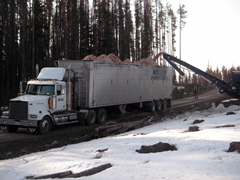
Roadside wood waste grinding near Burns Lake.

Ask people in British Columbia's timber towns how to reverse their plummeting fortunes and a lot of them will say the solution begins at home -- with locals gaining control of how nearby forests are put to use.

Too much of B.C.'s most valuable resource is in the hands of a few corporations with faraway headquarters and no incentive to reinvest in a diversified economy for rural B.C. When those big firms pull the plug on a B.C. operation, local employees often are among the last to know. The province needs to get creative about helping small forest communities take more control of their fates.

That's the message this reporter heard often during a recent journey through Prince George and nearby communities hard hit by mill closures and pest devastation.

One of those towns is Burns Lake, which sits at the approximate geographic centre of the mountain pine beetle epidemic in B.C.

'Community forests' the future?

Burns Lake, population 2,000, is worth watching as an example of what a difference local management of forests can make, because it is surrounded by the largest "community forest" in the province.

At 85,000 hectares, the Burns Lake community forest has more than tripled in area since it was created in 1998. That was the year the province introduced its community forest pilot program.

The program, which has grown and changed over the past decade, grants area-based tenure to communities and First Nations, allowing them to harvest and manage forests for community economic and environmental benefit.

Alistair Schroff, general manager of the Burn Lake community forest, has spent the past few years trying to figure out the new forest economy.

Could turning salvaged beetle wood into biofuel be the best way forward? Or would it be more sustainable to find ways to add value to logs through milling and manufacturing?

Biofuel's iffy future

The hauling distances associated with getting wood waste out of the bush create expenses that are, so far, the big stumbling block to wood-fuelled bioenergy thriving in B.C. But Schroff says there's no choice but to experiment. "We don't know what the winning techniques are, but we know we have to do something...it's just trying to learn our way through it," he says.

Right now, a local contractor is at work in the Burns Lake forest just south of Decker Lake, grinding up roadside piles of timber. The resulting chips are trucked to a pellet plant 80 kilometres away in Houston.

"This will extend our ability to go in and recover value and get those stands back into production," says Schroff.

"But our internal calculations suggest in three to seven years we would have a significant drop in what we're doing here" as the beetle-killed wood diminishes.

"And, really," says Schroff, "our land can produce a lot higher value material rather than raw fuel."

Competing with the big firms

Some of the highest value products are lumber products like wood siding, panelling and moulding -- basically, "anything that is not a smoothly planed rectangle," says Russ Cameron, president of the Independent Lumber Remanufacturer's Association.

The association represents 82 small companies, anywhere from 10 to 100 employees, across the province. Five years ago, membership was 120 strong.

"Our guys have taken a beating," says Cameron, noting that 83 former members have since gone out of business.

Cameron says the group was averaging $2.5 billion in sales in 2003, which has decreased about 30 per cent. The two biggest problems, he says, are conditions of the softwood lumber agreement that penalize domestic remanufacturing, and the fact that most timber is tied to a few major license holders.

Cameron says the B.C. timber sales program -- essentially an open market for timber -- is good, but smaller manufacturers can rarely outbid large companies like Western Forest Products or Canfor.

"There's no way you can bid against them," he says. "We don't have the time, the money, the expertise, the desire...we just want some lumber."

Remanufactures primarily get lumber from private woodlot owners, says Cameron, but he sees potential for more partnerships with community forests as well.

"It's a big undertaking for municipalities to get into logging, but as they develop, in my view, there will be some good partnerships to come out of that."

Community forests 'not really on radar'

Jennifer Gunter, co-ordinator of the B.C. Community Forests Association, says community forests have increased in number over the past couple of years, since the provincial government doubled the total annual allowable cut for these types of tenures in 2003.

There are currently 43 in the province right now, operated by municipalities, First Nations and community organizations.

"Most people don't really know about community forests. We're not really on the radar much here in B.C.," says Gunter.

Gunter says the association is currently working on a guide to non-timber forest products such as plant pharmaceuticals, mushrooms, berries and eco-tourism.

"Because they're a form of forest tenure, they've had to be very focused on timber harvesting. But as time goes on, there's more and more interest in diversifying and trying to figure out ways to survive into the future, particularly the ones that are in mountain pine-beetle affected areas."

'Keeping the community alive'

The Cheslatta Carrier First Nation (CCN), located about 50 kilometres south of Burns Lake, also holds a community forest license that supports one mill jointly owned by the CCN, the non-Native community of Ootsa Lake and Carrier Lumber Ltd.

Last December, the CCN signed a memorandum of understanding with bioenergy developer Pristine Power, paving the way for Pristine to build a 10-megawatt gasification plant that will feed off this mill's residue as well as nearby logging wood waste.

Mike Robertson, senior policy advisor for the CCN, says council had been looking for an alternative use for its mill waste -- 80,000 tonnes of which is currently incinerated in a beehive burner -- for 15 years.

Their mill currently runs on diesel generators, and operating costs have increased by $1 million in the past six months alone, says Robertson.

"Keeping the community alive is what we're all about. If we can break even for 25 or 50 years, we're incredibly successful, and that's our goal."

If there's a lesson to be taken from such efforts to get the most out of wood waste, argue experts, it's that diversification is key. And in this new forest economy, smaller community operations are better positioned to pull it off.

But not without key changes at the government level, say some experts, who point out that the success or failure of smaller community operations to adapt to a changing economy still hinges greatly on provincial forestry policies and trade agreements.

Beyond the next few decades awaits a new set of challenges for B.C.'s forest communities. Richard Hebda, the curator of botany and earth history at the Royal B.C. Museum, says to expect more pests, more fires and fewer trees – changing the way the forest can be used as a resource.

"Community forests, with good scientific, scholarly advice, wide-open discussion and council participation, have a great opportunity," says Hebda.

"At a provincial scale, we need to change the way the tenure system enables new innovations to go forth. We have to take action now."

Related Tyee stories:

 [Tyee]

30  Comments:

Login or register to post comments

  • demotto

    3 years ago

    Perfect time

    It is a perfect time to retool the way business is done. The perfect substitute to wood fibre is just waiting to be exploited. It provides so much more than just fibre.
    HEMP for VICTORY
    http://www.venusproject.com/ethics_in_action/Real_Reason_Hemp_Illegal.html

  • Skywalker

    3 years ago

    Deja vu all over again.

    BC Forestry is showing the same problems that the BC Fishing Industry has been showing for a decade. In Fishing it is decisions made by far away Ottawa. Decisions that are so often just part of the game of international politics. In Forestry it is because decisions are made by Victoria and a leader who uses trees as cards in a high stakes poker game. As long as he and his friends come out as winners, who cares about rural B.C.

  • Canis Latrans

    3 years ago

    Then we've gotta watch...

    Quote:
    The perfect substitute to wood fibre is just waiting to be exploited. It provides so much more than just fibre.
    HEMP for VICTORY

    Then we've just gotta watch, of course, that they don't then clear large swaths of forest land to grow hemp instead of trees. :-)

    Other than that, I much agree with the sentiments and ideas expressed in this article. It is past the time forest dependent communities began to take control of their own forest lands and shut the global corps out, hopefully to diversify their use, including their recreational and simple aesthetic values.

    But more than this, and subjecting the direction of forest land use to new concepts and forms of "democratic" worker and community control, there is a need as well for workers and communities, where mill and other production facilities are threatened with shutdowns and closures, to refuse this and their dismantling and sell-off. And if it proves necessary to occupy them in order secure this, put them under democratic worker and community control and management, and seek to create new "business models" outside of the overlong corporate ruling class dominated, controlled and prioritized model.

    A new model, and the national and provincial legal and financial support framework to facilitate, supportively advise, nurture and grow it, and serve the public as opposed to global-centric corporate interest, needs to be debated in labour and progressive political circles NOW, and concrete steps taken to move the country, the working class and broader public in this direction-, and in the process save the country from the predations of the US Empire Loyalist agenda of the increasingly extreme neo-conservative right, often heard even here in Tyee.

    This kind of a radically democratizing political AND economic social transformation vision for the country, in the end, up against the power of the global and national corporations betrayal of the nation and the people, is the only one seriously capable of saving the country from being absorbed and homogenized into such as NAFTA and the North Amerikan Union. Especially necessary as the US Empire shows all the early warning signs of having already passed its zenith point and to be sliding into serious global, political and economic decline. Why in the fuq would any sane, rational entity want to join up with Amerika at this degrading moment in its historical development. One could just as rationally recommitt the country to the British Crown and call for the rejoining of the dysfunctional and defunct British Empire. One being already dead and the other dying, if still dangerous in its death throes.

    Continued next post...[b]

  • Canis Latrans

    3 years ago

    then we've gotta watch 2...

    From previous post...

    The further development and enrichment of working class and community level democracy, and steps to revitalize the economic self-reliance of the country is the more appropriate direction towards which to turn, eschewing the sheep-like bleating of the corporatists and US Empire Loyalists here, rather than to further allow this slide into increased dependence on yet "another" Empire, it is increasingly obvious, is the more appropriate development direction.

    Not that growing a little "hemp" isn't a good idea-, necessarily. :-)

    A good article, Colleen.

  • demotto

    3 years ago

    That is the illusion

    In reality Canada is still under the Rule of the Monarch. If you read the legislation that is supposedly governing Canada everything is held in Right of Her Majesty. All of our so called Laws bind us to the Queen.
    The forests are already laid to waste by the beetle. Hemp provides 4 times as much fibre per acre as wood so wouldn`t 3/4 of the forest be able to remain intact once it grows back to be able to still have a fibre base if hemp were used instead of wood.
    Not to mention the protein source from the seed of hemp or the multitude of other products that can be made from it. The only way to break the chains of the corporate elite is to get out of their grip. The only way to do that is to not use their products which are mostly an oil based system. Until we wake up we are going to be nothing but slaves on plantation Earth.

  • Frank

    3 years ago

    Community forests?

    The word "community" causes people on the Right to choke. It reeks of horrible things like "sharing", "non profit" and socialism.

    If people shared things like forests and used them in a sustainable way for the benefit of the community instead of raping the land at the behest of Howe Street and then moving to a new place, it would in all probability bring on the Apocalypse within weeks.

  • Peter Dimitrov

    3 years ago

    Civilizing the Economy

    Great Comments Canis Latrans!

    I particularly like:

    "It is past the time forest dependent communities began to take control of their own forest lands and shut the global corps out, hopefully to diversify their use, including their recreational and simple aesthetic values.

    But more than this, and subjecting the direction of forest land use to new concepts and forms of "democratic" worker and community control, there is a need as well for workers and communities, where mill and other production facilities are threatened with shutdowns and closures, to refuse this and their dismantling and sell-off. And if it proves necessary to occupy them in order secure this, put them under democratic worker and community control and management, and seek to create new "business models" outside of the overlong corporate ruling class dominated, controlled and prioritized model.

    A new model, and the national and provincial legal and financial support framework to facilitate, supportively advise, nurture and grow it, and serve the public as opposed to global-centric corporate interest, needs to be debated in labour and progressive political circles NOW, and concrete steps taken to move the country, "

    May I add that due to our 150 year old colonial governance of British Columbia - far too much authoritiy is vested in the Executive Branch of government to say what 'goes down' in this province, -who gets privileged and cut into the deals, and who amongst the regions and classes of people gets excluded, impoverished, disempowered, disentitled, etc. To empower the local we need to come to an understanding of the meaning of the word 'subsidiarity'- it is a legal principle which we do not employ in this province -and as a consequence - the centralized, harmonizing influence of the Executive runs unchecked and unbalanced. It is my belief that subsidiarity is implicit within the Canadian constitution in that certain powers are federal, others provincial - but no such 'division of powers'/'checks & balances employing subsidiarity and empowering the regions exists within the provinces. In my view there is no modern reason whatsoever that the Crown, with centralized Executive powers, should hold title (subject to First Nations interests) over all Crown lands in British Columbia - there ought to be much more political/legal space for the 'local'. That is my view, now I fully expect Luke Skywalker to take a hard right swipe at me and this idea , but nonetheless, I invite respectful comments

  • anarcho

    3 years ago

    Check how they do it in Europe

    Community forests are what they have in France, and this is why they still have a forest industry after 5000 years of logging and we don't after a mere 120 years. I suspect other countries like Germany, Austria etc also have community forests and of course, they have been cutting trees about as long as the French.

  • greengreen

    3 years ago

    Beware of socialist hordes

    And check out those other terrible countries: Norway, Sweden, Denmark and Finland. they are kind of into the "we" thing, not the "me" thing. How silly,eh?

  • Romeogolf

    3 years ago

    Check out how they did it in Japan

    Jared Diamond has an interesting discussion of Japan's issues with deforestation in his book, Collapse on pp. 294-308. They succeeded in tackling the problem so that despite having the highest population density in the First World, 80% of their land area is sparsely-populated forested mountains. Nevertheless, the Japanese have merely exported their over-exploitation of resources to other countries and the ocean.

    In B.C., our problem is that we have a Third World economy in that most of the value that can be obtained from our resources is exported for others to profit from.

  • Canis Latrans

    3 years ago

    Romeogolf...

    Quote:
    In B.C., our problem is that we have a Third World economy in that most of the value that can be obtained from our resources is exported for others to profit from.

    I agree entirely, and an interesting comment perspective overall, especially concerning Japan. Again, a correct comment, in my view.

    There is no way, at the end of the day, we, and much more so true for large parts of the world, including Japan and the US itself, are going to successfully deal with these problems of over-development and exploitation of land and resources, and/or pollution of the seas or air, without addressing this issue of human over-population. China, at least for awhile, before taking its current full blown capitalist economy development course, did attempt to address this problem of over population, for which we and much of the "free market" West, so-called, heavily criticized them their One-Child Policy. They were then, however, in my view, correctly and laudably addressing a problem, which second to the problem of capitalism itself, is going to prove to be one of the must difficult problems to get at resolving, in cleaning up and creating a sustainable human population and global environment for all creatures and forms.

    And resolving both problems is a must, in my view, for the way they are inter-related, that of capitalism and population, feeding off,sustaining and driving each other, to the collapse exacerbation of the environment. In this, what is happening to the global forest base, here and everywhere, is but a partial manifestation of both over-population and a never ending capitalist "free market" growth feeding frenzy.

  • Romeogolf

    3 years ago

    Sustainability not just about GHGs

    For true Canis Latrans. Too many people seem to think that a technofix that reduces greenhouse gas emissions is all we need; they won't have to change their criminally wasteful lifestyles. They are seriously deluded. One way or another consumption will have to decline, be it voluntarily or at the behest of war, famine, disease, pestilence, and natural disasters.

  • ME2

    3 years ago

    Peter Dimitrov

    Even as a basically po-union and pro-community control person, particularly in respect to our forests, I still feel I must strongly disagree with your following advice. :

    ".....there is a need as well for workers and communities, where mill and other production facilities are threatened with shutdowns and closures, to refuse this and their dismantling and sell-off. And if it proves necessary to occupy them in order secure this, put them under democratic worker and community control and management, and seek to create new "business models" outside of the overlong corporate ruling class dominated, controlled and prioritized model."

    There are two ideas at issue here. The first is that the sheer size of existing production facilities has determined the rate of harvest, and thus the style of forest management applied to the resource.

    Since these are relatively big mills, here again we run into the recurring problem posed by the quick rate of return on investment required by commercial interests, versus the long-term and diversified (sustainability) returns sought for in public investments. (such as with BC Hydro)

    As is made evident by the recent wholesale sell-offs of TFLs, there is no long-term payoffs for investors in the holding of timber lands once the cream of the Old-Growth has been cut, as compared to the returns on the same money invested elsewhere.

    The reason for this is that the Old-Growth represents Capital - in the form of the time "nature" has invested in the growing of it - and all industry has done is convert those trees into money with the very least amount of investment and with no concern for their wasting of the resource. What is worse they've taken the Capital that is rightfully OURS and reinvested not a penny of it in our own country.

    And THAT'S what retainment of those mills will perpetuate Peter, whether they're owned by the community or an investor.

    In the Interior, millions of dollars of OUR money is going to be spent on replanting, likely on the quick-return Pl, and likely with little attention to creating a species rich, ecologically balanced forest. Beyond question, these should be given over to community control, and by the time they are ready for harvest, the existing production machinery should be out-of-date.

    What to do then, with those Old Growth trees of species other than PL still remaining? We have yet to recognise that these trees find their highest value because of the qualities found in slow-growing old trees - the "capital" I mentioned above.

    These should be given over to woodlots, small loggers, community drysorts, and small-scale millers. This is the ONLY way this wood will produce the value and jobs they represent, and escape being turned into 2x4s in the purely volune-oriented mills we now have.

    My second issue is that the Steelworkers (the old IWA) will oppose this - with plenty of reason - and a way of protecting worker interests will have to be worked out.

  • Canis Latrans

    3 years ago

    ME2 and Community Power...

    Actually, Peter was quoting me in the comment you have very astutely critiqued above. I did not go into the issue you raise, of the suitability of much of the especially wood "milling" enterprises with over large maws and appetite needs, as you correctly point out, because I saw it as a related but, in the context of my comment, separate issue-, for the purpose of "simplifying" the discussion at least. :-)

    But you are entirely correct, of course. The same is true of much of the extractive industries, from fish to mining to forestry, and even secondary processing/manufacturing, ; their appetite capacity for efficient operation and return on investment is just too damaging over the long haul. Though keeping in mind, that it is in place to serve the never ending demand growth need of the global "free market", and so necessary to the viability of so-called "modern" corporate capitalism.

    All true. But which still does not diminish one iota the critical need in these "collapsing free markets times" for working folks and other social progressive to prepare themselves to seize the "opportunity" that these times will nonetheless make available to us; over the times say, where everything is moving along tickety-boo with the system, it is stable, everyone is content, and hence no opportunity exists to begin to move society and the economy in a new direction-, away from capitalism and its over-development excesses.

    A new social, political and economic arrangement will not drop down out of the sky already fully formed and in place. Kid yourself not, there will be a period of at least relative chaos, where one state of inherited affairs exist while, hopefully, social forces and pressure for enlightened progressive social change are attempting to move society and the economy into an entirely new paradigm direction.

    And IF capitalism is the underpinning problem around which everything else pivots, including over population and resource exploitation, as I say it is :-), then there is a need to BEGIN to move communities and working people especially, into taking over what is and bringing it under the control of a broader societal and class interest set than just that of the corporate ruling class. And to my mind, in the case of capitalist enterprises that are in trouble, as is increasingly the case with forestry, for example, that means that first they must be seized from their corporate owners, made to serve the public/community interest,and upon that new paradigm foundation, begin to develop them in a new people and planet serving direction.

    Continued next post...

  • Canis Latrans

    3 years ago

    Me2 and Community Power...

    From previous post...

    And kid yourself not about two things around this enterprise of creating a new paradigm. First, the old order is unlikely to go easily or willingly. Certainly it is potentially very dangerous to presume it. Secondly, even after that is accomplished, presuming a lot :-), even while it is, in my view, the first thing that must be done, the creation of a new kind of political and economic democracy power, everything thereafter that will need to occur to create a more lower class people friendly world, AND a greener more sustainable one, will not still automatically or without struggle fall into place. :-)

    But it starts, in my view, not with "green" corporate products simply designed to bamboozle and in fact change nothing in the societal and environmental power arrangement, but with people, ordinary folks and their broader communities, taking power and control over especially the economy. Thereafter the politics will follow and, of necessity, be made to step into line with the new economic power paradigm-, the needs of people and the planet upon which they and all life absolutely depend.

    People still might not succeed, of course, but the course we are currently on leads certainly to economic and environmental collapse and war. All the not so early warning sign elements are already there in place, save for the US Empire Loyalists amongst us, who will not see it.

    Sweet dreams, brother/sister. Us old men need our rest. :-) That horse of mine wore me out today. :-)

  • Canis Latrans

    3 years ago

    Final comment...

    I agree with one other issue you allude to, Me2. The so-called Labour Movement that is today, is NOT the labour movement that was-, in very many cases. Many are and will be a serious problem-, because of the class-collaborative way they are integrated into capitalism's labour management system.

  • ME2

    3 years ago

    Canis L.

    Well said Canis, it looks like we are almost in total agreement, and I would only differ with you only in noting that we don't need to wait for some future time for things to get ad enough to set the stage for radical change.

    It won't get much worse for forest industry dependant towns than it is now becoming, and the only forces keeping things from blowing up are a soothing press and forestry-friendly town councils. And no doubt the Fed/Prov money for tree-planting will help.

    Barring a complete financial burn-out, there will never be a better time to demand restructuring in the forest industry than right now, and so now is the time for us to put pressure on Fed, Prov and local politicians, and demand change. Maybe if the Tinworkers didn't object, perhaps even the NDP might say something positive?

  • City Person

    3 years ago

    Bravi, Canis Latrans!

    Canis Latrans, that was one of the best off the shelf pieces of leftist dogma I have seen in years. The Maoists in my university days don't hold a candle to you.

    Bravo!

  • Canis Latrans

    3 years ago

    Snitty City Person... :-)

    You have something you want to say? Some relevant idea or criticism you want to advance as a counter to my comments?

    By all means, let's hear it. :-)

  • City Person

    3 years ago

    Relax!

    Relax, Canis, it was just a compliment. I am sure you have many people in your circle who hold the exact same beliefs and since everybody you know agrees with said opinions, they must be correct.

  • lynn

    3 years ago

    Radical talk

    City Person,

    I think the world is just beginning to catch up with the thoughts expressed here by Canis Latrans. ;-)

    The impact of a faltering and failing world has more people than you think, City Person, hearing the sad notes of Adagio for Strings now being played for planet Earth. Perhaps...could it possibly be....surely not, ;-) that it is you that is living in the past?

    Just as an example, I was watching Craig Ferguson, the other night, nothing radical about that, pretty mainstream stuff, and the actor John Cusack was on as a guest talking about his new movie, War Inc., a satire based on a Naomi Klein article.

    The discussion between the two of them revolved around the often held misconception that capitalism is often equated with democracy....and whether capitalism, in the end, necessitates a policy of endless war. Then they got into a discussion about how all ideologies are a history of man exploiting man. ( Much like Ed Deak often states here).

    I thought that was a pretty good (and unexpected) discussion for a late night mainstream entertainment talk show.

    As Canis writes:

    Quote:
    But it starts, in my view, not with "green" corporate products simply designed to bamboozle and in fact change nothing in the societal and environmental power arrangement, but with people, ordinary folks and their broader communities, taking power and control over especially the economy. Thereafter the politics will follow and, of necessity, be made to step into line with the new economic power paradigm-, the needs of people and the planet upon which they and all life absolutely depend.

  • lynn

    3 years ago

    foggy me

    sorry, that was unclear, brain fog on my part, I'll put it this way:

    "The discussion between the two of them revolved around the oft held misconception that democracy and capitalism ride together."

  • anarcho

    3 years ago

    The Bart Simpson Method

    "Relax, Canis, it was just a compliment. I am sure you have many people in your circle who hold the exact same beliefs and since everybody you know agrees with said opinions, they must be correct."

    The Bart Simpson method of critique. Don't actually challenge anything written, just sneer. (Any 9 year-old knows how to sneer.)

  • ME2

    3 years ago

    Lynn

    Lynn, Capitalism, which is only an economic system, can "ride" with any political system. Democracy, which is a political system, can "ride" with any economic system.

    Capitalism is to date the only economic system which can free the landless from economic servitude, primarily those in the urban areas.

    No matter what the economic system, it always happens that the wealthy become uncontrollable and parasitise their host countries, exactly as we are seeing today.

    Clearly, a means of controlling the excesses of wealth must be found, and that can only be through a political system. There is only one - Democracy - which appears to satisfy the need for protecting the freedoms we have only so recently gained.

    Under the general heading of Democracy, there are three management subsets we can choose from : Fascism, Socialism and Communism. Of the three, only Socialism offers a genuine attempt to incorporate realistic Democratic practice into governance, especially with respect to controlling economic elites, private or governmental.

    Because it is so efficient in manipulating money, Capitalism, like Oil, will be with us for a long time to come. It's excesses, such as unearned wealth though the creation of the fiat money Ed rightly hates so much, is partially controlled by states like Norway, but will never be fully controlled by anyone unless more Socialistic countries come into being, such as in South America or in the mid-east - once the Yanks are booted out.

    It's not Capitalism, Lynn, but rather the Capitalists who we've got to take on.

  • lynn

    3 years ago

    Just call me economically-challenged ;-)

    No, I agree ME2, and see the distinction between capitalism as an economic system and democracy as a political one but wouldn't you say that capitalism all too easily perverts anything it infiltrates creating a kind of hybrid, creating asocial systems that extol price ( and capital) over the real value or worth of things. Wouldn't all political systems eventually dis-integrate under the economic kind of de-humanization that literally makes us "count" and measure and compare (numerically) everything.... while ironically making fewer and fewer things really matter or count with us in a meaningful way - ultimately a system based on the creation of more and more addictions, and dependent on that addictive behavior for the sole purpose to sell more things - from shoes to ipods.

    Okay, economics is definitely not my strong suit as you can see ;-) and I know you are going to ask me what then would replace it (capitalism)?.... what would work in the global world we are now operating in that involves and revolves around the endless counting and pricing of things for exchange ...foreign trade etc.

    I'm not sure but I think all economic and political systems should always be based on the recognition of the reverence for and the temporality of life itself. Sounds flaky - but I don't mean to be...but that is the direction where I think the real revolution in thinking must come from.

    That's where the privateers are really in denial, about the temporality of life and about death, really. Nothing is private property for very long, nothing is really owned, everything is just being borrowed.... and we, too live on borrowed time...and a very short time at that. So I'd like an economic/political system that reflects that. Much like a library card confers generous access but not ownership.

    I think this needs more work. ;-)

  • Stump

    3 years ago

    Hey "Hurtland"... Bend Over!

    Priorities, schmiorities, let's sell the bakery so we can buy tickets to the circus!

    Quote:
    Thursday, May 15 - 10:38:00 PM News1130 Staff
    VANCOUVER (NEWS1130) - Premier Gordon Campbell will be front and centre at a news conference tomorrow morning at BC Place Stadium, to announce the provincial government has decided to put a retractable roof on the stadium.
    Sources confirm work on the new roof will begin after the 2010 Olympics, with a target date for the new roof's completion by 2011. BC Place Stadium will be hosting the Olympic Opening Ceremonies, but there isn't enough time to have the new roof in place before the Games.
    The BC Lions confirm they will be attending the news conference at 10 am Friday, but they won't say what it's about. Representatives from the Vancouver Whitecaps soccer team are also expected to attend, but have refused to comment on the news. One unconfirmed report says the Whitecaps could be moving into the dome on an interim basis.
    On April 30th, Tourism and Sport Minister Stan Hagen revealed the provincial government favoured a new, retractable roof for BC Place Stadium, but no decision had been made. Hagen cryptically said the government was considering many options, including leaving the existing inflatable roof in place for the 2010 Olympics, then replacing it after the Games.
    Some estimates say the price tag for a permanent, retractable roof could be as high as $200 million.

  • Stump

    3 years ago

    all apologies

    Quote:
    I'm not sure but I think all economic and political systems should always be based on the recognition of the reverence for and the temporality of life itself. Sounds flaky - but I don't mean to be...but that is the direction where I think the real revolution in thinking must come from.

    I don't think you should be apologizing for having your head screwed on right and a healthy perspective/priorities Lynn.

    The flakes are the fools who think our biosphere is some kind of perpetual motion machine with free energy to be spent and an endless capacity for abuse.

    Like the motto on a building in downtown Vancouver says... "unlimited growth increases the divide."

  • City Person

    3 years ago

    Perhaps you are correct, Lynn!

    Quote:
    I think the world is just beginning to catch up with the thoughts expressed here by Canis Latrans. ;-)

    I think you are completely correct, Lynn; forcible expropriation of private property by unelected revolutionaries has proven itself an excellent remediation for social injustice.

    Just ask any of the citizens of said countries and I am sure they will agree with you.

    Because if they don't........

  • lynn

    3 years ago

    Bananas

    Thank you for your kind words, Stump.

    City Person,

    Who said anything about "unelected" revolutionaries?

    It's amazing that you think it's quite alright for an elite few to control and exert power over the economy but not ordinary people themselves. Why is it so revolutionary to demand that people and communities have a right to power and control their own lives, their working lives as well?

    And what about the expropriation of public property that is now taking place in the banana republic that is now BC, led by a generalissimo and his unquestioning cadre of elected officials quite content, eager in fact, to betray the public who elected them in order to represent and favour the special "private" interests of their friends?

    As this article point out:

    Quote:
    "Our guys have taken a beating," says Cameron, noting that 83 former members have since gone out of business.

    Cameron says the group was averaging $2.5 billion in sales in 2003, which has decreased about 30 per cent. The two biggest problems, he says, are conditions of the softwood lumber agreement that penalize domestic remanufacturing, and the fact that most timber is tied to a few major license holders.

    Isn't that "forcible expropriation" of the worst kind, City Person - to cause what had been successful for the many to fail - in order that a few may prosper?

  • ME2

    3 years ago

    Lynn

    Geeez, Lynn, that's logic, not ideology. Why do you expect CP will know the difference?

    • The discussion for this story is closed. No more comments can be added.