The Economist Tories Loved, Then Silenced
Mark Jaccard's tough takes on global warming.
Jaccard: Canada set to fail.
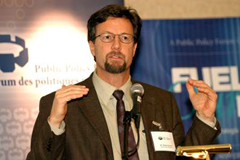
Simon Fraser University economist Mark Jaccard and his team of researchers have done something that's rare in politics.
They've reached a set of conclusions that poke holes in just about everyone's plan to fight global warming.
Jaccard upset many environmentalists in the spring when he argued that it's too late for Canada to reach its targets under the Kyoto Accord. But he pleased federal Environment Minister John Baird -- who also says that Kyoto is a lost cause.
Jaccard, Baird said at the time, is one of the best economists in the country.
Then, earlier this month, Jaccard and his team released a study for the C.D. Howe Institute that concluded that the federal Conservative government's plans to reduce greenhouse gases won't come anywhere near their targets.
The study didn't attract a great deal of media attention, but it was apparently noticed by the government.
Jaccard was scheduled to appear in Ottawa before the Commons environment committee a few days after the release of the C.D. Howe report. Instead, the Conservative chair of the party stepped down and no other Tory volunteered to fill in for him -- throwing the committee into limbo.
Opposition MPs charged that the move came out of the government's playbook on how to shut down committees that might generate negative publicity for the Stephen Harper Tories.
Tax tiff
Mind you, the Liberals on the committee who cheered Jaccard's critique of current government policies were likely less fond of his analysis of the "unfortunate record" of previous governments -- most of them Liberal -- on curbing emissions.
In any event, Jaccard and his team were back in the news a few days later, when a study they had done for the Tory government was released by Green party leader Elizabeth May.
The study, which May obtained through an Access to Information request, concluded that a carbon tax would have little impact on the national economy -- and might even prove to be a stimulus.
Seeing as May is the only party leader proposing a carbon tax -- something Baird says would ruin the economy -- the Green leader was understandably cheered to find a heavyweight economist supporting her position.
Although the Greens, along with the other opposition parties, argue that Canada's Kyoto targets can still be met, which puts them at odds with Jaccard and his team on that score...
Some days you just don't know who to believe.
Jaccard's controversial conclusions
Given the recent popularity of Jaccard and his team, it seems worthwhile to look at exactly what they are saying. Here then, are some of the conclusions reached by Jaccard and the Energy and Materials Research Group.
Past federal governments failed utterly to stop the growth of greenhouse gas emissions.
The C.D. Howe report reviews a series of initiatives that were announced by the 1988-1993 Mulroney Conservative government and the Liberal governments of 1993 to 2006.
"While these initiatives and commitments appear to have been taken in earnest," the report says, "Canadian governments have an unfortunate record on GHG targets and policies."
Since 1988, "five major policy initiatives have failed to stem the steady growth of Canadian GHG emissions....
"Emissions actually rose faster during the period of policy initiatives, 1990 to 2006, than during the previous decade, from 1980 to 1990, even though this earlier period had no GHG reduction policies."
The problem, Jaccard and co-author Nic Rivers conclude, is that these schemes all relied on voluntary measures, such as subsidies and information programs. And voluntary measures aren't enough to significantly reduce emissions.
Which brings us to the team's second point...
Current Conservative policies are unlikely to reduce emissions below current levels.
Federal targets call for a reduction of 20 per cent in greenhouse gas emissions by 2020.
But when Jaccard and Rivers ran the government's policies through an economic simulation model, they found that under the Tory plans, "overall emissions in Canada are unlikely to fall below current levels."
"It's not that they wouldn't do anything," Rivers, an EMRG research associate, told the Tyee. "But they would be quite dramatically insufficient to reach the targets.
"Our guess was that they would more or less stabilize emissions at around today's level over the next three or four decades, but they wouldn't reduce them by 20 per cent over the next 10 years and by 65 per cent over the next 40 years, which is what the Conservatives promised."
Part of the problem is that the Conservative plan has several loopholes that allow industries to continue spewing emissions while complying with the regulations.
For example, the government allows emitters to invest in what are called domestic offset credits rather than reduce emissions.
The federal regulations cover the big industrial emitters, which account for about half the greenhouse gas emissions in the economy.
Under the offset scheme, a large industry that is supposed to reduce its emissions is allowed to subsidize someone outside the regulated sector -- a business with a large fleet of cars, say -- to reduce emissions on its behalf.
"The problem is that this type of offset credit system tends to be really administratively burdensome," said Rivers. "It tends to be hard to verify."
If a company switches its vehicles to more efficient models, for example, who's to say they wouldn't have done the same thing in the absence of the offset program?
"A lot of your subsidies end up being paid to people who would have done the actions regardless of whether you would have paid the subsidy." (Economists call these people free riders)
The study makes a number of generous assumptions on behalf of the government. For example, it assumes that the government will adopt California's aggressive auto emissions standards -- something that's far from certain. The study suggests a conclusion that Jaccard and his team have argued before:
The best way to reduce emissions is through a carbon tax or cap-and-trade system.
"For sure, to really reduce greenhouse gas emissions in the country is going to require some sort of economy-wide price signal like a tax or else a regulatory signal like a cap-and-trade system," Rivers said.
A carbon tax places an additional charge on fossil fuels, in the hopes of reducing their use. A cap-and-trade system sets limits on emissions and issues what are, in effect, permits to give off greenhouse gases. Companies can trade these permits in a way that results in lower overall emissions.
"Right now, what the Conservatives have proposed is a regulatory signal on just half of the economy with some loopholes," Rivers said. "So it's a step in the right direction, but it's certainly not sufficient to reduce emissions dramatically in the country."
Mandatory policies such as carbon taxes and cap-and-trade "directly or implicitly put a value on the use of the atmosphere as a waste receptacle for dumping GHGs," the C.D. Howe study says, adding that "the most important conclusion of independent research is that without a value on the atmosphere, GHG emissions will not fall."
But Jaccard and Rivers admit that what works economically won't always work politically.
"The only effective policies are also the most difficult for finding political acceptance," they write. "This explains why politicians have been reluctant to implement them, and it explains the policy failures of the last decade and a half.
"Canadian politicians have largely opted for politically painless policies that were also ineffective. These policies were implemented, but emissions kept rising."
If Jaccard's team is sympathetic to the political realities surrounding mandatory limits, it doesn't buy the economic argument that a carbon tax would tank the economy. Actually...
A carbon tax will have little effect on the economy.
This, according to the study done for the federal government and released by the Green party. The study, done for Natural Resources Canada, concludes that a carbon tax of up to $50 a tonne -- the level urged by the Green party -- would barely be noticed in terms of GDP.
In fact, such a tax might even boost the economy, rather than drag it down.
With "small taxes -- somewhere up to $50 a tonne -- the effect on the economy was not at all dramatic," said Rivers. "It would be somewhere around a very, very small loss to a very small gain over the next 30 years."
The difference made by a tax at that level, Rivers said, would be somewhere in the range of one-tenth of one per cent in overall GDP.
The report modelled the effect of taxes up to $250 per tonne.
"The really key point to take from this is that any of these tax levels won't really change that [economic growth] pattern much," Rivers said.
Even at the $250 level, "we still expect to see that the growth pattern would be virtually unchanged."
That's because there's a fair amount of capacity in the Canadian economy to adapt to the kind of changes a carbon tax would bring -- given enough time.
"So when a tax is applied we can reduce our emissions pretty substantially and avoid paying the tax."
The problem is that it does take time before the economy can adapt. Which brings up the Jaccard team's final point...
It's too late to meet Canada's Kyoto target.
Under its Kyoto commitments, Canada is supposed to reduce its emissions to below 1990 levels by 2012. But instead of going down, emissions have been going way up, leaving the Kyoto goals pretty far off.
"It takes a long time for the system to rejig itself," said Rivers. "So even applying a pretty big carbon tax in 2006 doesn't give you very long to close power plants and coal plants and rebuild them.... To have people sell their cars, to have people re-insulate their houses or buy new types of furnaces, to have buildings get retrofitted -- that kind of stuff will happen over time, but if we try to force it into a three or four year period, the costs are absolutely enormous."
That's especially true in the industrial sector, where technologies can stay in place for 50 years or more.
"To have a cement plant that's just built a new kiln to be told a year later that they have to reduce emissions by two thirds or by a third is really going to damage the economy," Rivers said. "A policy that would achieve that is a completely unrealistic policy."
The message to government, he said, is: "Get your policy in now so that you start influencing this capital stock over the future. The policy has to come in now. The emissions reductions aren't going to happen for a few years."
Related Tyee stories:
- John Baird, Light Rail Killer
Did Tories' new enviro minister undercut a big light rail project to settle a political score? A Tyee special report. - Harper's Green Mirage
PM weakly revived some programs he cancelled. But what about that dirty deal with Bush? - How Ottawa Sabotaged Our Kyoto Pledge in 2002
Quiet deal with oil industry locked in failure.


16
Login or register to post comments
Fiat lux
4 years ago
The problem is who believes
The problem is who believes anything that comes out of neoclassical economists, or their advertising agencies, like the CD Howe and Fraser Inst., even when they may say the obvious and right things?
Anybody who doesn't realize that the present economic theories, forced on Earth for the benefit of a global corporate dictatorship, through the fraudulent accounting system of the GDP, growth and productivity figures, are killing the environment and humanity, has serious mental and moral problems.
This includes our provincial and federal governments, with the ministers fighting for future directorships .
Harper is one of these pathetic figures, brainwashed with the criminal, neoclassical market economic theory, totally out of touch with the realities of life.
Ed Deak.
Jeffrey J.
4 years ago
Easter Island all over again
When explorers first discovered Easter Island, they found a once great society reduced to starvation after its leaders destroyed their own environment. Is the Harper government incapable of self preservation? Can we stop destroying our environment? If not, this government will condem us to join the Easter Islanders in their fate. Talk about a crime against humanity.
mopled
4 years ago
They call this a consensus?
"What of the one claim that we hear over and over again, that 2,000 or 2,500 of the world's top scientists endorse the IPCC position? I asked the IPCC for their names, to gauge their views. "The 2,500 or so scientists you are referring to are reviewers from countries all over the world," the IPCC Secretariat responded. "The list with their names and contacts will be attached to future IPCC publications, which will hopefully be on-line in the second half of 2007."
An IPCC reviewer does not assess the IPCC's comprehensive findings. He might only review one small part of one study that later becomes one small input to the published IPCC report. Far from endorsing the IPCC reports, some reviewers, offended at what they considered a sham review process, have demanded that the IPCC remove their names from the list of reviewers. One even threatened legal action when the IPCC refused.
A great many scientists, without doubt, are four-square in their support of the IPCC. A great many others are not. A petition organized by the Oregon Institute of Science and Medicine between 1999 and 2001 claimed some 17,800 scientists in opposition to the Kyoto Protocol. A more recent indicator comes from the U.S.-based National Registry of Environmental Professionals, an accrediting organization whose 12,000 environmental practitioners have standing with U.S. government agencies such as the Environmental Protection Agency and the Department of Energy. In a November, 2006, survey of its members, it found that only 59% think human activities are largely responsible for the warming that has occurred, and only 39% make their priority the curbing of carbon emissions. And 71% believe the increase in hurricanes is likely natural, not easily attributed to human activities."
Read the series:
http://www.canada.com/nationalpost/financialpost/comment/story.html?id=c47c1209-233b-412c-b6d1-5c755457a8af
organiccanadian...
4 years ago
Harper is surprisingly ineffective as a fake-environmentalist,
having presented his third pretend 'action plan' on climate change.
He hides his real opinions on everything - so it is difficult to tell if he is just in psychological denial about climate change - deluded or brainwashed by the 'scientific studies' by the Fraser Institute et al, - or if he is one of the several million hurry-the-rapture/apocalypse 'left-behinders' on this continent. One has to wonder about his mental health and grip on reality, having offered no less than three transparently phony programs.
Either way, he must be wondering how in the world he is ever going to gain his majority and then completely sell this country out to the Wall Street Republicans, when even the right wing media in Canada seems to be willing to expose the BS and loopholes woven through his environmental 'plans.'
What next? Probably a plan with real teeth, but that he can ensure goes unenforced as long as he remains in power.
James Burns
4 years ago
Jaccard on CBC Ideas
Well for the global warming deniers Jaccard isn't a savior at all, as he believes the science that human carbon emissions are a primary cause. If you want some perspective on his points of view, check out his podcast on CBC's Ideas called: Fossil Fuels: Friend or Foe.
http://www.cbc.ca/ideas/podcast.html
By the sound of it, he is far from a neoclassical economist. If anything, he appears to be a strong advocate for energy efficiency and green technologies, along with carbon taxes and cap and trade regulations.
As for the Financial Post's lengthy deniers series on global warming, so what? That corporatist rag isn't going to do anything other than churn out denialist misinformation. If it did anything else it would lose most of its biggest advertisers.
BC Dude
4 years ago
Has anyone heard of this
Has anyone heard of this site, if true a great start to following the Big money trail!
Possibly a lot of answers to why so many roadblocks are in the way of environmentalists trying to save OUR Planet from Global Warming, like maybe greed and corruption in all levels of Canadian governments?
http://www.theclassactionsuit.com/index.html
BC Dude
4 years ago
A must read for people who
A must read for people who want real news regarding our economy and some of the players!
http://www.warrenkinsella.com/musings.htm
http://www.harperindex.ca/index.cfm
http://www.hydrofactsbc.ca/
http://www.agoracosmopolitan.com/home/Frontpage/2007/04/10/01481.html
You can forget about the Economy as Our future wanna-be owners "Bush's NAU" along with S Harper's Conservatives, Fed Liberal's, R Klien and Gordo's blessings and what we can look forward to if we don't kick these thugs out of OUR Federal and Provincial Legislature Buildings Now!
http://www.democracynow.org/article.pl?sid=07/06/25/1421214&mode=thread&tid=25
Frank
4 years ago
The more things stay the same
The fact is even teeny-weeny costs are seen as outrageous by the anti-environment folks.
Which is why not enough will ever get done. Yet if Lovelock's prediction ever happened, no doubt the last corporation would find a way to blame environmentalists for civilization's collapse.
Fiat lux
4 years ago
Don't blame the
Don't blame the corporations, but the universities, where this legalized destruction is being taught as a "wealth creating science".
The corporations are only following the theories and twist them to their best advantage, because for a CEO nothing exists past the next quarterly profits.
Wealth can not be created, only taken.....
This simple, unbreakable rule is something way above the heads of our economists and politicians.
Ed Deak.
BC Dude
4 years ago
What do people in Canada
What do people in Canada think about USA Lawmakers being given cart blank rights to carry loaded guns into OUR country?
No f-ing way robot USA (Blackwater Boys) cops to be allowed into Canada!
S Harper has got go NOW!
I know it's not about this blog but we won't have an economy to worry about very soon!
I went to the 9/11 Truth Conference in Vancouver over the weekend, a great lineup of speakers and media presentations. http://www.911truth.org/
iamcur
4 years ago
This still ignores the major problem
Carbon taxes and caps are a start and good incentive for change, but the BIG problem is human use of fossil fuels [coal, gas, oil and tar sands]AND the dominant religious belief that having a lot of kids is good.
1. Canada must join other nations in developing other sources of fuel by funding research and granting tax incentives to private organizations. Production of electricity by hydrogen, solar furnaces, geothermal, tidal and wave generators and wind must be developed.
This will result in an economic boom for those nations switching over to new technology.
2. Canada MUST stop developing the tar sands- it wastes too much water and gas. Unfortunately, this requires our governments to somehow remove themselves from slavery to petrochemical companies.
3. Canada's cities must develop more autonomy and sources of income so as to enable them to redesign infrastructure, transportation networks, and new styles of zoning for residential, business and industry.
4. Other things that would help- religious people must pressure their heirarchies to change policy on birth control and human domination of other animals [good luck]: the World Bank must reverse policy and fund food production and information technology that benefits locals: remove food subsidies in first world countries and pay fair prices for third world products: and refuse to buy goods from nations that overly pollute and produce dangerous goods [even if they are cheaper].
5-100. Fill in the blanks here.
Fiat lux
4 years ago
Canada can't do sweet b....
Canada can't do sweet b.... all, until we get out of NAFTA, the WTO, and now of TILMA, because their rules override all government actions and public initiatives.
Once the oil from the tar sands started across the border, it can not be stopped.
This is "democracy" 21st century style, but the voting public laps it up.
Ed Deak.
BC Dude
4 years ago
I hear you Ed, and am not
I hear you Ed, and am not afraid but feel betrayed by my own countrymen as we should all be one force and together we have the power to bring this into the light (meaning The Public) now! These dark forces fear the light, as they work best in the secrecy of darkness!
These cowardly neocons who sit back waiting, hoping that the fear factor will paralyze the masses into turning over and play dead for them to put shackles on our lives.
But damn-it, and them to Hell for eternity I'm going to do my best to screw up their evil plans!
30 million Canadians and 300 million Americans and about 150 million Mexicans that's a good start I'd say!
Bad guys about 1800 or so maybe!
ttp://911truth.org/osamas/morales.html
Armed Skytrain Rent-A-Cop, Transit fare checkers (my butt) another abuse of power (a widely "spitting" shown on local TV news) why now? Every day we have something else to absorb?
BC Dude
4 years ago
Does anyone remember about a
Does anyone remember about a year ago, at the Main and Hastings Skytrain Station the local military held a mock crowd control exercise at mid day on a Sunday?
It was on the evening news for 1 day only then nothing, until a city councilor brought it up and was soundly put down but wouldn't sit down I never did find out what that was realy about but today "click" 1 and 1 = already it has begun.
Remember Betty Krawczyk!
http://bettysearlyedition.blogspot.com/2007/02/bettys-final-submissions-to-madam.html
Police state
electric_bicyclist
4 years ago
Forget big government -- Do It Yourself
The sacking of Prof. Jaccard (I've heard him speak on at least one occassion, and agree with many of his opinions) isn't unusual: Just read the new books, "The Greatest Tale Ever Sold", and "The Road To Kandahar", and you'll see that Jaccard's story is typical.
So, for those out there who would like to see wind turbines in BC, you may have to Do It Yourself! Why not?
Here's my own little example: We can absolutely demonstrate a wind turbine charging an electric car directly.
Begin by podering on this statement, below, published in The Economist:
'Only 10 years to save the planet'
-Dr. Jim Hansen, U.S. chief climatologist
How did we DIY? In response to this real threat, Solar Power Roadshow presents 25 different 'Anybody Can Create Energy' activities at some 150 events annually in BC.
Now, we've developed something really inspiring: A vertical and/or horizontal axis wind turbine that charges an electric car directly. And, within 12 minutes, our model car can be off and running on its electric motor and batteries.
No one has shown this in BC before. We'd like to demonstrate our wind-to-car technology to young people, so they can see what is really possible, and show young people something profoundly inspiring.
What do you think?
Rob Matthies
Solar Power Roadshow
(6 0 4) 7 3 9 - 7 7 1 7
electric_bicyclist
4 years ago
To Jeffrey: EASTER ISLAND..book: The Last Generation
The reference to Easter Island is accurate, according to the new book, in Vancouver's public library, titled: THE LAST GENERATION (us baby boomers).
This is an excellent book. Non-fiction.
If you saw the movie "The Day After Tomorrow", you'll understand this book.