Carbon Sinks in Haida Gwaii
Pilot project could be boon for tiny community. If it works.
Alder: Nature's band-aid.
British Columbians could soon buy and trade certified carbon credits as part of a continental carbon market, according to an announcement made last week by Premier Gordon Campbell. And from cooking up mine tailings to seeding the oceans with iron, it seems there will be no shortage of proposed carbon-offset schemes for eager greens to buy into.
But as one Haida village is finding out, planting a carbon credit farm is no easy feat. Scientists, activists and businessmen don't all agree on the net environmental impact of some projects, or even on how much carbon they can offset.
Carbon Sinks in Haida Gwaii
John Disney is the economic development officer for Old Massett, a Haida village of about 700 on the eastern shore of Masset Inlet. Disney thinks there is money to be made and carbon to be sequestered by cutting the alder out of the long-ago logged riverbanks in the region and replanting the area with conifers. He just needs $4.5 million and access to protected buffer areas on the banks of two rivers to prove it.
At its most simple the idea goes like this. Trees absorb carbon from the atmosphere and store it as wood. Big trees store more carbon than little ones and coniferous trees sequester more carbon than alders, especially given their longer lifespan.
Disney figures he can help areas along the riverbanks of Haida Gwaii suck more carbon by replacing the alder that has grown up since the old growth was logged decades ago. If funded, the project would also provide hundreds of days of well-paid employment for the under-employed community of Old Masset.
But, as Disney is finding out, nothing is that simple, especially not carbon credits.
Disney and his partners at Raincoast Carbon Restorations have identified 100 kilometres of river-sides along two important fish-bearing streams on the islands for a proposed pilot project. But because they want to do the work on Crown land, Disney first needs permission from the provincial government. The land also falls within riparian zones, which are protected under provincial legislation to within 50 to 100 metres of the water's edge.
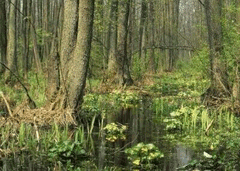
Red alder is the coastal rainforest's natural band-aid. The species grows quickly after a disturbance, be it clear cut, flood or landslide. Conifers reseed and grow in these patches until the shorter-lived alder dies back and conifers once again take over. In the meantime alder plays an important role in maintaining soil stability, especially along the banks of fish-bearing streams.
As a result, the B.C. Forest Service is cautious about Disney's plans. The service had four comprehensive reviews done of Disney's project and some large questions were raised, such as whether cutting alder to plant conifers will actually benefit the riparian areas, and, if this benefit will come any sooner than it is taking these areas to naturally regenerate.
Peter Tschaplinski, a manager in the research branch of the Ministry of Forests, wrote in his review of the Haida Climate Forest Project that the proposal overestimates how effective similar projects have been. "The authors [of the pilot project proposal] may be unaware," he wrote, "that the outcomes of tens of millions of dollars worth of riparian and stream channel restoration projects conducted under [Forest Renewal B.C.'s Watershed Restoration Program] have never been properly evaluated."
Not only have many of these projects not been evaluated, but others had disastrous results. He goes on to say: "In spite of good intentions, there are numerous examples of WRP-funded projects where substantial amount of damage was inadvertently done to riparian areas.... "
'Credible science'
Others question whether the scheme can produce the net carbon offsets it claims.
"You can't sell this kind of thing unless you've got credible science behind it," says Gary Bull, a professor in the Forestry faculty at the University of British Columbia. Bull commends the vision of the Haida Climate Forest Project, but warns that the proposal falls short of demonstrating its viability. He says soaking carbon out of the atmosphere with riparian restoration projects is a good idea, but the proposal needs to follow an accepted methodology.
Bull suggests the proponents look toward the emerging international standards for carbon sequestration projects of bodies like the United Nations Framework Convention on Climate Change.
He also points out that while Canadian forests soak up carbon they release it as well and both of these factors have to be taken into account before carbon forest projects can be taken seriously. Forests are a polluter, he says, noting forest fires, are one major source. "But they also have the potential to solve part of the problem through sequestration."
Others have pointed out there has been no accounting of the amount of carbon that will be produced in getting this project underway. How many trucks will go up and down the logging roads, how many times, to do the work?
Ownership questioned
Another stumbling block for the Haida Gwaii Climate Forest Project is the question of who owns carbon credits and who should benefit from the sale of them.
The federal government has, in the past, declared that as the signatory of the Kyoto Protocol, they own any forest carbon sinks. The province hasn't come up with any policy on the question.
Bull thinks the Haida Gwaii project is great in this aspect, if only because it pushes the agenda. In New Zealand the government tried to claim they owned all the carbon credits and the landowners went ballistic, he says. The government eventually backed down. But in Canada, "No one seems to care right now."
One of the biggest concerns about not just this project, but any carbon credit scheme, comes down to a philosophical issue. Some think selling companies the right to continue polluting is immoral and is the wrong approach on climate change.
But that's poppycock according to people like Joseph Pallant from ERA Ecosystem Restoration Associates, a private company with a project similar to Disney's in the Lower Mainland. Pallant says ensuring the science for any carbon credit project is sound is essential, but he doesn't have time for those who balk at the thought of selling credits in the first place.
ERA plants conifers on the banks of ravines and rivers in Maple Ridge. Like the Haida Gwai proposal, the company removes alder, or plants in existing openings, but there are a few key differences between the projects. Most significantly, the urban land is owned by the municipality and, as Pallant describes, has been so altered that there are no nearby conifers for any natural re-seeding to take place. The municipality gives ERA the right to the carbon credits in exchange for free restoration of green spaces in Maple Ridge.
In this case, Pallant and associates appear to have a winning project. They have done the science, set the baselines, modeled the carbon and had it all validated and verified through the rigorous international greenhouse gas standard known as ISO 14064-2, under which carbon sequestration must be scientifically verifiable and additional (meaning carbon wouldn't be soaked up anyway, if the project were not done.)
Pallant says the trees planted so far are conservatively projected to sequester 200,000 tonnes of carbon dioxide equivalent over the next 80 years. Anyone can offset 10 tonnes emitted from their SUV every year by paying ERA $100 and help keep this project rolling. ERA estimates they will sequester 2,300,000 tonnes when the project in Maple Ridge has been fully planted.
But even ERA, which has planted 25,000 trees in Maple Ridge since 2005, will not show any net carbon sequestration for several years while the little conifers are getting established.
That's a small point, says Pallant, who believes the climate change situation is so dire, that we are so close to the tipping point where shifts may occur that will make it impossible for life as we know it to continue, that it is irresponsible not to support carbon credit projects. "All good actions should be applauded and supported," he says.
The jury is still out on carbon credit projects like Disney's, but he and his partners may wish to heed the words of another of the forestry expert, UBC professor Dr. Hamish Kimmins, who reviewed his project:
"Carbon storage is the current 'flavour of the month' but this will change," he wrote. "The Kyoto accord will evolve to recognize that forests have a finite ability to store carbon, and when this is fully utilized, forests are no longer a useful way of removing atmospheric C."
Related Tyee stories:


Right to Bear
08-06-2007
What do we know???
You mean trees in the forest actually serve a purpose besides to provide me with nice shingles on my new home... Who knew??
(tongue firmly placed in cheek)
We as humans had better tread a lot lighter, because clearly WE DO NOT KNOW ENOUGH TO KNOW WHAT WE DO NOT KNOW...
Peace,
Bear
Bytesmiths
08-06-2007
Tree removal: BAD IDEA!
Looks like yet another business proposal to line someone's pockets at the expense of the environment -- as well as more evidence against the purchasing of carbon credits by the guilty-feeling profligate consumers of the world. Take an intercontinental jet trip, then tear up some alder thicket to assuage the guilt -- that's the ticket!
I agree that the science needs to be carefully considered. I (a degreed ecologist and Permaculture instructor) am not sold on the argument that cutting alders and planting conifers does anything beyond providing lumber to someone in 70 years instead of 100 years.
Alders are part of a natural succession that is optimized for building soil. When the short-lived alder falls, it is incorporated by detritivores into soil carbon, which is generally more stable than putting it into live wood, which can burn in a fire. It may also become a nurse log for other, longer-lived trees, providing them a concentrated source of nutrients for a fast start.
Alders are also nitrogen-fixers, building soil in preparation for the natural succession of Doug fir, and finally, the climax Western red cedar.
If we must meddle, a better approach may be to coppice and mulch the alder. Young trees remove more carbon than mature trees, and you can pack a lot more alder into an area than you can Doug fir! But sadly, alder is valuable only to nature, not to businessmen.
There is no scientific evidence that tearing up alders and planting firs or other conifers will improve the carbon situation in any way -- especially if all the services that alders provide must be done with fossil fuel. Will bulldozers be used to rip-rap and stabilize stream banks? Will artificial fertilizer (made from fossil fuel) make up for the nitrogen the alders had been making? I see the carbon balance quickly going negative.
One of Permaculture's principles, "Let nature take it's course," seems prudent here.
Right to Bear
08-06-2007
Intersting Bytesmith...
Wow, very interesting Bytesmith. Excellent and informative post. The best line is the Permaculture's principle "Let nature take it's course". Spot on!!
Peace,
Bear
skumeek
08-06-2007
why do they have to remove
why do they have to remove the alder?
freebear
11-06-2007
Carbon Sinks and Intensity Targets
I am one of those who thinks that 'carbon sink credits' and trading those credits, as well as the federal Environment Minister's 'intensity based targets' are just a 'shell game'.
A game designed to look like you are doing something, but really you are not, in fact 'our' activities continue to increase carbon emmissions!
And those that say real action will cripple the economy, and therefore we can't do it, or those that say climate chamge is not happening, and that mankind has nothing do do with it, I guess do not want to sacrifice anything.
Well wait, they do seem willing to sacrifice soldiers (those that defend the right to drill for, and profit from, oil), various species (e.g. polar bear), and future human generations!
We need to realize that we need to make do with less, not more!
If you recycle 100 margarine containers in one year, but manufacture and sell 150 margarine containers the next year, have you saved any new use of oil?
No!
But the only way 'we' will make do with less is during a time of crisis.
Until then, we will continue to dance and misdirect and dippsy-doodle and deke on the same sinking ship (earthship!), or car headed to the brick wall!
Sacrifice, seems no longer a necessity in time of war, in fact the best way to help with the war effort is to keep on shopping at the mall according to George Bush!
snert
11-06-2007
You have evidence to the contrary?
Bytesmiths
Step easy
11-06-2007
moving nature along?
I think this project could work for its intended purpose (provided there is evidence that Conifers are better at seqeustering carbon than Alder), only if it is undertaken properly. In my view, selective logging, done with as little carbon burning equipment as possible, and over a lengthy period of time (say several years). Actually, bytesmiths' suggestion of mulching the alder in situ would appear to be more along the lines of assisting nature in 'taking its course'.
ME2
12-06-2007
I am among those who oppose
I am among those who oppose this scheme, and my/our opposition has had little or nothing to do with the very creative mathematics its proponents have advanced re the possibilities of carbon sequestration.
Instead, our opposition is based entirely upon the ill-effects the removal of Alder from Riparian Zones would have for our Queen Charlotte Island watercourses.
As anyone even vaguely familiar with Fish/Forestry issues will know, the many contributions to in-stream productivity by broadleaf trees in these zones is essential for the welfare of salmonids in their initial years, and particularly for trout throughout their life cycle. These contributions cannot be replaced by Conifers such as Spruce.
All this was recognized and confirmed some twenty years ago when MoF and MoE went to court and successfully blocked the local Forest Industry from removing Alder from Riparian Zones.
Alder becomes extremely important on the Charlottes when it is realized that it is the only one of out our half-dozen native broadleaf trees that now survive in these zones, since the introduced Beaver and Deer are quite rapidly extirpating the others, with only very occasional individuals now left.
Had John Disney and the Masset Band done their research – or even asked knowledgeable Band members – they would have been aware of this, and so one is forced to speculate that they don’t care.
And so too with Heather Ramsay with her poorly-researched article which makes it appear that only the mathematics and the political issue of who gets the payoff are the only issues here, whereas in fact the affront to basic biological concerns lie behind the opposition from line staff in the Provincial ministries and concerned local public. I expect more than this from a Tyee article.
snert
12-06-2007
ME2
Probably all the alder that you are so greatly concerned about will be replaced naturally by other species within 100 years.
Alder is a recovery species that usually only exists for a brief period of time (life span around 50 years +/-) in areas that have been cleared by some process, natural or otherwise. I don't think the fish really care just what trees are growing along the river banks as long as the needed shade and soil stability are provided.
handel
13-06-2007
Does anyone know if logging
Does anyone know if logging companies working in BC(or Canada)get carbon credits for 'reforestation'? If not maybe they should apply?
I also wonder if "off set" dollars end up primarily, or even partly, in the hands of multinationals. For example: I believe one of the oil companies working in Australia gets to take more oil out of the ground by giving the Aboriginal peoples ‘the right’ to burn the land as they did traditionally. Burning in this way prevents large hot fires in dry seasons and is now considered sequestration. I'm not sure how carbon credits can be assigned when people are doing what should be done in the first place. I wonder too if airline 'carbon credit' dollars fund the oil company that pays the wages of the aboriginal who sets the fires? Where do these carbon credit dollars really go and who is paying them?
Planting trees just doesn’t do it for me – even in a city and at such a price! I got a whole yard full of lovely trees that God planted as soon as people stopped cutting the vegetation. It is beautiful. It changes with the seasons and all the seasons are different. I have shade and animals and change and I don’t have to lift a finger except to keep non-native species like broom and blackberries from taking over.
Joseph Pallant
14-06-2007
Ecosystem Restoration, a little bit deeper.
Good day. I am writing in response to some of the questions and concerns raised in the discussion forum.
ERA Ecosystem Restoration Associates generates carbon offsets through restoring ecosystems that are unable to regenerate on their own. Throughout the lower mainland in the early and mid parts of the last century, forests were cleared, with cities, roads, homes, subdivisions and farms put in their stead. Often times, areas left on the margins and along waterways were logged, but deemed unsuitable for building or farming, and so left to their own regenerative devices.
Under normal circumstances where a patch of forest is disturbed, it will take between 50 and 200 years for the land to follow the natural progression of alder to brush and back to conifer forest, the long-term holding pattern of this ecosystem. However, because the forests were cleared to such a massive extent there is insufficient standing tree stock left to re-seed these land areas. After a “natural” disturbance such as a winter tree blowdown, there are trees on the edges of a cleared area that drop their seeds and eventually restore the area. In this case, roads, homes and farms that border our project lands are unable to play that re-seeding ecosystem role. Furthermore, the Himalayan blackberry, non-native to North America, has become established in the area. In a normal system, alder trees will grow up after disturbance, live their lifetime of 50-100 years, and then die. Brush species will grow in the gaps in the canopy where the alder used to be, eventually dominating most of the site. Over time, conifers will gain a foothold, sprouting through the brush layer. However, in this case, even if there was sufficient seed around, the Himalayan blackberry grows so densely that any potential trees are unable to gain a foothold, leaving instead blackberry thickets into the foreseeable future, with no re-growth of the original conifer forest stand.
ERA has developed its Community Ecosystem Restoration Project (CERP) in order to restore areas such as those described above to their long term forest regime, such as would have been found previous to large scale logging of the Lower Mainland. We plant a mix of the native conifers Western Red Cedar, Douglas Fir, Sitka Spruce, Western Hemlock, plus the deciduous Cottonwood according to planting prescriptions prepared by a Registered Professional Biologist. Planting is done singly or in clusters of up to nine trees per site. In this fashion, we aim to mimic the progression of conifer re-growth in a degrading alder stand. The only alders that are felled are those dead and dying, accelerating the opening of the canopy so we can replant with the natural forest tree species. The trees are left where they fall, ensuring the enrichment of soil carbon and the return of nutrients. A quantity of old trees and snags are left to ensure that wildlife which use these habitats may continue to thrive.
Joseph Pallant
14-06-2007
And deeper...
Continued from above...
ERA’s projects are undertaken on municipally owned land that is protected under covenant. This work is done free of charge, to restore public lands for the benefit of the environment as well as local residents of the region. The lands are protected by federal, provincial and municipal riparian regulations, ensuring that the land will not be logged or developed.
There is no heavy machinery used in these operations. All forest entries are on foot. Brush-saws (think big weed whacker) and chainsaws are used to prepare the cluster-areas for planting. Our restoration design maximizes stabilization of creek banks and slopes.
This project is based on sound science and solid expertise in the ecosystem restoration, carbon quantification and climate change mitigation fields. The ISO 14064-2 validation and verification that the CERP has undergone sets it apart as a highly credible and effective carbon offset project. The lands that have been restored are in a situation where just letting nature take its course will not restore what used to be “natural”. Humanity has already interfered in the localized ecosystems of our project area, so as that they cannot grow back to their former state without our involvement. This theme has grander implications. Between 1850 and 1998, a full 33% of all human-caused greenhouse gas emissions have been caused by land use change, primarily through deforestation (IPCC 2000). That’s a third of the climate change that humans have created, from unsustainable land use. Pardon me if I include a “!”
The logical conclusion that can be drawn from this is that there is very significant opportunity tackle climate change by restoring degraded lands to their forested, high carbon-storage state. Through quantifying the CO2 removal benefit to the atmosphere from the CERP, ERA is able to restore ecosystems that would otherwise be left to degrade further to a low-carbon storage state. ERA sells the attendant benefit, denominated in tonnes of CO2, to concerned individuals and business that recognize their everyday activities contribute to climate change – and wish to support actions that mitigate the problem. The question is not one of guilt, but rather responsibility. If you spill a cup of milk, don’t cry about it, just clean it up. You don’t clean it up because you feel guilty; you just do it because it needs to be done. Carbon finance through the selling of carbon offsets gives the mechanism to “clean up the milk” and restore degraded ecosystems. Restoring ecosystems with native, long-lived productive forests combats climate change. So that’s what we do.
If you would like to learn more about our projects, or help combat climate change, please feel free to visit us at www.econeutral.com or contact Joseph Pallant at 604-646-0400.
ME2
15-06-2007
Alder
Nowhere did I attack ERA and/or Mr Pallant re their efforts. If their goal is to create forests similar to Old Growth (> 250 years), and not just industry-friendly, "working forest", then they have my full support.
My references were restricted to streamside locations on the Queen Charlotte Islands, though the Alaskan references cited below probably apply on the South-Coast BC too.
Canadian Journal of Fisheries and Aquatic Sciences v. 59 no. 3 (March 2002) p. 503-13
Canadian Journal of Fisheries and Aquatic Sciences v. 60 no. 3 (March 2003) p. 309-20
As one might suspect, there is plenty more pro-Alder ammunition to be found re its critical importance to Riparian Zones.