- Ms Kaye is a Tyee Builder. You can be, too.
- Mary Carlisle is a Tyee Builder. You can be, too.
- Prem Gill is a Tyee Builder. You can be, too.
- Nancy Flight is a Tyee Builder. You can be, too.
- Justin Everett is a Tyee Builder. You can be, too.
- John Westover is a Tyee Builder. You can be, too.
- Nora Etches is a Tyee Builder. You can be, too.
- Edward Henderson is a Tyee Builder. You can be, too.
- Bharadwaj Chandramouli is a Tyee Builder. You can be, too.
- Dean Chatterson is a Tyee Builder. You can be, too.
- Marius Scurtescu is a Tyee Builder. You can be, too.
- Robert Parkes is a Tyee Builder. You can be, too.
- James Murton is a Tyee Builder. You can be, too.
- Susan Doyle is a Tyee Builder. You can be, too.
- Vincent Strgar is a Tyee Builder. You can be, too.
- Helen Spiegelman is a Tyee Builder. You can be, too.
- Subir Guin is a Tyee Builder. You can be, too.
- Kimball Finigan is a Tyee Builder. You can be, too.
- Joanne Manley is a Tyee Builder. You can be, too.
- David Leach is a Tyee Builder. You can be, too.
The Great Abalone Theft
Poachers savaging the species: Sentences still too light?
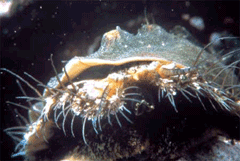
Northern Abalone in BC waters.
Last month in Prince Rupert three poachers caught with 11,000 live abalone crammed into the back of their pickup truck were sentenced. It was the biggest bust of its kind in B.C.’s history, but did the punishment suit the crime?
Some people in the poachers' home town of Skidegate on Haida Gwaii say it wasn't nearly severe enough.
An as-yet unpublished DFO report speculates that Northern abalone, once a $1 million a year industry in B.C., will be extinct in coastal waters within 50 years.
Harvesting abalone has been illegal since 1990, when Fisheries and Oceans Canada (DFO) put a total ban in place on stocks that reached near crash during commercial fishing heyday of the 1970s and 1980s.
Stan and Dan McNeil and their sister's boyfriend, Randal Graf, were each charged with three counts, two under the federal Fisheries Act and one under the relatively new Species at Risk Act, a hallowed piece of legislation which claims to offer protection to threatened and endangered aquatic species.
When the day of reckoning arrived, Stan McNeil, who has been charged with Fisheries offences before, received the stiffest punishment.
He was fined $20,000 and given a 12-month conditional sentence, six months of which could be served under house arrest.
The other two were fined $10,000 each and given four months conditional sentence, with three months served under house arrest.
All three men are prohibited from diving (that's how abalone are harvested), Stan for five years and the other two for two years each. Stan lost his boat (worth an estimated $150,000), his truck and his dive gear.
Judson Brown, who works in resource management, grew up in the same small community, going to the same schools as Graf and the McNeil brothers. He's one of the locals surprised by what he considers a light sentence. He notes that Stan McNeil may have lost his boat and some gear, but he didn't entirely lose his ability to make a living.
Brown wonders what happened to the man's commercial fishing licenses, potentially worth millions. And he can still buy another boat. "It's not that hard to do," says Brown.
Brown says if this was the case that was supposed to serve as a deterrent for future poachers, he doesn't think the judge went far enough. "Judges don't view resource protection in the same light as a bank robbery or an assault," he says.
Traditional food commercialized
"Live by the sword and die by the sword," says Captain Gold, a Haida elder who used to harvest abalone from the ancient village of Skung Gwaii at the southern tip of Gwaii Haanas National Park Reserve and Haida Heritage Site. A whole generation of his people hasn't been able to eat the tasty mollusk due to the greedy harvest of the animals by legal harvesters before the ban, and further plundering by illegal poachers.
Captain Gold has no compunction about saying he isn't impressed with the way the Department of Fisheries and Oceans have managed the resource in the first place. When DFO placed a total harvesting ban on the fishery in 1990, fisheries managers hoped that the beleaguered abalone would recover. But habitat surveys over the last 10 years have shown that the numbers are not bouncing back.
Captain Gold points to the commercial sea urchin fishery, which saw an upsurge in activity in northern waters starting in 1990, right around the same time the abalone ban was put in place.
Abalone and sea urchins are found in the same habitat and both are harvested by diving. "If you can get $5 for a sea urchin and $30 for an abalone, which would you take?" he says.
He thinks all commercialization of Haida traditional foods has had a negative effect on Haida people's ability to harvest the abundance themselves.
Other sentences
Brian Jubinville is the supervisor of the Fisheries and Oceans Canada's Special Investigations Unit for Southern Vancouver Island. He has made abalone and catching poachers his own personal quest. He was near despondent when he heard how many abalone were found with Graf and the McNeil brothers when the poachers were caught near Port Edwards in February 2006.
On the day the sentence was announced, Jubinville was still digesting the punishment meted out. His initial reaction was disappointment.
It was an astounding number of animals, he said, and although Fisheries officers tried to take the abalone back out to the ocean after the seizure, he doesn't think many of them survived.
He pointed to recent poaching cases and the sentences involved as a reason for his concern.
In November 2004, David McGuire of Victoria was caught with 450 live animals and pled guilty to 13 counts of fishing for, possessing and selling abalone. He was fined $25,000 and given a 10-year diving prohibition.
Joseph Ho of a Vancouver seafood wholesale/retail company received a fine of $50,000 related to the same case.
Observers expected the case involving the McNeils and Graf, the first prosecuted under the Species at Risk Act, would be dealt with more severely.
Jubinville says it is difficult to say how much poaching is taking place in B.C., but most scientists think that poachers like these are responsible for the continued decline of the species.
Recovery projects
Something positive that can come out of the fines imposed on poachers is that the courts often dictate part of the money collected be donated to recovery projects.
The Bamfield Huu-ay-aht Community Abalone Project Society received $22,500 from a recent abalone conviction fine and this money has helped keep the project afloat.
The project, which has been underway since 2001, supports a hatchery and a reseeding project that raises Northern Abalone in tanks and then releases them into the wild ocean.
Society president John Richards says he has also been able to sell some hatchery-raised abalone to high-end restaurants in Vancouver and on Vancouver Island. The animals are very slow growing, and even though he has some five-year-old abalone, they are only an inch to an inch and a half in diameter. At a price of $8 to $10 wholesale for the small creatures, they are only suited to a very high-end market.
Return the shells
Both C Restaurant and the Sooke Harbour House, restaurants committed to serving local and sustainably-harvested foods, have bought abalone from Bamfield, but restaurant managers also face some onerous DFO regulations involved in selling a threatened species. All shells from the abalone served must be collected and returned to DFO, for example.
Richards knows the market would prefer bigger sizes and fewer regulations, but all he can do is wait. Meanwhile any extra income is helpful to his struggling hatchery.
Eating an animal out of extinction may seem counter-intuitive, but that's just one of the innovative ways researchers and other coastal project leaders are attempting to turn around the Northern Abalone's fate.
Another unlikely sounding project achieving success uses abalone condos. No, these aren't fitted with stainless steel appliances, but they are located in some prime locations, from a shellfish's point of view.
The Haida Fisheries Program is in its tenth year of monitoring local abalone populations. Abalone condos, an innovation of local marine biologist Bart DeFreitas, are artificial habitats that make finding juvenile abalone a heck of a lot easier. Abalone are nocturnal and like to hide in cracks and crevices, especially when they are small (sizes ranging from 11 to 109 mm).
By the end of 2006, 144 artificial habitats were in place and 900 "baby" abalone were counted in the waters around Haida Gwaii.
Related Tyee stories:
- Little Hope for the Ugly Fish
Demand for the toothfish has almost emptied the seas of it. - Save Our Oceans, Eat Like a Pig
Let's stop wasting tasty fish on animal feed. - When Money Buys Grizzly Lives
How good a deal was the purchase of coastal hunting rights?


13
Login or register to post comments
ME2
5 years ago
Abalone
There are a number of arguable assumptions re Abalone in this article.
The first is DFO's contention that Northern Abalone, (Haliotis kamtschatkana or Pinto Abalone) is under threat of extinction. But the threat is to commercial harvesting only, not to the species itself.
Commercial-size Abalone require some 6-10 years to acquire harvestable size (9-11 cm), but will breed at age 3 when it is only 3 cm (1 1/2"). These are called "surf abalone". Although fully-grown abalone will produce up to 1,000 X the eggs that a surf abalone will, this was still plenty to ensure survival of the abalone in the days of the Sea Otter.
Perhaps someone else knows of evidence, but I am unaware of any midden evidence that pre-contact sboriginals ate any appreciable amount of abalone. The reason for this was that the Sea otter co-existed with Pre-contact Coastal FNs, and they ate the larger abalone - those unable to hide under rocks and crevices like the tiny surf abalone. For millennia this was the success strategy of the species in the days of the Sea otter.
In 2002 a study, Survey of Northern Abalone, Haliotis kamtschatkana populations in Eagle Bay, was done under the aegis of the Bamfield Marine Station. They contended that the primary problem facing the Abalone (outside of poaching) was the "Sea urchin barrens", evidence of the destruction of the kelp forests, the abalone's necessary habitat.
And thus the Sea urchin is slowly eliminating the kelp forests along the Coast from California to Alaska, and with it disappears the primary and utterly irreplaceable engine of our inshore productivity, necessary to far more species than just Abalone.
The only answer to the kelp problem is the re-introduction of the Sea otter (its major food item is the Sea urchin) to our coasts.
Opposing this is DFO - interested only in protecting its Urchin fishery - and FNs who fear loss of their not so "traditional" food. the Abalone.
doggone
5 years ago
Can we see a pattern here?
Good information ME2.
Translating fish into money will always be a problem. I agree with the Haida: stop all fishing for sale.
If you can not eat what you catch in the next season do not catch it - let whatever animal grow on and spawn.
Whatever you do to the resource do not imagine that dollars will compensate for the destruction. Dollars are paper (or now days electronic funds) and basically meaningless. Trees are much better than dollars and fish are also just fine to eat.
Making these things "comodities" and encouraging boneheads to rip them off for sale will plague us for a while-
Soon enough the bonehead will be simply trying to feed himself and his family.
IAMC
5 years ago
sounds like growing pot sentences
11,00 pot plants gets you less time than these guys got.
Where is are sense of justice?
Do these animals not grow back?
I am confused with this logic.
Burgess
5 years ago
Out in the Broken Island
Out in the Broken Island Group between Bamfield and Uclulet by an obscure little Island a float plane from the US had a diving group working the shallows. The Abalone were being stashed in the floats of the plane. They got nervous when we got too close and flew out to who knows where. Anyway the problem is the Fed DFO sanction the 'piracy' by lack of enforcement and funding. What else is new? Looks like the DFO and Ottawa Mandarins will only be happy when the last fish, abalone and the rest of the sea life are gone thus leaving the ocean to the 'fish farmers' who only take and never give. When they are done with BC they will move to somewhere else. Our Norwegian Billionaire couldn't give a tinker's dam for BC and our local fishers as long as he can ruin them for the interest of his own pockets. Notice they don't spare any effort or money to refute the science of coastal destruction of wild stocks. And don't forget costal communities don't make BIG campaign donations. It is so hard to believe that the coastal communities are just laying down and letting the destruction happen. Maybe costal communities could take a lesson from the sea lions and be pro active, after all the sea lions are hungry and just maybe the communities aren't that hungry yet.
ME2
5 years ago
Resource Depletion
Yes, it's all about money, and who gets what. Even the Great God Sustainability means only "How much money will it yield?"
But the ocean contains an interdependant ecosystem which is being rapidly dismantled.
If the present pace continues, soon the ocean will stop yielding not only money, but food as well.
Right to Bear
5 years ago
Here we go again....
Me2 said:
My neck is sore from nodding in agreement to all the spot on comments responsing to this article.
Here we go again... And so many wonder why the Earths creatures are struggling to exist. With this many anthropocentric people it is hard to imagine good change before it is too late for these animals... I will attempt to remain hopeful though.
Peace,
Bear
doggone
5 years ago
Please do Bear
Your voice keeps on giving me hope.
The thing I'm watching now (CBC) is how they play out the fish farm contamination of smolts and fry. Some of my best friends work in the "sea farm Salmon" industry and I have been involved in on land hatchery construction.
You (nor I) could not believe how much PVC pipe goes into an on shore fish hatchery but very likely the on shore system is better for the survival of local salmon.
By the time we get all the technology built I imagine some kind of crash will have happened.
Call me a pessimist if you like but when full bore exploitation is normal the crash ain't too far off
Right to Bear
5 years ago
Kickin' Back...
I hear ya doggone...the crash is nipping at our heels indeed, but for now, all I can think of doing is stopping, turning around, and kicking back. Heck, I will put on my "kill-a-fly-in-the-corner" cowboy boots if I have to, but either way, they will feel my commitment.
I keep thinking of a organic fish farm in a closed containment situation, being a possibility in the future. Obviously there can be only a minimum number of fish in the tank, as too many creates an serious environment for disease to flurish. Cost would be extremely high, but say-la-vi, as it would be supporting a system that is low-impact for the Earth. It is too late for things to not be done right by the Earths standards, and as I know you know my friend, this has got to be our priority today...
Peace bro,
Bear
anne cameron
5 years ago
hey loyola
I live in Tahsis. The otter has been reintroduced here and I'm not a huge fan of the bristle-faced little darlin's... I'm trying to take a long-term view, I'm trying to remind myself there was a time there were lots of otter here and everything seemed to mesh together and work just fine but...when there were swarms of otter there wasn't as much competition for the food resources of the coast. Nobody had diving gear, nobody had power boats, there seemed to be enough for everyone because nobody was selling tonnes to foreign markets.
anne cameron
5 years ago
draggers
Canada has refused to sign the agreement banning draggers. These boats plow the ocean floor, destroying the habitat of the abalone, geoduck, horse clam and other threatened species. The kelp forests can't grow if the seabed is wrecked on a regular basis, and the sea urchin gets the blame when, in fact, there are less of them every year. The draggers are the major problem.
The introduced sea otters have stripped the rocks of mussels, stripped the beaches of clams and are now feasting on a rapidly crashing crab population. And they're doing this because there aren't enough sea urchins.
And Loyala Hearn couldn't find his arse with both hands to wipe it.
anne cameron
5 years ago
condom wrapped boats
Federal law states that foreign registered boats must return for a certain amount of time each year. Unless they need vital repair or maintainance they cannot stay here. So a local marina has over a dozen of these amerikkkan registered boats sitting on trailers and wrapped in plastic to protect them from the weather. They've been here since the end of sports fishing season last year. Not a wrench has been turned, not a centimeter of fibreglass applied. I've written Loyala Hearn several times about this but he has done nothing at all.
WHY have regulations if you aren't going to enforce them?
Non residents openly hire out as fish guides and that's against the law but write to the fish minister and nothing happens.
Report faulty sewage disposal by a commercial enterprise and..nothing happens.
Casey would waltz with the strawberry blonde and the band played on...whirled round the floor with the girl he adored and the band played on...and played on...and played on...
kenl
5 years ago
anne cameron
I believe you are in error re draggers
My understanding is that abalone, sea urchins and kelp all live at or near the intertidal zone,which is away from the draggers preferred fishing areas.
I am not defending the drag method of fishing, merely pointing out your error
Right to Bear
5 years ago
Reintroduction...
Hi Anne,
Excellent info, with all the passion of the caring soul you are...Thanks!!
On the subject of the reintroduction of sea otters, I am not surprised you take the higher long term road fitting for the natural ecology of this area... I only wish more would do so.
The plight of the sea otters sort of reminds me of the plight of the wolves. Years ago wolves lived comfortably in North America. They ate only what they needed and their populations were naturally regulated. No excesses and no debts exist in nature. Ecosystems are always perfect, or they would not exist. Then, things changed upon the introduction of the cow. Wolves, by no fault of their own, and in many cases they were falsely accused, became the number one enemy of the North American rancher, and remain so to this day. The “successful” extermination of wolves became evident after an out and out war to destroy them all. This then allowed for money's to be made on this unnaturally changed habitat. The ranching industry was allowed to swell and take on a life of its own. The wolves traditional lands were stolen from them as they died, and even with an effort to reintroduce wolves to areas such as Montana and Wyoming, the lifestyles and basic economy built by the ranching community (with the exception of a few) was and still is, resistant to change or unwilling to adapt in order to accommodate the reintroduction program for the health of the ecosystem in these areas. The struggle continues.
Anne, there is a saying that goes something like this “If a persons livelihood depends on denying a truth, then that is what they will do” Sad, but true.
Peace,
Bear