Help the Planet, Buy a Car?
That's what BC's auto dealers say. The fine print on their green sell.
'Cars a favourite whipping boy'
With all the recent attention paid to climate change, there are plenty of ideas on how to save the planet. Many of them make immediate sense.
Then, there is the suggestion from B.C.'s car dealers: buy a car!
On Monday of this week, the day before the throne speech was due, the New Car Dealers Association of B.C. appeared worried by speculation in some news media outlets over the weekend that the speech might have a green focus.
And that might have been not-so-good news for the pushers of large SUVs, light trucks and minivans. For those types of vehicles generally share two characteristics.
First, they're the most damaging to the planet.
For instance, the $73,000 2007 Lincoln Navigator SUV ("365 ft.-lb of Dominating Presence") slurps enough gas that a gallon will push the three-tonne, 300-horsepower behemoth a mere 13 miles around town. On the highway, it will run another five miles further.
That poor fuel efficiency translates into more planetary damage per kilometre travelled: full-size SUVs, minivans, pickup trucks and the like emit about 40 per cent more greenhouse gases per kilometre travelled than do passenger cars, according to Environment Canada.
The second characteristic of these heavier vehicles is that they bring in the largest profit margins, according to John Bennett, the executive director of Climate Action Network Canada.
"They don't want to sell small cars," Bennett says.
Same old road
How big a problem are cars?
Environment Canada reports that around 30 per cent of the country's carbon dioxide emissions are from transportation -- including aviation, trains and heavy trucks. And nearly half of that comes from cars, SUVs, minivans and light trucks -- the very vehicles sold by the association's members.
But exactly what are the guys in the white shoes going to do about this?
Halt the sale of unnecessary, gas-guzzling vehicles like the Navigator?
Buy carbon credits to offset the volume of carbon dioxide that each vehicle they sell will produce over its lifetime?
At the very least, give away a free bicycle with every vehicle?
Well, not exactly.
In a statement issued on Monday this week -- the day before the government's throne speech came down -- the car dealers association claimed to "applaud" the speech's expected announcement of the government's push against global warming.
(In any event, the association certainly seems to like the Liberals: it turned over $153,000 and change to the B.C. Liberals in 2005, almost all of it during the election campaign, according to Elections B.C. reports.)
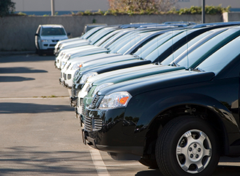
The solution, says the association, is for owners of B.C.'s more than one million least efficient vehicles to get rid of them, and buy new, or newer, ones.
Here's the gist of the dealers' argument that buying a new car is good for the planet. Cars are much more efficient than they were 20 years ago. In fact, a 2007 model car produces about half the greenhouse gases of its 1987 equivalent.
"Clearly, the biggest gains relative to auto emissions of all kinds are to be made in removing old vehicles from the road, not impeding access to new ones," car dealers association President and Chief Executive Officer Glen Ringdal said in the Feb. 12 statement.
"We hope the government's plan will acknowledge this self-evident truth and introduce measures that will help the owners of over one million least efficient vehicles in our province remove them from B.C. roads and replace them with new or newer, more efficient vehicles."
Fuel efficiency worsened
The car dealers' statement also boasts that the Canadian auto manufacturing industry "has been a leader for nearly 20 years in developing and marketing technologies to reduce its sector contributions to airborne emissions and [greenhouse gases]."
But if the industry has been a leader for the last two decades in selling green technologies, how come the average fleet fuel efficiency for Canadian passenger vehicles has declined by five per cent since 1987? (The data is from a November 2006 report produced by the Canadian Automobile Association and Ontario's Pollution Probe.) While the manufacturers have been busy adding idiotic, safety-harming features like cruise control and cell phone connections, actual improvements in fuel efficiency have become road kill, squashed as flat as a wayward skunk.
Climate Action Network Canada's Bennett says that, in boasting of their greenness, the car dealers are trying to mislead the public.
For one thing, the only reason fuel efficiency improved in the 1980s was because of U.S. government regulations, which stopped forcing improvement in 1990.
"As soon as the regulations stopped requiring improvement, the cars stopped improving," Bennett says.
Bennett adds that about 20 per cent of the pollution caused by a car over its lifetime is created before the car is even driven, once the effects of mining, smelting and manufacturing are taken into account.
"There's an awful lot of greenhouse gas impact before you get the car on the road," Bennett says.
So the act of merely buying a new car -- even if you leave it sitting in the driveway --means adding extra greenhouse gases to the atmosphere.
Customer is wrong
In their statement, the car dealers attempt to blame, in part, the nasty consumers, for buying the wrong cars.
"Of course the 345 member dealers of our association can sell only the products that are produced by manufacturers and that consumers want to buy," this week's statement says. (Emphasis in original.)
The fact that citizens continue to buy gas-guzzlers has nothing to do with the car companies' heavy promotion of them. So it just wouldn't be right for us to stop selling such machines.
In a Feb. 14 interview from Houston, B.C., Ringdal is asked whether dealers push customers away from less-efficient vehicles.
"What we do encourage always is that people should buy the vehicle that meets their needs," Ringdal says. "Up here where I am, in Houston, a little car is not of much use." It all depends what you "need," he says.
"In whatever circumstances you are, and what your needs are, you should drive the most efficient vehicle possible. So if you drive on to my lot, and I've got a Navigator and I've got a [Ford] Fusion, which one meets your needs?"
But have dealers been discouraging sales of the Navigator in places like balmy Victoria, where they have been immensely popular?
"I don't know that they have," Ringdal says, "but their consciousness is being raised, at the same time as the general population's."
As it turns out, this week's throne speech didn't introduce hefty new taxes on gas-guzzlers, let alone ban them.
But it did promise tougher standards on vehicle emissions, starting in 2009, as part of a larger goal of reducing green house gas emissions by at least 33 per cent by 2020. Ringdal says he's happy about the government's promises, made in the speech, to go after all sources of greenhouse gases -- not just those from cars.
"Cars have been a favourite whipping boy for quite a few years," he says.
Fear of regulation
If car dealers are having an epiphany of sorts when it comes to selling inefficient vehicles, there might be more than pure altruism involved.
According to a September 2006 report by Walter McManus of the University of Michigan's Transportation Research Institute, fuel efficiency could be good for Detroit.
McManus's study found that car manufacturers' previous opposition to mandatory improvements in fuel economy was misguided, since consumers will pay more for fuel economy -- even when gas prices are not high.
In 2005, when the prevailing price for gas in the U.S. was $2.30 per gallon, consumers were willing to pay $578 US for each extra mile that a car would run on a gallon.
His conclusion is that a proactive strategy of boosting fuel economy -- beyond what is required by law -- would boost annual profits for Ford, General Motors and Daimler-Chrysler by a total of up to $2 billion US.
Indeed, the so-called "sub compact" segment of the Canadian car market seems to be doing well.
As of August 2006, sales of sub-compacts in Canada had jumped 21 per cent from a year earlier, according to the Association of International Automobile Manufacturers of Canada.
The B.C. dealers' February 12 statement suggests that among their concerns is fear of more regulations.
However, the Climate Action Network's Bennett says regulations are exactly what we need.
"The only thing that has ever improved the automobile has been regulation," he says. "Everything from seatbelts to bumpers has been regulated, over the objections of the industry."
"If they had their way, you'd still have a 1940s-style car with no seat belts, weighing five thousand pounds and getting about nine miles to the gallon."
Related Tyee stories:


52
Login or register to post comments
herbie
4 years ago
If you live in Houston, the
If you live in Houston, the dealer is absolutely correct. You would be doing your part purchasing a new vehicle that got 13 mpg, instead of keeping your old 1989 that got only 9 mpg. That's a 50% reduction in tailpipe emissions.
Residents of Area 250 have a different set of rules to reflect a different reality. I haven't seen one Smart car of the 1/2 dozen in Prince George on the road since November.
Grumpy
4 years ago
Want to reduce auto emmission?
If you want to reduce auto emissions, you have to reduce dependence on the car. In the are code 250 area, except for Victoria and Kelowna, we should not worry about cars.
In Vancouver it is different, even though we have a large and expensive public transit system, for many it is next to useless, but we still pour hundreds of millions of dollars into it annually and achieve next to nothing.
what is needed is a comprehensive 'rail' system, over 300 km. of route mileage, to attain a network size to attract the motorist from the car.
What would be the cost?
300 km. @ $125 million/km. (RAV/SkyTrain metro cost) $37.5 billion.
300 km. @ $90 million/km. (Evergreen Line hybrid light rail/metro) $27 billion.
300 km. @ $30 million/km. (proposed Ottawa LRT) $9 billion.
300 km. @ $15 million/km. (Average Karlsruhe LRT on-street/track sharing cost) $4.5 billion.
Gateway $4.5 billion.
RAV/Canada line 19 km. $2.3 billion.
One can see that for the cost of modern LRT utilizing both building on-street (on reserved rights-of-ways of course) and track sharing with regular railways one can achieve a 300 km. network for the cost of Gateway or put another way, for about twice the cost of RAV/Canada Line, we could build over 15 times of rail route, servicing many more communities!
See why no one else in north America, with a few exceptions (due to population size Washington DC and Los Angles are building new metros L.A. also operates LRT and Washington DC is now planning for the return of LRT), is building with metro? See why no one comes to Vancouver to see how we build rapid transit?
Has the penny dropped guys! It hasn't yet with TransLink.
ModernSerf
4 years ago
Feebating anyone?
This is a classic candidate for feebating. Simply tax the worst offenders and use the money for rebates on best.
The auto industry will complain, but they will still sell just as many cars and if individual companies cannot remain competitive in the new marketplace, well...that's corporate Darwinism.
I personally believe this is part of the reason (the main one still being quality) that Toyota and Honda have been steadily gaining marketshare against the "Big 3".
While I agree with Grumpy that intelligent public transit is preferred, I think that population density/city planning need to be more intelligently applied as well. Suburban sprawl has aggrevated the transportation system as much as it has the residential emission situation.
How about directly adding to the gas tax with the money going directly back into public transit and EV car subsidies?
tessa
4 years ago
huh?
Uhm, gallons? I have no idea what gallons mean, so those examples are pretty much useless to me.
As for Grumpy, he seems to forget that Montreal and Toronoto are both building new metro extensions, along with many others, although he still has a point.
snert
4 years ago
How about taxing everyone.
Why tax only fuel users? Why not tax everyone then open more bus routes with smaller buses and make public transportation free.
With the advent of modern technology it is possible to to incorporate flexible routing and scheduling an a demand basis. It's even possible to do real time route adjustments to pick up phone-in riders.
Quit the blame game and start doing some serious out-of-box thinking otherwise we'll just wind up giving away any advantages we have in life to those who are or those who don't give a shit.
I don't know just how accurate Grumpy's figures are but you could sure buy a hell of a lot of buses for $2.3B.
woody
4 years ago
imperial---metric
Hi tessa, 1 gal=4.5 litres
BLONDE PITBULL
4 years ago
Grumpy
I wanted to know what you would do for public transit in the GRVD without the flaming of the existing skytrain system. By that I don't need to hear the retrashing of it (I get it that its not what you would have picked but now that we have it I don't think knocking it down and starting over is a viable option) so with the amount of time and knowledge you have what would you do to improve transit while working with the current set up?
murdock
4 years ago
6000 SUX
less science and less fiction all the time...
http://eater.org/gallery/albums/OMGLOL/6000sux.sized.jpg
http://en.wikipedia.org/wiki/RoboCop
is Omni Corp far behind?
Chris H
4 years ago
Gas Guzzler tax
The government should scrap the luxury sales tax on vehicles and instead have a gas guzzler tax. Any vehicle that gets less than 40mpg should be hit with a 10% tax, and any vehicle that gets less than 20mpg should be hit with a 25% tax. That WOULD have an impact! Tax the gas guzzlers, save the world!
kram
4 years ago
SOV Tax
How about taxing vehicle at toll booths based on:
engine size + weight X number of empty seats.
That would have an impact, no?
Stump
4 years ago
the problem with gas guzzler taxes
is they unfairly penalize people in the trades who need big trucks.
What we need is consumers with common sense. Don't hold your breath.
Stump
4 years ago
the problem with gas guzzler taxes
is they unfairly penalize people in the trades who need big trucks.
What we need is consumers with common sense. Don't hold your breath.
Chris H
4 years ago
Cost of doing business
If you need a big, gas guzzling truck for your business then it is a cost of doing business; one that every company/person in that trade will have to have. And, if you truly need it, then is it not a tax write-off? A gas guzzler tax on vehicles at the point of sale will encourage everyone to look for more fuel effecient alternatives. I don't think taxing people who are polluting the environment more than others is penalizing others unfairly. As a consumer, I will share in those costs if businesses need to hand them down to me.
Tractorman
4 years ago
I can't believe some of the
I can't believe some of the stuff I'm reading here.
1. Why are you [apparently] willing to spend $125 million PER KILOMETER for another rail system that will lose money? Grumps is spot on with his analysis. The only way that public transport will remain viable is for the construction costs to come down.
2. In case you don't realize it, fuel is already taxed - to death. Both the federal and provincial governments have been taxing fuel since the dawn of time. They got real serious about it during the reign of Canada's worst dictator [pee-aire trudope]. If you choose to have a ride that gets 10 miles per gallon, then you are already paying far more in taxes than most of us do.
3. There seems to be a lot of urban comments and very few rural comments on this subject. Here's one. My truck is a 4*4. My car is a 4*4. My tractor [well the big one anyway] is a 4*4. The reason? Well not all of us live in balmy Vancouver. There are times when it's either shift into four wheel drive and pollute your face off or call a tow truck to get you out of a snow drift. Some people own four wheel drive vehicles because they are necessary.
4. How about taxing vehicles at toll booths? Cool. What a way to destroy the economy and the environment in one swell foop. It ain't like we already have line ups for almost everything imaginable and now you want to make another one and for what purpose? To force people to wait with their engines idling so they can pay more money into a system that doesn't work to start with. Clever. In addition, this number of seats thing may work if [IF!!!!] it only applied to commuters. What about the travelling salesman? Or the guy who is going to a business meeting? Or some guy who is trying to get to a job interview? Or the trucker trying to deliver a load of goods?
5. Pass the increases on as a cost of doing business? It ain't like business doesn't already have a mitt full of gummint regulations to work around. A few thousand more regulations won't hurt much will they?
6. I saw a comment concerning the scarcity of Smart Cars since November. Now that you bring up the subject, I haven't seen too many either. I did see one with Saskatchewan plates out by Barriere a while ago. We were driving back home from the Okanagan during a lull between winter storms and we saw some brave soul in one. I have heard that they only get about 65 MPG and are almost small enough to put in your pocket. By comparison, my brother's Volkswagon Jetta TD, which has true 5 passneger capability also got 65 MPG. Which would I choose? It's kind of a no-brainer, isn't it?
Tractorman
freebear
4 years ago
Here comes the sales pitch!
Buy, Buy, Buy!
So the solution is to consume more!?
So the plan is to grow, grow, grow!?
We need to make do with less on a planet that has limits!
Intersting that so few, besides Modern Serf, recognize that our settlement patterns greatly afect our use of energy.
So despite the greenwash from the Premier and the car dealers association, we will still build the same suburbs and more lanes for more cars!?
If the car dealships had their way 'we' would be buying a new car every year!
We won't stop until we choke on our own exhauist!!!!!!!!!!!!!!!!!!!!!!!!!!!!!!!
Wilbur the Wild
4 years ago
What's the point of
What's the point of improving gas mileage by twenty percent if the number of cars increases by twenty percent? Nothing is gained.
There are too many people in this country. If there were half as many, we could all drive gas guzzlers and still reduce the amount of greenhouse gas emissions. Instead of telling us all to do with less, the government should reduce the birth rate and immigration and encourage emigration.
Every human in this country generates 5 tonnes of green house gasses per year. By not having the average 2.3 children per family, I’m reducing my greenhouse gas contributions by 11.5 tonnes per year and exceeding the 1 tonne challenge by 1150%.
I have no intention of cutting back on consumption as long as the government allows the population to increase. I don’t have kids so I have no compunctions about trashing the planet.
Chris H
4 years ago
Where is the incentive?
Where is the incentive to buy a way higher priced 4X4 hybrid? It may take you years to recoup that higher price in gas cost savings.
Where is the incentive for companies to produce more fuel efficient vehicles? If you go shopping for a truck or car, you'll see how limited your choices are.
The fact of the matter is that we need to do something and people, including those in rural areas, need to make the best choices for the planet. There are many who claim to "need" that gas guzzling 4X4, but never leave the Lower Mainland. We know that the car industry isn't going to do anything about it. Ask any car dealer, they'll sell their grandma down the river to make a nice profit.
Stump
4 years ago
Where is the incentive?
I'll be picking up mine from daycare in an hour.
Kudos Wilbur, I've never heard "I can't get laid" as a reason for screwing everyone else before. That's a first.
thomas49
4 years ago
Quote:Where is the incentive
well folks,looking at the news the other day,i noted that the big three are billions of dollars in the red !!!
might be incentive to sell more ENVIRONMENTALLY FRIENDLY VEHICLES...when they have to pick up their CORPORATE WELFARE CHEQUES from the government of the day...LIKE CHRYSLER DID BACK IN THE OLD DAYS WHEN THEY WERE TREADING WATER...
REMEMBER !!!
Boy did they ever get a big WELFARE CHEQUE! from the Americans...THEN THEY GOT SMART AND STARTED FLOGGING THE ....k-car...REMEMBER !!!
seems,these clowns are hard of hearing and of course they sell cars ...THEY ARE NOT TO BE TRUSTED.
VanIsle Guy
4 years ago
More taxes in general is NOT
More taxes in general is NOT a solution to the environmental problems. We have billions of dollars of our money in "surplus" (i.e. excessive taxes) that could be used in all sorts of ways to help with environmental problems.
The soccer-mom with the Lincoln Navigator is way more of a problem than the Roofer with the F350 pickup! While soccer-mom could (should?) be driving a Jetta diesel, the roofer needs a pickup.
The solutions are going to be mandatory efficiency and smarter consumers. The gov't can mandate fuel efficiency. The tough one is going to be forcing consumers to buy more efficient vehicles. Maybe targeted taxes (taxing people in cities who buy big trucks who don't need them for work) might be a partial solution to forcing consumers to make "smarter" choices. Also, eliminating taxes on fuel efficient vehicles would be a good idea.
snert
4 years ago
Everybody makes their own sacrifices.
Stump
You got a problem with that. Your kids are already some of the highest energy/capita users in the world. Who's screwing who?
Stump
4 years ago
If you think Canada is overpopulated
you can always come to Vancouver where we have a number of lovely bridges for you to take the solution into your own hands. I'd recommend Lion's Gate or Ironworker's for the nicest view for the short trip down.
My beef with Wilbur is his/her attitude that not having kids gives you the right to 'trash the planet'.
SharingIsGood
4 years ago
Chris H tax scheme deserves thought
I like Chris's tax scheme. I would like to add that the cars should also get 20 year or 400,000 km warranties on the powertrain, frame and body. Cars not getting those warranties should be taxed into extinction. Cars should be built to last. No tax on equipment for cars being retro-fitted to burn hydrogen.
Car companies should get tax breaks for building hydrogen burning cars, and there should be a world-wide 25 billion dollar prize to the first inventor/team to develop safe and practical (cost-effective) hydrogen storage and distribution for automobiles. If a government solves the problem, then it gets the prize. The technology should then be available to all - with no patent ever to be granted for the technology. Wind, geothermal, solar, and tidal generators should be used to decompose H2O. All vendors of gasolene wishing to remain in business must make hydrogen available for cars.
woody
4 years ago
WILBUR GO IN STYLE
Stump
Its reassuring to know, that there are people like Wilbur the Wild out there, as I have two gas guzzlers that Im going to unload soon. Rather than follow your bridge advice, which can tie up bridge traffic needlessly. If Wilbur the Wild purchases my beaters, within 6 months he will be gone, having starved to death from supporting these guzzlers .Wilbur the Wild stay away from those bridges until you seen these beauties,they may cause slow death but, you’ll go luxuriously.
Chris H
4 years ago
Sure the roofer needs his truck ...
"Maybe targeted taxes (taxing people in cities who buy big trucks who don't need them for work) might be a partial solution to forcing consumers to make "smarter" choices."
You could always tax the gas guzzlers at the point of sale and then give a tax rebate to those that claim the vehicle as a business expense. There are ways of doing it without hurting the roofer who needs the big truck. Needing a big truck because you pull a 5th wheel around to go camping is a want and not a need, and should be taxed accordingly.
In London and Paris the price of gas is nearly $2 a liter. Their before tax cost of gas to the consumer is something in the neighbourhood of 56 or 57 cents (10 cents cheaper than BC). We could go that route, but I think people here would be much more receptive to taxing vehicles at the point of sale. We are simply not taxing people for the damage to the environment. At what rate do you discount this damage? What will clean air be worth to your grandchildren?
darcy.mcgee
4 years ago
Cars are not the cause of Global Warming
More global warming gasses come from houses and buildings than from cars and trucks.
Cars and trucks are a conveniently visible problem, but a small portion of the global energy consumption problem. Building more efficient buildings around the world would go a long way towards solving the problem.
So stop ragging on the car deals and start bugging Bob Rennie instead. Even if you get everybody -- EVERYBODY -- in North America out of their cars and on foot, or on a bicycle the problem of global warming will Not Be Solved.
I'm certainly not saying cars aren't a problem, but isn't it better to focus on solving the real problem instead of just the visible one?
I own a car. I cycle to work every day.
Chris H
4 years ago
Really?
From The Vancouver Sun - Larry Pynn - Nov.24, 2006:
"Per-capita energy use for heating, lighting and appliances actually declined five per cent between 1990 and 2002, while household energy use rose eight per cent due to increases in the size of Canada's population.
Between 1981 and 2003, the proportion of Canadian households heating their homes with oil fell to 13 per cent from 34 per cent, while those heating with natural gas rose to 50 per cent from 42 per cent and those with electricity rose to 33 per cent from 21 per cent.
Compared with oil, heating with natural gas or electricity (when produced with low emission technologies such as nuclear and hydro power) produces fewer greenhouse gas emissions and air pollutants, Statistics Canada said.
By 2004, retail pump sales of gasoline had increased 24 per cent over 1990, reaching a record 36.6 billion litres."
Skywalker
4 years ago
Skywalker
Not that long ago the push was for more diesel fueled cars. Diesel was about two-thirds the cost of regular grade gasoline. In the last 4 years the price of diesel has doubled and it is priced higher than regular. What that means is that no matter what you do to be more efficient and save youself money the oil companies will see to it that there are no monetary benefits for your efforts. I kind of makes people cynical. Scare someone into spending much more for a hybrid car and soon they will question the wisdom. Make the hybrid cheaper in the long run and there will be a positive reaction.
Then you also need to recognize that hybrid cars are not going to work well in some road conditions and for some families. Even transit does not work in all regions.
Finally all this spin from Campbell is more hot air as there is no money to be available to implement his green vision. He must be chortling his way to the next election.
rac
4 years ago
Here, Cars are the Problem!!!!
darcy.mcgee get real. In the Lower Mainland, light duty vehicles (cars SUV's) are responsible for 30% of emissions. This is expected to grow by 30% by 2030. The rest of the region's emissions are not expected to grow. The 30% does not include the emissions from refining gas or from tar sands production. It does not include the energy used to produce the vehicle.
Regarding buildings. Yes, less reduce emissions. But buildings (housing) is more essential to life than cars. Most people living in the world and most people who have ever lived or will ever live will get or have got by fine without a car. Even hundreds of thousands of people including myself get by without one. You can to if you really put your mind to it.
rac
4 years ago
Golden Ears Bridge the Really Bad Deal
Why do people always pick on the Canada Line instead of the Golden Ears Bridge. The bridge is $200 million over budget and will cost $800 million. On opening day, it is expected to carry only 20,000. Compare that to $2 billion for the Canada Line which is expected to carry 100,000 per day. So that is 40,000 per user for the Golden Ears Bridge verses 20,000 for the Canada Line.
The proposed Highway 1 expansion and Port Mann Twinning are even worse. Say the current capacity is 100,000 per day and there is demand for 130,000. Thus the new bridge and lanes would be needed for only 30,000 users. At $1.5 billion, that is $50,000 per user.
The Canada Line SkyTrain are less expensive per user than most LRT systems in North America. The exception is Calgary.
Roads are the really bad deal. Fight them, not transit!!!!
snert
4 years ago
The bridges are necessary.
Unless you want to stop population growth in the lower mainland in it's tracks. Which is not really all that bad of an idea. Work on that.
woody
4 years ago
you want to stop population growth in the lower mainland
SNOT,You want to stop growth in the lower mainland, feed em all lots of beef, in 10 years or so, they'll all be dead from heart failure,problem solved.
SharingIsGood
4 years ago
housing -v- cars - Darcy...
The problem is both, housing and cars. I hope that all future condos are green. Condos save much energy in terms of heating/cooling required (when build using green technologies. Large houses (like SUVs) require lots of energy to produce as well as to use. Over the last 30 years, there have been far too many single detached houses built that are more than 2000 sq. ft. Most families can live quite comfortably within a 2000 sq. ft. house. Though many people like these spaces, they are a sin against nature.
Better than single detached homes for individual families are cluster homes that are built in groups of four with common walls on two sides thus creating central heat sinks. If they work it right (and know how to share), they can even build in some nice shared amenities, thereby reducing the need for building and heating recreational areas.
Just because one can afford an over-sized home, it does not make it moral to have one. The few exceptions to this are for the extremely rich and/or famous. They need larger spaces just to have some peace. As the have nots become more numerous, these homes that the excedingly rich build will become more like prisons than oases.
Cars need to be made smaller for the same reasons houses need to be smaller.
If we truly look at what works best for the planet, most manufacturing should take place in warm dry climates that don't require so much heat/protection from the elements. Canada is a bad place to manufacture things for this reason. Unless we develope inexpensive renewable, non-polluting energy, Canada is a bad place to develope heavy industry.
rac
4 years ago
Plenty of Bridges, Too Many Cars
There are more than enough bridges. We need much better transit and land use planning so people are not being forced to drive and clog up the roads and bridges around the region.
G West
4 years ago
Related issues
The ongoing expansion of Delta Port facilities; the conversion of ALR land for industrial purposes; the future alienation of treaty settlement land from native to industrial and commercial ownership; the twinning of the Port Mann; and other changes to facilitate further industrialization and enhancement of shipping and receiving infrastructure as a result of a carefully scripted program on this government's agenda since the day it was elected will more than cancel out any progress made by a few individuals who decide to buy Toyota Prius automobiles over the next ten years.
Citizen responsibility is important but as long as our elected representatives won't be accountable and responsible for what they are really up to - instead of doing the people's business and furthering the peoples' agenda – (as they promised to do) - rather than advancing their own (the Campbell government's that is) we are in deep and deepening waters.
BC Dude
4 years ago
Gordo just paying his
Gordo just paying his buddies back by building all these roads and bridges to nowhere and how many billions?
I believe he's out to financially break BC.
http://www.publicpowerbc.ca/
G West
4 years ago
An interview from today's NYTimes
Questions for Drew Shindell
Political Heat
Interview By DEBORAH SOLOMON
Q: As a physicist and climatologist at the NASA Goddard Institute for Space Studies, you recently testified before Congress about ways in which the Bush administration has tried to prevent you from releasing information on global warming. Can you give us an example? Sure. Press releases about global warming were watered down to the point where you wondered, Why would this capture anyone’s interest? Once when I issued a report predicting rapid warming in Antarctica, the press release ended up highlighting, in effect, that Antarctica has a climate.
If your department is that politicized, how does that affect research? Well, five years from now, we will know less about our home planet that we know now. The future does not have money set aside to maintain even the current level of observations. There were proposals for lots of climate-monitoring instruments, most of which have been canceled.
By NASA? Well, it’s a NASA decision following the directives from their political leaders. The money has been redirected into the manned space program, primarily.
Are you referring to President Bush and his plan to send Americans to Mars? The moon and Mars, yes. It’s fine to do it for national spirit or exploring the cosmos, but the problem is that it comes at the cost of observing and protecting our home planet.
Why is NASA involved in climate research in the first place? There is no federal agency whose primary mission is the climate, and that’s a problem, because climate doesn’t command the clout that it should in Washington. Since NASA is the primary agency for launching new scientific satellites, it has ended up collecting some of the most important data on climate change.
I take it you don’t ride along on the satellites. Like the guy in “Dr. Strangelove” who was riding on the bombs? No. I would volunteer to go up on the shuttle, but I don’t think they would take someone like me. My eyesight is really bad.
What do you make of the news of that female astronaut who reportedly planned to kill a romantic rival? Who knew that NASA would turn up in Congress one week and in the tabloids the next?
There are now several bills floating around Congress that would limit greenhouse-gas emissions. Is one better than the others? They are useful first steps. But they are just baby steps. In the long term, we have to reduce emissions much more than any of these bills envision. At the state level, California is a great example of what the rest of the country should be doing. They require that energy be used efficiently, and as a result their per capita energy use has stayed level for decades, despite the growth in their economy.
Why do you think the federal government has been so phobic about adopting energy-efficiency regulations? “Phobic” is the right word, because it’s irrational not to conserve when you think of all the advantages, such as keeping money in consumers’ pockets instead of sending it to Middle Eastern countries that hate us.
What do you consider the most immediate threat of global warming? More heat waves, more drought, rising sea levels and stronger hurricanes.
On the plus side, will New Yorkers one day be able to walk down Broadway in the dead of winter and get a tan? No, it’s not going to get sunnier. Same amount of sun. Just hotter.
The president acknowledged the problem of “global climate change” in his State of the Union address last month. What do you think of the phrase? I’m mostly O.K. with it. It’s a phrase scientists use all the time.
And “global warming”? A bad name. Global warming sounds cozy and comfortable.
So perhaps you should try a new coinage. “Climate meltdown” sounds a little more ominous.
snert
4 years ago
A significant number.
SharingIsGood
A significant number of these 'oversized' homes have illegal suites in them and therefore are making your vision happen.
SharingIsGood
4 years ago
not my vision
snert:
My vision isn't having somebody dodging taxes from rental income to afford owning an oversized home - though there is higher density. If everyone was honest about their true income, it could reduce the taxes for all; people wouldn't need to try to get away with illegal suites, which could be classified as immoral, but it must be OK if everybody does it - wrong! Poor people can't do it, they can only rent; but the mantra seems to be, "They had better be clean and quiet if they want the opportunity to live in my illegal suite."
snert
4 years ago
It's interesting
SharingIsGood
It's interesting that you label the suite owners as evil doers for trying to dodge taxes etc. The solution to this lies with municipal governments who chose to not allow additional living accommodations in "single" family dwellings. The reason for that being that some single family dwelling owners may prefer to be just that.
As far as your comment about "clean and quiet" I don't see a big problem with that. Just where does it say that you have to accept unsavoury individuals for tenants?
This seems to apply to the perpetually legislated slum called the DTES though.
freebear
4 years ago
A Sustainability Tax instead of Property Tax
I would propose that we dump property taxes and replace with a 'Sustainability Tax'.
One that considers the buildings number of occupants, floor area, water use, 'fast' runoff produced, green house gases emitted, distance to nearest bus stop/LRT/Commuter Train station, etc.
Incentive: Live lighter on the ecosystem; pay less tax.
Sad how few people post about the patterns of settlement which have been terribly inefficient when it comes to energy use and transporation (only efficient in a systen that discounts external costs to the environment, health and community).
What do you think?
snert
4 years ago
I Think
freebear
That only the rich people will benefit from your proposal simply because they will be able to save the most taxes by following it.
They will soon control all of the properties within the low taxation zones. So what are the other 95% of us going to do?
freebear
4 years ago
Sustainability Tax Concept Clarification
The idea is to reverse NIMBYism Snert.
The only way the rich will benefit is if they support smaller homes, public transit in their neighborhoods, affordable housing (low income), recycling centre, community gardens, etc.
If the rich do not want these things/activities/land uses (and so many other criteria) in their neighborhoods; they WILL PAY MORE TAX, not less.
In other words, less effective, less efficient (e.g. city infrastructure), less ecological (firendly) and less socially just activities and land uses (re: properties); will pay MORE!
Does this help explain the concept?
snert
4 years ago
I understand what you are saying.
The rich will benefit by virtue of the fact that they will own all the property unless you wish to make all the housing in these areas public then watch things turn into slums real quick.
I've never been to London or New York but I do believe that wealthy or at least reasonably wealthy people are quite content to live in smaller accommodations if the location is right.
You can only crowd so many souls in a small space and the rest have to look elsewhere. It's not hard to guess who the losers will be.
freebear
4 years ago
Snert: And who are the
Snert:
And who are the losers now? I am talking about change for the better, not worse!
Perhaps the (high) sustainability tax would mean property owners would sell. A group could purchase and develop co-housing?
Stump
4 years ago
Quote:If the rich do not
Yeah, because we should all have to do what the rich want! The rich should decide urban planning issues of course. It's worked out so well to date hasn't it?
I think it's a pretty poor substitute for democracy when the rich can buy their way out of being good citizens and make the whole community suffer for it.
Bad, bad idea.
freebear
4 years ago
No Fan of the Rich
Obviously I am having trouble explaining the sustainability tax. There will be a base rate, and verything else would be based on sustainability crieria/measures.
Someone living in a neigbourhood with a greater mix of: housing types (condos, single family homes, duplexes, fourplexes, town houses, patio homes, coop housing, co-housing), households, demographics, incomes, community garden, community waste management, shared laundry facilities, bus stop, commercial shops/businesses, etc. WOULD PAY LESS TAX.
Someone living in a 'community' that is gated, single housing type ('Monster Homes') no public transit, no demographic and income mix, etc. WILL PAY MORE TAX.
The idea is to move behaviour towards sustainability, and those that do not move behaviour will pay
snert
4 years ago
You know governments and taxes.
You know governments and taxes. They'll try and tax everyone to the max.
Where would you suggest that this type of community be built or do you have an area in mind now? Maybe that will clarify things a bit more.
paullind10
4 years ago
Canadian Government Promotes Self, Not Green Cars
"..Of that $21 million will go towards the ecoENERGY for a Personal Vehicles program. This so called program will provide information on green cars on the market in the form of stickers and websites..."
Is is just me or do they sound like the previous Liberal government that spends lots of money on promoting itself and getting nothing done. Do we really need 21 million spent on information websites and stickers?
The websites already exist. That leaves stickers and advertisements for the Conservatives to promote green cars and themselves.
They alluded to something useful prior to the announcement, giving $2000 tax credits to consumers buying fuel efficient green cars but decided on this personal Public Relations campaign of stickers and websites instead.
If half of the 21 million goes to administration that could of left 10.5 million towards tax incentives to actually buy the cars. That could of helped the sales of over 5000 cars, instead we get a zillion stickers and redundant websites promoting green cars and the Tory government.
Someone correct me if I am wrong, does this new ecoENERGY do anything useful, or is it a Conservative promotion tool?
pfezziwig, www.GreenCarsNow.com
dave49
4 years ago
Car safety
The only legitimate argument right now for faster replacement of cars is for safety. Check out the safety index scores compiled by www.informedforlife.org. There are more safe cars on the road now than in 2003.
As for emissions and fuel efficiency, we are still coasting on standards the US set in the 1990s.
No matter how you look at it, unless we change our expectations, cars are going to be a tough issue.
Where is a safe, inexpensive electric car for urban use? I'm not talking about these LSVs (Low Speed Vehicles), the glorified golf carts that max out at 40 KMPH. They don't have to be crash tested. Would you put your children in a vehicle like that?
woody
4 years ago
the rubber meets the road
On the news today, car drivers in B.C. were bitching about the gas prices being higher here then else where in the country. What’s all the bitching about? The gas companies are only trying to encourage consumers to conserve, this is the green way .All the polls say that we won’t mind paying more to save the environment. Well start saving. This is where the rubber meets the road. Love it, love it.
Stump
4 years ago
urban cars
There's a bunch. They're called trolley buses. But you have to share them with a couple of dozen other folks and make minor adjustments to your schedule. Oh, the horror, the horror.
Too much hassle? Buy a bike. Even though they are still in the minority, too many people are proving you CAN rely on transit, bikes, and walking for for most of your urban transporation needs for the nay-sayers to have a withered, unused leg to stand on anymore.