
- Ms Kaye is a Tyee Builder. You can be, too.
- Mary Carlisle is a Tyee Builder. You can be, too.
- Prem Gill is a Tyee Builder. You can be, too.
- Nancy Flight is a Tyee Builder. You can be, too.
- Justin Everett is a Tyee Builder. You can be, too.
- John Westover is a Tyee Builder. You can be, too.
- Nora Etches is a Tyee Builder. You can be, too.
- Edward Henderson is a Tyee Builder. You can be, too.
- Bharadwaj Chandramouli is a Tyee Builder. You can be, too.
- Dean Chatterson is a Tyee Builder. You can be, too.
- Marius Scurtescu is a Tyee Builder. You can be, too.
- Robert Parkes is a Tyee Builder. You can be, too.
- James Murton is a Tyee Builder. You can be, too.
- Susan Doyle is a Tyee Builder. You can be, too.
- Vincent Strgar is a Tyee Builder. You can be, too.
- Helen Spiegelman is a Tyee Builder. You can be, too.
- Subir Guin is a Tyee Builder. You can be, too.
- Kimball Finigan is a Tyee Builder. You can be, too.
- Joanne Manley is a Tyee Builder. You can be, too.
- David Leach is a Tyee Builder. You can be, too.
Sinking Cash into Water
Mexico, like many governments, can't afford water needs. Private money has big ideas.
[Editor's note: Of 800 international journalists covering the Fourth World Water Forum underway in Mexico City, Chris Wood is the only Canadian. This is the last of three dispatches he filed for The Tyee. Read the first two here and here.]
East of Mexico City's International Airport, the last scruffy suburb of pitted streets lined with small stores, repair shops and roughly built brick and cement apartments falls away behind us. My Mexican host hands some pesos to the toll collector and we head out on the autopiste toward Texcoco, 17 km away. On either side of the highway, desolation stretches to the horizon.
Brown scrub plants rise from a flat expanse of bare gravel. Here and there, sections of grey cement sewer pipe lie abandoned. We pass a small junkyard, its stock of wrecked cars and trucks trailing off into the scrub. Brown dust blows past the windshield.
Twenty years ago, this was a lake. When Cortez first peeked over the mountains to the East, a 100 km lake ran the length of the valley he saw below. It made the city of the 'Mexicas', misnamed by history as the Aztecs, the Venice of pre-Columbian North America. As recently as ten years ago, my friend tells me, this highway ran between stretches of blue water braided with stands of tall grasses where white herons stalked the shallows.
Today, we drive to and around Texcoco and back to Mexico City-spending an hour and a half in all-without a glimpse of any open water at all. The only 'water' we spot anywhere is a viscous-looking grey-green liquid running along the bottom of some canals that may be meant for irrigation or used to carry sewage-or both.
This is what public administration of water in Mexico, a rough but undeniably functional democracy, has accomplished.
Earlier in the day, the world's third-richest man, Mexico's Carlos Slim Helú, had addressed delegates attending the Fourth World Water Forum on the far side of the city. The proposition that water is a fundamental human right is "undeniable," Slim told them. "But it has to be paid for."
Pressing for water as 'right'
Deliberations at the World Forum ended the next day. Among the 123 countries attending, Cuba, Bolivia, Spain and Uruguay refused to sign a concluding document, excoriating those that did for failing to issue a formal endorsement of the "undeniable" human right.
For the same reason, the World Wildlife Fund and other advocacy groups condemned the Forum as a failure that had "done nothing new" to lessen the plight of the one-sixth of humanity lacking safe and sufficient water.
Council of Canadians chairperson Maude Barlow, Canadian Union of Public Employees President Paul Moist and Mary Corkery, a spokesman for KAIROS, a Christian group advocating for social justice, joined their voices in denouncing both Canada's failure to support elevating water to the status of human right and the involvement of business in providing it.
"Water privatization," the three wrote in the Toronto Star, "allows for some of the worst human rights violations." Ottawa's reluctance to support its declaration as a human right, they added, is nothing short of "shocking."
Logging on to The Tyee, I'm pleased to find that my earlier dispatches from the forum have provoked a lively exchange of views in the site's community. But again, I am struck by how frequently this complex, many-layered subject seems reduced to a simple, up-down vote on the charged dichotomy of 'privatized commodity' versus 'human right.'
Traveling vendors
One has to wonder whether Barlow and her associates have been taking notes from George W. Bush, whose "with us or with the terrorists" formula has worked so well for his foreign policy.
In both cases, the dichotomy presents a false and dangerously limiting set of choices.
On the same day that Slim declared water an "undeniable" human right, Mexico's leading scientist, Nobel Prize-winning chemist Mario Molina, endorsed another of his proposals. The tycoon proposed an independent public agency-the Mexican equivalent of a crown corporation-to combine public and private funds to bring water and sanitation to the 17 million Mexicans who lack them.
"I agree with the idea," Molina told the daily Universel, "because the government doesn't have the funds to do the work."
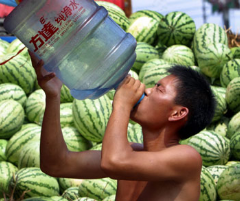
Meanwhile, in every village, town or smaller city in Mexico-indeed, in all but the very richest neighborhoods of the capital itself-trucks grind slowly through the streets. They are usually painted white and blue or green, and they bear a variety of local and national brand names. Behind the cab, racks of 20-liter water jugs sweat in the sun. From loudspeakers above it, blares the repetitive call: "aguaaaaa…. aguaaaa". This is how most households in Mexico get their drinking water.
Market forces
As distasteful as leftist critics find it, the 'private' sector, at every scale, is already centrally involved in providing water in rich and poor countries.
France has relied on private companies to build and maintain its water services since Napoleon's time. Some of those are now among the global corporations that critics of privatization most strongly oppose.
Mexico's water trucks are widely replicated in other developing regions of the world. In Africa, Asia, Latin America and the Caribbean, millions of people similarly rely on local private vendors who deliver drinking water in jugs, jerry-cans or sometimes by the dipper-full from salvaged fuel drums. Usually, these people pay a price-per-liter for the indispensable liquid that is far higher than that paid by wealthier compatriots who enjoy it piped into their homes by limited public utilities.
Most, I imagine, would thank us who live in wealth far more for the gift of a simple well, a cistern for harvesting rain or a cheap and effective water-purifier, than they would for another human "right" added to those already being violated or ignored in their lives.
Reviving Mexico City's lake
Real solutions to the world's multi-faceted water crises are more likely to be found in pragmatic advances based on economic realities. One of those, just as Molina and Slim said, is that facilities to deliver clean, secure water to people-whether in the form of a state-of-the art central treatment facility or a rainwater-collection pond-don't pop into thin air. They must be paid for.
Other Mexican analysts at the Forum told their home audience that it needs to pay eight times what it does now for water. Noting that Mexico City alone needs $5 to $6 billion worth of new water and sanitation infrastructure, the National Water Commission estimated that in order to extend basic services to the 17 million Mexicans who now lack them, average water rates must rise to 8.8 pesos (about ninety cents) per cubic meter.
In an elegant office south of downtown, where bare wood, polished grey marble, raw cement and welded steel blend industrial and natural influences around a garden open to the sky, architect Juan Cordero walked me through an even more ambitious plan.
Working with other architects, urban planners and researchers at the Autonomous University of Mexico, as well as Harvard, Cordero has developed a plan to restore the vanished lake along the city's eastern margin.
He and his colleagues have spent eight years and $2 million (most of them private) so far to work out the details of the proposal. Their scope is sweeping. Seven new treatment plants would be built to extract clean water from the 95 percent of Mexico City's sewage that is now being pumped raw into aquifers north of the capital. That water would be used to restore a chain of lakes and wetlands on either side of the Texcoco highway.
'Like a lung'
There is more to the plan than refilling the lake. The mountain slopes to the east, where the subsoil is porous (unlike the valley bottom) would be reforested. That would allow the area's relatively abundant rainfall to percolate down and replenish depleted aquifers. "Mexico City can and should be self-sufficient in water," Cordero told me.
The restored lake would "act like a lung," to reduce Mexico City's air pollution by a quarter. Refilled to something less than capacity, the lake and its wetlands would largely eliminate the flooding and sewer backups that are an ever-present threat to seven million people living in the poorest neighborhoods of the city.
The whole deal would cost several billion dollars. But Cordero and fellow proponents believe the sale of newly desirable real estate around the margins of the restored lake would more than cover the cost. The plan also calls for relocating Mexico's overstretched airport to an expanded facility on an island in the middle of the lake, freeing up additional land for sale and redevelopment.
The groundwork has all been laid, Cordero says. The land to be reflooded is mostly unoccupied. No communities would require relocation. "It's simply a political decision." It is also inconceivable without the involvement of private investment on a large scale.
Muddied debate?
The Fourth World Water Forum may have agreed on little more than good intentions. But critics risk making the perfect the enemy of the good. Putting 11,000 people from the world's most water-stressed countries together to compare notes is likely to do as much good (or more) on the ground as adding another to the list of human 'rights' that remain unenforceable wherever societies and governments are failing-almost universally also the places where water is scarcest and most soiled.
Water runs everywhere. Its place in our existence-our habitat, as well as our society-cannot usefully be resolved by opposing a "human right" to a "commodity for profit." In the real world, the essential liquid is also intimately and inextricably part of every economy.
In Canada, roughly 80 percent of the water we use goes for industry. Water may run through our national identity, our spirituality and our imagination. But short of putting ourselves out of business as a civilization, we also can't do without it for growing and processing food, or pulling oil from tar sands or pulp from forest fibre. Or anything else.
'Rights' don't exist in nature. They are creations of human values. What is true is that water is a human necessity. And no society that denied it to its citizens would stand for more than a week (the longest a human can go without water). Equally, in no rational democratic state, or even a dictatorial one, is it plausible to imagine water being priced beyond the reach of every citizen.
False choices make for stirring rhetoric-as Bush and Barlow are plainly both aware. But they also can make for bad policy.
Read Chris Wood's previous dispatches here and here.
Wood is a former national editor of Maclean's and an award-winning author of fiction and non-fiction. His latest book, on climate change and water, will appear next year from Raincoast Books. ![]()


45
Login or register to post comments
haraldkann
6 years ago
Comments on "Sinking Cash into Water"
mexico city is a prime example of what happens when you don't take PLANNING seriously.
one of the oldest cities on the face of the planet and look how poor ther situation is.
so much for those who say we will find solutions ...down the road............manyana!
Avicenna
6 years ago
Why stop at water as a right for all living creatures born upon this world with its limited resources? Land, energy, and food would also be a right in a socially constructed ecosystem - but we've been forced to swallow the capitalist notion of the self-proclaimed inheritors of wealth having first dibs on everything we deem of value (or of necessity, as the case may be). Finders keepers, losers weepers, no? Some will find it a more challenging feat to keep the air exchange going throughout their limited life spans - it's all in the luck of the draw in this world of the have's and have not's.
Fiat lux
6 years ago
"..........government doesn't have the funds to do the work" is bloody nonsense. The guy may be a Nobel winning chemist, but doesn't know anything about present day money creation.
By law all money belongs to the public through governments. Whe don't "own" the money in our pockets, or bank accounts. This is why it is illegal either to "create" or "destroy" money.
Yet, governments all over the world have given away their money creation rights to private banks. The Bank of Canada is publicly owned, but doesn't create the money for public use. Why not?
The US Federal Reserve is a collection of private banks with a government appointed head.
In the past, money creation was tied to gold reserves, then it was tied to deposit reserves, but all this been deregulated, in Canada's case in 1991 in secret, by Mulroney. Now our privately owned banks can create any amount of monies, while transferring the responsibility for the conversion of that money on the public, because every dollar created by private banks is public debt, while they reap the benefits.
Private banks can now "create" money against the assets of borrowers, then account those assets as their own and create more against their own created loans.
Go to google and type in "money creation" or "how banks create money" for more details.
Now banks in selected countries can "create" capital to take over the assets and resources of others, collectivizing the world's economy into a few hands and confiscating the property rights of the vast majority through overcapitalized investments. This is the biggest racket and con-job in history, legalized and enforced by governments all over the world on the advice of their miseducated and brainwashed economists.
We live in an era of the incredible inflation by imaginary money, disempowering and destituting billions of people, which is then accounted by economists and politicians as "growth of the GDP", while millions starve to death every year.
The logical solution would be that as long as the public owns the money and is responsible for its convertibility, the public has the right to decide where and how that money goes and who benefits from it. This should include all public services.
If governments permit carpetbaggers to take over economies, destitute and kill people with the perceived power of freshly created, imaginary money, the public has the right to demand money creation for beneficial purposes. Including water treatment, medicare, jobs and whatever.
What the world doesn't need are the 400 or so people who "own" and control about half of the world's wealth and resources.
I'm a lifelong private enterpriser and property owner, but what goes on now and how the public is being misled by economists and politicians is not only disgusting, but outright crime.
Ed Deak, Big Lake,
G West
6 years ago
Avicenna
Sadly, you're right. But in areas where people of good will can make a difference, and there are still lots of those areas, the obligation is to keep pushing. I know you're doing that and that you won't give up. The future depends on it. My generation has a lot of explaining to do, your generation has to do a lot more than just talk.
Cheers and good luck.
nightbloom
6 years ago
The prospect of making "the masses" pay for potable water (and eventually non-toxic air, etc.) is reminding me of some of the darkest and most pessimistic science fiction I've read. Robert Heinlein wrote futuristic scenarios along these lines (great stuff, actually). Hopefully this is one dystopian scenario the novelists won't be right about....although some s.f. writer from the last century have proven to be incredibly prescient on everything from air warfare, the atomic bomb and government/oligarchal population control through media.
Kudos to KAIROS [[url]http://www.kairoscanada.org/e/index.asp][/url]
Interesting name too. Kairos is Greek for:
nightbloom
6 years ago
Those brackets messed up the Kairos Canada link. Here it is again, if anyone's interested:
http://www.kairoscanada.org/e/index.asp
Peter Dimitrov
6 years ago
...I agree with you Ed Deak...that is a pile of manure...that 'governments don't have the money'. The problem with Mexico is that the wealth from its rich oil sector has gone to privilege a minority in that country - as what used to occur in Venezuela....and the privileged didn't/don't care 'squat' about the majority in Mexico who are poor or poor middle class, or doing what ought to have been done decades ago - do the population studies to foresee the demand on water - and implement some creative sustainability planning---including revamping their water & water pollution laws. Of course, the privileged leaders of Mexico - under the pressure of US Capital, the IMF, and later NAFTA - weren't about to kick their masters in the teeth and go about things with their own 'endogenous development model' --as Venezuela is doing.
With respect to capital 'shortages' and Ed Deak's comment which I respect, there are various way to deal with this. Indeed, governments ought to be in charge of their own banking system, but if they print more money - well they will learn that 'international currency markets' will further devaluate their currency and they may not be able to buy on the 'international market' those commodities for which they need that their national economies do not produce and cannot produce by import substitution strategies--such as computers, medicines, various health technologies, materials to repair airplanes, locomotives, and other aspects of their economic/transportation infrastructure. So on one hand, may I suggest, that Mexico needs to use more of its internal capital from its vast Oil production, but secondly, the South together with progressive countries in the North
need to pressure for substantive modification of the international financing scheme, Bretton Woods Agreements, and one such modification could be the 'creation of special drawing rights for all countries' to support low cost expenditures for improving the provision of public goods, such as clean water, good quality housing, better quality education and medical care - one might call it a "Special Drawing Rights for Public Goods" initiative. ....why not, as Ed Deak says, all national governments are in charge of their currency, and we, collectively, being under the Bretton Woods agreements can collectively modify how that group provides currency in the form of 'special drawing rights' for countries. ...it has got to come sooner or later. Lets allocate what money we can nationally, print some more but not to the point of seriously devaluing the currency, and collectively lets 'print-up'/create a "Special Drawing Rights for Public Goods" initiative.....gotta go get some aqua now!
moodyguy
6 years ago
Interesting article. I do find however, that in criticizing Bush and Barlow, Wood himself is unable to appreciate his own biases and assumptions which come across loud and clear. For example:
"Equally, in no rational democratic state, or even a dictatorial one, is it plausible to imagine water being priced beyond the reach of every citizen."
This currently happens in the world particularly in areas where supplies of safe water are privatized. Recently construction workers in Dubai have been on strike for increased pay (currently @ $4.00 day for 12-14 hr days etc.)and improved living conditions. Part of the living conditions includes the provision of safe water. In most of the UAE workers have water but it is desalinated, nontreated and not safe even for bathing. Yet this is what people drink. They cannot afford the safe privately provided bottled water. I use this example as a former resident of the country which is extremely wealthy but in which much of the population (not citizens)exists in extreme poverty.
The falicy of your argument is that you are confusing market mechanisms, which can be used to encourage conservation (for instance metering of water in the lower mainjland with increasing fees beyond a certain level of use) and privatization which is the provision of service to produce a profit for the service provider. No profit potential, no service is provided (AIDS drug in Africa are the classic example, can't afford to pay, no treatment provided).
The problem with relying on private investment is that there tends to be a belief in corporate altruism. Business people may be nice people but corporations operate only for profit-this is not bad except when people lose sight of this and expect them to do otherwise.
Avicenna
6 years ago
G West, alas, many of my zeitgeist are too zoned out on prozac to make heads or tails of anything. Thus, the report just out from Ontario that our "pill pushing" ways are polluting the water we do have - may make us rethink our whole approach to living the good life. Since goodwill begins at home, I will say that all who come my way will be guaranteed liquid reinforcement (green tea if they care for it). That's the best I can do at the moment.
In regards to the nature of self-serving oil-rich gov'ts that neglect the needs of their populace - those are exactly the type of governments that the US ensures sits at the helm of such nations. Any gov't that is run by the people for the people - are viewed as "socialists" that need to be overthrown since they are much more difficult to "do business with". It happened in Iran, Argentina - and I'm sure Chavez can tell some tales about the Empire which would put NAFTA and the lack of water in Mexico in perspective.
G West
6 years ago
Again Wood seems more concerned, in the end, with sticking it to the left than actually dealing with the issue straight on, as Peter does above and did yesterday on another thread and as Ed has as well.
It's true the NDP didn't do everything it should have on this file while it was in power in this province, but that's hardly carte blanche to suggest that the main damage to the environment hasn't been done by capitalist interests, greedy oligarchs and toadies of all stripes in governments from the left, the right and of every stripe in between.
To even hint that a further surrender of these vital concerns about water, its use and its continued availability to the gentle hands of the current crop of neoconservatives isn't only stupid, it is suicidal.
It is long past time that ordinary people woke up.
skeptikool
6 years ago
In such an arid area, I think that I would be making much use of the sun - that I believe shines frequently with great heat.
Extremely simple but effective stills may be made that require little wood, paint and clear plastic or glass, and minimum carpentry skills.
Their use would be impossible for apartment-dwellers without access to roof tops or yard areas but should present litle problem for most rural inhabitants.
With such a device, neither the dishwater nor one's pee need go to waste. Of course, it may be argued that these liquids are already being used for the gardens. I still believe the stills may be used to advantage.
haraldkann
6 years ago
on suzikis show last year i think it was,they were in viet nam at some little village that was self sufficient.they used methane from the pigs and other animal feces collected in a vat and left to ferment,the fire is very clean and toxicity levels were low for easy human use.
the water was collected through condensation on plastic sheeting dripping into clean vats.
everything was recycled,it was really cool and cost next to nothing.
there was also a nature show about south americans collecting water with plastic sheeting the same way,seems they collected it of leaves forever,so it wasn't really a new move to them ...only more efficient.
nightbloom
6 years ago
The Dune series by Frank Herbert was another great science fiction epic that plays with water scarcity as a dominant theme, with clear applicability to the current dilemma surrounding both water and oil...It's one of my all-time favourites (yes, I guess I'm showing my true nerdy colours).
Too bad the sequels his son (Brian Herbert) co-wrote after Frank Herbert's death were so poor. The originals really are a masterpiece. It's unfortunate Frank Herbert was never able to complete the sequel to the final extant installment (Chapterhouse Dune).
Fiat lux
6 years ago
Your idea is great, but "economically not feasible" according to economists, because it wouldn't add to "growth of the GDP", that requires huge capital investments and large infrastructures, "creating" large profits for the multinational water Mafia. Pardon me "wealth creating foreign investment" the world needs more of. With created, imaginary capital, of course.
I've been designing and developing soft technology for individual self sufficiency for over 50 years and have been very successful. Just waiting when the Economist Police comes and wipes us out, as what we're doing and building can not be accounted as GDP, apart from the materials and tools we have to buy.
Now, if we'd selle out so that our forest could be clearcut, and go on cruises from the proceeds, that would be "growth", but because we stay, work and build, we're parasites.
Ed Deak.
murdock
6 years ago
Delay and obfuscation are normal parts of decay and collapse.
Kind of makes one wonder what life was like around the large Roman cities in the Iberian Peninsula during the 3rd and 4th Centuries as the aquifers and cisterns started to fall apart and the 'funds' from the imperial city were not forthcoming to do the needed repairs.
The populace of such locales as Mexico City and other water-starved regions have the choice, follow leaders that have their own agenda or self-regulate and really plan for a sustainable future.
Given past examples of the Anasazi and possibly Easter Island, we 'humanity' may not be willing to do what is neccessary, until we are forced into it by truly unpleasant circumstance.
G West
6 years ago
the Vietnamese option would work more or less perfectly in certain government jurisdictions where the available hot air could be harnessed to some additional advantage, surely.
haraldkann
6 years ago
yes certain govt.jurisdictions could be harnessed with heat exchange fans used to draw all that hot air into plausible energy.
i think al capp designed something like that years ago for dogpatch,or maybe it was walt kelly thinking out loud from his little shack in the okeefenokee swamps...
well the mexicans have had since mayan times to straighten out their water problems,so i don't have to much faith in institutions like KAMPBELL INC.
Avicenna
6 years ago
The NGO I work with (AKDN) which works primarily with the developing countries in central and south Asia as well as Africa - recently won the Alcan Prize for Sustainability http://www.akdn.org/agency/akpbs.html for the environmental and water sanitation system we established in parts of Pakistan (and Afghanistan) that were in dire need of water. If it can done there in the mountainous regions of a war poor land - then it can certainly be done virtually anywhere. Where there is a will there is a way. -One of the great things about AKDN is that it doesn't develop a relationship of reliance, but it teaches those in difficult circumstances to help themselves. We already have the University of Central Asia up and running - just shows that mayhap combat is not the best way to establish stability.
mikev
6 years ago
Hehe Dune is alright, but check out Space Balls for something more on topic (and more hilarious - "comb the desert!" and they get out their giant comb!!). Getting air out a pop can! They send this huge spaceship in the shape of a maid with a vacuum to take over another planet and suck away all of their air. "She's gone to suck!!" hehe. Anyway, here's a fitting quote I had lying around:
--Sheldon Emry
thomas49
6 years ago
nightbloom,thank you for that kairos link,that is very interesting reading.
alexwh
6 years ago
This was a most interesting article. I left Mexico City with my wife and two young daughters for Vancouver in 1975. By then el Lago de Texcoco was a dream. The water your writer was told existed 20 years ago was either a mirage or the result of some rainy season heavy precipitation. To write about Mexico City's water concerns without citing its pollution, garbage and poverty problems is like considering only one of the four horsemen. The valley of Mexico has a pass on its North side. Until a few years ago there was a huge refinery there (Azcapotzalco)and many cement plants. The North wind would blow and carry away the hydrocarbon and cement factory pollution to the posh area of Mexico City on its South side (the University of Mexico is there). There the wind would run into a mountain barrier. The stuff in the atmosphere would then fall and make that posh area the most polluted in the city. Plans for digging a huge tunnel through those mountains and put in giant evacuation fans have not gone anywhere. In the winter it doesn't rain so that the atmosphere becomes so thick with contamination that you cannot see the mountains and birds in flight have been seen dropping to their death. Those who live in Mexico Cite breathe that. In the summer, when it rains, the rains come down with the pollutants. There is lots of sulphur dioxide in that air. When it mixes with the water it changes into sulfurous acid and sulphuric acid. If you don't wax your car often the paint becomes dull within a year thanks to the acid rain.
Poet, novelist and environmentalist, Homero Aridjis says that the seasons of the year no longer exist in Mexico City. William Gibson writes in Virtual Light The air beyond the window touches each source of light with a faint hepatic corona, a tint of jaundice edging imperceptibly into brownish translucence. Fine dry flakes of fecal snow, billowing in from the sewage flats, have lodge in the lens of the night.nd
alexwh
6 years ago
I wish the Tyee's comments had an editing capability. I look at my posts. I post them and then I find my typos. So now for a corrected look at that last paragraph. William Gibson admitted to me that he had never been to Mexico City when he wrote this "bang on" and ever so evocative description of the city. Here it is corrected:
The air beyond the window touches each source of light wiht a faint hepatic corona, a tint of jaundice edging imperceptibly into brownish translucence. Fine dry flakes of fecal snow, billowing in from the sewage flats, have lodged in the lens of the night.
G West
6 years ago
alexwh
thank you for your words ... when I read them, and chris wood's article earlier, I couldn't remember exactly what other words they made me think of. I knew it had to do with Mexico and rain and just now it came to me.
Malcolm Lowry, Under the Volcano
lynn
6 years ago
Thanks G West, too...a world away from Mexico but those are wonderful words to read on a darkly wild night on the coast...
Bailey
6 years ago
All very interesting thoughts. I need to take exception to a basic assumption behind the piece.
I don't believe such a position could actually be defended. Rights do exist in nature. they are built into the very fabric of life.
The rain falls from heaven on the rightous and the wicked alike, to paraphrase something I read somewhere. Life in itself conveys inalienable rights on the living. There are lists.
What doesn't exist in nature is an infallible way to defend rights from jackals, who steal whatever they can. But even there, the situation is fraught with rights. If a jackal is stealing her child, who would deny a mother's right to kill the beast?
If someone is stealing the means to live from whole populations, driving them to poverty and death, that person is a murderer, and has only those rights society offers any murderer.
Which, I must say, are about the same as the rights we accord to that other jackal.
G West
6 years ago
bailey
Agree completely. I think the author has an agenda. I responded to that in my post to the first piece he wrote on the general subject.
Bailey
6 years ago
I think what we are dealing with here is a modern example of "The Big Lie" Hitler's famous technique for winkling large populations more or less acquiescently into slavery. This one seems to have several stages, each of which must be accepted for any to have their desired effect.
For example, if we believe money is a real thing in itself, apart from it's function as a medium of exchange, then we accept the idea of property rights, where some can accumulate much more value than they have ever created.
Then we can accept that money owned, even if not earned, permits itself to be protected, even from those who actually did create the value it represents. The real position is now completely reversed, and the jackal claims the right to kill the mother for asking for her child back.
Then we move to the idea that the victims of this scam can actually be permitted to suffer and die without being allowed so much as a glimpse of the value they created. We even blame them for being so poor. It's their own fault you see, they should have been jackals. There is such a thing as free will, after all.
I know, stated baldly like this it's quite bizarre, but no more so than Hitler's 'eugenic' arguments for his own mass murders.
G West
6 years ago
bailey
you probably know i don't disagree...only point of contention between us is over the analogy - and i don't mean to say it isn't necessarily apt - the problem is that certain words have attached to themselves a kind of totemic value. i wouldn't use the specific words you have because readers often tend to take them as rhetorical overkill and shut down.
Do you know what I mean? my approach is more indirect ... I try to get a reader thinking and digging around on her own ... if they're worth the candle and reason can capture their interest, then they'll gradually wake up to the scarier connotations and associations on their own...least that's my operational discipline.
I put it out there for your evaluation - I'm not trying to be judgmental - cheers
Bailey
6 years ago
People are actually dying. Real people. Real deaths.
This is not rhetorical overkill. It's actual overkill.
Bailey
6 years ago
Sorry, G; That reads more harshly than I meant it to.
What I mean is, I chose the words, rhetoric or not. Some truths are so hard to hear that if they're softened in the telling, they will be avoidable, and avoided by the hearers.
Sometimes plainness is an effective rhetoric.
G West
6 years ago
bailey
no problem, man...I get pretty angry too - we share the same road and we're going in the same direction. I can throw grenades with the best of them and I'll do it from time to time - I didn't want you to think I was being critical - therefore my last line. My problem with those words is nothing like the difficulty guys like Claude Lantzmann have with those words and associations - I'm not saying it is wrong or immoral to make the comparisons, that somehow 'H-----' is forbidden territory and trotting out the name for mundane comparative uses other than allusions to the Holocaust is both bad taste and somehow demeans the dead and the meaning of their memory.
No, not at all.
I'm just saying that the associations are strong medicine and that they are often misused so there's a kind of dilution of meaning that happens if they're thrown around too casually.
Maybe you're right and I'm wrong about whether or not this issue and this forum are the right place to use the big guns, that's my only point a tactical debate only, dude.
Bailey
6 years ago
Oh, I see. It's the reference to Hitler you mean. I understand. The man was a criminal of such odious memory that his very name puts people off. You're right of course.
I don't mean to compare anybody to him. The reference to him was an allusion to his place in the history of rhetoric. He obviously didn't invent lying, but he elevated it to a level previously unknown.
The operational premise of 'The Big Lie' is more like Pynchon's proverb for paranoids, "If they can keep you from asking the right questions, they don't have to worry about the answers".
Which is to say, if one can create a fictional picture of reality, convince large numbers of people to believe it, then all the discussion will be based on fictional premises. Easy to deal with by manufacturing internally
consistant excuses. Much harder to deal with truth.
The truth is, people are dying. Real people. Real deaths. To protect the 'property rights' of people who created no value to earn their property.
Another interesting lie I see hanging around the schoolyards lately-- that current neoconservative thought has anything to do with Capitalism. I think not.
Capitalism is an economic system that's skewed to allow society to accomplish larger projects than would be possible with only the amounts of money one person or one family could create with their own labour. What we're seeing is economy stripping. Quite nearly the opposite of Capitalism.
It's almost like mining the world for value, which is then isolated by jackals, excuse me, I mean entrepreneurs who have now gotten down to basics, water, air, food, human organs etc, etc, et frigging cetera.
G West
6 years ago
bailey
absolutely. much of that stuff - the neocon crap - comes from a deliberate misunderstanding of economic theory - i've always felt you can't know anything real about the way the economy works in this, and other capitalistic cultures, without understanding marx.
What neocons are all about is theft and misappropriation of common property...their jargon just gives it an intellectual gloss.
Individuals surrender some of their independence to gain collective goods - and avoid the brutality of nature and the violence of every man for himself - only to have the commons (and nearly every other thing of economic value) ripped from their control and enjoyment by the invisible hands of the market and the misappropriation of capital
The market was meant to serve man, not the other way around. The only reason it persists is the big lie that somehow every poor slob with two hands and half a brain is somehow going to find his way to the top of the greasy pole for a while. The hobbesian bargain has been turned on its head - just that we live longer than Hobbes expected and our long lives and good health can be put to useful purpose – with the advent of the rush to dump universal health care and the ageing of the baby boomers - even that may be subject to change, but that’s another story .
And of course, the essential lie to the whole shell game is the idea that the West somehow earned its place on the top of the heap because of its thrift, hard work and Christian virtue and that it's perfectly ok to stay there as long as we can no matter what that means for the rest of the world.
That's why the right is always angry - they know they're defending a lie and you have to bear your teeth when you're doing that, imo.
Oh yea, bailey, we're on the same page. .keep the powder dry.
Fiat lux
6 years ago
Today's capitalism couldn't survive a minute without the right of creating money out of the air to licence the exploitation of resources and humanity all over the world.
In short, it is not a science, not economics, but one of the pseudo religions that has been used to elevate and maintain certain ruling classes with superhuman legal rights through history.
And it was "democratically elected" governments who gave them the right and are now enforcing its powers, regardless of consequences, by calling their fraud GDO, Growth and Productivity.
Ed Deak, Big Lake.
Fiat lux
6 years ago
Sorry, it should be GDP, of course
Ed.
G West
6 years ago
Yep, Ed, I agree - those are the tools they use...but it wouldn't be any better if all the value was still gold either ...you can't eat gold although there's a 'legend' that the Aztecs actually tried to feed molten gold to a few Spaniards once upon a time.
Fiat lux
6 years ago
No better use for gold I could think of.
Ed
G West
6 years ago
Fiat lux
Ed
In case you happen to drop by, I thought I'd leave this little tidbit from Niall Ferguson...about global economies and risks of disaster: For your consideration.
http://www.latimes.com/news/columnists/la-oe-ferguson20mar20,1,3071287.column?coll=la-news-columns
Colin
6 years ago
While travelling in Venezuela, the locals use the gold they find to fill their cavities. They give it to the dentist, who uses some to fill the tooth and then keeps the rest as payment. The area I was in was rich in loose gold, my brother’s crew chief found a big nugget in a drainage ditch walking home one day. The area around Las Christina’s was sort of like how Dawson was during the gold rush.
Likely your computer has gold in it and it makes a excellent and durable solder for connections.
beer4mepleeze
6 years ago
colin i hate to tell you,no such thing as gold solder,silver solder ,yes.silver is used in highend electronics and only at a 2 to 7 % mix.gold is use for plating contacts,though and i think that is what you were thinking of.
the use of gold in electronics today is enormous and other precious metals and rare earth metals are increasing in use as well.we should have a deposit(like bottle deposits/levies) on electronics,so we can reuse the important components.
donntarris
6 years ago
I was SO glad to log on to this story and see that the monetary issue was already being put forward. As with water, air, and land, money creation belongs to the people. We have allowed ourselves to be enslaved by the notion that people must buy land, or the more absurd one that one can "own" land - but we seem to have forgotten that the land was conveniently "claimed" or "stolen" in the past. In effect, we are all forced to purchase that which was stolen from us in some past generation - and once we "own" it, we are in possession of stolen goods. This point seems to have escaped most people in the civilized world. The weapon for land acquisition has changed, at least in North America, from guns to money.
I am tired of hearing our governments, either ignorantly or criminally, telling their constituents that they/we don't have the money for education, health care, roadways, power, water... There seems to be a choice here which seems to be overlooked. If you're a supposedly law-abiding country in need of some resource, you try to raise the money to purchase from someone else. Alternatively, if you're the US and want more oil, you use guns.
Canada still has the Bank of Canada and the Bank of Canada Act, which does NOT put more importance on zero inflation over employment and other public need. The threat of inflation is a ruse used by private banks so that they can hold onto money creation, and unfortunately, most of our elected officials, one example being Gary Lunn, don't actually have the desire or apparently the knowledge at hand to see this and do something about it for their constituents, themselves, or their families.
For folks who believe this to be hogwash, please rent "The Money Masters" DVD set and watch it. Then ask your bank some questions, ask your MPs and MLAs some questions, get them to deny it in writing with their names signed as "proof". A good read for Canadians is David Orchard's "The Fight For Canada", unfortunately out of print, but you may find a copy at your local library or second hand book store.
Cheers all,
Donn in BC
YlaReina
6 years ago
The one good thing about living in Vancouver is at least we're doing something about water for the long term. Perhaps not all we can do, but a lot. For a current list of GVRD projects see:
http://www.gvrd.bc.ca/water/SCWUP.htm
As a taxpayer this is something I can at least agree with.
Umslopogaas
6 years ago
So the Mexicans make a great and admirable effort and restore the environment around Mexico City. Then do they promptly have another 17 million babies?
Or Vancouver manages the GVRD water and the population there eventually grows to many, many more millions.
Too many people. No politician wants to attempt to take that on with all the crack-pot religions telling their followers to breed and breed and breed.
We are going to peak and crash soon, that is nature's way and politics, science and religion cannot prevent that.
Colin
6 years ago
Beer
I am no expert on the subject, but I just asked one, you are correct that the content for both Gold and Silver solder is in the 2-10% range, I learned something new today as I understood the content was much higher! Thank you
Same guy (builds electronic instruments for mining exploration and other types of work) mentioned that if both gold and diamonds weren’t so artificially inflated in price, the number of uses would triple overnight!
Back closer to subject
If you increase the average level of education, health care and income, birth rates decline rapidly. Lots of children is the "welfare and old age support system" in poor countries.
G West
6 years ago
Colin
glad you picked up on Umslopogaas's smear, I saw it but failed to call him on it. Education + good health + a decent standard of living = small families ( in Mexico and everywhere else).