'He'd Be Alive Today'
Logger's widow says her man could have been saved.
Debbie Geddes is grieving and very angry.
Geddes lost her boyfriend, 52-year-old Ted Gramlich, in a falling accident near Parksville, November 21. He was the 38th person out of 41 to die in woods-related deaths in the province so far this year.
Geddes feels sure that Gramlich wouldn't have died if sufficient attention had been given to safety precautions in the heli-logging operation.
"If safety was first, as they say, he'd be alive today," she said. "He'd be in hospital but he'd be alive. I'm very angry abut the fact that he suffered because they didn't get there in time, and he didn't have to."
Returned to logging
Geddes said that according to what she had been told, Gramlich died of internal bleeding after being struck by forest material, perhaps triggered by failure to have or use a metal bar that should have been used at that point.
"People get around that," she said, "They shouldn't, but they do."
That, says Geddes, is not the point, and she's furious that a representative of the BC Forest Safety Council - just established last year - recently responded to this year's near doubling of forest-industry deaths in BC by noting it's not a record, by any means. "We don't want to go back to those days," she said, recalling times when woods personnel were hardly more than canon-fodder in the battle for profits.
Geddes says Gramlich got out of logging, his line of work since he was 19, after he broke a leg a couple of years ago. The couple set up a small business of their own to try to generate an alternate income. But Geddes says her boyfriend wanted to be able to give her more, so he went back.
He began working, as so many do now, for a very small outfit as his own contractor with a partner. As the BC logging industry shifts to more private, small contractors, safety factors are eroding say union safety officers and other experts tracking the trend.
Delayed response
Tragically, the two men were working some distance apart and not able to see each other when the accident occurred. Geddes says Gramlich was thrown 75 feet by the force of the blow and lay bleeding internally for 45 minutes before his partner suspected something must be wrong and raised the alarm.
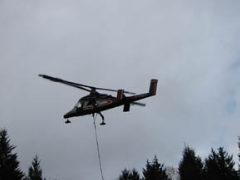
Then, because there was no helicopter landing pad nearby, she says it was another two hours before they were able to airlift him out to hospital, not in nearby Nanaimo because of fog, but in Duncan.
He died, she says, on the way to hospital. Had he got there quicker, she feels he would have had broken bones but would have survived the accident.
"He was very cautious and he always had the right gear," she said this week. "The WCB (Workers' Compensation Board) and the company still haven't managed to get in there to complete their investigation."
'If I can save one life'
Geddes said she worked in industrial first-aid in Alberta prior to linking up with Gramlich and she intends to upgrade her training to work in the forest industry to try to help his colleagues out in the woods.
"If I can save just one life that would be wonderful. He has lots of 'brothers' out there."
The B.C. Forest Safety Council, which is working on programs to have both qualifying fallers and truck-loggers certified as fully trained, including in safety matters, has a policy that "all accidents are preventable."
That, said Geddes, merely supports the tendency of too many logging companies to shift the blame as much as possible to the failures of individual workers, whether their own contract employers or as direct employees of larger companies. It reduces, say industry critics, the larger companies' own responsibility for ensuring they provide a suitable safety-program "net".
It is not known whether a formal inquest will be held into Gramlich's death. The main forest union says that full, formal inquests should be part of the BC Coroners Service's inquiry into all such industrial fatalities.
For more on pressure faced by the Coroners Service to hold inquests on logging accidents, read today's Tyee article here.
Campbell River journalist Quentin Dodd is a regular contributor to The Tyee. ![]()


13
Login or register to post comments
BC Mary
6 years ago
Comments on "'He'd Be Alive Today'"
Heartfelt condolences to Debbie Geddes.
Forests and forestry workers are so much a part of British Columbia, I am ashamed to think that both are being so badly neglected.
Perhaps Ms Geddes will join us, on this thread, to add her comments? I hope so.
crh
6 years ago
Ted Gramlich should still be around today. This is shamefull.
All human beings are of equal worth.
Coyote
6 years ago
Extremely regrettable.
Unfortunately, de-unionization in the wood industry, and especially in the woods themselves, has contributed much to the worsening of the safety situation there.
There is a logger son-in-law in this family of mine, and I know he much fears the conditions he must work in everyday, and the direction the industry is moving in, towards more and more contracting out as a means of employers getting out of being directly responsible for WCB benefits etc. It puts everyone that works the bush in a tough spot.
It's about the only thing he knows work-wise and otherwise where he likes to be, in the bush, which traps many an unfortunate fellow.
And it isn't likely to change quick in this neoconservative capitalist environment. It really is up to workers what's going to be done about it-, and the choice is the devil or the deep blue sea for many of them, I know.
Best wishes to your own getting through this period, Debbie.
Bob Rogers
6 years ago
I feel that this is the result of Big Business running the industry for the sole benfit of shareholders. The bottom line is maximized profits. Contracting out releaves the Forestry Companies of having to deal with employee benfits and union wages. The contractor has to cut all the corners he can to be able to win a bid. This results, for example, in some haulers having to make TWO nine hour runs a day to make ends meet. I have had enough after six hours at any task let alone 18. It is inhumane to ask this type of performance of people. The Campbell regime gleefully condones this situation by sanctioning Big Business and never minding what effect this has on the quality of life for the average British Columbian. Money isn't everything. Maybe It's time to storm the castle.
jackrusell
6 years ago
My condolences as well. It is about time we made the industry take notice, Dying should not be part of the cost of doing business. Workers are just numbers to the shareholders more has to be done to correct this situation. 1 death is too many in any industry.
BC Mary
6 years ago
From the other Tyee story on logger deaths, these comments by Kootenay ...
The Corporations profit two ways from this. First, by reducing the workforce they have effectively reduced the effectiveness of the Union (less Union members), the group of people who were the watch dogs for safety and workers rights.
Secondly, the small contractors have nobody to look out for them and are struggling to make ends meet as they are now responsible for the additional cost of purchasing and maintaining the vehicles and equipment required to do their job. With WCB slashed to the bone, there are no inspectors in the field to watch out for them. The contractors are working very long hours in extreme conditions, just trying to make ends meet. It is truly tragic and I feel a great deal of sympathy for them.
What’s really sickening, is the response of the Right Wingers, who despite killing 42 loggers so far this year continue to blame everyone else for their deaths. The heartless bastards refuse to acknowledge that their policies are the root of the problem because changing them will affect their bottom line ...
kjc
6 years ago
As someone who worked in BC's forest industry for over twenty years, I witnessed the hijacking of small towns across the province by the US PR firm-created "Share" groups and the selection of Liberal party candidates from those who rose within the ranks of these various splinter groups of the BC Forest Alliance to become the new "voice" of rural BC. As soon as the Share groups became the government, they quietly folded their tents and slipped away. Not one of these groups, including Jack Munro's Forest Alliance exist today and it is traitors like him, who never actually worked a day in their life in the bush, that are to blame Ted Gramlich's death.
Debbie is right. Ted Gramlich would be alive today if the standards that were in place when the Liberal party came into office were in place today. I was personally disgusted to see Munro in attendance at the meeting recently convened to address the high death rate in the bush. In what capacity was he there? Corporate toady and sell-out? Assfuck? Murderer?
Martin
6 years ago
Logging accidents have increased in proportion to the activity in the industry.
The socialists on this website pine for the days of the 1990's, when there were far fewer accidents. That's because far fewer people were working: the left did its best to kill the forest industry.
Average Joe
6 years ago
First off my deepest condolences Ms.Debbie Geddes.
I attend the Workers' Memorial on April 28th each year. It never ceases to amaze me that workplace incidents causing injuries, illnesses and deaths pass by relatively unnoticed year after year by the general public as well as the media. Sure you hear of the odd case, usually when the incident in some way threatens the public, like a worker falling from a building on a busy city street.
We need all workplace deaths to be publicized by the media and an incident report with a causation analysis submitted to all similar employers and their employees to inform them of the root cause of each incident in order to prevent similar problems from happening again.
Workplace deaths are only going to rise with the current de-regulation of safety standards and enforcement, the "lowest bid first" mentality, and also the de-skilling of workers that is infesting our great province. Our Olympics will be built by spilling human blood and poisoning thousands.
Forestry is a horrendous killer but the corporate murders lurk elsewhere at an even higher capacity. The silent slaughter by occupation disease from asbestos, solvents, particulates and the chemical warfare that most construction and other workers are naively up against may not be as graphic as the quick kill spurting of blood, but they are causing more injuries and deaths then even forestry.
We are up against a huge shortage of skilled workers yet we do not protect the ones we have. The idea that deaths are a part of workplace costs has got to stop. All injuries and deaths are preventable.
We are facing health care cost that are unmanageable, yet we continue to let our workers be poisoned on a daily basis causing all kinds of medical, social and judicial costs.
Unfortunately all too often the worker that raises the safety issue in the workplace is the worker who is sent packing with a pink slip, and it's a well known fact with the workers out there.
Workers themselves are all too often complacent and ignore safety issues because they were once too often called a sissy or are uninformed of the reality of hidden hazards. Sadly the injuries they obtain do not go away at quiting time, they stay for much longer.
It's time for a major change in our workplace society.
It's time to lock up illness, injury and death.
Prevention, education and enforcement are the keys.
rkewen
6 years ago
My condolences to Ms. Geddes.
I would like to take Martin above to task about his statements though, to wit:
The socialists on this website pine for the days of the 1990's, when there were far fewer accidents. That's because far fewer people were working: the left did its best to kill the forest industry.
As an ex-rigging monkey during the early seventies and into the eighties on the north coast and in the mountains of the interior, I would have to say that Martin's observation is totally false. There may be more "activity" measured in production of fibre or in terms of dollar value. However, in terms of the number of men working in the bush there is much less
activity today than most times in the past. Thanks to mechanization higher production is possible with less manpower and the dollar value of forest products is much higher today due to basic inflation.
I haven't worked in the bush, logging, since the early eighties, but still talk to those who do and am amazed that in many cases they make the same or very little more than I did twenty years ago. This is in spite of often having to perform the equivalent of multiple jobs and much longer travel time (unpaid). Indeed I joke with some of my friends that one morning they will get on the crummy and find that a money-box, like found on buses, will have been installed and they will be required to pay for the privilege of being transported to the side.
I've been trying to find accurate statistics on worker injuries and fatalities in the bush, but have found it difficult to find any that go back farther than ten or fifteen years at most and those are unnecessarily difficult to find online. It is my feeling that the current rates are inexcusably high when considered in relation to the reduced numbers of men working in the bush, but the WCB (or whatever they call themselves now) has no interest in making this information easy to access.
I almost never saw a representative of WCB anywhere near a working high-lead show when I was in the bush and imagine nothing has changed in that regard. Of course the first priority of WCB, from what I saw, was to protect employers from liability and then to, if possible, blame the victim for his own injury or death.
Looking at the price of lumber and other forest products it is obvious someone is making money in the woods. Unfortunately those doing the dangerous, difficult and dirty part of transforming trees into commodities aren't receiving their fair share of the wealth, but then what else if new?
lynn
6 years ago
An excellent and informative piece, rkewen. I hope you are able to eventually access those statistics on worker injuries and fatalities in the bush.
Before sunrise, and after a long drive from town, the loggers here where I live leave in a crew boat to travel to the next inlet up the coast, not returning until dusk again... and then of course another long ride home still awaits them.
Such hard workers with such a dangerous job.
My condolences to you, Ms. Geddes, and I applaud you for the stand you have taken on "safety first" in what must be a very difficult time for you.
Marysue
6 years ago
My deepests condolences to Ms. Geddes! It is true--we've seen it here in the North Island--a logger with two fractured legs has less chance to survive than a drug addict shot in the chest in Vancouver's East Side. My young son-in-law was maimed after a fall because of shoddy equipment his woods boss would not fix, nor alert anyone that it was broken. The young man was lucky to have a union behind him, for once he was hurt and unable to do his former job,the employer fired him! My son-in-law's union had to fight WCB to get him his operation, physiotherapy and retraining. God help you if you don't belong to a union thse days! The WCB has only one stamp label: "Deny"! WCB should really be called Employer Compensation Board, for that is what it is. There are not enough inspectors to do the job even 5% effectively. There are much less woods workers these days, yet there are much more accidents and less pay or benefits going to them. rkewans is right-- "Martin" who wrote here hasn't got a blessed clue. The rightwingers and their corporations are killing the woods industry, AND the industry's workers. I've been a forest industry worker, too--very long time! So very close to death many times. May Martin get a job swamping or setting chokers so's he may become more enlightened..if he doesn't get dead.
woody
6 years ago
Marysue,says It is true--we've seen it here in the North Island--a logger with two fractured legs has less chance to survive than a drug addict shot in the chest in Vancouver's East Side
Truer words have never been spoken.
My condolences, Ms. Geddes,