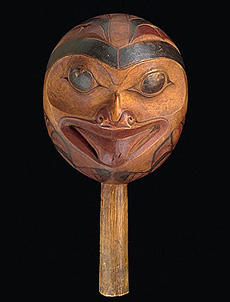
Keeping Alive the Haida Tongue
'Every word is precious' says Diane Brown, one of a team painstakingly preserving a rich oral language.
When a neighbour asked Doreen Mearns of Skidegate for help figuring out how to paint the Haida translation for "Peace on Earth" on his window this Christmas season, she knew exactly where to turn.
Mearns speaks the language, but some phrases don't immediately slip off the tongue. The answer was found by flipping through a glossary containing over 9,000 Skidegate Haida words with English translations, which has emerged over the last seven years thanks to the Skidegate Haida Immersion Program (SHIP).
Mearns is one of 20 elders registered in a program with the goal of preserving the language. In addition to spending days archiving the knowledge of fluent speakers, she and others teach the language to community members on Monday and Thursday nights.
Those who are registered at SHIP can think of only 30 people in Skidegate who speak Haida and then only 15 of them are fluent. Of these 15, the youngest is 56 years old and the oldest is over 90. The average age of Skidegate Haida speakers is 78, says instructor Diane Brown and it is these kinds of statistics that bring a real urgency to their work.
Elders run the show
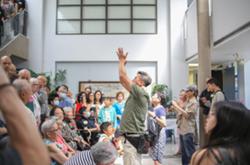
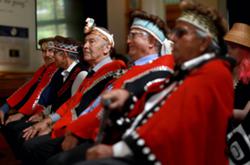
Every morning the elders gather around a large table in the longhouse which used to house the band office and is now home to SHIP. With a view of the sea, they record words and phrases on paper and on CD.
The traditional post and beam construction of the building is complemented by the impressive modern technology used to complete the task. Microphones in front of each participant capture the voices of some of the only speakers of the Skidegate Haida language in the world. And like a true ship, a large control panel, manned by Brown and her collegue Kevin Borsario, a high school teacher who was seconded to the program when it began seven years ago, seems to steer the proceedings.
But that which looks modern does not always hold the most power as Borsario points out, it is the elders themselves who are in control. Everything from the general structure of the day, to the linguistic method for writing this otherwise oral language, has been designed by them, he says.
Each day at SHIP starts with a prayer in Haida and then five new words a day are added to the glossary. Once each word is written and spoken, the participants then have the chance to make a sentence using the new words which is also recorded.
"Every word is precious," says Brown.
No mink coat? 'Oh dear'
Some sentences are funny, like when syang (mink) and haajasdii (oh dear) were recorded in a plaintive, "Oh dear, I don't have a mink coat." Others tell a mini-story, like how a cedar oven mitt was used to take things out of a fire, proving these exercises are more than a linguistics, but part of documenting a culture.
Throughout the proceedings elders discuss the spellings and pronunciations of each word making changes if necessary. Every village had its own dialect, says Borsario, so it is important to note the differences. Occasionally someone points out a more specific meaning for words than was first noted on the board.
Hlkayxuuda, for example, means shady, but according to GitKun, the word is specific to the canopy of an old forest. He says it takes the third generation of trees to produce this particular quality of light.
GitKun's English name is John Williams, but those who dare to use such monikers in the Haida immersion program must cough up a hefty 25 cent fine.
GitKun is a valuable resource. Now 82 years old, he grew up on the islands, but served as a United Church minister in Kitimat for 12 years and before that he was the vice-president of the Queen Charlotte branch of the Native Brotherhood of B.C.
Two years ago, he replaced his uncle as the hereditary chief of Tanu. GitKun is acutely aware of the vulnerable state of the Haida language. One of his sentences, using the featured vocabulary, told of a time when he was sick in Vancouver and his grandfather visited him in a dream.
"I knew I was going to live when my grandfather left me without inviting me to go with him," he says.
'What can we call ourselves?'
Niis Wes, Ernie Wilson, sits beside GitKun at the long table. At 91, he is a valuable resource as well. Born in Skidegate, he says he has done everything in his life — trapping, trolling, logging, along with working and captaining on a seine boat. He likes to pass on bits of information when he can.
He also spent five years in residential school in Chilliwack, where they tried, as he says, to kill their language.
"And they darn near succeeded too."
Wrapping an uninitiated tongue around the sounds of the language is challenging and even though Niis Wes is near deaf due to his 30 years on a noisy logging boat, he is patient at correcting pronunciation. If one doesn't pronounce the word right, it will mean something else, he warns.
This expertise on the nuances of the language at is why archiving what he knows and what he sounds like is so important to people at SHIP.
"If we lose the language, what can we call ourselves?" says Niis Wes.
Both these men worry the younger generation doesn't feel the same urgency about preserving the Haida language.
"School children say they don't need [the language]," says GitKun, who adds youth spend too much time with television. He also fears their initiation into drugs and alcohol.
Language outlawed
Although Skidegate Band Council education administrator Gail Russ acknowledges the language and culture programs offered at the daycare, elementary school and high school levels are not going to make students fluent, she says it is helping them learn phrases, words, stories and songs.
"It is imperative to offer the language to a younger generation," she says. There are classes offered for Haida and non-Haida students through day care and kindergarten through Grade 11.
In the Grade 8 class at Queen Charlotte Secondary the students are beginning to get a sense of why it is important for them to take Haida. "To keep the culture alive," says 13 year-old Victor Edgars. But most of the students admit they don't speak Haida at home. "Why?" teacher Debbie Burton asks and the children explain their parents don't speak the language either because, in the past, they were told not to.
As far back as the mid-1800s laws and government policy were focused on assimilating native cultures by outlawing practices such as the potlatch and forcing children to stop speaking their languages at residential schools.
When Burton presses the children about why their parents were discouraged from speaking their language, one young man says, "Because they didn't understand us."
Extinct tongues
Worldwide there are 6,500 languages and experts fear that half of them may be extinct within 50 years. Canada has 50 to 73 aboriginal languages representing 11 language families. British Columbia is rich with more than half of these languages representing eight distinct language families.
When a language is lost, so too is the local knowledge, ways of thinking and specialized skills that go along with it.
No aboriginal languages are protected by legislation, but in 2002, the Canadian government committed $160 million over 10 years to the preservation of Aboriginal languages and culture.
Ensuring some of that money trickles down to the tiny SHIP program is just one of the challenges the program faces. Brown, who at 56 thinks she may be the youngest fluent speaker of Skidegate Haida, knows she is up against huge hurdles, but she has seen a lot of progress.
"There is more Haida being spoken than seven years ago," she says, adding that everyone in the program can and often is called upon to tell stories or to begin and end a gathering with a prayer.
Legacy on CDs Hundreds of CDs have been recorded at SHIP including stories on things like fishing, food gathering, weaving and more. There are lessons that cover topics like hunger, thirst, feelings, animals and plants. There are conversational CDs, the alphabet and basic grammar is recorded, more than 700 place names are documented along with a map and there is even a CD of baby talk phrases for young parents. All of these are available for sale through the program.
Many years from now, says Brown, great-grandchildren will be able to pick a CD and listen to their great-grandmother's way of speaking. But she hopes more people will take advantage of the program now.
"The opportunity to learn the language from fluent speakers is not going to be there forever," she says.
Heather Ramsay lives in Queen Charlotte City. This article also appeared the Queen Charlotte Islands Observer.
![]()


25
Login or register to post comments
BC Mary (not verified)
7 years ago
A lovely, happy story of progress. Thank you, Heather Ramsay and the Haida Elders.
anarcho (not verified)
7 years ago
Terrible the cultural genoicide that was practiced against Native People. Hopefully the Elders will be able to inspire the younger generation to speak their language. Around the world other languages that were almost stamped out of existence, such as Catala,Basque, Welsh and Scots Gaelic are being revived. Let's hope Haida will do so too!
Percy (not verified)
7 years ago
It's a very heart warming story, and we wish success to people of any culture who find it important to pass on their heritage language. But it's not likely to succeed, simply because, below a certain threshold of native speakers, languages tend to "commit suicide". That is, it becomes necessary for speakers to adopt a second language in order to function effectively in life. If you can only speak with 140 people (number of Haida speakers according to 2001 B.C. census), your life chances will be limited. I'm curious though, at the insistence that language defines a culture. Clearly, the overwhelming majority of Haida no longer speak or understand Haida. Are they less Haida? Is someone who speaks Haida "more Haida" than a non-speaker? Are the Irish "less Irish" because they speak English today?
Ranbir (not verified)
7 years ago
"Language" can create artificial divisions within human society. Genetically humans are the same. I personally think it is better to identify with the species, in our case "humans", than with any artificially-created sub-division like: nation, province, city, culture, language etc...
Kit (not verified)
7 years ago
A different thread, a different anal outburst.
Ranbir (not verified)
7 years ago
I hope people are also chronicling Haida use of local herbs and plants, sometimes medicines and remedies are found in traditional cultures. Aspirin was found in this way.
Ranbir (not verified)
7 years ago
Hebrew has made a comeback in recent times, so it might be worthwhile to find out what the Israeli government did.
Sam Salmon (not verified)
7 years ago
If someone here would like a further exposure to the richness of Haida language read A Story As Sharp As A Knife-Robert Bringhurst. It's not in Haida but is an English translation of 'Haida Mythtellers and Their World'. A person might think it would give them a view from the wrong side of the looking glass but nothing could be farther from the truth-the brilliance of Haida oral literature is transcendent.
Sam Salmon (not verified)
7 years ago
I forgot to add that I've been to Haida Gwai 7 times now and *sometimes* at the edge of my vision I've seen a bit of what the mythtellers talk about-it is a place apart.
kengineer (not verified)
7 years ago
Hey there Sam,your telling people to read Bringhurst?The man's credibilty gets flushed down the toilet anytime a Haida attemps to discuss his book,views or justifications.The problem is the books "English translation" comes from his assumed opinion.We few Haida today have to work hard to make sure books like these have no influence with our future generations.
Jim Crowfoot (not verified)
7 years ago
An important example of the struggle to reverse the loss of social diversity that is very important for understanding and maintaining biological diversity and for understanding and appreciating the our collective human heritage.
Chris Kempling (not verified)
7 years ago
Although this article repeats the "residential school killed our language" mantra, people need to acknowledge the role of Christian missionaries in preserving aboriginal languages. Because of the Christian religious goal to have the Bible translated into every world language, many oral languages now have a script, and many have their own dictionaries for the first time. In my part of BC, Missionary Dick Wilson spent over 20 years of his life living in Ft St. James creating a Carrier English dictionary, then using that to translate the New Testament into Carrier. It was completed just over a year ago, and read publicly for the first time at the 2003 Carolfest celebration. It is true that the residential school experience seriously diminished aboriginal languages. It is equally true that many languages are now preserved forever due to the selfless efforts of committed Christian missionaries. Chris Kempling Quesnel
Percy (not verified)
7 years ago
I studied Cree once. The teacher was a Cree from the James Bay area. He said, "Approximately 30,000 people speak Cree, and almost none are unilingual Cree. Cree speakers are mostly old, and they have a high rate of illiteracy in Cree. There is nothing published in Cree except the Bible and hydro-electric studies. Moreover, Cree is a very difficult language to learn, and learning materials are very limited. It is conceivable that by the time you will have mastered Cree, there will be no living native Cree speakers in the world. However, learning Cree will be very rewarding in terms of cultural insights and sensitivity. And for Cree-speakers who are in the city, it is a way of rebuilding community." I think he accurately summarized the policy reasons for some public support for this initiative.
Rob (not verified)
7 years ago
"When a language is lost, so too is the local knowledge, ways of thinking and specialized skills that go along with it." An excellent point, which, unfortunately, the limits of a feature article may not allow you to expand on. Canadian author Mark Abley wrote a book called Spoken Here: Travels Among Threatened Languages that delves into this. He covers a few different endangered languages, including a few first nations ones. Also, he explores the use of Hebrew in Israel vs. Yiddish, which I thought was quite interesting. Might be worth a read, for anyone who is interested.
Truman Green (not verified)
7 years ago
Good article! I think this is a hugely interesting question--the need to preserve dying languages--but I must admit I am of two minds about it. Every baby is a brand new human being and not singularly related to the culture or language of its parents in any discernible way. A few months ago there was a recurring "multi-cultural" advertisement on CBC television that had a Canadian of so-called Asian origin saying something like: "Canada is my home, but I shall never forget that I have 5000 years of Chinese culture running through my veins." This, of course, is pure nonsense and the embodiment of the "heritage" mantra. A Canadian with red hair and white skin could be every bit as much "Chinese" (or Haida) as the tv actor, who, in reality had less than one second of Chinese culture running through his blood. Strangely, this is a very difficult concept for many. The genetic system, while mind-goggling elegant and complex, has thankfully shown no interest in coding for culture and language. The recent completion of the human genome project has proven that all humans share 99.9% similar dna. The concept of heritage, like that of being born into a certain religion or culture, is entirely a matter of mythology. In fact, the racist creed is that members of certain groups are culturally different because of genetic inheritance.(The insidious claim of the tv actor). While I understand the human-rights aspect of indigenous language preservation (certainly it was a crime to forbid the use of indigenous language),it seems to me that we might do better as a species if we would all learn to speak the same language--which is hopefully a work in progress.
anne cameron (not verified)
7 years ago
Chris Kempling your attempt to glorify the Christian involvement is predictable and pathetic. May I tell you of the Christian treatment of a woman I call my cousin? At age five she was snatched from the arms of her hysterically weeping mother. She was taken to a Christian church run Residential school. She did not speak English. WHen she asked a question in her own language she was scolded. She didn't know what had been said to her so she asked another question and she was scolded more harshly. She began to weep and call for her mother. She was strapped. She had never been hit before this, she went hysterical. She was punished, they made her kneel on a broomstick placed on the floor of the gym in front of the rest of the students (prisoners) and they left her there until this baby pee'd herself. THen she was hauled off and spanked. A student was given permission to speak their language only long enough to explain to this baby why she had been brutalized. The result? This baby didn't say another word for months! Suffer little children, I guess. For insomuch as ye do even unto the least of one of these, my lambs, so ye do unto me. Your Christians brutalized Jesus. So don't be so lofty about the "residential school mantra". What Christianity did was a sin and making excuses now is shameful. I have grandchildren who are registered status first nations, the thought of one of them being treated in that way makes me furious. If anyone tries anything like that on one of my grandchildren you can be sure Grandma will be reaching for a gun. Take your apologia and ram it
Ron (not verified)
7 years ago
Truman, Excellent point about the benefits of a common global language, but we already have one: English. If Haida is successfully preserved, it will be almost certainly be as someone's second or third tongue.
maggie paquet (not verified)
7 years ago
Truman Green, please read and then think about the following quote: "Wilderness is the raw material out of which man has hammered the artifact called civilisation. Wilderness was never a homogeneous raw material. It was very diverse, and the resulting artifacts are very diverse. These differences in the end product are known as cultures. The rich diversity of the world's cultures reflects a corresponding diversity in the wilds that gave them birth.
Kent (not verified)
7 years ago
Thank you Anne Cameron. You said what needed to be said. While I was raised a Christian and spent several years in Bible School, in my old age I am appauled at what is done in the Name of Christ. We see George W. Bush, supposedly a follower of the Prince of Peace, instrumental in the killing of thousands of innocent Iraqies, not to mention his own troops. Yet 50 plus percent of his own people, the "Christian" majority, think this is just fine.
Truman Green (not verified)
7 years ago
Maggie Paquet, thanks for taking an interest in my comment. I'm making some notes regarding your rebuttal, but I wonder if you'd give me an example of the "racial memory," which you have "seen in action." I might also suggest that, as a scientist, you might be more careful with numbers. The important ratio is as follows: (According to Svante Paabo of the Max Planck Institute for Evolutionary Anthropology, writing in SCIENCE 2/13/01) "No doubt the genomic view of our place in nature will be both a source of humility and a blow to the idea of human uniqueness. However, the most obvious challenge to the notion of human uniqueness is likely to come from comparisons of genomes of closely related species. We already know that the overall DNA sequence similarity between humans and chimpanzees is about 99%." Maggie,you may be the only scientist in the world who isn't aware of the real number. According to the human genome project it's between 98.4% and 99% The similarity between human individuals is 99.9% Your statement, therefore, that "it's probably that.1% that contains racial memory..." is not only numerically inaccurate, but logically questionable. (I would never claim that you used .1% to improve your argument, of course) As a belief it might be a "hopeful monster", as pop-evolutionist, Stephen Jay Gould might say. I would never, of course, question your credentials but I tend to harbour a certain respect for an institute named for the man who discovered that light travels in weird packets called "quanta." (I'm sure you've heard of quantum physics and quantum mechanics) I might also suggest that you delve into the work of Svante Paabo. (His SCIENCE article is entitled, The Human Genome and Our View of Ourselves.) The concept of "racial memory" is very complex and persistent, but hardly contemporary. While I am certain that you do not regard yourself as a racist, (and I'm sure you're not) you have unwittingly presented the prerequisite underpinning of the racist doctrine: That specific populations are able to somehow convert their cultural experience into genetically inheritable dna. In evolutionary theory this is known as the idea of "acquired characteristics," or "Lamarkianism," and has been thoroughly discredited by all serious scientists. (I invite you to google, "acquired characteristics and-Lamarkianism") It is interesting to note that Charles Darwin maintained confidence in this idea, (you are in good company, because without confidence in "acquired characteristics" Darwin would have likely abandoned his faith in natural selection) but there is no evidence in the modern literature and research that it exists.(The demise of this idea was circa 1895) Can you imagine a world in which humans actually were able to achieve the feat of cultural genetic inheritance? Most of the things which the racists believe about differences among people of varying physical appearances and cultures would be TRUE. I'll leave this for you to contemplate. You write: "The day that everyone speaks the same language will be the day the earth has died because it will mean there is no diversity." I suspect that sometime in the past everyone DID speak the same language.(You may be thinking in reverse!) The diversity of experience may be responsible for the emergence of variety in language, but I doubt that it is a prerequsite for the existence of sentient life--human or simian. This may be a syllogistic non sequitur. I forgive you, though, because in all honesty, I must admit that the perception of the existence of "acquired characteristics" is among the most compelling logical errors with which we,as thoughtful beings must deal. If I were intellectually paranoid I would suspect that the "creator," whatever that may be, planted it in the psyches of ancient humans in order to inspire conflict...uh...I mean diversity. No, there's no racial memory, Maggie Paquet. And no Santa Claus. It's all a fantasy. I know it SEEMS that it's true. Think genome, not phenome, when you're thinking about diversity. It is also compelling to believe that: "Wilderness is the raw material out of which man has hammered the artifact called civilization," and that we have, in effect, manufactured ourselves by "encoding" such struggles against nature, but the current generation of genetic research has brought this persistent view into disrepute. Your expert also writes: "Wilderness was never a homogeneous raw material..." Perhaps this confused tautology diminishes the necessity for one to continue reading the rest of his statement. But I persisted! Please forward examples of racial memory. I'm very interested in them. I've never seen one,eh. And please--no stickleback fish research! And yes, I understand that you're not necessarily referring to divisions among human populations with your term, "racial," but the mechanism would operate in a similar fashion, whether between species or populations within species--if it existed--because of the substantial variations in culture. And yes, I'd want my language preserved too, if it was threatened. I'm only human, eh.
Truman Green (not verified)
7 years ago
Hi, Maggie. I'm baaack! There may be a better pivot for this discussion: In my first comment I wrote, "Every baby is a brand new human being and not singularly,(I should have written genetically) related to the culture or language of its parents in any discernible way." The question is: Is this true?
Truman Green (not verified)
7 years ago
Wake up, Maggie! I think I've got something to say to you.
Truman Green (not verified)
7 years ago
Maggie: Don't you want to continue this discussion? Don't feel embarrassed. Noam Chomsky once theorized that we humans learned language by means of mass of cells so homogeneous that they could be considered as analogues to language organs. Stephen Jay Gould, when not able to rationalize the anomalies in the fossil record, and the sudden emergence of new species came up with a joke called, "punctuated equilibrium." Dickie Dawkins laughably proposed "memes" as analogues of genes,--immutable packets of ideas which could be culturally inherited, and so forth and so on. And not to leave out Charles Darwin's "natural selection by means of the survival of the fittest," probably the biggest joke in the history of human thought. Like yourself, Maggie, these people all claimed to be scientists. So, Maggie, not to worry. You're in good company. Your "racial memory" is not so much more bizarre than, say, Rupert Sheldrake's "causative formation," or should I say "formative causation"? He's a scientist.
Truman Green (not verified)
7 years ago
Did I mention Einstein's "cosmological constant?"
mikel dupree (not verified)
6 years ago
im a 16 year old male i am haida raven double fin killer whale i would like to speak our language im trying to learn by the computer but it is very hard to pronounce the words correctly if You could email me at