- Ms Kaye is a Tyee Builder. You can be, too.
- Mary Carlisle is a Tyee Builder. You can be, too.
- Prem Gill is a Tyee Builder. You can be, too.
- Nancy Flight is a Tyee Builder. You can be, too.
- Justin Everett is a Tyee Builder. You can be, too.
- John Westover is a Tyee Builder. You can be, too.
- Nora Etches is a Tyee Builder. You can be, too.
- Edward Henderson is a Tyee Builder. You can be, too.
- Bharadwaj Chandramouli is a Tyee Builder. You can be, too.
- Dean Chatterson is a Tyee Builder. You can be, too.
- Marius Scurtescu is a Tyee Builder. You can be, too.
- Robert Parkes is a Tyee Builder. You can be, too.
- James Murton is a Tyee Builder. You can be, too.
- Susan Doyle is a Tyee Builder. You can be, too.
- Vincent Strgar is a Tyee Builder. You can be, too.
- Helen Spiegelman is a Tyee Builder. You can be, too.
- Subir Guin is a Tyee Builder. You can be, too.
- Kimball Finigan is a Tyee Builder. You can be, too.
- Joanne Manley is a Tyee Builder. You can be, too.
- David Leach is a Tyee Builder. You can be, too.
Wild Claims about Avian Flu
Media too quick to say wild birds spread the virus.
While scientists and conservationists are calling for a more careful, science-based approach to avian influenza, some members of the media are covering the story in a sensational and superficial manner. One ABC News story, for example, didn't mince words. "[Bird flu] is being spread much faster than first predicted from one wild flock of birds to another, an airborne delivery system that no government can stop."
"The North American media at the moment are being enormously irresponsible," says Nial Moores, Director of Birds Korea. Mr. Moores was particularly concerned by a Wall Street Journal article last summer (that can be read on-line at the Pittsburgh Post-Gazette) which compared migratory birds to "intercontinental ballistic missiles."
Although it is most likely true that avian influenza can spread from one flock of wild birds to another, and in so doing move short distances, there is, as yet, no conclusive evidence to suggest that wild birds can carry the disease "ballistic missile style" over long distances. In fact, scientists say anyone who argues wild birds are responsible, is speculating rather than relying on any facts.
"The collective expertise of the world right now cannot tell you whether the virus moved by human agency in poultry and poultry products in animal feeds or whether it moved by the natural agency of wild birds," says Dr. Ted Leighton, Executive Director of the Canadian Cooperative Wildlife Health Centre and one of Canada's foremost experts on avian influenza in wild birds. He insists there is much we need to learn about the spread of high pathogenicity H5N1.
'Silk Road' culprits
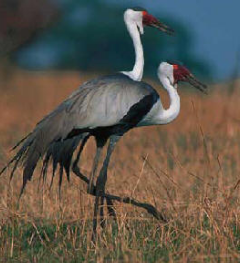
Dr. Hartup, Director of Veterinary Services at the International Crane Foundation, also cautions that we can't jump to conclusions. "People are oversimplifying the movement of birds. You can overlay a map with a huge circle on it and say, 'Yeah, that's what caused the spread.' But if we're going to pin the blame on wild bird movement, we're going to have to be much more specific. It's too easy to generalize."
Maps like the ones Dr. Hartup describes are common. BBC News offers one example. The Washington Post offers another.
Finding more sophisticated maps and materials that present alternate theories of the disease's transmission in the mainstream media is not as easy. America's National Public Radio, however, (on a web page that corresponds to a February 16, 2006 episode of All Things Considered) shows a map containing both a migratory bird flyway and the path of the Silk Road. Many experts believe the Silk Road and the Trans-Siberian railway have acted as conduits for the transmission of the disease through the legal and illegal trade in birds.
There's lots at stake in this issue. And like any threat this large, H5N1 is a story with many angles. The virus presents immediate and potential medical, social, economic, environmental and ethical ramifications for people around the globe.
Squalking at the real enemy
Naturally, we must consider how to protect ourselves from the next pandemic strain of influenza virus (which may or may not come from an H5N1 strain). At the same time, people must consider how to protect animals, many of which are already endangered. A Convention on the Conservation of Migratory Species of Wild Animals task force report, for example, lists six species of Eurasian birds that could entirely be wiped out by avian influenza. The report only considered Eurasian birds. In total, it compiled a list of 36 species that were at particular risk.
Some conservationists are worried about the threat people pose to wild birds through officially sanctioned or private culls. In support of this concern, Mr. Moores points to verified and reported wild bird culls in Vietnam, Indonesia and Russia. There have also been culls in Thailand.
So how likely is it that migratory birds could bring avian flu to Canada? "If I had to bet, I'd bet that if the virus does come to North America, it would come by human agency. That doesn't mean the probability of it coming by wild bird agency is zero. It would appear to be low. But the consequences could be high. So it's a risk, and we would be well advised to be on the lookout for it," says Dr. Ted Leighton, Executive Director of the Canadian Cooperative Wildlife Health Centre (CCWHC).
Avian health benefits
The CCWHC coordinates Canada's Inter-Agency Wild Bird Influenza Survey. Last summer and fall, that survey collected approximately 4300 wild ducks from six general Canadian migration corridors. Scientists then began to catalogue the range of influenza viruses present in the birds. At that time, the survey also began the routine testing of dead wild birds. No bird turned out to be highly pathogenic.
Recently, scientists have started to pay attention to the health benefits of nature, and not just to the potential cures found in plants. As ironic as it sounds, getting out and seeing birds could be the perfect antidote for anyone feeling stressed out about a possible pandemic.
For information about birding, check out Birding In BC, or in the Lower Mainland, visit the Reifel Bird Sanctuary whose website says the spring is an excellent time to see Western Sandpipers, hawks, eagles, cormorants and ospreys, all of which come to the mouth of the Fraser river to feed on salmon and eulachon.
Grant Sheppard is a freelance writer from B.C. He is currently teaching in Japan.


11
Login or register to post comments
G West
6 years ago
Comments on "Wild Claims about Avian Flu"
Interesting piece.
Does no comments mean no problem?
I doubt it.
Wait till a sick crane drops out of the sky near Pocatello, Idaho; then, no matter how well reasoned and sensible this article is, we'll get excited... and so will CNN and Gloria Vanderbilt's little boy.
Colin
6 years ago
I know many years ago a case of Hoof and Mouth disease was traced to a pair of muddy army boots brought back from Germany, after that everything had to be very well cleaned before transporting home. Humans do make great vectors.
haraldkann
6 years ago
good point colin,about the great massacare of cattle and our lack of hygenic measures.
but these bugs and virus' have been around forever
slowly mutating.only our/human negligence gives disease a foot hold.our bad hygenic practices and our greed in the mass marketing of farm animals causes untold horrors,like the slaughter of millions of diseased creatures.
and to extrapolate this subject,look at what paul watson wrote about the celebrities complaining about the seal hunt on another thread and think to the slaughter of all those supposedly sick animals a few years back.
did you hear any complaints over the millions of animals slaughtered ?how about all those birds lately ?
so it is small wonder things go wrong,with only a few voices in the wilderness .
Colin
6 years ago
I was reading an article on the vectoring of Disease and species by large storms such as Hurricanes, quite amazing, the storm can deposit some species up to 20-50 miles away.
Had a great book called Malaria, “something†and Jewish Grandmothers all about the history of Disease vectoring. Quite a good little read.
tonib
6 years ago
Can't help but think that the avian flu hysteria pales in comparison to the very real hiv\aids pandemic currently wiping out whole families in Africa as we speak. Can we put these issues in perspective? Is this not as important as avian flu because it doesn't directly affect us? !!!!
Colin
6 years ago
I think Aids/HIV affects us here, granted not as much as in Africa. The difference is that the mode of transmission is easily dealt with if you want to, especially in a country with a highly literate population, but if the wild birds are the main vector, then there is little we can do to prevent outbreaks of the Avian flu and can for the most part only be reactive.
I believe the death toll during the 1919 outbreak was in the 20 million or higher?
clubofrome
6 years ago
Word of the day!
clubofrome
6 years ago
ECHOECHO echo.....
Nana
6 years ago
Wild birds are being scapegoated. The real problem is factory farming.
"Dr. Palese points to studies of serum collected from rural Chinese populations in 1992. The results indicated that millions of people had natural antibodies to H5N1. This suggests they had been infected and recovered without becoming noticeably or extremely sick - not the outcome one would expect from a virus as feared as this one."
http://www.csmonitor.com/2006/0321/p09s01-coop.html
"Even before the advent of the current bird flu crisis, factory poultry farming was already an environmental and socioeconomic disaster. In recent years, the industry has been able to grow in developing countries only by externalising costs and using monopoly power to exploit workers and contract producers -- the local people have to bear the costs and the benefits go elsewhere, as much of the product is exported to wealthier countries."
http://www.grain.org/briefings/?id=194
clubofrome
6 years ago
People, at least the ones in the wealthier countries, believe that processes are in place to protect food supplies, water supplies and the like. If you read the article above you can only conclude that corporations are far more concerned with profit than public health. Sending tainted product to market before the inspectors come round to condemn their livestock. The average westerner usually considers this a conspiracy theory by wing nuts, commies and lefties. They still cling to the belief that society is good and that checks and balances are in place. That the cavalry will ride in to save the day when the bad guys come to town. If you believe that corporations are indeed acting selfishly and only in the interest in profit, then you must conclude that society and our races as a species is in dire straights. The horror storys about Monsanto curl your toes in disgust, but yet everyone still drives to the Super store to fill the trunck with the best prices on all the staples. Fruit loops, Kraft Dinner (by the case lot) Campbells hungry man soup, Stouffers lein cuisine, chips and pop, and yes farm factory meats with all the horomones and antibiotics that are probably undermining our immune systems as well. The more you live in this society the more you have to buy into the big lie. To discover the truth would mean the end of this comsummer driven world, and the comfort that goes with it, the vacations, the labour saving devices, all gone. How can it be? Surely we have the technology and the will to figure out solutions so that a good portion of our population can maintain a resemblance of life as we have come to know it? That's the question we'd all like the answers to. But one thing is for sure the faster we barrel down the freeway with our foot to the floor eating cheese burgers and tossing the wrappers out the window (Denis Leary!) the sooner we will reach a point of no return. The easy pickin resourses are all but wiped out, so once the big wheel stops, it stops for good. At least as far as the next 100 generations are concerned anyway. What's my name? Warning! Ding Ding Ding! This is the automatic alarm system bell, limits to growth collision imminent...
jwstewart
6 years ago
Whew! Thanks for the link Nana, I almost bought a small hobby farm with a free range chicken setup.
http://winnipeg.comfree.ca/display.html?code=9275
I'm glad I didn't, now I'm properly informed and I know that to properly raise poultry, I need a production level chicken Gulag.