

 SHARE:
TheTyee.ca
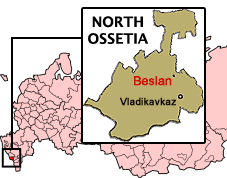
On the morning of September 1, 2004, a small armed force captured a school in western Russian town of Beslan, taking hundreds of students hostage.
One day later, a small article describing the event appeared on Wikipedia.org, an open-source encyclopedia. Over the next 24 hours, Wikipedia users compiled the information from other news reports together into one article, revising and expanding it 46 times.
People coming to the article from Wikipedia's "Current Events" page could read a concise summary of the event, with links to the history of the region and the ongoing war. This was old school, just-the-facts reporting.
Wikipedia.org, an online hypertext encyclopedia to which anybody can add and edit information, could be the future of journalism. Wikipedia is not only a reference work, it also makes a pretty good newspaper.
How it started
Wikipedia was founded in 2001 as an online, collaborative encyclopedia. As of September 2004, it has over 340,000 articles, compared to about 65,000 articles in the Encyclopaedia Britannica.
The key point of Wikipedia is anyone can create or edit any article, using a simple markup language for formatting and hyperlinks to other articles and external sites. There is no official editorial board, no peer review. Instead there is the aggregate intelligence of thousands of users. For instance, I wrote the initial entry on slasher films, briefly summarizing the history of the sub-genre, starting with The Texas Chain Saw Massacre. A few months later, I found someone had added to it, saying that the form had really originated with a sequence in an obscure 1971 Italian movie called Reazion a catena. Wikipedia is not just a collection of information, it is a culture and a society. Regular contributors come to more-or-less agree on what constitutes a neutral point of view (NPOV) for articles. Oftentimes, a controversial article will get altered back and forth until it reaches a compromise state that everybody can agree upon. In other cases, ideas and theories that are not widely accepted get their own topic, like the page devoted to alternate theories of AIDS.
Vandals at the gates The system effectively protects itself because the regular contributors, who understand the tacit rules, outnumber the cranks and vandals. All changes to articles are tracked, and since old versions of articles can be easily reinstated, it is easier to fix an article than it is to damage it. People have tested Wikipedia's ability to self-protect, with varying degrees of success. One set of deliberately introduced factual errors were fixed within hours. Another set were not fixed after five days. Most of the commentators on Wikipedia have compared it to established resources like the Encyclopaedia Britannica. However, it also functions as a daily news source. Newspapers are limited by space, like encyclopedias, but also limited by time and expertise. A news editor must publish something by the deadline, and cannot always find somebody who has as any familiarity with the topic. Thus, a story can end up being covered by somebody who has no more than a layperson's knowledge of the subject, and doesn't have the time to do research. This produces what's known in the trade as parachute journalism. You drop a reporter in the middle of a country he's never heard of before and tell him to go among people whose language he doesn't speak, and grab a story, any story, preferably sensational and easily understood. Nuance and context be damned. It's summed up by the title of English journalist Edward Behr's memoirs, published in 1981: "Anyone here been raped and speaks English?" Picture that being said by a trio of white guys with video cameras standing next to a Land Rover in an African marketplace.
Enthusiasts and experts By comparison, Wikipedia has the advantage that topics are written about by people who are enthusiasts and experts, if not formally accredited experts. Furthermore, the articles are collaborative and cumulative. Contributors build upon what others have written before, and can revise a topic as new information becomes available. Ideally, Wikipedia provides the latest summary of a topic, written by knowledgeable people and with links to background, while a news item can be too isolated and without context. If you've every read anything about a subject near to your heart and been frustrated to find something inaccurate, incomplete or unnuanced, it's quite satisfying to click the word "Edit" on a Wikipedia page and set the record straight. The problem is, however, that while it's fun to contribute to Wikipedia, that very quality diminishes its value as a reference. You can't settle an argument by referring to a Wikipedia article, because your opponent can always say, "Who are these people? Where's the peer review?" Whether the information in the article is accurate or not, the fact that the articles are written in the sand undermines the credibility. Unfortunately, the issue of credibility of an information source is a separate issue from its content. Encyclopedias and newspapers both depend on their reputations so that people will trust them. The New York Times calls itself "the paper of record." For many people, if the Encyclopaedia Britannica says it, it's so.
Power of collective scrutiny Some commentators defend Wikipedia, saying that newspapers and reference works do contain errors, and that the open, distributed nature of the Wikipedia makes it accurate enough to be useful. As blogger and Creative Commons founder Joichi Ito observes: "Tradition [sic] authority is gained through a combination of talent, hard work and politics. Wikipedia and many open source projects gain their authority through the collective scrutiny of thousands of people. Although it depends a bit on the field, the question is whether something is more likely to be true coming from a source whose resume sounds authoritative or a source that has been viewed by hundreds of thousands of people (with the ability to comment) and has survived." So, how to combine the best features of newspaper and encyclopedia? Phrased another way, how can we keep the strengths of Wikipedia as a source for both news and reference, while making it something people can trust? How can Wikipedia's reputation be improved? Creating a list of editors, contributors or both which are approved by some authority would help, but that would reduce the number of possible contributors, resulting in less-rich content. Waiting for editorial approval would diminish the system's responsiveness. Recognizing some users as more valuable than others, in some kind of gold membership, would get away from the egalitarian premise of the project. Apart from the practical considerations, to add some kind of editorial control to Wikipedia would run the risk of imposing editorial bias (beyond that of the generally white, middle-class, technically savvy young males who create most of the Internet).
The Wikipedians are already proposing ways to improve the project's credibility, with an eye towards eventually publishing a paper edition.
Relied upon more and more Despite the credibility issue, Wikipedia has slowly gained a presence as a reference for other news publications. The Wikipedia as a news reference page lists citations from the Christian Science Monitor, Bloomberg News, CBC Manitoba, Maisonneuve magazine and the Globe and Mail. These references appear to be mainly as background reference for features and columns, not primary sources for news items. However, on September 8, 2004, a CNN.com article on Shamil Basayev, a Chechen rebel leader and the alleged mastermind of the Beslan school hostage siege, referenced Wikipedia for details like the loss of his foot due to a land mine and his part in the Chechen war. The Internet age has shown us that truth is a much more slippery concept than we once thought. Witness the war of information waged in the U.S. by the Bush and Kerry camps about their respective candidates' military service histories and other issues. There's a profusion of evidence and testimony offered by both sides, and sorting through all of it would be a full time job. Some people will decide what to believe based on the news sources they trust, or their political affiliations. Others will take the time to dig deep and look at multiple sources, and possibly contribute some of their own. Using Wikipedia requires a major shift in the way we view our sources of news and reference. Wikipedia shows that information should be tested, as a way of getting better information, but also that it should be shared. If you have knowledge, offer it to the world. If you see something wrong with Wikipedia, fix it.
Vancouver journalist Peter Tupper is a regular contributor to The Tyee. ![[Tyee]](/design-article.thetyee.ca/ui/img/yellowblob.png)







Tyee Commenting Guidelines
Comments that violate guidelines risk being deleted, and violations may result in a temporary or permanent user ban. Maintain the spirit of good conversation to stay in the discussion.
*Please note The Tyee is not a forum for spreading misinformation about COVID-19, denying its existence or minimizing its risk to public health.
Do:
Do not: