Life

A Tyee Series

Riding Vancouver's Streets into the Future

Getting a city right means many ways of getting around, and truly public space.

By Jessica Linzey, 15 Jul 2011, Momentum Magazine

Linzey-600.jpg

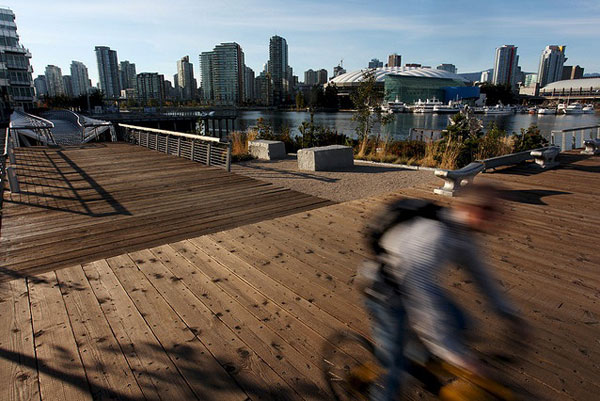
Southeast False Creek: revolutionary public space or typical car-centric planning? Photo by Bhlubarber from Your BC: The Tyee's Photo Pool.

Related

[Editor's Note: This is the second installment in The Tyee's "Self-Propelled Summer," a weekly series of cycle-centric articles from Momentum magazine. Enjoy this 2009 article on bike-friendly urban planning and always remember to wear a helmet while riding your bike and a seatbelt while driving your car.]

The Carrall Street Greenway is quiet and leafy in some stretches, heavy with unpredictable traffic and ongoing construction in others. On Sundays through August and September of 2009, a full city block of it was given over to a farmers market. The greenway has space for pedestrians, cyclists and vehicles alike, and the materials used to delineate these spaces are both thoughtful and beautiful.

The greenway is a $5-million community development and transportation corridor project that, once finished, will connect False Creek to the south with the Burrard Inlet to the north, linking the historic neighborhoods of Chinatown, the Downtown Eastside and Gastown through six short blocks.

As Arno Schortinghuis put it, "It's Vancouver's only complete street. But what a lovely street it is."

Schortinghuis is president of the volunteer-run Vancouver Area Cycling Coalition (VACC) whose mission is to make cycling an integral part of the local transportation culture. A two-hour ride with Schortinghuis through some of the city's best and worst efforts at this integration begins at a project he would file in the latter category: the Millennium Development site of the 2010 Olympic Village on the south side of False Creek.

"This was a real missed opportunity to create a public space where people can interact on roads built for non-motorized use," Schortinghuis said. "This is meant to be the greenest development in B.C., but we got only one bike lane. It's typical car-centric planning."

Vancouverism: Choice is in our DNA

According to former city councillor Gordon Price, pushed to its extreme, this car-centric planning could very well mean civilization suicide. The great irony about Vancouver, he said, "is that it made the key decision not to build freeways and plow through the fabric of generations of human experience. Today's urban design is looking at the streetscape as public space and moving aggressively forward on this. So it's astonishing that now that we're at this time of extreme high risk, about the only thing we do is commit money to building the Sea-to-Sky Highway, the Golden Ears Bridge and a future dependent on the price of oil."

Suburban development aside, Price –- now director of the City Program at Simon Fraser University –- argues that when people speak of "Vancouverism," they're really talking about what happens when people are offered the right mix of transportation choices.

"After World War II," he said, "cities began designing their urban regions for the motor vehicle. But Vancouver chose not to re-build around the motor vehicle, which might have driven out all other transportation choices."

Instead, Vancouver opted to build on the fabric of the streetcar corridors and not to go the way of what Price calls "motordom."

"This was a very powerful decision," he said. "Because of it, by and large, the city today is what it's always been. We still live in what were traditional streetcar villages. What has changed is the sophistication of transportation and this is what makes cycling so interesting. There is a cultural aspect to it. This era of contesting space that we have entered is fascinating."

The argument goes, then, that it is the layering of choices that makes transportation -- and cities -- work. By giving public space over to bike lanes (as the city did with the Burrard Street Bridge bike lane trial that began this summer) thus giving people another practical transportation choice, the car will start dropping off, and what will be left is livable public space. But eliminate that choice, and problems arise.

According to Price, "Car-free days only work when they are exceptional moments. Pedestrianizing Granville Street -- removing the choice of taxi and car-sharing -- violates its very DNA."

'The car changed everything'

Andrew Pask disagrees. Sort of. While he agrees good cities allow people to switch between modes of transportation, ideally people should be able to use two feet or a bicycle to get anywhere.

"There is something to what Price is arguing," said Pask, "but the car changed everything. Planning now, it's all car-centric. We don't have a streetcar. We don't have dedicated bus lanes. We don't have separated bike lanes. I'm not anti-car, not one mode versus the other. It's just a question of ratio."

Pask is the director of the Vancouver Public Space Network. Formed in 2006, the VPSN is a "grassroots collective that engages in advocacy, outreach and education on public space issues in and around Vancouver." Project areas include but are not limited to, greenspaces, public and city art, urban design and security and surveillance. It's a big undertaking but one that is clearly engaging the public imagination -- at last count, the VPSN boasted more than 1,700 members and 2009's "Where's the Square?" design ideas competition drew 54 entrants.

"Vancouver has tremendous public space," said Pask, citing Stanley Park and the seawall as examples. "We excel at linear spaces, areas that enable solitary reflection. But public squares, plazas, the grand gathering places -- this is where we're deficient. We need places to commune with one another. It's important for the quality of life. 'Where's the Square?' grew out of that."

Congregation over contemplation

Maged Senbel is an urban design professor with the School of Community and Rural Planning (SCARP) at the University of British Columbia. He agrees that Vancouver's unique form of public space -- particularly the seawall that winds around the city -- is not necessarily space for congregation, but rather for contemplation in a beautiful setting.

"But this," he said, "is not where community takes shape. Community takes shape where people are involved in the creation of space, and the inhabiting of space. Take Commercial Drive, or the art gallery. People have taken ownership, are involved, empowered."

"Beyond this, there isn't a lot," Senbel said, "that encourages spontaneous mixing of people."

But he's not sure that any place -- great public squares included -- does that well.

"Is that even desirable? We have this idea of what is vibrant and active. But there's an incredible variety and dynamism in Vancouver's public spaces -- spaces that fit with the psyche of this city. The current concern is with being the greenest city in the world. But this doesn't prioritize public space. It's not about seeking out appropriate or innovative ways of creating public space. Vancouver has that already."

A work in progress

Vancouver is a young city. Neighborhoods take time to appear and grow.

Regardless of the arguments around what is and isn't working, what's most important to Andrew Pask is that the city's planners always keep public space at the foreground of their thoughts about urban design. To that end, Councillor George Chow believes the City's design focus should be on "neighborhood gathering places that are attractive and safe."

In an email, Chow -- who currently sits as liaison with the Vancouver City Planning Commission -- said: "We should define the principles and policies that would govern the development of new public spaces. We should also explore how the city can create public spaces in concert with private land owners and developers."

It's a sentiment shared by Pask. "This is about livability," he said. "The City needs to be taking the lead on this, not the developer."

Chow suggested that the City start by taking inventory of the successes and failures of existing spaces. Like Schortinghuis, Price and Pask, Richard Campbell of the British Columbia Cycling Coalition (BCCC) points to the Carrall Street Greenway and the Burrard Street Bridge initiatives as something the city got right.

But unlike the others who would like to see the bikeways network -- which carries bicycle commuters through lower-traffic city streets -- expanded, Campbell would prefer to see more bike routes along the high-traffic arterials. "The benefit of this," he said, "is that it's a great way for cyclists to display themselves. Here, we hide our cyclists on the side streets. In cities like Paris, we see them go proudly by as we sip our coffees at the sidewalk cafe. This is just one more reason we should get rid of parking on the main streets. Hide the cars, highlight the people."

The conversation around reclaiming public space through urban design is big and one in which many people are passionately engaged. But whatever its citizens and activists may feel about current public space, it's clear Vancouver needs to be planning for a future that takes into account an aging population and a looming fuel shortage. As Campbell puts it, we've done a good job of designing a city for adults. Now we need to think about what works for kids.  [Tyee]

9  Comments:

Login or register to post comments

  • Andrew VPSN

    45 weeks ago

    edge spaces versus a civic 'heart'

    Funny, I just came across my copy of the original Momentum article the other night.

    I remember thinking, reading the piece again, that I could have said things a bit better. In Vancouver we've done some fine work at creating public space along the edges - whether the grand linear park that is the Seawall, or beaches, or waterfront plazas (like Jack Poole, beside the convention centre). Some of these spaces work better than others - largely in a recreational sense. Tied in with this, a good portion of the sites, though not all, are built to support an almost meditative appreciation of the ocean or north shore mountains.

    It's the central gathering space, the downtown plaza or square, that we haven't quite figured out - the sort of urban social 'heart' that can be found in many other cities around the world. The Where's the Square competition generated some great ideas in that regard, but truth be told we've had good ideas 'on the books' for several decades (with studies on the creation of a central plaza in Vancouver dating back to at least the 1950s).

    I'm still hopeful that we can achieve this.

  • zalm

    45 weeks ago

    I think we've created a problem

    Our city's too big for the kinds of dreams expressed here. It's too big and too selfish to utilize public spaces to accommodate our gatherings to "commune" with one another. It's too big to reasonably cycle around unless you're young. I can get across Munster in Germany in 15 minutes on the cycle routes and road network. I can't even get to Stanley Park in that time here.

    And it's raised a generation of selfish beings, some of whom drive cars, and some of whom cycle. The conflicts are bellicose and astounding to behold.

    I live on the 10th Ave. cycle route - a subsidiary cycle route that is one of the heaviest-trafficked in the city. It's here that I get to see daily the crop of rude human beings we've raised. The "cyclists allowed to disregard stop signs" campaign began here. Cars that use this neighbourhood as a parking lot for downtown (the price of a one-zone Skytrain ticket) now wait minutes to get out of driveways and across side streets, or else cut everyone off in a mad dash to get to the next stop sign. Shouting from road conflicts occurs every few minutes. A pet has been run down. I was run into by another cyclist, likely because I stopped at the stop sign, but I don't know because he only swore at me. Electric bikes, gas-powered scooters, and now minibikes over 50 cc routinely use the route at speeds higher than cars used to do. A fire truck blocking the street to attend a call at the senior's building raised a storm of invective that could be heard down the block.

    Pedestrians often like to walk here because of the h eritage houses, except sometimes when the traffic is too heavy. Others like to cross kitty-corner and block traffic in all four directions. Many walk dogs. Most even pick up their dogshit.

    I tell you, it's rather like what it must have been like living on Georgia Street in the 1930s when the Lion's Gate Bridge went in. House prices fell in 1933 and never recovered until the properties were rezoned commercial/office. People abandoned Georgia for Robson. That was a time when human-scale actually meant a walkable, livable city.

    What we have now is a cariciture of that time. I like the vision expressed by the people here, but it's all useless dreams because this city is too big, too individualistic, and has too much inequity in it to ever be the civilized genteel place we all imagine it once was.

  • Andrew VPSN

    45 weeks ago

    Car centric plans vs planning

    p.s. The city now is still quite car-centric, but the municipal planning focus in recent decades has actually been on creating compact, walkable communities. This is a good thing.

    Vancouver has streetcar travel in its genes ("a streetcar city"), the urban structure that supported this back in the late 1800s was re-purposed to support increased use of the private automobile... the real consequences of which only started to become apparent in the 60s and 70s.

    The South East False Creek development definitely isn't "typical car-centric planning" in that regard. Its got a well-thought out public realm program, pedestrian-focused design, and a building/street relationship quite different from most other neighbourhoods in Vancouver.

  • freebear

    45 weeks ago

    How many planners ride the bus?

    Almost none! It is called the 'windshield perspective'.

    Remember though; how much of the economy is predicated on the personal automobile. Just take a look around at the gas stations,insurance, car washes, parking lots, muffler shops, accessories shops, car dealerships, autobody shops, tire shops.....

    Even the federal government bailed out the auto industry!

    The newspapers have driving section!

    Almost every single family home has pavement and at least one (many have 2-3)car hole (re: garage)!

  • Helen Spiegelman

    45 weeks ago

    public spaces

    I like George Chow's proposal to look at/for public spaces at the neighbourhood scale rather than the macro-scale. I really like the proposal to take an inventory of them -- and other neighbourhood assets. The act of doing this inventory and the place it is lodged becomes a shared public space.

    I also nominate Sunset Beach (site of Walk for Peace Rallies in the 1980s) as a global public space that happened to be in Vancouver.

  • snert

    44 weeks ago

    Helen Spiegelman

    Quote:
    I also nominate Sunset Beach (site of Walk for Peace Rallies in the 1980s) as a global public space that happened to be in Vancouver.

    It never ceases to amaze me how the people that say they cherish Vancouver so much can never get it through their heads that the best way to preserve it's uniqueness is to stop jumping up and down whilst waving their hands and saying "Look at me! Look at me! See how pretty I am." All that does is attract more people to come which creates more havoc which is what they were attempting to avoid in the first place.

    Vancouver, the city whose flower should be the Narcissus.

  • Sam Salmon

    44 weeks ago

    'Vancouver, the city whose flower should be the Narcissus.'

    Indeed!

  • Joseph Jones

    44 weeks ago

    Rhetoric vs Performance

    Writing here as an East Vancouver resident sandwiched between the first two (perhaps the only ever to be, out of the projected nineteen?) "neighbourhood centres" at Kingsway/Knight and in Norquay. This planning was supposed to implement the multimillion-dollar overarching CityPlan initiated in 1995. Anybody really want to call that planning, more than fifteen years onward?

    What have we got so far in livability and sustainability and alternative to the automobile?

    One. The largest retail space at King Edward Village (KEV) sat empty for years and has just been occupied by a drive-to federal government agency. No walkable local retail here! The TD Bank is useful, but has dissed Kingsway by being allowed to turn its back to the street. Getting a grocery meant further height/density concessions to the developer because of the former landowner's abusive restrictive covenant. Oh yes, and the big public benefit, touted as a new library for the community? Not exactly. Try ten years of no-charge lease on the space, after which the developer starts sucking up a new revenue stream from the City of Vancouver.

    Two. Two other drive-to vertical gated communities are already destined for 2300 Kingsway and 2669 Kingsway.

    Three. Nasty minimal back alleys at KEV – and coming at 2300 Kingsway – where pedestrians get to dodge automobiles and delivery trucks, and weave among parked vehicles that refuse the underground option. There's a good reason no cafe life has emerged in the "courtyard" at KEV. A handful of surface parking spots are obviously far more relevant.

    Four. Norquay Working Group could not convince planners and politicians that a bicycle lane (even one going west only) along Kingsway was a better use of public space than an automobile-dividing median planter typically filled with weeds and dead plants. Such median infrastructure is a waste if we ever get back the middle-of-the-street tram that Kingsway used to have. Paint us a much cheaper bicycle lane instead.

    Five. A curb cut to send a tsunami of traffic across the Kingsway sidewalk at 2300 Kingsway, as pedestrians will scurry past, traversing shadow cast by a 22-storey tower with no setback.

    Six. A privatized plaza in the interior of 2300 Kingsway set one level up from the hoi polloi that consort with motor vehicles in the alley below.

    Seven. A daycare as prime community feature in the interior of 2300 Kingsway. The 10,000 residents of Norquay not served by those 37 daycare spaces effectively realize NO public benefit.

    Eight. Plans at 2699 Kingsway (public hearing was July 12) that seem unlike to address effectively Urban Design Panel consensus concerns about orientation and garbage/utility protrusion into the focus of stingy public space.

    Call these the eight unwonders of East Vancouver.

    Also ask yourself why the curse of this sort of planning – rezoning swaths laid over thousands of single-family homes – has been directed only at East Vancouver, ever.

  • zalm

    44 weeks ago

    Nice comments, Joseph

    I'd only disagree with one - the bicycle lane on Kingsway. In my young and crazy days I used to ride both ways on it - it was safer coming west as you came down the hill so you could keep up to speed with traffic, but it was still the riskiest thing to do in Vancouver short of shooting a pound of fresh smack with the dirtiest used needle you could borrow from your local junkie.

    Traffic is insane on Kingsway, and a bicycle lane is simply a shooting gallery for the little rubber ducks on wheels that line up in the sights of all those pickups and Benzes with blind drivers practicing for their eye exams... I'v eseen three pedestrians hit and I've com on two flat bicycles - and I'm hardly ever on the road.

    No thank you - leave Kingsway to the cars as a monument to stupid planning.

    • The discussion for this story is closed. No more comments can be added.