
Life

Japan in Springtime

Amidst catastrophe arrive cherry blossoms and the season for hanami, a nation's celebrations of life.

By Steve Burgess, 17 Mar 2011, TheTyee.ca

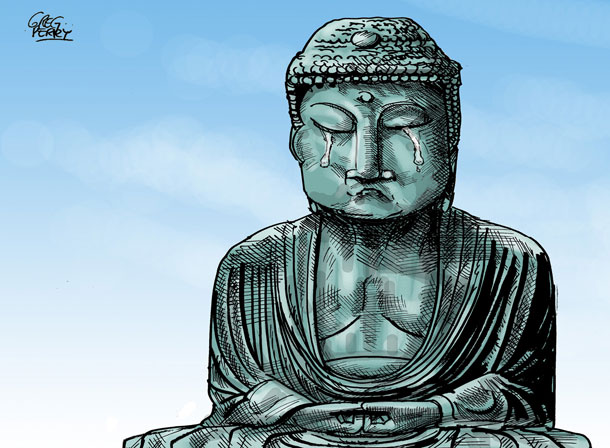
Cartoon of a crying Buddha statue

Cartoon by Greg Perry.

It's almost cherry blossom time in Japan. The annual flowering of sakura is a much-anticipated season -- Japanese postcards and brochures are so sakura-heavy that a newcomer might think the pink flowers bloom all year round. It's not just the photographers who wait for sakura to reappear. The sudden explosion of pink is the signal for a nation-wide bacchanal, a series of parties called hanami. Hanami are outdoor picnics where friends and co-workers spread blankets beneath flowering cherry trees, unpack a vast array of snacks and home-made delicacies, and proceed to get rip-roaring drunk, presumably in solemn tribute to the beauty of nature.

This year? Perhaps not the time for Japan to celebrate nature. She who makes the tiny flowers bloom moves earth and sea to destroy lives and sweep away homes like so many petals. Will Japanese people still feel comfortable about putting on their cherished national open-air celebration? Scheduled Japanese events such as Fashion Week have been cancelled, and it would not be surprising if the national mood militates against light-hearted abandon. The trees will still bloom but for some their beauty might seem mocking, like coloured balloons at a funeral. "In Tokyo, everyone worries about radioactivity in the air," writes my friend Miwako. "So no one wants to do a hanami next month. Many people are leaving Tokyo right now."

Laughter in the park

I was invited to a hanami once. It was held in a beautiful park near Denenchofu, an hour from Tokyo. There were about a dozen of us, parked on a blue tarp laden with food -- gyoza, dried squid, deep-fried chicken nuggets, kimchi, chicken wings, Pringle's potato chips, yam fries, salad rolls, sushi rolls, shrimp noodle salad, pistachios, honey-roasted peanuts, Japanese pickles, and corn dogs, miniature ones on wooden sticks.

Also beer. But it was going fast. Some of the drinking was mandated, although there was plenty of enthusiastic volunteerism too. The forced drinking was connected to mass games of rock-paper-scissors, which is done a little differently in Japan. It involves a six-beat opening chant that goes: "Saisyoha guu; Jyanken pon!" Roughly translated it means, "First the stone; now let's go!" On the sixth beat the weapon of choice is revealed in the usual way, rock beats scissors, scissors cuts paper, paper covers rock. But this version of the game is a group activity. Six or seven people line up on each side with one person as a sort of referee to decide who wins and who loses. Losers then play again until finally only two are left. The ultimate loser is then commanded to shotgun a beer.

The problem was, I don't drink. So when I inevitably lost a game -- possibly via rigged officiating, though I could prove nothing -- it required a huddle to decide my fate. Decision reached, a paper plate was thrust in my direction. I was sentenced to roam the park, begging for food from other groups of picnickers.

It was a daunting prospect. Welcoming and polite though the Japanese are, a mistrust of foreigners remains common, fanned by media and politicians alike. The governor of Tokyo once said that, following a major earthquake, the first task of Tokyo police would be to round up foreigners in order to prevent riots and crime.

Now I was tasked with advancing upon strangers, thrusting out my plate with grunted demands. Actually the situation held possibilities -- with any luck the terrified locals might toss me their wallets and jewelry.

The group I approached did indeed look upon me with some alarm. "Sumi-masen," I pleaded, holding out the little plate. Blank looks and concerned glances ensued. Then they heard the cheering. My companions had gathered at the edge of their tarp to urge me on. The light dawned -- this gai-jin was being hazed. Smiles broke out, and suddenly food was piled on my little plate -- cake, potato chips, edamame. I returned a conquering hero. And there was much drinking.

Mourning and hope

Is this the year for such antics? Not for me to say. But I hope so. I hope Japanese people still gather under the cherry trees for their annual rite -- a little more subdued perhaps. But events like the great quake and tsunami have demonstrated once again the unity of Japanese society. National joys are part of that, along with national sorrows. So people of Japan, raise a toast to the beauty and terror of nature. And to yourselves. It is well deserved.  [Tyee]

6  Comments:

Login or register to post comments

  • warbler

    1 year ago

    Shikata ga nai

    I had the privilege of being able to attend a few hanami parties with good friends and colleagues during my years working in Japan and unlike you, Steve, I do drink, so those memories are fond, albeit a bit foggy.

    Due to its unique geographic disposition, Japan has been hammered by tsunami, earthquakes, typhoon, flooding, volcanoes as long as there have been humans inhabiting the islands. Thus, disaster is deeply woven into the cultural fabric and national psyche. This results in a resiliency that few Westerners understand. We often mistake this resiliency for indifference, fatalism or denial, but it's anything but.

    The Japanese have an expression you'll hear a lot if you spend time there: shikata ga nai, loosely translated as it can't be helped. It represents a unique cultural trait, among many others, that gets them through one disaster and tragedy after another.

    The other trait that unites the Japanese and helps them through these trying times is wa (the circle of harmony); the health of community is more important than the health or sum of its parts.

    In answer to your question, as long as their are cherry blossoms in Japan, even in Sendai, there will be hanami celebrations. I'd even venture to suggest that even if there were no cherry trees left, they'd find a way to recreate the tradition.

  • Driftwood

    1 year ago

    If you wish to donate...

    Here is the CBC site which gives phone numbers and links to reputable organizations:
    http://www.cbc.ca/japanrelief/

  • Driftwood

    1 year ago

    Not such a dumb idea

    If Thetyee wishes to contribute, they could publish the above link somewhere on this site.

  • Driftwood

    1 year ago

    This isn't about picnicking

    under a cherry tree, and I hope Thetyee eventually wanders out of the gate here and starts to act like a channel of information on what is right now the most important issue on the planet.
    The situation is not as benign as we might think in terms of radiation arriving here. There are a couple of very interesting links which might come close to the truth. Here is one link which is written in plain English by someone who used to work in the nuclear industry:
    http://globalresearch.ca/index.php?context=va&aid=23764 Lots of interesting links in the article, including one to a Youtube of Rachel Madow which I found very helpful.
    http://www.youtube.com/watch?v=sjdgHqY2K-4

    Then there are the ocean currents - we all know that it is the Japanese current which keeps the BC coast warm, and it comes pretty well straight across the Pacific and splits on the coast of North America. Some goes north and some goes south and it washes up on all the beaches here. So even if that radiation which is even now gushing out of various cooling ponds at the Fukushima plant falls into the ocean, it will surely get into the food chain and ocean currents and arrive here.
    This doesn't look good and we all know how the bean counters screwed up the GOM disaster. Is that going to happen here? There are enough parallels between the two events to make it likely. Just repeating what Yukiya Amano, the director general of the International Atomic Energy Agency (the UN nuclear watchdog) said, and I'm paraphrasing: 'This is no longer a matter just for Japan to handle. This is a matter for all the countries of the world to work together on solving.'
    We know that certain private corporations screwed up the GOM by dumping millions of gallons of Corexit deep underwater as they pondered how to come out in the best financial position. We can't afford that in Japan. Don't believe for a second that the radiation coming over the ocean is 'miniscule' or that there is a 'negligible' chance of a mishap far larger than Chernobyl. There is 24000 times the radiation just in those 'spent' rods in the cooling ponds than was emitted from the bombing of Hiroshima. Read the article and judge for yourself.

  • warbler

    1 year ago

    Driftwood

    Relax, grasshopper. The world is well aware of the pending crisis in Japan. Tyee readers are, I venture to guess, as informed as any people are in this part of the globe. There are a gazillion ads on TV, radio, print, online that tell people where to donate - if they so desire. We all know how to reach the Red Cross, via CBC or otherwise.

    And yes, this is, in part, about picnics in the park. Don't lose sight of the point in this article.

  • Driftwood

    1 year ago

    @Warburg

    First, calling me grasshopper is disrespectful, but we'll let that go:)
    The meat of your argument: "Tyee readers are, I venture to guess, as informed as any people are in this part of the globe." is true of some and not so true of others. Depending on your viewpoint. Either way it is not solely the result of them reading environmentalist articles on the Thetyee as the mother ship plugs them in to more of the same politically.

    And there is nothing wrong with giving the CBC link - it has half a dozen links to reputable charities where you can donate by phone if you don't wish to take a chance on the Internet.

    The other links stand on their own merit. Now I'm getting on a plane to Tokyo. Gonna buy me a jug of wine.

    • The discussion for this story is closed. No more comments can be added.