Life

A Tyee Series

Hunting the Elusive Wapato

Women are leading a revival of First Nations' staple foods. To get lucky, you have to get mucky.

By Joanne Will, 14 Jan 2010, TheTyee.ca

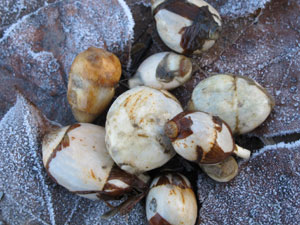
wapato.jpg

Freshly harvested wapato from the Fraser Valley. Photo: J.B. MacKinnon

Related

With my feet twisting in the mud of a frigid river, I have already lost the festive socks that were a Christmas gift from my mom. Now the river bottom is turning to quicksand beneath my bare feet. I sink slowly at first, then slip swiftly from waist-deep until the water is nearly at my neck. The water is so cold that it is crusted with ice along the shore, and I know I can't last much longer. Beside me, Roma Leon of the Katzie First Nation seems to be settling in for the long haul, her feet roiling up clouds of silt.

We are hunting wapato -- unsuccessfully, so far. We're in an experimental test plot, and the number of wapato (pronounced WAH-pah-toe) tubers that might be hidden in the muck here is unknown. It's all part of a dawning revival of the staple foods of First Nations in B.C.

Hey, is that Sagittaria latifolia?

Many people imagine that British Columbia's First Nations were formerly hunter-gatherer cultures with a diet heavy on the berries, meat and fish. In fact, many nations also cultivated foods, especially sources of complex carbohydrates. Across the province, tubers, flower bulbs, and other starchy root crops were managed to boost production using techniques ranging from selective harvesting to burning over fields. Not only were these foods a direct source of nutrients, they were also valuable trade items for other edibles. In fact, the word "wapato" is taken from Chinook trade jargon. The tuber had different names among the province's various nations, and the plant is known to science as Sagittaria latifolia.

The scale of the harvests could be astounding. According to the best available case study, the waters around Sauvie Island, just north of Portland, Oregon, produced enough tubers in 1890 to provide at least 31,000 people with 20 per cent of the calories they needed for the year, all while maintaining healthy wetlands for waterfowl, muskrat, sturgeon and other species. In such quality habitat, an inexperienced person could harvest an estimated 350 tubers (about six pounds) in an hour.

This fall, the Katzie First Nation held their first community harvest in many decades, spearheaded by Roma Leon. "We found wapato that's 4,500 years old at the archaeological site in Maple Ridge," said Roma as we approached the Fraser Valley slough where we would go overboard in search of tubers. "Right now it's totally lost. We know maybe half a dozen places that have them. We're trying to learn how we can get more plants, get them growing better, and look after them so they can be used culturally, traditionally and spiritually."

It's no coincidence that women are leading this renewal. Much of the work of caring for and harvesting crops was traditionally a woman's role in Katzie territory, which includes the Pitt and Alouette watersheds and portions of the downriver Fraser Valley. Historically, each family had their own wapato plots to tend. A family might clear a section of river of other growth, and camp there for a month or more to harvest. The next year, the plot would be available to another family in the community.

Lost and found

Roma first noticed wapato plants about a dozen years ago, but took action after Terry Spurgeon, who studied wapato at Simon Fraser University, visited the Katzie to show where wapato were still growing. Many of the areas were subsequently destroyed by the placement of riprap, or rock piled along the waterfront to control erosion. Throughout the Fraser River lowlands, wapato habitat has been steadily lost as wetlands are dyked, drained, dredged, or otherwise altered. Meanwhile, table potatoes replaced wapato tubers in First Nations diets.

Fall and winter, unfortunately, are the harvest time. The Katzie men traditionally collected the tubers that floated to the surface, so it is fitting that Katzie Chief Mike Leon is looking on from the boat -- and sometimes laughing -- as Roma and I work our toes deeper in the mud. It's bloody cold work. By fall, the beautiful arrowhead-shaped foliage and white flowers of the wapato plant have died, and it takes local knowledge to locate a patch of tubers.

And then it happens. One, two, three, five -- soon nine wapato tubers rise up to bob on the surface. By the time 10 minutes have passed, though, my legs are numb and I can no longer feel my feet. I pull myself back into the boat. Roma lasts twice as long.

Back on shore, Mike warms me up with thoughts of a wapato bake. "When we baked them in the office, the smell was wonderful, and it filled the whole room," he says. His own hope, he adds, is to revive the wapato in the Katzie diet as a way to combat health problems such as diabetes and obesity.

After a drive back into Vancouver with the car's heater on full blast, I'm ready to give the wapato a taste test. The fresh tubers are about the size of new potatoes, store well, and have an odour that might best be described as funky. After half an hour in the oven, though, a sweet smell is coming from the kitchen. Roma had compared the taste to a cross between potato and corn. I'd add roasted chestnut to that description, and agree with her conclusion that wapato tastes better than a regular potato. Best of all, just a few make a filling meal -- even after the morning's hard work.

Digging camas

My second hunt for wild roots takes place on Victoria's windblown Cattle Point. Again, I have expert advice. Cheryl Bryce grew up harvesting camas and other traditional plant foods with her grandmother in Beacon Hill Park. Like Mike and Roma Leon with the wapato, Bryce is convinced that camas can help restore the health of her people, the Lekwungen. Over the past decade she has taken that message to local schools and universities, and has organized the first community harvests in recent memory.

You might stay dry collecting camas, but it still takes heavy effort. We dig in the gravelly soil with our hands and a traditional paddle -- a curved wooden stick that bears some resemblance to a cricket bat. Luckily, two of Cheryl's nephews are here to help.

In 2001, the Lekwungen held a feast, their first in more than half a century. "It was a whole day event, spread by word of mouth," says Bryce. More than 75 people came out, and only a handful had ever before tasted camas bulbs. "We had all kinds of our traditional food, and celebrated our ancestors. It was amazing to see people enjoying the food," she recalls. In 2005, Bryce helped organize a public camas harvest in Victoria near Camosun College. It has since turned into an annual event.

"I started realizing how important it was to share food with family and community," she says. "I wanted people to know it's indigenous to our area, it's a local food, and that there is far less of it than there used to be."

Sweet and smoky

Among First Nations on southern Vancouver Island and throughout the U.S. Pacific Northwest, women traditionally cared for the camas fields. Harvested bulbs were steamed in pits between layers of plants like salal, skunk cabbage and ferns. The bulbs could also be dried, pounded into flour and mixed with other foods, such as black tree lichen.

"The longer you cook it, the better it is and the sweeter it gets," explains Sinclair Philip of the Sooke Harbour House, where camas bulbs sometimes feature on the menu. Camas bulbs, like onions, contain inulin fibres, so that they sweeten with cooking but have a minimal impact on blood sugar levels. "Pit cooking adds a smoked flavour, and is especially good if you add salal and fern. No matter what you do in the kitchen, you'll never achieve the same results as with pit cooking."

Camas are found only in the extreme coastal southwest of the province and southern Columbia Valley. There are two varieties, each with pale to dark blue, star-shaped flowers: common camas (Camassia quamash), and the great camas (Camassia Leichtlinii), which is a deep-soil variety. Then there is the meadow death-camas, a lethally poisonous plant that is easy to tell from the others when in bloom -- it has white, clustered flowers -- but has bulbs virtually identical to those of edible camas. Harvesting is recommended only when the plants are in flower.

Bringing back the meadows

Most camas in B.C. are found in Garry oak meadows, one of Canada's most endangered ecosystems. Less than five per cent of the meadows that bloomed at the start of the colonial era are intact today. One of the few protected areas is the five-acre Cowichan Garry Oak Preserve near Duncan, established in 1999 by the Nature Conservancy of Canada. In 2006, the preserve was the site of the Cowichan Tribes' first harvest since perhaps the 1930s.

"It was more symbolic than anything because we only got a few bulbs out of the ground," says the preserve's site manager Irvin Banmen. "But there were youth there, and the elders were leading it. They're hoping to incorporate camas into their diet."

Still sifting through the soil at Cattle Point, Cheryl Bryce says that anyone who lives in the area can plant camas in their yard and play a part in restoring the meadows. She notes that the flower goes to the heart even of colonial history in the province; in 1842, James Douglas, the future governor of British Columbia, picked a Lekwungen camas field as the site for Fort Victoria.

"He described Victoria as this beautiful, purple place. The management of camas made this area a nutrient-rich soil, and so appealing," says Bryce.

Bryce's nephews uncover camas bulbs and excitedly present their discoveries. Some wild onions turn up, too, and we take turns smelling them. But the last summer flowers have long since died off, and we can't be certain that our pretty white bulbs are not death camas. Giving thanks for the harvest, we place them back in the earth for spring bloom.  [Tyee]

20  Comments:

Login or register to post comments

  • mikev

    2 years ago

    wonderful article

    Thank you.

  • Michael J

    2 years ago

    eating in the muck

    There's something liberating about knowing you can stick your toes in the Fraser River mud and dislodge some dinner. Thanks Tyee and Joanne Will for turning me on to a roadside comestible I never knew existed. Here are a couple vignettes to return the favour.

    While in Greece a few years ago my wife and I struck up a conversation with an older couple harvesting oregano and wild onions on the hillside below the ruins at Argos. They chuckled at our bare legs as we cut a straight swath down the hillside through the scratchy grasses rather than wind down the switch-backed and much longer roadway. Papa was having a nap in the weeds when we ran across them while mama stooped and chopped her herbs. With almost no common language between us we discovered they had a son in Toronto and had visited Canada. Proof that food is indeed a universal language.

    As a kid I sometimes accompanied my maternal grandparents for early spring harvesting sessions of "Svinushki" (literally pig's ears) a pungent wild green favoured by an older generation of Canadians of Doukhobor heritage. The look of the slender green stalks and broad leaves was generic but the smell was absolutely unique. Our favoured harvesting location was along drainage ditches and canals on Lulu island. They were steamed or boiled, salted, and perhaps a drop of vinegar added to create a strangely repellant/attractive flavour. I have not seem them since my grandparents departed and would be curious to know if others have had any experience with this strange but seemingly common herb.

  • Bailey

    2 years ago

    Food as identity

    All cultures are passed on in families, and nothing is more definitive of the flavour of a family than food.

    It was no accident that, when trying to eliminate native cultures in the last century children were separated from their homes and sent to schools in other places, then forcibly deprived of their ability to understand their grandparent's talk or learn their ways of living. Cooking is one of the most important of our ways, whoever we are.

    Some years ago I started wondering why there were no Salish restaurants in Vancouver, a city where literally dozens of overseas cultures are represented.

    One could absorb the flavours of Canton and Afganistan, Korea and France. Texas and Mongolia. There was a very popular type of restaurant called 'Chinese and Canadian Food'. Hundreds of those.

    But nobody seemed to have any good idea what the locals ate, before.

    I'm pleased to hear about this effort to recover and heal the spirits of people by honouring the foods of their culture. I hope at some point, the ladies who are doing this will share these aromas with the rest of us, and maybe open an authentic Salish eatery someplace. I would really like to try that out and I bet others would too.

  • Jerry Munro

    2 years ago

    Reviving traditional foods...

    Great article. I enjoyed reading it very much.

    My best wishes for success to these women. Anything that can help liberate us from dependency on the current mass "pesticides and high carbon inputs" food system is a good thing.

    More and more we need to move away from the dependency system of the Big Money run capitalist marketplace, to the rediscovery of our self-sufficiency roots... and not only Natives. And that connected back up with a greater sence of community and co-operation, finally overcoming the narrow self-interest and greed driven competitive market system of capitalism.

  • Janie Jones

    2 years ago

    Getting Mucky

    Guess you weren't around for the Muckamuck Restaurant labour dispute Bailey.

    "Unions aren't native": the Muckamuck restaurant labour dispute, Vancouver, B.C.
    http://findarticles.com/p/articles/mi_hb6394/is_40/ai_n28699054/

  • qmackie

    2 years ago

    Nicely done

    This is a really nicely done article, thanks. Anthropologists have divided the world into "hunters and gatherers" and "agriculturalists" and yet so much of human life falls in between, in mixed economies. These practices such as wapato and camas cultivation put the lie to western master narratives that the indigenous people of BC did not truly "occupy" the land and hence it was ok to take it away from them.

  • snert

    2 years ago

    Gotta love tradition.

    The women were up to their necks in frigid water and men sat in the boats. Oh, for the old ways.

    FWIW this plant would not produce sustainable quantities if grown in the traditional manner. There's just too many people who might be interested in eating it and not enough suitable habitat to grow it even commercially.

    The irony of articles like these is that by making something widely known there is a great possibility of doing more harm than good.

  • cavers

    2 years ago

    Right on!

    Loved the article - thanks a lot. Folks who want to know more about traditional plant cultivation might pick up Nancy Turner's recent book The Earth's Blanket. A very good corrective (like this article) to the assumption that Aboriginal people in BC were all "hunter-gatherers."

  • Jerry Munro

    2 years ago

    Muckamuck Memories...

    "Guess you weren't around for the Muckamuck Restaurant labour dispute Bailey."

    Well, I actually was, and stood on the picketline more than once.

    "Unions aren't Native." or aren't American, are anti-freedom etc, are all part of a "class" line carried by the business class everywhere, amongst current Natives no less than Whites. (A nascent ruling class, within the "inherited" Chief system was always there amongst Natives as it was amongst all early peoples, no less than it was ancient Europeans. The class system didn't arise out of a vacuum bottle, but naturally out of the early chieftain systems of all early tribalism, at least known to me, over a very long history.)

    In short, this particular issue is more one of "class" than racial. It is merely that in this instance, the facade at least was Native.

    And I'm not certain from this point in time, but if I recall correctly, the owners of this restaurant were not, in fact, Native, nor was the food that very much. It was more a kind of "fusion", along with the decor, dressed up as Native. Recalling from some "old memories" of conversations with some of those who worked there. (And I concede, old memories are not always 100% reliable, especially this far out.)

    It's like still today, most of the "Native" arts and crafts shops are. om fact. are owned by "business class" Whites. Even more and more of the content is from Japan or China, rather than Native craftpersons. (Example, the Cowichan sweaters in the case of the 2010 Olympics, about which there has been an issue.)

  • Janie Jones

    2 years ago

    The Muckamuck

    No the Muckamuck was not native owned but I think the owners were genuinely bewildered by their reception in Vancouver because at the time they thought they were shining a much needed spotlight on native culture.

    I may have seen you on the picket line as at the time I was a student at Emily Carr and a First Nations classmate of mine who is now quite a well known artist told me about a mural he had been commissioned to do for it. Innocently I decided to have a meal there with my boyfriend. We noticed the picket line when we got there and held back but decided to go in anyway when we saw some natives go in. I also wanted to see my friend's mural.

    It was beautiful inside, the owners had obviously gone to considerable expense and from what I could see all of the staff, including the long-haired young man who served us were First Nations.

    The food was excellent - barbequed salmon, halibut etc. I made note of the salad ingredients and still have them in a hand written cookbook but yes, it was more of a fusion cuisine than authentic west coast native but it was beautifully served on hand carved wooden platters of authentic design lined with cedar boughs.

    On our way out, the folks on the picket line really laid into us though, screaming "scabs" and all sorts of vile nonsense at us halfway down the block.

    I believe SORWUC had larger aims. The Muckamuck was a test case for them, their ultimate aim was to unionize all of the restaurants in Vancouver.

  • Bailey

    2 years ago

    The Muckamuck

    I do remember the Muckamuck, though I never ate there.

    I don't count it as a native cuisine kind of place, since the menu was advertised as featuring all kinds of things that I would have questioned as native. Much as I like bannock, for instance, wheat flour and baking powder and lard arrived with the Hudson's Bay traders, and were used to allow natives to concentrate on trapping fur for the European markets, rather than making their livings in their own way. They were very expensive, though not as expensive as the steel tools and firearms that were the maim incentive.

    I might have gone eventually anyway, I like salmon too, but then the picket lines went up, and I do have some personal standards about crossing those.

    No, I'm talking about the real deal. That would be good. Real foods that sustained real cultures are a unique artefact that give a unique viewpoint for anyone to understand a culture for what it truly is.

    Food is a strange thing, looked at as a medium of expression. As art, it represents the most complete form, the most total experience.

    For one thing, the artist, the cook I mean, is there with the audience during the creation. For another, all participants use all of their senses to experience it. Sight of the work and the presentation, sounds of fire and sizzle, chopping and talking. Smell of course and taste, but also spiritual senses that are hard to define.

    Then comes the eating, when all gather around the piece,preparers and eaters alike, Pause a moment in anticipation, then engulf the artwork entirely, physically transforming it into their very substance. It literally becomes us, at the cellular level as well as the social and spiritual ones.

    There can be no better way to try to understand what a people are, than to sample their cooking. Especially Grandmother's recipes.

  • Janie Jones

    2 years ago

    How self righteous can you get?

    " . . . since the menu was advertised as featuring all kinds of things that I would have questioned as native. Much as I like bannock, for instance, wheat flour and baking powder and lard arrived with the Hudson's Bay traders, and were used to allow natives to concentrate on trapping fur for the European markets, rather than making their livings in their own way."

    The natives in my area take great pride in their bannock and would be insulted to not have it considered to be native cuisine at this point and who are you to say it isn't? And why wouldn't natives want to make a living? No one forced them to trap for the HBC. Do you think that natives really want to roll back the clock and live as their ancestors did? If that is the case, why don't you?

    I think snert has it right.

    And I have no regrets over supporting my native friend and going to see his beautiful mural. I think SORWUC made a bad choice in selecting Vancouver's only native themed restaurant for their test case. How do you think it felt for the native staff to have cross a picket line every time they went to work?

  • Jerry Munro

    2 years ago

    Appearances and Reality...

    "Native themed", as pleasant as it may have been in its own right, was still not "Native." , but "pretend Native".

    You then, as would have the then owners of the Muckamuck, would see no problem with "pretend Native" art or Cowichan sweaters from China or Japan, or wherever, representing "real Native" arts and crafts, at the Olympics, for example.

    Sorry Ms Jones, but you and I clearly have different standards. (Though I actually agree with you on the bannock. Though I doubt all, certainly many Natives adopted it from the Scots, of course, but long ago made it their's as well. Which is the way such things go.)

    Still, if "knock offs" are your standard, then you should have no problem with others "knocking off" your art elsewhere, without your approval.

    Hmmm, you sound like many another "educated" brat White we encountered on that picketline, who had no problem walking around workers' rights to organize. You're alright, afterall. Mommy and Daddy made sure of that.

    It was mostly just "White food", dressed up to "look" Native, in a "look Native decor", actually made who knos where, under the control of "White owners". Sounds like White Canada and its "White controlled reserve system" alright. Oppress the Natives, in fact, while flying the false flag of democratic appearances and bullshit tolerance.

    I think we all have a pretty good picture of you, dahling... and Snert.

  • Janie Jones

    2 years ago

    Self-righteousness racism.

    The artwork and carvings featured in the restaurant were made by First Nations artists who were well paid for them and the money he made off the mural supported my friend while he was at Emily Carr for several months.

    Scottish immigrants taught the Cowichans how to knit "Cowichan" sweaters and many of the border pattern, Irish chains etc. were directly adopted by them in their designs so how come nobody is complaining about their cultural appropriation of European handiwork?

    I don't fly any false flags and your notion that I am somehow "oppressing" anyone because I am a non-status BC native and your use of the terms "White brat" & "White Canada" is racist to the extreme.

  • Bailey

    2 years ago

    I'd be very sorry to be thought racist

    When I was a teenager, I chanced to live in a place where the American civil rights movement was swirling about me. I experienced both the white and the black environments and, though I had no active part to play, I was but young and not black, I was filled with hope that those who sought equality there might succeed, and so bring freedom to us all. Transform 'democracy' and save us from the institutional class based oppression we all live under still.

    The women's rights movement, the gay rights movement, the labor movement all swirled in their own times, all brought me hope, and all succeeded in their goals to some degree. But.

    We seem as a species to have a real basic need to oppress and cheat each other. The only criterion seems to be that they, the victims, be weaker than ourselves, so the crimes we commit against them should have no real consequence for us. Lately it's natives, who are capable of their own reactions, and the disabled, who are not. Labor still, but there it's class rather than circumstances of birth, so maybe shouldn't be included in this list.

    Every time somebody fights against that oppression and wins, to however small degree, society is transformed to that exact degree, and hope carries forward.

    I'm a naive man, I know. I believe, with little evidence, that when we know each other better, eat together, visit each other's families and know each others grandparents and children and ways, that that knowledge will somehow bring us to a place where, instead of doing each other dirt the way we do, we might instead make a commonality of our purposes, join together and save each other from this stupid path we seem to be following, all lockstep and hellbent.

  • ME2

    2 years ago

    You're far from naive, Bailey

    Re the header of your last comment, Bailey, "I'd be very sorry to be thought racist".

    Because I've dared to challenge on these Tyee threads the flawed reasoning and the often simply untrue statemets of pro-anboriginal advocates, I've often been called a Racist. I've recognised this as the usual attempt at cowing dissent through Political Correctness, so I've just ignored the stratagem.

    That doesn't mean that I've ignored writing about what was "good" about native pre-contact culture, things which would be considered "Evil" today, but which any of us living in those times without our accumulated knowledge would consider perfectly normal.

    As archaeologist G Mackie notes, local FNs were not simply hunter-gatherers, but were also orchardists - managing Crabapple stands - and farmers managing huge gardens of Riceroot, Camas, Silverweed, and various medicinal plants. Added to that, they also practiced aquaculture by managing vatious kinds of clam-beds, along with sustianable management of salmon runs with their weir system.

    Through managing and sharing these comunally while employing a strict hierachical system of ownership, they managed to avoid the greed and Me First attitudes which so thoroughly pollute out present culture.

    However, FN's never did overcome their hatred of and constant warring with every outside tribe until the white man put an end to the warring, and the coming of the lingua franca of Chinook - and later English - promoted inter-tribal trading without the need for warriors and interpreters to be present for safety.

    Throughout humanity's history, the primary glue holding all cultures togther, from aboriginal to "civilised", has been economics - the need to acquire and defend resources. Until we realise that simple fact, and further realise that we could achieve far more through co-operation than warring, we will continue to find fault with a person's cultural history, skin colour, religion, or whatever else we can dream up.

    Incidentally, since the neocon / Fascist disparages co-operation, instead extolling unlimited competition driven only by greed (The Market), the above explains why I remain a Socialist.

    Since I wandered away from the point Bailey's post re cultural tolerance prompted me to make, I'll try to keep focussed on it tomorrow :-)

  • snert

    2 years ago

    coyoteman

    I see why they lost the strike. Were you in a leadership role?

  • Janie Jones

    2 years ago

    Ninety-five percent of BC natives do not have a status number

    Excellent points made ME2. I think the time has come that there be a broader recognition that organizations like the BC Union of Indian Chiefs, the BC Assembly of First Nations etc. have only been made possible through the "Pax Britannica" you describe above and the generous funding of the Canadian taxpayer while the rest of us born and bred native Canadians are increasingly being marginalized in our own country by the excessive and escalating demand that only those who carry a status number have any rights on or "ownership" of the crown lands and resources of this province. Is the fact that this plays into the hands of national and multinational corporate hands just a coincidence?

    I don't care if any one calls me a racist for standing up and defending my home and native land from the corrupt depredations of foreign multinationals like GE and their First Nations "partners" while they won't even share their windfall profits with members of their own "nations":

    Douglas reconsidering In-SHUCK-ch involvement
    http://www.piquenewsmagazine.com/pique/index.php?cat=C_News&content=Douglas+referendum+1702

    or using the Olympics to extort more money for a problem that doesn't even affect them i.e. the Squamish and the pine beetle:

    Williams threatens to use international media to get more money
    http://www.piquenewsmagazine.com/pique/index.php?cat=C_News&content=First+nat+forestry+money+1702

  • toquer

    2 years ago

    Easily grown, but beware the river muck

    Wapato, AKA arrowhead, is very easy to grow at home: you can even grow it in a bucket. Am I alone, however, in being a tad worried about eating anything that grows in the muck on the bottom of Fraser River sloughs?

  • Janie Jones

    2 years ago

    Blue Camus Bulbs

    According to a book I have called Northern Bounty - A Celebration of Canadian Cuisine, edible blue camas bulbs can be cultivated but most of the bulbs that are available commercially come from Holland. They have been served at the Sooke Harbour House as a side dish.

    If one is gathering them in the wild, care must be taken that they are not confused with the Death Camus which is very similar to the edible blue variety.

    • The discussion for this story is closed. No more comments can be added.