Life

Where the Wild Things Were

Children of divorce, loneliness and other magical things.

By Miné Salkin, 17 Nov 2009, TheTyee.ca

where-the-wild-things-are.jpg

Jonze interprets Sendak: Adapting to cataclysm

Related

Last week I walked into a theatre thinking I would watch the movie version of Where the Wild Things Are and experience something of a child's joy. Instead, director Spike Jonze offered a view of divorce, neglect and naivety. A glimpse of childhood that, to me, was very familiar.

I read Where the Wild Things Are to death when I was a child. Max's cheeky mischief leads his mother to banish him to his room. Like most kids, I'd had that happen to me on occasion. And, as I was an only child like Max, I would have to come up with a way to entertain myself. Over time, the scene of my punishment became my refuge. The outside world didn't always make sense to me. The world of my parents didn't make sense to me either. It was up to me to make my own world. A world of forts constructed from pillows and blankets and make-believe.

Like Max, too, I remember being deeply perturbed when I learned that the sun would eventually die. The giver of all life, the celestial mother too far away to reach would gradually dim and fizzle out. As a child you imagine these things as being quite violent events; you're unreasonably imaginative, and terrified to accept that all life as we know it will eventually cease to exist. When you're raised on Tom & Jerry and Bugs Bunny cartoons, the sun's demise seems the most cataclysmic disaster imaginable. That's a bit like watching divorce happen.

The flow

My parents separated in 1992 when I was six, and made it official two years later, during the last century's second highest peak in divorces. I remember my mom telling me that "we were broke" and "your dad doesn't want to work," and none of it made sense to me. We weren't broke, but rather, in the slow and painful process of breaking apart. I remember my mom whisking me away to stay with her friend Gloria, a raven-haired manic-depressive whose boyfriend had an uncanny resemblance to Leonard Nimoy. We slept on couches with her cats for a few days before we went back to the house. My father moved out, and diplomatically my parents agreed I would stay with him on weekends. That's when I began building forts again.

It wasn't long before my mother started seeing someone else. His name was James and he introduced me to the wonderful world of Roald Dahl. We watched morning cartoons and he let me braid pigtails in his hair. I could see that my dad was upset and bothered by this new father figure in my life. As far as I saw it, there wasn't much I could do but go with the flow of things. That's how divorced kids learn about loyalty. How children learn about adaptation. How children learn about jealousy.

Watching Max on the screen last week, there he was asking the question: Who is this stranger kissing my mom in the living room? The rage and sense of betrayal carry through cinematically, intimately, as Max peers cautiously over the door frame, curiosity mingled with confusion. Like a lot of children of divorce, I saw very similar things, but didn't understand them. After dinner one night I went into the kitchen to ask my mom to read me a bedtime book. Instead I found her kissing James as he held her head in one hand, wine glass in the other. It wasn't a scene I belonged in. Back into the reading fort I went.

Freud is not my co-pilot

When Max is asked in the film what is the cure for loneliness, he responds that "a little loneliness is good."

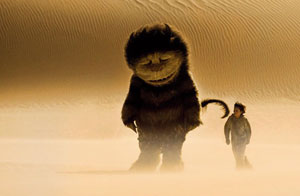
There's a sadness and a beauty in the way Max manages his loneliness by using his imagination. He takes himself to a place we've all visited, where our greatest fear is being eaten by a monster, and our greatest defence is becoming bigger than any other person, so big that we become confidant and advisor to monsters.

When Maurice Sendak's book was published in 1964, a dumpster bin-sized amount of literature spewed out, upchucking explanations for the monsters as oversized, morality play characters, each representing a basic human emotion. In Jonze's film version, monster Carol (James Gandolfini) could easily be read as a transvestite with an insatiable sexual hunger, hence his voracious appetite for past kings. The asexuality of these creatures could make for a Freudian buffet of psychoanalytic opinion. The book has been said to demarcate the fine line between fear, comfort and some deep-seated desire to gobble up your own mother. But spare me, please. Enough is enough. This child of divorce isn't interested in living a life obsessively psychoanalyzed.

Jonze has no patience for this either, which is why I left the movie theatre surprised, but satisfied. The film reminded me that loneliness is too easily made into monster, that loneliness also has the power to conjure magic for a child who lives inside excellent forts, and who possesses a storybook that makes her the King of the Wild Things.  [Tyee]

14  Comments:

  • sludge

    16-11-2009

    It sounds like divorce isn't

    It sounds like divorce isn't so bad for kids after all.

  • PatrickMcEvoyHalston

    17-11-2009

    Down with Freud: give me a razor, and /or some pills, please!

    re: "The film reminded me that loneliness is too easily made into monster, that loneliness also has the power to conjure magic for a child who lives inside excellent forts, and who possesses a storybook that makes her the King of the Wild Things."

    Loneliness / abandonment does other things, like make you create imaginary friends that talk to you when you're a child, then turn on you to harrague ever-after about how bad you are, how selfish you are, adolescence on (oh those wonderful persecutory alters, split personalities -- sorry, I meant wonderful spiritual animal friends!). Other things too: like make you adopt a posture of acquiescence, defeat, self-minimization ("a little in a bit of solitude"), in hopes that this will make you finally well suited to obtain the attention and love you missed out on. Psychoanalysis --or just intuitive, loving therapy -- can help out with this. But if you're down with Freud and up on romancing deprivation and cruelty ("I was abandoned; but this turned out to be a good thing!--thanks, mom!"), I hope at least you accomplish little when people like you turn on progressives who aren't so keen on making isolation and deprivation seem grounds for the imaginative life: who see it instead as the source of becoming demon-haunted, schizoid, self-lacerating -- fucked-up.

    (Great post, Patrick! Freud has too long been neglected!)

  • morechatter

    17-11-2009

    There is a monster in my bed

    As the sweet little girls crys out and no one hears as mommy was told if she continued to try to protect her little 3 year old from unwanted sexual advances she was going to loose her all together.
    She is now 4 and heavily masturbates as the wee one talks of Daddy playing with her privates and acts out in the usual way for children who are sexually abused. What do the courts and government have to say about the little girls behavior? Apparently oversexed tots are the norm in BC so told to give little one privacy in her room to engage in masturbation. And its real hard to sit back but the courts tell mom if she pursuses her concerns the courts will turn wee one over to the abuser and mom will be out of the picture all together. It must be a very lonely place.

  • dorothy

    17-11-2009

    Ouch!

    "Other things too: like make you adopt a posture of acquiescence, defeat, self-minimization ("a little in a bit of solitude"), in hopes that this will make you finally well suited to obtain the attention and love you missed out on."

    OK, there is grief and pain, my friend, and I was talking about solitude as A CHOICE. As it happens, I am well familiar with the other scenario, too, from a person very close to me, and know exactly the life-long task it puts on one to mobilize just a little bit of trust and ability to take an emotional risk.

    It is, just like some time ago, I think, very curageous of you to speak up, and so this is is not a crossing of any kind of sharp swords. I wish you all the best and would never presume to prescribe anything for someone else, as that would be hugely presumptuous. You did humble me in regard to how good paretns I were privileged to be in care of, and reminded me, maybe in a timely way, that this cannot be taken for granted.

    Dammit to Hel and back again, it shouldn't be that way!

  • PatrickMcEvoyHalston

    17-11-2009

    Attendance

    Appears as if I was quoting you, Dorothy, but for some reason I actually thought I was quoting the article: I read the article and the responses, and my guess is that your "a little in a bit of solitude" well enough captured the feel of, the circumlocation one feels/experiences within, the piece, that I inadvertently quoted you.

    In any event, I hear you, and like having you call me friend.

    There is a myth out there we are all to ready to cooperate with, even though it helps fascilitate a great evil--a block to social improvement, to living standards--and that is that creativity is born out of "seeing both the good and the bad in life," in knowing bare cupboards, the uncertain meal-ticket--real want. I hold this as entirely false, and that imagination is in fact kindled by being well attended to by supportive people, who make you feel secure enough to venture out, who are there for you when you want to return, and delight in the back-and-forth you see when loving people share adventures with one another, when they spur each other one. Every sad artist had more self-esteem than his/her breathren--and in that s/he was sort of lonely, but comparatively, very well fueled.

    We tend to focus on the cruelty, on the isolation, but the story is in the attendance, in the love. Always.

  • VivianLea Doubt

    18-11-2009

    those were both great posts...

    Patrick, thank you.

    A conversation with a very close friend has sparked a lot of thinking for me...rightly or wrongly, she iterated that many people find my joy suspicious.I think there is a grain of truth in what she says - I enjoy no obvious succeses such as wealth or fame (or even the simple middle-class 'security'of being able to pay the bills) yet I am deeply happy with life. I attribute this to an expectation of joy that was instilled by loving and attentive parents...

    It might be called hope, I suppose...and yet others might say naivete. Still...I thank you for pointing out that we must always focus on the love...

    Dorothy, I too enjoy solitude and seek it out, which perhaps makes us rare. But loneliness seems to be all too common, and very heart-wrenching, and to be avoided.

  • foobar

    19-11-2009

    naive

    And here I thought the book was about helping kids get through that part of their lives where they start to dream and have nightmares and wake up at night imagining monsters under their beds, and being able to say "be still" and stare without blinking calms them down and lets them go back to sleep.

    That's worked pretty well for my kids. I never imagined it was really all about divorce and loneliness and sexual abuse. Who knew?

  • RobleyBlake

    19-11-2009

    Living With Mom, Spending Time With Dad

    Divorce can be extremely traumatic to families, especially children. Living With Mom, Spending Time With Dad takes us through a myriad of emotions that two children, Stephen and Alex, experience through this tumultuous period. Young Alex especially gives an extremely candid and honest account of the day-to-day trauma, the hostility and at times the many poignant memories that he has. Living with Mom, Spending Time with Dad also addresses the concerns and anguish of being torn between two parents. Throughout the story there is that underlying hope that everything will turn out alright and everyone will be back in their original comfort zone.

  • The discussion for this story is closed. No more comments can be added.