Life

Fidel Don't Surf

But some Cubans do, so I brought a nine-foot gift.

By Grant Shilling, 19 Feb 2008, TheTyee.ca

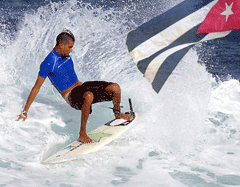
Umberto Rodriguez surfing with Cuban flag.

Surfista? Si! Courtesy Havana Surf.

Canadians who go to Cuba often pack something to help out the locals. Me? I decided to bring my beloved Muffs surfboard as a gift.

In Havana, there are about 30 surfers, a small but highly dedicated community. But surfboards in Cuba are extremely difficult to come by. Many surfers share one board, and you can't find any for rent or for sale in the country. So how do surfers there get boards? Sometimes by scavenging old refrigerators for their foam cores, and building from there. Other times visiting surfers like me leave our boards behind, often at the boatyards near the Marina Hemmingway Wharf.

Boarding issues

My Muffs is a longboard built sometime in the late '70s and named after an all girl punk band. The board is old and heavy with fat rails and a lot of meat in it and could use some repair but in a country choc-o-bloc with pre-revolution Chevys and Fords, repairing the board should be a snap. The Muffs was a popular loaner in Tofino, originating with Ralph Tieleman's generosity and passing between many surfers including the artist Aaron Marshall who painted the distinct musical note and Muffs logo on the board as Ralph's message-on-a-surfboard to Kim of the Muffs. Or as Muffs rider Neil McQueen Facebooked from New Zealand; "If boards could talk!"

Getting the Muffs board to Cuba was my first concern. The maximum length of board that Air Canada allows is 6'8" (part of a global war on longboards) and The Muffs board is 9'6" and as I mentioned, weighs a lot. Although I was flying a charter and had made pre-arrangements, I was still nervous that once we got to the airport there would be complications.

At check-in, the Air Transat attendant asked me, "Is this a windsurf board?" And that was about it.

Surf, not war

I realized my concerns were nothing compared to those faced by my inspiration for this gesture, Dorian Paskowitz. "Doc" Paskowitz, an 86-year-old Jewish surfing guru based in California, is considered the father of Israeli surfing (as well as nine children many raised in a Winnebago by the sea). Paskowitz donated a dozen surfboards last year to Gaza's small surfing community, in a gesture he hoped would get Israelis and Palestinians riding for peace.

"God will surf with the devil if the waves are good," Paskowitz was quoted as saying. "When a surfer sees another surfer with a board, he can't help but say something that brings them together."

Inspired by his approach I have informally created the organization Boards Not Bombs (soon to be formalized, whatever that means.). I hope in the near future to take a Boards Not Bombs crew to the Middle East for another hit of peace (they could always use it). I have more faith in that than anything Bush could dream of accomplishing.

Breaking the ice

The first surfers I met while schlepping my board through the white-light-white-heat streets of Havana lived under the shadow of the monumental Russian embassy in the western section of Cuba known as Miramar. Sitting on the steps of a modernist two story apartment (think beach Bauhaus) were three young men. One in Rip Curl shorts.

"Surfista?"

"Si. Si."

Yo tengo uno tabla de surf."

"Si, Si."

Sitting on the steps were:

Daniel, 30, a computer programmer and a self-described "surf pioneer' in Cuba who began surfing the Miramar coast as a mere "chico." For a board he used his desktop from school. He next made a board out of the insulation from refrigerators and heavy boat fiberglass scrounged from the Marina Hemingway Wharf

Angel, 38, a cook at a four star hotel who took a lot of ribbing for his happy cooking belly and fear of reefs.

David, 27, a full-time percussionist and surf bum. "Surfing Libre! Music libre!" We chuckled and agreed how the two are similar in spirit -- especially true in a country alive with music on every corner and calle.

We chatted for a while in the Esperanto of surf slang, and then piled into Daniel's Lada to go to the beach and check the surf.

"You can surf in Canada?" asked Daniel on the way to the beach. "What do you have to do, break through the ice?"

I explained that five-millimetre wetsuits are necessary for surfing in the frigid water in wintertime.

"That be like surfing in a condom," said Daniel.

Flotsam and jetsam

We also found ourselves in the age-old surfing discussion of longboard versus short. As regards sex or surfing, we agreed: why not both?

During the months of December through early March, northeast trade winds deliver small, warm (20 C), surf-able swells (perfect for longboards) to the northeast shores of Cuba, including areas in and around Havana.

A gnarly, sharp, shallow coral reef made things a bit treacherous but contributed to a well-shaped wave. The shore was strewn with water bottles, condoms and blue, bloated man of wars. The detritus contrasted sharply with the inviting azure colours of the Caribbean tossing onto the shore.

'Fidel doesn't care'

As we checked the surf, which was too flat that day, I couldn't help but notice the number of joggers and exercisers in the parks, beaches and streets of Cuba.

I asked my companions where surfing fit in to this scheme.

"Fidel doesn't care about surfing," Daniel says with a shrug. "Because it isn't an Olympic sport."

Is there room in a proletariat revolution for a surf bum?

Most definitely. "As long as there are waves."

Daniel told me there are no surf contests in Cuba but pointed out that Cuban-American surfer Cory Lopez came over a few years ago for a first-of-its kind surf expedition.

"He rips."

We surfed two days of mushy pinners - with the Muffs boards and a fishtail that one of the guys borrowed from a friend. And then I left my Muffs board behind with my three amigos. They hustled it into the house in broad daylight (its what the Cubans seemed to do with gifts)

Safe sex bakery

No doubt there are deep flaws in aspects of the Cuban political system. For me the main thing the average Cuban person seems to be missing is freedom to travel. The spirit of the place is very free.

Speaking of which, we also brought 300 hundred condoms, and delivered them to Café Salud in Downtown Havana, a youth drop-in centre where issues of safe sex are discussed. We arrive in a taxi to the address, a bakery selling those extra frosty, very sweet and pink Cuban cakes.

A middle-aged woman doing a brisk trade with the cakes greets us.

"Café Salud?"

"Si?"

An overheated baker called out to her from the back.

"Café Salud?" we ask again, confused.

"Si?"

I opened the box of condoms, some of which are flavoured, to show the woman.

"Oh, si, si..."

We were relieved to learn that the bakery hosts the youth in their off-hours. We also gave the woman piles of sealed makeup and mascara, which she seemed especially pleased with.

Adios

Near the end of the trip, my six-year-old son left his beloved boogie board (it's got flames on it -- c'mon!) with some kids playing on the beach.

Yet, no matter what we brought to give to Cuba, it gave way more back.

Muchas gracias, Muffs. Muchas gracias, Cuba.

Related Tyee stories:

 [Tyee]

34  Comments:

Login or register to post comments

  • James Burns

    3 years ago

    Ironic the appearance of

    Ironic the appearance of this article about Cuba, given that Fidel announced his retirement today. I'll write more later. I'll also probably try calling my friends down there if the phone lines aren't jammed with ex-pats calling home.

    As a side note the comment above is spam, it has no place in this thread and should be removed.

  • bob the cat

    3 years ago

    Second that

    I`m surprised to see the Visible Justice comment still in place..especially the "link".
    Checked it out last night...its still here?

  • Geoff

    3 years ago

    Administrator

    The spam is gone.

    Thanks for the heads up.

    Geoff

  • Clawman

    3 years ago

    Fidel, travel to Cuba, and all that

    For the most part, I don't believe in injecting politics in the choices we make about tourism. But Cuba, with Fidel fading away, offers some opportunities for creative subversion.

    See
    http://web.mac.com/claude.adams/iWeb/SpyglassHill/Cuba%20Libre.html

  • Clawman

    3 years ago

    complete link

    Here's the end of the link:
    SpyglassHill/Cuba%20Libre.html

  • sherrysmith

    3 years ago

    Fidel don't surf

    Great article.
    I have never been to Cuba and have wanted to for many years. I wanted to go before things changed as my friends who go on a regular basis, love it and love the people.
    Being a musician also I have been told how great and how many good musicians live there. Thanks for your gift to someone who really appreciated it. I would like to contribute also in some way to the folks there.

  • James Burns

    3 years ago

    Cuba travel 1

    First off the top, the phone lines were jammed yesterday (too much family calling home). I briefly got a hold of some friends, but the connection kept cutting out, so we couldn't really talk. But on to other things, since the article above is on travel.

    Gawd, what a load of crap that National Post article Clawman links to is. But then again what could you expect of the National Post on Cuba.

    I've never had a problem bringing any kind of books, or magazines into Cuba. My very first trip in the '90s I brought a stack of magazines, including a year's worth of the New Yorker and Harper's, as well as a bunch of English lit that most American evangelicals would consider subversive. The only thing that might get you into trouble in Cuba would be porn. And even then it would only be confiscated and probably end up on the black market. The exception would, like pretty much everywhere, be child porn. I suspect that would land you in jail, but it rightfully would pretty much anywhere.

    The problem Cubans have isn't really not being allowed to have certain reading material, it's a lack of availability of and a lack of money to buy reading material. Of course stuff calling for the overthrow of the government, or terrorist instructional material would get you in trouble. But that's not looked too kindly on here in Canada or the US either. God help you if you land in the US with an almanac and look remotely Middle Eastern. Freedom of speech and association is ever more an endangered right in this post 9/11 world.

    To give you a sense of entertainment available there, one of the most popular shows on Cuban TV is CSI. I assume it's been pirated, since as far as I know the US embargo includes TV shows. And you can see foreign movies in the cinemas, including "The Lives of Others", which was sold out for it's whole run. The quality of Cuban TV news is far less propagandistic than American cable news, but it certainly could be better. Although a lot more of their news is coming via Telesur now.

    When there, I eat and stay with friends, because it's cheaper, the food is better, and because I get to avoid las yumas; a lot of latter are not fun to be around.
    (continued)

  • James Burns

    3 years ago

    Cuba travel 2

    I've never been to an all-inclusive resort, so I can't really comment on those. However, the licenses Cubans are required to have for casa particulars are foolishly onerous, as is the case for all small business. Things would work far better in Cuba if they allowed small business to flourish, provided it's reasonably (not onerously) regulated for health and safety.

    Don't buy art on the street. Most of it is tourist crap. If you want really good art you have to know people in the arts community, and they aren't hard to find if you are smart enough to take oh say take Spanish lessons at Havana University (unlike the writer's recommendation), because you have the opportunity to meet Cuban students and professors who are a part of that community. However, any art shipped out of Cuba requires approval paper work, or it won't be able to leave with you. For that you also need good contacts, although the artist will usually know how to get that done.

    Cuba is very safe in comparison to the rest of Latin America, but that doesn't mean you have a ticket to be a dumbass. Any tourist is vastly wealthier than all Cubans. Muggings do happen. Assault and murder are very rare, and from what I've heard, the only murders have been of sex tourists, or the victims of American terrorism.

    Paid guides could be a problem if they are non-government, because every place they take you to that is non-government will be required to pay them a commission. So they get paid twice: the daily rate you pay them directly, and the kickback they get for bringing customers, which you also pay in increased prices.

    I know Havana well enough to get around on my own most of the time. But I'm often in the company of friends, and they are very protective of me. Little pisses them off more than a Cuban trying to rip me off. Cubans often aren't shy about getting into an argument. I do tend to treat my friends to things while I'm there, but if I do it too much they get embarrassed and a little morose over the fact they have so little.

    Cuba is in many ways a closed society, but it is far less likely to change unless the US stops the embargo, and stops supporting terrorism, particularly through the hardline Cuban-American mafia. Cubans know perfectly well that if they let the Americans in under American terms they will simply be slaves to American corporations, and no Cuban in Cuba I've talked to, not even those who are rabidly anti-Castro, wants that.

  • Clawman

    3 years ago

    Access to information

    James, the crapulous NatPost article (which I wrote BTW) doesn't say there are restrictions on reading material tourists are allowed to bring in. It does say that Cubans themselves have such limited access to books, especially those with an anti-totalitarian bent, that when I showed Cuban friends paperback copies of Solzhenitsyn and Orwell, they were astonished . . . Fidel is a colorful guy, but he's paternalistic as hell, and he sees subversion in almost everything, including what we see as mainstream literature.

    By the way, I don't believe in the American embargo, and I don't believe citizens in a democratic society should be instructed by their governments where we may and may not travel, but I DO believe that most of the tourists heading for Veradero should think twice about the system that their dollars are supporting. Far less "trickles down" into the population than they imagine. That's why I made my pitch for "subversive" tourism--strategic spending. For example, taking Spanish lessons privately, rather than the state institutions. Spend the money where it can really do some good . . .

  • James Burns

    3 years ago

    The only time I've been to

    The only time I've been to Varadero was with Cuban friends. There are plenty of beaches there Cubans can go to, as well as a tiny amusement park. To get there from Havana, we took an old bus. It was packed with other Cubans. A number of Cubans had portable DVD players, and they spent a good part of the drive there and back watching pirated music videos.

    I completely believe in supporting the non-government business sector in Cuba as much as possible. It's the primary reason why I stay away from the tourist stuff. The other major reason is that I tend to find the tourists often loathsome.

    Where literature is concerned, I can only relate my experience, which has been totally non-problematic. Although I've only been going to the island since well after the political thaw in the late '80s early '90s.

    You're utterly wrong in thinking that average Cubans don't benefit from "the system". One of the biggest problems in Cuba, where "the system" is concerned, is theft. Theft occurs on a massive scale. Theft is how the black market in Cuba functions, and without it the people in Cuba wouldn't get by. Everyone complains about it, and just about everyone does it. On the other hand all that theft weakens the system to an incredible degree, and makes it next to impossible to meet expectations. But then that tends to be the problem with centrally planned economies.

    Consumer goods and non-essential services really should be handled by a regulated (for health and safety and to prevent corporate monopoly) market. It's simply more effective. But, if you go to Cuba, and you want to spend money where it will really do some good, it's not as simple as thumbing your nose at government run institutions. Besides, you'd also miss the ballet, the opera, the museum of fine art, and a host of other places. In my opinion, if you go there you should try to make local connections with good people and from them get introduced to the country. There are plenty of Canada-Cuba solidarity organizations that can help you plug in to solid locals. I personally just got lucky my first trip, because I went to Havana University to find out about study there. That plugged me into the real local scene immediately, as the students I met essentially adopted me.

    But what bothers me most is how easy it is for people from outside Cuba to criticize the government, when the system there is a direct result of American belligerence. What needs to change first is that US belligerence. The effects of that belligerence are very real and debilitating for Cuba at all levels. I mean for christ sake the CIA helped sponsor a terrorist who was setting off bombs in Havana as recently as 1997. I just hope there really is a thaw in US-Cuba relations (and the best hope for that appears to be an Obama presidency).

  • Clawman

    3 years ago

    The system

    " . . .the system there is a direct result of American belligerence . . . "

    Wrong. Read some modern history. The system is s direct result of Castro's reckless embrace of Marxism. He allowed the Soviets to use the island as a potential launching pad for their missiles. In fact, if you watch "The Fog of War", you discover the true extent of Castro's lunacy. He was actually disappointed when Khruschev backed down and refused to launch a few missiles at US cities. He felt the Soviets were cowards. Was this enough cause for American belligerence, or not? . . .

    Years later, when the Cold War ended and the Soviets went home, the Cuban economy collapsed. True, the American embargo and their obsession with Castro didn't help matters, but no way was it the direct cause of Cuba's troubles.

  • G West

    3 years ago

    I always felt Soviet missiles

    I always felt a few Soviet missiles stationed off the coast of the US were a hell of good idea. Not all that different from the American ones in Turkey.

    Maybe if there had been some in Cuba the US wouldn't have acted like such a damn bully for a generation with respect to any Latin American country that wanted to address its own people's needs. Never much liked hegemony of any stripe mind you, and I find the US variety particularly offensive.

    You might want to remember that part of the settlement after the crisis in '62 involved the removal of those missiles in Turkey and a promise from the US to respect Cuba's sovereignty and not invade.

    Unfortunately, the Americans didn't realize that constructive engagement with Castro would have made a lot more sense than listening to a lot of Cuban expats in Florida.

    Castro was far from perfect but a quick look back at the social indices under Batista might help you understand why Fidel is still revered down there.

  • James Burns

    3 years ago

    Wrong

    Wrong. Read and watch something other than American historical propaganda. Cuba was a nation enslaved by American corporations and American organized crime. Cuba was a cesspit for the poor, with a white elite that lived off the exploitation of everyone else.

    The Americans took a hardline with Castro after the revolution. Their position was the same as any other colonial power, steeped in racism, viewing the local population as ill-kempt stupid lesser humans. So Castro embraced the Soviets as a hedge against renewed American imperialism. And it worked. The Cuban Missile Crisis has helped protect the Cubans from American attack since the treaty was signed.

    And your utter bullshit that Castro was disappointed Kruschev didn't launch some missiles at the US is simply an idiotic lie. In "The Fog of War" McNarmara said Castro told him he would have used nuclear weapons had the Americans invaded. What Castro was angry at the Soviets for was for removing the missiles and nuclear warheads, that the Soviets had forced on the Cubans, without even consulting them. Do you seriously make claim to being a journalist? It's exactly that kind of laziness that is what's wrong with so much of the crap that passes for reportage in our society.

    Your incredible naivety that the embargo is not the major source of economic trouble for Cuba flies in the face of even simple common sense. Tell me, just how robust would the Canadian economy be if it was completely cut off from the US? The Cuban economy collapsed with the collapse of its major trading partner. As would happen to the Canadian economy if the US economy collapsed. Cuba as dug itself out of that hole with very little help from the rest of the world, a hole that would have destroyed most other nations. Now with the help of Venezuela things have slowly started to improve.

    The Cuban government needs to change in a positive direction, but for that to really happen Americans must cease their endless belligerence. And ideologues like you need to get their facts straight, and stop relying on knee-jerk bias.

  • ME2

    3 years ago

    Re Toadying for the US

    I find it amusing that those Yanks who decry terrorism when it is visited upon them, are pretty damn quick to use it themselves, such as in Cuba, and bemoan the fact that a half-dozen CIA assassination attacks on Castro failed.

    With the streets of Havana filled with CIA agents, with pamphlets being constantly dropped by air on Cuban residents, with TV and Radio airwaves jammed with US propaganda, with Cuban exiles constantly lobbying for an invasion, with the US State Department constantly interfering in Cuba's foreign trade deals - and a whole lot more - it is little wonder that political freedom is scarce in Cuba.

    And then take a look at the tremendous loss of freedoms the US has justified with just ONE incident, 9-11, and also with the War Against Drugs.

    At is little wonder, and in this issue in particular, that toadies for the US receive short shrift on Tyee threads.

  • Clawman

    3 years ago

    Castro and missiles

    In "The Fog of War," McNamara says he met Castro in 1992. They talked about the missile crisis. Castro said he wanted the Russians to give him the power to launch the missiles against US targets. McNamara, shocked, asked Castro if he realized this would result in the utter destruction of Cuba. Castro replied yes, he was okay with that.

    Enlightened leadership?

    One more bit of toadying: Cubans may indeed "revere" Castro for his anti-American machismo, but I've met enough Cubans to know that, if they had the right, and the means, to leave the island for the US or Canada, they would do so, in great numbers, and with little hesitation, despite Cuba's "model" health and education system.

  • James Burns

    3 years ago

    Clawman, go back and watch

    Clawman, go back and watch "The Fog of War" with the mantra: details matter. Also bear in mind it is a piece of hagiography. McNamara is a war criminal. His book and the movie are an attempt at redemption for his crimes. The notion that Castro wanted to launch a preemptive nuclear attack is utter nonsense. If he were really that crazy, there is no way he would have lasted as long as he has. I don't agree with a hell of a lot of what he's done, but he's both strategically and tactically brilliant when it comes to politics.

    Of course Cubans would leave the island in great numbers (to Canada not quite so much, because they all hate cold). That's true of people in every third world country. Cubans believe in the American myth, which is understandable given their exposure to "las yumas" is seeing the well-off and wealthy who can afford to vacation in Cuba. They don't experience the downside. They don't see the poverty. Materially they would almost certainly be better off, but they would likely end up with McJobs, unless they are young enough and have family already here who are wealthy enough to help put them through a local university.

    Without the embargo, and with the ability to have a small business that isn't intentionally throttled by foolish bureaucracy, there would be vastly fewer Cubans who would want to leave.

  • Clawman

    3 years ago

    talk to them

    James, to call The Fog hagiography is to miss the point entirely, and to insult a filmmaker, Errol Morris, who has made a career of puncturing pretense. It's McNamara's apologia--what he learned from his mistakes. Watch it again.

    Do you really believe madness is an obstacle to longevity in leadership? Think Caeucescu. Think Stalin. Think Kim Jong-Il . . . the list goes on. Cuba has more natural wealth than any country its size in the hemisphere, yet it's people are poor, and Castro has been in charge for 50 years. If you don't see any cause-and-effect here, if you think it's all the fault of the Americans, then you've parked your critical thinking somewhere out of reach.

    As for Cubans and their life choices, I think it's paternalistic as hell to assume that those who fled to the US (including, by the way, members of Castro's immediate family) have somehow been bamboozled by the American "myth." Ask them. They've seen life on both sides. They see Castro as "tactically brilliant" only in the sense that he's managed to survive for so long, at great cost to Cubanos. And certainly not for his benevolent leadership.

  • Clawman

    3 years ago

    talk to them

    James, to call The Fog hagiography is to miss the point entirely, and to insult a filmmaker, Errol Morris, who has made a career of puncturing pretense. It's McNamara's apologia--what he learned from his mistakes. Watch it again.

    Do you really believe madness is an obstacle to longevity in leadership? Think Caeucescu. Think Stalin. Think Kim Jong-Il . . . the list goes on. Cuba has more natural wealth than any country its size in the hemisphere, yet it's people are poor, and Castro has been in charge for 50 years. If you don't see any cause-and-effect here, if you think it's all the fault of the Americans, then you've parked your critical thinking somewhere out of reach.

    As for Cubans and their life choices, I think it's paternalistic as hell to assume that those who fled to the US (including, by the way, members of Castro's immediate family) have somehow been bamboozled by the American "myth." Ask them. They've seen life on both sides. They see Castro as "tactically brilliant" only in the sense that he's managed to survive for so long, at great cost to Cubanos. And certainly not for his benevolent leadership.

  • James Burns

    3 years ago

    blah, blah, blaaaaaaah

    Quote:
    Do you really believe madness is an obstacle to longevity in leadership?

    Nope, W got re-elected. But even he hasn't tried preemptive nuclear war... at least not yet. All American presidents have far more innocent blood on their hands than Castro. I can understand why Americans and right-wing ideologues like you want to demonize Castro to the point of fantasy, it makes you and your cherished leaders look good in comparison, but you're really only fooling yourself.

    Quote:
    Cuba has more natural wealth than any country its size...

    Clawman, what the hell about a total US embargo don't you understand? You could have all the resources in the world and still be dirt poor if you had no one, or only a highly restricted market to sell to. The Americans don't just harass Cuba on trade, they harass any corporation that does business in Cuba that also wants to do business in the US. Who do you think most people will choose?

    Quote:
    I think it's paternalistic as hell to assume that those who fled to the US (including, by the way, members of Castro's immediate family) have somehow been bamboozled by the American "myth."

    I didn't say that. If you're going to resort to intentionally mis-paraphrasing what I wrote, I don't see what more we have to debate. It's a tactic only those with weak arguments use. Please try to respond at least honestly to my points.

    I clearly said not just Cubans but practically everyone from third world countries believe in the American myth. I said that were the embargo lifted, and small business allowed to flourish not nearly as many Cubans would want to leave. I said nothing about Cuban-Americans.

    I've talked to many, many Cubans. I know just how much some of them hate Castro. I also know just how much some of them love him. Your arguments aren't just simplistic, they are steeped in American propaganda, which is unfortunate. It makes me realize you went to Cuba with a set of preconceptions, and looked only for those things that confirmed them. To bad for you. Wallow in your ignorance. It's a very American thing to do.

  • Clawman

    3 years ago

    blah . . .

    James, try a little anger management. Wise men converse. Others rant.

  • G West

    3 years ago

    btw Clawman

    It may be a rant clawman - it also has the advantage of being right.

    As for the intensity of the American embargo, pls consult the campaign they've mounted against Sherritt Gordon - a Canadian company - and one of the few businesses with the balls to actually fight back against American hegemony.

    The fact that Cuba didn't just self-destruct after 1990 is a testimony to the determination, grit and dedication of the Cuban people - it certainly owes nothing to the good will, good wishes, or good sense of the American position.

    As for Fidel, try reading some of his published work - I think you'll find it more intellectual than anything George Bush (father or son) ever penned.

  • Clawman

    3 years ago

    Right

    Take a closer look. While showing the "balls to actually fight back against American hegemony," companies like Sherritt actually enter a very cozy corporate relationship with Cuba's selfless rulers. As I learned when I did some reporting there in the 1990s, the companies pay the government the equivalent of the Cuban workers wages (at pay rates equivalent to those of workers in Canada) and the Cuban government pays the workers in local currency (at pay rates equivalent to those in Cuba) and skims the rest. Isn't capitalism wonderful?

    Maybe we can dispense with all these good-guy, bad-guy dichotomies, and acknowledge that it's all a power/profit/hegemony game, for Sherritt, for Castro, for the Americans. And its the average Cubans who are the losers. You talk about determination, grit and dedication of the Cuban people. In my visits there I found a quiet anger and a very palpable fear.

    Just one example: a doctorate-level woman who would qualify as a full professor in a Canadian university, is forced to give private English lessons to survive. And she emails me in coded language, because she's terrified that the security people are watching and reading. Paranoid? Maybe. But I can't presume that. She lives there. I don't. (And she doesn't read Fidel's published work. She knows it for what it is.)

  • James Burns

    3 years ago

    Dispensation 1

    Ah so you want to dispense with the dichotomies you started and promulgated now that the lunacy of American policy has been pointed out?

    Nowhere did I suggest Castro, or the Cuban government are "good guys". They are nationalists who have done everything they can to preserve their power, which rightly or wrongly they see as vital to protecting the interests of the Cuban people. The only reason the Cuban government has a leg to stand on with that view has to do with the truly obscene belligerence of successive US Administrations, and because they do make substantial effort to redistribute wealth fairly in their society. But centrally planned economies are wrong headed and often riddled with corruption in my opinion, whether they are led by communist politburos or corporatist fascists.

    As for the deal with Sherrit the Cuban government takes the tack it does, again rightly or wrongly, because they want to prevent a select group of Cubans being vastly materially better off than everyone else. That material advantage still does happen to a certain extent with well placed government officials and those involved in tourism, but even they don't have it as good materially (I'm talking consumer goods here) as a lower middle class household in Canada. Socially, however, they tend to have it far better than people here in Canada. The social intelligence average Cubans display often amazes me.
    (continued)

  • James Burns

    3 years ago

    Dispensation 2

    (continued)
    In my visits there I've experienced a rather wide range of emotion from Cubans, rarely have I had more fun in the company of others. They certainly are not drowning in fear and anger. Far more common is a kind of melancholy due to the fact that they feel stuck between the rock of US belligerence, and the hard line of their government. There is no doubt life is materially hard in Cuba. And there is far too much political repression, due directly to the American threat. I say that every time I talk about the place. But I place most of the blame on the US, because it is only because of their belligerence that the communists, and Castro in particular, has maintained such an iron fisted grip on power. If that belligerence evaporated, either the current Cuban government would change things positively, or Cubans would change their government.

    Cubans culturally are just far too outgoing, argumentative, and resourceful to put up with what they currently have if they really believed there were better alternatives. They are fiercely nationalistic. Not a single Cuban I've talked to, no matter how much they disliked their government, believed the US government had their interests in mind. Not one. They all fear what the American government would do in Cuba more than their own. That's particularly true with the Bush Administration. Given the American track record in Latin America, I think they have an excellent point. But I also have no doubt that if the US government lifted the embargo, and engaged in positive negotiation, things would start to change immediately in Cuba. And really, it's in the best interests of the US that Cuba have a peaceful transition to being a more open society, to say nothing for Cubans themselves.

  • G West

    3 years ago

    Still not willing to actually admit

    Still not willing to admit that the real problem here - especially since 1989 - is the USA.

    It seems pretty obvious to me that it is only the political lump of expats in Florida (and pure hidebound stubbornness) that have prevented the US government from engaging with the Cubans on the island in a way that would have benefited both parties.

    How is it rational for the US to engage (and in fact become China's largest creditor) with a regime that is (arguably) far more brutal and intractable than Castro’s at the same time it demonizes and makes every possible effort to sabotage the Caribbean nation?

    It can only be some kind of collective insanity and a naive desire to turn back the clock - no matter how you slice it.

  • G West

    3 years ago

    And furthermore,

    I think it's also only fair to not the following Associated Press report of November 7, 2007

    UN praises Cuba's ability to feed people

    By Will Weissert

    Havana - A U.N. food expert hailed Cuba as a world model in feeding its population, some 18 years after the collapse of the Soviet Bloc ravaged the island's economy and sparked widespread hunger.

    Jean Ziegler, who has been the United Nations' independent investigator on "the right to food" since 2000, spent 11 days in Cuba on a fact-finding mission, meeting with top officials and chatting up farmers, state managers and ordinary Cubans waiting in line for food allotted by ration cards.

    "We haven't seen even one malnourished person" - a rare feat in much of poverty-stricken Latin America, Ziegler said Tuesday. "The right to being fed is the priority, without a doubt."

    Cuba is one of 32 countries that include the "right to food" in their constitutions, and fewer still - including Brazil, Latin America's largest economy - meet pledges to provide food to all their citizens, he said.

    Ziegler, who visited two prisons in Havana to ask inmates about their daily diets, did not address human rights concerns over the arbitrary imprisonment and alleged abuse of political prisoners and critics of the island's one-party government.

    Despite a 46-year U.S. embargo against the communist-run island, Cuba has found ways to ensure its population does not go hungry, Ziegler said. "Cuba always invents an answer," he noted.

    [emphasis mine]

  • G West

    3 years ago

    errata

    that's 'note' in the first sentence above, not 'not'...

  • jovenclub

    3 years ago

    on Cuba and tourism

    First, Grant, thanks for a nice story of your Cuba surfing experience. I always love hearing positive stories about Canadians and Cubans.

    Second, I cringe every time I see a non-Cuban like Claude pontificate in the National Pest about Cuban matters. I remember an article from a couple of years ago, also in the NP, in which the first-time visitor (but apparently sufficiently qualified to write a scathing article) told us about the "poor woman who collected the bones off of his plate in a downtown café, to feed her starving family." What this idiot didn't realize is that Cuba a couple of weeks earlier had banned the import of meat-based pet foods due to contamination fears, and Cuban workers in diplomats' homes were sent out to collect anything the pets would eat. Damned ignorance turned into Northern-media-"fact".

    As for Claude's NP article... sigh... is there a limit to the lengths of these comments? It would take me all day to deal with the ethnocentric distortions. Let me simply address the issue of Tourism.

    Although I've been working / researching Cuba for a decade and a half, spending time there at least once a year, and personally avoiding the tourist resorts, I have no problem with recommending Canadians make use of the hotels and beaches of Varadero, etc. Unlike every other example of mass tourism development in the Developing World, Cuba's foreign investment scheme was brilliantly implemented, giving the Cuban State a 51% stake in 99% of those ventures, which enabled the country to rapidly build up an infrastructure, while maintaining control of the operation and generating income that kept the state functioning. Profits from tourism support the extensive safety net of education, health, services, etc.

  • jovenclub

    3 years ago

    part 2

    With the completion of these 15- and 20-year agreements, the infrastructure now reverts 100% to Cuban ownership (after the foreign investor has realized a health profit on that investment). Some of the hotel management deals have been renegotiated and foreign firms continue to lend expertise to Cuba in this vital sector. But the money generated keeps Cuban children fed, educated, healthy and with a secure future.

    The "tourism apartheid" about which everyone rags on Cuba is ridiculously hypocritical. Locals being barred from hotels is nothing new in the tourism models of the world, as tourism operators seek to "protect" their guests from locals who are looking for contact with tourists for financial gain. This is an unfortunate reality that tourism has also brought to Cuba, and one which the authorities have struggled with.

    Remember prostitition? In the early years of the 1990s economic crisis, prostitution, which had disappeared from Cuba for over 30 years since women now had other, dignified opportunities within the Revolution, suddenly made a comeback as the embargo compounded by the Soviet trade ties disappearing devastated the Cuban economy. What happened in the U.S. press?

    "Fidel is selling Cuban women to prop up his regime!" they screamed.

    It took a year or two of difficult discussions among the Cuban politicians, Federation of Cuban Women, and other mass organizations to come up with a response to prostitution that would not criminalize women (as we do in North America), but attempt to give them better education and employment possibilities.

    So prostitutes were arrested and placed in these programs. What was the U.S. media response?

    "Fidel is Repressing Cuban Women!"

    So you see, nothing Cuba does is ever good enough - it is always held to a higher standard than any other nation on earth.

    Those who go to Cuba without taking the time to learn about Cuban reality - and that includes the context in which everything happens - inevitably find exactly what they thought they'd find. "Repression", "Sadness", "No Hope". Heck, I can find that in any barrio in Canada.

    My experiences with Cubans have been somewhat different. I've been fortunate, through my research and personal connections, to meet people who are not out there looking to meet tourists. These are people who go to work every day, who face the challenges of an embargoed (but rapidly growing) economy, and who know there are problems but are working to fix them, without jumping on the bandwagon of the so-called "dissidents" and their good pals at the U.S. interests' section.

    www.nscuba.org

  • alive

    3 years ago

    good comment

    jovenclub,
    thanks for your comments here, it is good to hear from a person who actually has taken the time to learn about things.
    Where can a person get more "real" information about Cuba?
    I am ready to ditch this country and looking for a society that cares for its citizens; so far Cuba sound like it?

  • G West

    3 years ago

    Thanks jovenclub

    Haven't seen you posting here before - but I'd be glad to see you back anytime.

    Cheers.

    alive: don't give up on this place quite yet my friend - there's work to do.

  • G West

    3 years ago

    And since we're all talking about Fidel

    Maybe we should recall that he's still around; and kicking - and writing for that matter.

    Here's the latest:

    http://www.cuba.cu/gobierno/discursos/2008/ing/f220208i

    Enjoy!

  • jovenclub

    3 years ago

    Good news about Cuba

    Thanks amigos. I'll try to keep myself to a paragraph or two in the future... ;)

    I found this site, and story, via my daily Google News search on Cuba. The island is the focus of my PhD research on Human Development (as per the UNDP's Human Development Index), and my past research on Cuban informatics (hence the "Joven Club" moniker, short for the Joven Club de Computación e Informática", the island-wide network of some 600 community-accessible centres for computer training, email, web design, etc. See http://www.jovenclub.cu).

    As for good sources of info on Cuba.... the problem is, many of us who have access to it have no time to manage websites. Nelson Valdes' fabulous email list, Cuba-L, is one of the best, but it's fee-based. There are countless Cuba solidarity groups throughout North America and the world, too. But if you have the patience, you can glean a lot of info from the major news services, so long as you know how to sift out the stuff that originates in Washington.

    Actually, it's more difficult than that, because journalists today, particularly those in the U.S., have grown up with the knowledge that Fidel is 'evil incarnate' - they begin their reporting from that basis, and never, ever, challenge their own conceptions. It's hard to be accurate when what you think you know is th e result of decades of Washington / Miami propaganda.

    While you're sitting on the beach, waiting for the waves to build, take along a couple of books. Both Peter Roman's "Cuba's Experience with Representative Democracy" and Isaac Saney's "Cuba: A Revolution in Motion" are well worth checking out. Roman's deals specifically with popular participation in government, and Saney provides a very good introduction to Cuba, including topics not covered by many other authors, including Cuba's legal system.

    Any of you Mac users can pop over to Canada's Mac community forum (www.ehmac.ca) and search for my (many) threads and debates (user: cubamark).

    Cheers, guys. I'm off to check out the rest of this site.

  • G West

    3 years ago

    Couldn't resist one last post on this subject

    The rumours of the demise of La Revolución Cubana are nothing new. Perhaps some readers might remember this OpEd piece from that well-known American authority Elliot Abrams - written in 1989:

    http://query.nytimes.com/gst/fullpage.html?res=950DE7DE163BF936A35754C0A96F948260&scp=2&sq=+%22Castro+Looks+to+the+Future+%97+Nervously%22&st=nyt

    Like Mark Twain, I suspect Fidel and the Cuban 'experiment' may be able to say that ... "(t)he rumors of my death have been greatly exaggerated" for some time to come...

    • The discussion for this story is closed. No more comments can be added.