Life

The Difficulty of Being German

The World Cup helps put decades of scorn in the past.

By Laurie Mercer, 29 Jun 2006, TheTyee.ca

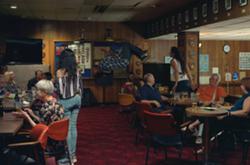
volksbar.png

In Koln's Volks bar. Laurie Mercer photo.

[Editor's note: Vancouver's Laurie Mercer, a former concert promoter and band manager who now sells vintage music on the internet at Coolforever, is travelling throughout Europe with his friend Gijs to watch soccer in bars where the home team is playing. He's posting stories about his trip on Gone Footie! This is an excerpt from the site.]

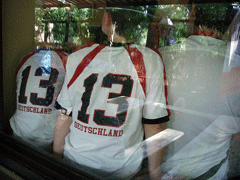
We arrive at the Volks bar in Koln by cab. Can this be the place? It looks absolutely deserted. As we walk closer, we can see children sitting in the window, backs to us, Deutchsland 13 on their jerseys. We walk into the bar and are immediately greeted by Alexandra.

Germany leads Sweden 2-0 with about 30 minutes to go. The bar is completely stuffed with people, and unlike most of the bars where we have seen games there are many children and elders in the crowd. Almost all of them have German colours somewhere on them -- painted on faces, emblazoned on jerseys, hats, flags. The excitement and energy is thrilling.

The game ends; the cheering is enthusiastic, the faces smiling. Compared to some of the celebrations I have seen on this tour, though, it is subdued. Alexandra seems relieved; later, chatting, she says that most German fans were very afraid of Sweden.

We walk a short distance to her home, where she has offered to put us up for the night. They have only recently moved from the Black Forest to Koln (more familiar in English as Cologne) and are renovating their new home. It is lovely, the results of their effort evident; the high ceilings and cheery paint give it a feeling of space and warmth.

She and her partner, Bertrand, have a merchandising company that provides t-shirts for touring bands and festivals. Bertrand is away at a festival; unfortunately I will not meet him on this visit. He has been helping my friends in the band NoMeansNo for years, so I was looking forward to seeing him. So it goes. Alexandra, charismatic, articulate, and friendly, makes us feel very welcome, delaying our attempts to take her to dinner by opening a delicious bottle of French rose I have never seen before.

Germans without cheap theatre

We loiter and finish the bottle while talking about football and the World Cup. I mention the comments of Fred, in Austria, that this is a team that young Germans can be proud of.

She agrees most certainly. "The World Cup is so important to Germans, so important to Europe," she says. "And this team is the right kind of team. Teams in the past, they would play defensive, wait till the end of the game and hope to get one goal. Plus," she adds, "always the theatrical." She makes a diving gesture with her hands, "that is not something that we, the young people, can be proud of. It may win, yes, but football is a great sport, and should be played with desire, and style. This team likes to attack, they are young players, not the old players; they want to win on skill, not like a machine.

"And it is important that we play this way, even if we do not win. Germany needs to show the world what we truly are: a liberal country, a progressive country, a vital part of Europe. Germany and France have supported the Euro and made it strong."

Gijs smiles: "And Holland."

"Yes, and Holland." She smiles too. "We want to show the world that we will accept all of them, make the World Cup a great event, make it so the best team will win the tournament." She grows more serious. "The World Cup is about more than the individual countries, or teams, it is a great world spirit, and Germany is trusted with that spirit. It is very, very important for Germany to carry that well. For the world to see that this Germany is a new place, to help change what people think of Germany.

"We are all trying hard, very hard, to earn, prove, that that is not the Germany of World War II any more. We are proving it through our acts, through what we are doing. It is so very, very important to us to make sure that nothing goes wrong, no terrorists attacks, yet still make it good for people to come here. We all know that many people do not like Germans, they just do not like Germans." She pauses.

'Many people do not like Germans'

I ask her how old she is, born in the '70s? '80s? "The '80s," she says. Even her parents were likely born after the war. What connection does she have with those well-documented, damnable atrocities of the past?

"Many people do not like Germans, but Germans work very hard to like everybody. We are taught in school to be very careful, to treat people with respect. And that is now why it is good for us to have the World Cup. People my age can now sing the national hymn, can be proud to be a German," she added. "For many years, to sing the national hymn, it would be without your heart, it would always stick in your throat a bit, there were always the questions and the shame and the doubt."

I had seen anti-German sentiment: in Amsterdam, when I looked for some Germans to watch their game against Costa Rica with last week; recently I had heard it, when a Dutch friend told me he often teased a German friend when discussing scores by answering '40-'45, the years of the German occupation of Holland.

Is there an expiry date for collective guilt? The butchery of the 20th century will never go away. That German hands were bloody is undeniable. Still, the list of other offenders is brutally long: Stalinist Russia, Pol Pot's Cambodia and Rwanda come to mind. The recent Erroll Morris documentary The Fog of War, probing the memories of American warlord Robert McNamara, made it clear that Nagasaki and Hiroshima may not have been inevitable or necessary.

But I have never met an American, or Russian, or Cambodian twenty-something struggling personally with responsibility for acts committed two generations ago.

Singing in the Volks park

Alexandra is still happily talking about football. "And this time, with this team," she says, "it is so great that Germans who have come here from other places -- from Turkey, from Africa -- are proud of German team, big fans and big supporters. In the past, often, many of the new Germans would not be involved, but this time, everyone, everyone is happy to follow the team, happy to be German, happy to sing the national hymn."

We leave, the wine finished, to walk through a local park -- the Volks Park -- to a pasta bar, where we can watch the first half of the Argentina-Mexico game. The park is beautiful, people cooking on barbecues and lolling about; a half-dozen beautiful swans dotting a small lake, the trees verdant and aromatic; it's very name -- the Folk's Park -- happily reminding me that the Vancouver Folk Music Festival will be waiting on my return to Vancouver.

I had come to Europe to observe the World Cup spirit, a nebulous pursuit of a celebratory collective consciousness; here was evidence of the power and importance of this spirit. The German nation, hosting the event, is using that positive power to make the tournament successful and flawless, as well as to apply healing energy to its dark image, to the still-visible wounds of their past.

And so it follows for Alexandra and many other Germans that their football team has to reflect these goals, that they play a clean, skilled game -- "without theatricals" -- and strive for an honest and true result. And with a team that plays that way, it's a happy time to be a German.

Recent Tyee stories and related links: Stan Persky writes about Germany's features in Right Now, Berlin Is a Kick. Laurie Mercer writes about a futile search for German soccer fans in Amsterdamned and finding The Most Happy Drunks in My Life in Koln. Mercer's previous Tyee dispatch was Looking for Italy, Finding Ghana.  [Tyee]

11  Comments:

Login or register to post comments

  • rotlin

    5 years ago

    Comments on "The Difficulty of Being German"

    Blanket stereotyping is wrong. But there are specific characteristics that
    do have some basis in objective fact. Canadians enjoy ice hockey. Germans
    like drinking beer. Statistics on hockey ticket sales and beer sales figures support those observations.

    Germany today is not the same as it was 2 generations ago. Decades of guilt and shame over their Nazi history combined with being on the fault lines of the Cold War conflict have combined to make pacifism a widespread national characteristic.

    In 2002 during an election campaign Chancellor Gerhard Schroder's criticized the pending "military adventure" in Iraq and said that Germany would not participate nor "click their heels" to follow anyone's lead. His party narrowly won that election. Other factors such as the economy played a role in the election but opposition to the Iraq adventure was wide-spread and seen as a vote-getter.

    Despite not joining the "Coalition of the Willing" in Iraq there are German soldiers in the former Yugoslavia and in Northern Afghanistan. Military adventures involving aggression are frowned on but peacekeeping missions are grudgingly accepted as necessary. Which has obvious parallels to Canada and its
    military policies.

  • Kaz

    5 years ago

    A great article. I've recently spent a great deal of time with some German students while abroad, and it is troubling to me that people born in the 70's and 80's still seem to carry this burden. Nearly without exception, the Germans I have met have been exceptionally friendly and welcoming people, and I truly believe that it is a great thing if this World Cup does help them to take some pride in their own nationality.

  • freebear

    5 years ago

    Get over it!

    I grew up being called a Kraut and Nazi (I was born in Montreal, my parents were from Germany) and dealt with it like water off a duck's back (Would be called verbal bullying today!).

  • sthrendyle

    5 years ago

    i was just in germany, at the world cup, and can essentially attest to everything in this article, maybe even more. i will be honest - germany wasn't exactly ever on my 'must see' travel list before attending the WC (which i did pretty much on a whim, some of it inspired by the GER team's thrilling opening victory in Munich). i was hugely surprised - the places that i went to - Munich, Nuremburg, and an alpine town called Mittenwald - were absolutely fabulous places to visit.
    and though i don't speak nor read german, i also had this sense that - especially after living in the redneck 'heartland' of BC - that germany is simply an intellectually and socially superior country to canada. there are no less than FIVE daily newspapers in Munich. only one could be classified as a CanWest style tabloid. the main one - Die Welt - was chock a bloc with long, discursive articles that looked like New Yorker stories. a german told me that politics, industry, education, and health were the mainstays of these newspapers.
    German society - again, i'm speaking superficially, but the above article would confirm it - seems to have an intellectual rigour and appreciation not only of nature but arts and sciences (the techonolgical museums in Munich are truly amazing). the transit system in munich would simply blow your mind.
    material goods are simply built better, and built to last. think of the names - Mercedes, Porsche, Braun, etc. there is no idiotic ornamentation of pandering to consumer's lowest common denominator. the women - (ok, women, get ready to have your hackles raised) - didn't dress like they were channeling their inner slut. they (and the men) exuded taste, style, and class.
    i came away thinking about the hokey fucking UN ranking of the 'best' countries to live in, and what utter bullshit it is. there is SO much that we could learn and implement from the Germans that it isn't funny. and wouldn't YOU like those six weeks of holidays?
    you really come away thinking that Canada just mindlessly squanders opportunities in sucking up to Uncle Sam in terms of trade, culture, lifestyle, and
    after michael ballack, the brilliant footballer (formerly from east germany), the patron saint of the new Germany is likely, in fact, Goethe, whose aphorisms certainly point to aspiring to a higher plane of humanitarianism and philosophy than we are used to seeing. on leaving GER on monday, i even bought an adidas GER soccer jersey.
    Tyee readers - look east to the New Europe for inspiration on how a truly global society and economy work.
    and shake your head in dismay at the Harper government, wasting billions on the military...

  • Colin

    5 years ago

    Apparently the Brit fans drank the Germans out of beer, leaving the Germans bewildered as to how that could possibly happen. Wish Spike Milligan was around to comment on that moment.

  • Colin

    5 years ago

    Sthrendyle

    Read your comment on Harper and the military. Well the Germans were dam grateful we were there back in the 80’s, they opened up their homes and towns to us. I guess living 30 minutes by fighterbomber from the Iron curtain alters your thinking.

    So you think our guys should fly in old airplanes and drive old trucks with wheels that fall off? I guess Canadian soldiers aren’t worth anything to you?

  • homechunks

    5 years ago

    Regarding Germany, my gf spent two years there (one before university, one after). She is in regular contact with her friends over there, and we recently (fall 04) visited. Believe me, the phrase "the grass is greener on the other side" still applies. Sure, German society is orderly, pacifist (for the most part), and friendly, but there is an undercurrent of something (don't want to call it racism, but that's not far off - almost a class-ism with some ethnophobic tendencies) that is not too far below the surface. Just ask any of your "enlightened" German friends what they think of the Turks/Russians/whoever who emigrate to their country and take the jobs that no home-grown German will do...better yet, have a look at their unemployment numbers (high) and vacation time (unsustainable) and tell me if their quality of life isn't due for an adjustment...

  • Colin

    5 years ago

    Homechunks
    I remember a German lady in a MacDonalds in Freiberg commenting to me about how those nasty Turks let their kid run around in the restaurant, I pointed out to her that was the intent of McDonalds, she walked off in a huff.

    The only reason I wasted time in a MacDonald’s there was because of my girlfriend wanted to go there.

  • zalm

    5 years ago

    And living there is definitely not the same as visiting there. Sthrendyle, I enjoy visitng as much as you do for the same reasons and more. But living there, as my wife did for two years before we were married is another thing entirely. The undercurrent of orderliness manifests as a prying nosiness that would be intolerable here or nost other places in the world.

    When we stayed with relatives in Solingen, neighbours two doors away complained about the smell of the barbeque being on for two successive nights - according to unwritten custom one night a month is plenty, and they could have taken Reiner to court to enforce it too. However, the vegetarians next door didn't care.

    Regulation of minutiae, state-supported church, inefficient and overly-structured health care (albeit with more technology than in Canada), social streaming and classism all still run rampant there. And yes, if you want a plastic bag to carry your food home from the market in, it is still disparaging referred to as a "Turkish suitcase".

    No wonder when Germans break free of stricture and class, they do so with a veangance. The anarcho-punks next to my wife's cousin in Brandenburg put any such on Commercial Drive to shame in terms of lifestyle, dress and speech.

    It may be a long time before Germany recovers some measure of that innocent pride of place that Candians take for granted.

  • dorothy

    5 years ago

    I do not believe there are any specific 'german traits', just like 'swedish traits', 'English traits' etc., that cannot be readily explained by the history/geography of each people. My family has some Danes in it, and it can drive me absolutely mad, what in Denmark is termed 'false modesty', they have the British beaten by several lengths in the art of understatement. Likewise, Germans ostensibly wish for everyone to forget 'what happened back there', but there were, when I was young, still youngish German fathers, who would take their family up along the Danish westcoast, point out the ugly broken concrete remnants of the foreign intrusion, and, with no small measure of pride, tell their bright-eyed offspring that 'this was where granddad was in the 40's'. So, talk about innocence, there is more than one kind!
    We could choose to hiss and spit over these inherent traits, but, realizing they are simply results of history and evolution, we consider it more civilized these day to issue a quiet sigh, take a little pride in who we ourselves are, and give some goddamn grace to those who are not as high on the human ladder as we. He who can does, he who cannot makes himself obnoxious.

  • Gloomy

    5 years ago

    dorothy
    valid observation!
    There is also a trait amongst germans, to either be the ultimate rulers or the bootlicking servant!
    In everyday life, i have converted a few people from acting like a member of the masterrace, by simply outstaring them!
    The conversion is immediate, and absolute!
    They do not seem to know the middle ground where people are equal.
    I sincerely hope that the younger generation have learned a few things

    • No best comments selected by an editor for this story yet. To see all comments, click the All Comments tab, above.
    • The discussion for this story is closed. No more comments can be added.