



 SHARE:
Another voyage begins with another fleecing. It's becoming a tradition.
I had been warned about Shanghai taxi scams before my departure. These are not as dire as the traveler's traps of previous eras -- once upon a time to be "Shanghaied" meant to be abducted, either drunk or sleeping off a blow to the head, only to wake up on board a ship and destined for two years of deck-swabbing and conjugal visits with the bo'suns mate. Today, the typical penalty for an unwary Shanghai visitor is merely an exorbitant cab fare.
Look out for the fixed-price taxis, I was told. They are highway robbers. Get a metered taxi only -- the eventual price should be about 120 yuan, or approximately $17 Cdn.
Right. I followed the airport signs that said "Taxi," but emerged in what looked like a bus line. A tourist pointed me to the taxi area down the way, where a guy in a suit stood guard. He checked my destination and directed me to another spot. A man there asked my destination, took my bag and led me down some stairs to… a parking garage.
I shied. This felt wrong. "Meter taxi!" I protested. "Meter!"
"Yes, yes, meter taxi," my driver insisted. "Official taxi."
'Traffic was murder'
The car looked standard and was, in fact, meter-equipped. I got in uncertainly. Uncertainly shaded over into alarm when we emerged from the parkade and another man got into the cab. It was the official-looking guy from the airport who had told me where to stand to get a taxi. They were partners. I was beginning to think that excess charges would be the best-case scenario here.
"120 yuan to my hotel, right?" I asked wanly. The new passenger shook his head. "No, no -- that is from the other airport. There are two. This airport is further."
Traffic was murder. The meter, which started at a friendly 10 yuan, had somewhere along the way made an Olympian long jump to 250 yuan. Clearly, there are meters and then there are meters. The eventual price was 360 yuan, plus a few years of my life lost to this guy's Chinese NASCAR driving. Staff at my hotel confirmed that I paid three times the going rate. I was madder than Justice Gomery tied to a wet hen.
Untapped conservative votes
Speaking of whom…I cast my vote and left the country, thinking I was bidding a happy goodbye to all that. But unexpected election reminders are available here via local media. Almost the only English program on my TV is a series of Chinese lessons hosted by Canadian Mark Rowswell, a popular entertainment figure here, known as Dashan. Rowswell is the man who inadvertently succeeded in getting the Gomery Report into Chinese headlines last fall, when it emerged that some of that Canadian government money financed a Chinese TV special he'd done. Presumably, all China was as outraged as Stephen Harper -- hundreds of millions of Conservative votes lie here, untapped.
Meanwhile, the January 13 edition of the local English language paper, Shanghai Daily, featured a picture of Paul Martin sitting with a midget, who was dressed in a suit and tie. It looked like another attack ad -- a miniature Stephen Harper dwarfed by big Paul. But it turned out to be that CBC child reporter, nine-year-old Daniel Cook, interviewing the PM. Even in Shanghai, the Liberals look desperate.
Meanwhile, I'm doing all right here as long as I stay out of cabs and decline the kind offers of watch sellers. Occasionally, a lovely young woman will appear at my elbow and earnestly insist that she wants to practice her English with me. One way or another, it is the young lady and her accomplices who will end up charging for the lesson. I already paid the taxi driver for mine and have no desire for another. Thus I have taken to responding to the nice young women with a sprightly, "Ja! Sprechen zie Deutsch?"
Despite its colonial past, Shanghai is not Hong Kong -- English, while widely spoken, or at least attempted, is not nearly as pervasive here. Street signs are usually helpful, though. Yesterday on the campus of Tongji University, I saw a traffic sign that featured a silhouette of a tuba in a red circle with a slash through it. "No tuba or French horn playing" is, I believe, a standard traffic regulation. But in most jurisdictions, the law is merely assumed. Nice of local authorities to spell it out.
Shabby and ultra-modern
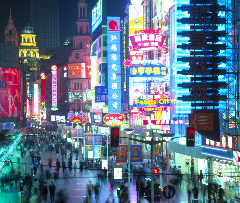
One feature Shanghai shares with Hong Kong is a waterfront promenade that looks across a band of water to an ultra-modern skyline, transformed at night with a razzle-dazzle display of flashing light. Also, like Hong Kong, in Shanghai contrasts face each other across the water. In Hong Kong, the Kowloon neighbourhood, with its older Chinese character, looks over at skyscraper-happy Hong Kong Island. In Shanghai, the contrast is even more pronounced, at least on the surface. West of the Huangpu River lies the famous Bund, a grand row of stately European structures long despised by Cultural Revolutionaries as decadent reminders of Shanghai's shameful colonial past. Somehow they have survived both ideology and development, though only just -- there was a move in the 90's to tear many of the buildings down for high-rises.
Across the Huangpu is the new Shanghai, started from scratch. Here, the only nod to tradition appears to be a salute to 1930's Buck Rogers-style sci-fi, courtesy of the signature Oriental Pearl TV Tower, a retro-futuristic structure of giant balls and tubes that plays the role of the Eiffel Tower in almost every Shanghai postcard. Miniature versions with their own coloured lighting are offered to you every few steps along the waterfront, along with the requisite Omega watches value priced at about seven bucks, and fluorescent wands, toy dogs and all manner of state-of-the-art crapola. It's fun for awhile.
Still, the real fun is in the streets behind my hotel in the Old City, where there are plenty of shabby little restaurants with Chinese-language-only menus and Chinese-language-only staff and where a foreign diner is forced to play charades, acting out "noodles with shrimp or maybe chicken or whatever's edible."
I hope boomtown Shanghai doesn't blow those little places off the grid.
When Steve Burgess isn't turning down 'watch sellers' he's observing culture for The Tyee. ![[Tyee]](/design-article.thetyee.ca/ui/img/yellowblob.png)











Tyee Commenting Guidelines
Comments that violate guidelines risk being deleted, and violations may result in a temporary or permanent user ban. Maintain the spirit of good conversation to stay in the discussion.
*Please note The Tyee is not a forum for spreading misinformation about COVID-19, denying its existence or minimizing its risk to public health.
Do:
Do not: