

 SHARE:
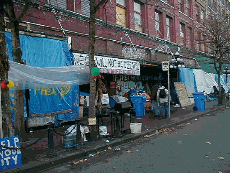
[Editor's note: Too often, the experiences of Downtown Eastside Vancouver are compressed into sound bites or stark images. This excerpt from a new book offers an opportunity to hear at length, and in complex detail from a once affluent woman who fled an abusive relationship and struggled to survive in BC's poorest neighbourhood.
Edited from interviews conducted in October 2001, March 2002, and November 2003, this is the first chapter of In Plain Sight: Reflections on Life in Downtown Eastside Vancouver, edited by Leslie A. Robertson and Dara Culhane. Culhane will read from the book at Word on the Street at the main branch of Vancouver Public Library on Sunday at 5 p.m., an event sponsored by The Tyee.]
EDITORS' INTRODUCTION
"Back and Forth and Forth and Back" begins with an incident of domestic violence and a woman's relocation to protect herself from further abuse by her partner. Pawz recounts leaving work, family, and familiar surroundings out of fear for her life. She chose not to include information about her early life and carefully edited other details that could identify her to her aggressor, thus showing how his power to intimidate her crosses boundaries of place; he is still able to silence her voice. Her narrative also evokes the question of why it is victims of violence (usually women and children) who are uprooted rather than the perpetrators of violence (usually male partners).
Pawz describes her early impressions of the Downtown Eastside-a place chosen because of its affordable rent and the possibility for anonymity. She speaks about the continuing resonance of violence that she confronted daily, her shock at the openness of drug use, and her negative encounters on the street. As time goes by, and she begins to listen to other people's stories, she identifies herself as a member of that community and seeks to contribute constructively to it. "Back and Forth and Forth and Back" was compiled from two interviews with the Health & Home Research Project and a follow-up interview in November 2003, at Pawz's request. It is the only story in this collection that retains the chronological sequence of the interviews. Perhaps more than any other narrator in this book, Pawz tells how, in their attempt to cope with poverty, people eventually accept conditions that they initially find shocking.
Back and Forth and Forth and Back
People have said to me, "I don't know how you don't have that fashionable white coat!" You know, the ones with the pockets in the back (laughing). It's because of all the things I've been through that have crossed over the line.
I had a child who passed away. I was almost murdered. I was raped. I've had all these bad things happen; yet I don't want to say I'm unhappy to be alive.
The nineties was a bad time for me. That's when my ex tried to kill me. The cop told me, "I have to get you out of town. Today." So they came to my house and we packed up whatever I could, whatever I had, and they snuck me out of town in the trunk of a car. The police relocated me to a safe house and I ended up moving to B.C. because my ex thought I would stay in [a different province].
I was starting over. Fresh.
I was in the safe house for two weeks. You have a certain period to decide where you want to go. I didn't want to stay where I was because he knew everybody that I knew. So I came here and didn't keep in contact with anybody.
I couldn't believe something like this had happened. I'd seen it on TV, but never in my wildest dreams did I actually think it would happen to me! I was in shock. I'd never had any kind of violent experience that I could remember. I had never been actually hit.
To this day, once in a while I'll be somewhere and I'll think that I've seen ---. And that fear comes over me-not fear but anxiety-and my heart starts racing.
I started thinking about things that I never thought about before-like retribution; I was planning it out in my mind. It started to scare me because I had never thought things like this (laughing). I went to a therapist, and she said to me, "What you are thinking is normal." As soon as she said that, I stopped thinking it because I realized that it was part of the process-the healing process. First it's shock, then it's pain, then it's anger, and then it's forgiveness. I found out that it wasn't me. I started thinking that maybe it was my fault, that I provoked it. I couldn't fathom the whole process, and still, to this day, when I think about it, I can't believe this happened to me.
I was in a transition house and one of the workers there, who was a counsellor, said, "You have to pick a job." I had to pick an industry where my ex wouldn't even think to look. I was going to do what I always did, but instead I decided to do something totally different.
I moved to the East End and started working for this auto-body company. I did my practicum and they asked if I would be interested in coming to work for them. I said, "Sure!"
But some weeks I might make major amounts of money and some weeks I might make nothing. I said, "I can't live on this!"
I told them, "I'm sorry, but I have to find another job," and I went to work at another company. It was good, but I have asthma, and being around all the dust and the fumes was giving me so many attacks, even though I wore my respirator religiously. I thought, maybe if I go on a part-time basis... But nobody hires part-time. So now I have to do something else.
It wasn't until I came down here (laughing) that I really had an awakening! Just the idea of Main and Hastings. Main and Hastings, with the cop shop right across the street (laughing). The amount of activity-they're so blatant and bold!
When I came here I was supposed to have a place with a friend, but they had already gotten somebody else, so I had nowhere to live. I needed a place quick and there was a hotel room that I saw. I ended up down at a place on ---. Of all the hotels it seemed like the best one-for a hotel or rooming house it was not bad. Not good, but not bad (laughing). I befriended the manager so that kind of helped a bit because he looked out for me. In the morning he would come and knock on my door and tell me that there's coffee in the office. He'd ask me, "Did you have any problems last night?"
One of the first nights that I was there, there was a knock on my door at eleven o'clock. I said, "Hello! Who is it?"
A guy says, "Oh, it's me. Open the door." I said, "Who is it?"
He goes, "You know-me," and he said his name. 23
I said, "I'm sorry, you've mistaken me for someone else."
He goes, "Just open the door!"
I said, "Come back in the daylight."
He said, "Just open the door."
I said, "Get the fuck away from my door!"
I didn't have a phone. I couldn't phone the police or anything, so I put chairs against the door. But it's not like in the movies where the chair props the door closed and it stays closed. The doorknob was here (gesturing high), and the chair's down here (gesturing low). It was just something to make me feel safe.
I told him, "I'm not opening the door. Get the fuck away!"
It went quiet for about fifteen minutes. Then all of a sudden-I don't know what happened; there was all this banging and yelling and you could hear wrestling, and then it went quiet. About half an hour later I opened my door and peeked out and there was blood everywhere. I don't mean like just little drops, blood everywhere! I shut my door and I just sat against it all night long because I couldn't sleep.
In the morning, as soon as it started getting daylight and I could hear the birds start chirping, one of my neighbours was out there with a mop, just starting to clean. I said, "Don't! I want the manager to see this." I went and knocked on the manager's door. So he came up. He wasn't too happy about me waking him up that early, but when he came out he says, "Who was it?"
"I don't know," I said.
There was blood from the bathroom, all the way out the hallway, down the stairs and out the door. We don't know who it was, still to this day. I said to the manager, "I can't live in a place like this!" So they changed the locks on the front door and everybody had to start buzzing the manager to get in from then on.
But there was still the state of the hallway. You had to tiptoe through the syringes to get to the bathroom. I told the woman who owned the hotel and she said, "Ah, the manager-he'll take care of you. He'll take care."
Well, he took all the rent money and split that night (laughing). Some people didn't get a receipt. They said, "Oh, I'll pick the receipt up tomorrow." All those people lost out on their rent because they didn't get a receipt there and then. They had to pay again. I had mine paid directly from social services, so they couldn't say anything. Thank God for that!
In that hotel there were too many drunks and they started getting violent. There was one guy that was getting violent with his girlfriend, and it was really affecting me-and not just on a conscious level; I was dreaming about it. I'd see a girl with black eyes, and she'd say, "That's it! He's outta here!" The next day she's making up with him. I thought, "It's a vicious circle."
I only went through it once. You know, my parents have been married for a long time and my dad never hit my mom. You just don't hit somebody. And, if somebody hits you, you don't go back for seconds! I believe that. You don't deserve that; nobody deserves that!
And to see somebody say, "Oh, he loves me. I did it. It's my fault." (Shaking her head)
I don't believe in that. I don't believe that to love somebody you have to hit them.
So I would say, "You don't have to tolerate it."
And other people in the hotel were, like, "Oh, mind your own business!"
"Well, you're fighting and you're arguing in the middle of the night waking everybody up. It becomes everybody's business!"
I said to the manager, "Something's got to be done about this!"
I was supposed to take over the manager's job, but I started volunteering down here. When I told the landlord that I was working, she thought that I had a job, so she gave the manager's job to somebody else. That would have been a great job, being the hotel manager. Free rent, free phone; you work nine to five. All you do is clean up and collect the rent. Well, I was cleaning up anyways because I can't stand the dirt. It worked out to twelve hundred bucks a month and I worked out my food to two hundred bucks a month, so a thousand bucks cash in the bank! Every month! That's twelve grand a year, and the job was given to somebody else!
I stayed at that hotel for five months, something like that, but I was homeless for six months after. I found out about this new place they were building. I was volunteering, and a housing advocate told me about it. I ended up living on people's floors because the housing project said that they were going to be completed and then they kept prolonging it and prolonging it. First it was an earthquake, then it was budgeting, and they kept saying, "Oh, next month," so I couldn't really get a place (sighing).
My friend said, "Okay, you can sleep at my place on the floor."
I was between three friends, two days at one place, two days at another place, two days at another place. I was living out of a suitcase. My friends were starting to get ... they'd say, "You said only a month!"
Two, three, four months go by and I was cleaning up everybody's place. I was buying my own food because I didn't have to pay rent, but my worker knew that I was only supposed to get support money. So I was cleaning three houses because everywhere I went I had to clean (laughing). Everywhere! My hands were getting sore, and where I was volunteering I was also cleaning, doing the floor. I was constantly on the go and I was losing all this weight. People were saying, "How come you're losing so much weight?"
"Well, I'm running around from place to place to place!" And I couldn't sleep-in anywhere! If I wasn't tired I had to just lay there because my friends had to sleep (laughing). It was chaotic. When I finally did get in to the new place, all I wanted to do was sleep, and do you think I could? I couldn't sleep! I couldn't sleep! I was so used to that routine. The new place, there was a lot of drugs in there, and a lot of prostitutes.
One day I'm standing outside. I was expecting a friend to come over but I forgot to give them my buzzer number. I'm waiting downstairs, and I didn't know which way they were going to come from. So I was turning- I was looking both ways-and this girl comes down and she says, "Are you buying one?" I forget the actual words, "Are you putting out a buy?"
I said, "Excuse me?"
"Are you putting out a buy?"
I was, like, "What are you talking about?"
She goes, "You know ... are you looking for a date?"
I said, "No. A friend's coming over."
She goes, "You're a prostitute right?" (Laughing)
I was, like, "Excuse me! I don't think so!"
She goes, "So you're putting out a buy then?"
I said, "What part of 'I'm not a prostitute' don't you understand?"
She just looked at me and she started laughing. I'm thinking, "They're going to think I'm one!"
The first day I was in my new place, I had just had a piece of foam dropped off for a bed and an ambulance pulled up; a guy OD'd in the stairway. Well, you're right downtown and it's so convenient, when they want to get high they just go two blocks. I just wasn't anticipating that! I'm not totally ignorant, but I was ignorant of the lifestyle down here and how accepting it is.
I've had people come up to me and say, "Do you have water?"
At first I had no idea what water meant. "What do you mean water?" [Water is used to prepare heroin or cocaine for injecting].
There's little blue things on the street and I wondered what they were. At first I thought somebody had lost something. Then I thought it was 26 2.. perfume. Then it just clicked in; that's water isn't it? I wasn't going to stop and ask somebody.
You can't say hi to anybody here because the first thing they say is, "What do you want from me?" I lived in a small town, everybody says hi to everybody, and good morning. Out here, they close up, "What do you want?"
I've kind of got my guard up now. It's been a wake-up call.
The whole coming-to-B.C. thing has changed me.
Living here, I think you become cynical and maybe desensitized? Have I said that correctly? Cold. I was never like that before. People would say, "Could I get a smoke off you, please?"
Now, I'm totally broke and I ask somebody, and they go, "No!"
Well, I've learned how to say no lately, and sometimes not by choice, just because I don't have. Even if I do, I've found myself saying no and it's kind of cold. It is.
I don't have money. I'm stressed. Because of my budget I don't have the right kind of nutrients, I can't buy fresh fruits and vegetables all the time. Welfare doesn't give you a lot of money! They only give you a hundred and seventy-five dollars to live on, and that's to pay all your bills too.
I got scammed down here. This chick-like, I don't get much money- and this chick came into the bar and she was bawling her eyes out. "I just got robbed! I have no money to get home!"
So I reached in my pocket and I gave her some money. That was a Thursday night, and I saw her on Sunday about one o'clock in the afternoon walking down the street crying, talking to this old guy. So I said to her, "Hi. Do you remember me? You just got robbed Thursday?"
She goes, "No! It just happened now!" The guy was handing her twenty bucks, and I'm, like, "Oh man! I got scammed!" She followed me up the street and had the nerve to ask me for more money. I was just livid! I just wonder how many people have dealt with that. How many people have been sucked into it? That's sad.
You know, you only have to go two blocks away and you can buy something for $10,000. If you come two blocks this way you can sell that thing for twenty bucks!
I'm learning a lot down here.
I think that women's most important health concern is physical abuse by men. Okay, let me rephrase that, by partners, by men and women. I think that's one of the biggest health concerns because I'm hearing it! I'm living right here on a daily basis and hearing it. Second, I would say, is stress, mental stress; and third, I would say is drugs-those three, maybe not in that order. Right now I don't have any health problems except for asthma and lack of sleep.
Almost everybody I know has hep C. Thank God I don't have it. I even went to the doctor's because-remember I was saying that I was homeless?-When I was staying at my friends' places, a couple of them had hep C. I was staying with three people, and two out of the three had hep C. I didn't know how it was passed on. Here I am, I'm drinking out of their cup, "Oh, there's a cigarette. Can I have a drag? Oh, can I have a sip of pop?" Same straw.
So I went to the doctor. I was really concerned. They tested me and, thank God, nothing.
I had the A and B vaccination (showing a large scar on her arm). Harsh, eh? I went once, then thirty days later a second time, and then six months later a third. That third one, I had nothing for a week and then it kind of bubbled up. They said, "Oh, it's just a reaction, it's fine."
I'm not a hypochondriac but I panic (laughing).
After my accident I started taking painkillers because of my back. The doctor said to me, "You know, there must be a lot of pain in people's lives."
I said, "What?"
He said, "For people to be taking drugs, any type of drugs. You must have some serious pain in your life to be taking these painkillers."
I started thinking about it. You can think of it metaphorically, whether or not you've had pain, whether it means, like, a broken heart or a broken bone. To be taking painkillers you must have had some serious pain. I can't say that I haven't tried drugs.
But do I go and buy them? No.
In the seventies when I was going to school, I tried marijuana and all that. I've tried heroin, coke, crack, Ecstasy, MDA, and alcohol, of course. But I don't do needles or anything like that. Heroin and coke-I tried these in the last little while, the last year. I tried crack. You know, I don't live my life around it like some people who want it all the time. I prefer to have food and make-up and nail polish and, when I'm working, a lunch. I never do drugs on the street, always at a friend's house, and it's just because everyone else is doing it, kind of thing. I saw this thing on TV about being an addict-addictive. They had rats. I don't know if it was rats or mice, but they give them a hit of cocaine or whatever it is, and these animals who don't know the difference, they want it! I was in awe.
To see these people, they'll walk around with no shoes on their feet and totally dirty. They've given up! They've lost hope! What amazes me-or what I think about is-I look around and I wonder what's happened in their lives to make them get to that point. What has happened in their life? I look at drugs as a painkiller, and, basically, what they're doing is numbing themselves to the pain. Well, what was so bad that they have to keep themselves numb? Maybe I've got a few wires that aren't connecting, but you know, I look around and I think, "How can these people give up hope?" (Pausing)
I figure people are going to do drugs. There's no ifs, ands, or buts about it; they're going to do it.
I think it's a good idea that they have a safe injection site, not to promote drug use, but the fact is, people are going to do it. Now, at least you have the people there and you can say, "Look, this is what's available for treatment and recovery." At least then you've got their attention-even if it's only for a minute or two-instead of them just reading on a board, "If you need help call this number." They want help but they don't know where to go and what to do. This way at least you're giving them an avenue. I think probably everybody who's doing drugs will use [the safe injection site]. I think people are going to be curious. I mean, I'm curious and I don't even do needles.
I noticed that on all the four corners down here they have the different churches. One church gives out candy, bags of candy, and inside the bag they have literature from each church. You know, "Seek the Lord." So eating their candy is an incentive to get you to read their literature. Half of them don't even do that. They just take their candy and throw the literature away.
I think, legalize drugs. If they do legalize drugs-and over in Europe they have-I think within six months our deficit would be taken care of. Crime would go down to nothing because the criminals, I mean, what are they doing now? They're doing all this stealing and all for what?
For money to get drugs. If it's legal there wouldn't have to be all this crime, there wouldn't have to be the fencing.
Once in a while the police do a sweep but they've got to do something other than just that. They do it when something's going on-say, for the Molson Indy-then they do a big sweep so that the visitors don't see it. But as soon as the project is over it goes right back. Have more police officers doing the beat. Have something!
I get asked about drugs all the time, "Up? Down? Up? Down?"
All I do is, "No. No. No. No." You don't make eye contact.
I take the bus now. When I first moved down here I used to walk from the Sky Train, from Main Street down to Georgia. Now I'll take the bus. Just because of all the people out there that are not so nice. I get hassled on the street.
"How much? You need a ride. Get in! Come on, I'll give you a ride."
"No, thank you."
"Oh, come on! I'll give you a ride!"
"No, thank you."
"Oh, come on, I'll give you a ride. I'll give you a ride!"
If there was a cop I would have said, "Do something."
I've literally kicked a car. "I said no! What part of no." I was even going to put down on the back of my jacket, "I'm not a prostitute. Don't ask. Just don't talk to me."
Isn't that bad? Every night!
Just being down here-how can you say everyone down here is a drug addict? Or any woman down here is a prostitute? I tell you, I get so hungry some nights! I've thought about doing it! I thought about it, but I can't bring myself to do it. I can't. For women to be prostituting themselves, they've obviously got no respect for themselves. Or they don't care anymore. Maybe they do but they don't, maybe they have more respect for the drug. They'll do anything to get the drug, and I see that! It's like I'm looking into a fish bowl and I'm watching the fish swim around and I'm wondering why they keep on. Do they not realize? I don't know. But some people, that's all they've known in their life.
I got a letter from the government telling me to go to work or I'll get cut off social assistance. I believe it. It states that welfare's only temporary and that there are jobs available. Look! My hand is itchy. Money's coming! Oh, wait, that's the left hand. It's right receives, left leaves.
I liked working because I had something to do; I had somewhere to go. I was a productive person in society. I had money, and right now it's day to day, it's unknown. I'm still looking for work.
I have a friend and sometimes he needs help after he's completed a job, someone to go in and clean up the place. He'll throw me a pack of smokes or, if I need some cat food or something, he'll throw me something like that. A little bit of coin, not enough to-"Whoa! Let's go party tonight! Beer's on me"-but enough that I have smokes and that. I phone once in a while to see if he's got anything, but he got his truck stolen with all his tools so now he can't even work!
I don't have a phone so it's kind of a Catch-22. You're looking for work but they have no way of getting hold of you. Well, you could keep phoning them, but you haven't got the money to use a pay phone. Some free phones are only open from ten in the morning till five at night, and they've got a waiting list. So when you do get in on a place they say, "Well, could you come in and drop off a resume?" Well, that's fine, but then you have to pay for the bus fare and they've upped that. So that's four bucks a day just going from here to there.
I don't want a lot of money, just enough that the bills are paid so that when I lay down I don't have to worry about the phone ringing and it's a bill collector.
My perfect future? My perfect future, to be happy and healthy. Just to be happy and healthy, to have a job, and I'd like to have a house. I really want to mow a lawn and plant a garden. I'd like to have, not a big house, just a little house somewhere near water. And I want a dog.
3 months later ...
I take a lot of Tylenol 3s, codeine. I hate to say it; it's embarrassing for me. I was addicted.
I tried to quit and then that's when I found that the pain was so unbearable. I tried a couple of times; I just didn't want to have them control my life. Taking the painkillers didn't work; I mean you'd need more and more and more and more.
With Tylenol 3s, it's not like there was a high; it was just a painkiller. It's kind of a trick thing. These other drugs I've tried were in a social environment, whereas this was painkillers, it was prescribed by doctors. I've been taking them since 1993. Long time! Some days my stomach would be just burned from the painkillers. They caused stress, sometimes sleepless nights. I still struggle through that.
Was I on the methadone program the last time we talked?
I'm on meth now, from the painkillers. I've been on it down here for three months. When you hear about people being on methadone you always think of them as the kind of people that were doing needles and all that. I mean that was my impression.
I'm ignorant.
I take thirty-two milligrams a day, but I'm going down. I started noticing that if you don't get your methadone you feel really sick. Have you gotten any hot flashes? That's what it feels like, but it goes for hours, it's constant, it's not like it just shows up and then goes away. I'm not worried about getting addicted to methadone because I'm working down. The program was designed to get you off one substance, like to be on one substance and to work your way down. That's the way that the program was designed. I'm weaning myself off.
I feel lucky now. In the last six months I've seen a lot, a lot to make me be thankful.
I really didn't have it that bad. I hear some stories that I can't fathom!
I'm relating to the Downtown Eastside now, I'm starting to see they're real people! Everyone's got a story, some of them horrific. There's people I look at today and I just wonder how they can even smile. There are a lot of people down here trying to help, but it's a challenging battle. People need compassion. But from where? Nowadays everybody's so busy.
I've been to so many memorials.
My life is in this community now. I have some short-term goals that I'm going to work towards. I want to get work counselling or doing something downtown here, working with people.
One year, eight months later ...
I slipped on the methadone program. My pain came back.
While I was on the program I noticed that people who have an injury and take meth are treated differently. People judge you whether the pain is real or valid and they disregard your need for pain medication. That's what happened to me. I was injured and they wouldn't even give me a Tylenol because I was on methadone. So I did heroin for a little bit and it eased the pain temporarily, but it was expensive, and I slipped back into that vicious circle. As of November 2003, I'm back on the methadone, weaning myself off again.
I'm trying to find a painkiller that isn't addictive.
In November 2003, Pawz wrote the following paragraph to conclude her story.
Moving to B.C. was the best thing I could have done for myself.
Why? You ask. A place away from place where I had time and peace of mind to regain the self within.
Soul searching.
A realization of life's shortcomings and justice to be served. Time will tell.
NARRATOR'S AFTERWORD
November 2003
Leslie: Why do you want to make your story public?
Pawz: If my story affects anybody starting over anywhere in the world, they may get a different perspective on how they want to do it. I had to go into a transition house and totally start over again with employment, housing, relocating. I'd say to people, "Rethink starting over." Hopefully, the people who have to start over can have some sort of insight if they end up coming to the Downtown Eastside. They'll have some kind of insight into what could, but hopefully will not, happen to them. If I knew then what I know now-I would have been on guard. There's a lot of things that are overlooked when you first come down here, and you can be easily deceived, conned, scammed. If you do come to Vancouver, don't stay in the Downtown Eastside. Once you get down here it's hard to walk away from it. This is one of the reasons for publishing my story in this book.
And if I can give just a little bit of insight that might lead to government funding for safe houses and shelters ...
This story is a reminder of what the real world is. It's not just your little job and your home and your family; there's a lot more to the world. Getting my story out there will give people some insight into that.
Who do you want to read this?
I want someone with curiosity to read this, hopefully somebody who's never been through this and never will go through it. But if they do have to, then maybe they will remember that I survived so they can, too ... I got introduced to pain medication after an accident. When I came here, I was introduced to something that was "pain enlightening" and I ended up getting caught in it.
I could never foresee any of this happening to me. Speaking as someone who's now lived both sides of the coin-rich and poor, wearing both shoes-you are treated so differently when you have no money. God forbid you ever have to walk on the other side. A lot of people, when they get down here, they start thinking suicide. I wouldn't cop out that easily. I thought about it a couple of times, but I knew I was better off to fight than to give in. I think I've withstood the test of time (laughing).
Being here has made me stronger, and it's made me more in touch with myself, more aware of other people and their plight. I'm not the only one in this position, and I won't sit in a corner going, "Poor me, this shit happened to me." Down here a lot of crap happens to a lot of people, it's not just me. If this story applies to you, don't lose hope.
Excerpted with permission from: In Plain Sight: Reflections on Life in Downtown Eastside Vancouver, Edited by Leslie A. Robertson and Dara Culhane, copyright 2005, Talonbooks, Vancouver.
Dara Culhane will be presenting at The Word on the Street book and magazine festival on Sunday September 25th at 5pm at Library Square, Hamilton Street side. ![[Tyee]](/design-article.thetyee.ca/ui/img/yellowblob.png)





Tyee Commenting Guidelines
Comments that violate guidelines risk being deleted, and violations may result in a temporary or permanent user ban. Maintain the spirit of good conversation to stay in the discussion.
*Please note The Tyee is not a forum for spreading misinformation about COVID-19, denying its existence or minimizing its risk to public health.
Do:
Do not: