
- Mary Carlisle is a Tyee Builder. You can be, too.
- Prem Gill is a Tyee Builder. You can be, too.
- Nancy Flight is a Tyee Builder. You can be, too.
- Justin Everett is a Tyee Builder. You can be, too.
- John Westover is a Tyee Builder. You can be, too.
- Nora Etches is a Tyee Builder. You can be, too.
- Edward Henderson is a Tyee Builder. You can be, too.
- Bharadwaj Chandramouli is a Tyee Builder. You can be, too.
- Dean Chatterson is a Tyee Builder. You can be, too.
- Marius Scurtescu is a Tyee Builder. You can be, too.
- Robert Parkes is a Tyee Builder. You can be, too.
- James Murton is a Tyee Builder. You can be, too.
- Susan Doyle is a Tyee Builder. You can be, too.
- Vincent Strgar is a Tyee Builder. You can be, too.
- Helen Spiegelman is a Tyee Builder. You can be, too.
- Subir Guin is a Tyee Builder. You can be, too.
- Kimball Finigan is a Tyee Builder. You can be, too.
- Joanne Manley is a Tyee Builder. You can be, too.
- David Leach is a Tyee Builder. You can be, too.
- Joel Berger is a Tyee Builder. You can be, too.
Fiery Thoughts
At Anahim Lake, musing while B.C. Burns.
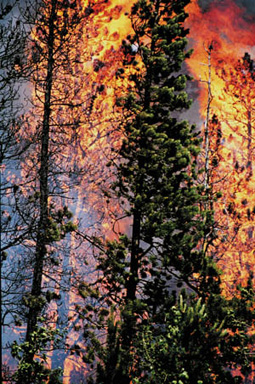
On the morning of Saturday, July 24, the Chilcotin's Gate cafe in Nimpo Lake was full of Swedish firefighters. The skies of the west Chilcotin were full of smoke.
The firefighters, young men and women on an exchange program, had been all over the province. Now they were beginning to gather near a fire in the southern reaches of Tweedsmuir Provincial Park--a fire that had been burning for over a month. In their red shirts and blue trousers, they had the gravitas of combat veterans. These were not excited young kids thirsting for adventure. In a few hours some of them would be evacuated just ahead of the explosive growth of the Lonesome Lake fire.
On the 24th the fire had spread a white haze all over the Chilcotin. On a visit to the Precipice, west of Anahim Lake, my wife and I could scarcely see across the canyon of the Hotnarko River. The peaks of the Rainbow Range, farther to the west, were lost in the smoke.
Destruction viewed from the porch
Back in Anahim Lake, we talked with a restaurant owner. He was cynical about the BC Fire Service policy that had allowed the fire to burn for weeks. A store clerk shared his opinion, but also saw the need for fire to remove beetle-killed trees--which are shockingly numerous across the region.
Clouds moved across Anahim Lake that afternoon. By 3:00, it looked as if a storm was moving in. But when I left the shade of my cabin porch, a few steps from the lakeshore, I looked up and saw an immense cloud of smoke streaming overhead from the southwest. The fire had begun to grow.
From the shore of Anahim Lake we could see two different worlds. To the west and north, the air had cleared; the Rainbow Range, Anahim Mountain, and the Ilgachuz mountains gleamed in the sunshine. To the south and southwest, and directly overhead, the sky was black. Smoke turned the sun into a red disc and sometimes blotted it out completely. Ashes, grey and greasy, fell around us.
Swedish shrugs
While we didn't learn of it until later, by then John Edwards had been evacuated from his father's famous cabin at Lonesome Lake, along with several Swedish firefighters. The fire was within 30 km of Anahim Lake, and threatening Charlotte Lake.
On Saturday evening we drove east of Anahim Lake to a hayfield with views in all directions. The south was still obscured by smoke all the way to the eastern horizon. The north was just another glorious summer evening as the sun sank toward the Rainbow Range.
On Sunday morning I was back in Nimpo Lake for coffee. The young Swedes were more numerous and even calmer than the day before. When I asked one how the fire was going, he shrugged: "Not too good, not too bad."
The wind had changed overnight. Most of the smoke was now blowing southeast--toward Vancouver--but a new smoke cloud was rising behind the mountains. The fire was continuing its explosive growth. A resort owner told me it had been upgraded to a level 6. He was stoic about the policies that had left the fire seemingly ignored for a month. It had already cost him money: a large section of Tweedsmuir was now closed to the public, so a Japanese film crew--working on a show about famous waterfalls--had cancelled its reservations and a segment on Hunlen Falls.
Coast in a haze
By late Sunday morning my wife and I were crossing Tweedsmuir on Highway 20, well north of the fire and under clear skies. As we went down the 15 percent grades on The Hill, the air was still smoky. But the Bella Coola Valley, well upwind of the fire, was breezy, green and cool.
Next day on the coastal ferry, we enjoyed clear air until we emerged from the inlets and began running down the coast toward Vancouver Island. The coast mountains here were lost in haze while the wind blew hard from the northwest. On Tuesday night, as we drove down the North Island Highway from Port McNeill to Campbell River, a red moon hung over the mountains; the fire in one of B.C.'s remotest valleys had extended its power over the whole coast.
A week later, the whole stretch of Highway 20 from Kleena Kleen to Tweedsmuir is under evacuation alert, though the fire is not yet threatening communities like Anahim Lake. Skies on July 31 were clear, with the wind blowing south, and over 300 firefighters were trying to contain the fire beyond Charlotte Lake.
Our relationship to forests, fire
Lonesome Lake is another reminder that we need to rethink our relationship to forests and fire. Stephen Pyne , in his excellent books on fire in history, has shown how Europeans long ago abandoned fire as a tool for farming and hunting. They then failed to understand how other cultures used fire to replenish and stabilize their environment. In the journals of his survey of western Canada in the late 1850s, Captain John Palliser was forever complaining about the Indians' burning of prairie and forest--without recognizing that those fires created the parkland through which he traveled so easily.
Now we have just begun to grasp the wisdom of the often-burned landscape. Our efforts to emulate the First Nations sometimes literally backfire, as when Parks Canada attempted a "controlled burn" in Jasper National Park in the spring of 2003. The assumption was that June rains would put the fire out; but June was dry and the fire devastated a great swathe south of the Athabasca River until August.
In our love of nature we insist on living close to forests, and in houses made from forest products. To protect both, we insist on fire suppression; that only ensures that fires will be both inevitable and far more violent.
So do we protect the Edwards cabin on Lonesome Lake in 2004 if it means an even worse fire in 2005 or 2010? Do we allow people to build their dream homes in fuel-rich forests? And do we protect the forests themselves, or let them burn until, like Louis Creek in 2003, even the saw mills burn with them?
Combustible decisions
The politics of combustion, internal and external, bedevil us in many forms: in the smog and carnage of automobiles, in the pollution and carnage of coal mining and burning, in the misery and carnage of wars fought for control of oil. Out of the entropy of combustion, we extract some desired work: a loaf of bread, a clay pot, a car bomb, a vacation at Anahim Lake. We are prepared to endure a great deal of suffering, our own and others', for the sake of such work.
We are also prepared to suffer if we can live closer to "nature"--that is, to a human artifact created by policy and technology over a hundred thousand years of fire use. Just as people rebuild on flood plains as soon as they've pumped out the rec room, those who live in the interface between woods and wooden houses will rebuild on the ashes. Over and over again.
Crawford Kilian is a frequent contributor to The Tyee. ![]()


13
Login or register to post comments
allan (not verified)
7 years ago
Crawford, you raise good points here, but I don't think the fire that destroyed the Edwards cabin at Lonesome Lake should be compared with the blaze that destroyed Louis Creek in 2003. Yes, the loss of the Edwards cabin was a disaster, but given that it was built in true wilderness with no road access, the people who built it and lived there understood quite well their fate was in nature's hands. While Lower Mainland residents may also feel Louis Creek is a rural, isolated comunity way out beyond Hope, the reality is certainly quite different. Despite former Manitoba premier Gary Filman's report on the 2003 fire season in B.C. there is much that could have been done to save Louis Creek and its sawmill, the mainstay for hundreds of local residents. Anyone in the least bit familiar with firefighting, who can get beyond Filman's star status as a former ''premier'' can appreciate how much whitewash he applied when compiling his ''conservative'' review of the fire season. In fact, anyone who watched the antics of the McLure fire(that spread to Louis Creek and then Barriere), and the bizarre management of it, would wonder about Filman's real intent. Yes it was a gargantuan fire, but no more massive than the wall of stupidity and thick-headedness displayed by fire officials and politicians who should have been roasted in the report for their handling of that disaster. People who should have been making decisions on that fire were contradicted or pushed aside by local politicians intent on being a big part of the solution. The outcome, communities destroyed and hundreds of permanent jobs toasted, was a political disaster first and foremost.
Stuart (not verified)
7 years ago
I'm surprised that no one has ever mentioned that the BC Forest service workers were cut Back. The folks that remove dead wood from the forest floor and generally act in a proactive Way . I wonder how much can be blamed on them being cut.
Jeffrey (not verified)
7 years ago
I've been watching this fire through the eyes of friends and clients living in the area an keeping a record of their reports and related material on my blog: http://jnblog.typepad.com/ There's no doubt these fires need to happen but a little swifter response might at least have had one of those sprinkler systems on the Edwards homestead and saved a significant heritage - and one man's long-time home. (They were very effective on other dwellings in the path of the fire.) It would also have helped if the media had been a little more on the ball. It took some insistence on the part of locals and the story of threat to the Edwards homestead mad the Globe & Mail. The more local (BC) media took a couple more days to wake up. At least this is all I was able to find or hear.
Eric (not verified)
7 years ago
Unwise fire supression is part of the problem. But it looks like climate change is becoming an even bigger element. The forcasts are for a much dryer interior if global warming continues. The Provincial Liberals decisions that promote greenhouse gas pollution are like throwing gas on the flames. e.g. Spending billions on freeways and highways instead of public transit - promoting oil, gas and coal instead of renewable energy.
anne cameron (not verified)
7 years ago
Cut back here, cut back there, gut this, gut that then squeal like a nun in a whorehouse when the singed chickens come home to roost. Yes, the sprinklers worked very well..but face it, they were used on a resort area...sorry, but a private home which happens to be a heritage site doesn't merit f*** all, you have to have a commercial venture to get the sprinkler system. I mean it's f*** all to break an old man's heart but do not by any means whatsoever interfere in any way with the profit margin of a private commercial venture. Sometimes wish we had a god or goddess known as The Great Big Foot, then we could pray to him/her/it to go to Victoria and KICK ASS!
Kent (not verified)
7 years ago
Cutting costs may well have cost us more, not only in fire fighting, but in many other areas. One wonders how the B.C. Fiberals can justify all these cuts whil still adding substantially to the debt load of this Province. Just wait until we add the cost of the Winter Olimpics which I predict will cost considerably more than estimates, and we are committed to them even if we throw the rascals out next May.
Stuart (not verified)
7 years ago
Liberals, I love it. Hey bye the way , we don't have enough money to keep St Mary's Hospital open in New West with 10 hr line ups in emergency at Royal Columbian But we Do have enough to build a speed skating oval. We have closed almost 100 schools but Have enough to expand the sea to sky hi way for 600 million plus. Greece is learning Like we will the hard way. government officials have said the final cost will not be known until after the Aug. 13-29 Games. Some analysts estimate the price tag could reach $12 billion and sink Greece into debt for years. Yep folks 12 billion plus for a small economy like Greece, that’s of lot of hard times For a 3 week party. Oh don't forget those are 2004 prices and not 2010 .
Stuart (not verified)
7 years ago
Sorry, Fiberals I love it.
Nelson (not verified)
7 years ago
Last time I was in Tweedmiur area (1971) it was boggy - couldn't start a camp fire let alone a forest fire. What have you people done up there? It was basically swamp up on the plateau. I am guessing that if the water table dropped the moss and grasses would get pretty fuely. Looks like we are in for some long hot summers. Not to worry A few thousand years from now there will be nothing but a thin ash layer. Incedently I do take this seriously: I live amoung large trees on V.I and it is a stress to feel the dry air and smell the warm gasses. My house could well be part of the thin layer of ashes.
Paul in Vancouver (not verified)
7 years ago
Even though there may be some benefit to burning brush, as Killian suggests, the amount of fires raging in rural BC this year is getting out of hand. And the BC Liberals cut back on Forest Service workers? Amazing. But what is also amazing is how many rural BCers voted for Harper's Conservatives in the last federal election, the one party that wants to pull out of the Kyoto Accord, which is the one international agreement that attempts to take on global warming, which is the one problem which is causing so many fires to get out of hand. I suppose the rationale is that it's okay to have your house and community burn down, as long as you're not being forced to register your gun!
Mike In Yellowknife (not verified)
7 years ago
A bit different topic folks, but can anyone tell me the extent of the burnt area surrounding Kleena Kleen? An old friend has, or had, a cabin down the dump road, and I havn't heard from him in a while. A visit there next summer is in the makings, but I kinda want to know if his cabin would be there any more. I have lost touch with him, and aside from showing up, I have no way to reach him. Thanks for your help folks.
Danielle Kashino (not verified)
7 years ago
I felled sad
Danielle Kashino (not verified)
7 years ago
People feel sad when they lose their houses so did I in the McLure Barriere Fire